
REBCO and BSCCO Coils at BNL Ramesh Gupta
REBCO and BSCCO Coils at BNL Ramesh Gupta Presenting work of BNL, PBL, FRIB, Muons, Inc. and SMES Teams MAP HTS MAGNET WORKSHOP Fermi National Accelerator Laboratory May 30 -31, 2012 1
Outline Superconducting Magnet Division • Overview of the BNL HTS magnet program – REBCO and BSCCO coils and conductor – 40 -50 km HTS (4 mm tape equivalent), 100+ coils, 10+ magnets – Emphasis on R&D involving high field or large use of HTS • Recent progress in high field HTS magnet technology – 15+ T in an all HTS magnet – protection and survival after quench (or whatever) of a relatively large HTS coil having a significant field and stored energy • Summary and Recommendations MAP HTS MAGNET WORKSHOP, May 2012 REBCO and BSCCO Coils at BNL Ramesh Gupta , BNL Slide No. 2
Superconducting Magnet Division Ongoing REBCO Programs at BNL • MAP high field solenoid SBIR with PBL, Inc. • SMES – with ABB & Super. Power • YBCO conductor testing at high fields – exciting results • HTS Quad – now a baseline design for FRIB • Cosine theta coils – PBL SBIR and FRIB funding • Curved dipole - STTR on FRIB with Muons, Inc. MAP HTS MAGNET WORKSHOP, May 2012 REBCO and BSCCO Coils at BNL Ramesh Gupta , BNL Slide No. 3
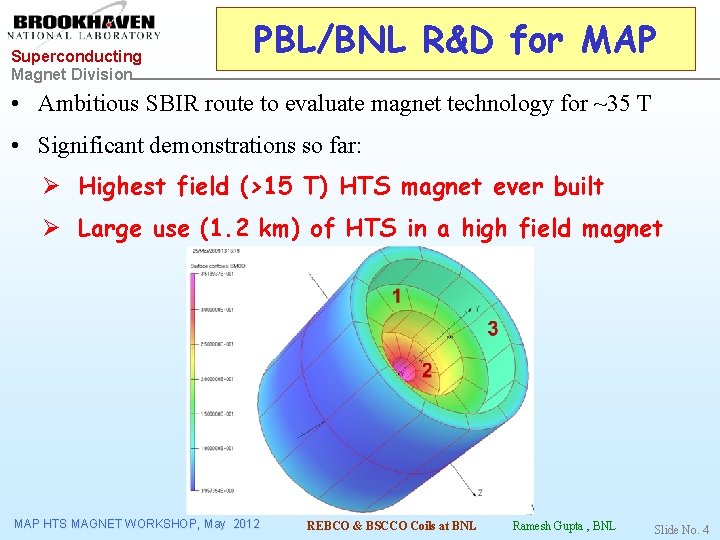
Superconducting Magnet Division PBL/BNL R&D for MAP • Ambitious SBIR route to evaluate magnet technology for ~35 T • Significant demonstrations so far: Ø Highest field (>15 T) HTS magnet ever built Ø Large use (1. 2 km) of HTS in a high field magnet MAP HTS MAGNET WORKSHOP, May 2012 REBCO & BSCCO Coils at BNL Ramesh Gupta , BNL Slide No. 4
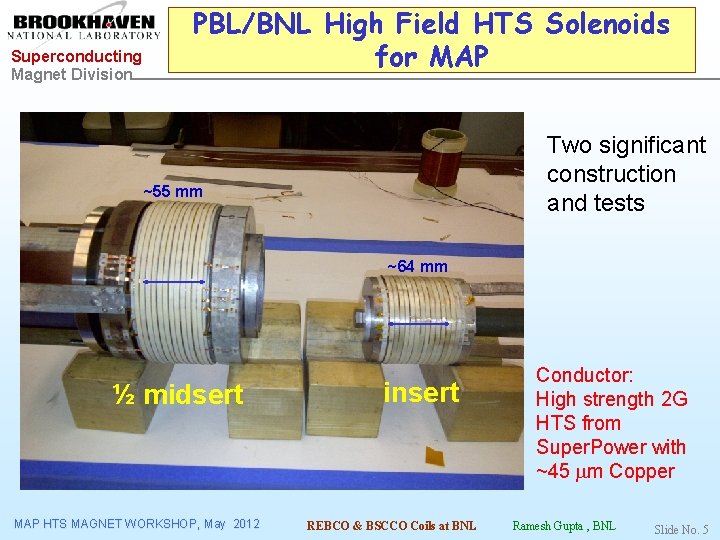
Superconducting Magnet Division PBL/BNL High Field HTS Solenoids for MAP Two significant construction and tests ~55 mm ~64 mm ½ midsert MAP HTS MAGNET WORKSHOP, May 2012 insert REBCO & BSCCO Coils at BNL Conductor: High strength 2 G HTS from Super. Power with ~45 mm Copper Ramesh Gupta , BNL Slide No. 5
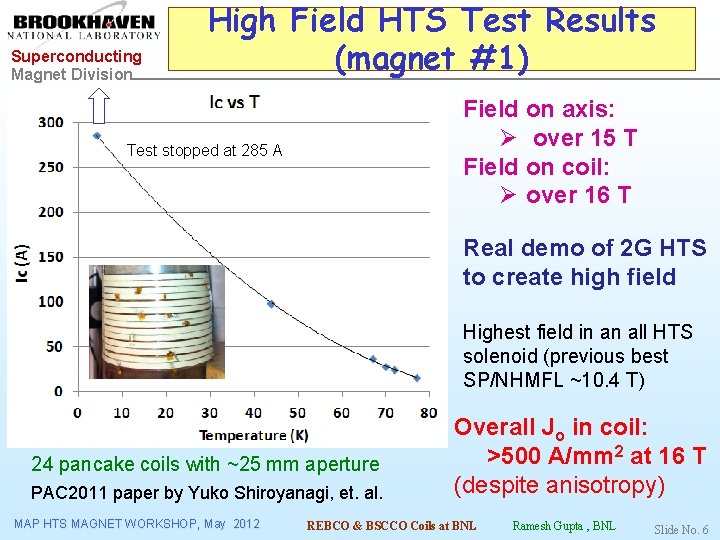
Superconducting Magnet Division High Field HTS Test Results (magnet #1) Field on axis: Ø over 15 T Field on coil: Ø over 16 T Test stopped at 285 A Real demo of 2 G HTS to create high field Highest field in an all HTS solenoid (previous best SP/NHMFL ~10. 4 T) 24 pancake coils with ~25 mm aperture PAC 2011 paper by Yuko Shiroyanagi, et. al. MAP HTS MAGNET WORKSHOP, May 2012 Overall Jo in coil: >500 A/mm 2 at 16 T (despite anisotropy) REBCO & BSCCO Coils at BNL Ramesh Gupta , BNL Slide No. 6
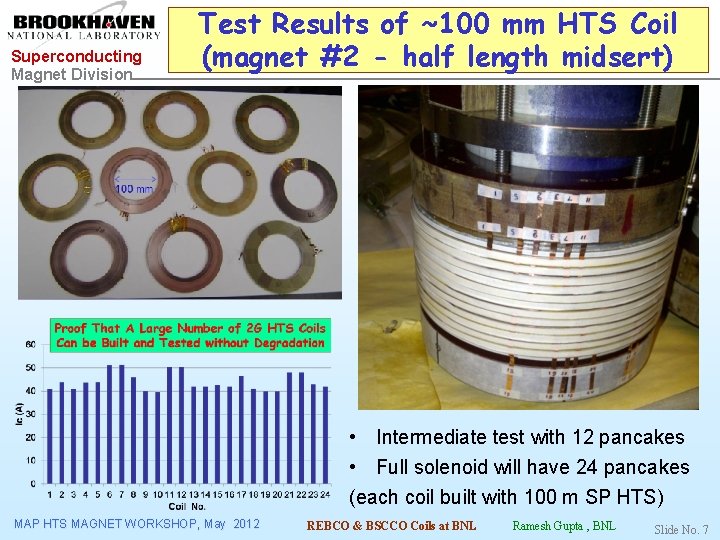
Superconducting Magnet Division Test Results of ~100 mm HTS Coil (magnet #2 - half length midsert) • Intermediate test with 12 pancakes • Full solenoid will have 24 pancakes (each coil built with 100 m SP HTS) MAP HTS MAGNET WORKSHOP, May 2012 REBCO & BSCCO Coils at BNL Ramesh Gupta , BNL Slide No. 7
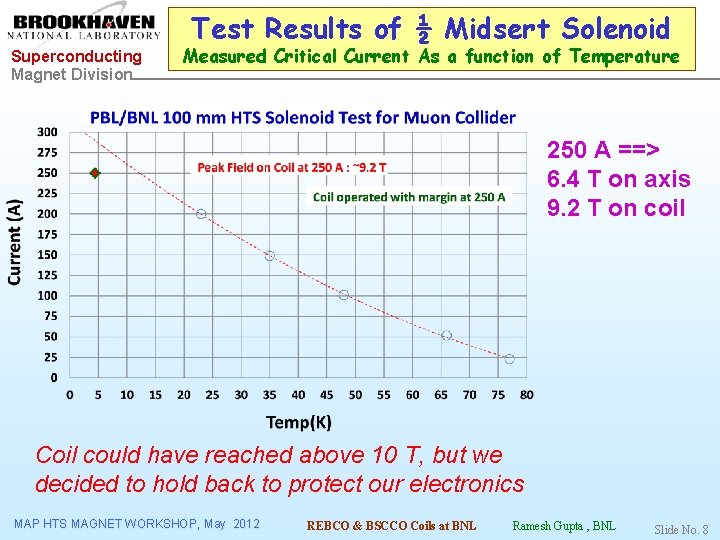
Test Results of ½ Midsert Solenoid Superconducting Magnet Division Measured Critical Current As a function of Temperature 250 A ==> 6. 4 T on axis 9. 2 T on coil Coil could have reached above 10 T, but we decided to hold back to protect our electronics MAP HTS MAGNET WORKSHOP, May 2012 REBCO & BSCCO Coils at BNL Ramesh Gupta , BNL Slide No. 8
Superconducting Magnet Division Status and Future of this Program • PBL/BNL 25 mm and 100 mm solenoids will be merged together and should be ready for test in a few months • Expected field: 20 -25 T (would be a remarkable result, if it works) – Highest field in an all HTS magnet (beating 15+ T just achieved) – Would be a major contribution of SBIR/STTR program (thanks) • Discussion on 20 T background field test of above at NHMFL • PBL/BNL team waiting for Phase II LTS outsert for ~35 T for MAP • Super. Power has volunteered for (a) small aperture coil to go inside 20 -25 T and (b) end coils with 6 mm tape. That would create 25+ T all HTS solenoid, if successful, when combined with above • A lot of excitement, a lot of challenges – please join us MAP HTS MAGNET WORKSHOP, May 2012 REBCO & BSCCO Coils at BNL Ramesh Gupta , BNL Slide No. 9
Superconducting Magnet Division Quench Protection in HTS Magnets • Protecting high field HTS magnets is a major concern. • HTS is significantly different from LTS. Things happen slowly (low quench velocities, etc. ) which could destroy the coil. • BNL approach: use different properties of HTS to our advantage – slow progress (longer pre-quench phase) allows more time to act before quench (proper term - run away). This will be the first line of defense to conventional approach with fast acting heaters on the coil (significant progress at NHMFL). • Challenge is to detect that pre-quench phase fast – small resistive voltage over large noise and inductive voltages. Major progress has been made in this area at BNL. • But some time with best effort, magnet may quench at high field with large stored energy. We must not only be able to avoid that but must also be able to survive that. • We are pleased to report that “the quench protection electronics was able to protect a 100 k. J class HTS coil”. • Of course, significant more work still remains. But the progress is being made. MAP HTS MAGNET WORKSHOP, May 2012 REBCO & BSCCO Coils at BNL Ramesh Gupta , BNL Slide No. 10
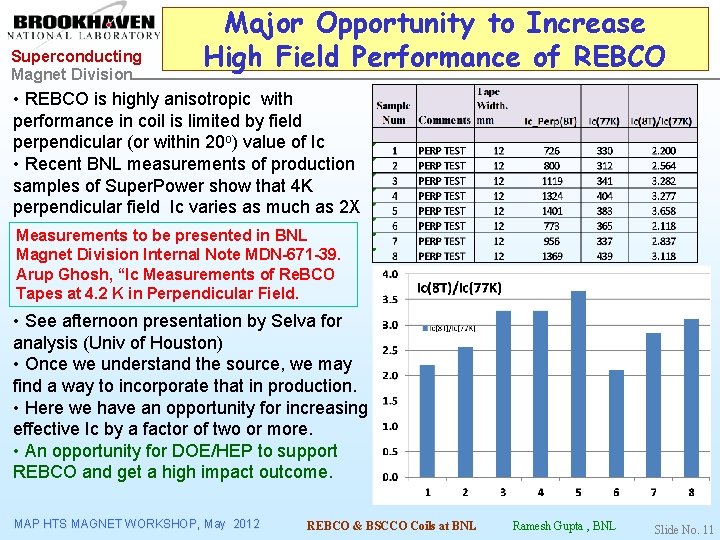
Superconducting Magnet Division Major Opportunity to Increase High Field Performance of REBCO • REBCO is highly anisotropic with performance in coil is limited by field perpendicular (or within 20 o) value of Ic • Recent BNL measurements of production samples of Super. Power show that 4 K perpendicular field Ic varies as much as 2 X Measurements to be presented in BNL Magnet Division Internal Note MDN-671 -39. Arup Ghosh, “Ic Measurements of Re. BCO Tapes at 4. 2 K in Perpendicular Field. • See afternoon presentation by Selva for analysis (Univ of Houston) • Once we understand the source, we may find a way to incorporate that in production. • Here we have an opportunity for increasing effective Ic by a factor of two or more. • An opportunity for DOE/HEP to support REBCO and get a high impact outcome. MAP HTS MAGNET WORKSHOP, May 2012 REBCO & BSCCO Coils at BNL Ramesh Gupta , BNL Slide No. 11
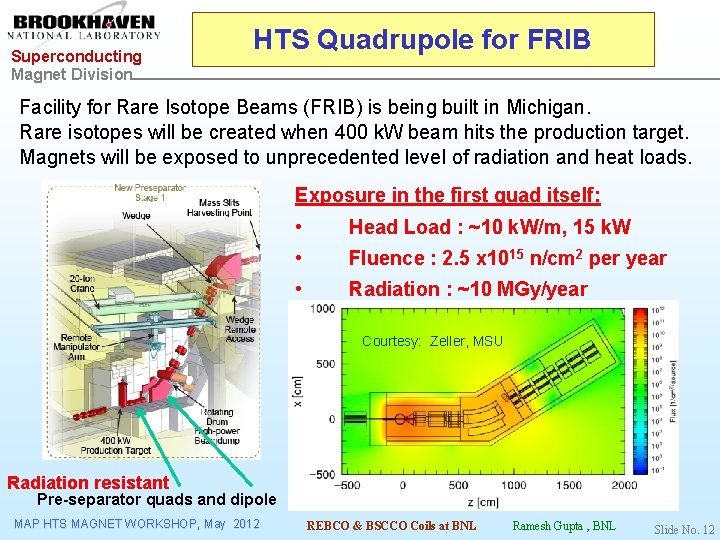
Superconducting Magnet Division HTS Quadrupole for FRIB Facility for Rare Isotope Beams (FRIB) is being built in Michigan. Rare isotopes will be created when 400 k. W beam hits the production target. Magnets will be exposed to unprecedented level of radiation and heat loads. Exposure in the first quad itself: • Head Load : ~10 k. W/m, 15 k. W • Fluence : 2. 5 x 10¹⁵ n/cm 2 per year • Radiation : ~10 MGy/year Courtesy: Zeller, MSU Radiation resistant Pre-separator quads and dipole MAP HTS MAGNET WORKSHOP, May 2012 REBCO & BSCCO Coils at BNL Ramesh Gupta , BNL Slide No. 12
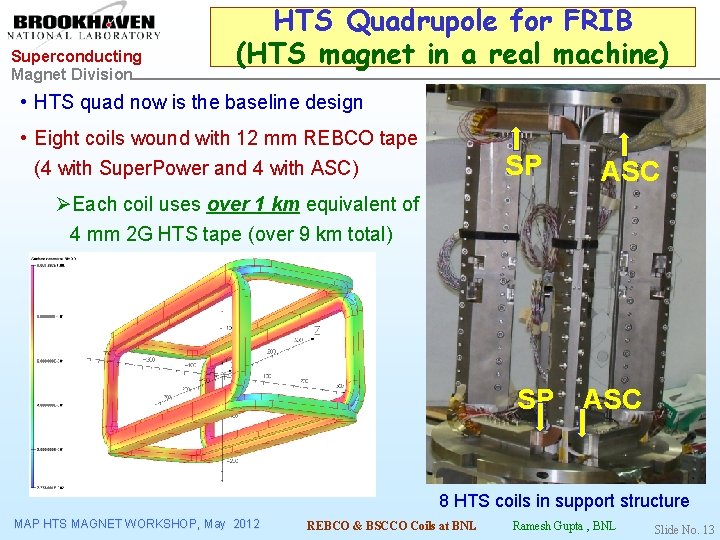
Superconducting Magnet Division HTS Quadrupole for FRIB (HTS magnet in a real machine) • HTS quad now is the baseline design • Eight coils wound with 12 mm REBCO tape (4 with Super. Power and 4 with ASC) SP ASC ØEach coil uses over 1 km equivalent of 4 mm 2 G HTS tape (over 9 km total) SP ASC 8 HTS coils in support structure MAP HTS MAGNET WORKSHOP, May 2012 REBCO & BSCCO Coils at BNL Ramesh Gupta , BNL Slide No. 13
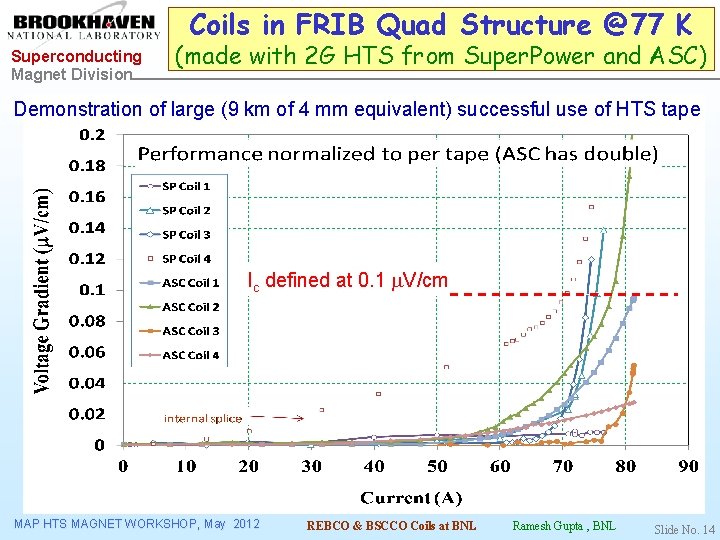
Coils in FRIB Quad Structure @77 K Superconducting Magnet Division (made with 2 G HTS from Super. Power and ASC) Demonstration of large (9 km of 4 mm equivalent) successful use of HTS tape Ic defined at 0. 1 m. V/cm MAP HTS MAGNET WORKSHOP, May 2012 REBCO & BSCCO Coils at BNL Ramesh Gupta , BNL Slide No. 14
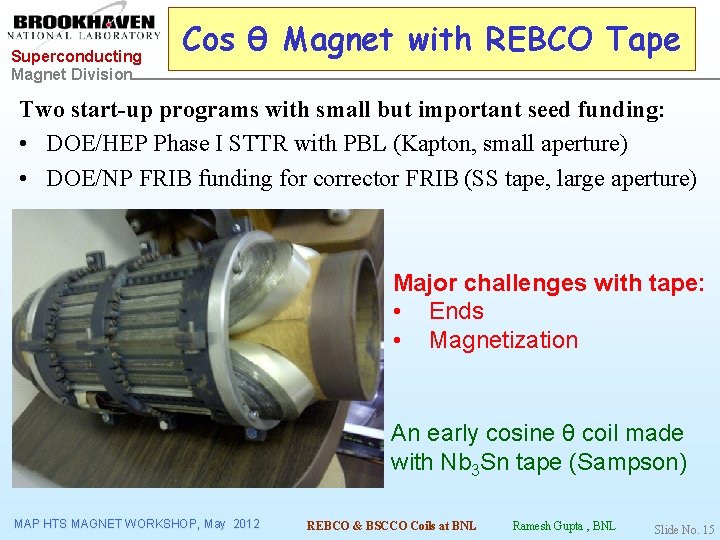
Superconducting Magnet Division Cos θ Magnet with REBCO Tape Two start-up programs with small but important seed funding: • DOE/HEP Phase I STTR with PBL (Kapton, small aperture) • DOE/NP FRIB funding for corrector FRIB (SS tape, large aperture) Major challenges with tape: • Ends • Magnetization An early cosine θ coil made with Nb 3 Sn tape (Sampson) MAP HTS MAGNET WORKSHOP, May 2012 REBCO & BSCCO Coils at BNL Ramesh Gupta , BNL Slide No. 15
Superconducting Magnet Division BSCCO Coil Programs at BNL • Bi 2212 magnet program with Nb 3 Sn Dipole for high field testing • Other BSCCO programs (not to be discussed here) – Bi 2223 Tape Common Coil Program – Bi 2223 Quadrupole for Rare Isotope Accelerator (RIA) – Bi 2223 Solenoid for ERL at BNL – Bi 2223 Solenoid for Superconducting electron gun MAP HTS MAGNET WORKSHOP, May 2012 REBCO & BSCCO Coils at BNL Ramesh Gupta , BNL Slide No. 16
Superconducting Magnet Division • • • Main Features of BNL Bi 2212 Program Rutherford cable React and Wind (R&W) conductor friendly common coil design Many coils successfully built and tested with significant conductor Produced highest current Bi 2212 coil (still a record) Also built Nb 3 Sn dipole (highest field R&W Nb 3 Sn dipole) to allow easy high field insert coil testing with unique design MAP HTS MAGNET WORKSHOP, May 2012 REBCO & BSCCO Coils at BNL Ramesh Gupta , BNL Slide No. 17
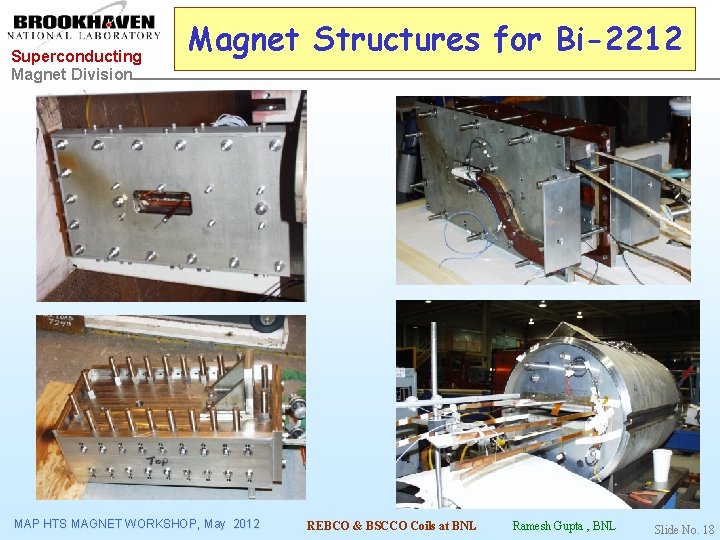
Superconducting Magnet Division Magnet Structures for Bi-2212 MAP HTS MAGNET WORKSHOP, May 2012 REBCO & BSCCO Coils at BNL Ramesh Gupta , BNL Slide No. 18
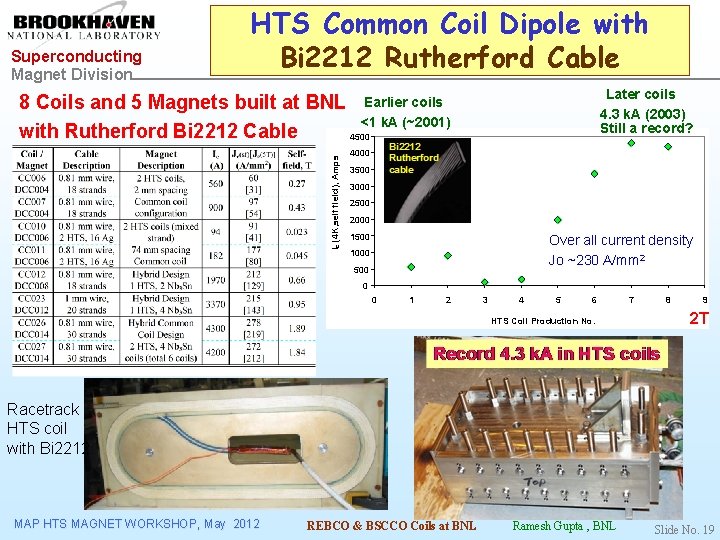
Superconducting Magnet Division HTS Common Coil Dipole with Bi 2212 Rutherford Cable Later coils 4. 3 k. A (2003) Still a record? Ic (4 K, self field), Amps 8 Coils and 5 Magnets built at BNL Earlier coils <1 k. A (~2001) with Rutherford Bi 2212 Cable 4500 4000 Ic 3500 3000 2500 2000 1500 Over allcables currentcan density HTS carry 2 currents in Jo significant ~230 A/mm magnet coils. 1000 500 0 0 1 2 3 4 5 6 HTS Coil Production No. 7 8 9 2 T Racetrack HTS coil with Bi 2212 MAP HTS MAGNET WORKSHOP, May 2012 REBCO & BSCCO Coils at BNL Ramesh Gupta , BNL Slide No. 19
Superconducting Magnet Division SUMMARY • Significant progress has been made in HTS magnet technology as demonstrated by large use of variety of HTS (Re. BCO, Bi 223 and Bi 2212) in a number of R&D coils and magnets for several projects • HTS has already been demonstrated as a high field superconductor (over 15 T in an all HTS magnet). Significant experiments are planned in next six months aiming 20+ T • Recent high field measurements in production conductor plus other progress indicates still more potential for Re. BCO • Early results in quench protection are encouraging • There are still many issues. However, the need of many future projects (including MAP) and impressive results obtained so far clearly shows need for more interest and support from DOE/HEP. MAP HTS MAGNET WORKSHOP, May 2012 REBCO & BSCCO Coils at BNL Ramesh Gupta , BNL Slide No. 20
Superconducting Magnet Division Recommendations • There are several focused HTS R&D projects which have been useful but they do not provide funding for systematic R&D. Such R&D would increase the scientific understanding and benefit all projects. There is an urgent need for DOE/HEP to provide supplemental funding to leverage those ongoing projects. • There is a need to support both conductors –(Re. BCO and Bi 2212) as each may be good for different applications. It seems that for MAP solenoid Re. BCO is the preferred conductor and for field quality applications Bi 2212. • In recent past, DOE/HEP has supported Bi 2212 significantly over Re. BCO perhaps because Re. BCO gets its supported from elsewhere. • However, most other support is not be for developing HTS as a high field conductor. A reasonable funding and a good collaboration between industry and research institutions may bring a significant improvements in this area. MAP HTS MAGNET WORKSHOP, May 2012 REBCO & BSCCO Coils at BNL Ramesh Gupta , BNL Slide No. 21
- Slides: 21