
Reassessing the Nordic Welfare Model Kickoff Conference Oslo
- Slides: 21
Reassessing the Nordic Welfare Model Kickoff Conference, Oslo, 24 -25. Oct, 2007 Globalization, Competitiveness and Social Inequality • Is Globalization a Threat to the Nordic Welfare model? • Or is the Nordic Welfare Model a Key to Global Competitiveness? • Jørgen Goul Andersen • Aalborg University www. ccws. dk
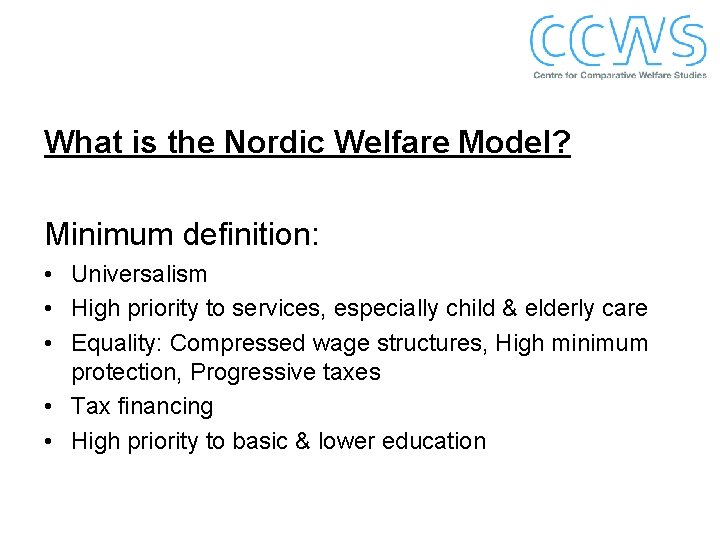
What is the Nordic Welfare Model? Minimum definition: • Universalism • High priority to services, especially child & elderly care • Equality: Compressed wage structures, High minimum protection, Progressive taxes • Tax financing • High priority to basic & lower education
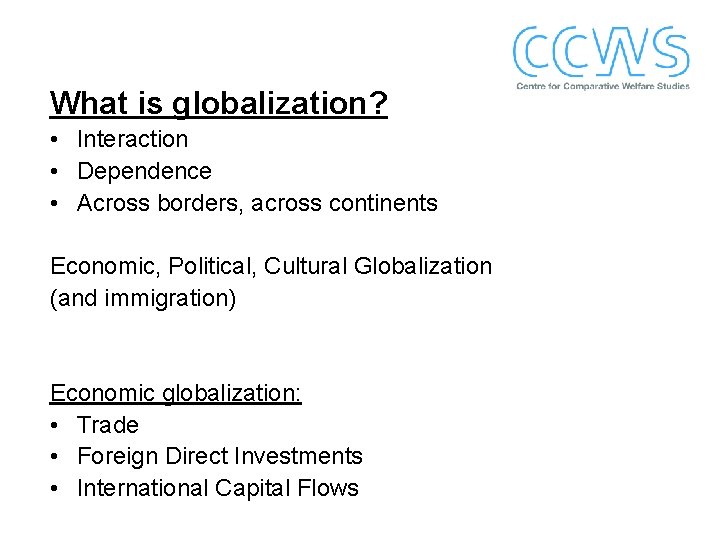
What is globalization? • Interaction • Dependence • Across borders, across continents Economic, Political, Cultural Globalization (and immigration) Economic globalization: • Trade • Foreign Direct Investments • International Capital Flows
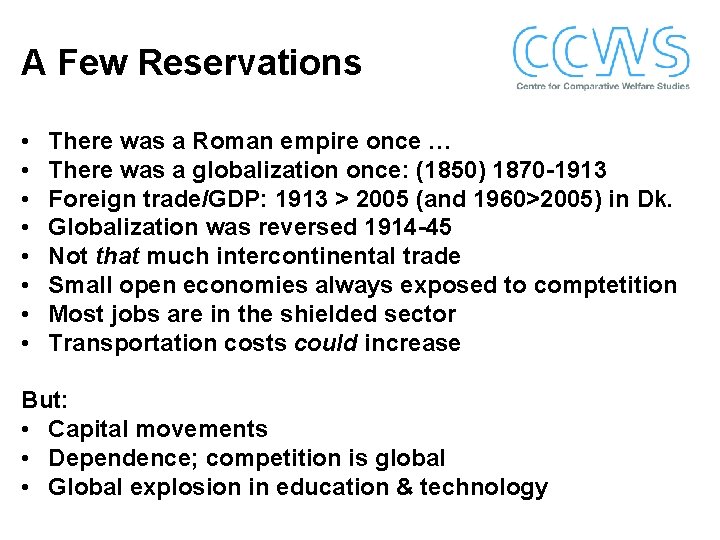
A Few Reservations • • There was a Roman empire once … There was a globalization once: (1850) 1870 -1913 Foreign trade/GDP: 1913 > 2005 (and 1960>2005) in Dk. Globalization was reversed 1914 -45 Not that much intercontinental trade Small open economies always exposed to comptetition Most jobs are in the shielded sector Transportation costs could increase But: • Capital movements • Dependence; competition is global • Global explosion in education & technology
But why should that impact on the welfare state? Previously diffuse arguments: - Nation state building & welfare state was linked - Competitiveness requires less regulation, lower taxes, etc. (≈ ”Washington Consensus”) - Global competition lead to increased inequality. And less state capability to do anything about it
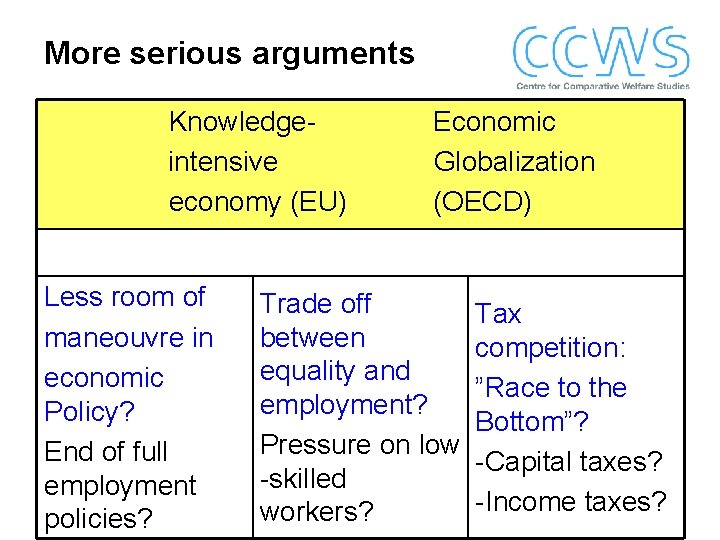
More serious arguments Knowledgeintensive economy (EU) Less room of maneouvre in economic Policy? End of full employment policies? Economic Globalization (OECD) Trade off between equality and employment? Pressure on low -skilled workers? Tax competition: ”Race to the Bottom”? -Capital taxes? -Income taxes?
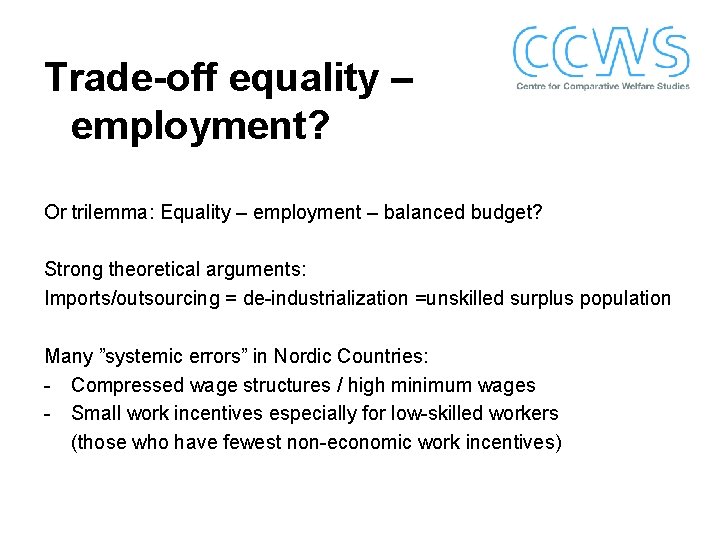
Trade-off equality – employment? Or trilemma: Equality – employment – balanced budget? Strong theoretical arguments: Imports/outsourcing = de-industrialization =unskilled surplus population Many ”systemic errors” in Nordic Countries: - Compressed wage structures / high minimum wages - Small work incentives especially for low-skilled workers (those who have fewest non-economic work incentives)
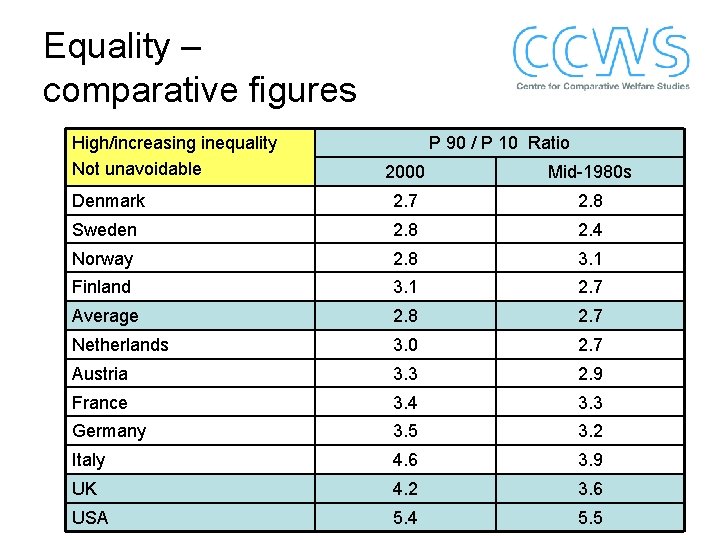
Equality – comparative figures High/increasing inequality Not unavoidable P 90 / P 10 Ratio 2000 Mid-1980 s Denmark 2. 7 2. 8 Sweden 2. 8 2. 4 Norway 2. 8 3. 1 Finland 3. 1 2. 7 Average 2. 8 2. 7 Netherlands 3. 0 2. 7 Austria 3. 3 2. 9 France 3. 4 3. 3 Germany 3. 5 3. 2 Italy 4. 6 3. 9 UK 4. 2 3. 6 USA 5. 4 5. 5
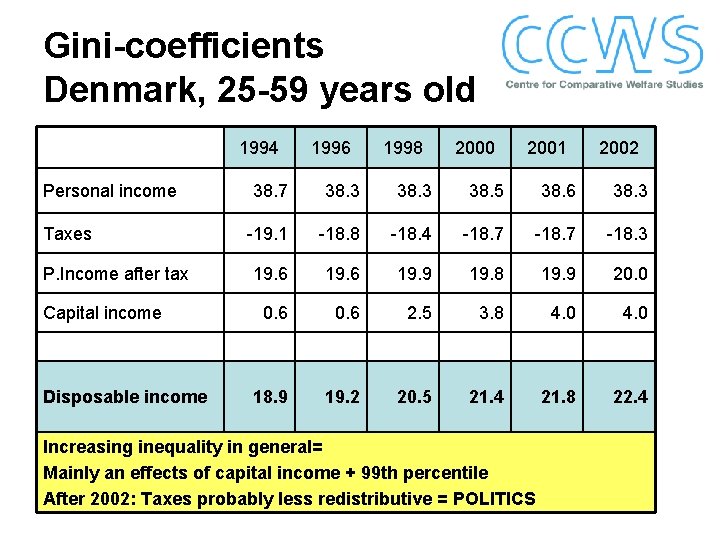
Gini-coefficients Denmark, 25 -59 years old 1994 Personal income Taxes P. Income after tax Capital income Disposable income 1996 1998 2000 2001 2002 38. 7 38. 3 38. 5 38. 6 38. 3 -19. 1 -18. 8 -18. 4 -18. 7 -18. 3 19. 6 19. 9 19. 8 19. 9 20. 0 0. 6 2. 5 3. 8 4. 0 18. 9 19. 2 20. 5 21. 4 21. 8 22. 4 Increasing inequality in general= Mainly an effects of capital income + 99 th percentile After 2002: Taxes probably less redistributive = POLITICS
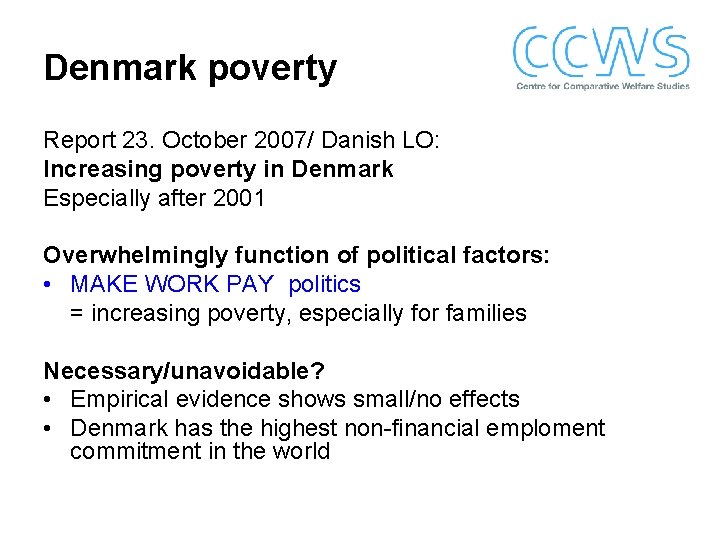
Denmark poverty Report 23. October 2007/ Danish LO: Increasing poverty in Denmark Especially after 2001 Overwhelmingly function of political factors: • MAKE WORK PAY politics = increasing poverty, especially for families Necessary/unavoidable? • Empirical evidence shows small/no effects • Denmark has the highest non-financial emploment commitment in the world
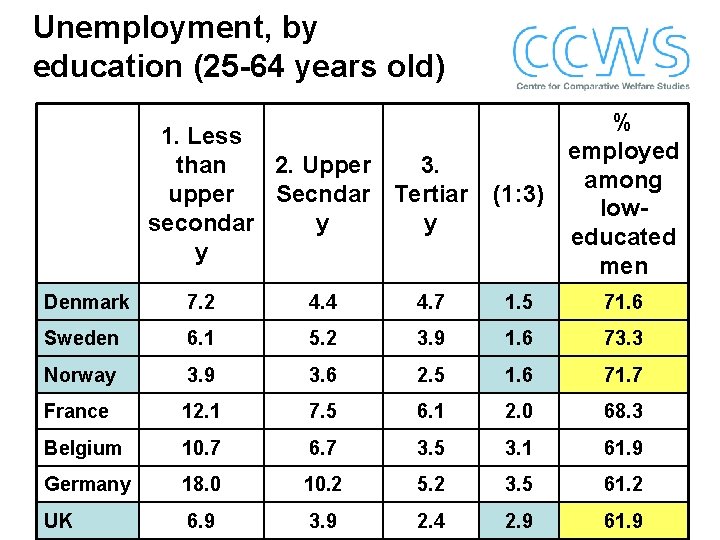
Unemployment, by education (25 -64 years old) 1. Less than 2. Upper 3. upper Secndar Tertiar secondar y y y % employed among (1: 3) loweducated men Denmark 7. 2 4. 4 4. 7 1. 5 71. 6 Sweden 6. 1 5. 2 3. 9 1. 6 73. 3 Norway 3. 9 3. 6 2. 5 1. 6 71. 7 France 12. 1 7. 5 6. 1 2. 0 68. 3 Belgium 10. 7 6. 7 3. 5 3. 1 61. 9 Germany 18. 0 10. 2 5. 2 3. 5 61. 2 UK 6. 9 3. 9 2. 4 2. 9 61. 9
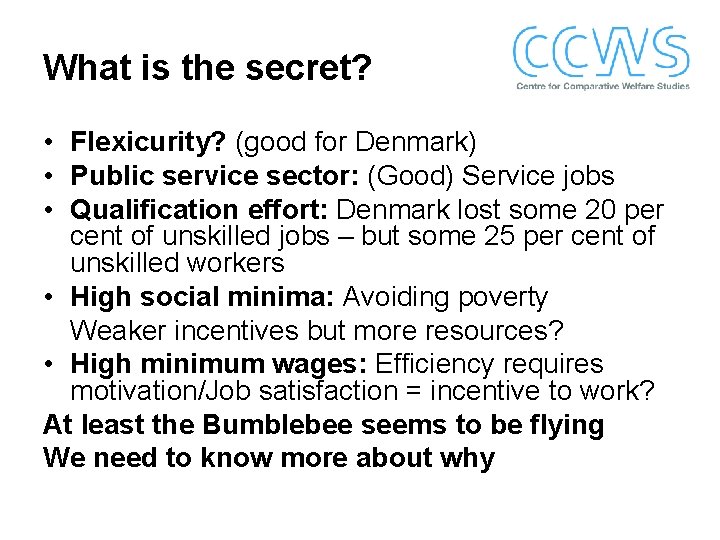
What is the secret? • Flexicurity? (good for Denmark) • Public service sector: (Good) Service jobs • Qualification effort: Denmark lost some 20 per cent of unskilled jobs – but some 25 per cent of unskilled workers • High social minima: Avoiding poverty Weaker incentives but more resources? • High minimum wages: Efficiency requires motivation/Job satisfaction = incentive to work? At least the Bumblebee seems to be flying We need to know more about why
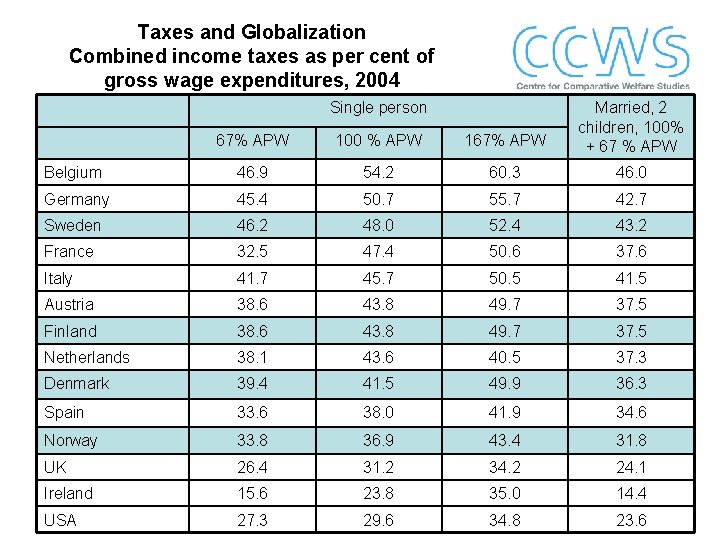
Taxes and Globalization Combined income taxes as per cent of gross wage expenditures, 2004 Single person 67% APW 100 % APW 167% APW Married, 2 children, 100% + 67 % APW Belgium 46. 9 54. 2 60. 3 46. 0 Germany 45. 4 50. 7 55. 7 42. 7 Sweden 46. 2 48. 0 52. 4 43. 2 France 32. 5 47. 4 50. 6 37. 6 Italy 41. 7 45. 7 50. 5 41. 5 Austria 38. 6 43. 8 49. 7 37. 5 Finland 38. 6 43. 8 49. 7 37. 5 Netherlands 38. 1 43. 6 40. 5 37. 3 Denmark 39. 4 41. 5 49. 9 36. 3 Spain 33. 6 38. 0 41. 9 34. 6 Norway 33. 8 36. 9 43. 4 31. 8 UK 26. 4 31. 2 34. 2 24. 1 Ireland 15. 6 23. 8 35. 0 14. 4 USA 27. 3 29. 6 34. 8 23. 6
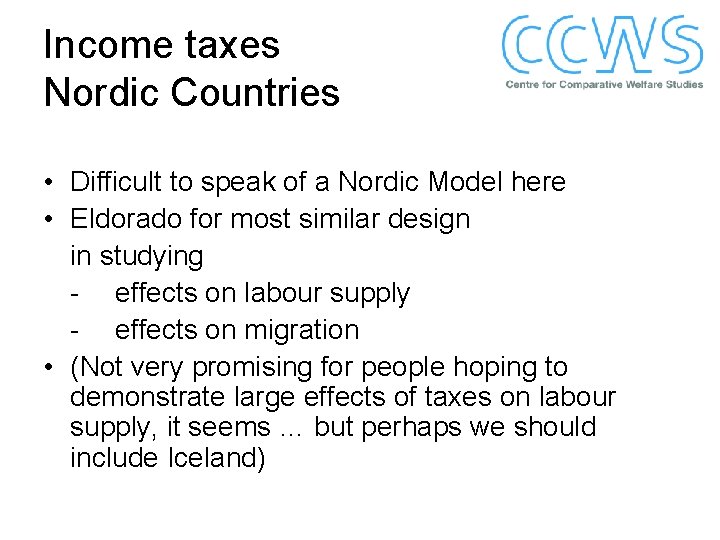
Income taxes Nordic Countries • Difficult to speak of a Nordic Model here • Eldorado for most similar design in studying - effects on labour supply - effects on migration • (Not very promising for people hoping to demonstrate large effects of taxes on labour supply, it seems … but perhaps we should include Iceland)
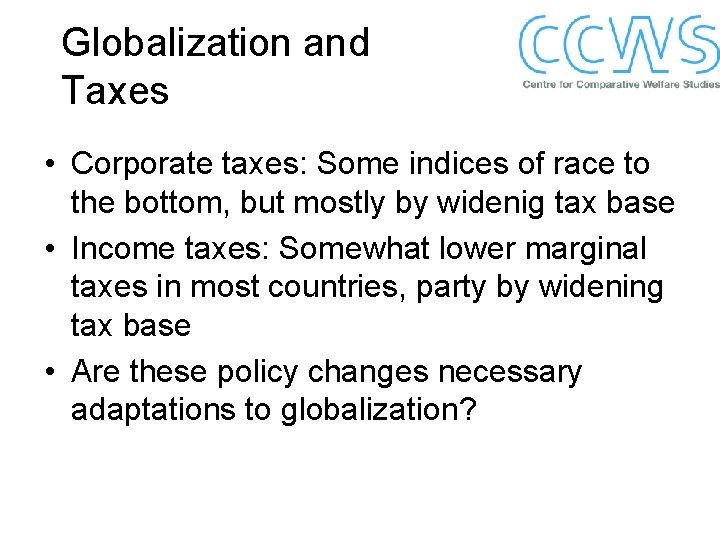
Globalization and Taxes • Corporate taxes: Some indices of race to the bottom, but mostly by widenig tax base • Income taxes: Somewhat lower marginal taxes in most countries, party by widening tax base • Are these policy changes necessary adaptations to globalization?
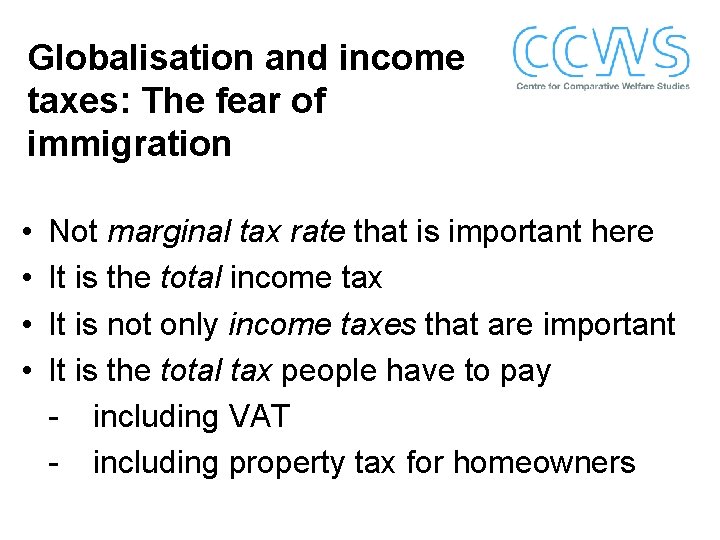
Globalisation and income taxes: The fear of immigration • • Not marginal tax rate that is important here It is the total income tax It is not only income taxes that are important It is the total tax people have to pay - including VAT - including property tax for homeowners
Globalisation and income taxes: The fear of immigration – II. • Not only taxes are important • The important calculus includes taxes plus necessary social expenditures (including private insurance) • For those age groups that are mobile across borders (roughly those aged less than 35) • Provided people move because of selfinterest
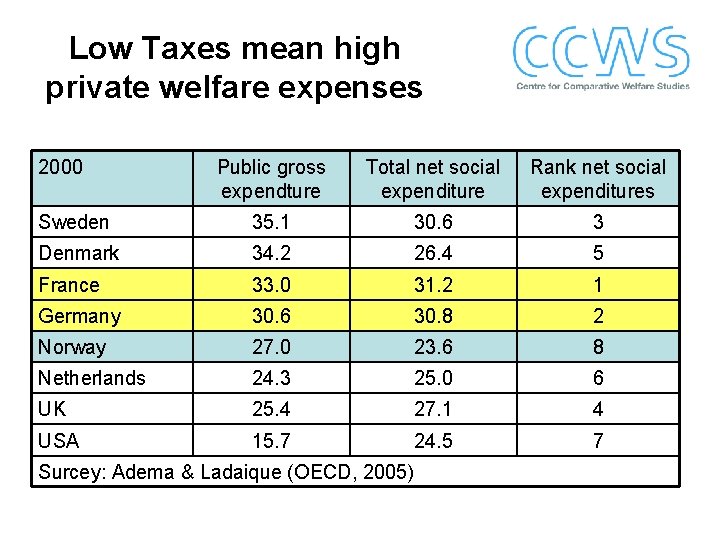
Low Taxes mean high private welfare expenses 2000 Public gross expendture Total net social expenditure Rank net social expenditures Sweden 35. 1 30. 6 3 Denmark 34. 2 26. 4 5 France 33. 0 31. 2 1 Germany 30. 6 30. 8 2 Norway 27. 0 23. 6 8 Netherlands 24. 3 25. 0 6 UK 25. 4 27. 1 4 USA 15. 7 24. 5 7 Surcey: Adema & Ladaique (OECD, 2005)
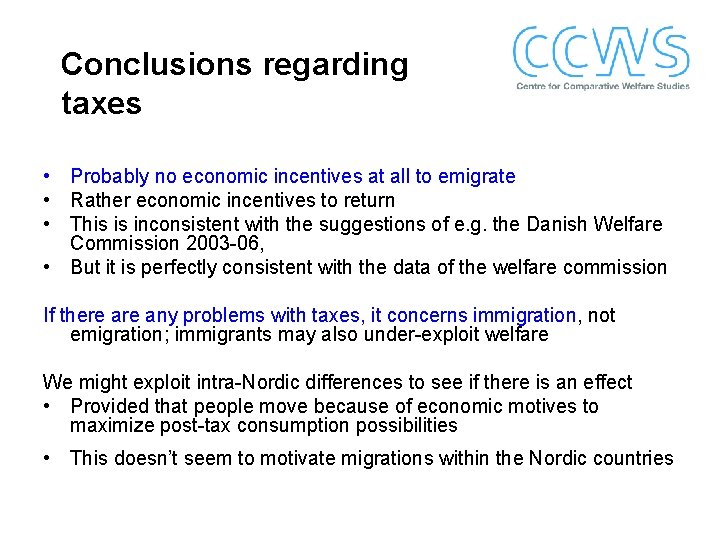
Conclusions regarding taxes • Probably no economic incentives at all to emigrate • Rather economic incentives to return • This is inconsistent with the suggestions of e. g. the Danish Welfare Commission 2003 -06, • But it is perfectly consistent with the data of the welfare commission If there any problems with taxes, it concerns immigration, not emigration; immigrants may also under-exploit welfare We might exploit intra-Nordic differences to see if there is an effect • Provided that people move because of economic motives to maximize post-tax consumption possibilities • This doesn’t seem to motivate migrations within the Nordic countries
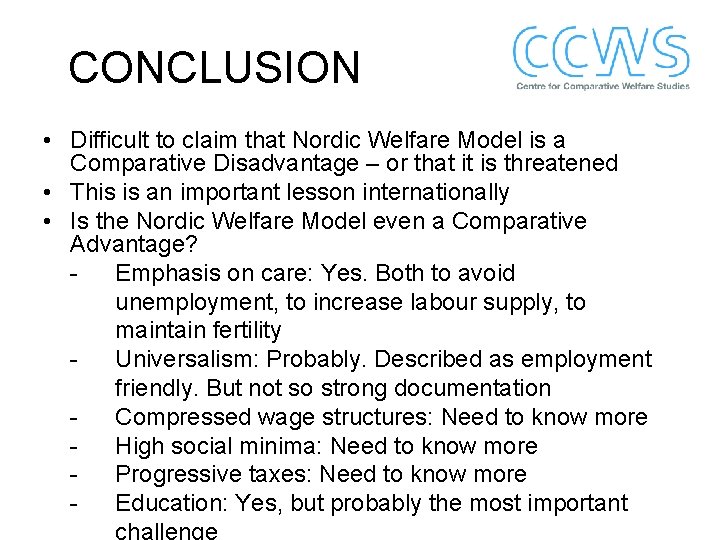
CONCLUSION • Difficult to claim that Nordic Welfare Model is a Comparative Disadvantage – or that it is threatened • This is an important lesson internationally • Is the Nordic Welfare Model even a Comparative Advantage? Emphasis on care: Yes. Both to avoid unemployment, to increase labour supply, to maintain fertility Universalism: Probably. Described as employment friendly. But not so strong documentation Compressed wage structures: Need to know more High social minima: Need to know more Progressive taxes: Need to know more Education: Yes, but probably the most important challenge
Beyond Conclusion It is likely that: • Social capital (which is very high) is (a) causally related to the welfare state and (b) has an important impact on economic efficiency and competitivenes • Feelings of influence at the workplace is (a) causally related to the welfare state and (b) has an important impact on innovation We need to know more about this – but this is highly difficult to document