
Reasons for plagiarism by students Why does it
Reasons for plagiarism by students: Why does it happen? Training module for HEI instructors Version: O 1 -A-3, English, 16 July 2019
Basic information for trainers • Target group of instructors: B. A. -beginner courses • Summary of content: This presentation lists the reasons of plagiarism as identified by plagiarizers themselves and then presents anonymous multi-mediated writing model as a remedy to prevent plagiarism in student assignments. • Learning objective(s): Participants will identify reasons of plagiarism and plan their writing courses by encouraging effective exchange of peer feedback to prevent plagiarism. • Educational format(s): presentation • Duration: 30 minutes • Recommended number of participants: any • To maximize the benefits, participants are expected to be experienced in teaching writing. 22/12/2021 Training module: Reasons for plagiarism by students: Why does it happen? 2
Reasons of plagiarism • A study conducted by Razı (2015 b): • Aimed to reveal the reasons of plagiarism • by interviewing plagiarizers • enrolled in Advanced Reading and Writing Skills Course • a first year course at English Language Teaching Department of a university in Turkey 22/12/2021 Training module: Reasons for plagiarism by students: Why does it happen? 3
Reasons of plagiarism • 194 students enrolled in the course • 28 plagiarized in their a academic writing assignments • 11 male plagiarizers • 17 female plagiarizers • Razı (2015 b) interviewed plagiarizers. • Considering any possible gender differences, the findings are presented separately for female and male students. 22/12/2021 Training module: Reasons for plagiarism by students: Why does it happen? 4
Findings: Male • 11 plagiarism incidents • 3 accidental • 8 deliberate • Male 10: “One of my class mates told me that she had an assignment that she hadn’t submitted on Turnitin previously. I decided to submit her assignment since there was no risk but she was mistaken since she didn’t remember that she had submitted it on Turnitin last year. ” 22/12/2021 Training module: Reasons for plagiarism by students: Why does it happen? 5
Reasons male M 1: Did not know how to paraphrase. M 2: Forgot to use quotation marks. M 3: Tried to catch deadline. M 4: Did not know how to paraphrase: Problems in restructuring. M 5: Bored and then tried to catch deadline. M 6: Cited like paraphrase to reduce quotation ratio. M 7: Did not know how to paraphrase. M 8: Did not know how to cite. M 9: Insufficient number of sources. Cited a single source poorly. M 10: Submitted a friend's assignment since she told him that she had not submitted it on Turnitin. • M 11: Submitted the same assignment for two courses. • • • 22/12/2021 Training module: Reasons for plagiarism by students: Why does it happen? 6
Findings: Female • 17 plagiarism incidents • 1 accidental • 16 deliberate • Female 9: “I realized that attending tutorials helped me avoid plagiarism as I had the chance of directly asking to you [the lecturer] but I got bored towards the end of the semester and did not attend the tutorials. To finalize my paper I simply copied expressions from other sources. ” 22/12/2021 Training module: Reasons for plagiarism by students: Why does it happen? 7
Reasons female • • • • • F 1: To catch deadline, borrowed some expressions from a friend. F 2: Since it was difficult to paraphrase, she avoided paraphrasing. F 3: Thought that mentioning the author would be enough to copy the sentence. F 4: Bored and then tried to catch deadline. F 5: Tried to catch deadline. F 6: Did not how to paraphrase. F 7: Tried to catch deadline. F 8: Bored towards the end of the paper and did not paraphrase carefully. F 9: Bored in some parts of the paper and did not paraphrase carefully. Non-attendance to tutors resulted in weak paraphrase. F 10: Tried to avoid submitting a short paper and integrated weak paraphrased expressions. F 11: Tried to avoid spoiling meaning in restructuring so only changed some words. F 12: Non-attendance to tutors because of illness and then tried to catch the deadline. F 13: Did not how to paraphrase. F 14: Thought that mentioning the author would be enough to copy the sentence. Tried to avoid spoiling meaning in restructuring so only changed some words. F 15: Did not how to paraphrase. F 16: Tried to catch deadline. F 17: Did not accept being interviewed. 22/12/2021 Training module: Reasons for plagiarism by students: Why does it happen? 8
Some more evidence. . . • Razı (2015 a) conducted another study • to reveal the difficulties that students experience in academic writing • and compared students‘ self-reported difficulties with their actual problems (identified by Razı himself as the lecturer) in academic writing • Students‘ difficulties did not match with their actual problems in academic writing. • They were not aware of their actual problems and this made them prone to plagiarism. 22/12/2021 Training module: Reasons for plagiarism by students: Why does it happen? 9
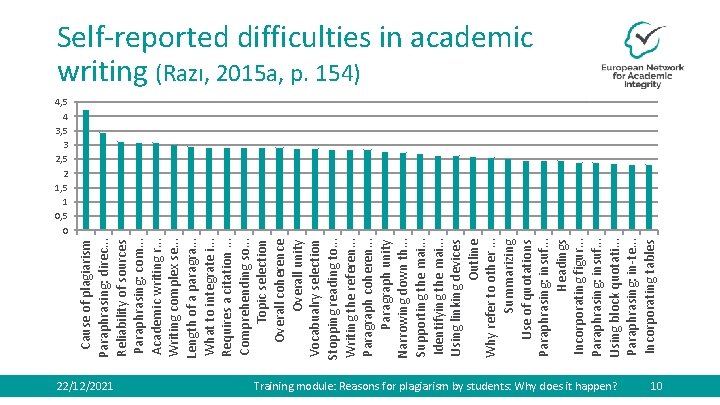
Cause of plagiarism Paraphrasing: direc. . . Reliability of sources Paraphrasing: com. . . Academic writing r. . . Writing complex se. . . Length of a paragra. . . What to integrate i. . . Requires a citation. . . Comprehending so. . . Topic selection Overall coherence Overall unity Vocabualry selection Stopping reading to. . . Writing the referen. . . Paragraph coheren. . . Paragraph unity Narrowing down th. . . Supporting the mai. . . Identifying the mai. . . Using linking devices Outline Why refer to other. . . Summarizing Use of quotations Paraphrasing: insuf. . . Headings Incorporating figur. . . Paraphrasing: insuf. . . Using block quotati. . . Paraphrasing: in-te. . . Incorporating tables Self-reported difficulties in academic writing (Razı, 2015 a, p. 154) 4, 5 4 3, 5 3 2, 5 2 1, 5 1 0, 5 0 22/12/2021 Training module: Reasons for plagiarism by students: Why does it happen? 10
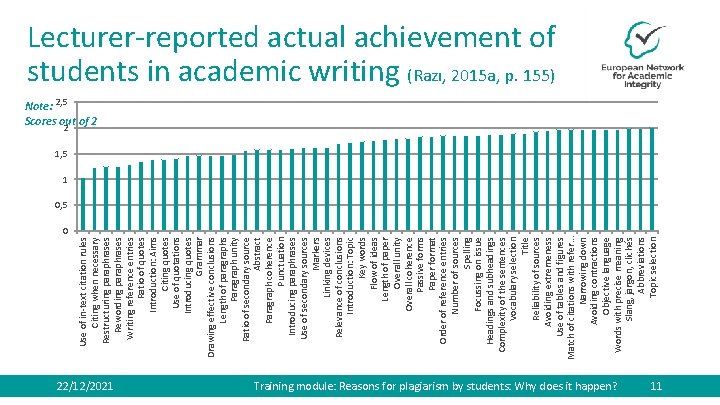
0 Use of in-text citation rules Citing when necessary Restructuring paraphrases Rewording paraphrases Writing reference entries Ratio of quotes Introduction: Aims Citing quotes Use of quotations Introducing quotes Grammar Drawing effective conclusions Length of paragraphs Paragraph unity Ratio of secondary source Abstract Paragraph coherence Punctuation Introducing paraphrases Use of secondary sources Markers Linking devices Relevance of conclusions Introduction: Topic Key words Flow of ideas Length of paper Overall unity Overall coherence Passive forms Paper format Order of reference entries Number of sources Spelling Focussing on issue Headings and subheadings Complexity of the sentences Vocabulary selection Title Reliability of sources Avoiding extremeness Use of tables and figures Match of citations with refer. . . Narrowing down Avoiding contractions Objective language Words with precise meaning Slang, jargon, clichés Abbreviations Topic selection Lecturer-reported actual achievement of students in academic writing (Razı, 2015 a, p. 155) Note: 2, 5 Scores out of 2 2 1, 5 1 0, 5 22/12/2021 Training module: Reasons for plagiarism by students: Why does it happen? 11
How to encourage students to develop better academic writing skills and prevent from plagiarism? • Benefit from anonymous multi-mediated writing model (Razı, 2017). • The model encourages students to exchange peer feedback in order to overcome their writing problems. • Each student paper is matched with three anonymous reviewers. • Before assigning reviewers, students are divided into three subcategories, namely ‘good’, ‘moderate’ and ‘weak’ in accordance with their writing proficiency. • Each student receives feedback from a good, moderate and weak peer and also provides direct feedback to a good, moderate and weak peer. • Such feedback exchange ensures a balanced distribution of asymmetrical and symmetrical feedback. • After students receive peer feedback, they revise and resubmit their papers. 22/12/2021 Training module: Reasons for plagiarism by students: Why does it happen? 12
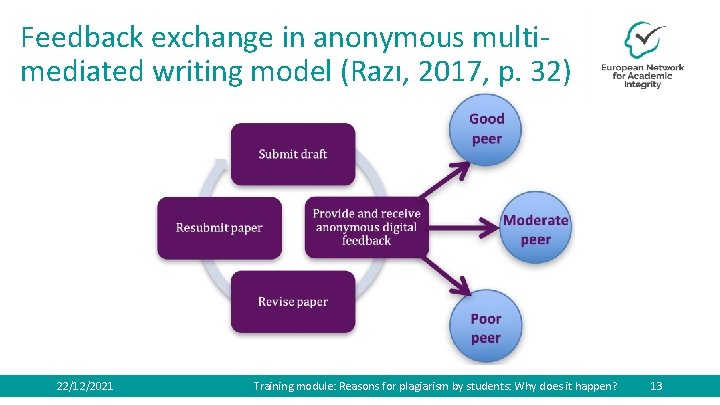
Feedback exchange in anonymous multimediated writing model (Razı, 2017, p. 32) 22/12/2021 Training module: Reasons for plagiarism by students: Why does it happen? 13
Conclusion • Students might have a variety of reasons to plagiarize. • Take first-year undergraduates’ inexperience into consideration. • Writing in a second/foreign language may increase the risks plagiarising due to lack of insufficient language proficiency. • Anonymous multi-mediated writing model reduces plagiarism incidents by helping students to develop metacognitive skills and become autonomous learners. 22/12/2021 Training module: Reasons for plagiarism by students: Why does it happen? 14
Acknowledgement & references • Razı, S. (2015 a). Cross-checked problems in undergraduate academic writing. K. Dikilitaş, R. Smith, & W. Trotman (Eds. ), Teacher-researchers in action (pp. 147 -161). Kent, UK: IATEFL. • Razı, S. (2015 b). Reasons of plagiarism in undergraduate academic writing and benefiting from Turnitin. Paper presented at the International conference plagiarism across Europe and beyond 2015, 1012 June, Brno, Czech Republic. • Razı, S. (2017). Anonymous multi-mediated writing model: Peer feedback exchange in EAP. In D. Köksal (Ed. ), Researching ELT: Classroom methodology and beyond (pp. 29 -42). Frankfurt: Peter Lang. 22/12/2021 Training module: Reasons for plagiarism by students: Why does it happen? 15
Author & contact information • Salim Razı (salimrazi@comu. edu. tr, salimrazi@gmail. com) 22/12/2021 Training module: Reasons for plagiarism by students: Why does it happen? 17
License information Title of the work: Reasons for plagiarism by students: Why does it happen? – Training module for HEI instructors Attribute work to name: ENAI working group for educational materials Licensed under: creativecommons. org/licenses/by/4. 0 Attribute using following text: “Reasons for plagiarism by students: Why does it happen? – Training module for HEI instructors” by ENAI working group for educational materials is licensed under a Creative Commons Attribution 4. 0 International License. 22/12/2021 Training module: Reasons for plagiarism by students: Why does it happen? 18
- Slides: 17