
Reasons For and Against Enterprise System Adoption Enterprise
- Slides: 31
Reasons For and Against Enterprise System Adoption Enterprise Architectures Conference David L. Olson Stockholm, 28 October 2004
Enterprise Systems (ERP) • A tremendous success – Enable firms to more efficiently • Integrate data • More timely reports needed for decision making • Improved processes lead to more efficient operations – One of the most profitable software implementations
And yet… • 65% of executives believe ERP can be harmful (Sarkis & Sundarraj, 2003) • IT investment is often wasted (Garry Lowenthal, CFO of Viper Motorcycle Co – Millman 2004) • Only a small minority, 10%, believe they are achieving a high return on technology investments (annual survey of financial executives, FEI & Computer Services Corporation – Millman 2004) • Only a select few companies have gotten value out of their ERP implementations, and those are world-class companies (David Hebert, The Hackett Group – Millman 2004)
Millman (2004) • ERP is notoriously over-sold and under-delivered • ERP is the most expensive but least-value derived kinds of implementation (Scott Phares, VPbusiness services, Business Engine) • When a lot of ERP investments are made, there wasn’t a business case built (Brian Zrimsek, The Gartner Group)
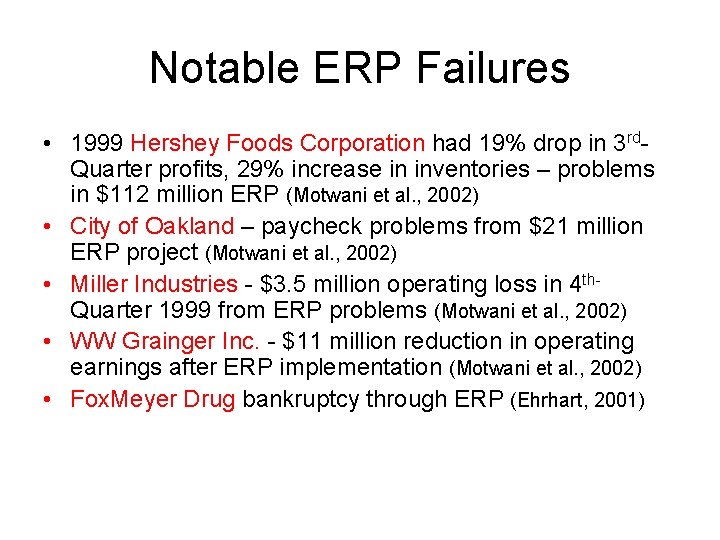
Notable ERP Failures • 1999 Hershey Foods Corporation had 19% drop in 3 rd. Quarter profits, 29% increase in inventories – problems in $112 million ERP (Motwani et al. , 2002) • City of Oakland – paycheck problems from $21 million ERP project (Motwani et al. , 2002) • Miller Industries - $3. 5 million operating loss in 4 th. Quarter 1999 from ERP problems (Motwani et al. , 2002) • WW Grainger Inc. - $11 million reduction in operating earnings after ERP implementation (Motwani et al. , 2002) • Fox. Meyer Drug bankruptcy through ERP (Ehrhart, 2001)
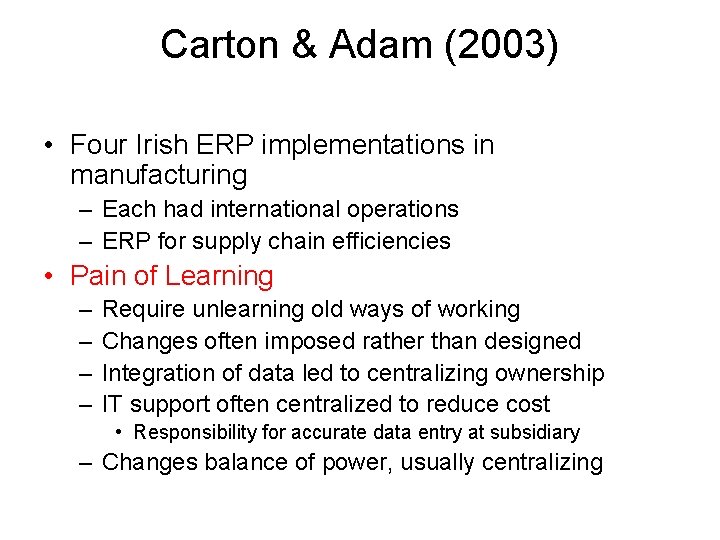
Carton & Adam (2003) • Four Irish ERP implementations in manufacturing – Each had international operations – ERP for supply chain efficiencies • Pain of Learning – – Require unlearning old ways of working Changes often imposed rather than designed Integration of data led to centralizing ownership IT support often centralized to reduce cost • Responsibility for accurate data entry at subsidiary – Changes balance of power, usually centralizing
Overview • Multinational ERP Issues – Business Process Reengineering – Federalism/Customization – Supply Chain Issues/Outsourcing – Lessons Learned – Conclusions • Social issues from – Network Society – Emergence of Systems – Future expectations
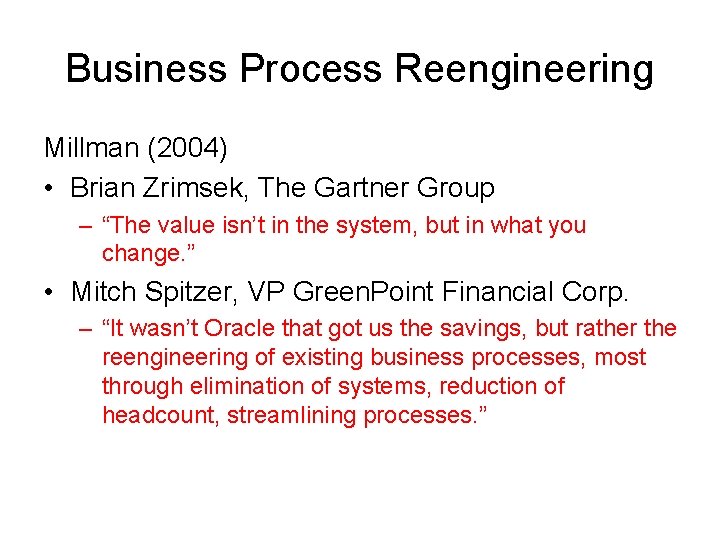
Business Process Reengineering Millman (2004) • Brian Zrimsek, The Gartner Group – “The value isn’t in the system, but in what you change. ” • Mitch Spitzer, VP Green. Point Financial Corp. – “It wasn’t Oracle that got us the savings, but rather the reengineering of existing business processes, most through elimination of systems, reduction of headcount, streamlining processes. ”
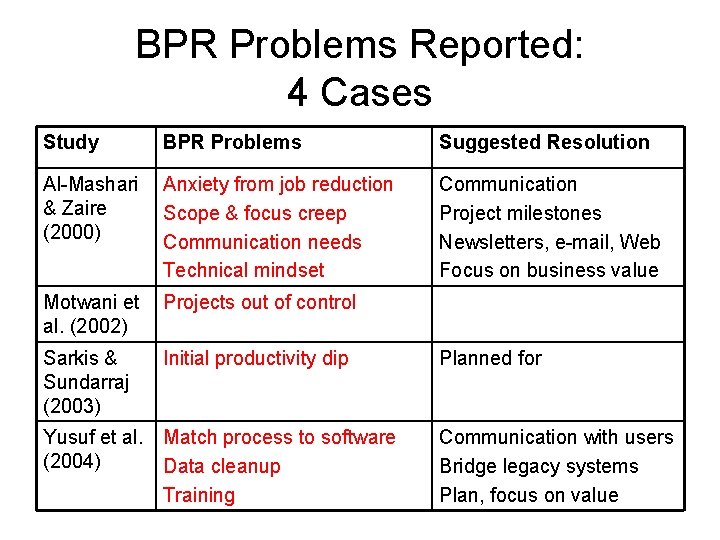
BPR Problems Reported: 4 Cases Study BPR Problems Suggested Resolution Al-Mashari & Zaire (2000) Anxiety from job reduction Scope & focus creep Communication needs Technical mindset Communication Project milestones Newsletters, e-mail, Web Focus on business value Motwani et al. (2002) Projects out of control Sarkis & Sundarraj (2003) Initial productivity dip Planned for Yusuf et al. (2004) Match process to software Data cleanup Training Communication with users Bridge legacy systems Plan, focus on value
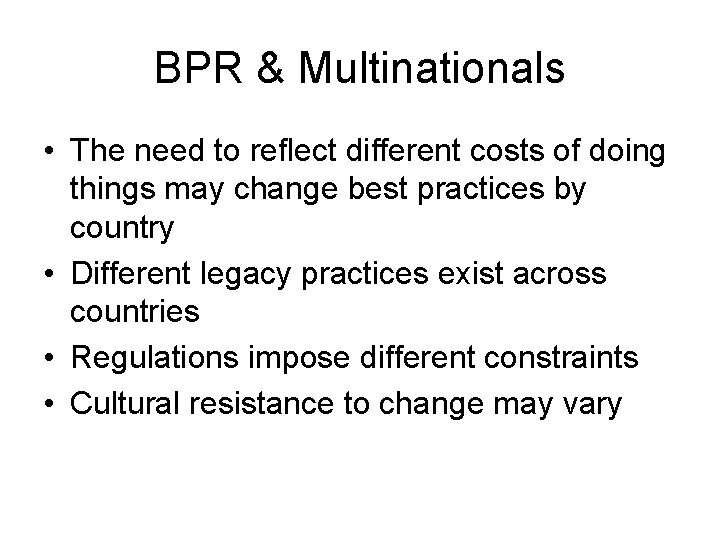
BPR & Multinationals • The need to reflect different costs of doing things may change best practices by country • Different legacy practices exist across countries • Regulations impose different constraints • Cultural resistance to change may vary
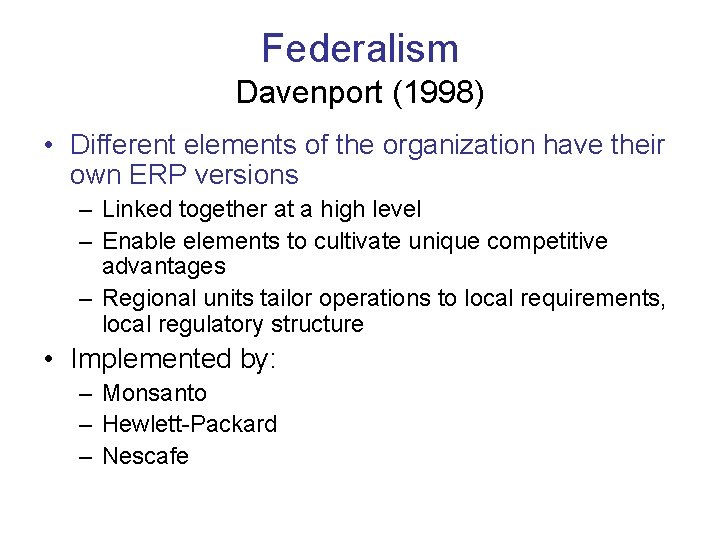
Federalism Davenport (1998) • Different elements of the organization have their own ERP versions – Linked together at a high level – Enable elements to cultivate unique competitive advantages – Regional units tailor operations to local requirements, local regulatory structure • Implemented by: – Monsanto – Hewlett-Packard – Nescafe
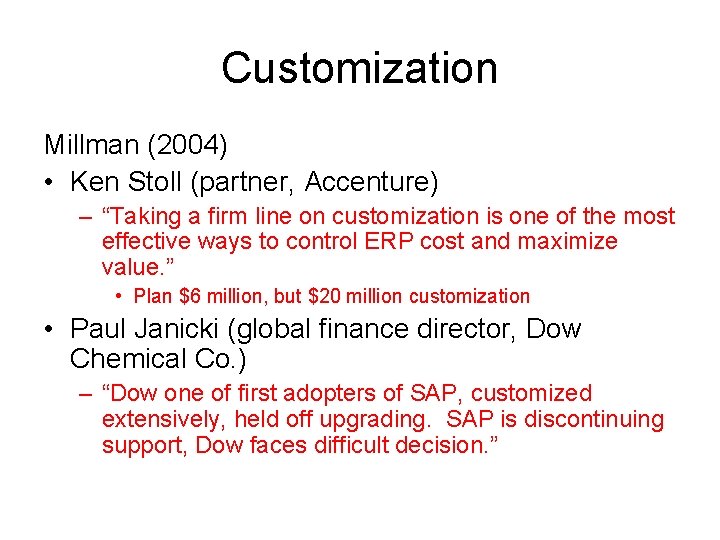
Customization Millman (2004) • Ken Stoll (partner, Accenture) – “Taking a firm line on customization is one of the most effective ways to control ERP cost and maximize value. ” • Plan $6 million, but $20 million customization • Paul Janicki (global finance director, Dow Chemical Co. ) – “Dow one of first adopters of SAP, customized extensively, held off upgrading. SAP is discontinuing support, Dow faces difficult decision. ”
Tradeoff • Federalism vs. Customization • Federalism provides flexibility to meet local needs – Multinational subsidiaries have local requirements • CUSTOMIZE – Customization is very risky & expensive
Supply Chain Factors – Multinational ERP • Multinational organizations inherently involve supply chains – Link suppliers, customers • A great deal of value in open systems – A major ERP trend since 1999
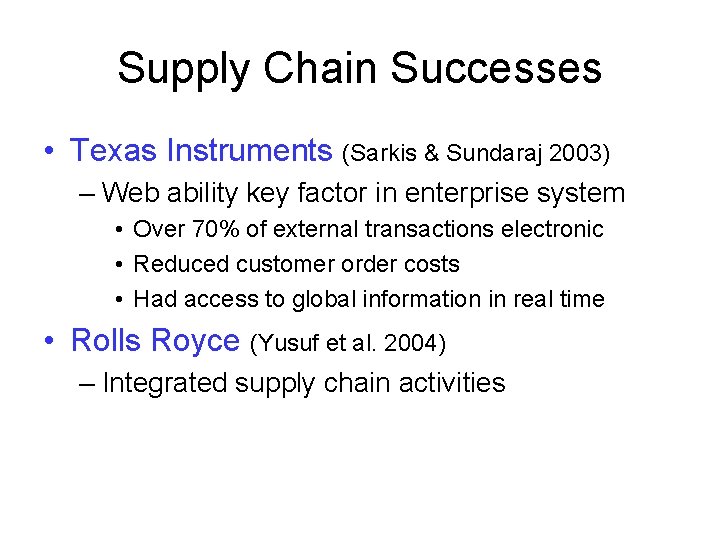
Supply Chain Successes • Texas Instruments (Sarkis & Sundaraj 2003) – Web ability key factor in enterprise system • Over 70% of external transactions electronic • Reduced customer order costs • Had access to global information in real time • Rolls Royce (Yusuf et al. 2004) – Integrated supply chain activities
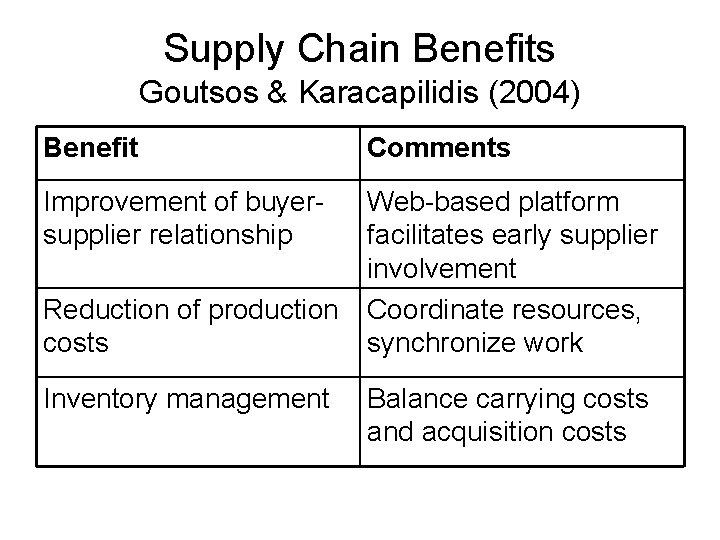
Supply Chain Benefits Goutsos & Karacapilidis (2004) Benefit Comments Improvement of buyersupplier relationship Web-based platform facilitates early supplier involvement Coordinate resources, synchronize work Reduction of production costs Inventory management Balance carrying costs and acquisition costs
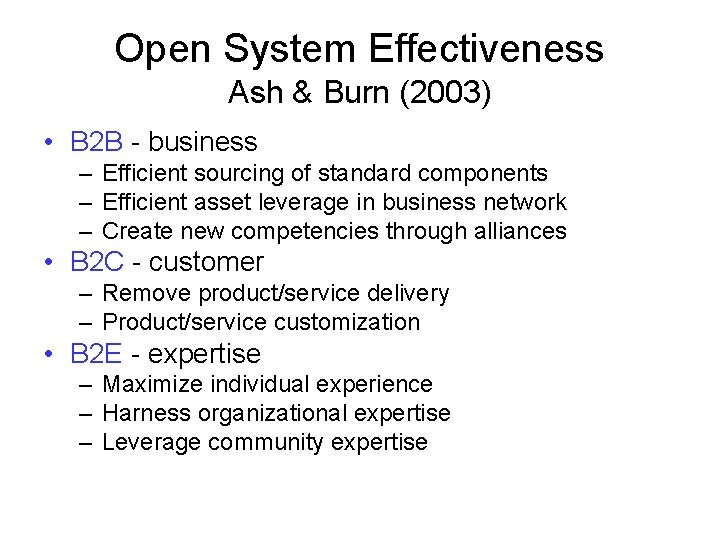
Open System Effectiveness Ash & Burn (2003) • B 2 B - business – Efficient sourcing of standard components – Efficient asset leverage in business network – Create new competencies through alliances • B 2 C - customer – Remove product/service delivery – Product/service customization • B 2 E - expertise – Maximize individual experience – Harness organizational expertise – Leverage community expertise
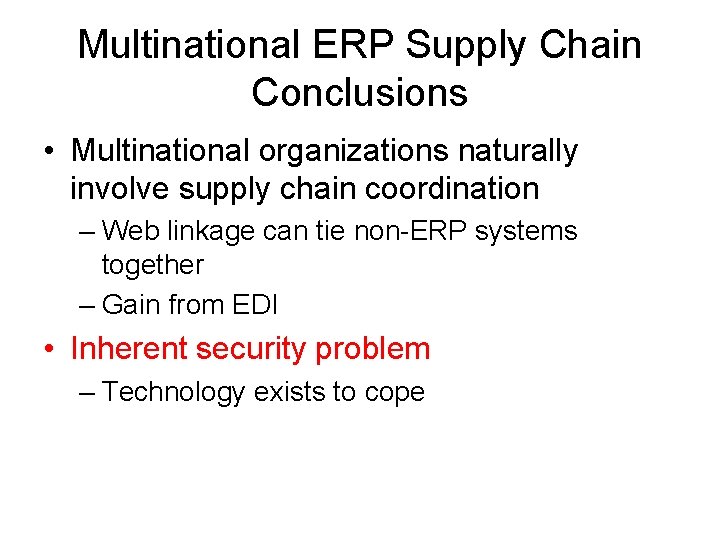
Multinational ERP Supply Chain Conclusions • Multinational organizations naturally involve supply chain coordination – Web linkage can tie non-ERP systems together – Gain from EDI • Inherent security problem – Technology exists to cope
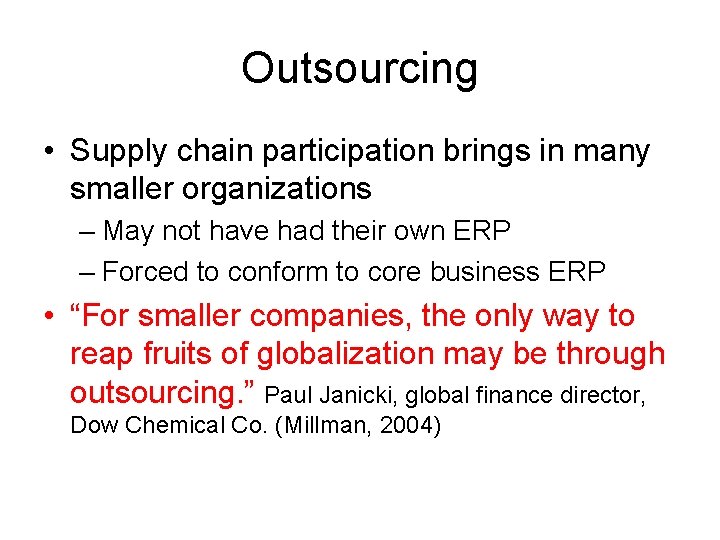
Outsourcing • Supply chain participation brings in many smaller organizations – May not have had their own ERP – Forced to conform to core business ERP • “For smaller companies, the only way to reap fruits of globalization may be through outsourcing. ” Paul Janicki, global finance director, Dow Chemical Co. (Millman, 2004)
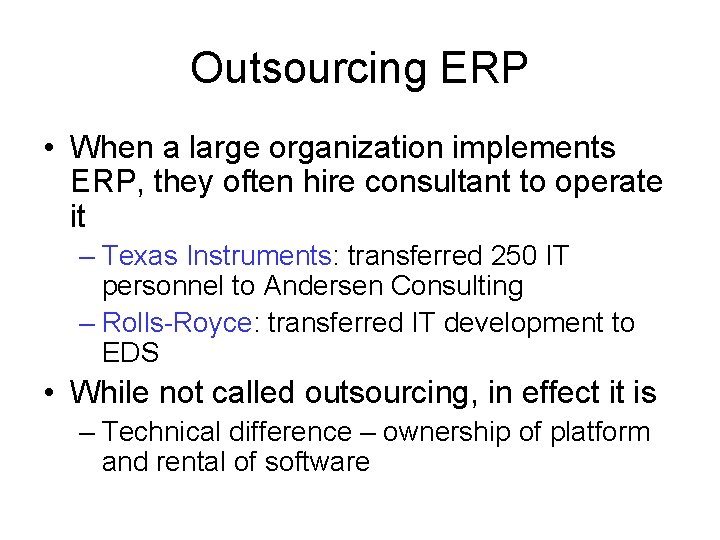
Outsourcing ERP • When a large organization implements ERP, they often hire consultant to operate it – Texas Instruments: transferred 250 IT personnel to Andersen Consulting – Rolls-Royce: transferred IT development to EDS • While not called outsourcing, in effect it is – Technical difference – ownership of platform and rental of software
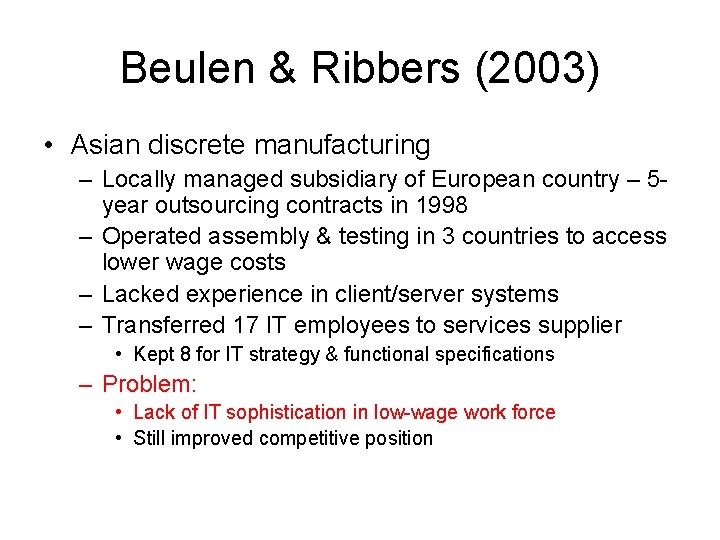
Beulen & Ribbers (2003) • Asian discrete manufacturing – Locally managed subsidiary of European country – 5 year outsourcing contracts in 1998 – Operated assembly & testing in 3 countries to access lower wage costs – Lacked experience in client/server systems – Transferred 17 IT employees to services supplier • Kept 8 for IT strategy & functional specifications – Problem: • Lack of IT sophistication in low-wage work force • Still improved competitive position
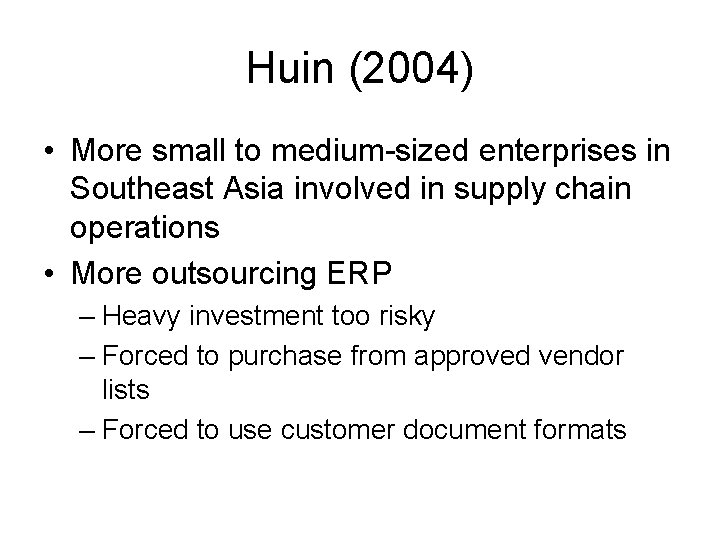
Huin (2004) • More small to medium-sized enterprises in Southeast Asia involved in supply chain operations • More outsourcing ERP – Heavy investment too risky – Forced to purchase from approved vendor lists – Forced to use customer document formats
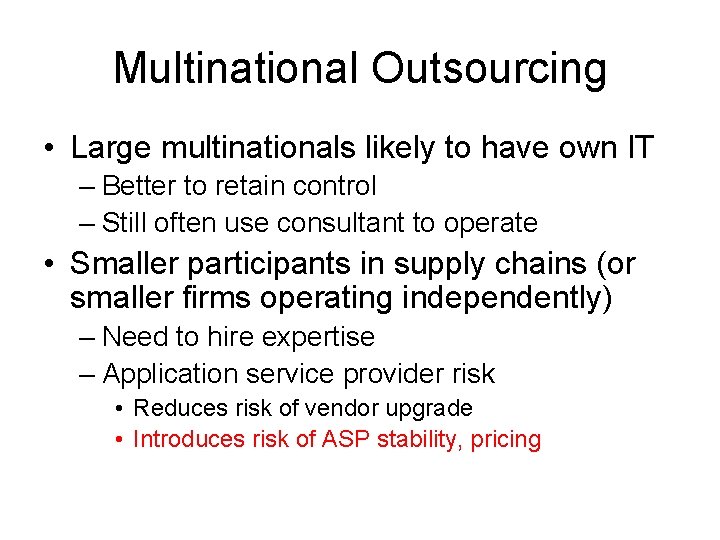
Multinational Outsourcing • Large multinationals likely to have own IT – Better to retain control – Still often use consultant to operate • Smaller participants in supply chains (or smaller firms operating independently) – Need to hire expertise – Application service provider risk • Reduces risk of vendor upgrade • Introduces risk of ASP stability, pricing
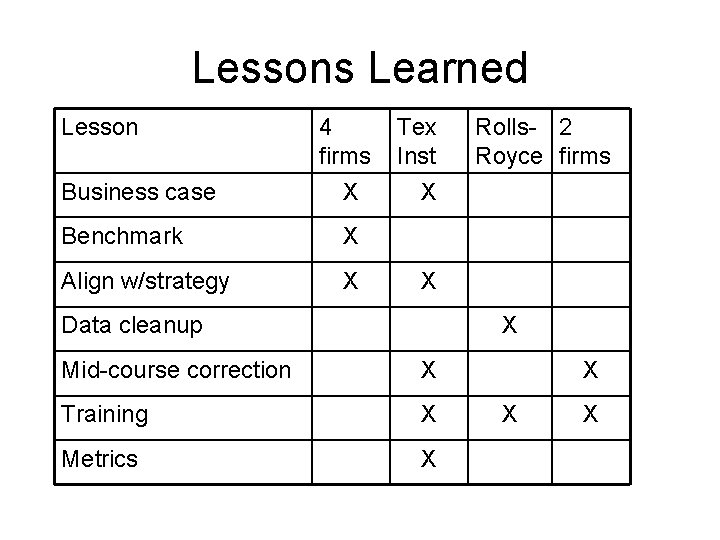
Lessons Learned Lesson Business case 4 firms X Benchmark X Align w/strategy X Tex Inst X Rolls- 2 Royce firms X Data cleanup X Mid-course correction X Training X Metrics X X
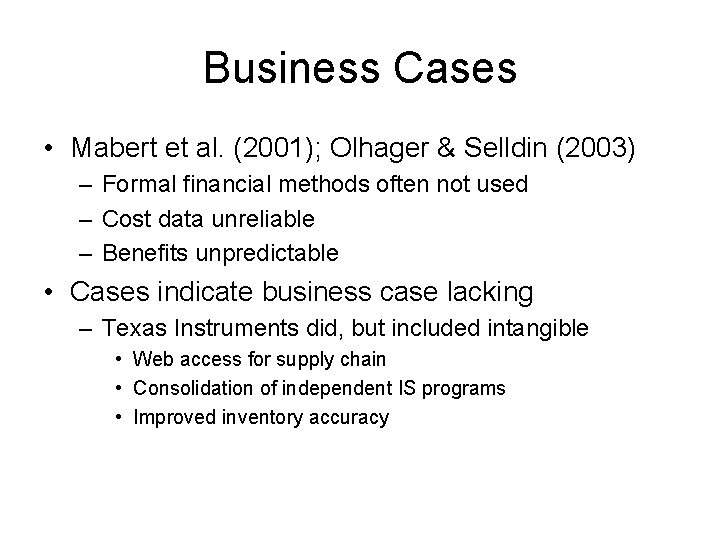
Business Cases • Mabert et al. (2001); Olhager & Selldin (2003) – Formal financial methods often not used – Cost data unreliable – Benefits unpredictable • Cases indicate business case lacking – Texas Instruments did, but included intangible • Web access for supply chain • Consolidation of independent IS programs • Improved inventory accuracy
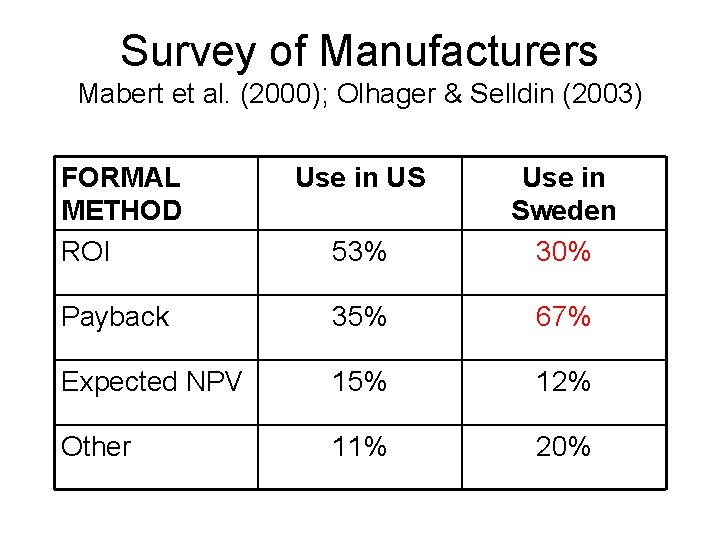
Survey of Manufacturers Mabert et al. (2000); Olhager & Selldin (2003) FORMAL METHOD ROI Use in US 53% Use in Sweden 30% Payback 35% 67% Expected NPV 15% 12% Other 11% 20%
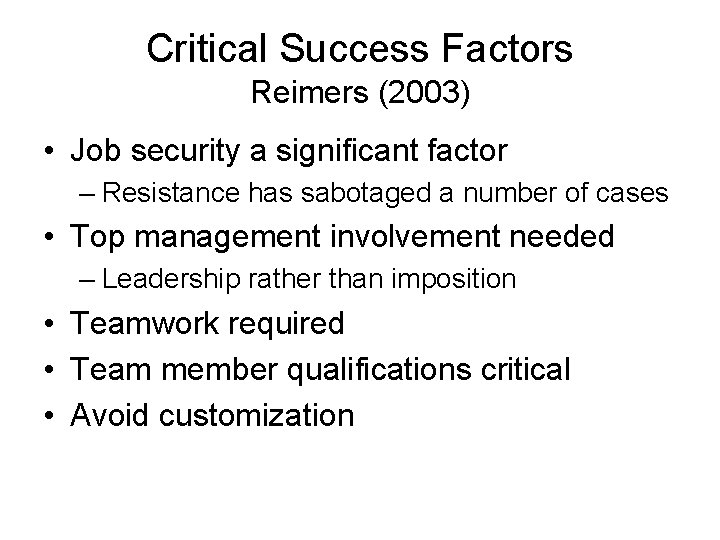
Critical Success Factors Reimers (2003) • Job security a significant factor – Resistance has sabotaged a number of cases • Top management involvement needed – Leadership rather than imposition • Teamwork required • Team member qualifications critical • Avoid customization
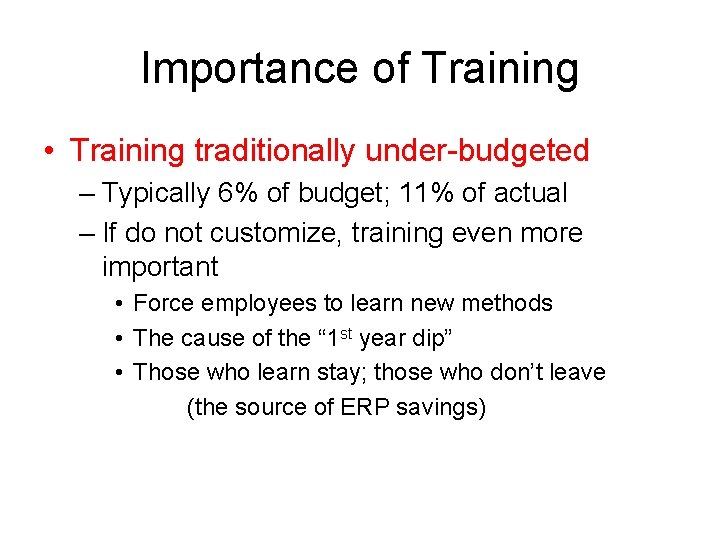
Importance of Training • Training traditionally under-budgeted – Typically 6% of budget; 11% of actual – If do not customize, training even more important • Force employees to learn new methods • The cause of the “ 1 st year dip” • Those who learn stay; those who don’t leave (the source of ERP savings)
Multinational Training Factors • Multinational subsidiaries have labor forces with varying computer skill background – BPR: automation replaces labor – If labor skill high (or if cost lower), less reason to automate – The greater the regulatory variation (or cultural factors of doing business), the more need for local labor
CONCLUSIONS • ERP systems very valuable – BPR provides improved methods – Open systems provide greater supply chain efficiency – Federalism can satisfy local requirements • Need to balance with cost of customization • ISSUES – Vendor manipulation – Application Service Providers
FUTURE • We live in a Networked Society – Castells • Systems emerge – Maturana & Varela; Steven Johnson – Systems naturally emerge without plan • These emerging systems are beyond control – SAP, Microsoft, economies, politics – unknown future systems • At best, we can be flexible, prepared for change