
Reasoning in Psychology Using Statistics Psychology 138 2017
- Slides: 46
Reasoning in Psychology Using Statistics Psychology 138 2017
• Quiz 3 due Friday, Feb. 23 at 11: 59 pm – Covers • Tables and graphs • Measures of center • Measures of variability • You don’t need SPSS, but may want to have a calculator handy Reasoning in Psychology Using Statistics Announcements
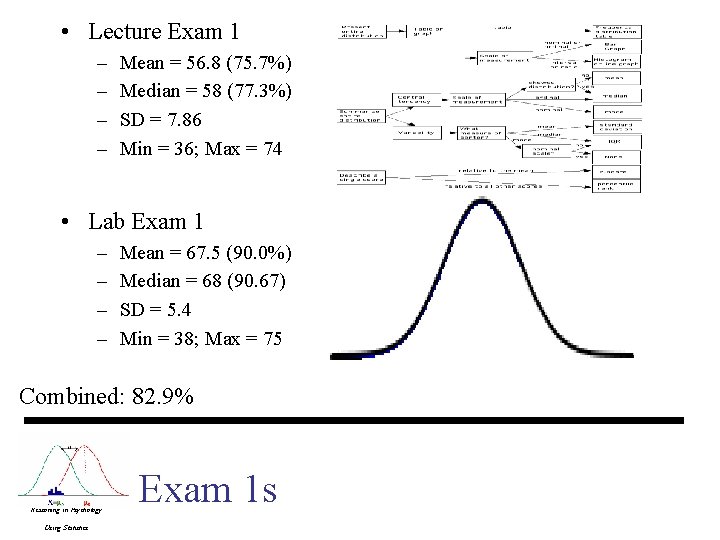
• Lecture Exam 1 – – Mean = 56. 8 (75. 7%) Median = 58 (77. 3%) SD = 7. 86 Min = 36; Max = 74 • Lab Exam 1 – – Mean = 67. 5 (90. 0%) Median = 68 (90. 67) SD = 5. 4 Min = 38; Max = 75 Combined: 82. 9% Reasoning in Psychology Using Statistics Exam 1 s
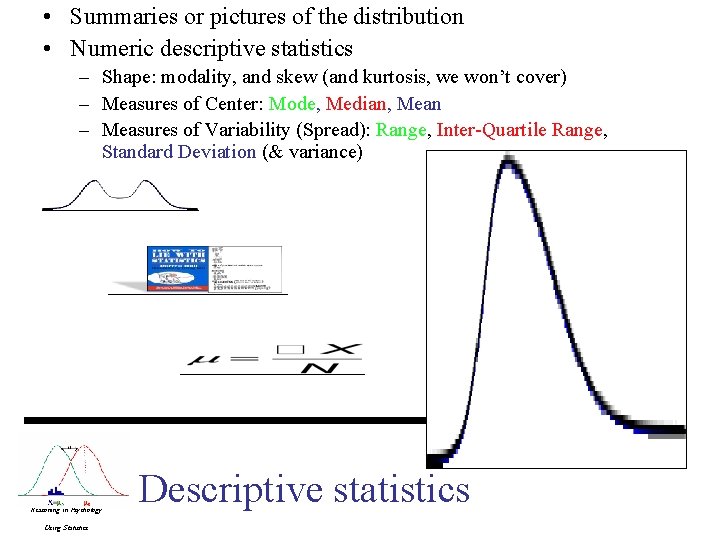
• Summaries or pictures of the distribution • Numeric descriptive statistics – Shape: modality, and skew (and kurtosis, we won’t cover) – Measures of Center: Mode, Median, Mean – Measures of Variability (Spread): Range, Inter-Quartile Range, Standard Deviation (& variance) Reasoning in Psychology Using Statistics Descriptive statistics
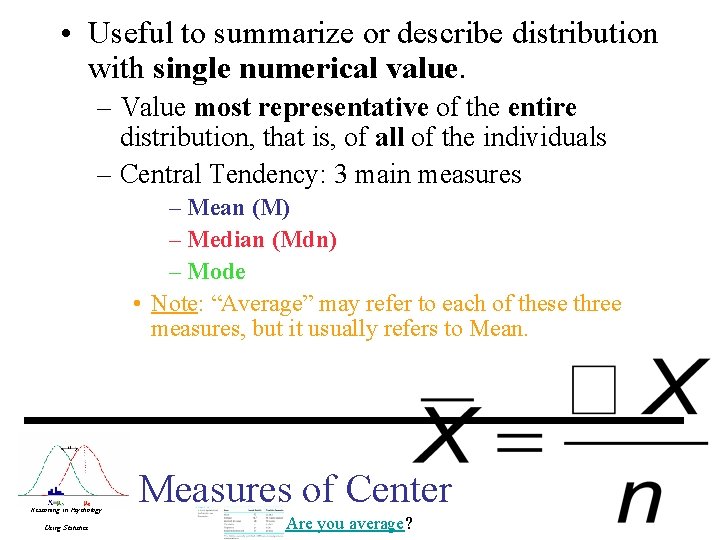
• Useful to summarize or describe distribution with single numerical value. – Value most representative of the entire distribution, that is, of all of the individuals – Central Tendency: 3 main measures – Mean (M) – Median (Mdn) – Mode • Note: “Average” may refer to each of these three measures, but it usually refers to Mean. Reasoning in Psychology Using Statistics Measures of Center Are you average?
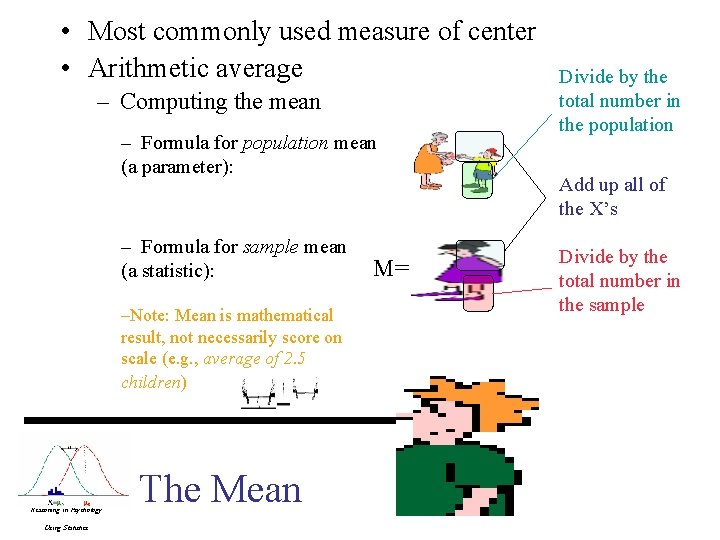
• Most commonly used measure of center • Arithmetic average – Computing the mean – Formula for population mean (a parameter): – Formula for sample mean (a statistic): –Note: Mean is mathematical result, not necessarily score on scale (e. g. , average of 2. 5 children) Reasoning in Psychology Using Statistics The Mean M= Divide by the total number in the population Add up all of the X’s Divide by the total number in the sample
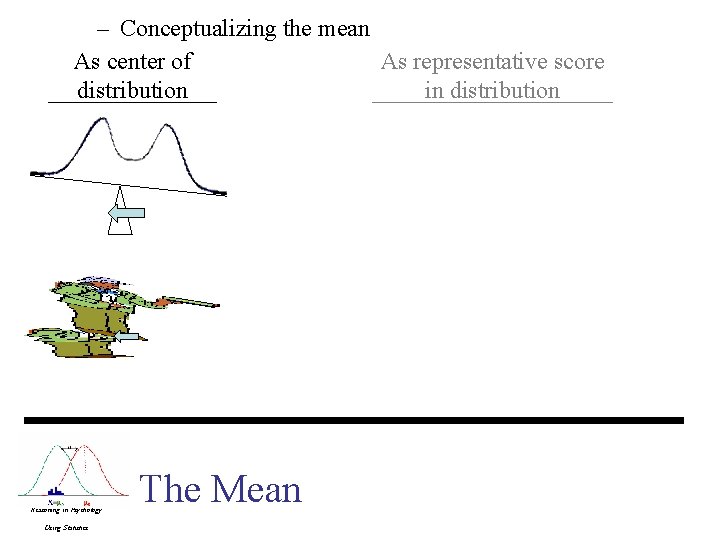
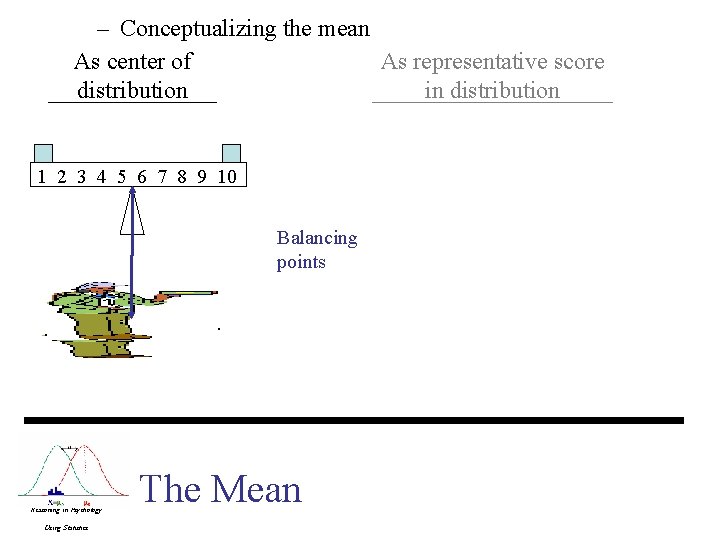
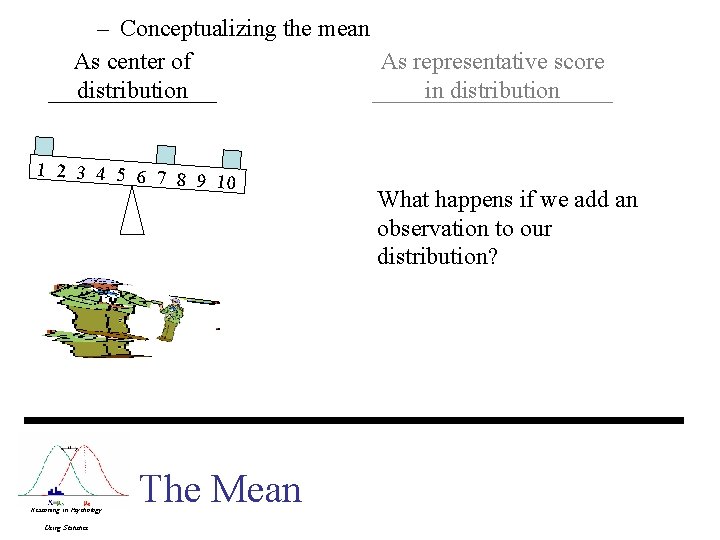
– Conceptualizing the mean As the center of As the representative the distribution score in the distribution Reasoning in Psychology Using Statistics The Mean
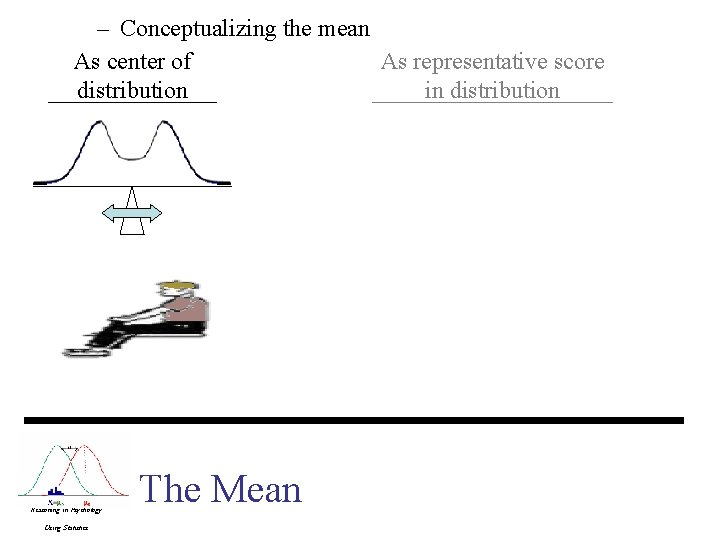
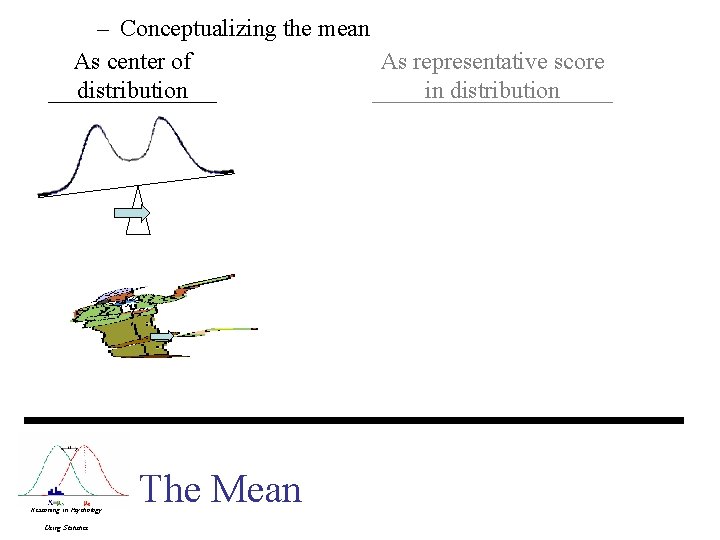
– Conceptualizing the mean As center of As representative score distribution in distribution Reasoning in Psychology Using Statistics The Mean
– Conceptualizing the mean As center of As representative score distribution in distribution Reasoning in Psychology Using Statistics The Mean
– Conceptualizing the mean As center of As representative score distribution in distribution Reasoning in Psychology Using Statistics The Mean
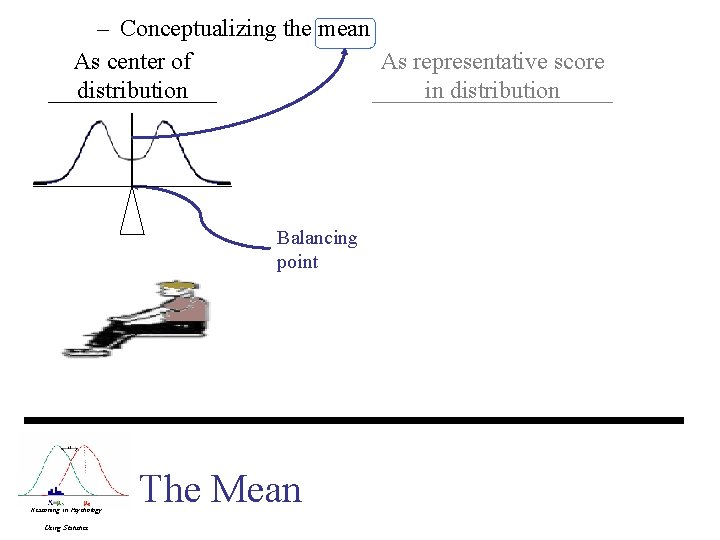
– Conceptualizing the mean As center of As representative score distribution in distribution Balancing point Reasoning in Psychology Using Statistics The Mean
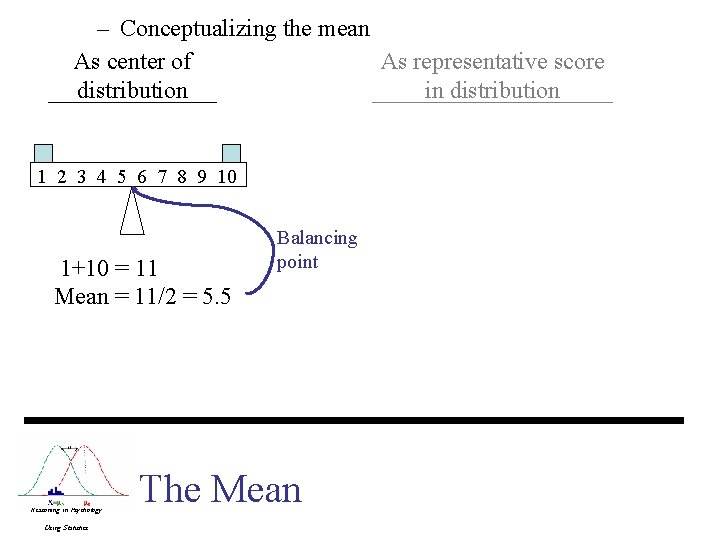
– Conceptualizing the mean As center of As representative score distribution in distribution 1 2 3 4 5 6 7 8 9 10 1+10 = 11 Mean = 11/2 = 5. 5 Reasoning in Psychology Using Statistics Balancing point The Mean
– Conceptualizing the mean As center of As representative score distribution in distribution 1 2 3 4 5 6 7 8 9 10 Balancing points Reasoning in Psychology Using Statistics The Mean
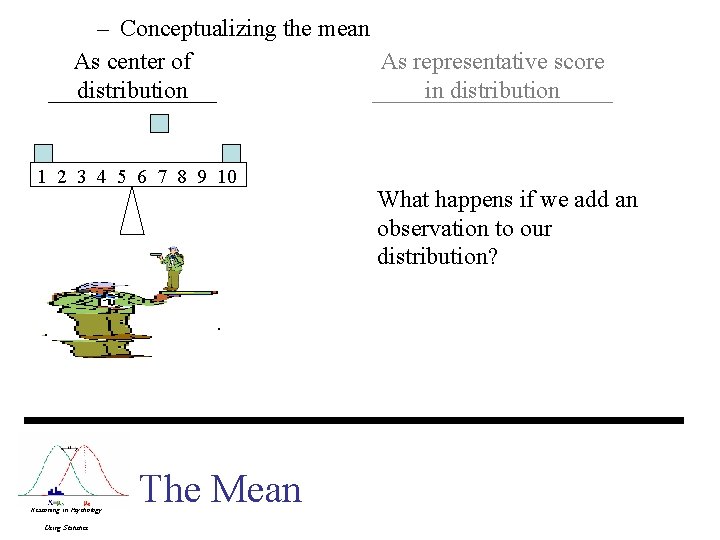
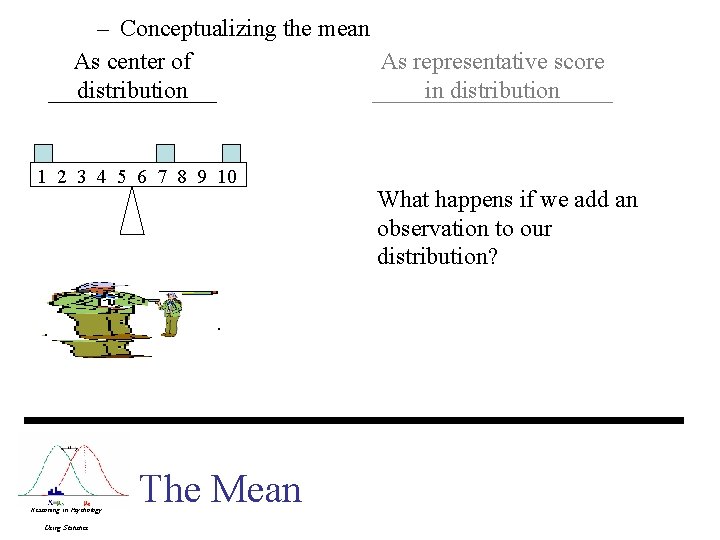
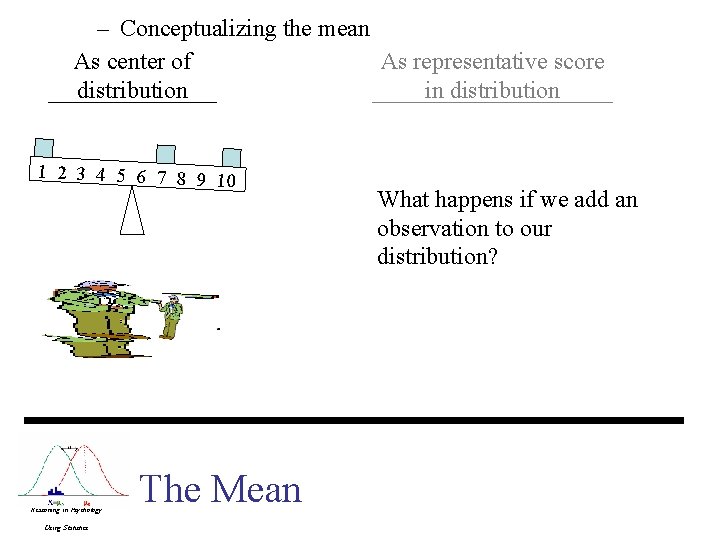
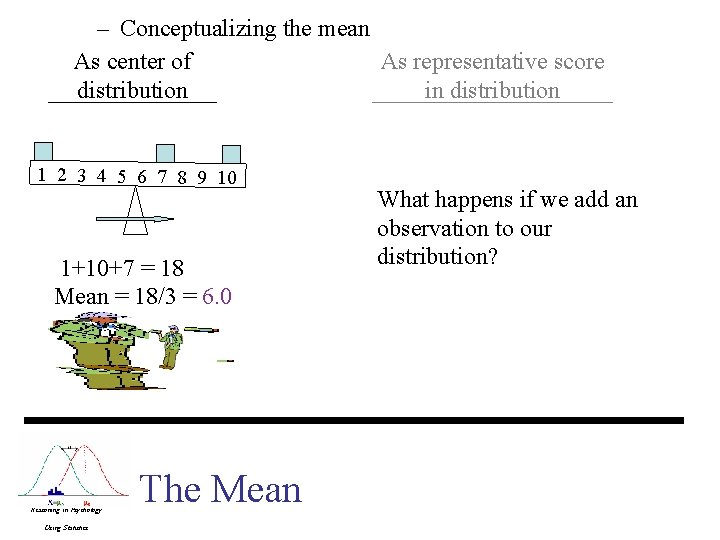
– Conceptualizing the mean As center of As representative score distribution in distribution 1 2 3 4 5 6 7 8 9 10 Reasoning in Psychology Using Statistics The Mean What happens if we add an observation to our distribution?
– Conceptualizing the mean As center of As representative score distribution in distribution 1 2 3 4 5 6 7 8 9 10 Reasoning in Psychology Using Statistics The Mean What happens if we add an observation to our distribution?
– Conceptualizing the mean As center of As representative score distribution in distribution 1 2 3 4 5 6 7 8 9 10 Reasoning in Psychology Using Statistics The Mean What happens if we add an observation to our distribution?
– Conceptualizing the mean As center of As representative score distribution in distribution 1 2 3 4 5 6 7 8 9 10 Reasoning in Psychology Using Statistics The Mean What happens if we add an observation to our distribution?
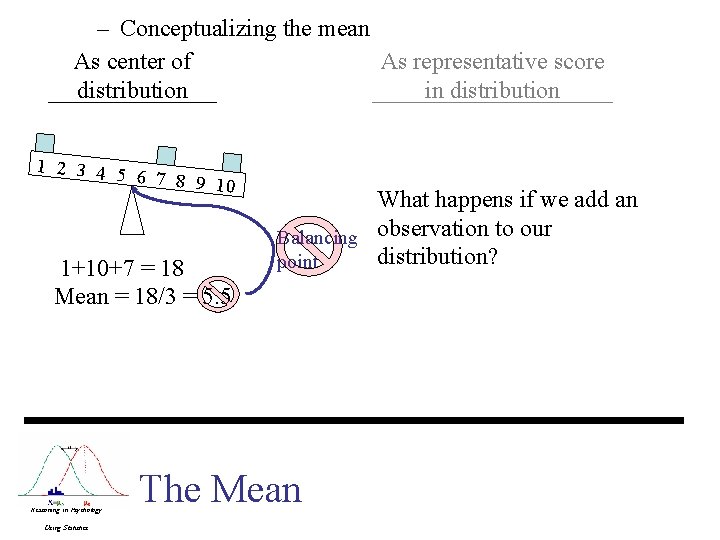
– Conceptualizing the mean As center of As representative score distribution in distribution 1 2 3 4 5 6 7 8 9 10 1+10+7 = 18 Mean = 18/3 = 5. 5 Reasoning in Psychology Using Statistics What happens if we add an Balancing observation to our distribution? point The Mean
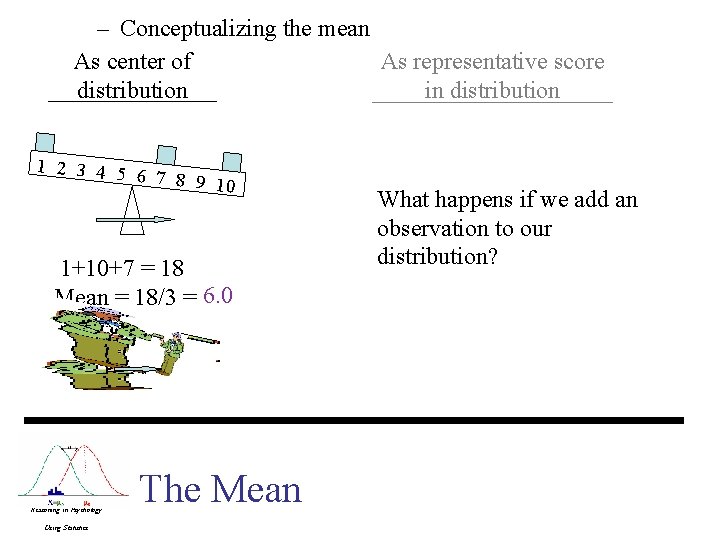
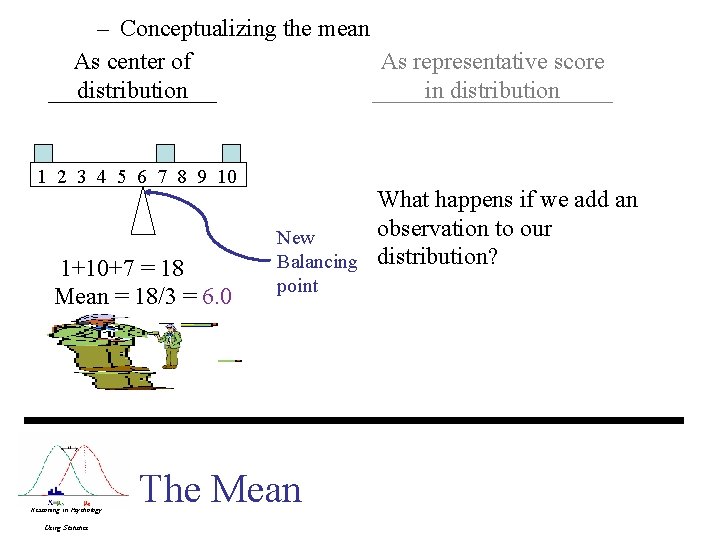
– Conceptualizing the mean As center of As representative score distribution in distribution 1 2 3 4 5 6 7 8 9 10 1+10+7 = 18 Mean = 18/3 = 6. 0 Reasoning in Psychology Using Statistics The Mean What happens if we add an observation to our distribution?
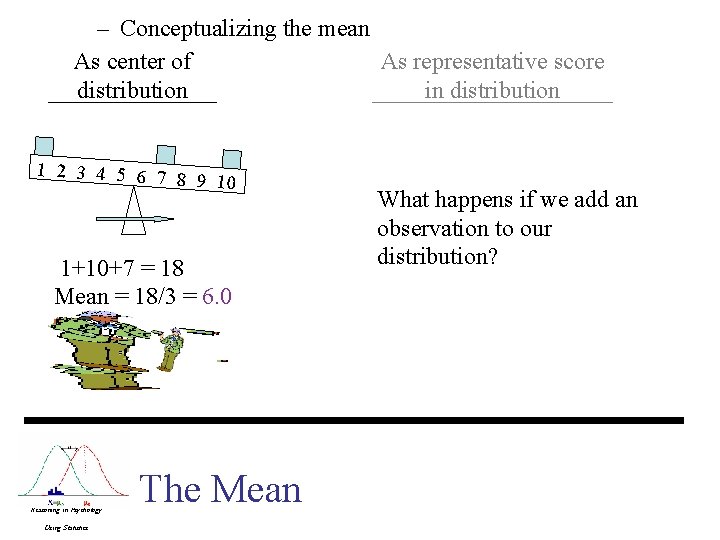
– Conceptualizing the mean As center of As representative score distribution in distribution 1 2 3 4 5 6 7 8 9 10 1+10+7 = 18 Mean = 18/3 = 6. 0 Reasoning in Psychology Using Statistics The Mean What happens if we add an observation to our distribution?
– Conceptualizing the mean As center of As representative score distribution in distribution 1 2 3 4 5 6 7 8 9 10 1+10+7 = 18 Mean = 18/3 = 6. 0 Reasoning in Psychology Using Statistics The Mean What happens if we add an observation to our distribution?
– Conceptualizing the mean As center of As representative score distribution in distribution 1 2 3 4 5 6 7 8 9 10 1+10+7 = 18 Mean = 18/3 = 6. 0 Reasoning in Psychology Using Statistics What happens if we add an observation to our New Balancing distribution? point The Mean
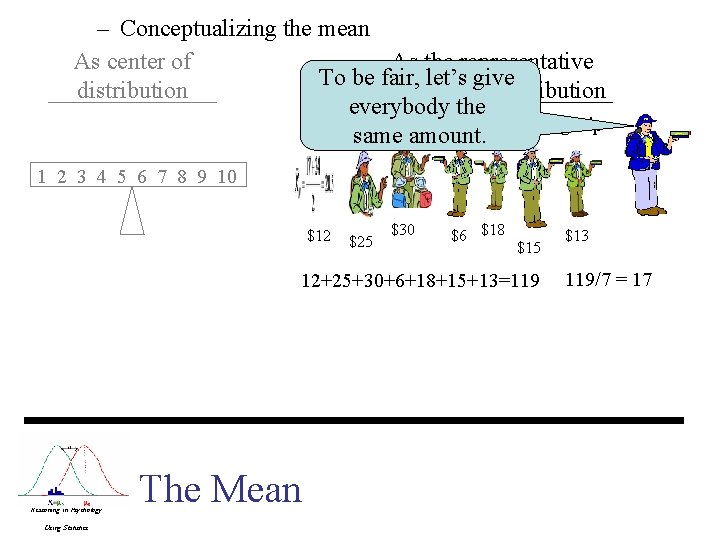
– Conceptualizing the mean As center of As the representative To be fair, let’s give distribution score in the distribution everybody the Girl Scout bake sale for camping trip same amount. 1 2 3 4 5 6 7 8 9 10 $12 $25 $30 $6 $18 $15 12+25+30+6+18+15+13=119 Reasoning in Psychology Using Statistics The Mean $13 119/7 = 17
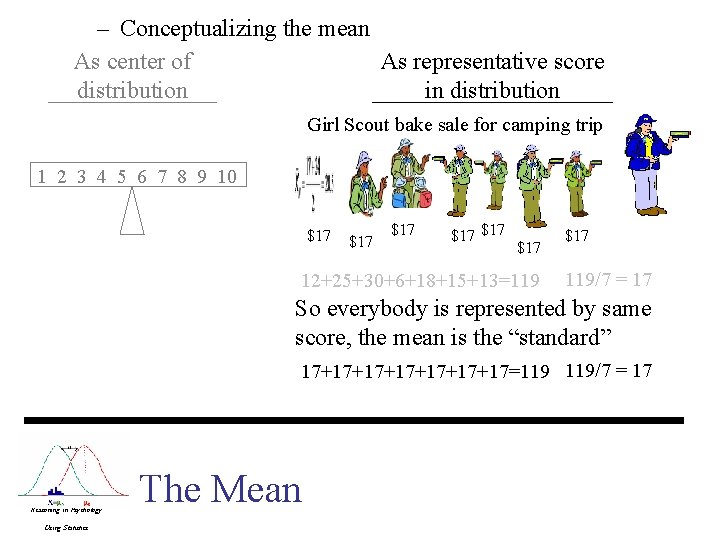
– Conceptualizing the mean As center of As representative score distribution in distribution Girl Scout bake sale for camping trip 1 2 3 4 5 6 7 8 9 10 $17 $17 $17 12+25+30+6+18+15+13=119 $17 119/7 = 17 So everybody is represented by same score, the mean is the “standard” 17+17+17+17=119 119/7 = 17 Reasoning in Psychology Using Statistics The Mean
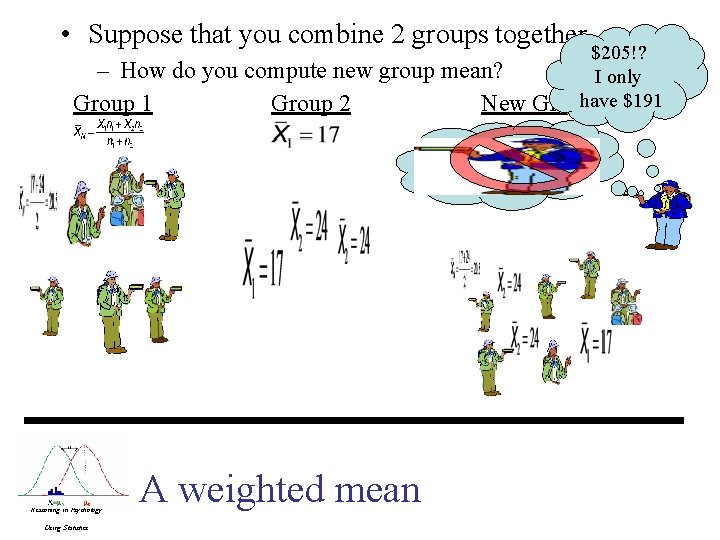
• Suppose that you combine 2 groups together. – How do you compute new group mean? Group 1 Group 2 New Reasoning in Psychology Using Statistics A weighted mean $205!? I only have $191 Group
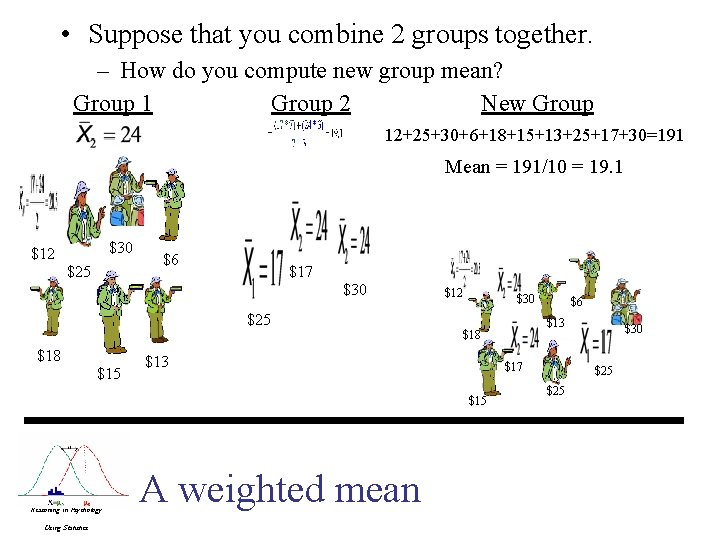
• Suppose that you combine 2 groups together. – How do you compute new group mean? Group 1 Group 2 New Group 12+25+30+6+18+15+13+25+17+30=191 Mean = 191/10 = 19. 1 $30 $12 $25 $6 $17 $30 $25 $18 $15 $12 $30 $17 $15 Reasoning in Psychology Using Statistics A weighted mean $13 $18 $13 $6 $30 $25
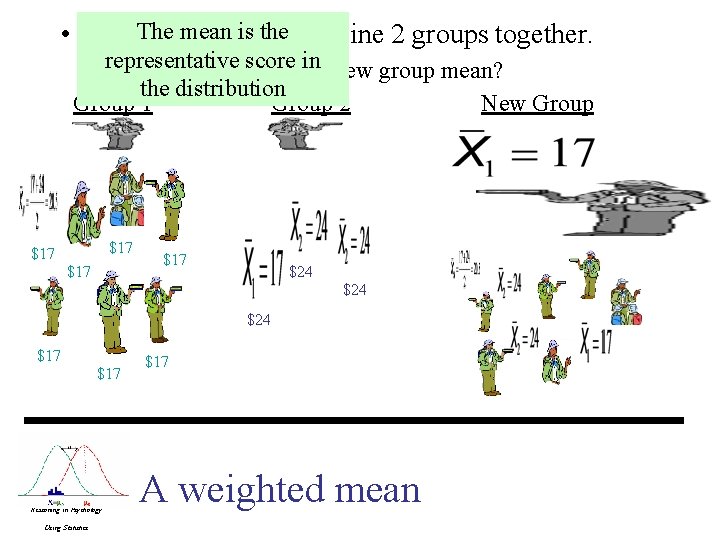
The mean thecombine 2 groups together. • Suppose that is you score in new group mean? –representative How do you compute the distribution Group 1 Group 2 New Group $17 $17 $24 $24 $17 Reasoning in Psychology Using Statistics $17 A weighted mean
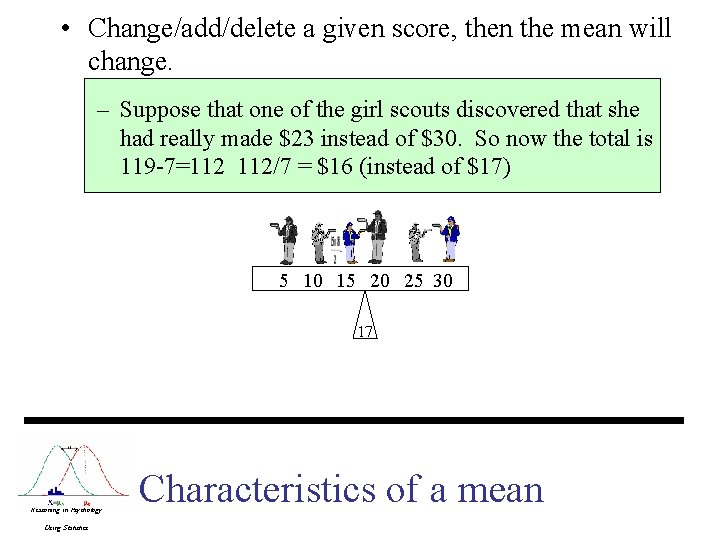
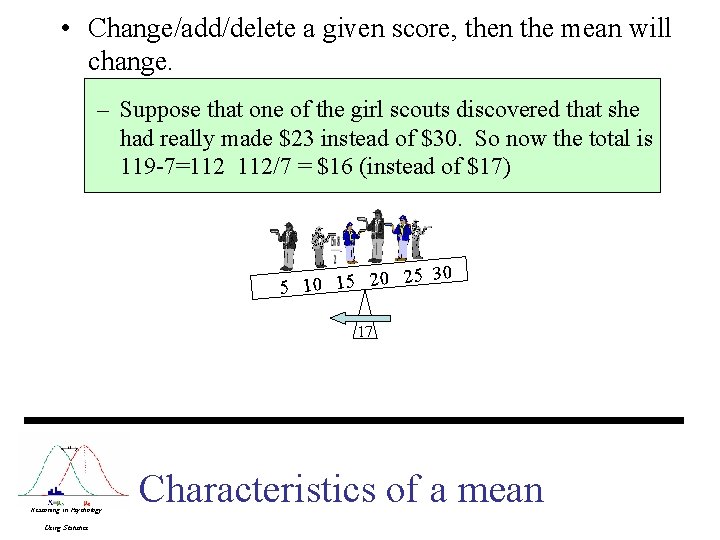
• Change/add/delete a given score, then the mean will change. – Suppose that one of the girl scouts discovered that she had really made $23 instead of $30. So now the total is 119 -7=112 112/7 = $16 (instead of $17) 5 10 15 20 25 30 17 Reasoning in Psychology Using Statistics Characteristics of a mean
• Change/add/delete a given score, then the mean will change. – Suppose that one of the girl scouts discovered that she had really made $23 instead of $30. So now the total is 119 -7=112 112/7 = $16 (instead of $17) 25 30 0 2 5 1 0 1 5 17 Reasoning in Psychology Using Statistics Characteristics of a mean
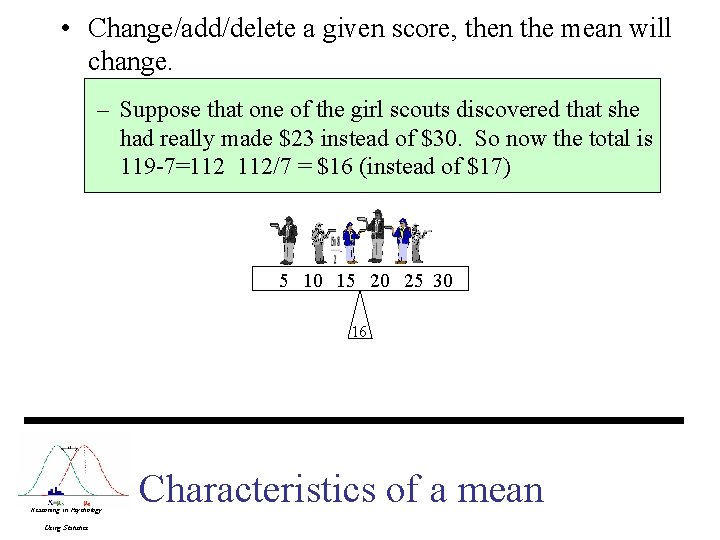
• Change/add/delete a given score, then the mean will change. – Suppose that one of the girl scouts discovered that she had really made $23 instead of $30. So now the total is 119 -7=112 112/7 = $16 (instead of $17) 5 10 15 20 25 30 16 Reasoning in Psychology Using Statistics Characteristics of a mean
• Change/add/delete a given score, then the mean will change. • Add/subtract a constant to each score, then the mean will change by adding(subtracting) that constant. – Suppose that you want to factor out a $2 camping fee for each girl scout. Subtract 2 from each amount. Now the total is $105, so the mean is 105/7 = $15. – But notice you could have just subtracted $2 from the previous mean of $17 and arrived at the same answer. Reasoning in Psychology Using Statistics Characteristics of a mean
• Change/add/delete a given score, then the mean will change. – Suppose that the troop sponsor agreed to match the money made by each girl scout (they give each girl scout an additional amount • Add/subtract a constant to each score, then the of money equal to however much each made on the sale). So now mean willischange adding(subtracting) the total $238, andby the mean for each girl is 238/7 =that $34 – Which is 2 times the original mean constant. • Multiply (or divide) each score by a constant, then the mean will change by being multiplied by that constant. Reasoning in Psychology Using Statistics Characteristics of a mean
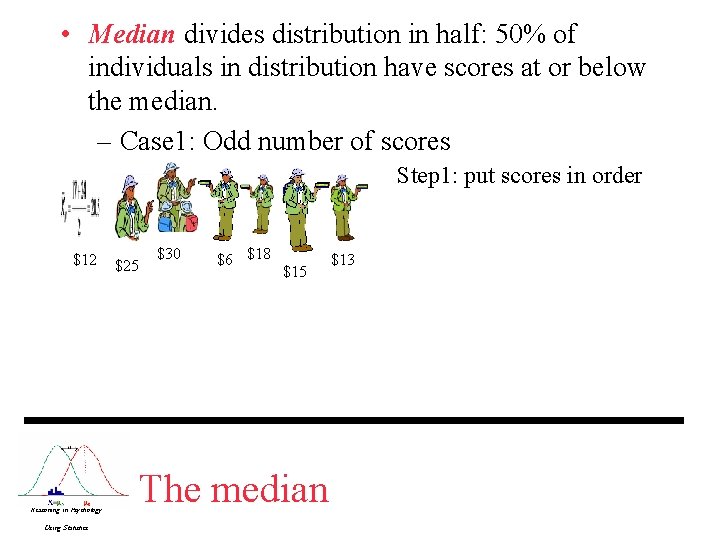
• Median divides distribution in half: 50% of individuals in distribution have scores at or below the median. – Case 1: Odd number of scores Step 1: put scores in order $12 Reasoning in Psychology Using Statistics $25 $30 $6 $18 $15 The median $13
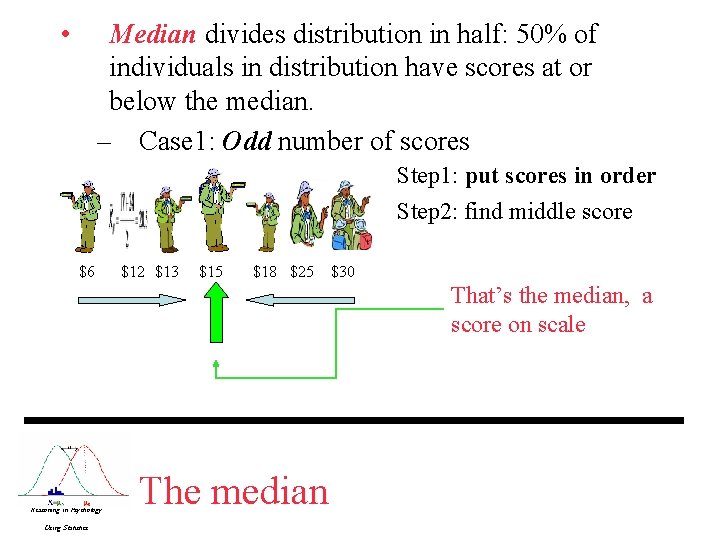
• Median divides distribution in half: 50% of individuals in distribution have scores at or below the median. – Case 1: Odd number of scores Step 1: put scores in order Step 2: find middle score $6 $12 $13 $15 $18 $25 $30 That’s the median, a score on scale Reasoning in Psychology Using Statistics The median
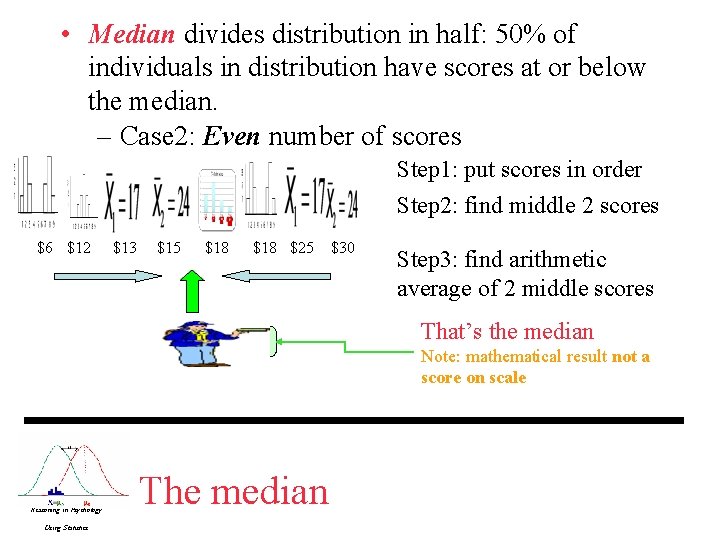
• Median divides distribution in half: 50% of individuals in distribution have scores at or below the median. – Case 2: Even number of scores Step 1: put scores in order Step 2: find middle 2 scores $6 $12 $13 $15 $18 $25 $30 Step 3: find arithmetic average of 2 middle scores That’s the median Note: mathematical result not a score on scale Reasoning in Psychology Using Statistics The median
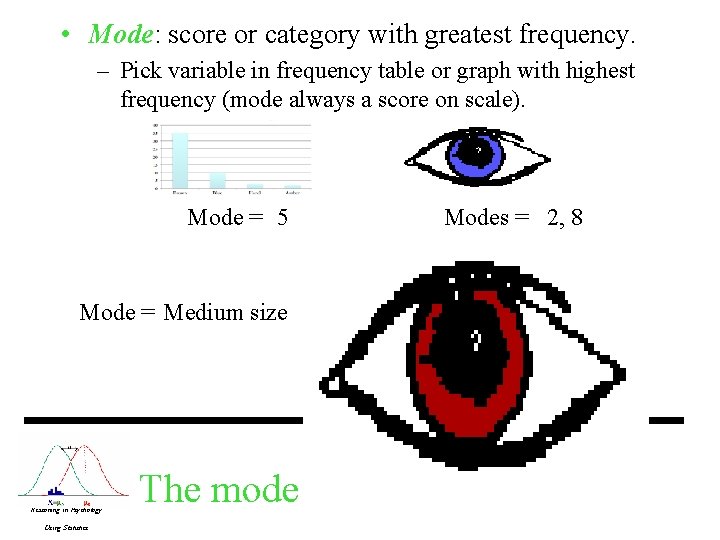
• Mode: score or category with greatest frequency. – Pick variable in frequency table or graph with highest frequency (mode always a score on scale). Mode = 5 Mode = Medium size Reasoning in Psychology Using Statistics The mode Modes = 2, 8
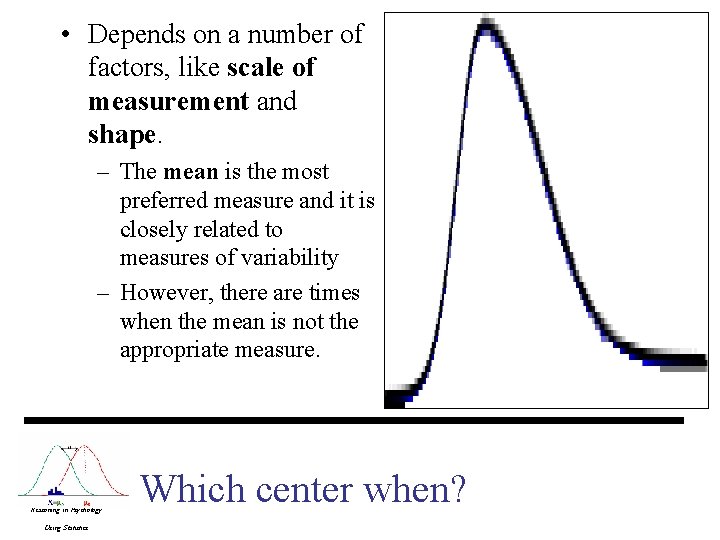
• Depends on a number of factors, like scale of measurement and shape. – The mean is the most preferred measure and it is closely related to measures of variability – However, there are times when the mean is not the appropriate measure. Reasoning in Psychology Using Statistics Which center when?
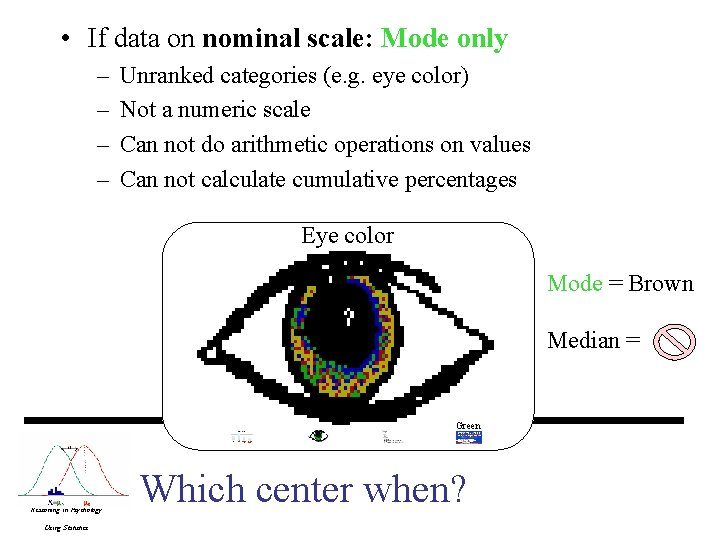
• If data on nominal scale: Mode only – – Unranked categories (e. g. eye color) Not a numeric scale Can not do arithmetic operations on values Can not calculate cumulative percentages Eye color Mode = Brown Median = Green Reasoning in Psychology Using Statistics Which center when?
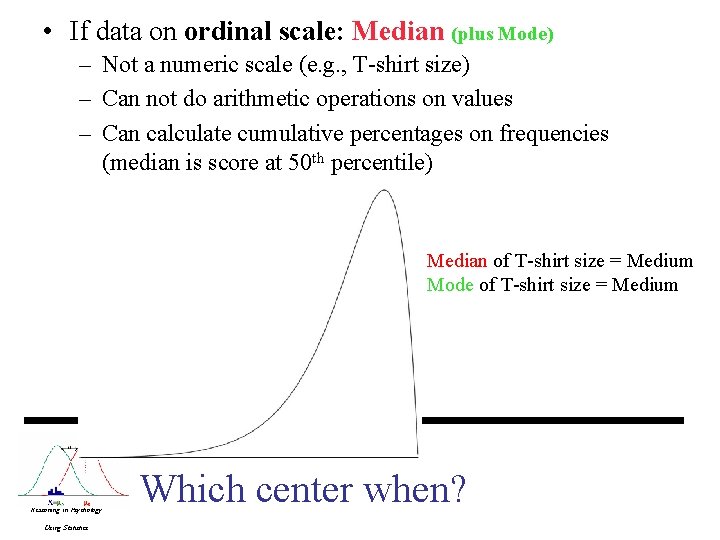
• If data on ordinal scale: Median (plus Mode) – Not a numeric scale (e. g. , T-shirt size) – Can not do arithmetic operations on values – Can calculate cumulative percentages on frequencies (median is score at 50 th percentile) Median of T-shirt size = Medium Mode of T-shirt size = Medium Reasoning in Psychology Using Statistics Which center when?
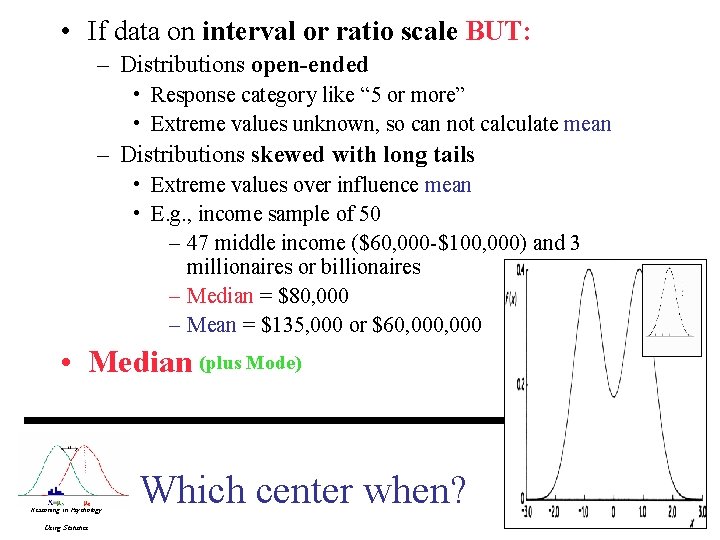
• If data on interval or ratio scale BUT: – Distributions open-ended • Response category like “ 5 or more” • Extreme values unknown, so can not calculate mean – Distributions skewed with long tails • Extreme values over influence mean • E. g. , income sample of 50 – 47 middle income ($60, 000 -$100, 000) and 3 millionaires or billionaires – Median = $80, 000 – Mean = $135, 000 or $60, 000 • Median (plus Mode) Reasoning in Psychology Using Statistics Which center when?
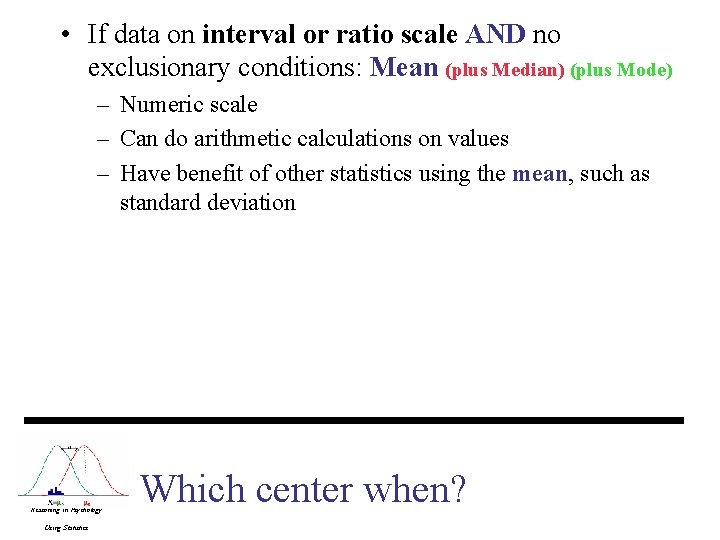
• If data on interval or ratio scale AND no exclusionary conditions: Mean (plus Median) (plus Mode) – Numeric scale – Can do arithmetic calculations on values – Have benefit of other statistics using the mean, such as standard deviation Reasoning in Psychology Using Statistics Which center when?
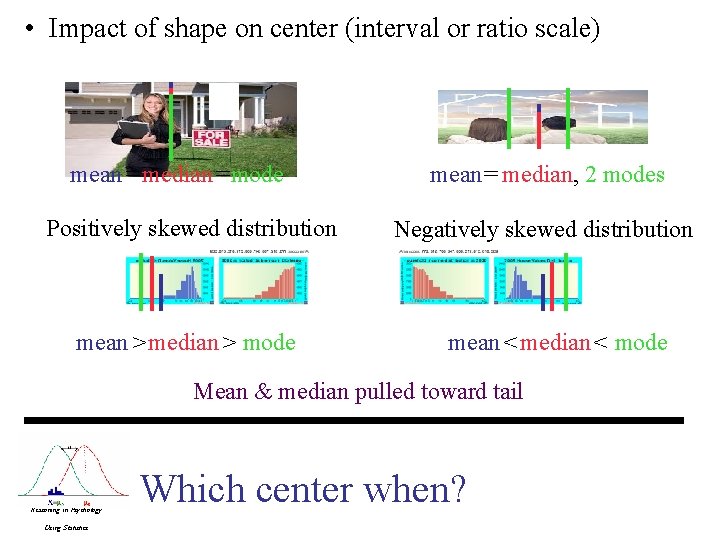
• Impact of shape on center (interval or ratio scale) mean = median = mode Positively skewed distribution mean > median > mode mean = median, 2 modes Negatively skewed distribution mean < median < mode Mean & median pulled toward tail Reasoning in Psychology Using Statistics Which center when?
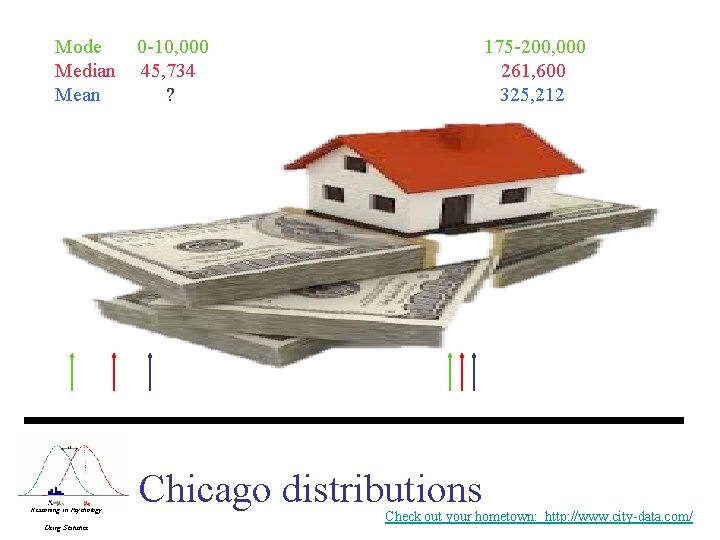
Mode Median Mean Reasoning in Psychology Using Statistics 0 -10, 000 45, 734 ? 175 -200, 000 261, 600 325, 212 Chicago distributions Check out your hometown: http: //www. city-data. com/
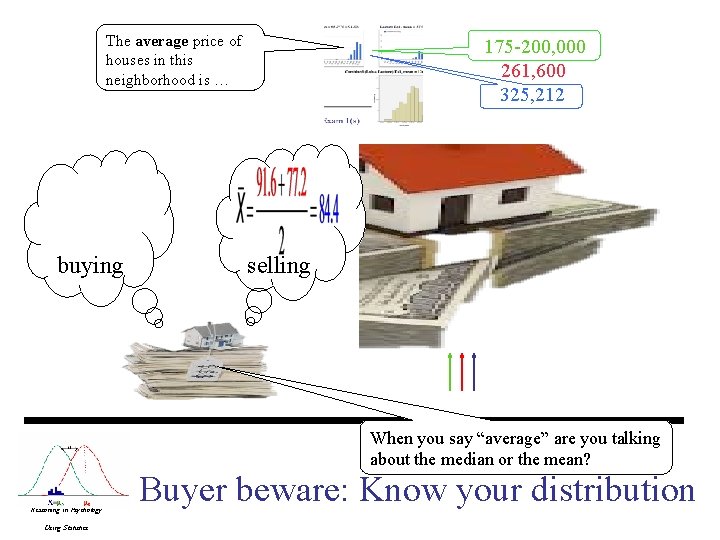
price of Mode The average 0 -10, 000 houses in this Medianneighborhood 45, 734 is … Mean ? buying 175 -200, 000 261, 600 325, 212 selling When you say “average” are you talking about the median or the mean? Reasoning in Psychology Using Statistics Buyer beware: Know your distribution
• Today’s lab – Compute mean, median, & mode both by hand & using SPSS • Questions? • • • Reasoning in Psychology Using Statistics Kahn Academy: The average (~12 mins) Kahn Academy: Central Tendency (~9 mins) Kahn Academy: Sample vs. Population Mean (~7 mins) Choosing the Best Measure of Central Tendency (~7 mins) Interpreting Measures of Central Tendency (~7 mins) Wrap up
• Suppose that you combine 2 groups together. – How do you compute new group mean? Average the 2 averages But it only works this way when the two groups have exactly the same number of scores Reasoning in Psychology Using Statistics A weighted mean