
Reasoning for Microphysics Modifications Several modification were made
- Slides: 11
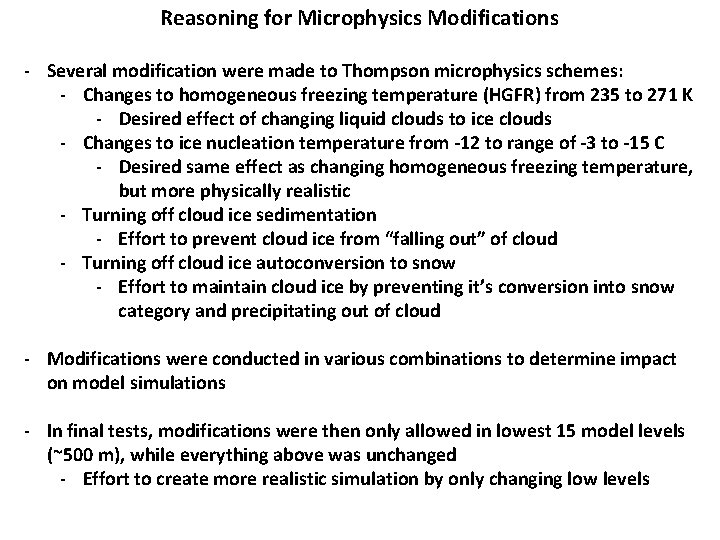
Reasoning for Microphysics Modifications - Several modification were made to Thompson microphysics schemes: - Changes to homogeneous freezing temperature (HGFR) from 235 to 271 K - Desired effect of changing liquid clouds to ice clouds - Changes to ice nucleation temperature from -12 to range of -3 to -15 C - Desired same effect as changing homogeneous freezing temperature, but more physically realistic - Turning off cloud ice sedimentation - Effort to prevent cloud ice from “falling out” of cloud - Turning off cloud ice autoconversion to snow - Effort to maintain cloud ice by preventing it’s conversion into snow category and precipitating out of cloud - Modifications were conducted in various combinations to determine impact on model simulations - In final tests, modifications were then only allowed in lowest 15 model levels (~500 m), while everything above was unchanged - Effort to create more realistic simulation by only changing low levels
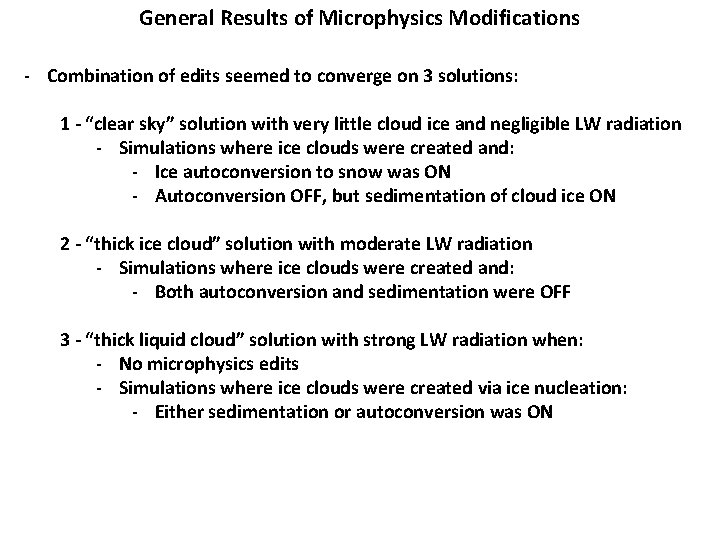
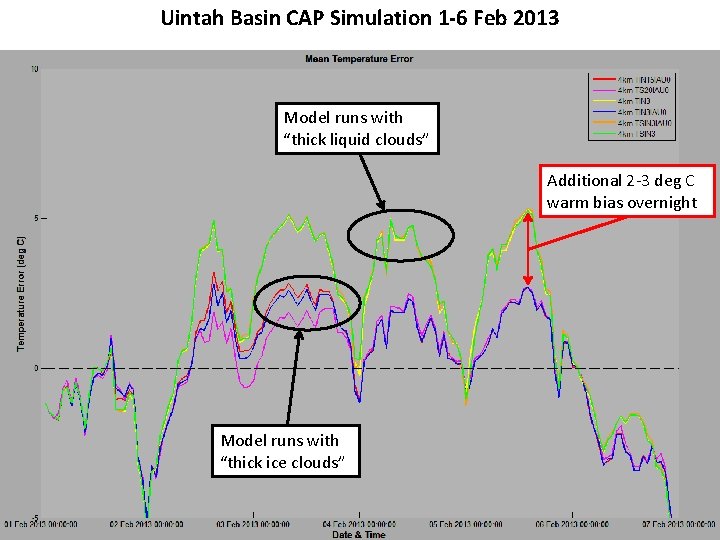
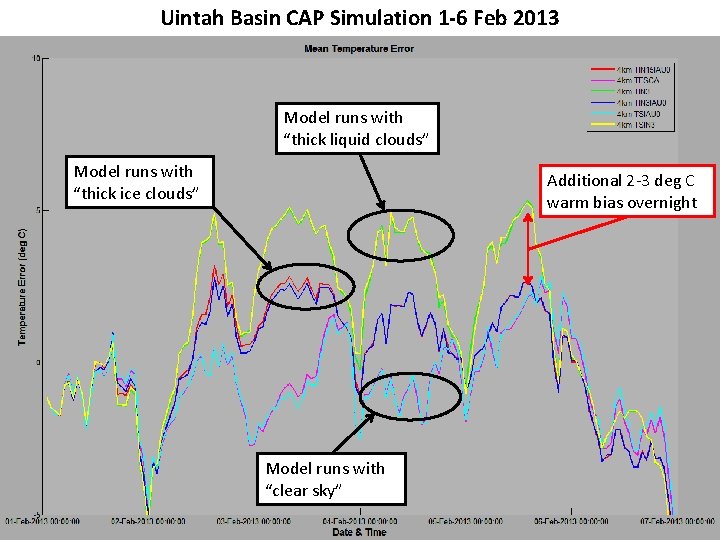
General Results of Microphysics Modifications - Combination of edits seemed to converge on 3 solutions: 1 - “clear sky” solution with very little cloud ice and negligible LW radiation - Simulations where ice clouds were created and: - Ice autoconversion to snow was ON - Autoconversion OFF, but sedimentation of cloud ice ON 2 - “thick ice cloud” solution with moderate LW radiation - Simulations where ice clouds were created and: - Both autoconversion and sedimentation were OFF 3 - “thick liquid cloud” solution with strong LW radiation when: - No microphysics edits - Simulations where ice clouds were created via ice nucleation: - Either sedimentation or autoconversion was ON
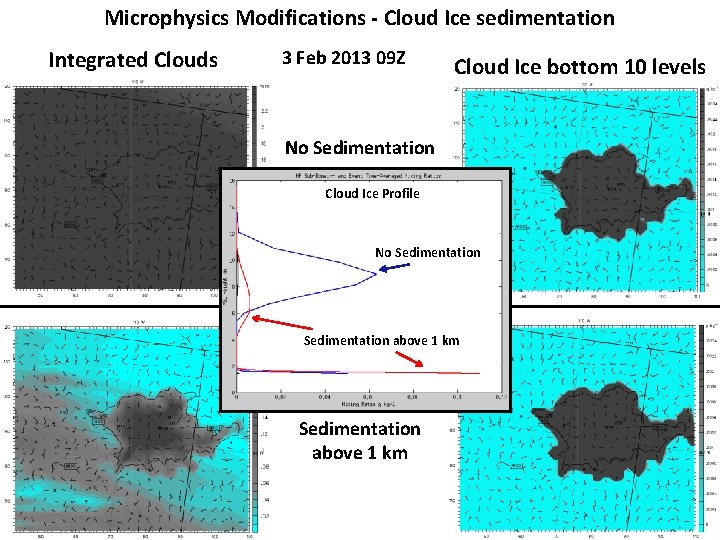
Microphysics Modifications - Cloud Ice sedimentation Integrated Clouds 3 Feb 2013 09 Z Cloud Ice bottom 10 levels No Sedimentation Cloud Ice Profile No Sedimentation above 1 km
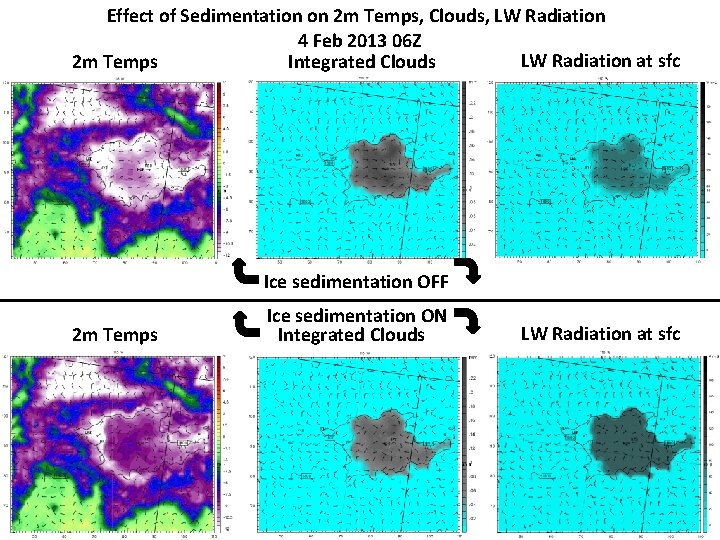
Effect of Sedimentation on 2 m Temps, Clouds, LW Radiation 4 Feb 2013 06 Z LW Radiation at sfc 2 m Temps Integrated Clouds Ice sedimentation OFF 2 m Temps Ice sedimentation ON Integrated Clouds LW Radiation at sfc
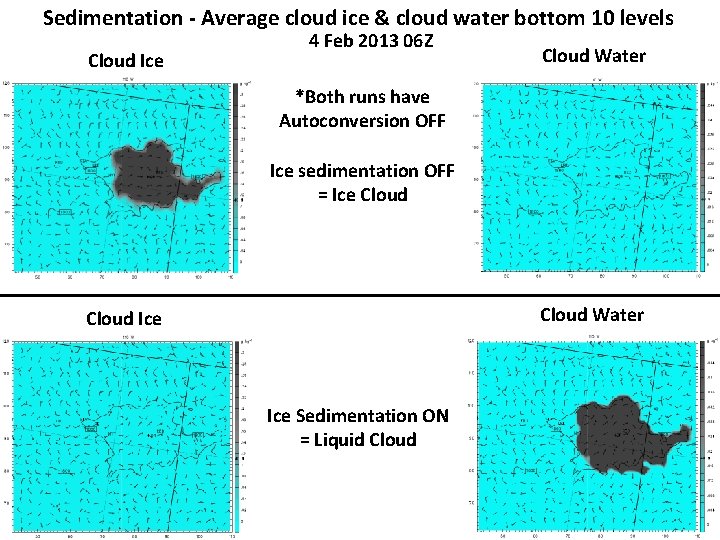
Sedimentation - Average cloud ice & cloud water bottom 10 levels Cloud Ice 4 Feb 2013 06 Z Cloud Water *Both runs have Autoconversion OFF Ice sedimentation OFF = Ice Cloud Water Cloud Ice Sedimentation ON = Liquid Cloud
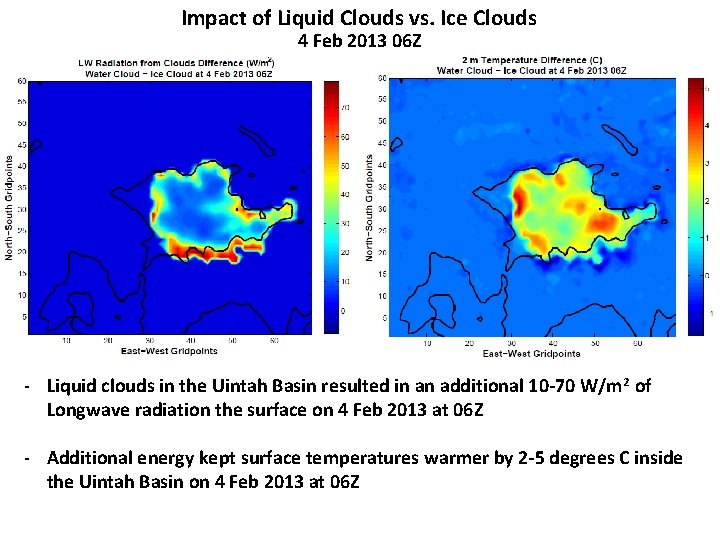
Impact of Liquid Clouds vs. Ice Clouds 4 Feb 2013 06 Z - Liquid clouds in the Uintah Basin resulted in an additional 10 -70 W/m 2 of Longwave radiation the surface on 4 Feb 2013 at 06 Z - Additional energy kept surface temperatures warmer by 2 -5 degrees C inside the Uintah Basin on 4 Feb 2013 at 06 Z
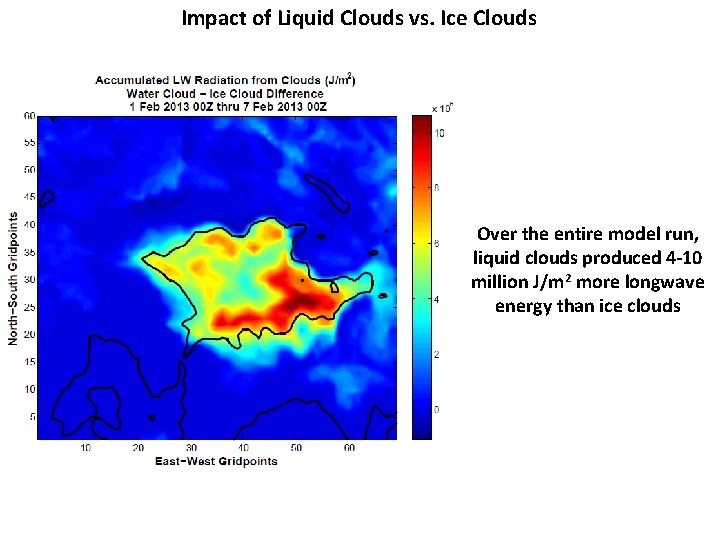
Impact of Liquid Clouds vs. Ice Clouds Over the entire model run, liquid clouds produced 4 -10 million J/m 2 more longwave energy than ice clouds
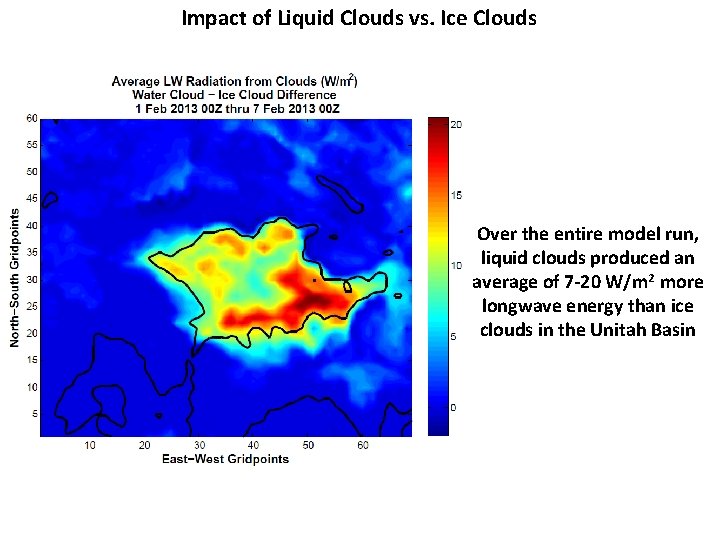
Impact of Liquid Clouds vs. Ice Clouds Over the entire model run, liquid clouds produced an average of 7 -20 W/m 2 more longwave energy than ice clouds in the Unitah Basin
Uintah Basin CAP Simulation 1 -6 Feb 2013 Model runs with “thick liquid clouds” Additional 2 -3 deg C warm bias overnight Model runs with “thick ice clouds”
Uintah Basin CAP Simulation 1 -6 Feb 2013 Model runs with “thick liquid clouds” Model runs with “thick ice clouds” Additional 2 -3 deg C warm bias overnight Model runs with “clear sky”
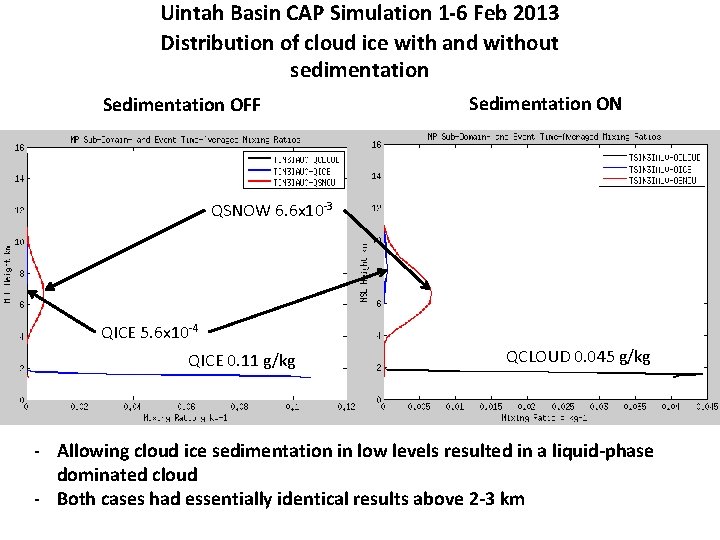
Uintah Basin CAP Simulation 1 -6 Feb 2013 Distribution of cloud ice with and without sedimentation Sedimentation OFF Sedimentation ON QSNOW 6. 6 x 10 -3 QICE 5. 6 x 10 -4 QICE 0. 11 g/kg QCLOUD 0. 045 g/kg - Allowing cloud ice sedimentation in low levels resulted in a liquid-phase dominated cloud - Both cases had essentially identical results above 2 -3 km