
Reasonable Accommodation Training AFGE District 6 Instructor Jamal
Reasonable Accommodation Training (AFGE District 6) Instructor: Jamal Goodrich EEO Attorneys 202 -639 -4006 Women’s & Fair Practices Depts. NVP Jeremy Lannan AMERICAN FEDERATION OF GOVERNMENT EMPLOYEES, AFL - CIO

What is the EEOC? The Equal Employment Opportunity Commission is a federal agency that enforces laws against workplace discrimination based on: • • • Race Color National Origin Religion Sex Age Disability Genetic information Retaliation 2
What Does EEO Do? • Requires work environment to be free of harassment based on protected class • Requires accommodation of religion and disability • Reaches intentional and unintentional discrimination • Reaches discrimination against “association” and mistaken attributions 3
What EEO Doesn’t Do… • Prohibit all forms of discrimination and reprisal • Establish quotas • Protect one race, gender, religion, etc over another • Attack Unfair Treatment • Fix Poor Management • Cure Personality Conflicts 4
FEDERAL LAWS Prohibit Employment Discrimination Title VII of the Civil Rights Act (“Title VII”) (42 U. S. C. 2000 e et seq. ) Americans with Disabilities Act (“ADA”) (42 U. S. C. 12101) Rehabilitation Act (“Rehab Act”) (29 U. S. C. 791) 5
Title VII: 1. 2. 3. 4. 5. 6. Race Color Religion Sex National Origin Reprisal ADA/Rehab Act: 8. Disability 6

Protected Class - Religion Sincerely held religious, ethical or moral beliefs Atheism is included ‘No Religious Preference’ is problematic 7
Protected Class – Disability Reaches EEO definition of disability only, not definitions related to: • VA Benefits • Motor Vehicle Administration • SSI Benefits • Workers’ Compensation • FMLA, etc 8
EEO Definitions For a Disabled Individual 1. 2. 3. Individual with a physical or mental impairment which substantially limits a major life activity; Individual who has record of physical or mental impairment which substantially limits a major life activity; or Individual who is regarded as having a physical or mental impairment which substantially limits a major life activity. 9
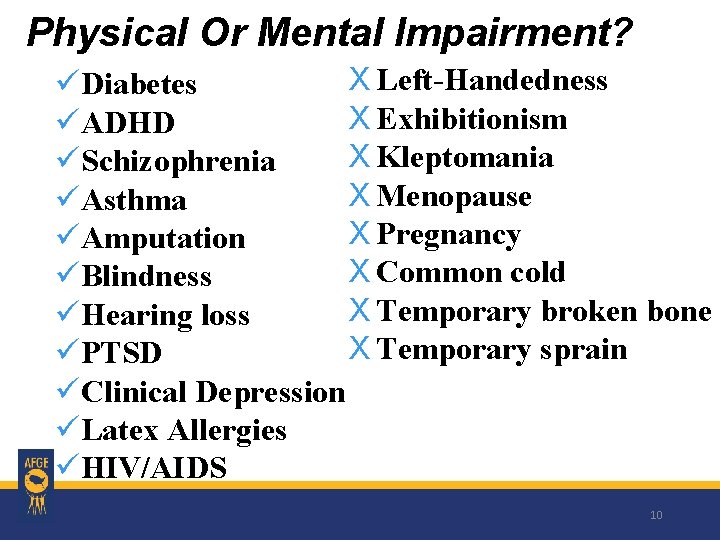
Physical Or Mental Impairment? Χ Left-Handedness üDiabetes Χ Exhibitionism üADHD Χ Kleptomania üSchizophrenia Χ Menopause üAsthma Χ Pregnancy üAmputation Χ Common cold üBlindness Χ Temporary broken bone üHearing loss Χ Temporary sprain üPTSD üClinical Depression üLatex Allergies üHIV/AIDS 10
ADA Amendments Act of 2008 The ADAAA amended the definition of the term "disability, " clarifying and broadening that definition to include: • eating, reading, bending, communicating, bodily functions such as functions of the immune system, normal cell growth, digestive, bowel, bladder, neurological, brain, respiratory, circulatory, endocrine and reproductive functions. • Episodic and in-remission impairment = disability if substantially limits major life activity when active 11
Theories of Discrimination AMERICAN FEDERATION OF GOVERNMENT EMPLOYEES, AFL - CIO
Theories of Discrimination 1. Disparate Treatment 2. Disparate Impact 3. Harassment or Hostile Work Environment 4. Reasonable Accommodations 5. Reprisal/Retaliation 13
Reasonable Accommodations Under Title VII, an employer must reasonably accommodate religious beliefs and practices of an employee unless: • The requested accommodation places an undue hardship on the employer Under the Americans with Disability Act (ADA), an employer must reasonably accommodate an employee with a disability unless • The requested accommodation places an undue hardship on the employer 14
Reasonable Accommodation: What Does That Mean? ? ? The term “Reasonable Accommodation” means: 1. “modifications or adjustments that enable a covered entity’s employee with a disability to enjoy equal benefits and privileges of employment as are enjoyed by its other similarly situated employees without disabilities. ” – 29 C. F. R. § 1630. 2(0)(1)(iii) 2. “making existing facilities readily accessible to and usable by individuals with disabilities” – 29 C. F. R. § 1630. 2(o) Example: employee access to accessible restrooms may be required as a reasonable accommodation 15
How to determine the appropriate Reasonable Accommodation: • “to determine the appropriate reasonable accommodation it may be necessary for the covered entity to initiate an informal, interactive process with the qualified individual with a disability in need of the accommodation. ” – 29 C. F. R. § 1630. 2(0)(3) NOTE: • The only statutory limitation on an employer’s obligation to provide “reasonable accommodation” is that no such change or medication is required if it would cause “undue hardship” on the employer. • A modification or adjustment satisfies the reasonable accommodation obligation if it is “effective. ” 16
The “Interactive Process”: What does that Mean? • When an individual’s disability and/or the need for accommodation is not obvious, the employer may ask the individual for reasonable documentation about his or her disability and functional limitations • Reasonable documentation means that the employer may require only the documentation that is needed to establish that a person has a disability within the meaning of the Rehabilitation Act and that the disability necessitates a reasonable accommodation • If an individuals’ disability or need for an accommodation is not obvious, and they refuse to provide the reasonable documentation requested by the employer, then he is not entitled to reasonable accommodation 17
How should the Reasonable Accommodation process work? : • An employer should respond expeditiously to a request for reasonable accommodation • If the employer and the individual with a disability need to engage in an interactive process, this too should proceed as quickly as possible • Similarly, the employer should act promptly to provide the reasonable accommodation • Unnecessary delays can result in a violation of the ADA 18
What is considered an “unnecessary delay” when seeking a Reasonable Accommodation? : In determining whethere has been an unnecessary delay in responding to a request for reasonable accommodation, relevant factors would include: 1. the reason(s) for delay; 2. the length of the delay; 3. how much the individual with a disability and the employer each contributed to the delay; 4. what the employer was doing during the delay; and 5. whether the required accommodation was simple or complex to provide. 19
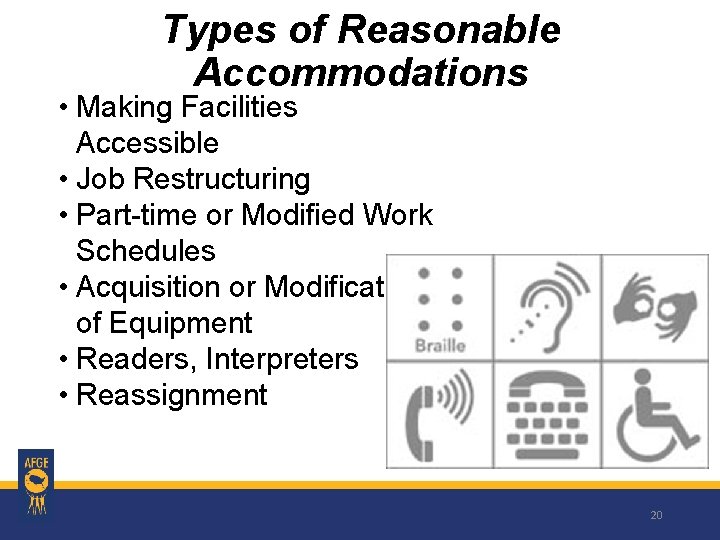
Types of Reasonable Accommodations • Making Facilities Accessible • Job Restructuring • Part-time or Modified Work Schedules • Acquisition or Modification of Equipment • Readers, Interpreters • Reassignment 20

Burdens of Proof AMERICAN FEDERATION OF GOVERNMENT EMPLOYEES, AFL - CIO
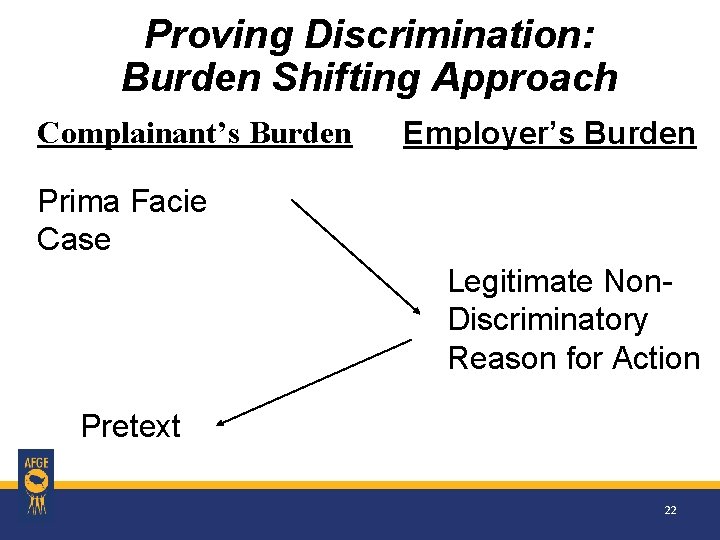
Proving Discrimination: Burden Shifting Approach Complainant’s Burden Employer’s Burden Prima Facie Case Legitimate Non. Discriminatory Reason for Action Pretext 22
Agency’s Legitimate Non. Discriminatory Reason (LDNR) • The agency must • (a) allege a reason that does not involve discrimination based on a protected class • (b) it must be a legitimate reason • (c) it’s your job to prove that this reason is nothing more than “pretext” otherwise known as a lie. 23
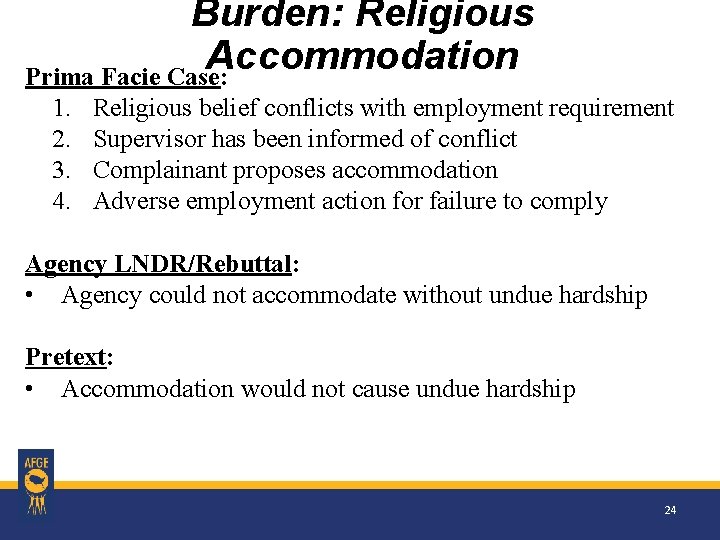
Burden: Religious Accommodation Prima Facie Case: 1. 2. 3. 4. Religious belief conflicts with employment requirement Supervisor has been informed of conflict Complainant proposes accommodation Adverse employment action for failure to comply Agency LNDR/Rebuttal: • Agency could not accommodate without undue hardship Pretext: • Accommodation would not cause undue hardship 24
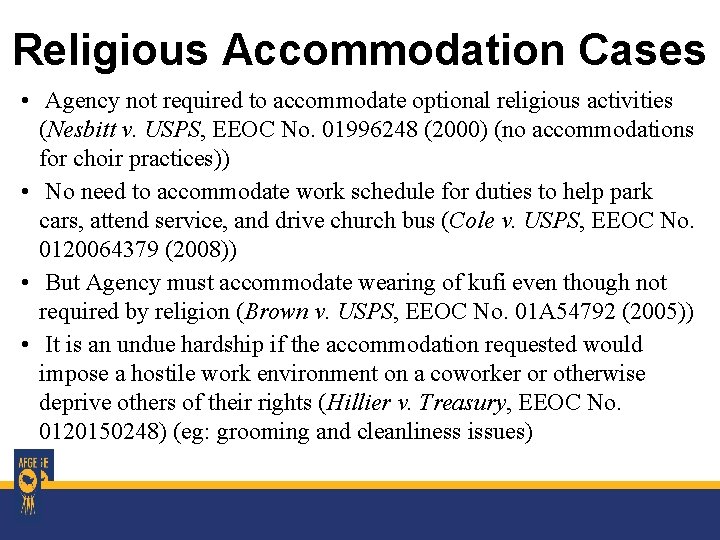
Religious Accommodation Cases • Agency not required to accommodate optional religious activities (Nesbitt v. USPS, EEOC No. 01996248 (2000) (no accommodations for choir practices)) • No need to accommodate work schedule for duties to help park cars, attend service, and drive church bus (Cole v. USPS, EEOC No. 0120064379 (2008)) • But Agency must accommodate wearing of kufi even though not required by religion (Brown v. USPS, EEOC No. 01 A 54792 (2005)) • It is an undue hardship if the accommodation requested would impose a hostile work environment on a coworker or otherwise deprive others of their rights (Hillier v. Treasury, EEOC No. 0120150248) (eg: grooming and cleanliness issues)
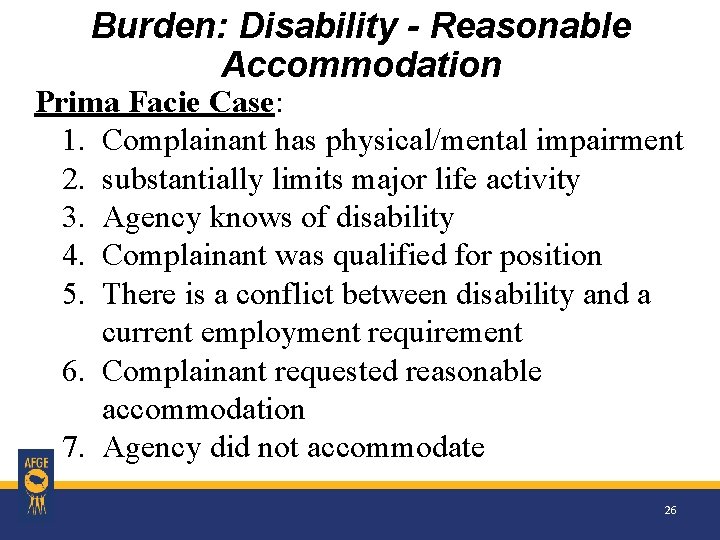
Burden: Disability - Reasonable Accommodation Prima Facie Case: 1. Complainant has physical/mental impairment 2. substantially limits major life activity 3. Agency knows of disability 4. Complainant was qualified for position 5. There is a conflict between disability and a current employment requirement 6. Complainant requested reasonable accommodation 7. Agency did not accommodate 26
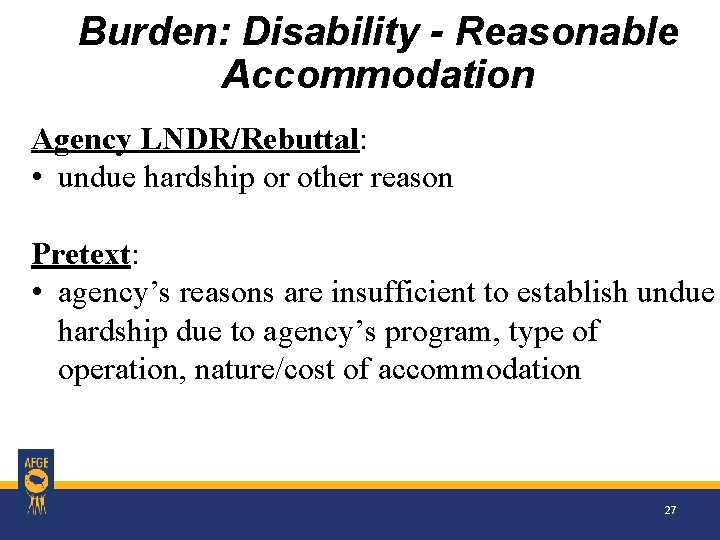
Burden: Disability - Reasonable Accommodation Agency LNDR/Rebuttal: • undue hardship or other reason Pretext: • agency’s reasons are insufficient to establish undue hardship due to agency’s program, type of operation, nature/cost of accommodation 27
Reasonable Accommodations • Agency does not deny accommodation when it requires employee to use accrued leave before granting LWOP (Lynette v. Do. J, EEOC No. 0720140010 (2015)) • Agency did not deny accommodation when it offered complainant liberal leave for medical treatment but denied her request to transfer to facility closer to her medical providers (Complainant v. SSA, EEOC No. 0120123279 (2015)) • Leave as a reasonable accommodation must be allowed when there are no other effective accommodations and the leave will not impose an undue hardship (Price v. Do. D, EEOC No. 03 A 10002 (2002)) • Advanced sick leave need not be granted unless offered to similarly situated individuals and there is a reasonable assurance employee will return to duty and pay back the leave (Mapes v. USPS, EEOC No. 0120090678 (2010))
“Accommodation of Last Resort” When a complainant will only agree to a specific accommodation that would be particularly costly to the Agency (i. e. , an “accommodation of last resort”) the interactive process is used to determine “that there are no other accommodations that would enable the complainant to perform the essential function of his position without imposing an undue hardship on the Agency. ” Example: • When unable to perform essential functions of position due to disability • Complainant could be moved to a vacant, funded position within same commuting area • Unless reassignment would impose an undue hardship 29
Telework as an Accommodation • In order to be entitled to telework, employee must show that working outside home would violate medical restrictions and that the job can be done outside the workplace (Genmill v. Do. T, EEOC No. 0120072201 (2009)) • Telework can be accomplished for part of the day (Petzer v. Do. D, EEOC No. 01 A 50812 (2006) (employee worked 4 hours/day at home and 4 hours at office) • Employee not entitled to telework if agency provides effective alternative accommodation (Dennis v. Dept. of Education, EEOC No. 0120090193 (2010)) • Agency may deny telework where employee has history of poor performance with direct supervision (Yeargins v. HUD, EEOC No. 03210100021 (2010)) • Although Agency may have to alter telework policies as accommodation, it does not have to do so where employee hasn’t yet demonstrated ability to work independently (Dahlman v. CPSC, EEOC No. 0120073190 (2010))
“Direct Threat” • If an individual poses a significant risk of substantial harm to health or safety for themselves or others they are considered a direct threat • Cannot be reduced or eliminated by “reasonable accommodation” 31

32

Questions? 33
- Slides: 33