
Reason Argument Lecture 4 Lecture Synopsis 1 Meaning
![(3) Equivocation Reconstruction [P 1] People desire happiness. [P 2] Whatever is desired is](https://slidetodoc.com/presentation_image/2abb0139355c1b66d020f239aaee1f92/image-26.jpg "(3) Equivocation Reconstruction [P 1] People desire happiness. [P 2] Whatever is desired is")
![(3) Equivocation The Problem ‘Desirable’ has two meanings. In [P 2], ‘desirable’ means ‘can](https://slidetodoc.com/presentation_image/2abb0139355c1b66d020f239aaee1f92/image-27.jpg "(3) Equivocation The Problem ‘Desirable’ has two meanings. In [P 2], ‘desirable’ means ‘can")
- Slides: 28
Reason & Argument Lecture 4
Lecture Synopsis 1. Meaning & Reference 2. Vagueness & Ambiguity 3. Equivocation
Recap: Weeks 1 -3 Technical Terms: Arguments, Premises, Conclusions, Induction, Validity, Soundness, Counter-examples. Techniques: Clarifying the structure of an argument (filling in implicit premises & (sub-)conclusions, eliminating extraneous info) Criticising an argument: using counter-examples and recognising syllogisms/fallacies
(1) Recap: should arguments Arguing for a ‘should’ conclusion. Key elements: Success Condition (SC) Optimal Means Condition (OMC) Ends-Justify-Means Condition (EJM)
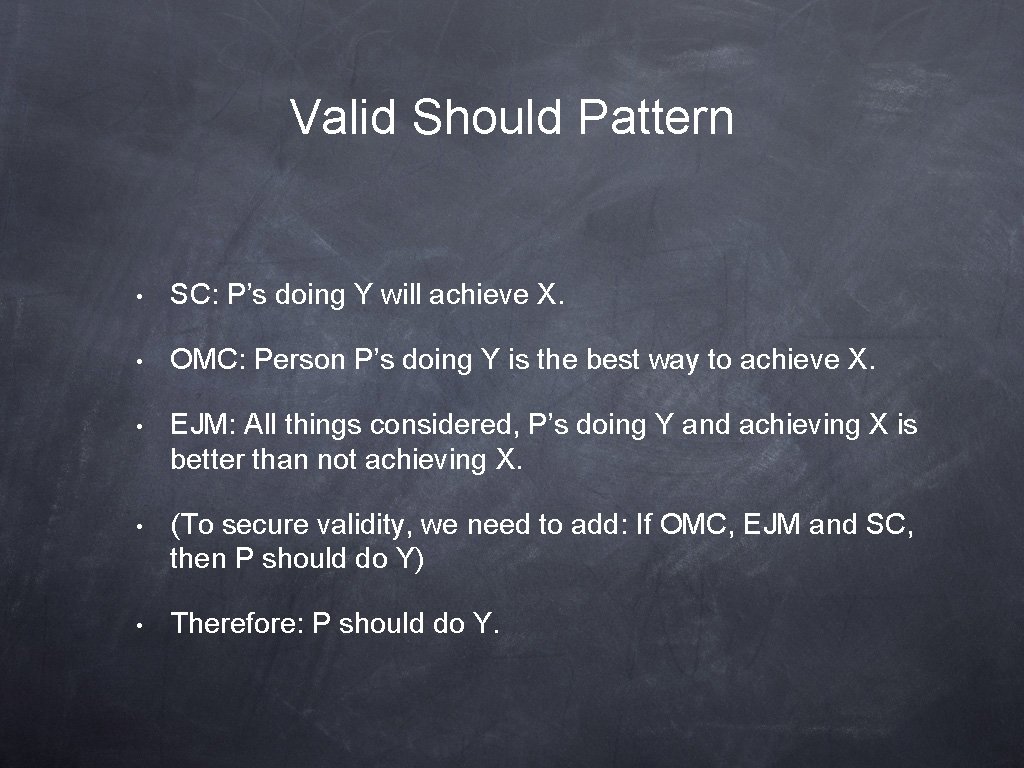
Valid Should Pattern • SC: P’s doing Y will achieve X. • OMC: Person P’s doing Y is the best way to achieve X. • EJM: All things considered, P’s doing Y and achieving X is better than not achieving X. • (To secure validity, we need to add: If OMC, EJM and SC, then P should do Y) • Therefore: P should do Y.
Today’s Theme Language Vital for communication & formation of ideas reasons & arguments. But: language is tricky! It can be vague and ambiguous: we have to interpret the language people use. In doing so, it helps to understand its intricacies!
(1) Meaning & Reference The Meaning of Meaning: a notoriously difficult and treacherous philosophical problem. What we can say: Meaning must be (in some sense) fixed. Reference: what a word refers to. This can change depending on the context in which the word is used. Reference is (in some sense) variable.
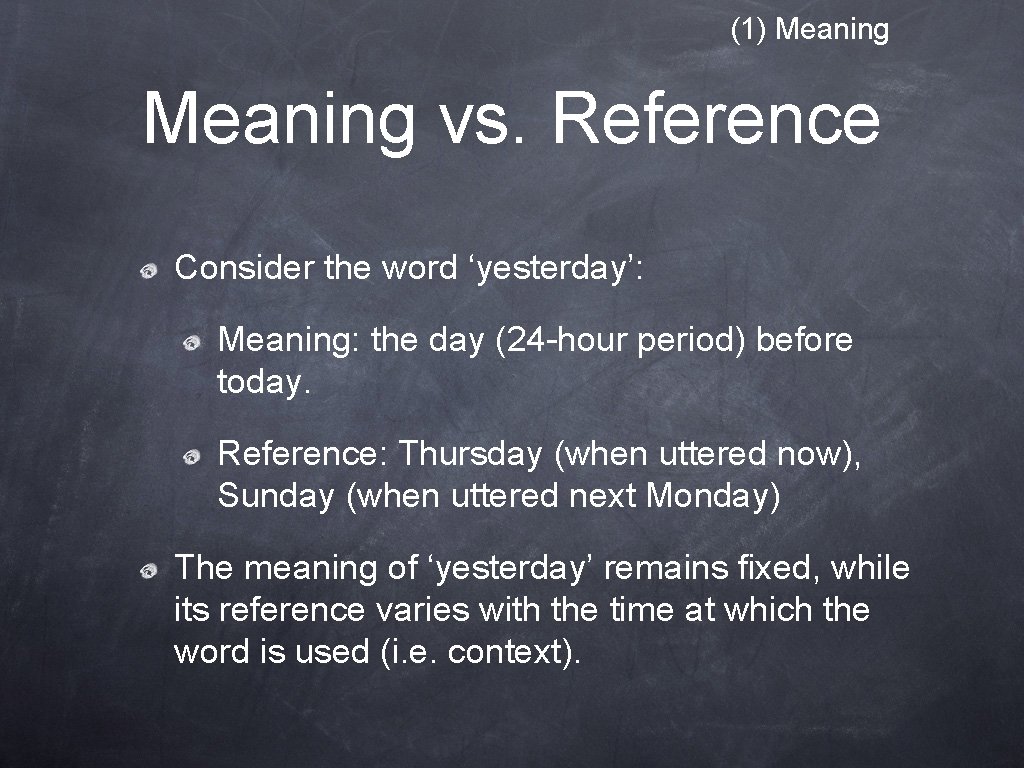
(1) Meaning vs. Reference Consider the word ‘yesterday’: Meaning: the day (24 -hour period) before today. Reference: Thursday (when uttered now), Sunday (when uttered next Monday) The meaning of ‘yesterday’ remains fixed, while its reference varies with the time at which the word is used (i. e. context).
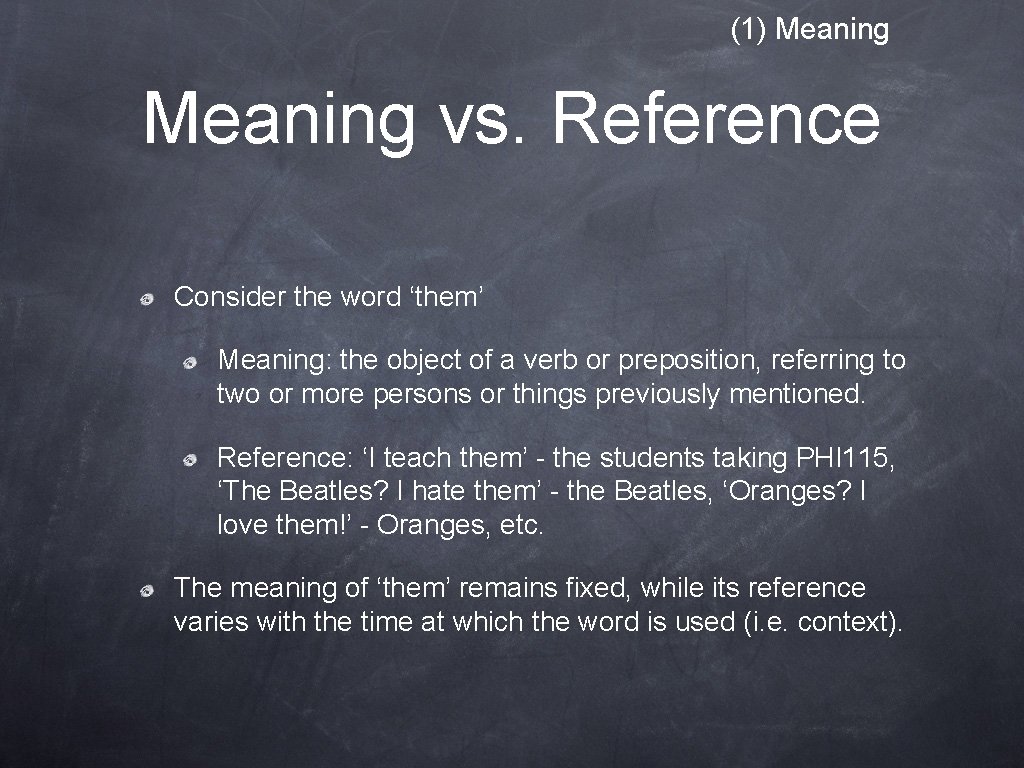
(1) Meaning vs. Reference Consider the word ‘them’ Meaning: the object of a verb or preposition, referring to two or more persons or things previously mentioned. Reference: ‘I teach them’ - the students taking PHI 115, ‘The Beatles? I hate them’ - the Beatles, ‘Oranges? I love them!’ - Oranges, etc. The meaning of ‘them’ remains fixed, while its reference varies with the time at which the word is used (i. e. context).
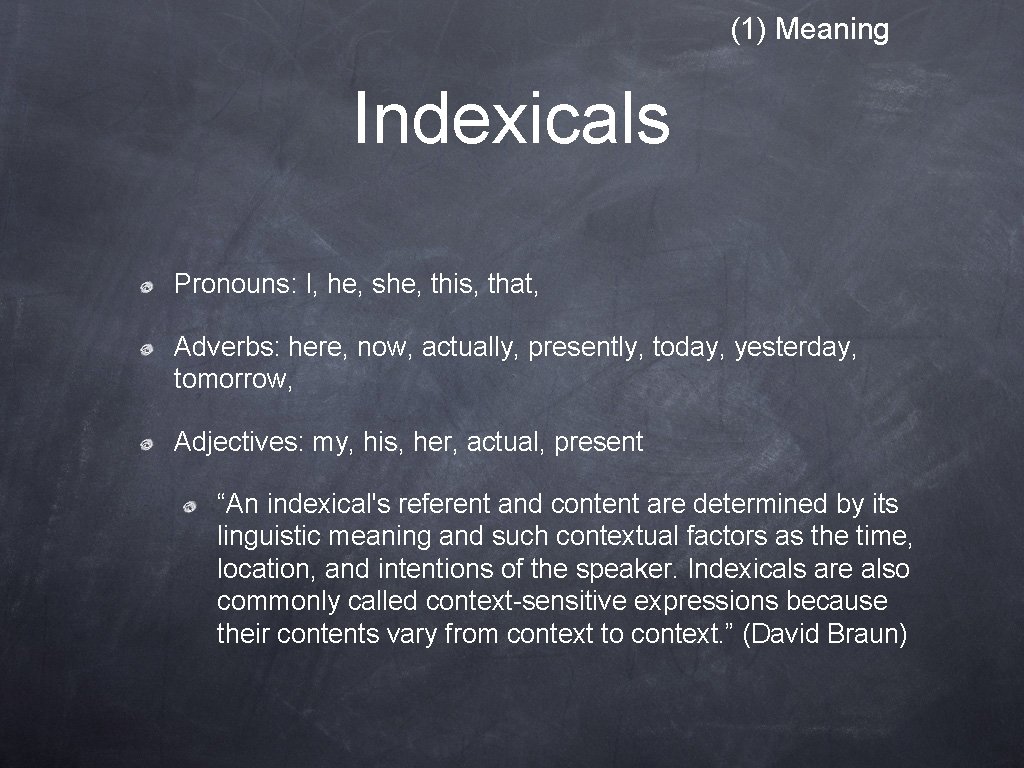
(1) Meaning Indexicals Pronouns: I, he, she, this, that, Adverbs: here, now, actually, presently, today, yesterday, tomorrow, Adjectives: my, his, her, actual, present “An indexical's referent and content are determined by its linguistic meaning and such contextual factors as the time, location, and intentions of the speaker. Indexicals are also commonly called context-sensitive expressions because their contents vary from context to context. ” (David Braun)
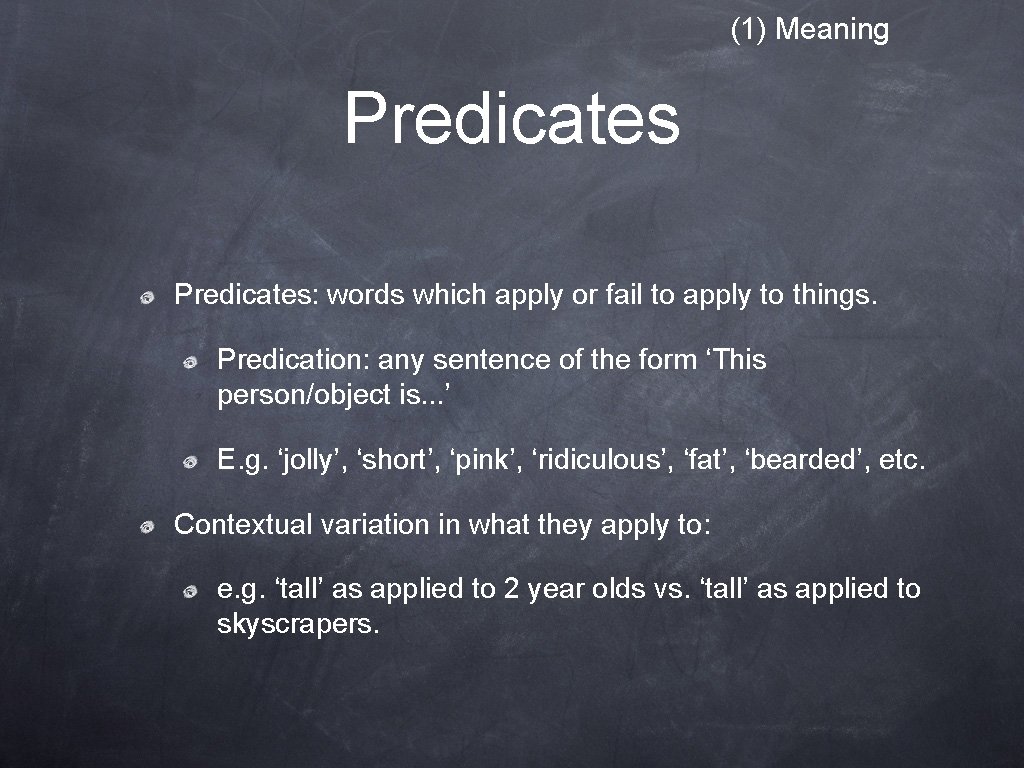
(1) Meaning Predicates: words which apply or fail to apply to things. Predication: any sentence of the form ‘This person/object is. . . ’ E. g. ‘jolly’, ‘short’, ‘pink’, ‘ridiculous’, ‘fat’, ‘bearded’, etc. Contextual variation in what they apply to: e. g. ‘tall’ as applied to 2 year olds vs. ‘tall’ as applied to skyscrapers.
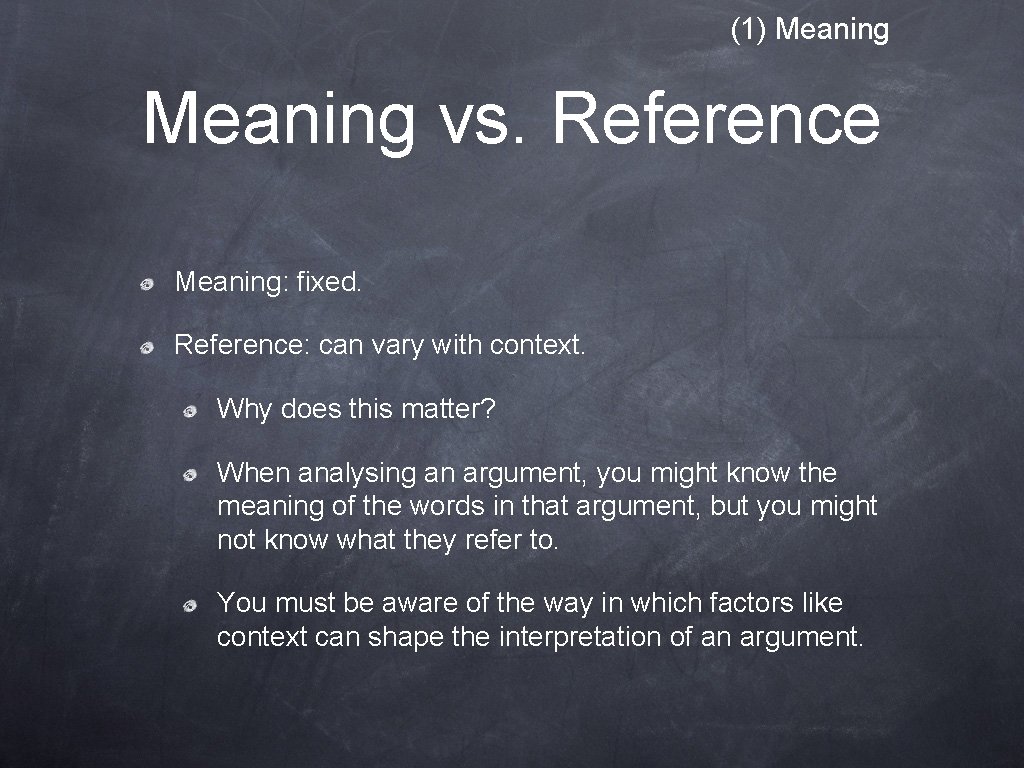
(1) Meaning vs. Reference Meaning: fixed. Reference: can vary with context. Why does this matter? When analysing an argument, you might know the meaning of the words in that argument, but you might not know what they refer to. You must be aware of the way in which factors like context can shape the interpretation of an argument.
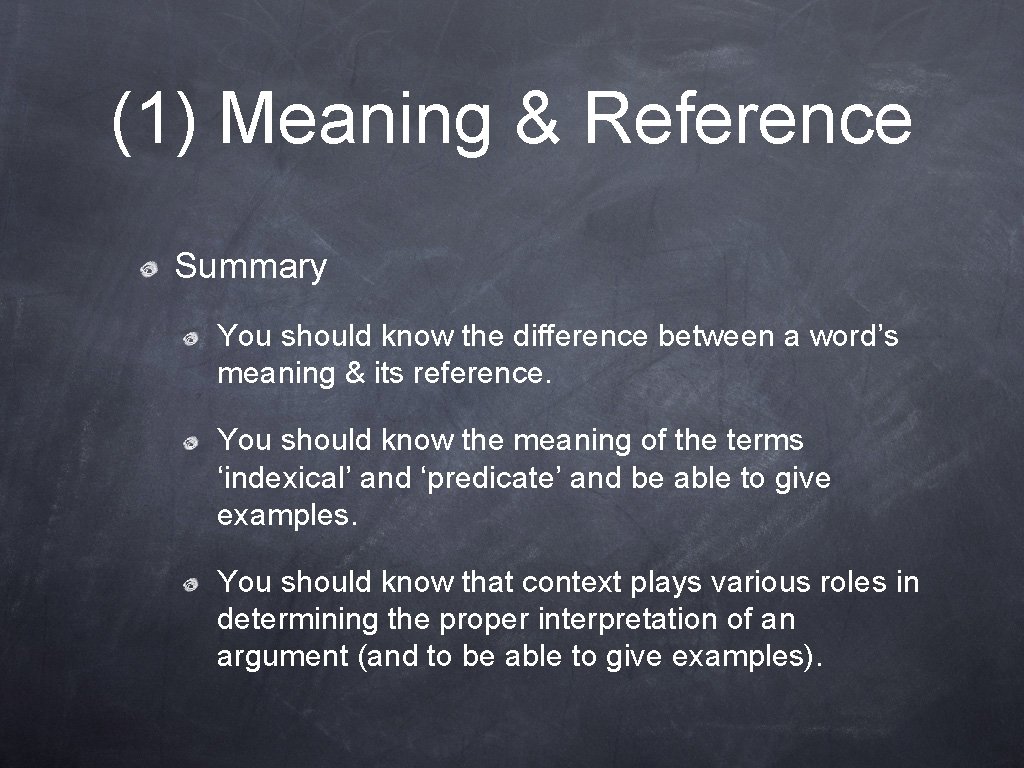
(1) Meaning & Reference Summary You should know the difference between a word’s meaning & its reference. You should know the meaning of the terms ‘indexical’ and ‘predicate’ and be able to give examples. You should know that context plays various roles in determining the proper interpretation of an argument (and to be able to give examples).
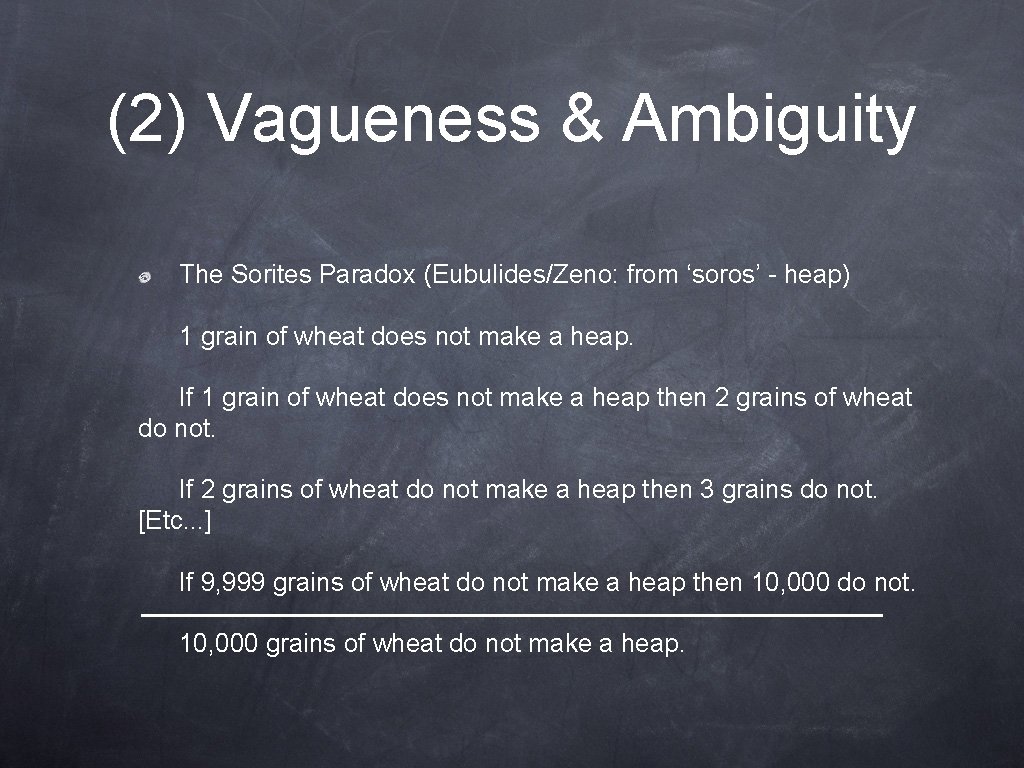
(2) Vagueness & Ambiguity The Sorites Paradox (Eubulides/Zeno: from ‘soros’ - heap) 1 grain of wheat does not make a heap. If 1 grain of wheat does not make a heap then 2 grains of wheat do not. If 2 grains of wheat do not make a heap then 3 grains do not. [Etc. . . ] If 9, 999 grains of wheat do not make a heap then 10, 000 do not. 10, 000 grains of wheat do not make a heap.
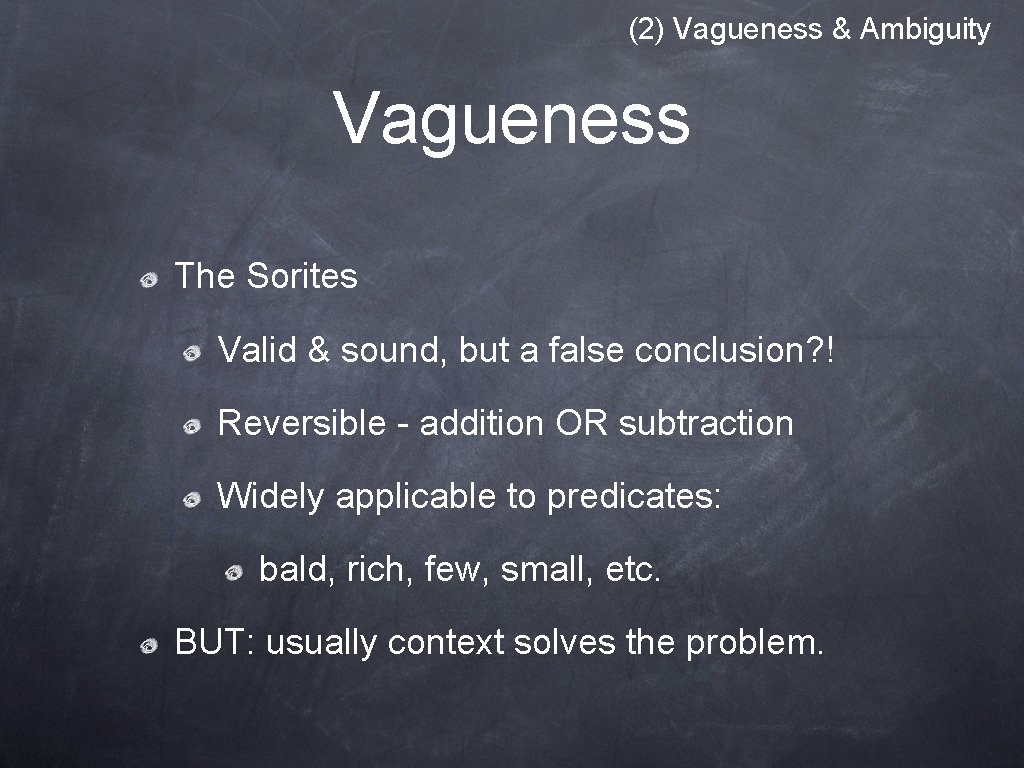
(2) Vagueness & Ambiguity Vagueness The Sorites Valid & sound, but a false conclusion? ! Reversible - addition OR subtraction Widely applicable to predicates: bald, rich, few, small, etc. BUT: usually context solves the problem.
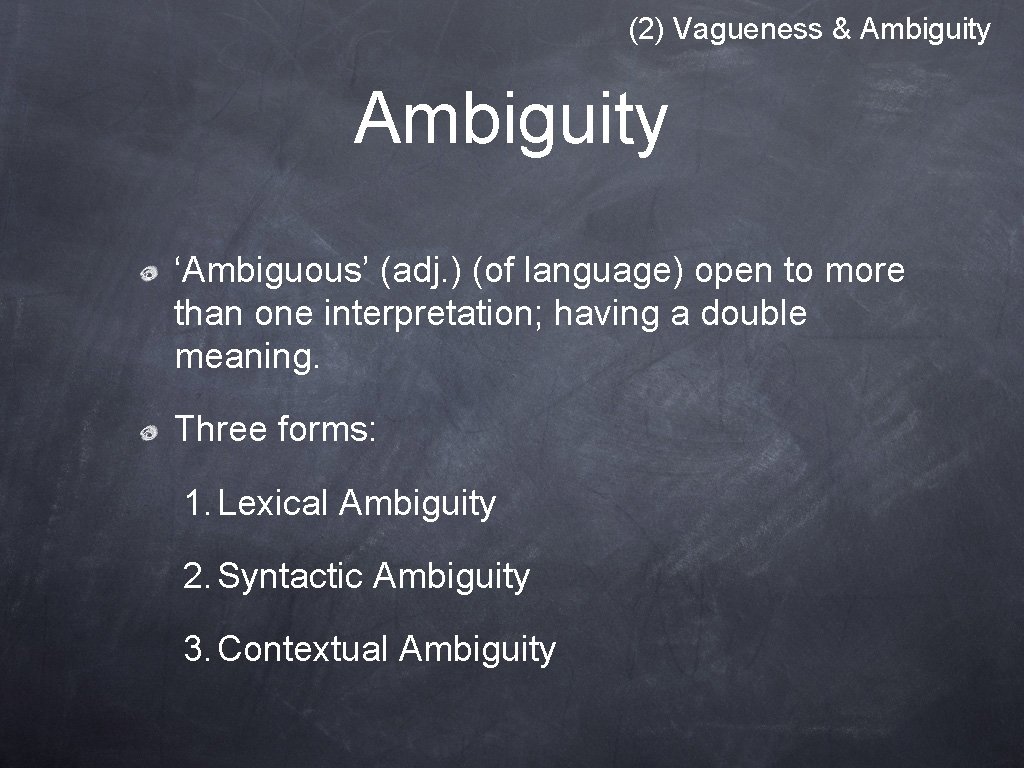
(2) Vagueness & Ambiguity ‘Ambiguous’ (adj. ) (of language) open to more than one interpretation; having a double meaning. Three forms: 1. Lexical Ambiguity 2. Syntactic Ambiguity 3. Contextual Ambiguity
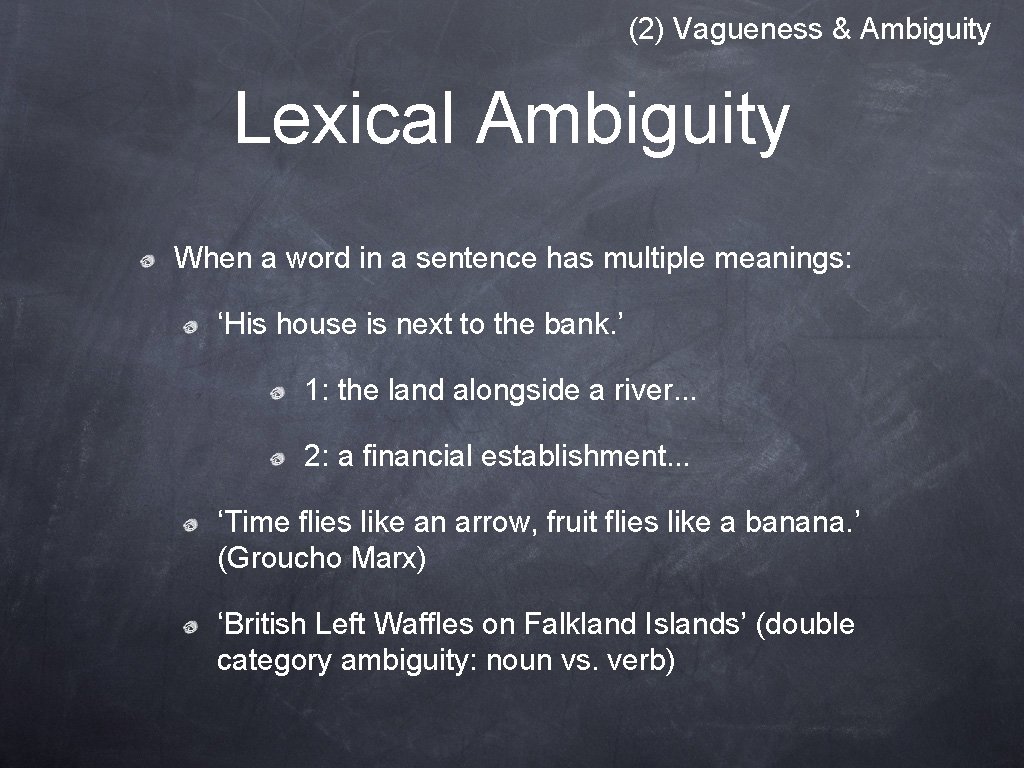
(2) Vagueness & Ambiguity Lexical Ambiguity When a word in a sentence has multiple meanings: ‘His house is next to the bank. ’ 1: the land alongside a river. . . 2: a financial establishment. . . ‘Time flies like an arrow, fruit flies like a banana. ’ (Groucho Marx) ‘British Left Waffles on Falkland Islands’ (double category ambiguity: noun vs. verb)
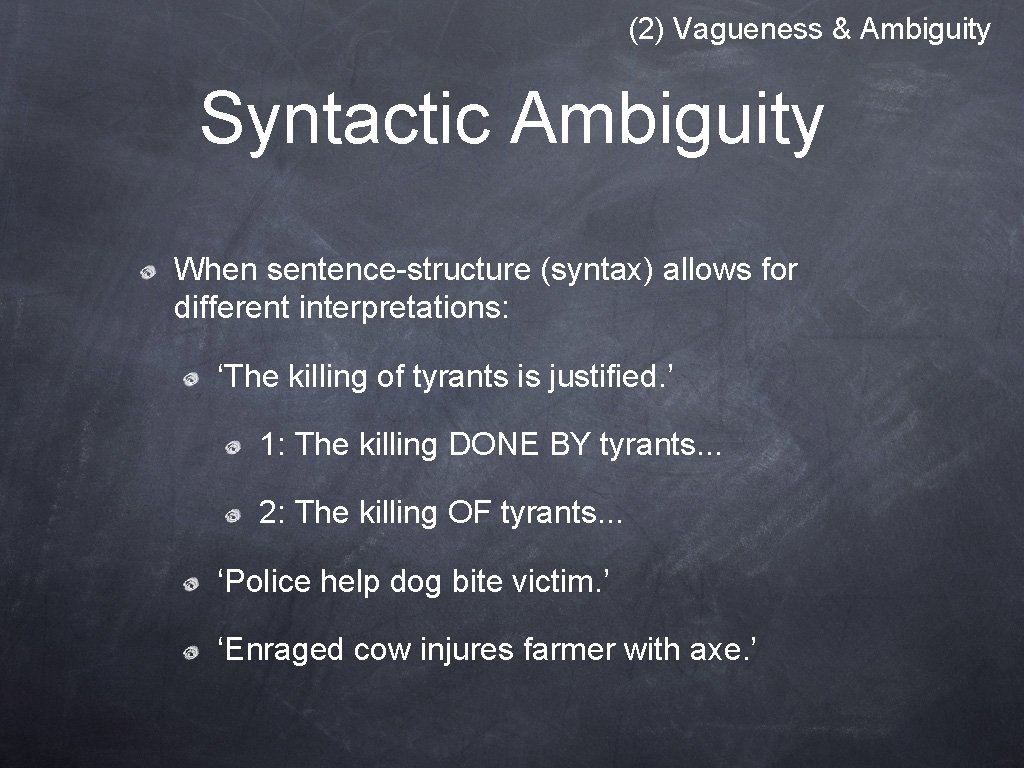
(2) Vagueness & Ambiguity Syntactic Ambiguity When sentence-structure (syntax) allows for different interpretations: ‘The killing of tyrants is justified. ’ 1: The killing DONE BY tyrants. . . 2: The killing OF tyrants. . . ‘Police help dog bite victim. ’ ‘Enraged cow injures farmer with axe. ’
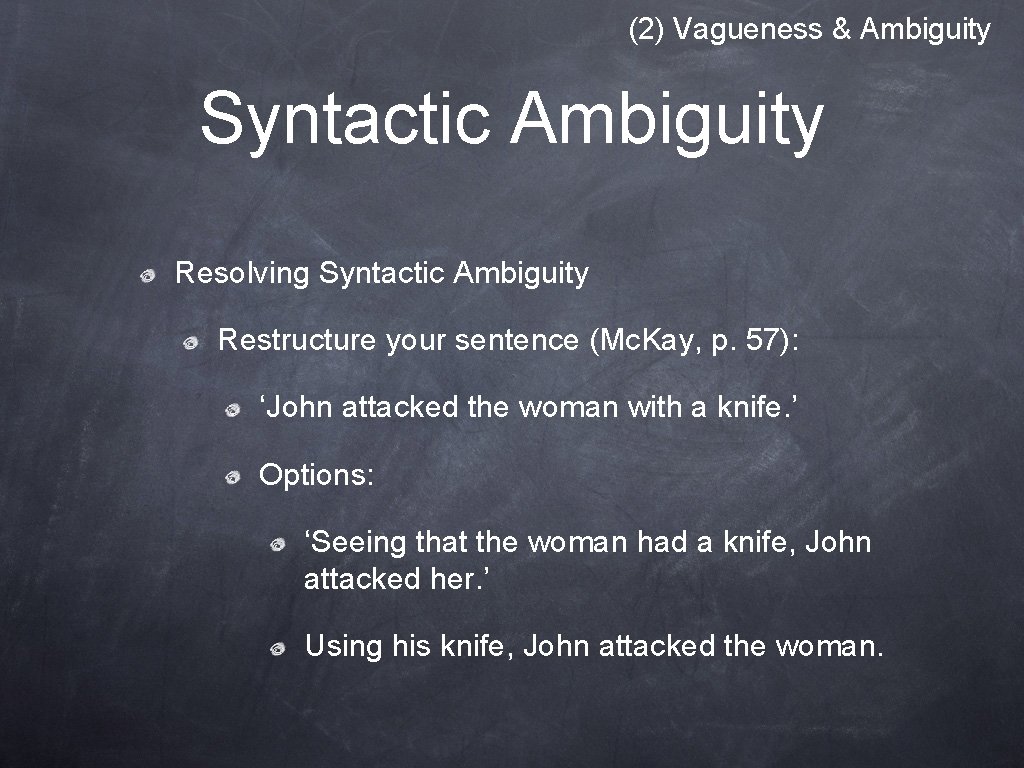
(2) Vagueness & Ambiguity Syntactic Ambiguity Resolving Syntactic Ambiguity Restructure your sentence (Mc. Kay, p. 57): ‘John attacked the woman with a knife. ’ Options: ‘Seeing that the woman had a knife, John attacked her. ’ Using his knife, John attacked the woman.
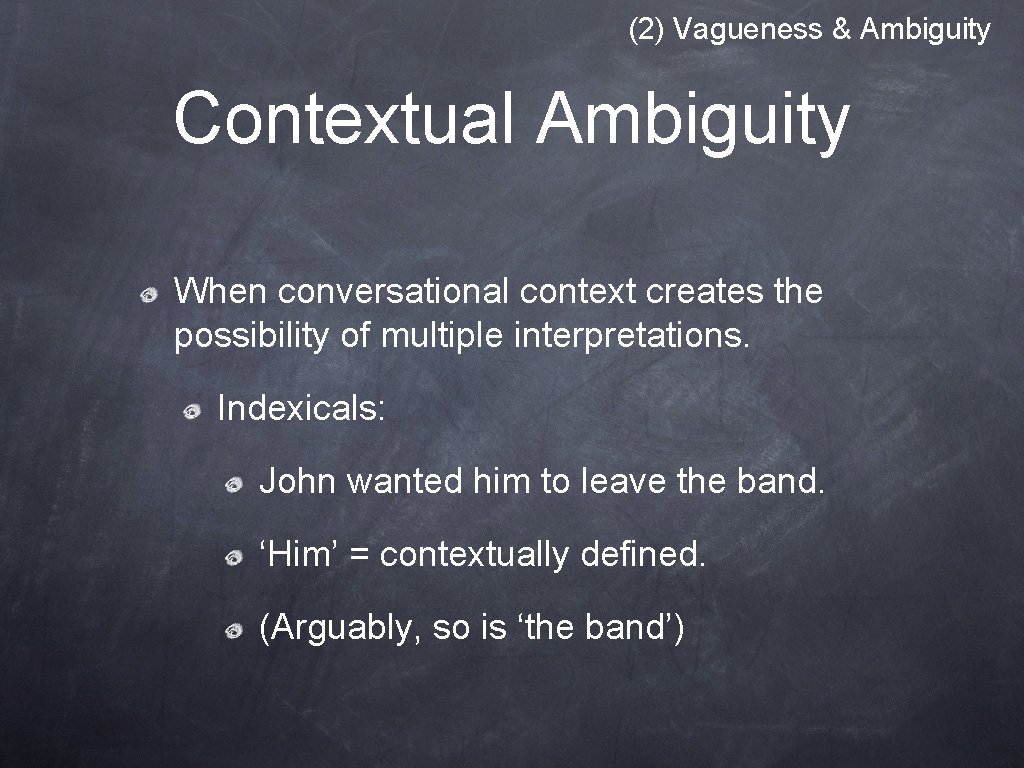
(2) Vagueness & Ambiguity Contextual Ambiguity When conversational context creates the possibility of multiple interpretations. Indexicals: John wanted him to leave the band. ‘Him’ = contextually defined. (Arguably, so is ‘the band’)
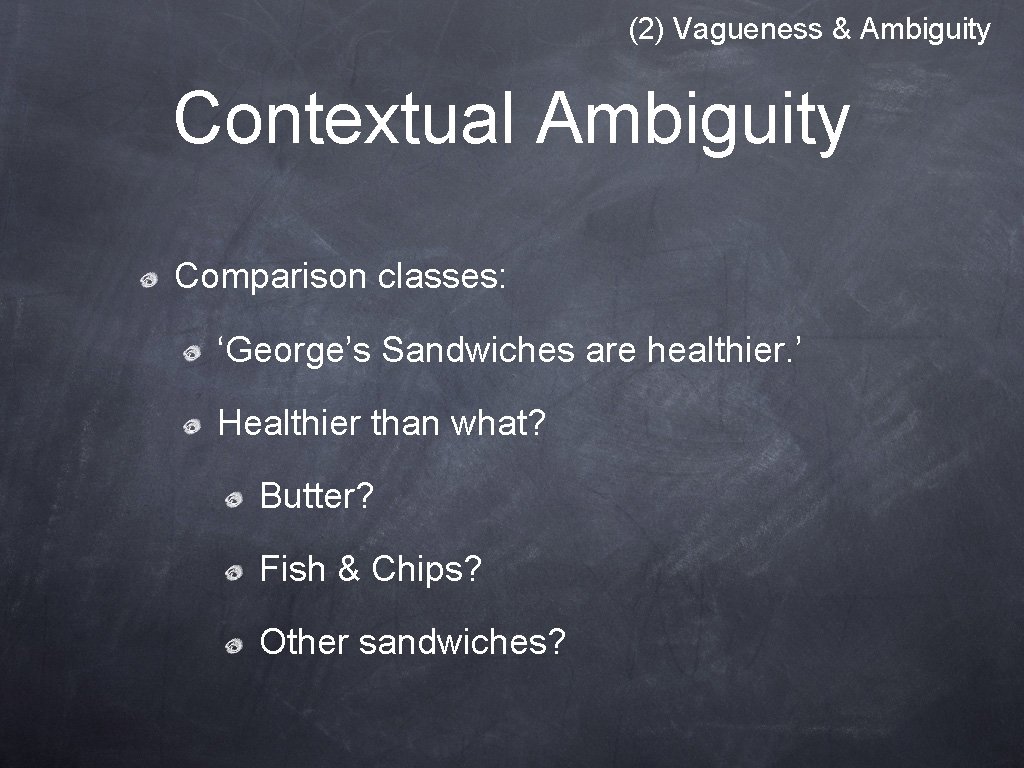
(2) Vagueness & Ambiguity Contextual Ambiguity Comparison classes: ‘George’s Sandwiches are healthier. ’ Healthier than what? Butter? Fish & Chips? Other sandwiches?
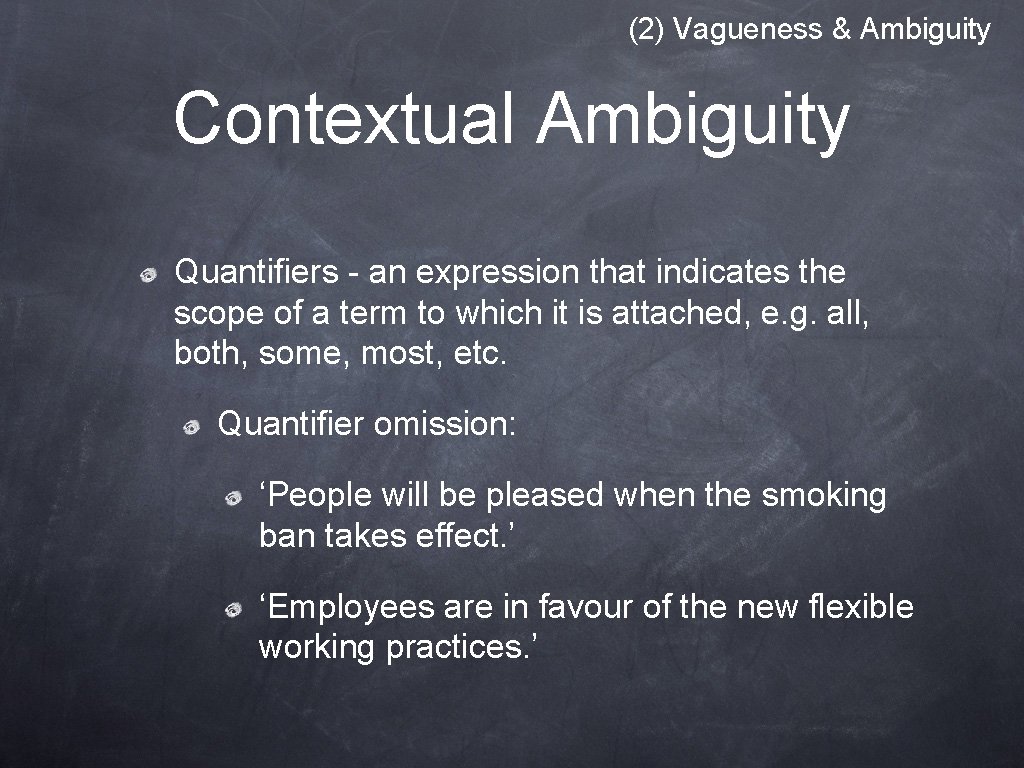
(2) Vagueness & Ambiguity Contextual Ambiguity Quantifiers - an expression that indicates the scope of a term to which it is attached, e. g. all, both, some, most, etc. Quantifier omission: ‘People will be pleased when the smoking ban takes effect. ’ ‘Employees are in favour of the new flexible working practices. ’
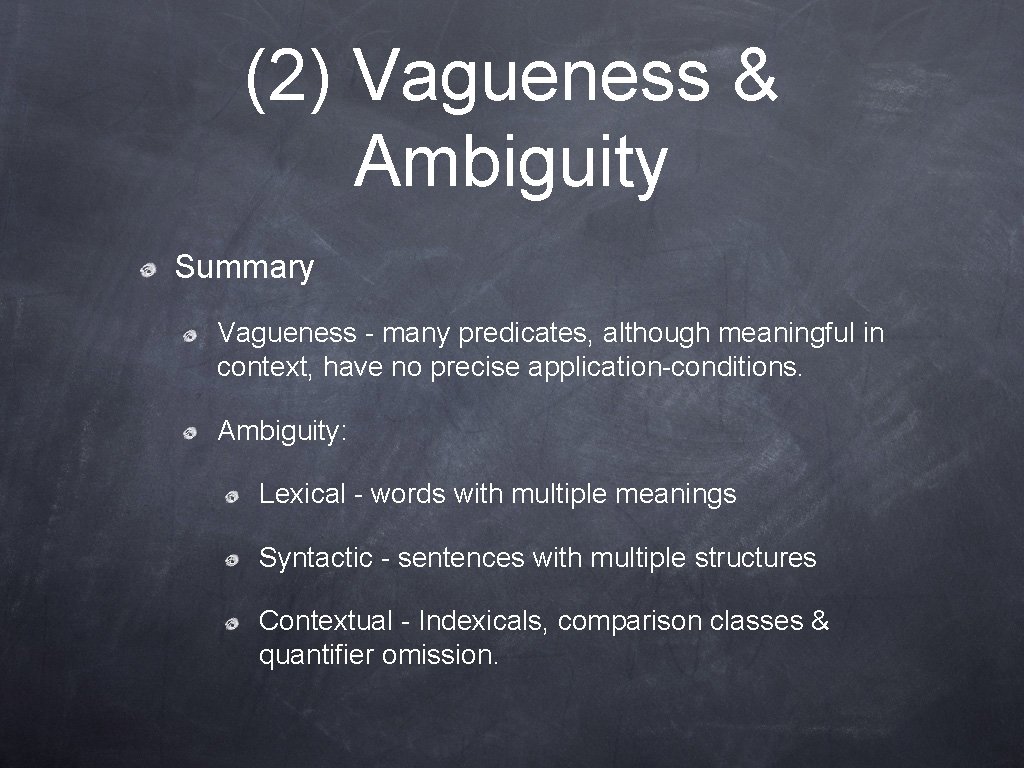
(2) Vagueness & Ambiguity Summary Vagueness - many predicates, although meaningful in context, have no precise application-conditions. Ambiguity: Lexical - words with multiple meanings Syntactic - sentences with multiple structures Contextual - Indexicals, comparison classes & quantifier omission.
(3) Equivocation Ambiguity creates equivocation: the use of ambiguous language to conceal the truth or to avoid committing oneself. Equivocation can undermine validity. i. e. it amounts to a fallacy.
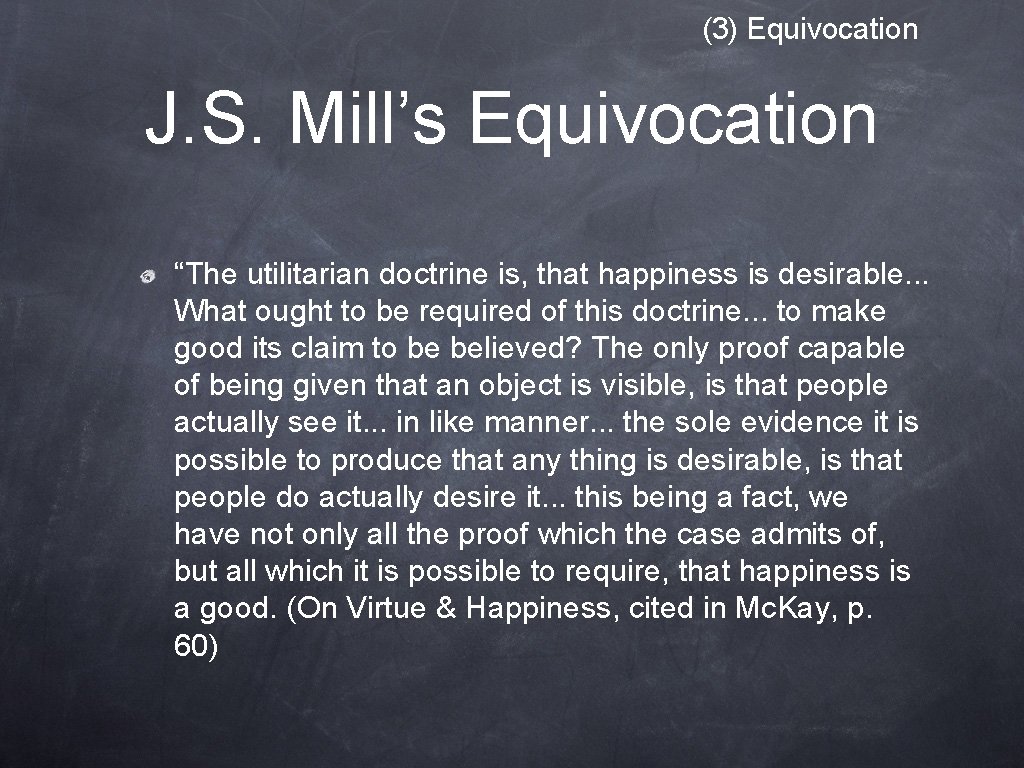
(3) Equivocation J. S. Mill’s Equivocation “The utilitarian doctrine is, that happiness is desirable. . . What ought to be required of this doctrine. . . to make good its claim to be believed? The only proof capable of being given that an object is visible, is that people actually see it. . . in like manner. . . the sole evidence it is possible to produce that any thing is desirable, is that people do actually desire it. . . this being a fact, we have not only all the proof which the case admits of, but all which it is possible to require, that happiness is a good. (On Virtue & Happiness, cited in Mc. Kay, p. 60)
(3) Equivocation Reconstruction [P 1] People desire happiness. [P 2] Whatever is desired is desirable. therefore, [C 1] Happiness is desirable. [P 3] Whatever is desirable is a good. (unstated) [C 1] Happiness is desirable. therefore, [C 2] Happiness is a good.
(3) Equivocation The Problem ‘Desirable’ has two meanings. In [P 2], ‘desirable’ means ‘can be desired’ (just like ‘visible’ means ‘can be seen’) Mill uses [P 2] to get [C 1] In [P 3], ‘desirable’ means ‘worthy of being desired’. But Mill uses [C 1] again to get [C 2]. Note the (clearly false) substitution of first meaning into [P 2]: [P 2] Whatever is desired is worthy of being desired.
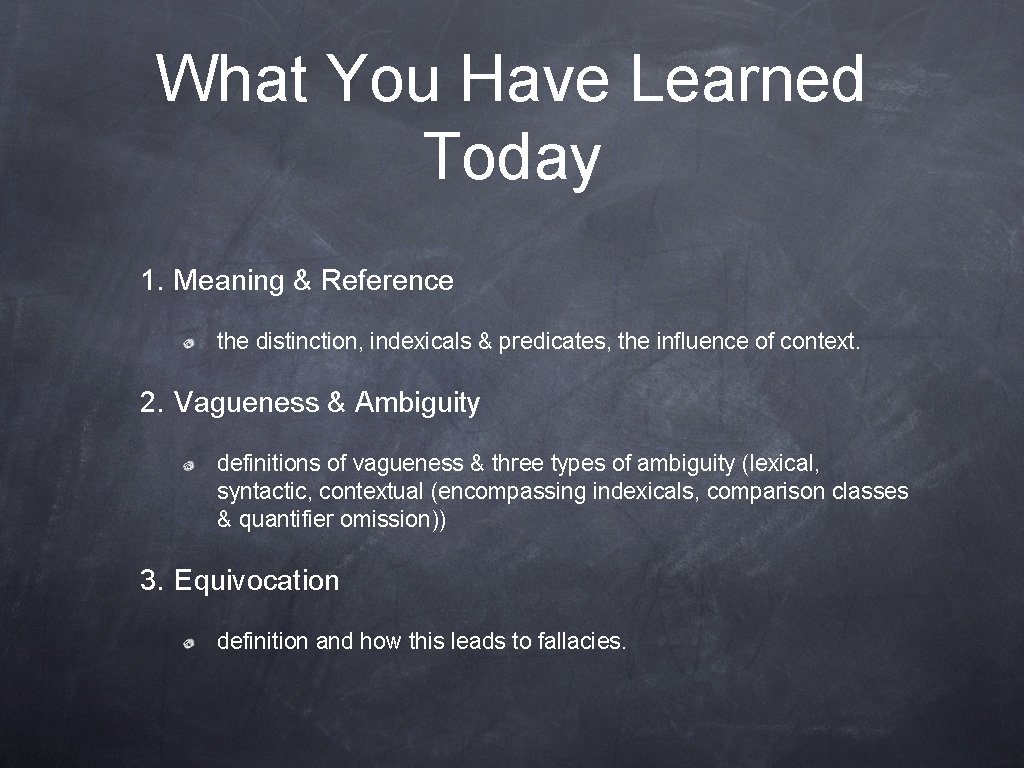
What You Have Learned Today 1. Meaning & Reference the distinction, indexicals & predicates, the influence of context. 2. Vagueness & Ambiguity definitions of vagueness & three types of ambiguity (lexical, syntactic, contextual (encompassing indexicals, comparison classes & quantifier omission)) 3. Equivocation definition and how this leads to fallacies.