
Realtime Video Streaming from Mobile Underwater Sensors Seongwon
Real-time Video Streaming from Mobile Underwater Sensors Seongwon Han (UCLA) Roy Chen (UCLA) Youngtae Noh (Cisco Systems Inc. ) Mario Gerla (UCLA) 1
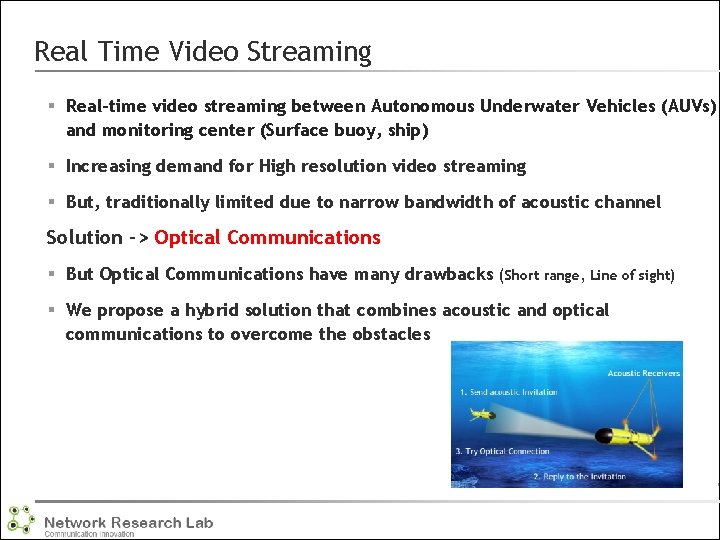
Real Time Video Streaming § Real-time video streaming between Autonomous Underwater Vehicles (AUVs) and monitoring center (Surface buoy, ship) § Increasing demand for High resolution video streaming § But, traditionally limited due to narrow bandwidth of acoustic channel Solution -> Optical Communications § But Optical Communications have many drawbacks (Short range, Line of sight) § We propose a hybrid solution that combines acoustic and optical communications to overcome the obstacles
Underwater Media Review § Cable tether § Impose a constraint on AUV’s mobility § Nearly impossible to wire multiple AUVs (cables will be tangled) § Acoustic wave § Low Data rate, long propagation delay, high error rate, multi-path effect, consumes a lot of energy especially for sending data § Optical LED § Requires alignment for communication (Light emitter & receiver) § Short Communication range: 10 to 100 m § Affected by water “purity” § Megabit/s data rates
Related Works There are many efforts to realize real-time video streaming or at least doing similar thing. § Transferring a low resolution still gray scale image via acoustic links Problem : it’s far from the real-time monitoring, transferring continuum of images is still a lot of burden for low bandwidth acoustic channel § Image enhancing techniques to get relatively high quality image with low data size Problem : Still itself cannot achieve our goal § High bandwidth real-time video transfer within short distance (~ 20 m) Problem : communication distance is too short
Solution : Hybrid protocol of Acoustics and Optics § Our goal is to provide real-time video monitoring between AUVs at all times Even if no optical link is available § Via Acoustics We focus on image processing technique to produce the image which is at least 90% smaller than low resolution gray scale image In this way, we can expect at most 3 – 5 frame rate per second (good enough for real-time video monitoring) Low resolution gray scale image is also transferred via Acoustic channel (either pre-defined interval say every 10 sec or specific image which is requested by user) Control message is always transmitted via acoustic links § Via Optical links High definition video is always transmitted via Optical links Control messages such as ACKs are transmitted via acoustic links
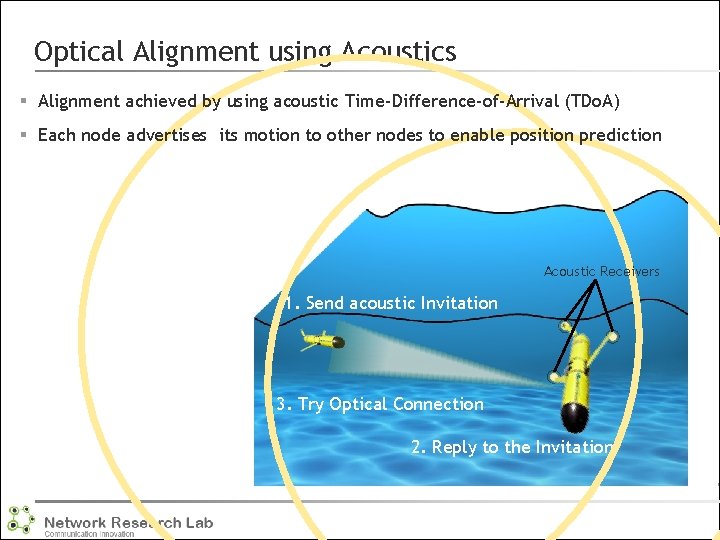
Optical Alignment using Acoustics § Alignment achieved by using acoustic Time-Difference-of-Arrival (TDo. A) § Each node advertises its motion to other nodes to enable position prediction Acoustic Receivers 1. Send acoustic Invitation 3. Try Optical Connection 2. Reply to the Invitation
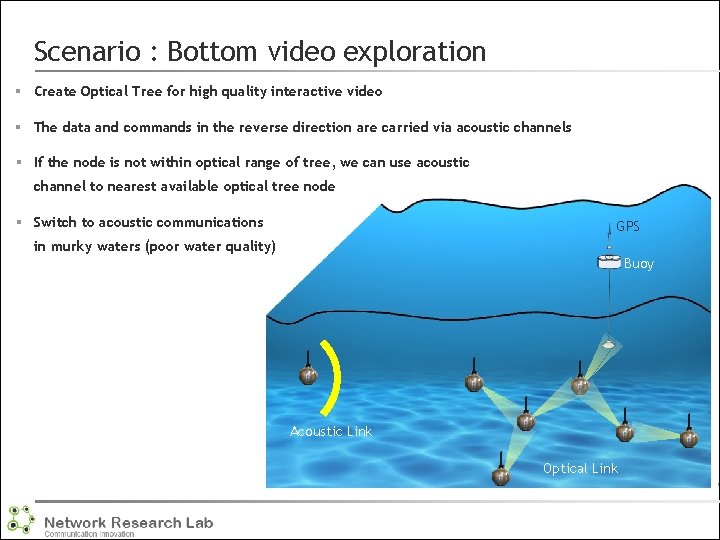
Scenario : Bottom video exploration § Create Optical Tree for high quality interactive video § The data and commands in the reverse direction are carried via acoustic channels § If the node is not within optical range of tree, we can use acoustic channel to nearest available optical tree node § Switch to acoustic communications GPS in murky waters (poor water quality) Buoy Acoustic Link Optical Link
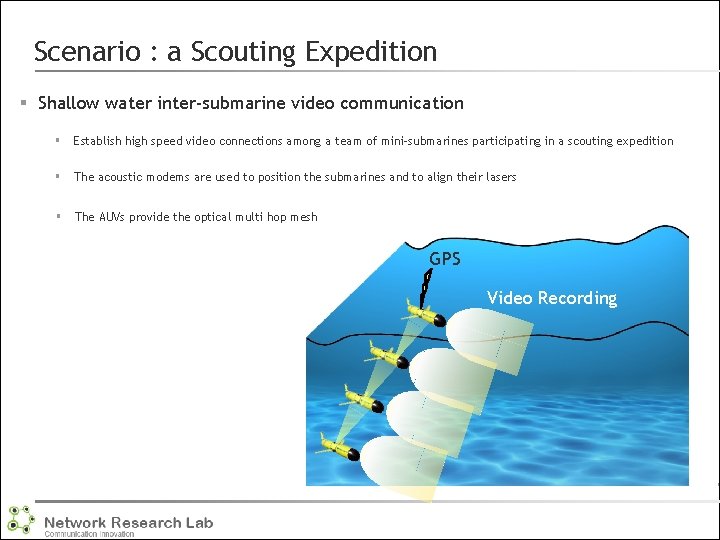
Scenario : a Scouting Expedition § Shallow water inter-submarine video communication § Establish high speed video connections among a team of mini-submarines participating in a scouting expedition § The acoustic modems are used to position the submarines and to align their lasers § The AUVs provide the optical multi hop mesh GPS Video Recording
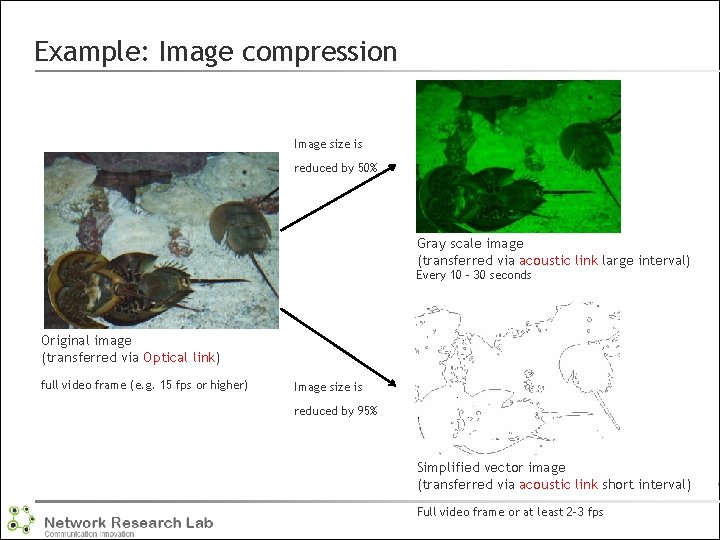
Example: Image compression Image size is reduced by 50% Gray scale image (transferred via acoustic link large interval) Every 10 - 30 seconds Original image (transferred via Optical link) full video frame (e. g. 15 fps or higher) Image size is reduced by 95% Simplified vector image (transferred via acoustic link short interval) Full video frame or at least 2 -3 fps
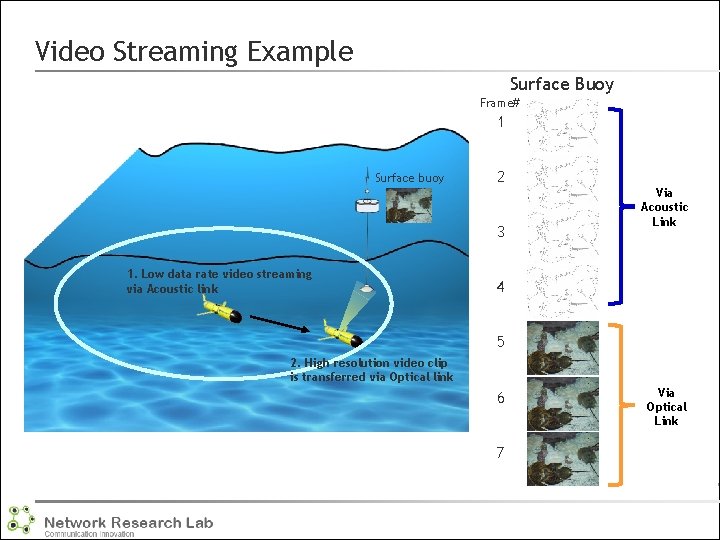
Video Streaming Example Surface Buoy Frame# 1 Surface buoy 2 3 1. Low data rate video streaming via Acoustic link Via Acoustic Link 4 5 2. High resolution video clip is transferred via Optical link 6 7 Via Optical Link
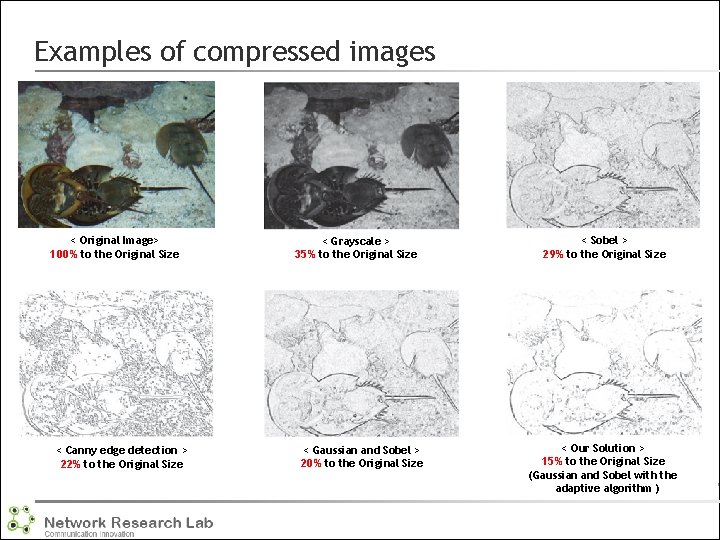
Examples of compressed images < Original Image> 100% to the Original Size < Canny edge detection > 22% to the Original Size < Grayscale > 35% to the Original Size < Gaussian and Sobel > 20% to the Original Size < Sobel > 29% to the Original Size < Our Solution > 15% to the Original Size (Gaussian and Sobel with the adaptive algorithm )
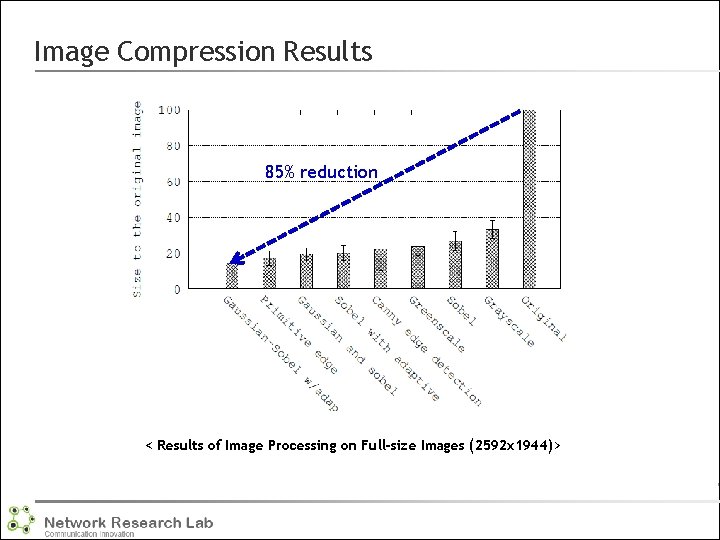
Image Compression Results 85% reduction < Results of Image Processing on Full-size Images (2592 x 1944)>
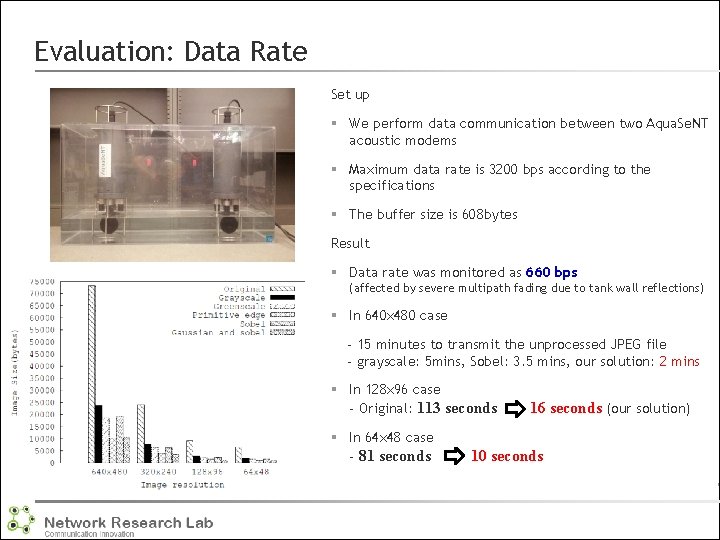
Evaluation: Data Rate Set up § We perform data communication between two Aqua. Se. NT acoustic modems § Maximum data rate is 3200 bps according to the specifications § The buffer size is 608 bytes Result § Data rate was monitored as 660 bps (affected by severe multipath fading due to tank wall reflections) § In 640 x 480 case - 15 minutes to transmit the unprocessed JPEG file - grayscale: 5 mins, Sobel: 3. 5 mins, our solution: 2 mins § In 128 x 96 case - Original: 113 seconds § In 64 x 48 case - 81 seconds 16 seconds (our solution) 10 seconds
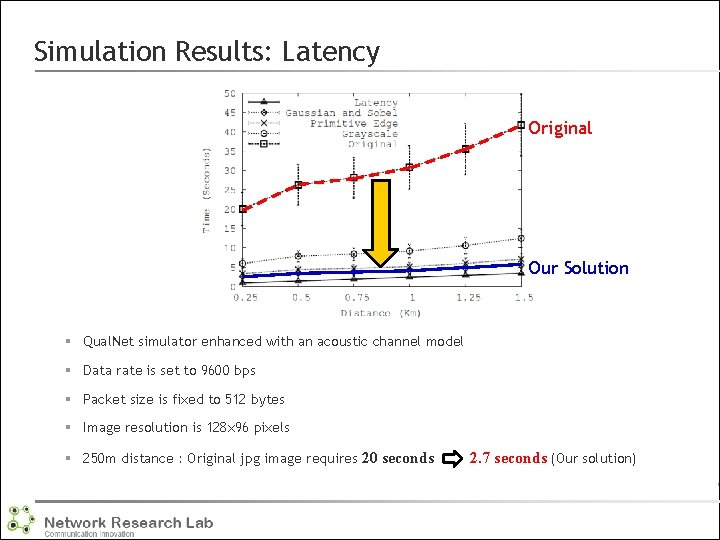
Simulation Results: Latency Original Our Solution § Qual. Net simulator enhanced with an acoustic channel model § Data rate is set to 9600 bps § Packet size is fixed to 512 bytes § Image resolution is 128 x 96 pixels § 250 m distance : Original jpg image requires 20 seconds 2. 7 seconds (Our solution)
Conclusions § Main contribution: enable reliable real-time video streaming without underwater optical cables (when the optical channel quits, the acoustic channel takes over) § Acoustic - useful for aligning nodes to initiate optical connection, back up channel § Optical - useful for transfer of large amounts of data at short range (< 50 m) § Future works - Smooth transition between the acoustic and optical video delivery mode by using image processing algorithm to compress the video before transmitting it on the acoustic channel 15

16
- Slides: 16