
RealTime Support for Automotive Application Outline Engine Control
- Slides: 27
Real-Time Support for Automotive Application
Outline • Engine Control Unit – Multiprocessor dynamic scheduling • Adaptive Cruise Control – Static priority scheduling – Mode-change – Server technique
Motivation for Multiprocessor • More advanced features and sophisticated applications are added for driving safety. • Customer’s demands for high level of comfort are increased. • As a result, high computational capability of the microprocessor is used in automobile system.
Multiprocessor Scheduling in ECU • Automotive Open Systems Architecture (AUTOSAR) suggests static priority scheduling for Engine Control Unit (ECU) • Limitations: – Guarantee for lower priority task – Shared resource
Dynamic Scheduler • Goal: – Increasing CPU utilization – Decreasing preemption overhead – Decreasing average waiting time – Guaranteeing all the tasks’ real time deadlines Mishra, Geetishree, and K. S. Gurumurthy. "Dynamic task scheduling on multicore automotive ECUs. " International Journal of VLSI design & Communication Systems (VLSICS) Vol. 5, No. 6, December 2014
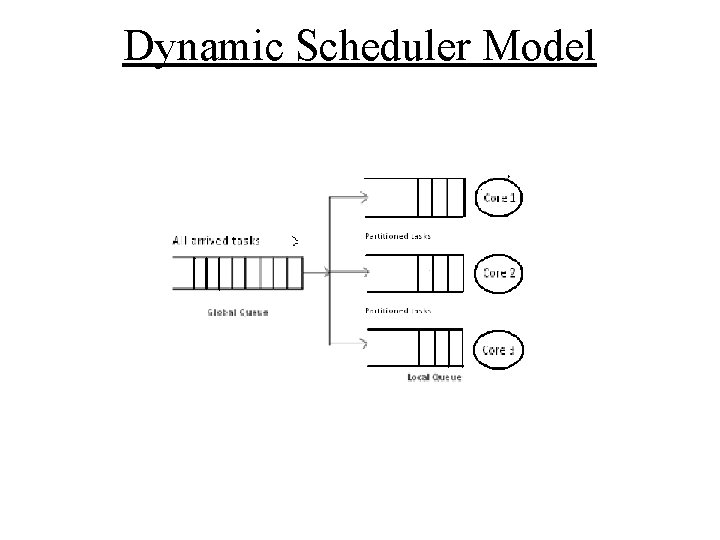
Dynamic Scheduler Model
Dynamic Scheduler Model • A combination of both global and partitioned queue architecture • At global queue, slack is calculated and priorities are assigned dynamically • At partitioned queues, a comparison happens between their slack and tasks are arranged in ascending order of their slack
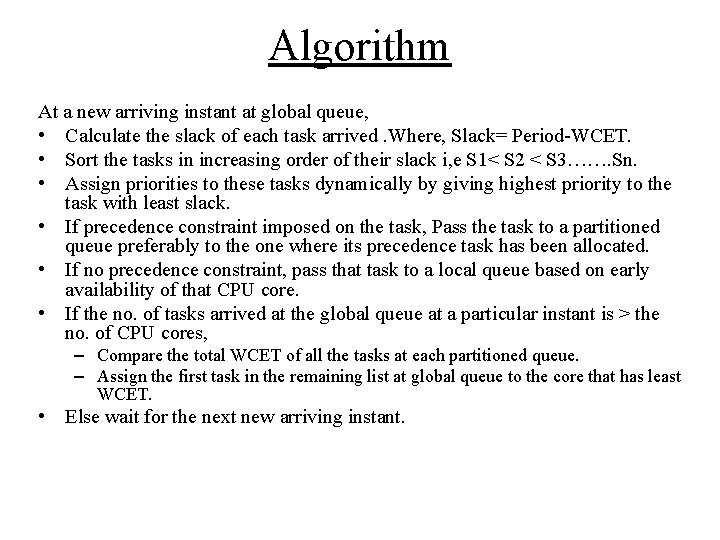
Algorithm At a new arriving instant at global queue, • Calculate the slack of each task arrived. Where, Slack= Period-WCET. • Sort the tasks in increasing order of their slack i, e S 1< S 2 < S 3……. Sn. • Assign priorities to these tasks dynamically by giving highest priority to the task with least slack. • If precedence constraint imposed on the task, Pass the task to a partitioned queue preferably to the one where its precedence task has been allocated. • If no precedence constraint, pass that task to a local queue based on early availability of that CPU core. • If the no. of tasks arrived at the global queue at a particular instant is > the no. of CPU cores, – Compare the total WCET of all the tasks at each partitioned queue. – Assign the first task in the remaining list at global queue to the core that has least WCET. • Else wait for the next new arriving instant.
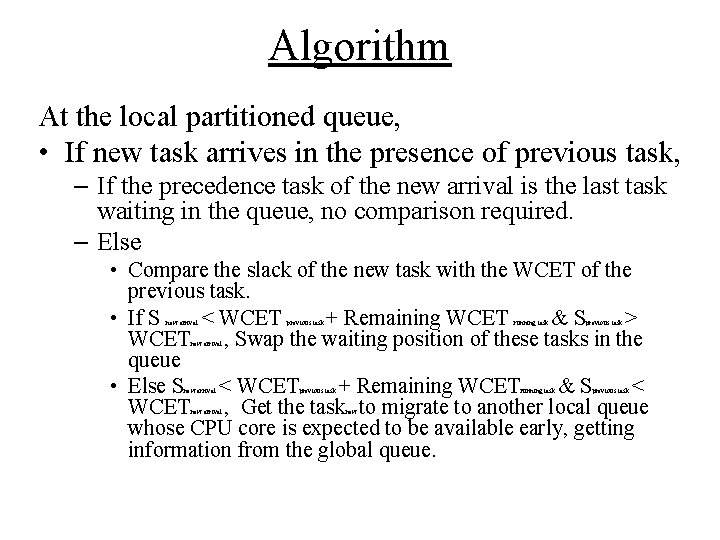
Algorithm At the local partitioned queue, • If new task arrives in the presence of previous task, – If the precedence task of the new arrival is the last task waiting in the queue, no comparison required. – Else • Compare the slack of the new task with the WCET of the previous task. • If S < WCET + Remaining WCET &S > WCET , Swap the waiting position of these tasks in the queue • Else S < WCET + Remaining WCET &S < WCET , Get the task to migrate to another local queue whose CPU core is expected to be available early, getting information from the global queue. new arrival previous task running task previous task new arrival previous task running task new previous task
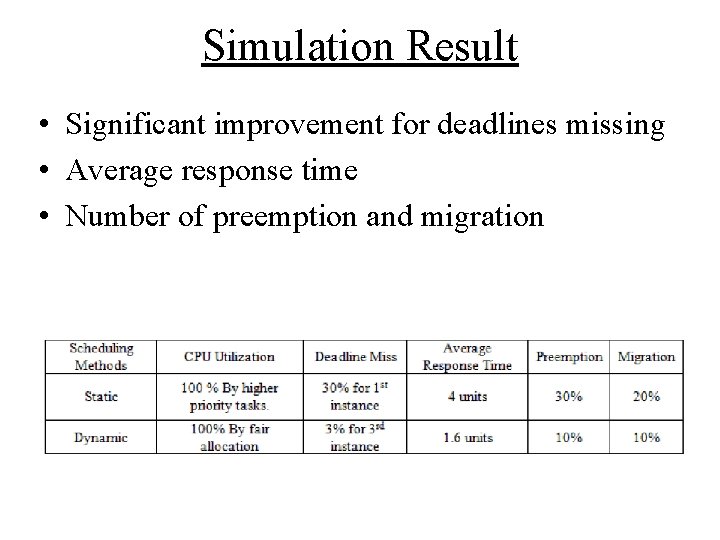
Simulation Result • Significant improvement for deadlines missing • Average response time • Number of preemption and migration
Adaptive Cruise Control (ACC) • Adjusting vehicle speed to maintain a safe distance from the vehicle ahead in the same lane • Returning to the set speed when traffic clears
Two-Level Controller • Upper-level controller: computes the desired speed. • Lower-level controller: achieves the desired speed by manipulating brake and engine outputs.
Raw Data and Derived Data • In current ACC systems, all the sensors sense the data periodically. • Raw data reflects the external environment. • Derived data are derived from raw data and/or other derived data.
Real-Time Issue in ACC • The task of the control system installed in the host vehicle is to continuously track the leading vehicle and adapt its velocity accordingly. The tracking rate should be – fast enough to have accurate information about the leading vehicle – slow enough to ensure that the system is not overloaded with redundant operations
Goal • Effective tracking of dynamically varying data • Timely updates of derived data • Handling mode specific task sets • Goud, Gurulingesh R. , et al. "Efficient real-time support for automotive applications: A case study. " Embedded and Real-Time Computing Systems and Applications, 2006. Proceedings. 12 th IEEE International Conference on. IEEE, 2006.
Approach • To address the above mentioned issues, two well known design techniques from real time system domain are exploited: mode-change protocol and real-time data update protocols.
Dual Mode System • Two mutually exclusive phases of operation for ACC. – Non-Critical Mode (NC Mode) – Safety-Critical Mode (SC Mode)
Details of the Modes • The decision on the current mode of the system is taken based on two parameters, distance of separation and the rate of change of distance. The change in their values triggers the modechange phenomenon.
Mode-Change Protocols • Once the mode-switch condition is satisfied, the mode-change process involves deleting the tasks in the current mode and creating the new tasks ensuring schedulability at any given point of time throughout this process. • Real, Jorge, and Alfons Crespo. "Mode change protocols for real-time systems: A survey and a new proposal. " Real-time systems 26. 2 (2004): 161197.
Scheduling Tasks in Different Modes • The modes in a system are characterized by number of active tasks. The tasks and their characteristics (period, WCET) are known a priori. Hence, static priority scheduling is the obvious choice for system with different modes. Rate Monotonic Algorithm (RMA) is used to schedule the tasks in the implementation.
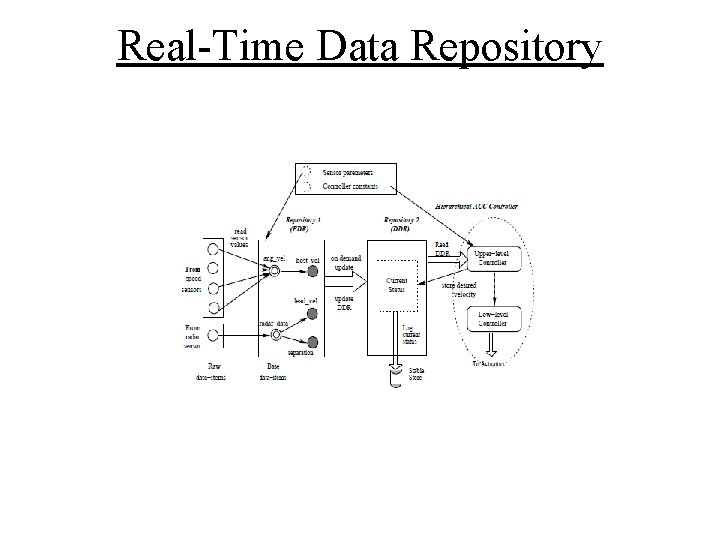
Real-Time Data Repository • Environment Data Repository (EDR) is storing the data pertaining to external environment and ACC system. • Derived Data Repository (DDR) acts as a global database for the system. ACC controller communicates with DDR to get desired speed parameters.
Real-Time Data Repository
Tasks Classification • Sensor Reading Tasks: data collected from sensors. • On-demand Update Tasks: the derived data items are calculated and updated only when one of the data items changes more than the threshold value.
Scheduling of On-Demand tasks • On-demand Update Tasks are modeled as aperiodic tasks. A well known conceptual framework to guarantee the service on aperiodic tasks is the aperiodic server technique.
Server Technique • Server models the behavior of tasks by reserving a share of processor bandwidth for each of the tasks. In ACC, there is also a controlling server thread to maintain each reserved bandwidth.
Tasks Classification • Lower Level Controller Tasks: they give command to the mechanical system of the vehicle to achieve the desired velocity. These tasks are performed by the hardware. • Other Tasks: They are the lower priority tasks such as monitoring weather and road conditions. These tasks are executed only when there are no critical tasks pending in the system.
Reference • Mishra, Geetishree, and K. S. Gurumurthy. " Dynamic task scheduling on multicore automotive ECUs. " International Journal of VLSI design & Communication Systems (VLSICS) Vol. 5, No. 6, December 2014 • Goud, Gurulingesh R. , et al. "Efficient real-time support for automotive applications: A case study. " Embedded and Real-Time Computing Systems and Applications, 2006. Proceedings. 12 th IEEE International Conference on. IEEE, 2006. • Real, Jorge, and Alfons Crespo. "Mode change protocols for real-time systems: A survey and a new proposal. " Real-time systems 26. 2 (2004): 161 -197.