
RealTime Operating Systems Prof Stephen A Edwards Copyright






- Slides: 37
Real-Time Operating Systems Prof. Stephen A. Edwards Copyright © 2001 Stephen A. Edwards All rights reserved
What’s an Operating System? § Provides environment for executing programs § Process abstraction for multitasking/concurrency • Scheduling § Hardware abstraction layer (device drivers) § Filesystems § Communication § We will focus on concurrent, real-time issues Copyright © 2001 Stephen A. Edwards All rights reserved
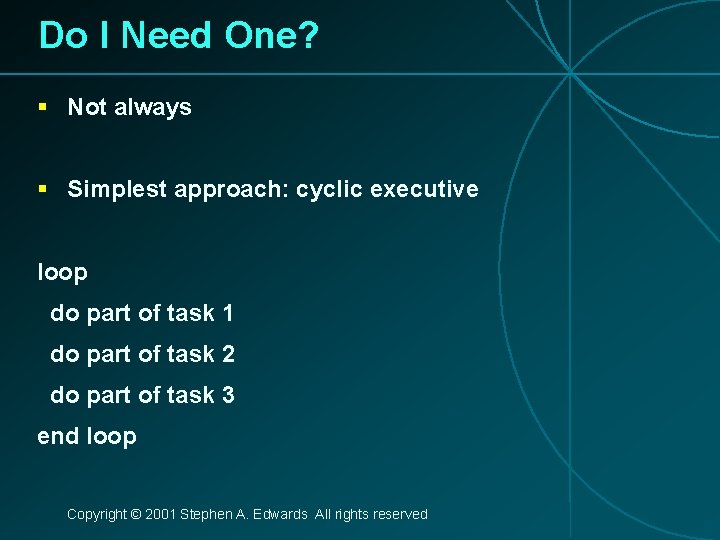
Do I Need One? § Not always § Simplest approach: cyclic executive loop do part of task 1 do part of task 2 do part of task 3 end loop Copyright © 2001 Stephen A. Edwards All rights reserved
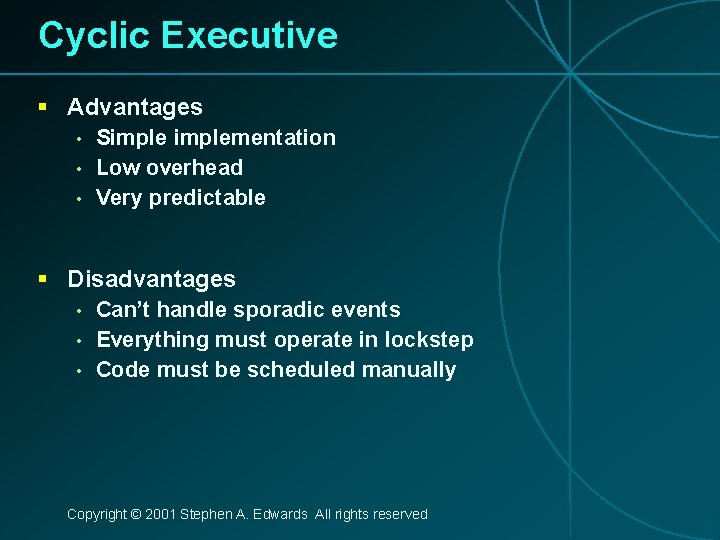
Cyclic Executive § Advantages • • • Simplementation Low overhead Very predictable § Disadvantages • • • Can’t handle sporadic events Everything must operate in lockstep Code must be scheduled manually Copyright © 2001 Stephen A. Edwards All rights reserved
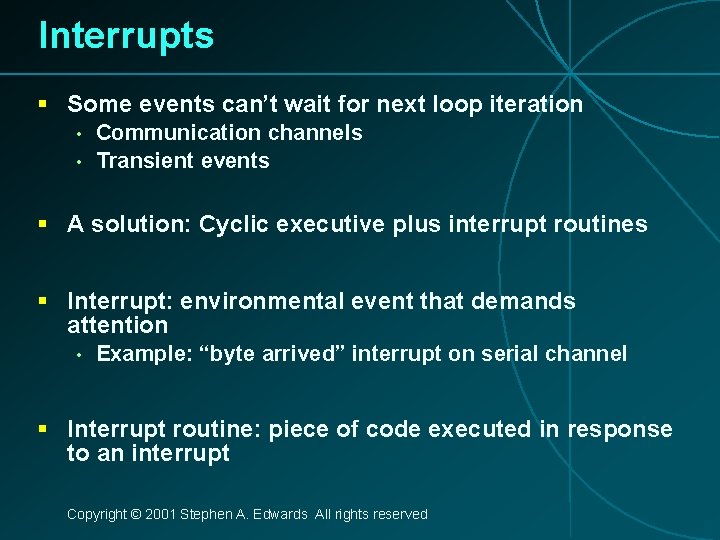
Interrupts § Some events can’t wait for next loop iteration • • Communication channels Transient events § A solution: Cyclic executive plus interrupt routines § Interrupt: environmental event that demands attention • Example: “byte arrived” interrupt on serial channel § Interrupt routine: piece of code executed in response to an interrupt Copyright © 2001 Stephen A. Edwards All rights reserved
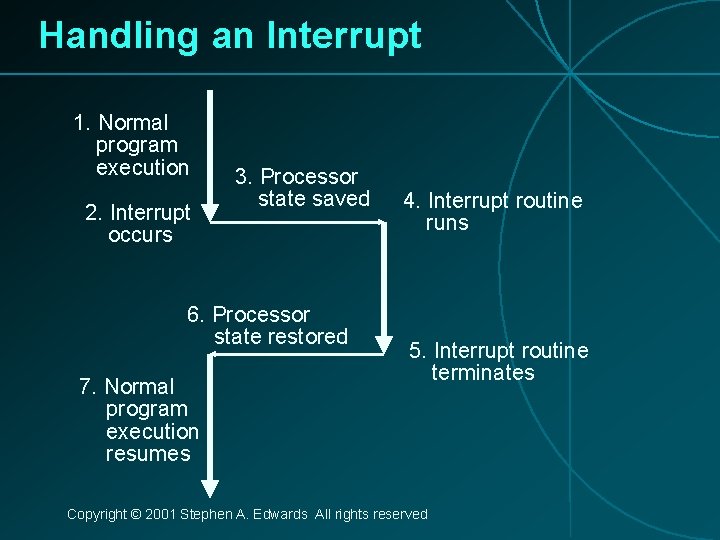
Handling an Interrupt 1. Normal program execution 2. Interrupt occurs 3. Processor state saved 6. Processor state restored 7. Normal program execution resumes 4. Interrupt routine runs 5. Interrupt routine terminates Copyright © 2001 Stephen A. Edwards All rights reserved
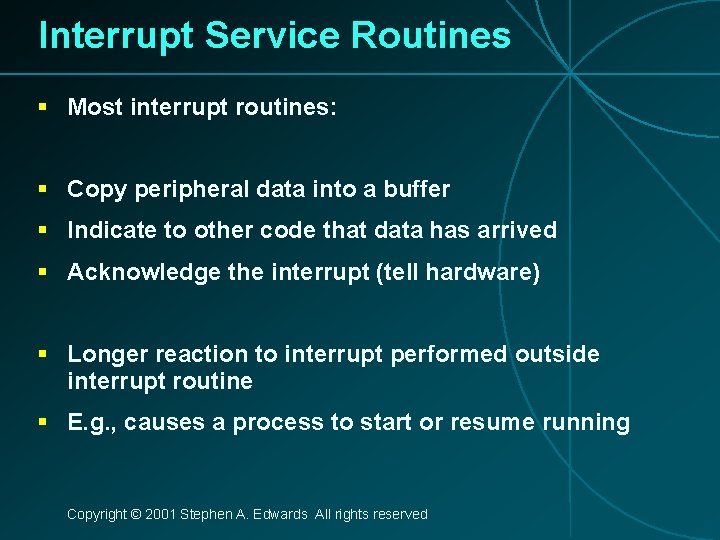
Interrupt Service Routines § Most interrupt routines: § Copy peripheral data into a buffer § Indicate to other code that data has arrived § Acknowledge the interrupt (tell hardware) § Longer reaction to interrupt performed outside interrupt routine § E. g. , causes a process to start or resume running Copyright © 2001 Stephen A. Edwards All rights reserved
Cyclic Executive Plus Interrupts § Works fine for many signal processing applications § 56001 has direct hardware support for this style § Insanely cheap, predictable interrupt handler: • • • When interrupt occurs, execute a single user-specified instruction This typically copies peripheral data into a circular buffer No context switch, no environment save, no delay Copyright © 2001 Stephen A. Edwards All rights reserved
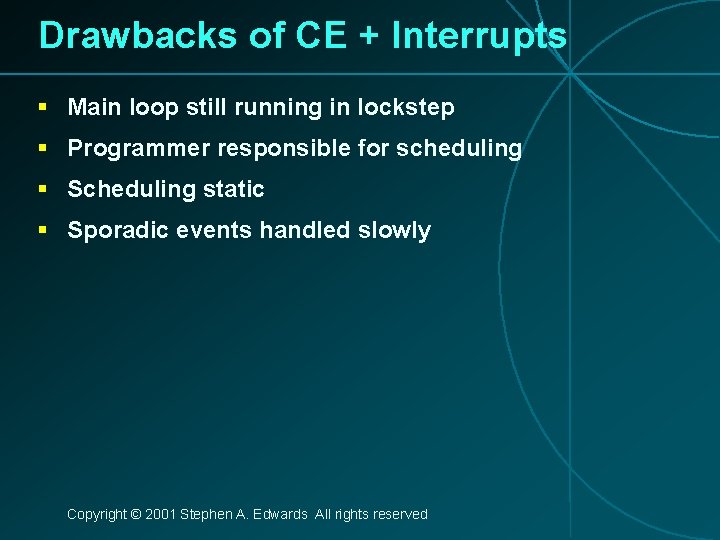
Drawbacks of CE + Interrupts § Main loop still running in lockstep § Programmer responsible for scheduling § Scheduling static § Sporadic events handled slowly Copyright © 2001 Stephen A. Edwards All rights reserved
Cooperative Multitasking § A cheap alternative § Non-preemptive § Processes responsible for relinquishing control § Examples: Original Windows, Macintosh § A process had to periodically call get_next_event() to let other processes proceed § Drawbacks: • • Programmer had to ensure this was called frequently An errant program would lock up the whole system § Alternative: preemptive multitasking Copyright © 2001 Stephen A. Edwards All rights reserved
Concurrency Provided by OS § Basic philosophy: Let the operating system handle scheduling, and let the programmer handle function § Scheduling and function usually orthogonal § Changing the algorithm would require a change in scheduling § First, a little history Copyright © 2001 Stephen A. Edwards All rights reserved
Batch Operating Systems § Original computers ran in batch mode: • • Submit job & its input Job runs to completion Collect output Submit next job § Processor cycles very expensive at the time § Jobs involved reading, writing data to/from tapes § Cycles were being spent waiting for the tape! Copyright © 2001 Stephen A. Edwards All rights reserved
Timesharing Operating Systems § Solution • • Store multiple batch jobs in memory at once When one is waiting for the tape, run the other one § Basic idea of timesharing systems § Fairness primary goal of timesharing schedulers • • Let no one process consume all the resources Make sure every process gets “equal” running time Copyright © 2001 Stephen A. Edwards All rights reserved
Real-Time Is Not Fair § Main goal of an RTOS scheduler: meeting deadlines § If you have five homework assignments and only one is due in an hour, you work on that one § Fairness does not help you meet deadlines Copyright © 2001 Stephen A. Edwards All rights reserved
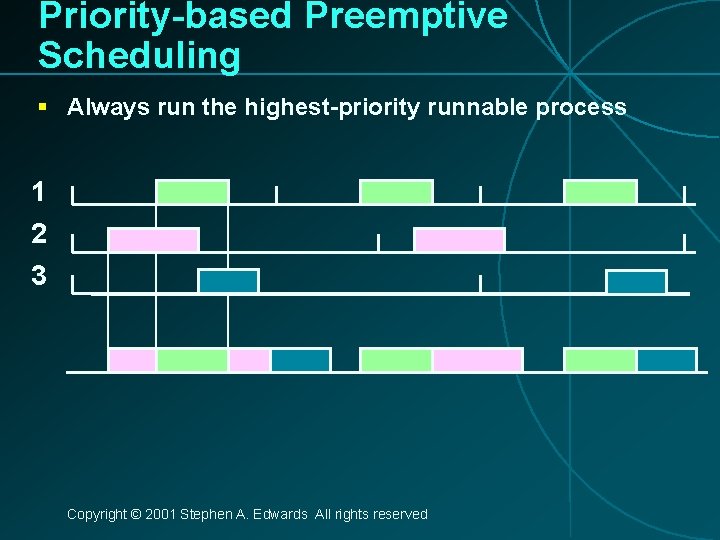
Priority-based Scheduling § Typical RTOS based on fixed-priority preemptive scheduler § Assign each process a priority § At any time, scheduler runs highest priority process ready to run § Process runs to completion unless preempted Copyright © 2001 Stephen A. Edwards All rights reserved
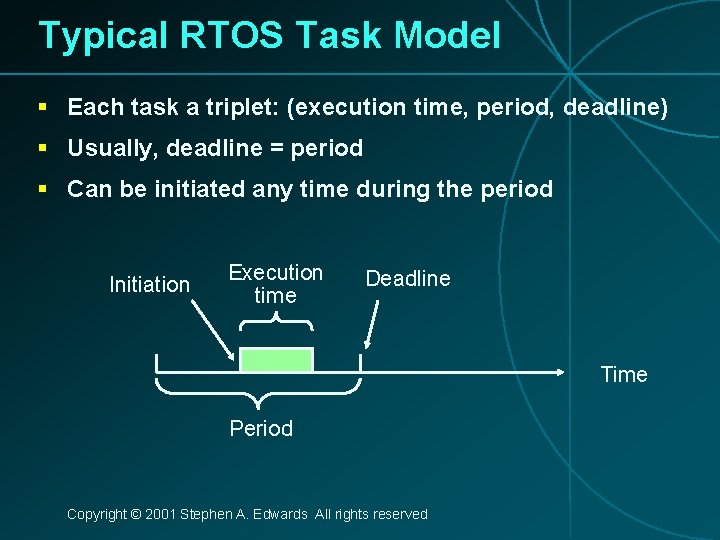
Typical RTOS Task Model § Each task a triplet: (execution time, period, deadline) § Usually, deadline = period § Can be initiated any time during the period Initiation Execution time Deadline Time Period Copyright © 2001 Stephen A. Edwards All rights reserved
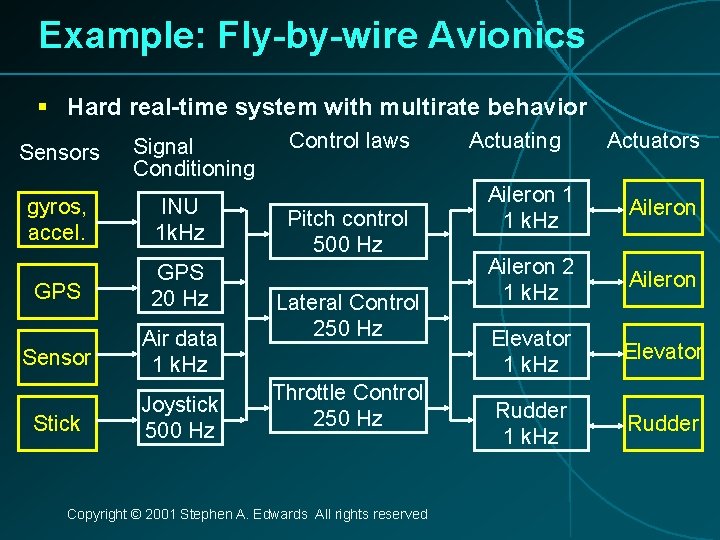
Example: Fly-by-wire Avionics § Hard real-time system with multirate behavior Sensors Signal Conditioning gyros, accel. INU 1 k. Hz GPS 20 Hz Sensor Air data 1 k. Hz Stick Joystick 500 Hz Control laws Pitch control 500 Hz Lateral Control 250 Hz Throttle Control 250 Hz Copyright © 2001 Stephen A. Edwards All rights reserved Actuating Actuators Aileron 1 1 k. Hz Aileron 2 1 k. Hz Aileron Elevator 1 k. Hz Elevator Rudder 1 k. Hz Rudder
Priority-based Preemptive Scheduling § Always run the highest-priority runnable process 1 2 3 Copyright © 2001 Stephen A. Edwards All rights reserved
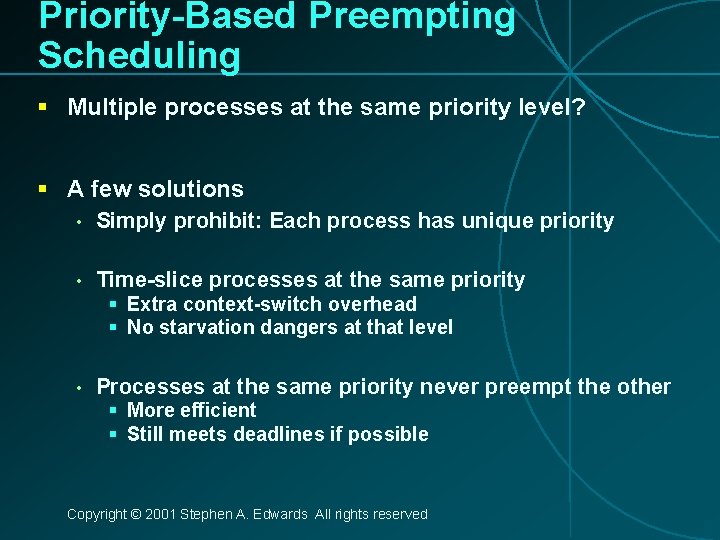
Priority-Based Preempting Scheduling § Multiple processes at the same priority level? § A few solutions • Simply prohibit: Each process has unique priority • Time-slice processes at the same priority § Extra context-switch overhead § No starvation dangers at that level • Processes at the same priority never preempt the other § More efficient § Still meets deadlines if possible Copyright © 2001 Stephen A. Edwards All rights reserved
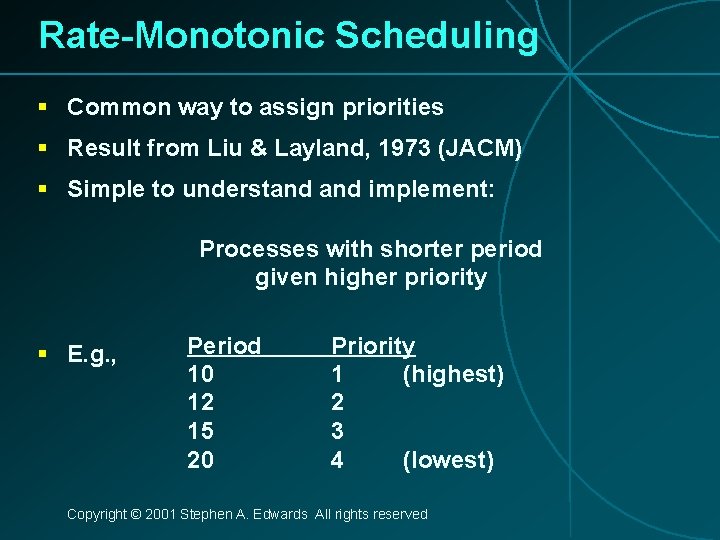
Rate-Monotonic Scheduling § Common way to assign priorities § Result from Liu & Layland, 1973 (JACM) § Simple to understand implement: Processes with shorter period given higher priority § E. g. , Period 10 12 15 20 Priority 1 (highest) 2 3 4 (lowest) Copyright © 2001 Stephen A. Edwards All rights reserved
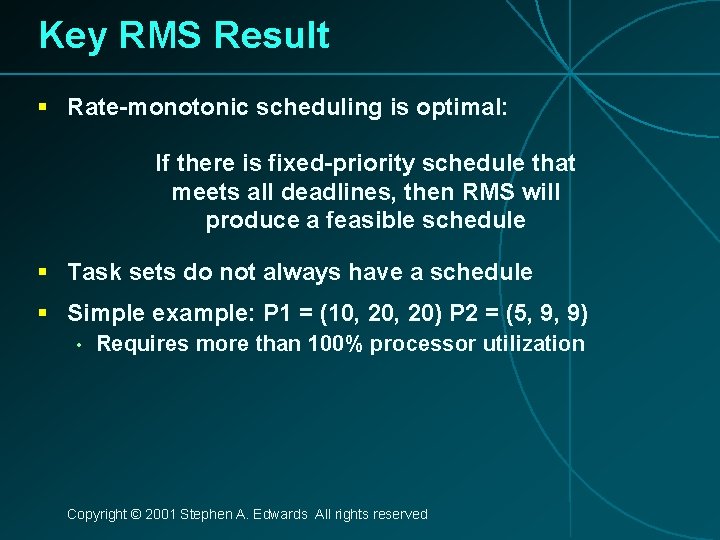
Key RMS Result § Rate-monotonic scheduling is optimal: If there is fixed-priority schedule that meets all deadlines, then RMS will produce a feasible schedule § Task sets do not always have a schedule § Simple example: P 1 = (10, 20) P 2 = (5, 9, 9) • Requires more than 100% processor utilization Copyright © 2001 Stephen A. Edwards All rights reserved
RMS Missing a Deadline § p 1 = (10, 20) p 2 = (15, 30) utilization is 100% 1 2 Would have met the deadline if p 2 = (10, 30), utilization reduced 83% P 2 misses first deadline Copyright © 2001 Stephen A. Edwards All rights reserved
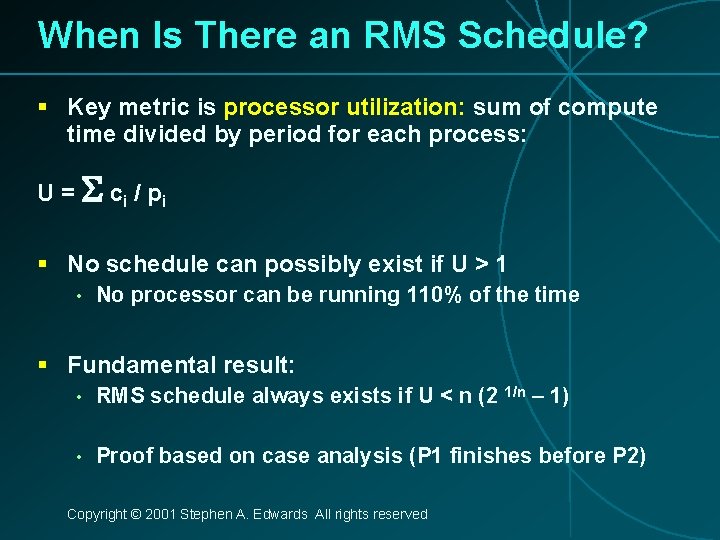
When Is There an RMS Schedule? § Key metric is processor utilization: sum of compute time divided by period for each process: U = ci / p i § No schedule can possibly exist if U > 1 • No processor can be running 110% of the time § Fundamental result: • RMS schedule always exists if U < n (2 1/n – 1) • Proof based on case analysis (P 1 finishes before P 2) Copyright © 2001 Stephen A. Edwards All rights reserved
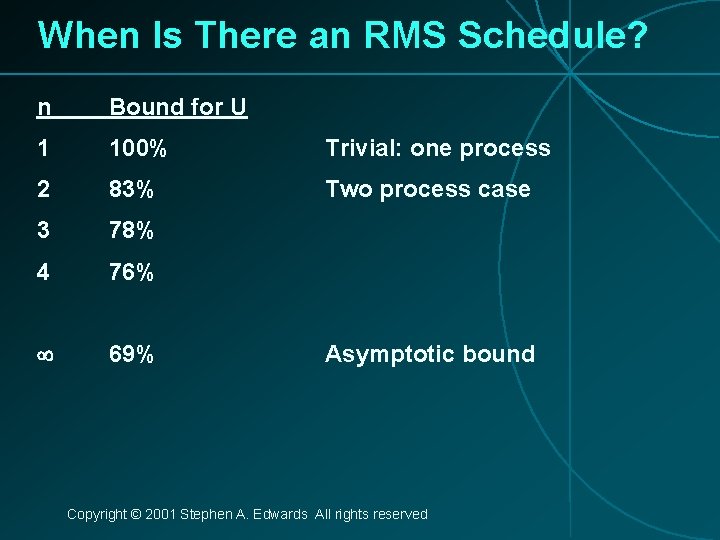
When Is There an RMS Schedule? n Bound for U 1 100% Trivial: one process 2 83% Two process case 3 78% 4 76% 69% Asymptotic bound Copyright © 2001 Stephen A. Edwards All rights reserved
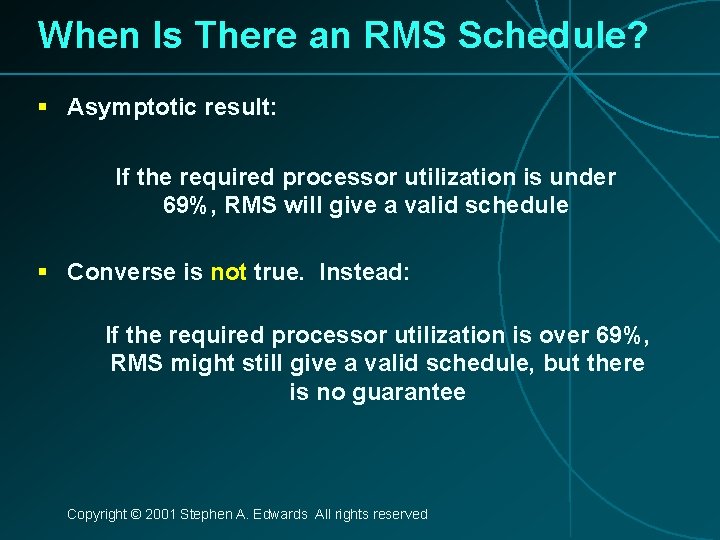
When Is There an RMS Schedule? § Asymptotic result: If the required processor utilization is under 69%, RMS will give a valid schedule § Converse is not true. Instead: If the required processor utilization is over 69%, RMS might still give a valid schedule, but there is no guarantee Copyright © 2001 Stephen A. Edwards All rights reserved
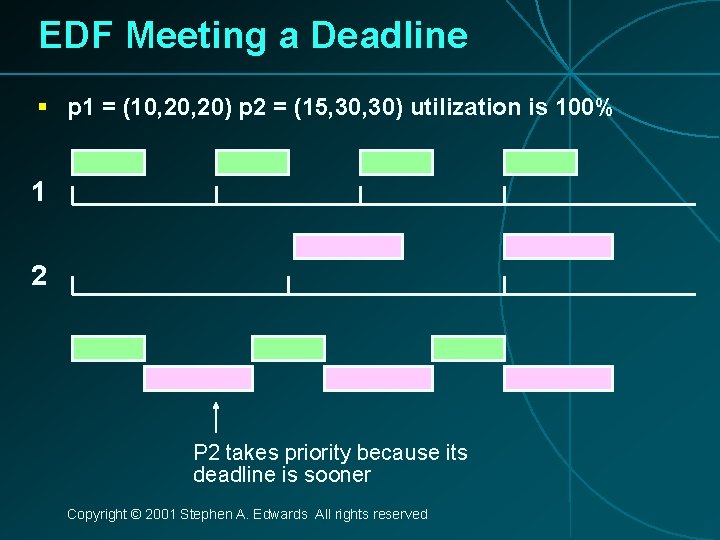
EDF Scheduling § RMS assumes fixed priorities § Can you do better with dynamically-chosen priorities? § Earliest deadline first: Processes with soonest deadline given highest priority Copyright © 2001 Stephen A. Edwards All rights reserved
EDF Meeting a Deadline § p 1 = (10, 20) p 2 = (15, 30) utilization is 100% 1 2 P 2 takes priority because its deadline is sooner Copyright © 2001 Stephen A. Edwards All rights reserved
Key EDF Result § Earliest deadline first scheduling is optimal: If a dynamic priority schedule exists, EDF will produce a feasible schedule § Earliest deadline first scheduling is efficient: A dynamic priority schedule exists if and only if utilization is no greater than 100% Copyright © 2001 Stephen A. Edwards All rights reserved
Static Scheduling More Prevalent § RMA only guarantees feasibility at 69% utilization, EDF guarantees it at 100% § EDF is complicated enough to have unacceptable overhead § More complicated than RMA: harder to analyze § Less predictable: can’t guarantee which process runs when Copyright © 2001 Stephen A. Edwards All rights reserved
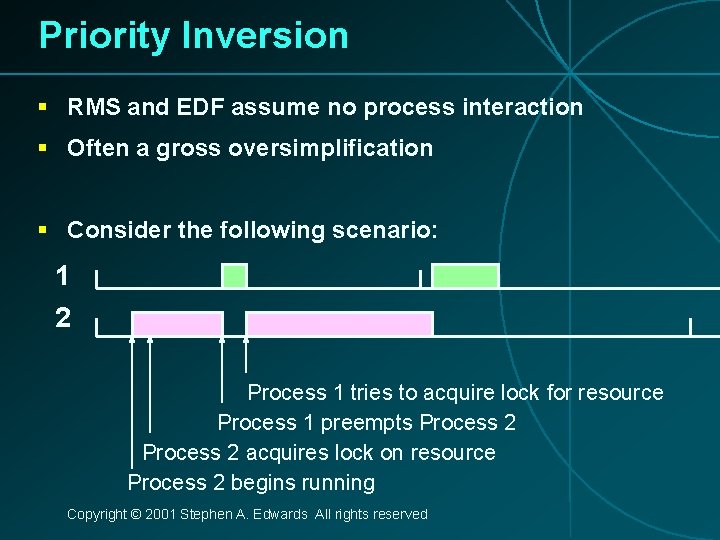
Priority Inversion § RMS and EDF assume no process interaction § Often a gross oversimplification § Consider the following scenario: 1 2 Process 1 tries to acquire lock for resource Process 1 preempts Process 2 acquires lock on resource Process 2 begins running Copyright © 2001 Stephen A. Edwards All rights reserved
Priority Inversion § Lower-priority process effectively blocks a higherpriority one § Lower-priority process’s ownership of lock prevents higher-priority process from running § Nasty: makes high-priority process runtime unpredictable Copyright © 2001 Stephen A. Edwards All rights reserved
Nastier Example § Higher priority process blocked indefinitely Process 2 delays process 3’s release of lock 1 2 3 Process 1 tries to acquire lock and is blocked Process 1 preempts Process 2 preempts Process 3 acquires lock on resource Process 3 begins running Copyright © 2001 Stephen A. Edwards All rights reserved
Priority Inheritance § Solution to priority inversion § Temporarily increase process’s priority when it acquires a lock § Level to increase: highest priority of any process that might want to acquire same lock • I. e. , high enough to prevent it from being preempted § Danger: Low-priority process acquires lock, gets high priority and hogs the processor • So much for RMS Copyright © 2001 Stephen A. Edwards All rights reserved
Priority Inheritance § Basic rule: low-priority processes should acquire high-priority locks only briefly § An example of why concurrent systems are so hard to analyze § RMS gives a strong result § No equivalent result when locks and priority inheritance is used Copyright © 2001 Stephen A. Edwards All rights reserved
Summary § Cyclic executive • • Way to avoid an RTOS Adding interrupts helps somewhat § Interrupt handlers • Gather data, acknowledge interrupt as quickly as possible § Cooperative multitasking • But programs don’t like to cooperate Copyright © 2001 Stephen A. Edwards All rights reserved
Summary § Preemptive Priority-Based Multitasking • Deadlines, not fairness, the goal of RTOSes § Rate-monotonic analysis • • Shorter periods get higher priorities Guaranteed at 69% utilization, may work higher § Earliest deadline first scheduling • • Dynamic priority scheme Optimal, guaranteed when utilization 100% or less Copyright © 2001 Stephen A. Edwards All rights reserved
Summary § Priority Inversion • Low-priority process acquires lock, blocks higherpriority process • Priority inheritance temporarily raises process priority • Difficult to analyze Copyright © 2001 Stephen A. Edwards All rights reserved