
REALTIME NAVIGATION OF INDEPENDENT AGENTS USING ADAPTIVE ROADMAPS
![Motivation Simulation of Virtual Humans Vi. Crowd [Musse & Thalmann 01; EPFL] Virtual Iraq](https://slidetodoc.com/presentation_image_h2/59a115b72ebc3d483c9ecd28210b4116/image-3.jpg "Motivation Simulation of Virtual Humans Vi. Crowd [Musse & Thalmann 01; EPFL] Virtual Iraq")

![Navigation: Local Dynamics Generalized force model of pedestrian dynamics [Helbing 2003] Emergent crowd behavior](https://slidetodoc.com/presentation_image_h2/59a115b72ebc3d483c9ecd28210b4116/image-33.jpg "Navigation: Local Dynamics Generalized force model of pedestrian dynamics [Helbing 2003] Emergent crowd behavior")



- Slides: 48
REAL-TIME NAVIGATION OF INDEPENDENT AGENTS USING ADAPTIVE ROADMAPS Avneesh Sud 1, Russell Gayle 2, Erik Andersen 2, Stephen Guy 2, Ming Lin 2, Dinesh Manocha 2 1: Microsoft Corp 2: UNC Chapel Hill http: //gamma. cs. unc. edu/crowd/aero
Motivation Navigating to goal - important behavior in virtual agent simulation Navigation requires path planning � Compute collision-free paths � Satisfy constraints on the path � Exhibit crowd dynamics
Motivation Simulation of Virtual Humans Vi. Crowd [Musse & Thalmann 01; EPFL] Virtual Iraq [ICT/USC 06] ABS [Tecchia et al. 01; UCL]
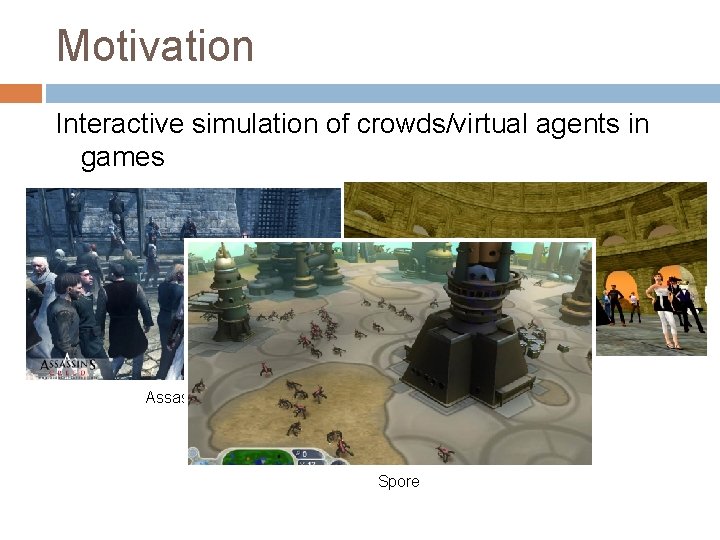
Motivation Interactive simulation of crowds/virtual agents in games Second Life Assassin’s Creed Spore
Challenges Path planning for multiple (thousands of) independent agents simultaneously Each agent is a dynamic obstacle Exact path planning for each agent in dynamic environments is P-space complete
Goal Real-time navigation for multiple virtual agents � Independent behavior � Global path planning � Dynamic environments � Thousands of agents
Applications Crowd simulation Multi-robot planning Social engineering Training and simulation Exploration Entertainment
Main Results Adaptive-Elastic ROadmaps (AERO): Graph structure for global navigation that adpats to dynamic environments Augment global path planning with local dynamics model
Results: Tradeshow Demo Simulation of 100 agents in an urban environment, 10 fps
Outline Related Work Our Approach Results Discussion and Conclusion
Outline Related Work Our Approach Results Discussion and Conclusion
Related Work Multiple agent planning Crowd dynamics
Related Work Multiple agent planning � Global path planning [Bayazit et al. 02, Li & Chou 03, Pettre et al. 05] � Local methods [Khatib 86] � Hybrid [Lamarche & Donikian 04] � Dynamic environments [Quinlan & Kthaib 93, Yang & Brock 06, Gayle et al. 07, Li & Gupta 07, Sud et al. 2007] Crowd Simulation
Related Work Multiple agent planning Crowd Simulation � Agent-based methods [Reynolds 87, Musse & Thalmann 97, Sung et al. 04, Pelechano et al. 07] � Cellular Automata [Hoogendoorn et al 00, Loscos et al. 03, Tu & Terzopoulos 93] � Particle Dynamics [Helbing 03, Sugiyama et al. 01] � Continuous Methods [Helbing 05, Treuille et al. 06]
Outline Related Work Our Approach � Overview � Adaptive Elastic Roadmaps (AERO) � Navigation using AERO Results Discussion and Conclusion
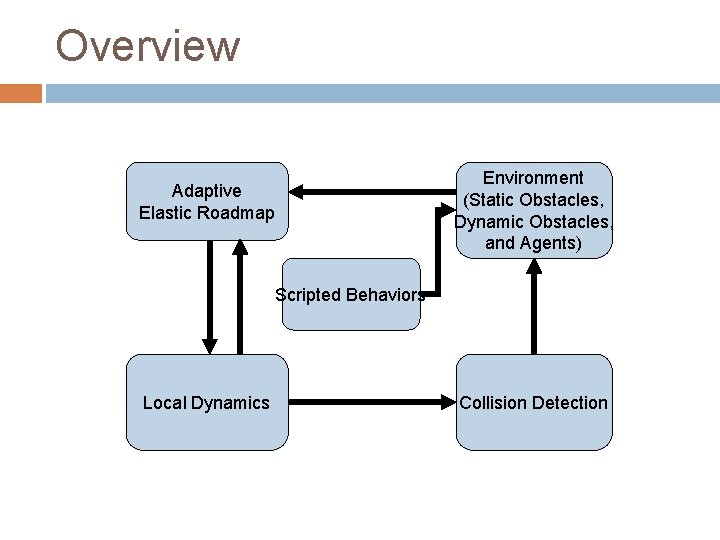
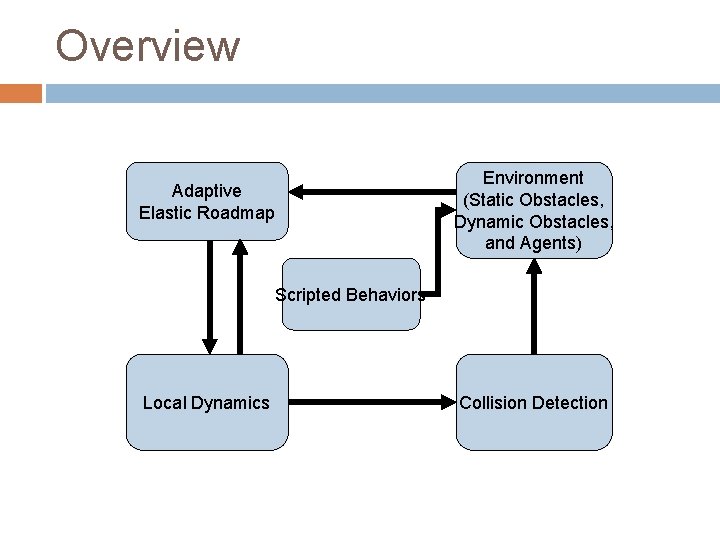
Overview At each time step Environment (Static Obstacles, Dynamic Obstacles, and Agents) Adaptive Elastic Roadmap Scripted Behaviors Local Dynamics Collision Detection
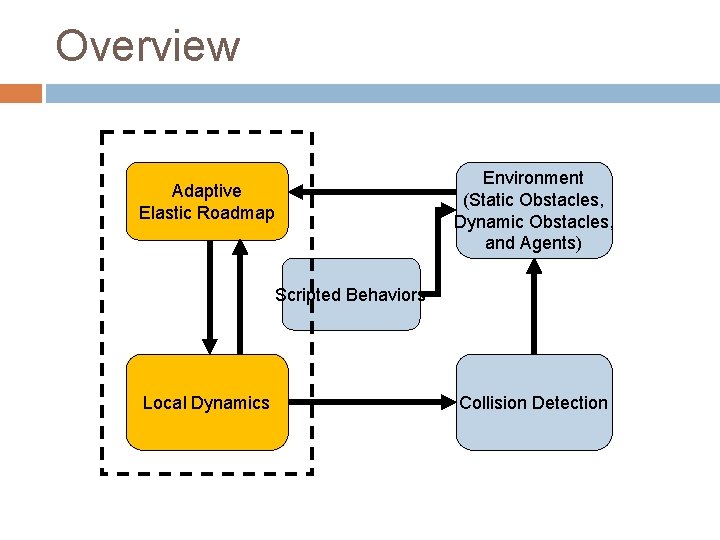
Overview At each time step Environment (Static Obstacles, Dynamic Obstacles, and Agents) Adaptive Elastic Roadmap Scripted Behaviors Local Dynamics Collision Detection
Outline Related Work Our Approach � Overview � Adaptive Elastic Roadmaps (AERO) � Navigation using AERO Results Discussion and Conclusion
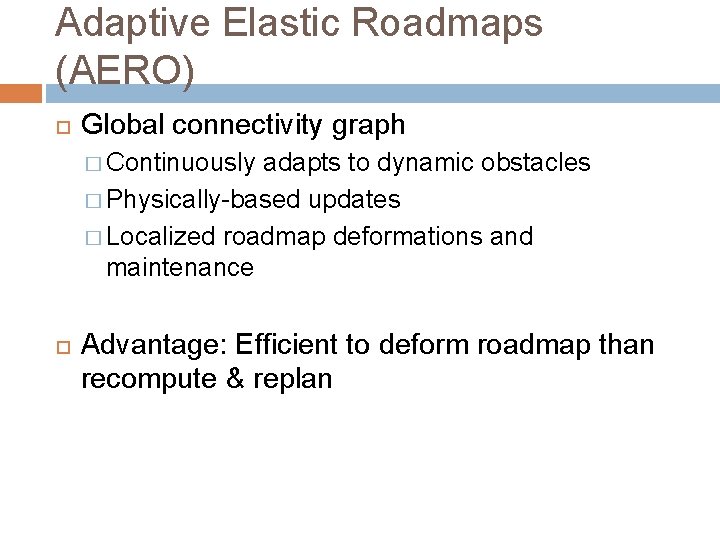
Adaptive Elastic Roadmaps (AERO) Global connectivity graph � Continuously adapts to dynamic obstacles � Physically-based updates � Localized roadmap deformations and maintenance Advantage: Efficient to deform roadmap than recompute & replan
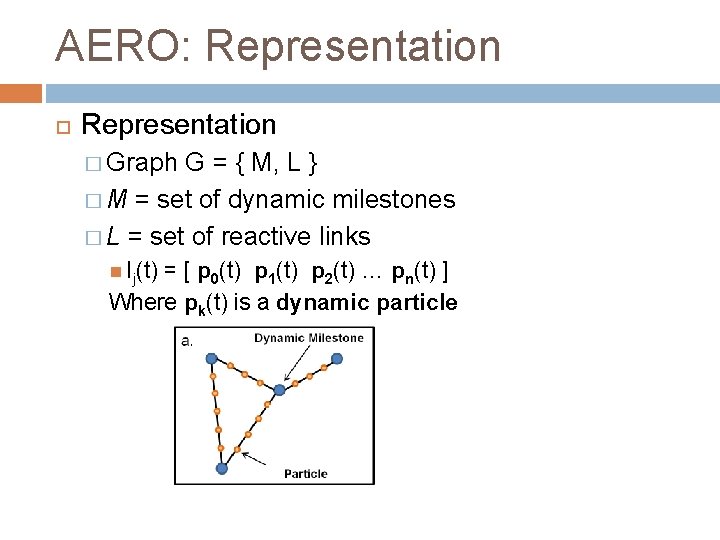
AERO: Representation � Graph G = { M, L } � M = set of dynamic milestones � L = set of reactive links lj(t) = [ p 0(t) p 1(t) p 2(t) … pn(t) ] Where pk(t) is a dynamic particle
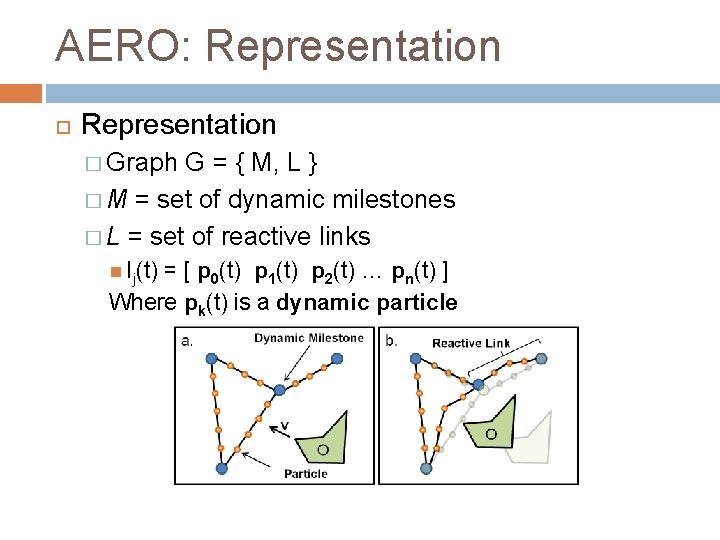
AERO: Representation � Graph G = { M, L } � M = set of dynamic milestones � L = set of reactive links lj(t) = [ p 0(t) p 1(t) p 2(t) … pn(t) ] Where pk(t) is a dynamic particle
AERO: Force Model Applied forces influence roadmap behavior � Force on particle/milestone i: Internal Forces � Prevent unnecessary link expansion � Prevent roadmap drift External Forces � Respond to obstacle motion
AERO: Force Model Quasi-Static simulation � Considers particles at rest � Prevents undesirable link oscillations Verlet integrator
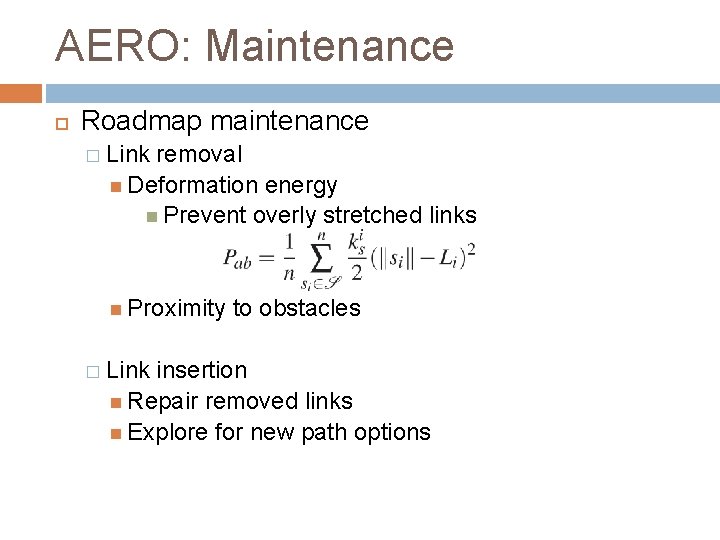
AERO: Maintenance Roadmap maintenance � Link removal Deformation energy Prevent overly stretched links Proximity � Link to obstacles insertion Repair removed links Explore for new path options
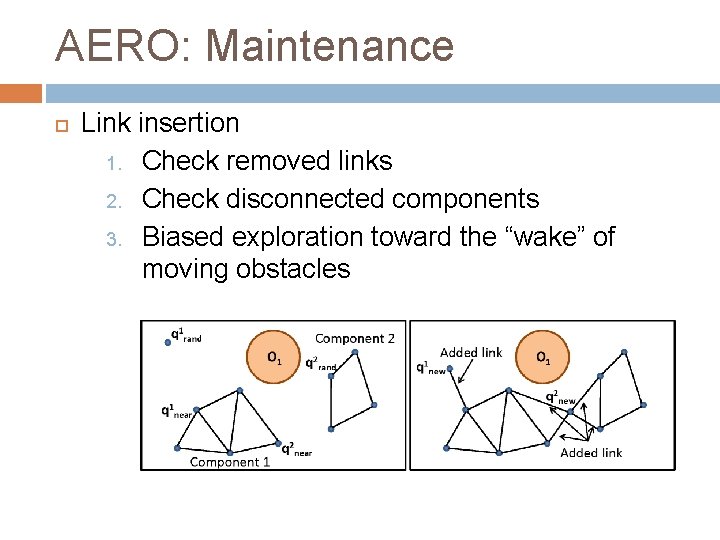
AERO: Maintenance Link insertion 1. Check removed links 2. Check disconnected components 3. Biased exploration toward the “wake” of moving obstacles
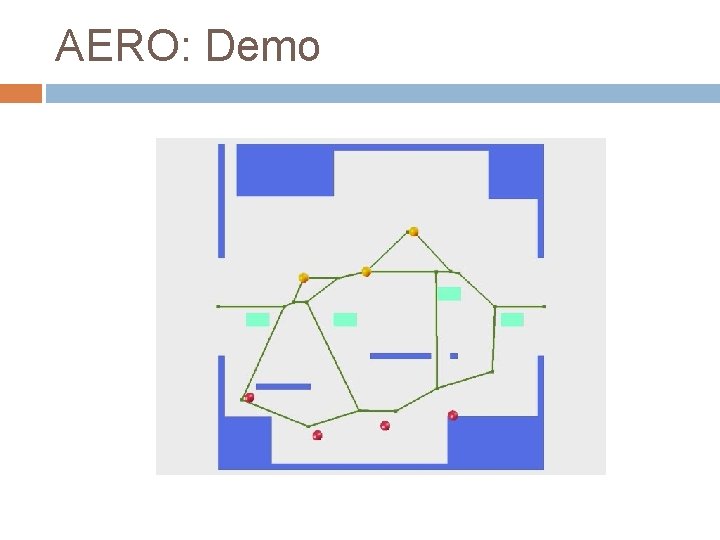
AERO: Demo
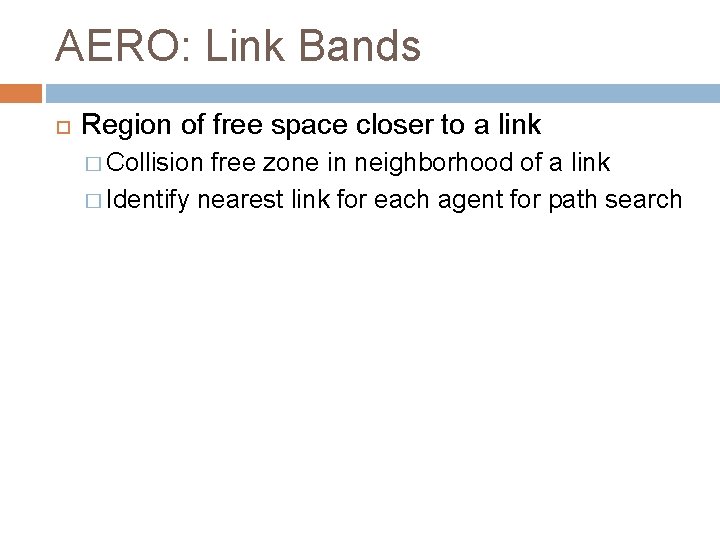
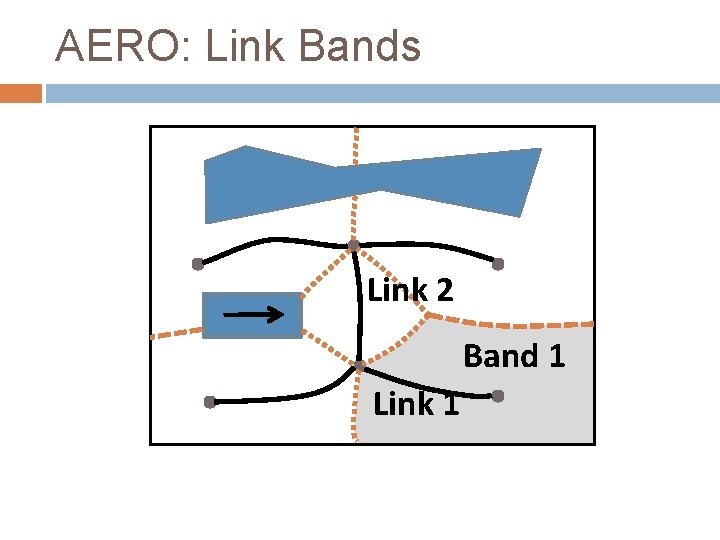
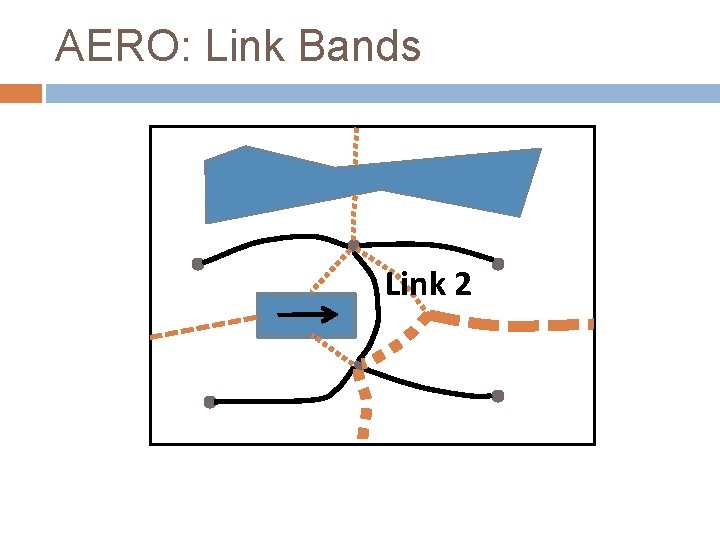
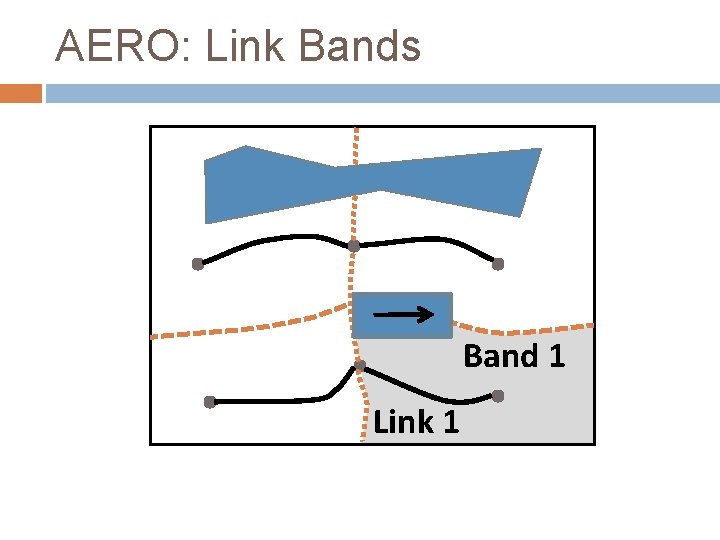
AERO: Link Bands Region of free space closer to a link � Collision free zone in neighborhood of a link � Identify nearest link for each agent for path search
AERO: Link Bands Link 2 Band 1 Link 1
AERO: Link Bands Link 2
AERO: Link Bands Band 1 Link 1
Outline Related Work Our Approach � Overview � Adaptive Elastic Roadmaps (AERO) � Navigation using AERO Results Discussion and Conclusion
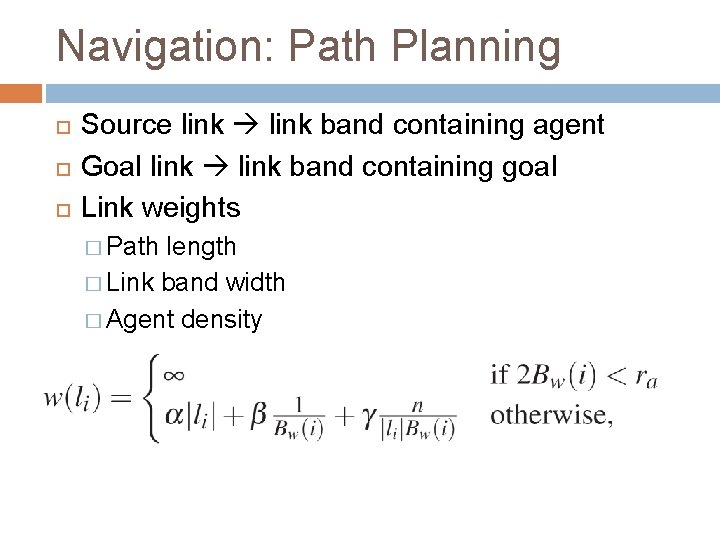
Navigation: Path Planning Source link band containing agent Goal link band containing goal Link weights � Path length � Link band width � Agent density
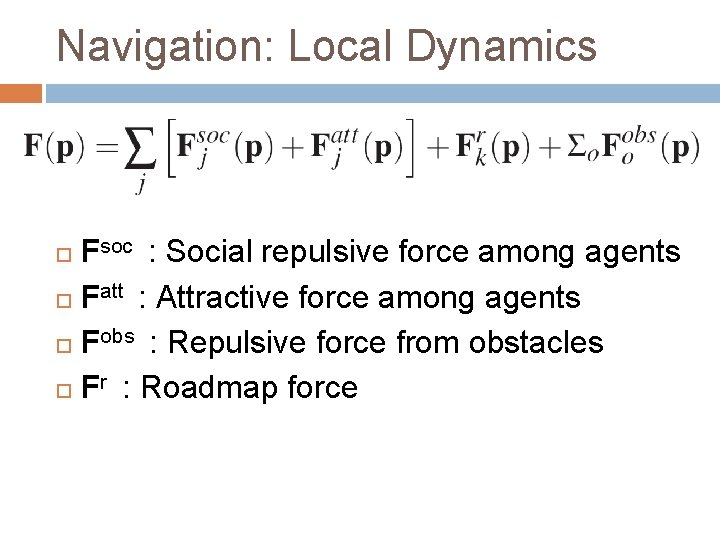
Navigation: Local Dynamics Generalized force model of pedestrian dynamics [Helbing 2003] Emergent crowd behavior at varying densities
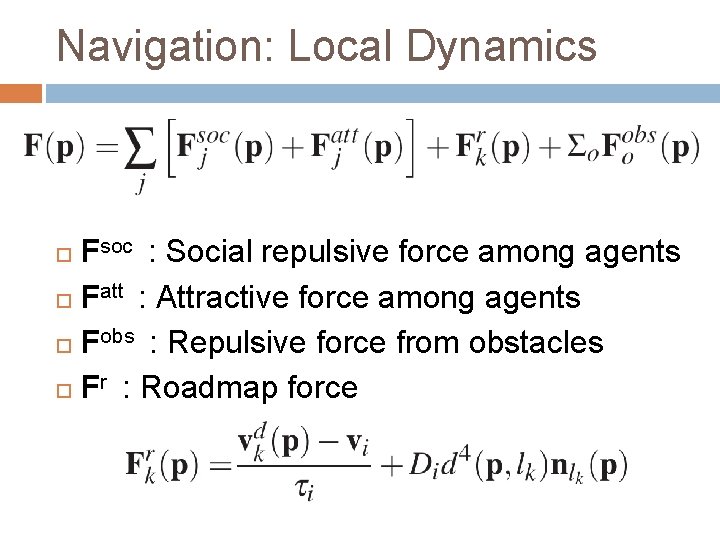
Navigation: Local Dynamics Fsoc : Social repulsive force among agents Fatt : Attractive force among agents Fobs : Repulsive force from obstacles Fr : Roadmap force
Navigation: Local Dynamics Fsoc : Social repulsive force among agents Fatt : Attractive force among agents Fobs : Repulsive force from obstacles Fr : Roadmap force
Overview At each time step Environment (Static Obstacles, Dynamic Obstacles, and Agents) Adaptive Elastic Roadmap Scripted Behaviors Local Dynamics Collision Detection
Outline Related Work Our Approach Results Discussion and Conclusion
Demos Maze Tradeshow City
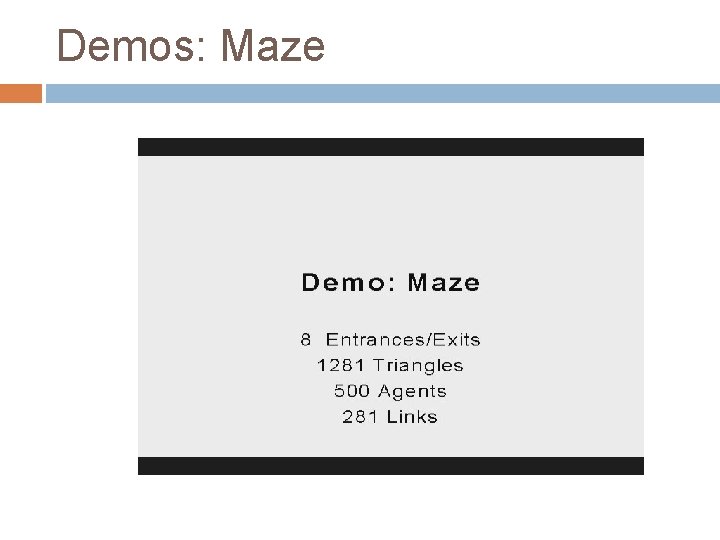
Demos: Maze
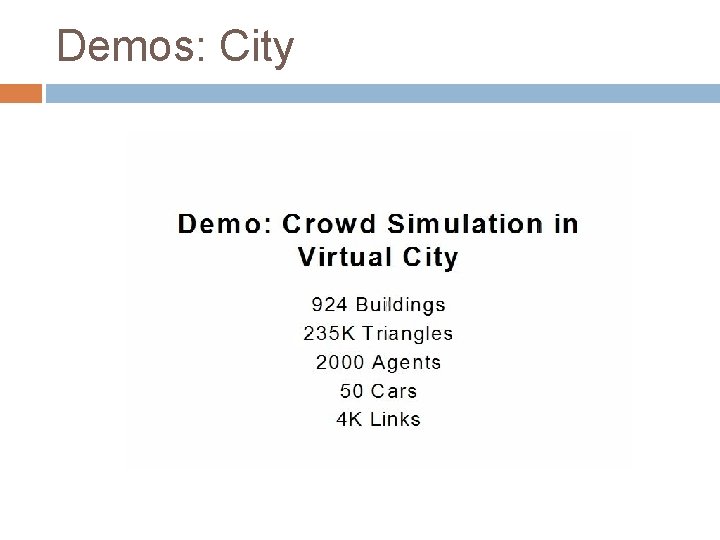
Demos: City
Demos: Tradeshow
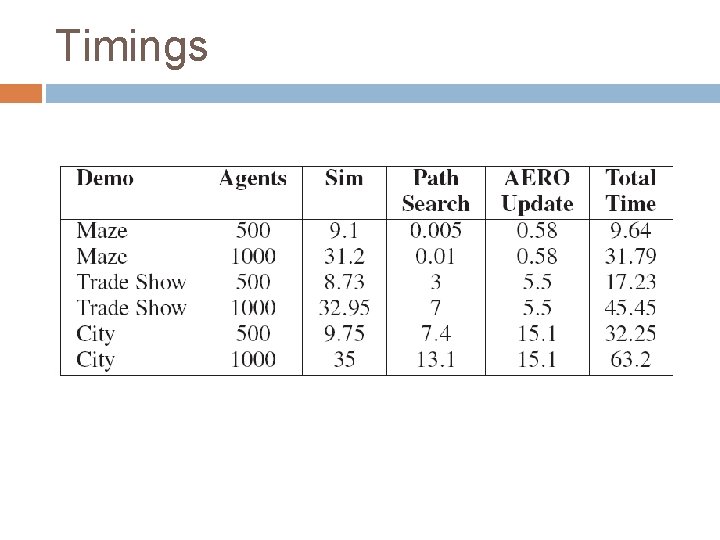
Timings
Outline Related Work Our Approach Results Discussion and Conclusion
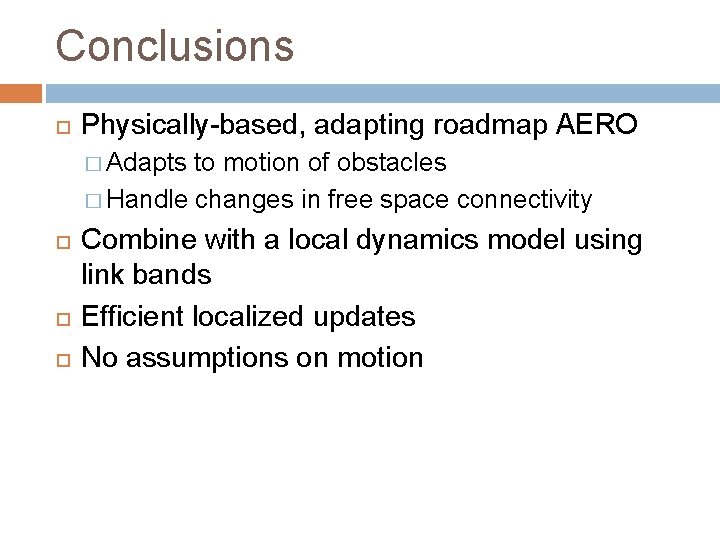
Conclusions Physically-based, adapting roadmap AERO � Adapts to motion of obstacles � Handle changes in free space connectivity Combine with a local dynamics model using link bands Efficient localized updates No assumptions on motion
Limitations Unrealistic high-Do. F human motion Computed paths may not be optimal Lacks convergence guarantees
Future Work Develop multi-resolution techniques � Exploit natural grouping behavior Higher Do. F articulated models for more realistic motions Example / Learning based methods to guide simulation [Lerner 2007]
Acknowledgements UNC GAMMA Group Anonymous reviewers Funding organizations � ARO � ONR � NSF � DARPA / RDECOM � Intel Corp � Microsoft Corp
Questions? http: //gamma. cs. unc. edu/crowd/aero avneesh. sud@microsoft. com