
RealTime MIMO Discrete Multitone Transceiver Testbed Alex G
Real-Time MIMO Discrete Multitone Transceiver Testbed Alex G. Olson, Aditya Chopra, Yousof Mortazavi, Ian C. Wong, and Brian L. Evans Embedded Signal Processing Laboratory The University of Texas at Austin
Introduction Problem Statement: �Single-channel wireline communications systems may not provide sufficient data rates for future telemetry applications �There is an upper limit to the communication bit rates depending on certain parameters : ü ü Modulation and coding schemes Transmit Energy Receiver noise floor Transmission Bandwidth Proposed Solution �Use multiple transceivers operating in parallel on different wires
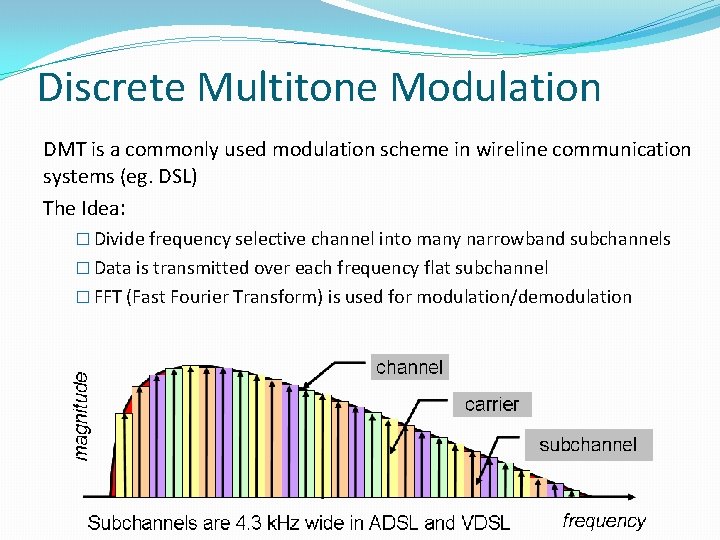
Discrete Multitone Modulation DMT is a commonly used modulation scheme in wireline communication systems (eg. DSL) The Idea: � Divide frequency selective channel into many narrowband subchannels � Data is transmitted over each frequency flat subchannel � FFT (Fast Fourier Transform) is used for modulation/demodulation
MIMO DMT Testbed Design Goal: Create a 2 x 2 DMT hardware testbed � Enables rapid prototyping/testing of new designs � Provides user with complete control over system parameters � Relatively unconstrained by resource and real-time issues � Can be connected to different cable designs � Allow visualization of the channel parameters and various communication performance metrics Benefits of Hardware Testbed � Configurable – User can choose system parameters and signal processing blocks � Allows evaluation of the communication performance and computational complexity tradeoffs � Cable modelling not required Design Challenges � Real-time constraints on the transmitter and receiver system � Analog front-end
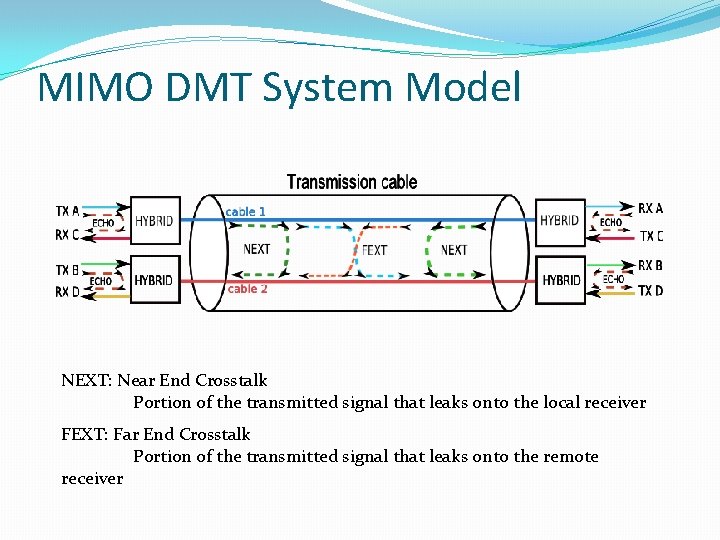
MIMO DMT System Model NEXT: Near End Crosstalk Portion of the transmitted signal that leaks onto the local receiver FEXT: Far End Crosstalk Portion of the transmitted signal that leaks onto the remote receiver
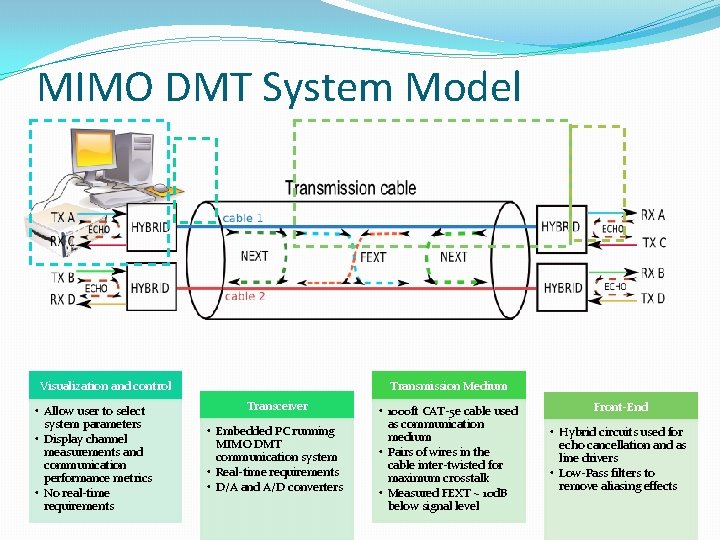
MIMO DMT System Model Visualization and control • Allow user to select system parameters • Display channel measurements and communication performance metrics • No real-time requirements Transmission Medium Transceiver • Embedded PC running MIMO DMT communication system • Real-time requirements • D/A and A/D converters • 1000 ft CAT-5 e cable used as communication medium • Pairs of wires in the cable inter-twisted for maximum crosstalk • Measured FEXT ~ 10 d. B below signal level Front-End • Hybrid circuits used for echo cancellation and as line drivers • Low-Pass filters to remove aliasing effects
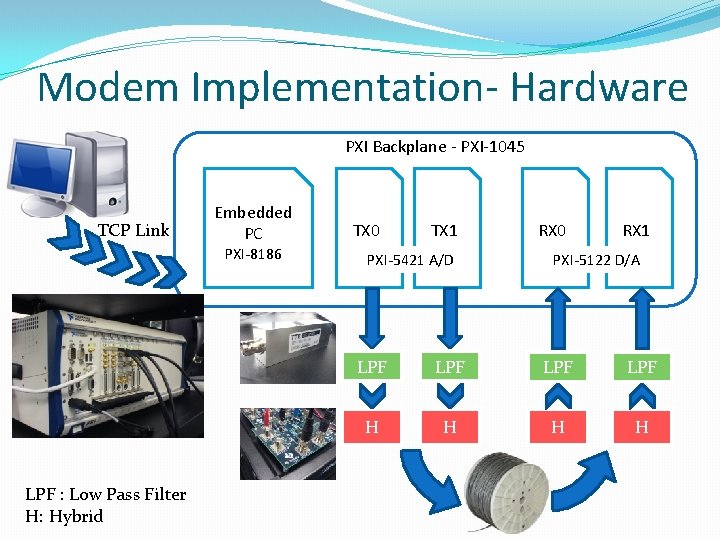
Modem Implementation- Hardware PXI Backplane - PXI-1045 TCP Link Embedded PC PXI-8186 LPF : Low Pass Filter H: Hybrid TX 0 TX 1 PXI-5421 A/D RX 0 RX 1 PXI-5122 D/A LPF LPF H H
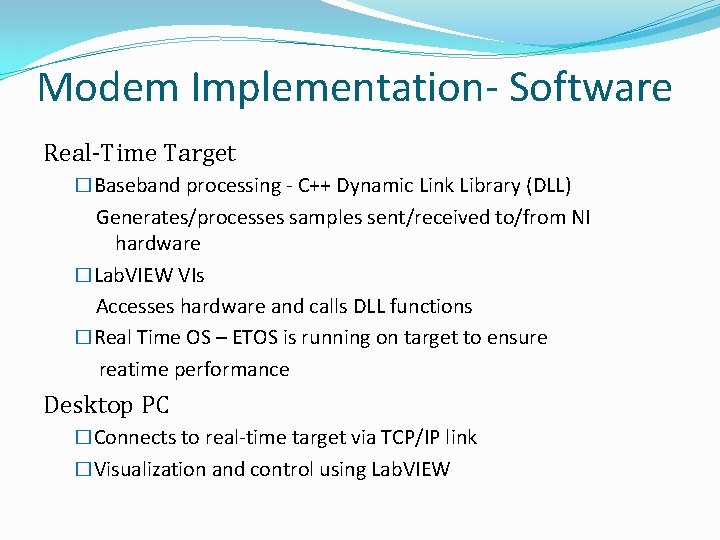
Modem Implementation- Software Real-Time Target �Baseband processing - C++ Dynamic Link Library (DLL) Generates/processes samples sent/received to/from NI hardware �Lab. VIEW VIs Accesses hardware and calls DLL functions �Real Time OS – ETOS is running on target to ensure reatime performance Desktop PC �Connects to real-time target via TCP/IP link �Visualization and control using Lab. VIEW
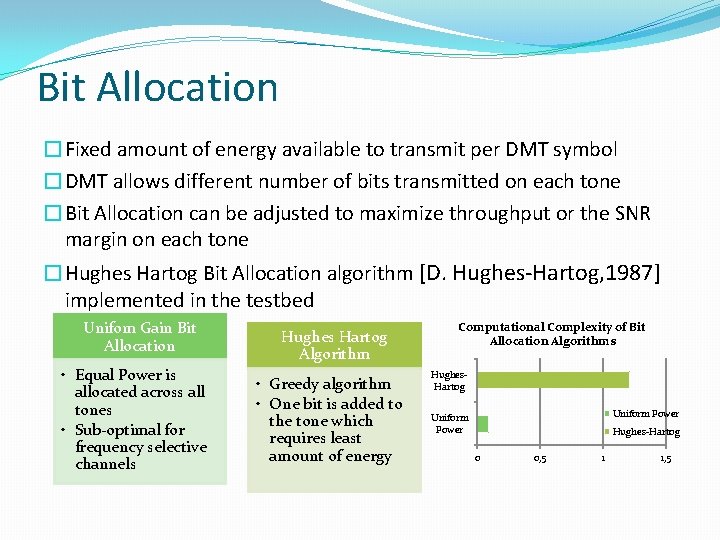
Bit Allocation �Fixed amount of energy available to transmit per DMT symbol �DMT allows different number of bits transmitted on each tone �Bit Allocation can be adjusted to maximize throughput or the SNR margin on each tone �Hughes Hartog Bit Allocation algorithm [D. Hughes-Hartog, 1987] implemented in the testbed Unifom Gain Bit Allocation • Equal Power is allocated across all tones • Sub-optimal for frequency selective channels Hughes Hartog Algorithm • Greedy algorithm • One bit is added to the tone which requires least amount of energy Computational Complexity of Bit Allocation Algorithms Hughes. Hartog Uniform Power Hughes-Hartog 0 0, 5 1 1, 5
FEXT Cancellation �Far End Crosstalk provides significant amount of deterioration to the bit rate �Using vectored DMT [Ginis and Cioffi, 2002] the multiple receivers are assumed to operate together to cancel crosstalk �Crosstalk can be cancelled through linear and non linear receivers � The Zero Forcing equalizer is an example of a linear receiver with crosstalk cancellation � Successive Interference Cancellation is a non linear crosstalk cancellation receiver
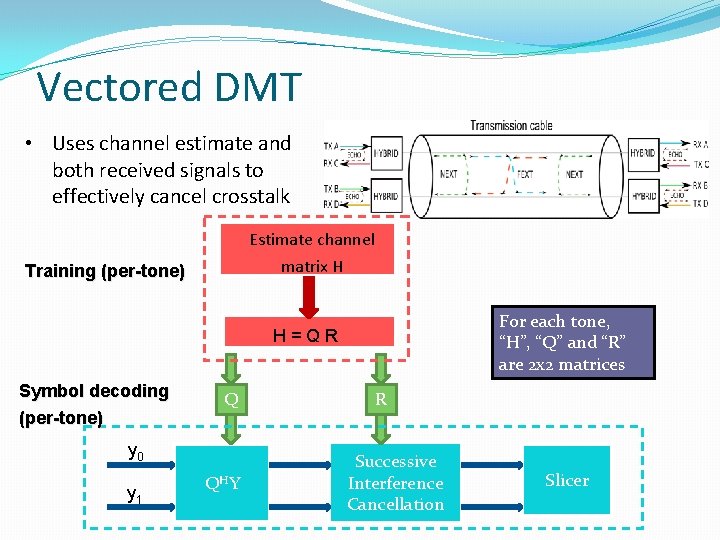
Vectored DMT • Uses channel estimate and both received signals to effectively cancel crosstalk Estimate channel matrix H Training (per-tone) For each tone, “H”, “Q” and “R” are 2 x 2 matrices H=QR Symbol decoding (per-tone) Q y 0 y 1 QHY R Successive Interference Cancellation Slicer
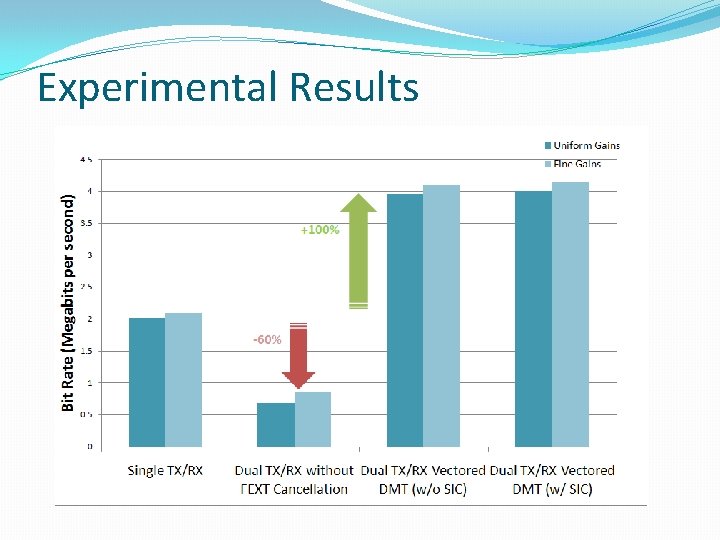
Experimental Results • System Parameters • 256 tones per DMT symbol • Maximum Transmitted Voltage 5. 0 V • Receiver noise floor ~ -60 d. B • 1000 ft CAT-5 cable • Inter-twisted pairs for maximum FEXT • FEXT limits SNR to ~10 d. B
Experimental Results
Conclusions �FEXT (crosstalk) can be effectively cancelled with Vectored DMT �Experimental tests show that a 2 x 2 Vectored DMT system achieves 1. 99 x data rate (~4 Mbps) over singlechannel DMT �Vectored DMT is practical and has low implementation cost (for 2 x 2 MIMO systems) �Hughes-Hartog bit loading (fine gains) can provide ~100 Kbps data rate improvement over uniform gain

�D. Hughes-Hartog, ”Ensemble modem structure for imperfect transmission media. ” U. S. Patents Nos. 4, 679, 227 (July 1987), 4, 731, 816 (March 1988), and 4, 833, 706 (May 1989) �G. Ginis and J. Cioffi, “Vectored transmission for digital subscriber line systems, ” IEEE J. Select. Areas Commun. , vol. 20, no. 5, pp. 1085 -1104, Jun. 2002
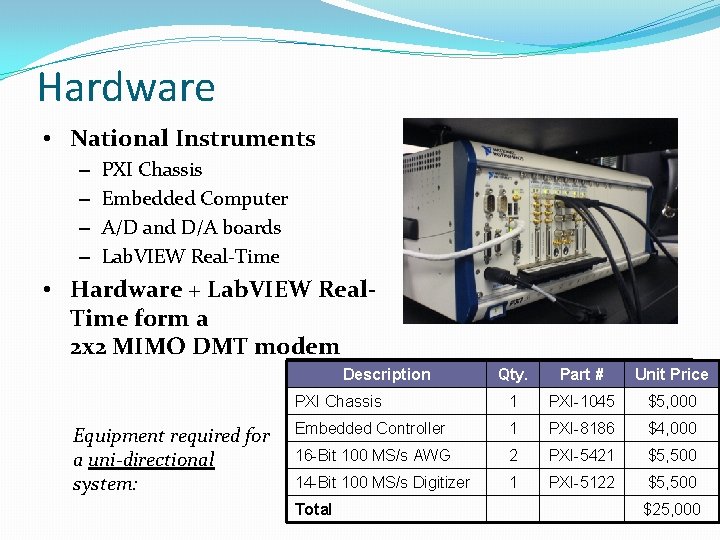
Hardware • National Instruments – – PXI Chassis Embedded Computer A/D and D/A boards Lab. VIEW Real-Time • Hardware + Lab. VIEW Real. Time form a 2 x 2 MIMO DMT modem Description Equipment required for a uni-directional system: Qty. Part # Unit Price PXI Chassis 1 PXI-1045 $5, 000 Embedded Controller 1 PXI-8186 $4, 000 16 -Bit 100 MS/s AWG 2 PXI-5421 $5, 500 14 -Bit 100 MS/s Digitizer 1 PXI-5122 $5, 500 Total $25, 000
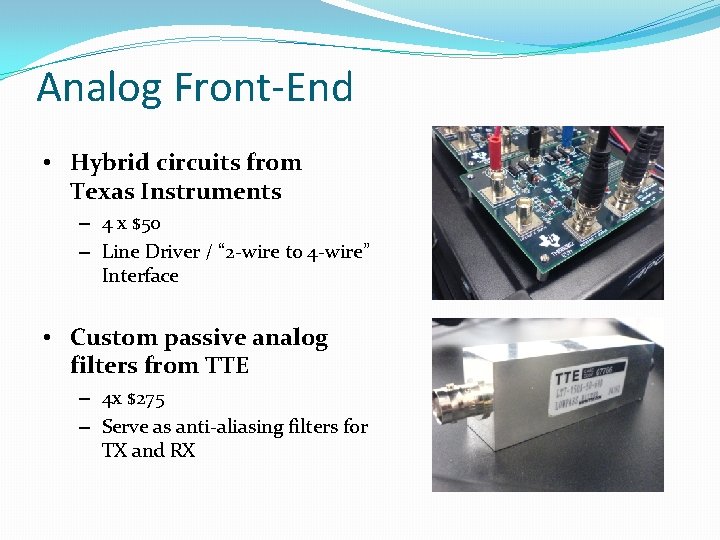
Analog Front-End • Hybrid circuits from Texas Instruments – 4 x $50 – Line Driver / “ 2 -wire to 4 -wire” Interface • Custom passive analog filters from TTE – 4 x $275 – Serve as anti-aliasing filters for TX and RX
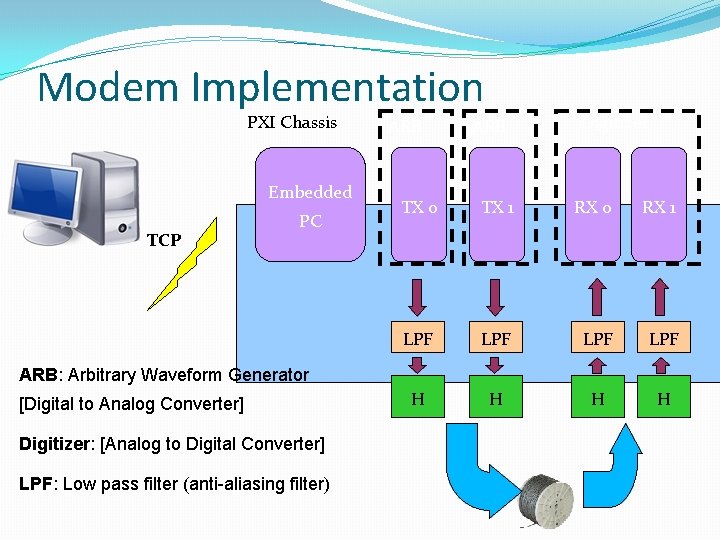
Modem Implementation PXI Chassis Embedded TCP PC ARB Digitizer TX 0 TX 1 RX 0 RX 1 LPF LPF H H ARB: Arbitrary Waveform Generator [Digital to Analog Converter] Digitizer: [Analog to Digital Converter] LPF: Low pass filter (anti-aliasing filter)
- Slides: 19