
RealTime Hatching Emil Praun Hugues Hoppe Matthew Webb
Real–Time Hatching Emil Praun Hugues Hoppe Matthew Webb Adam Finkelstein Princeton University Microsoft Research Princeton University
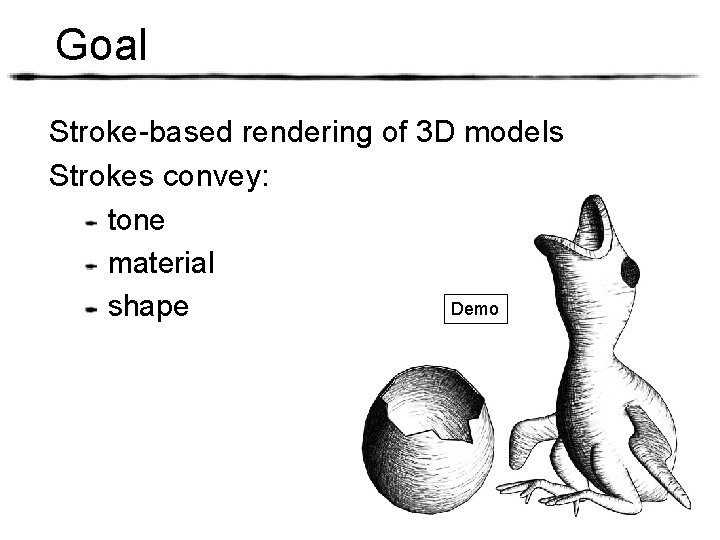
Goal Stroke-based rendering of 3 D models Strokes convey: tone material Demo shape
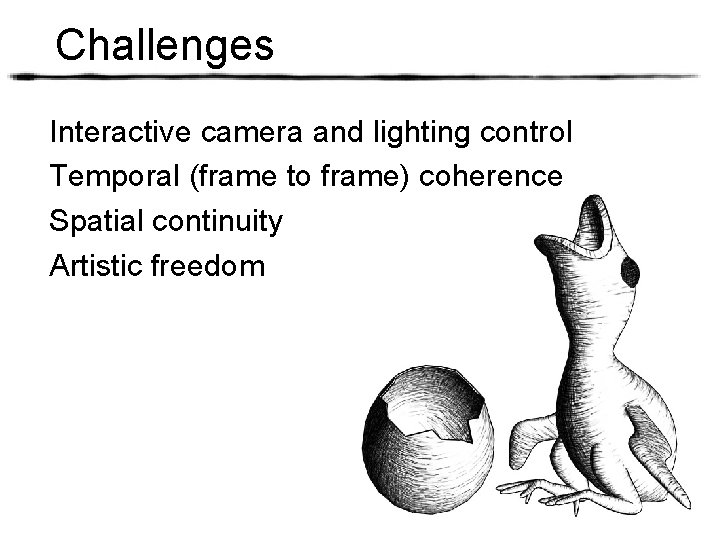
Challenges Interactive camera and lighting control Temporal (frame to frame) coherence Spatial continuity Artistic freedom
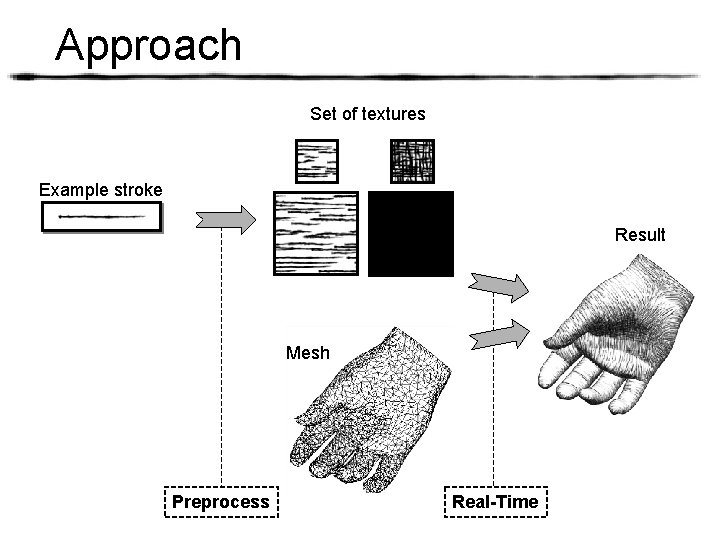
Approach Set of textures Example stroke Result Mesh Preprocess Real-Time
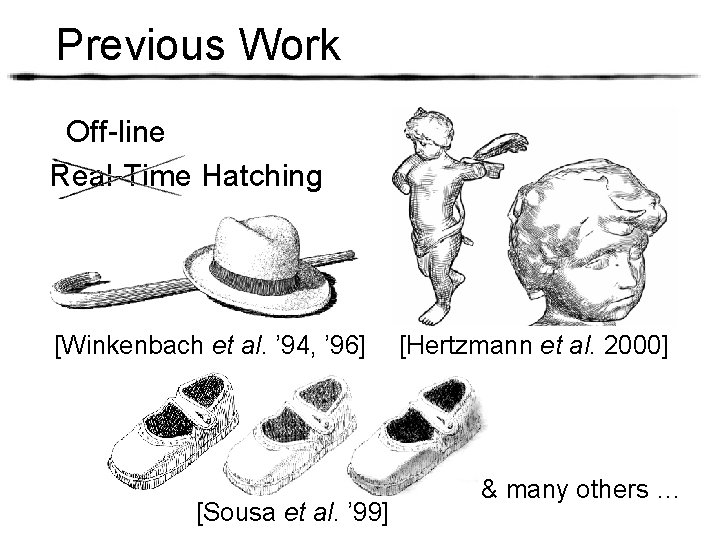
Previous Work Off-line Real-Time Hatching [Winkenbach et al. ’ 94, ’ 96] [Sousa et al. ’ 99] [Hertzmann et al. 2000] & many others …
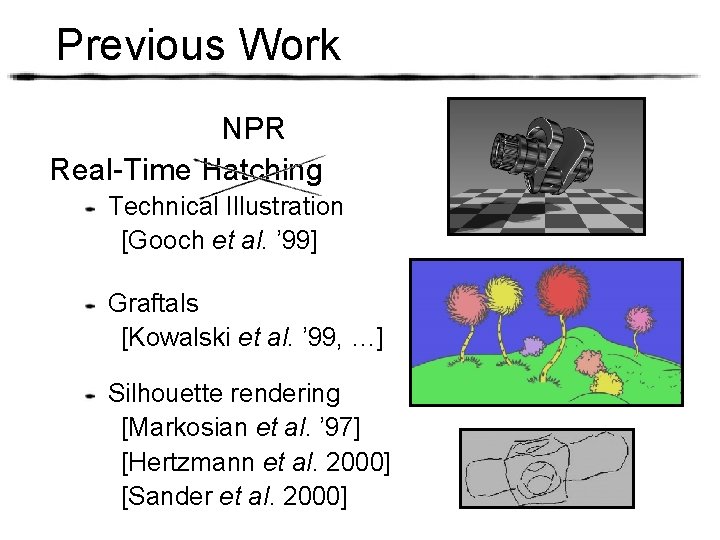
Previous Work NPR Real-Time Hatching Technical Illustration [Gooch et al. ’ 99] Graftals [Kowalski et al. ’ 99, …] Silhouette rendering [Markosian et al. ’ 97] [Hertzmann et al. 2000] [Sander et al. 2000]
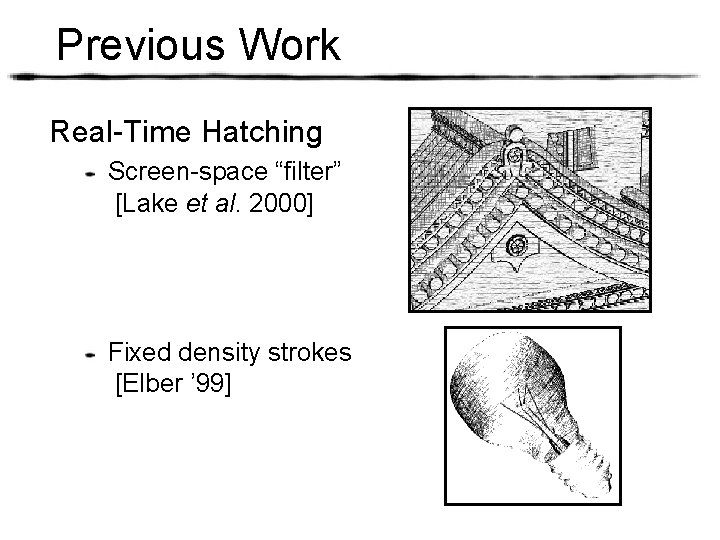
Previous Work Real-Time Hatching Screen-space “filter” [Lake et al. 2000] Fixed density strokes [Elber ’ 99]
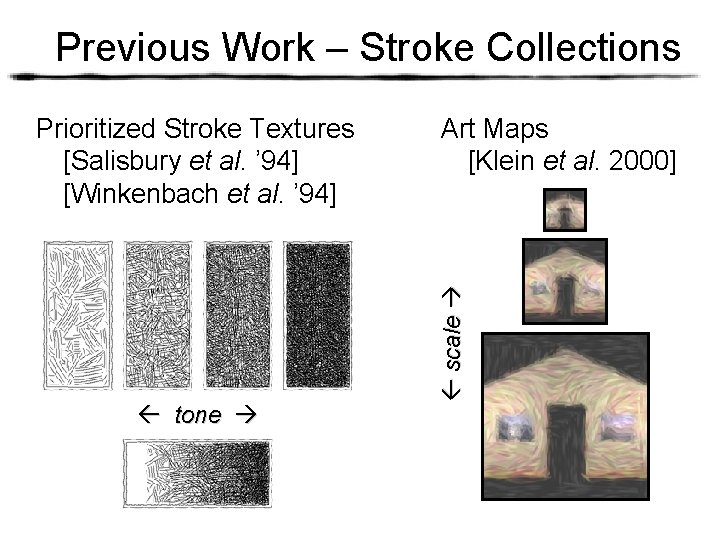
Previous Work – Stroke Collections tone Art Maps [Klein et al. 2000] scale Prioritized Stroke Textures [Salisbury et al. ’ 94] [Winkenbach et al. ’ 94]
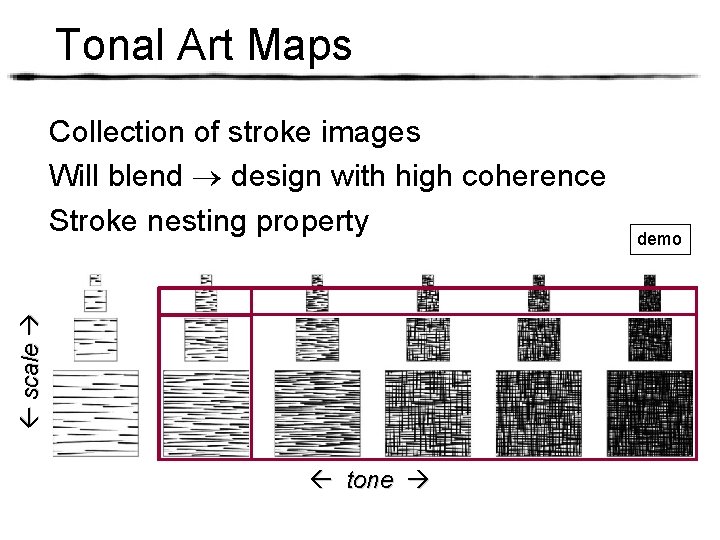
Tonal Art Maps scale Collection of stroke images Will blend design with high coherence Stroke nesting property tone demo
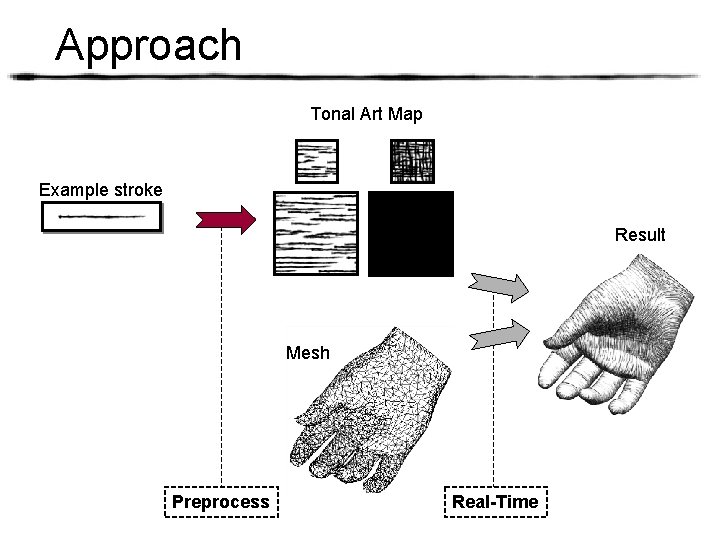
Approach Tonal Art Map Example stroke Result Mesh Preprocess Real-Time
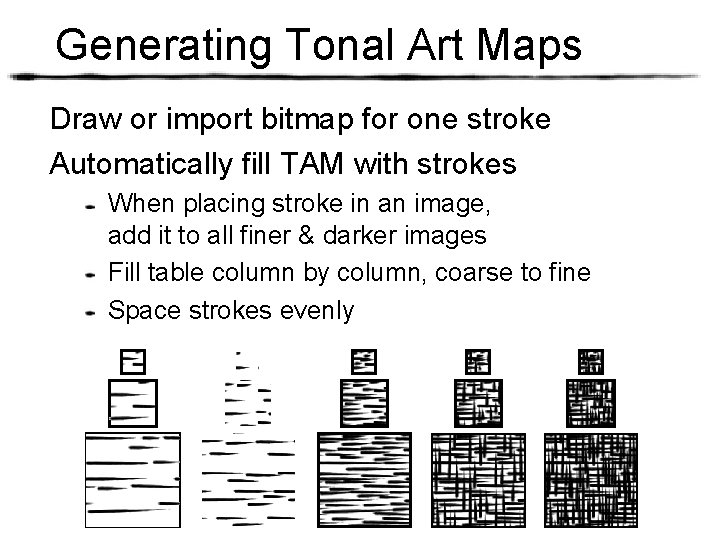
Generating Tonal Art Maps Draw or import bitmap for one stroke Automatically fill TAM with strokes When placing stroke in an image, add it to all finer & darker images Fill table column by column, coarse to fine Space strokes evenly
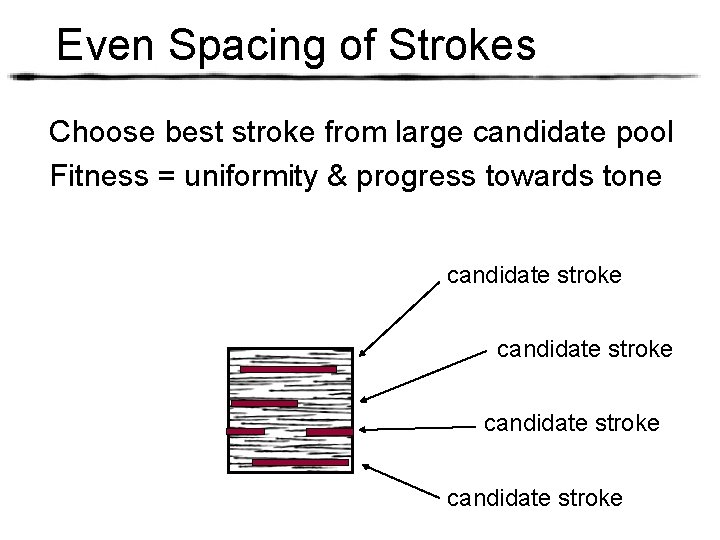
Even Spacing of Strokes Choose best stroke from large candidate pool Fitness = uniformity & progress towards tone candidate stroke
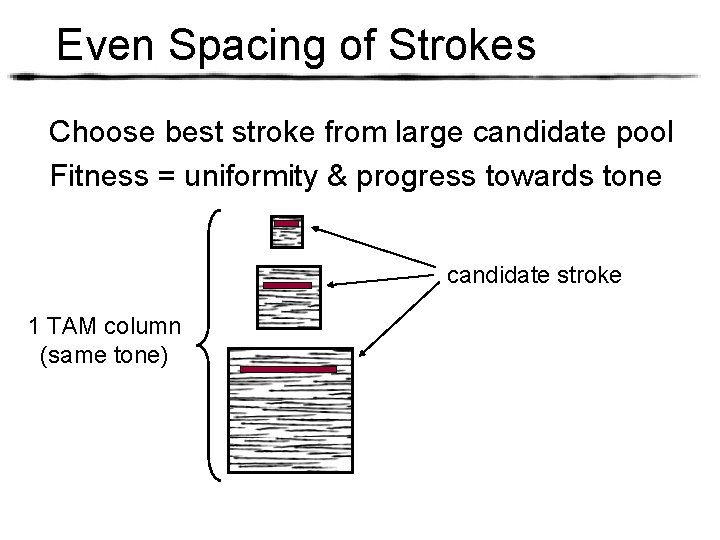
Even Spacing of Strokes Choose best stroke from large candidate pool Fitness = uniformity & progress towards tone candidate stroke 1 TAM column (same tone)
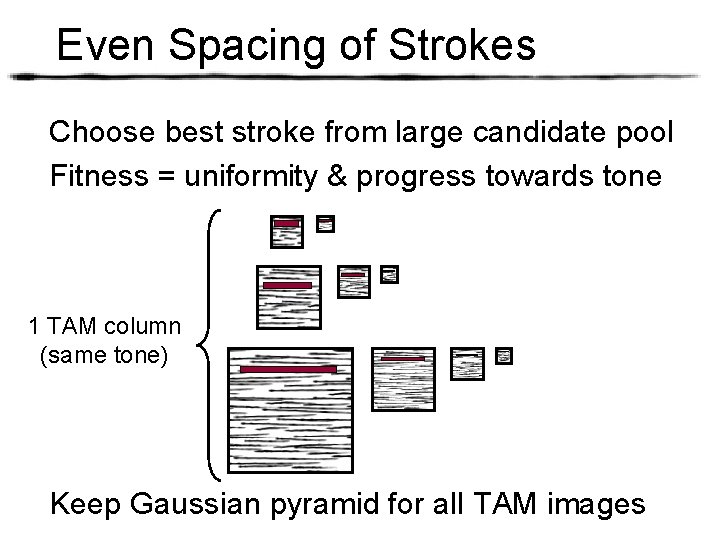
Even Spacing of Strokes Choose best stroke from large candidate pool Fitness = uniformity & progress towards tone 1 TAM column (same tone) Keep Gaussian pyramid for all TAM images
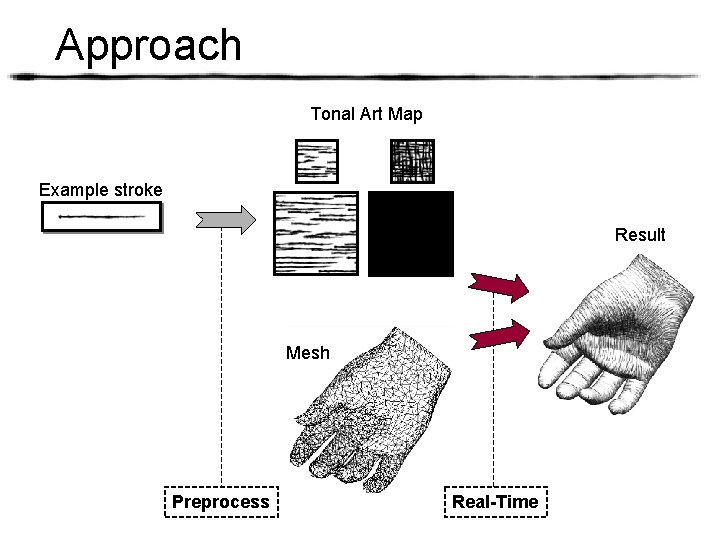
Approach Tonal Art Map Example stroke Result Mesh Preprocess Real-Time
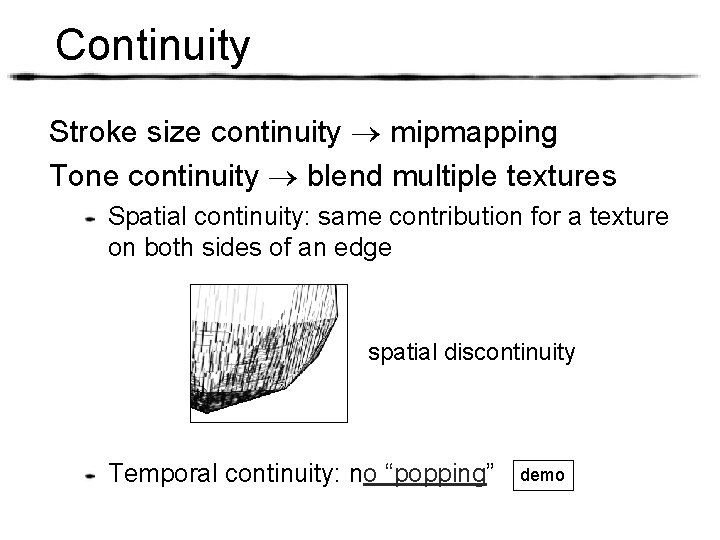
Continuity Stroke size continuity mipmapping Tone continuity blend multiple textures Spatial continuity: same contribution for a texture on both sides of an edge spatial discontinuity Temporal continuity: no “popping” demo
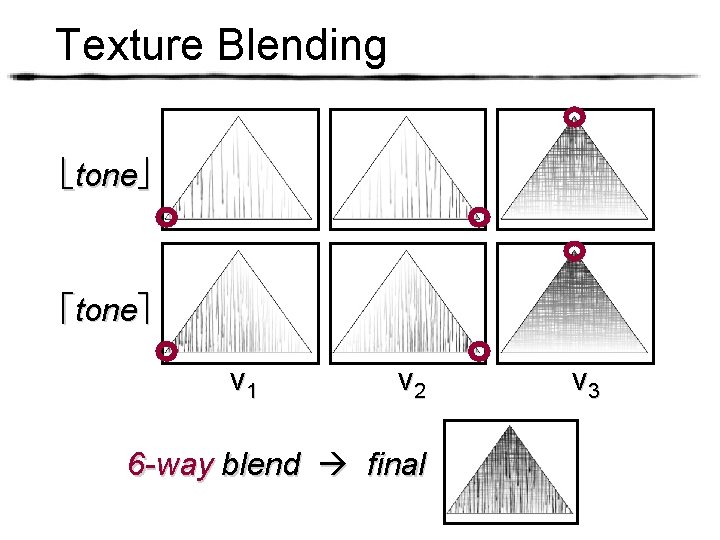
Texture Blending tone v 1 v 2 6 -way blend final v 3
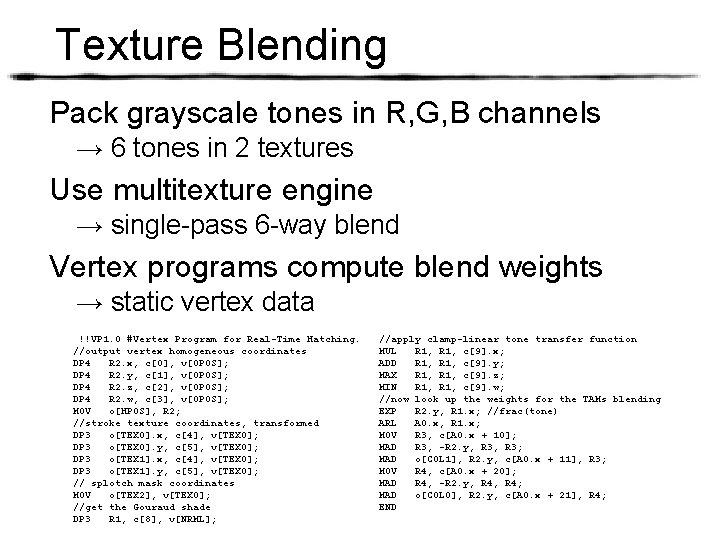
Texture Blending Pack grayscale tones in R, G, B channels → 6 tones in 2 textures Use multitexture engine → single-pass 6 -way blend Vertex programs compute blend weights → static vertex data !!VP 1. 0 #Vertex Program for Real-Time Hatching. //output vertex homogeneous coordinates DP 4 R 2. x, c[0], v[OPOS]; DP 4 R 2. y, c[1], v[OPOS]; DP 4 R 2. z, c[2], v[OPOS]; DP 4 R 2. w, c[3], v[OPOS]; MOV o[HPOS], R 2; //stroke texture coordinates, transformed DP 3 o[TEX 0]. x, c[4], v[TEX 0]; DP 3 o[TEX 0]. y, c[5], v[TEX 0]; DP 3 o[TEX 1]. x, c[4], v[TEX 0]; DP 3 o[TEX 1]. y, c[5], v[TEX 0]; // splotch mask coordinates MOV o[TEX 2], v[TEX 0]; //get the Gouraud shade DP 3 R 1, c[8], v[NRML]; //apply clamp-linear tone transfer function MUL R 1, c[9]. x; ADD R 1, c[9]. y; MAX R 1, c[9]. z; MIN R 1, c[9]. w; //now look up the weights for the TAMs blending EXP R 2. y, R 1. x; //frac(tone) ARL A 0. x, R 1. x; MOV R 3, c[A 0. x + 10]; MAD R 3, -R 2. y, R 3; MAD o[COL 1], R 2. y, c[A 0. x + 11], R 3; MOV R 4, c[A 0. x + 20]; MAD R 4, -R 2. y, R 4; MAD o[COL 0], R 2. y, c[A 0. x + 21], R 4; END
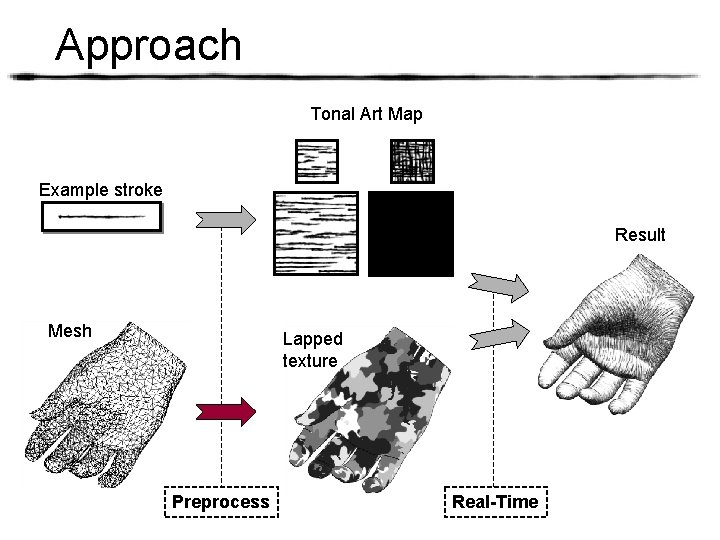
Approach Tonal Art Map Example stroke Result Mesh Lapped texture Preprocess Real-Time
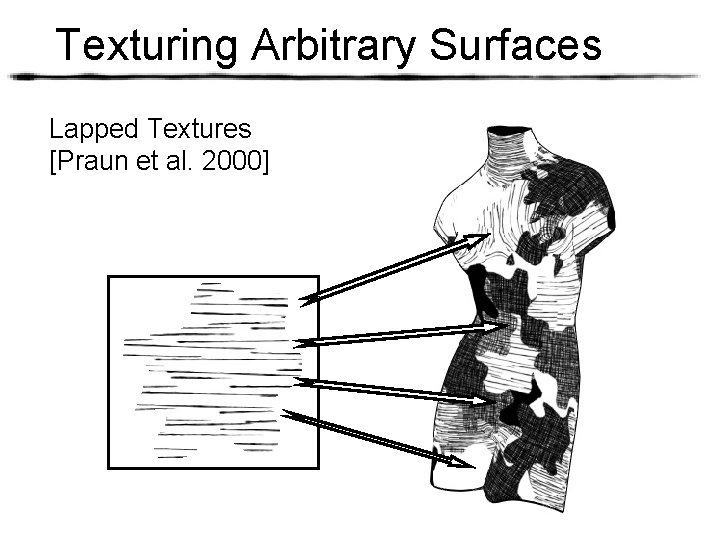
Texturing Arbitrary Surfaces Lapped Textures [Praun et al. 2000]
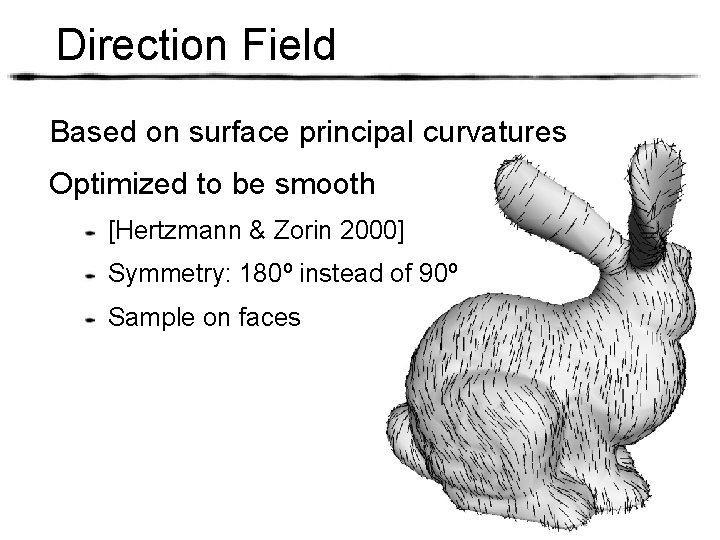
Direction Field Based on surface principal curvatures Optimized to be smooth [Hertzmann & Zorin 2000] Symmetry: 180º instead of 90º Sample on faces
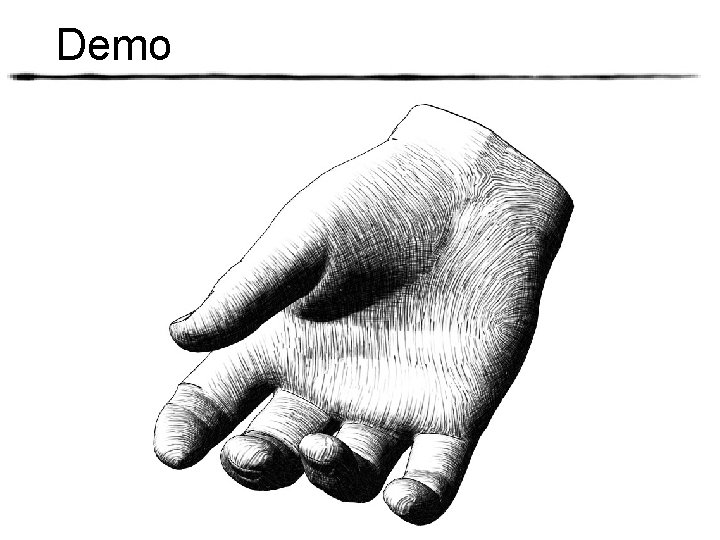
Demo
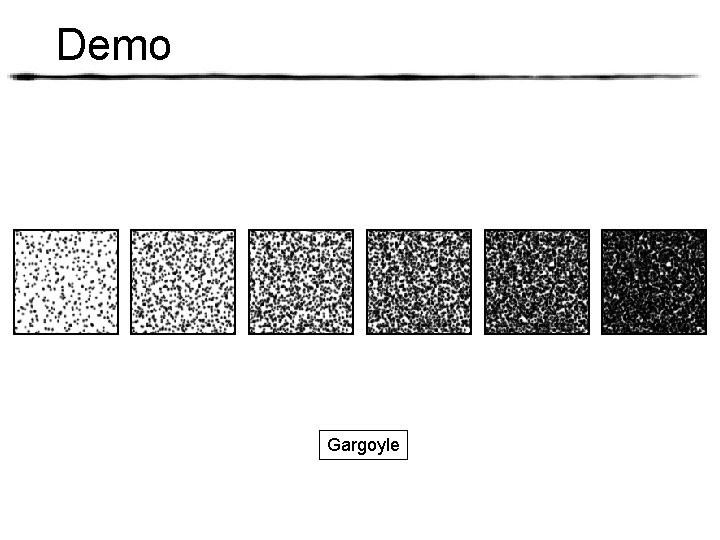
Demo Gargoyle
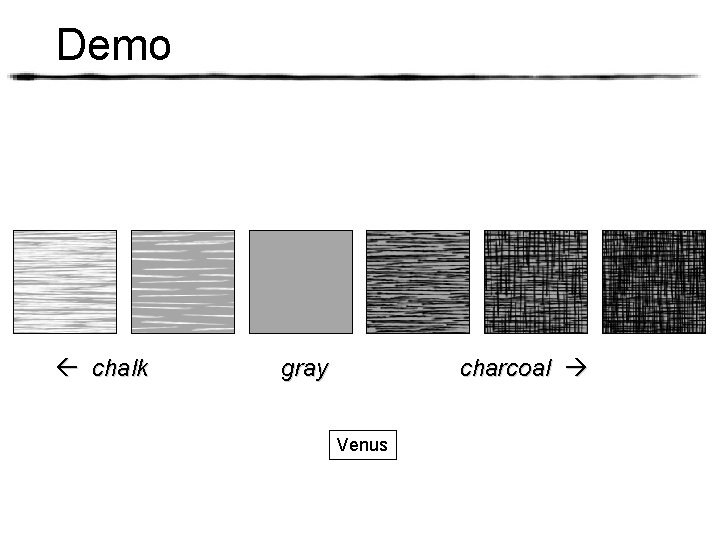
Demo chalk gray charcoal Venus
Summary Real-time hatching for NPR Strokes rendered as textures High coherence TAMs prevent blend artifacts 6 -way blend very fast on modern graphics
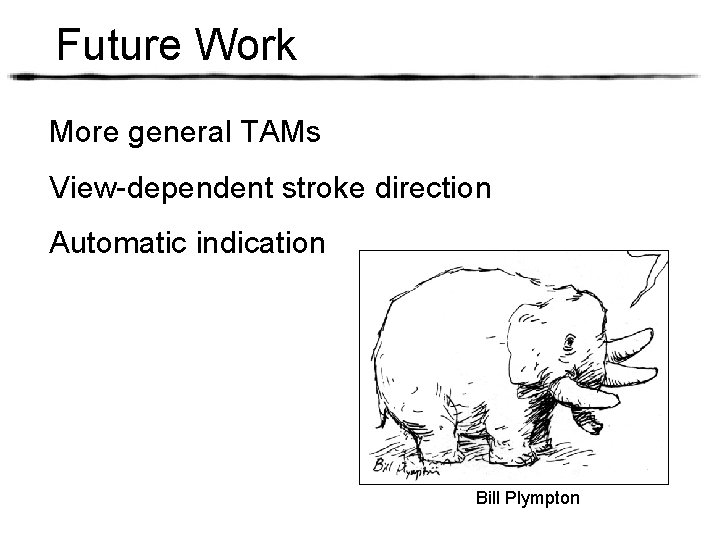
Future Work More general TAMs View-dependent stroke direction Automatic indication Bill Plympton
Acknowledgements Support Microsoft Research, NSF Hardware NVidia, Dell Models Viewpoint, Cyberware, Stanford, MIT Thanks Georges Winkenbach, Lee Markosian, Grady Klein

NPAR 2002 International Symposium on Non-Photorealistic Animation and Rendering • Annecy, France • Submissions: November 12, 2001 • Conference: June 3 -5, 2002 http: //npar 2002. cs. princeton. edu
- Slides: 28