
Realtime AI Systems Academia Giuseppe Di Guglielmo giuseppecs


- Slides: 22
Real-time AI Systems (Academia) Giuseppe Di Guglielmo giuseppe@cs. columbia. edu Columbia University Fast Machine Learning Fermi Lab September 10 -13, 2019
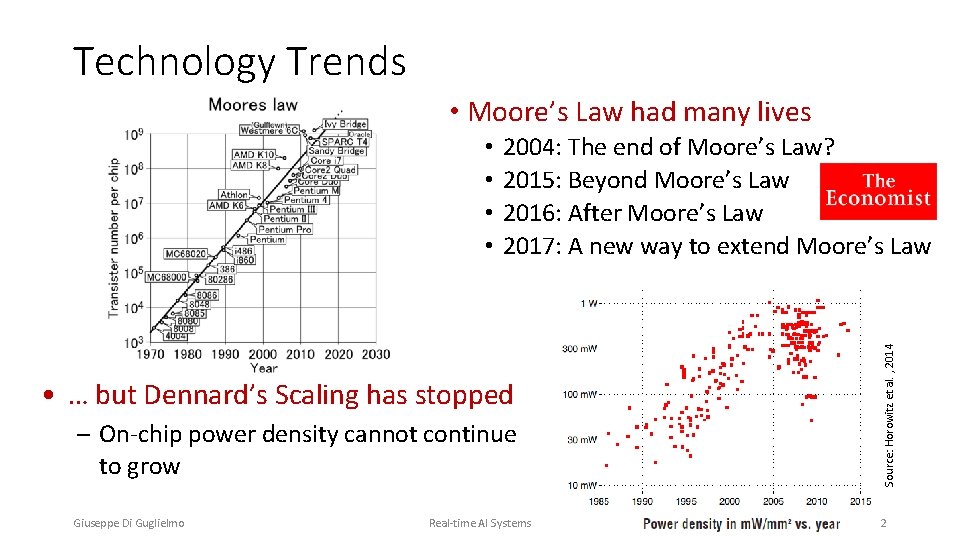
Technology Trends • Moore’s Law had many lives 2004: The end of Moore’s Law? 2015: Beyond Moore’s Law 2016: After Moore’s Law 2017: A new way to extend Moore’s Law – On‐chip power density cannot continue to grow Source: Horowitz et al. , 2014 • • Giuseppe Di Guglielmo 2 • … but Dennard’s Scaling has stopped Real‐time AI Systems
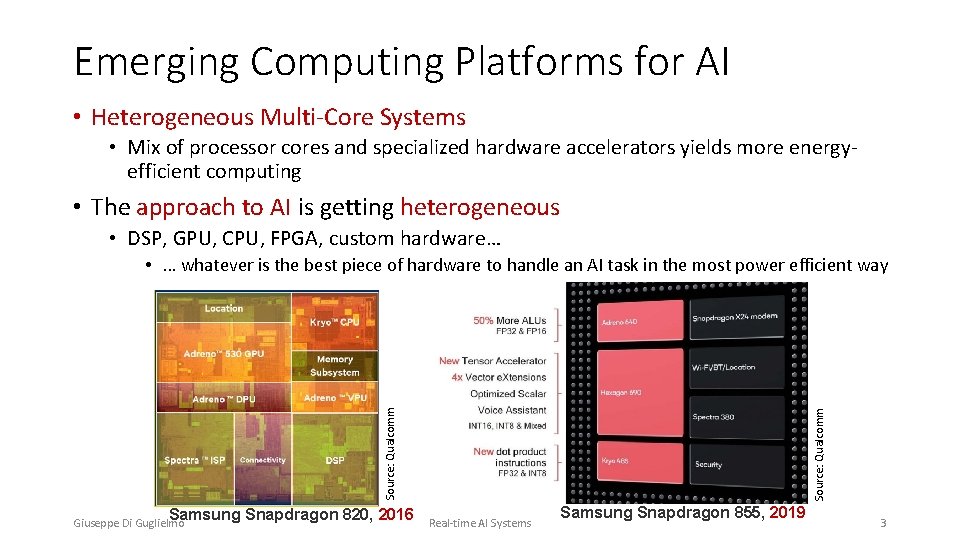
Emerging Computing Platforms for AI • Heterogeneous Multi‐Core Systems • Mix of processor cores and specialized hardware accelerators yields more energy‐ efficient computing • The approach to AI is getting heterogeneous • DSP, GPU, CPU, FPGA, custom hardware… Samsung Snapdragon 820, 2016 Giuseppe Di Guglielmo Source: Qualcomm • … whatever is the best piece of hardware to handle an AI task in the most power efficient way Real‐time AI Systems Samsung Snapdragon 855, 2019 3
Heterogeneous Multi-core System-on-Chip EC 2 F 1 November 2016 May 2016 (1 st gen. ) May 2017 (2 nd gen. ) March 2017 Zynq Ultra. Scale+ MPSo. C June 2016 Ivy Town Xeon + FPGA: The HARP Program Versal August 2017 Giuseppe Di Guglielmo December 2013 Sources: Intel, Google, Xilinx, Amazon Real‐time AI Systems October 2018 4
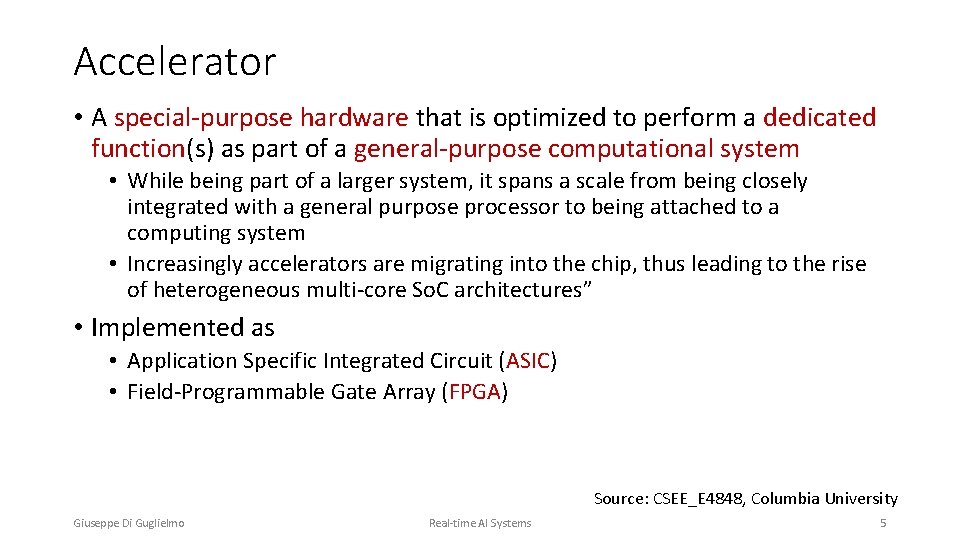
Accelerator • A special‐purpose hardware that is optimized to perform a dedicated function(s) as part of a general‐purpose computational system • While being part of a larger system, it spans a scale from being closely integrated with a general purpose processor to being attached to a computing system • Increasingly accelerators are migrating into the chip, thus leading to the rise of heterogeneous multi‐core So. C architectures” • Implemented as • Application Specific Integrated Circuit (ASIC) • Field‐Programmable Gate Array (FPGA) Source: CSEE_E 4848, Columbia University Giuseppe Di Guglielmo Real‐time AI Systems 5
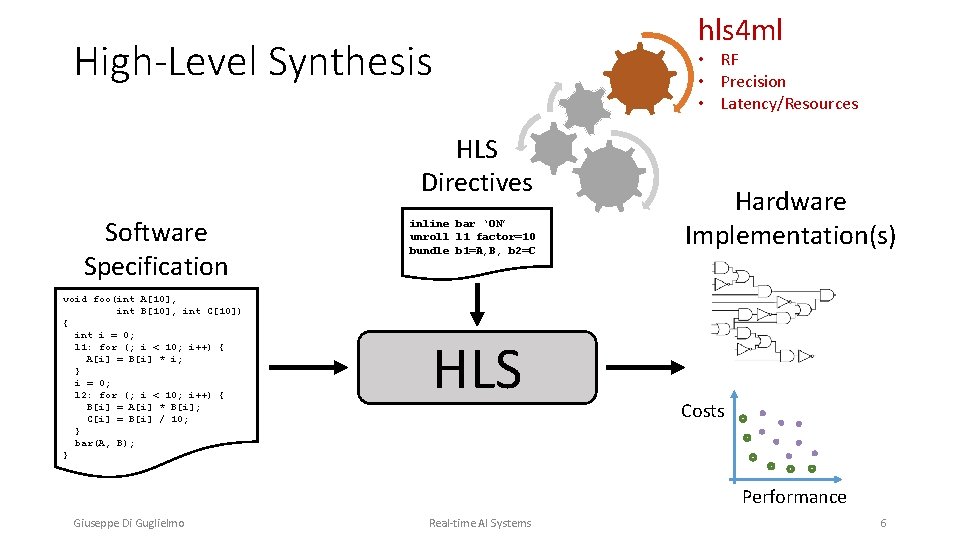
High-Level Synthesis HLS Directives Software Specification void foo(int A[10], int B[10], int C[10]) { int i = 0; l 1: for (; i < 10; i++) { A[i] = B[i] * i; } i = 0; l 2: for (; i < 10; i++) { B[i] = A[i] * B[i]; C[i] = B[i] / 10; } bar(A, B); } inline bar ‘ON’ unroll l 1 factor=10 bundle b 1=A, B, b 2=C HLS hls 4 ml • RF • Precision • Latency/Resources Hardware Implementation(s) Costs Performance Giuseppe Di Guglielmo Real‐time AI Systems 6
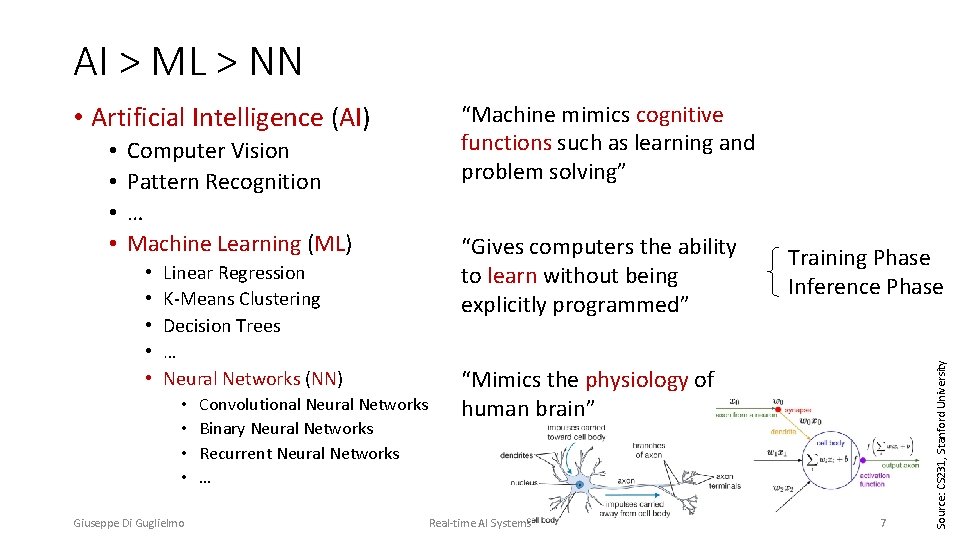
AI > ML > NN • • Computer Vision Pattern Recognition … Machine Learning (ML) • • • Linear Regression K‐Means Clustering Decision Trees … Neural Networks (NN) • • Giuseppe Di Guglielmo Convolutional Neural Networks Binary Neural Networks Recurrent Neural Networks … “Machine mimics cognitive functions such as learning and problem solving” “Gives computers the ability to learn without being explicitly programmed” Training Phase Inference Phase “Mimics the physiology of human brain” Real‐time AI Systems 7 Source: CS 231, Stanford University • Artificial Intelligence (AI)
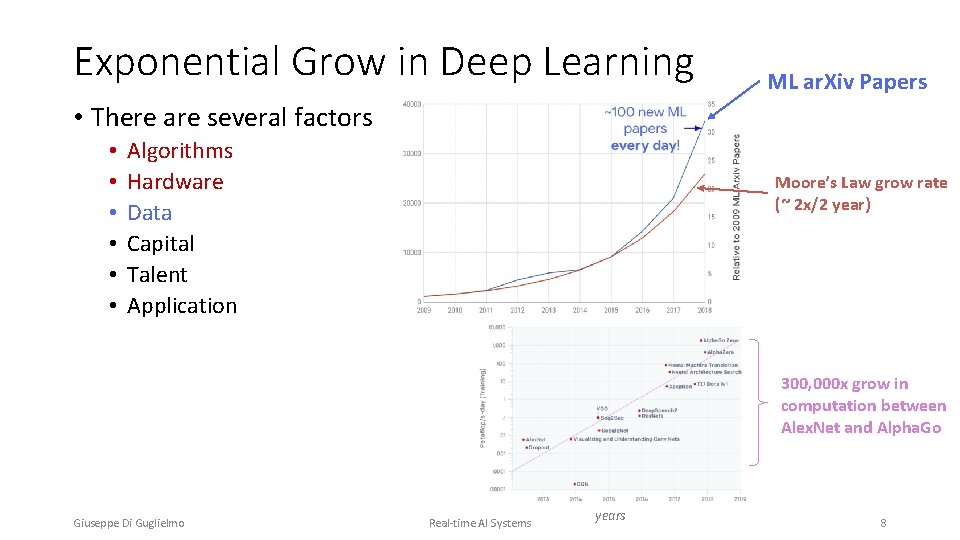
Exponential Grow in Deep Learning ML ar. Xiv Papers • There are several factors • • • Algorithms Hardware Data Capital Talent Application Moore’s Law grow rate (~ 2 x/2 year) 300, 000 x grow in computation between Alex. Net and Alpha. Go Giuseppe Di Guglielmo Real‐time AI Systems years 8
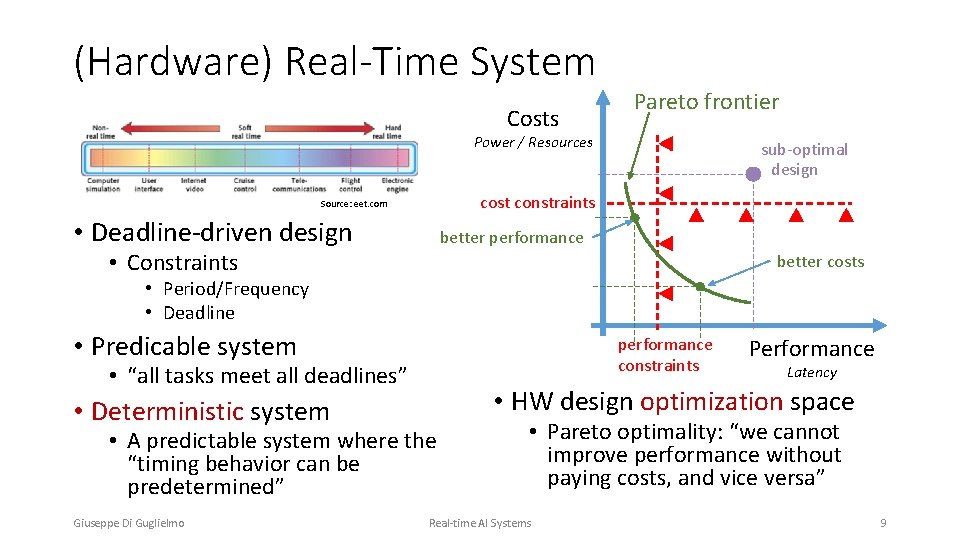
(Hardware) Real-Time System Costs Pareto frontier Power / Resources sub‐optimal design cost constraints Source: eet. com • Deadline‐driven design better performance • Constraints better costs • Period/Frequency • Deadline • Predicable system performance constraints • “all tasks meet all deadlines” • Deterministic system Latency • HW design optimization space • A predictable system where the “timing behavior can be predetermined” Giuseppe Di Guglielmo Performance • Pareto optimality: “we cannot improve performance without paying costs, and vice versa” Real‐time AI Systems 9
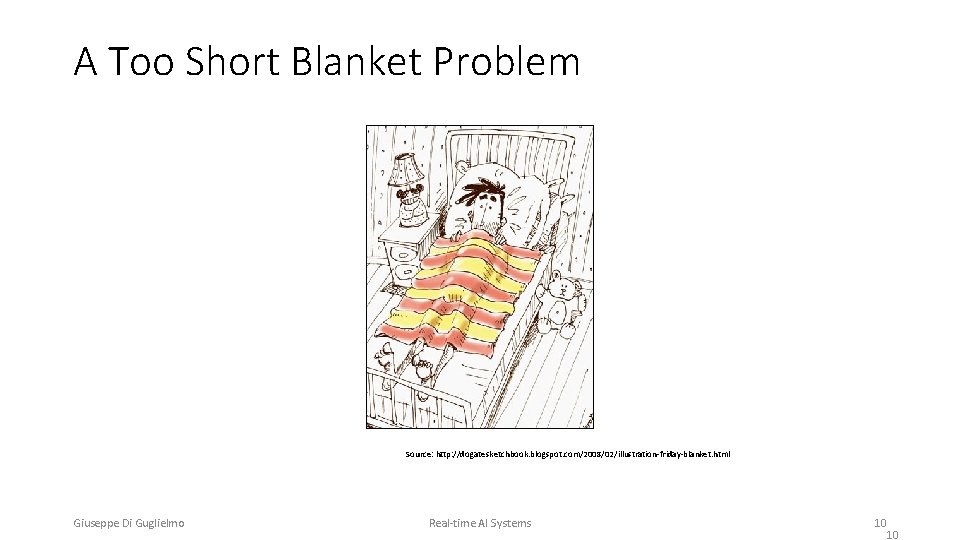
A Too Short Blanket Problem Source: http: //dogatesketchbook. blogspot. com/2008/02/illustration‐friday‐blanket. html Giuseppe Di Guglielmo Real‐time AI Systems 10 10
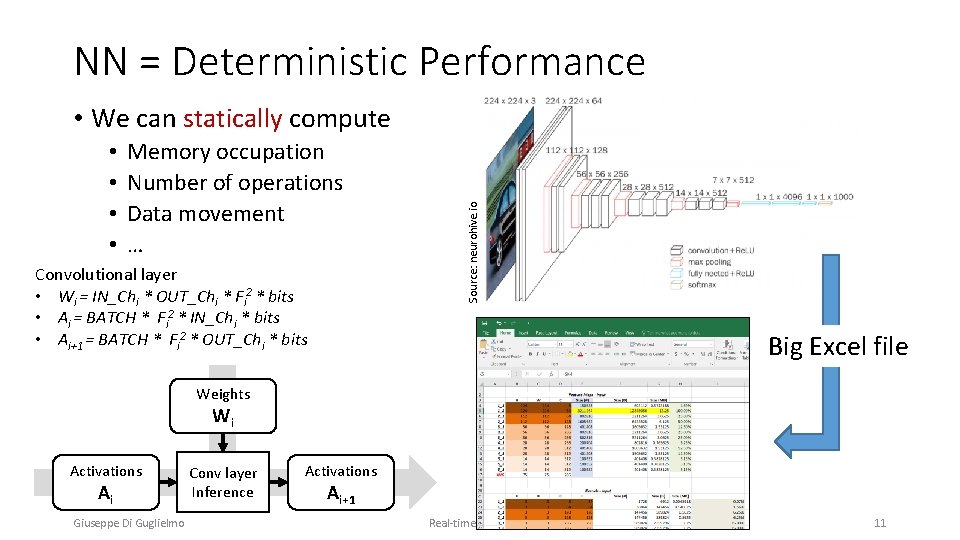
NN = Deterministic Performance • • Memory occupation Number of operations Data movement … Convolutional layer • Wi = IN_Chi * OUT_Chi * Fi 2 * bits • Ai = BATCH * Fi 2 * IN_Chi * bits • Ai+1 = BATCH * Fi 2 * OUT_Chi * bits Source: neurohive. io • We can statically compute Big Excel file Weights Wi Activations Ai Giuseppe Di Guglielmo Conv layer Inference Activations Ai+1 Real‐time AI Systems 11
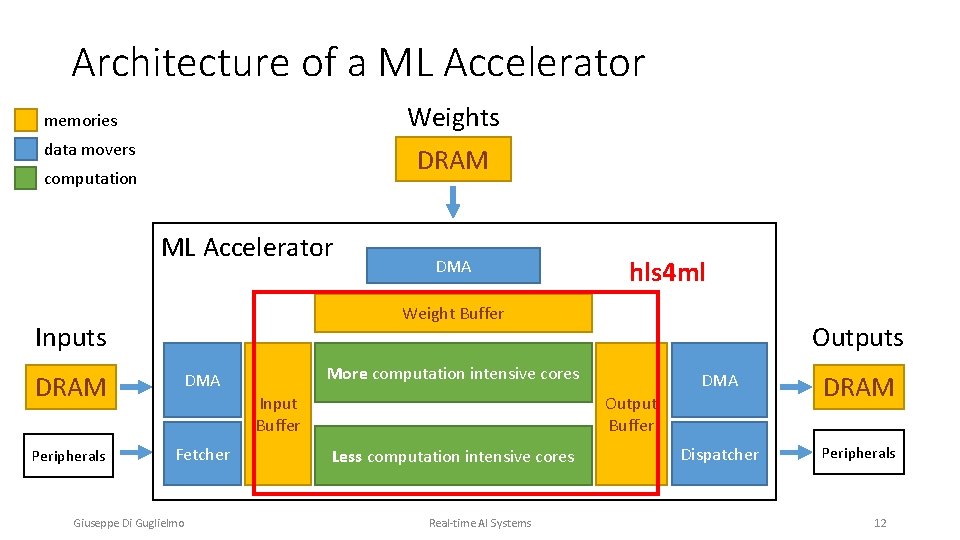
Architecture of a ML Accelerator Weights memories data movers DRAM computation ML Accelerator DMA hls 4 ml Weight Buffer Inputs DRAM DMA Peripherals Fetcher More computation intensive cores Input Buffer Giuseppe Di Guglielmo Outputs DMA DRAM Dispatcher Peripherals Output Buffer Less computation intensive cores Real‐time AI Systems 12
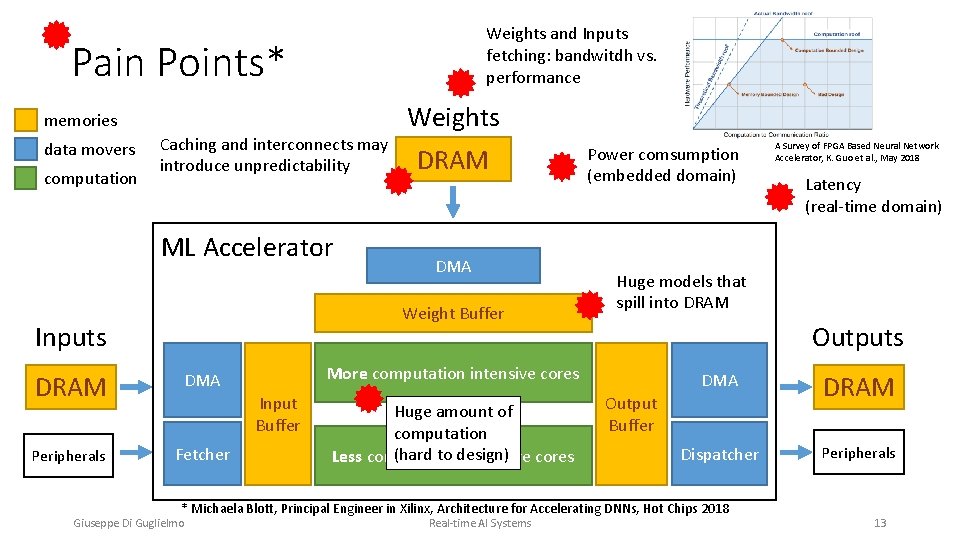
Weights and Inputs fetching: bandwitdh vs. performance Pain Points* memories data movers computation Caching and interconnects may introduce unpredictability ML Accelerator Weights DRAM DMA Weight Buffer Inputs DRAM DMA Peripherals Fetcher Power comsumption (embedded domain) Huge amount of computation (hard to design) Less computation intensive cores Outputs DMA DRAM Dispatcher Peripherals Output Buffer * Michaela Blott, Principal Engineer in Xilinx, Architecture for Accelerating DNNs, Hot Chips 2018 Giuseppe Di Guglielmo Real‐time AI Systems Latency (real‐time domain) Huge models that spill into DRAM More computation intensive cores Input Buffer A Survey of FPGA Based Neural Network Accelerator, K. Guo et al. , May 2018 13
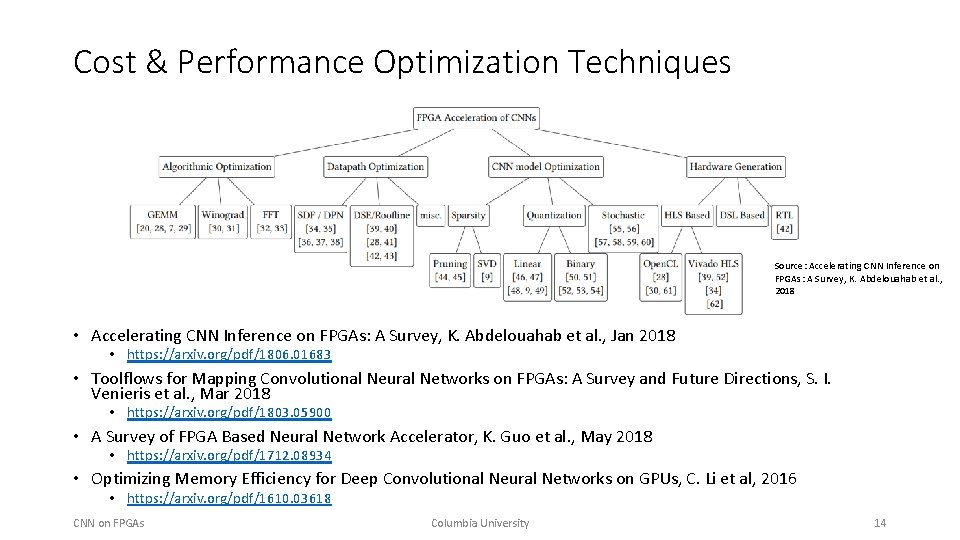
Cost & Performance Optimization Techniques Source: Accelerating CNN Inference on FPGAs: A Survey, K. Abdelouahab et al. , 2018 • Accelerating CNN Inference on FPGAs: A Survey, K. Abdelouahab et al. , Jan 2018 • https: //arxiv. org/pdf/1806. 01683 • Toolflows for Mapping Convolutional Neural Networks on FPGAs: A Survey and Future Directions, S. I. Venieris et al. , Mar 2018 • https: //arxiv. org/pdf/1803. 05900 • A Survey of FPGA Based Neural Network Accelerator, K. Guo et al. , May 2018 • https: //arxiv. org/pdf/1712. 08934 • Optimizing Memory Efficiency for Deep Convolutional Neural Networks on GPUs, C. Li et al, 2016 • https: //arxiv. org/pdf/1610. 03618 CNN on FPGAs Columbia University 14
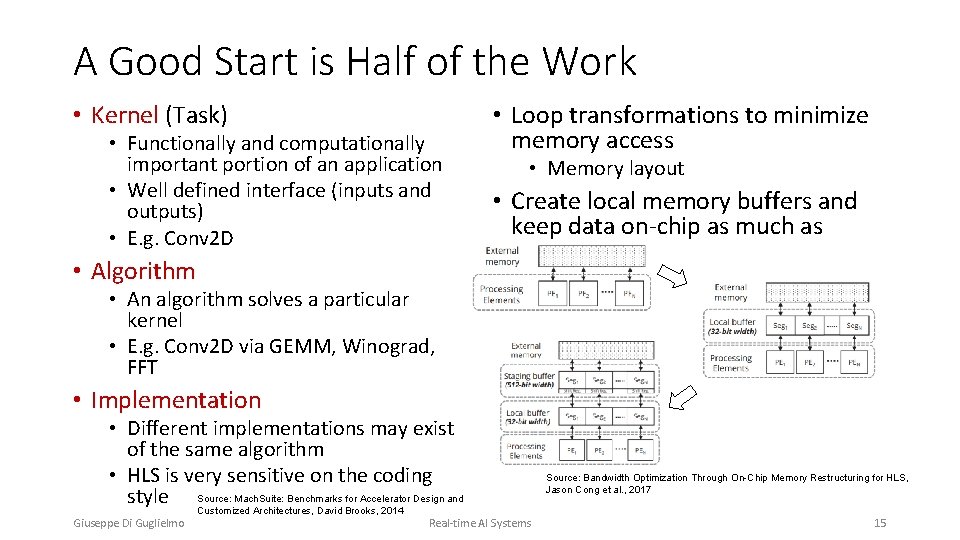
A Good Start is Half of the Work • Kernel (Task) • Functionally and computationally important portion of an application • Well defined interface (inputs and outputs) • E. g. Conv 2 D • Algorithm • Loop transformations to minimize memory access • Memory layout • Create local memory buffers and keep data on‐chip as much as possible • An algorithm solves a particular kernel • E. g. Conv 2 D via GEMM, Winograd, FFT • Implementation • Different implementations may exist of the same algorithm • HLS is very sensitive on the coding Mach. Suite: Benchmarks for Accelerator Design and style Source: Customized Architectures, David Brooks, 2014 Giuseppe Di Guglielmo Real‐time AI Systems Source: Bandwidth Optimization Through On-Chip Memory Restructuring for HLS, Jason Cong et al. , 2017 15
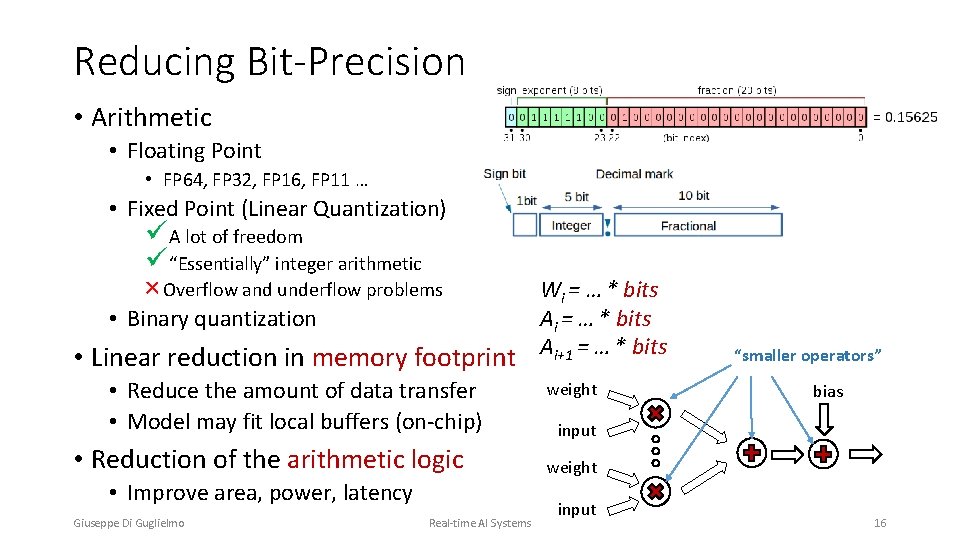
Reducing Bit-Precision • Arithmetic • Floating Point • FP 64, FP 32, FP 16, FP 11 … • Fixed Point (Linear Quantization) üA lot of freedom ü“Essentially” integer arithmetic × Overflow and underflow problems Wi = … * bits Ai = … * bits • Binary quantization • Linear reduction in memory footprint Ai+1 = … * bits weight • Reduce the amount of data transfer • Model may fit local buffers (on‐chip) input • Reduction of the arithmetic logic • Improve area, power, latency Giuseppe Di Guglielmo Real‐time AI Systems “smaller operators” bias weight input 16
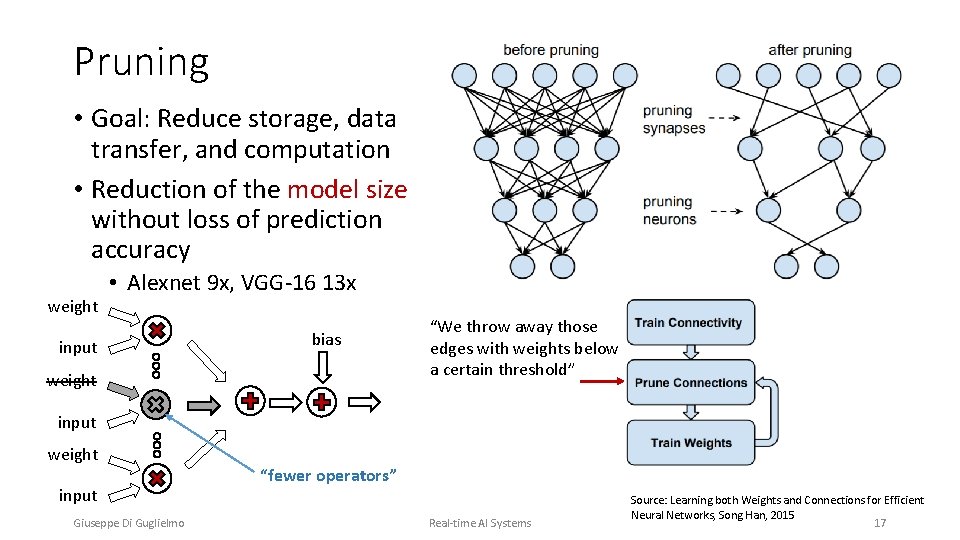
Pruning • Goal: Reduce storage, data transfer, and computation • Reduction of the model size without loss of prediction accuracy weight • Alexnet 9 x, VGG‐ 16 13 x input bias weight “We throw away those edges with weights below a certain threshold” input weight input Giuseppe Di Guglielmo “fewer operators” Real‐time AI Systems Source: Learning both Weights and Connections for Efficient Neural Networks, Song Han, 2015 17
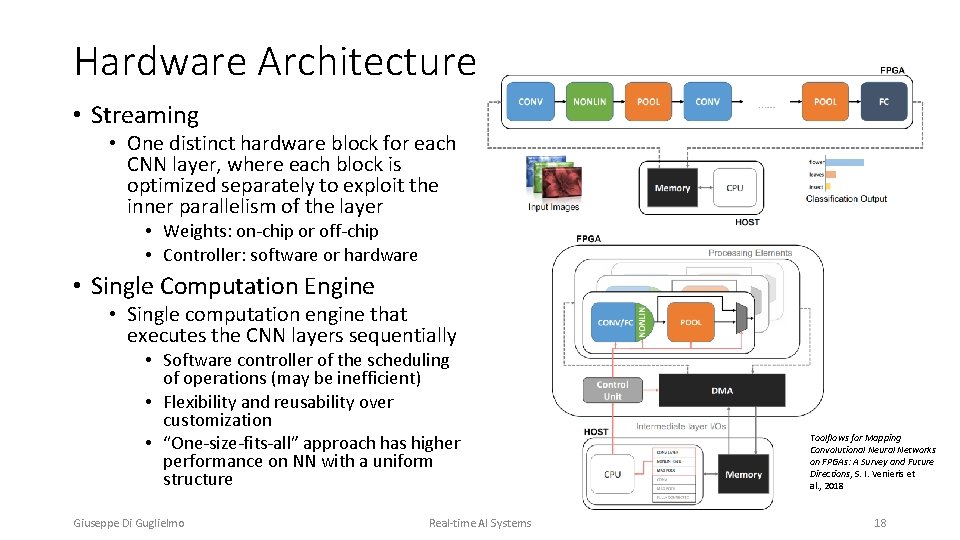
Hardware Architecture • Streaming • One distinct hardware block for each CNN layer, where each block is optimized separately to exploit the inner parallelism of the layer • Weights: on‐chip or off‐chip • Controller: software or hardware • Single Computation Engine • Single computation engine that executes the CNN layers sequentially • Software controller of the scheduling of operations (may be inefficient) • Flexibility and reusability over customization • “One‐size‐fits‐all” approach has higher performance on NN with a uniform structure Giuseppe Di Guglielmo Real‐time AI Systems Toolflows for Mapping Convolutional Neural Networks on FPGAs: A Survey and Future Directions, S. I. Venieris et al. , 2018 18
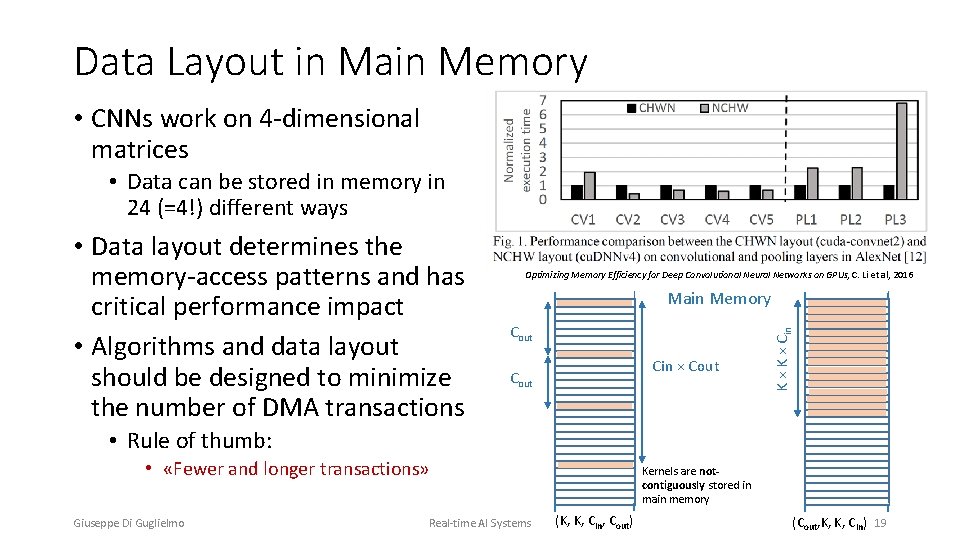
Data Layout in Main Memory • CNNs work on 4‐dimensional matrices • Data can be stored in memory in 24 (=4!) different ways Optimizing Memory Efficiency for Deep Convolutional Neural Networks on GPUs, C. Li et al, 2016 Main Memory Cout Cin × Cout K × Cin • Data layout determines the memory‐access patterns and has critical performance impact • Algorithms and data layout should be designed to minimize the number of DMA transactions • Rule of thumb: • «Fewer and longer transactions» Giuseppe Di Guglielmo Real‐time AI Systems Kernels are notcontiguously stored in main memory (K, K, Cin, Cout) (Cout, K, K, Cin) 19
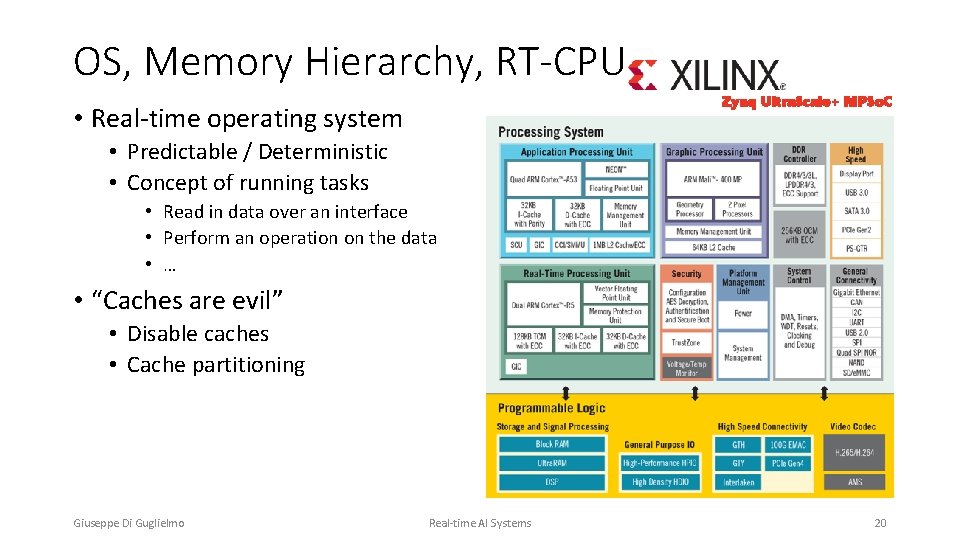
OS, Memory Hierarchy, RT-CPU Zynq Ultra. Scale+ MPSo. C • Real‐time operating system • Predictable / Deterministic • Concept of running tasks • Read in data over an interface • Perform an operation on the data • … • “Caches are evil” • Disable caches • Cache partitioning Giuseppe Di Guglielmo Real‐time AI Systems 20
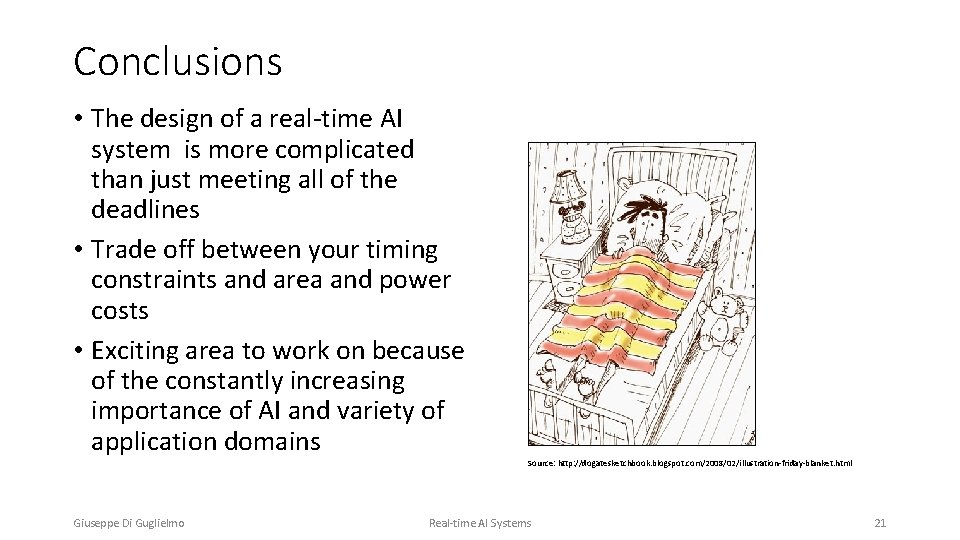
Conclusions • The design of a real‐time AI system is more complicated than just meeting all of the deadlines • Trade off between your timing constraints and area and power costs • Exciting area to work on because of the constantly increasing importance of AI and variety of application domains Source: http: //dogatesketchbook. blogspot. com/2008/02/illustration‐friday‐blanket. html Giuseppe Di Guglielmo Real‐time AI Systems 21
Q/A Thank you! Giuseppe Di Guglielmo Real‐time AI Systems 22