
Realizing Programming Models CS 258 Spring 99 David
- Slides: 38
Realizing Programming Models CS 258, Spring 99 David E. Culler Computer Science Division U. C. Berkeley 3/5/99 CS 258 S 99
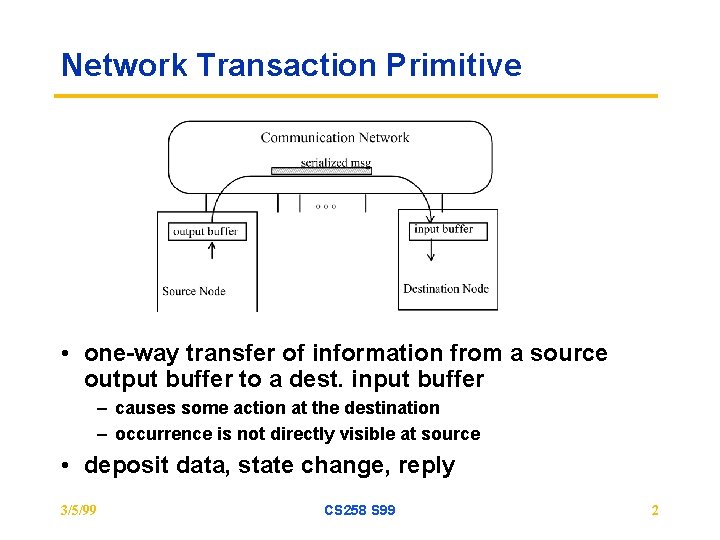
Network Transaction Primitive • one-way transfer of information from a source output buffer to a dest. input buffer – causes some action at the destination – occurrence is not directly visible at source • deposit data, state change, reply 3/5/99 CS 258 S 99 2
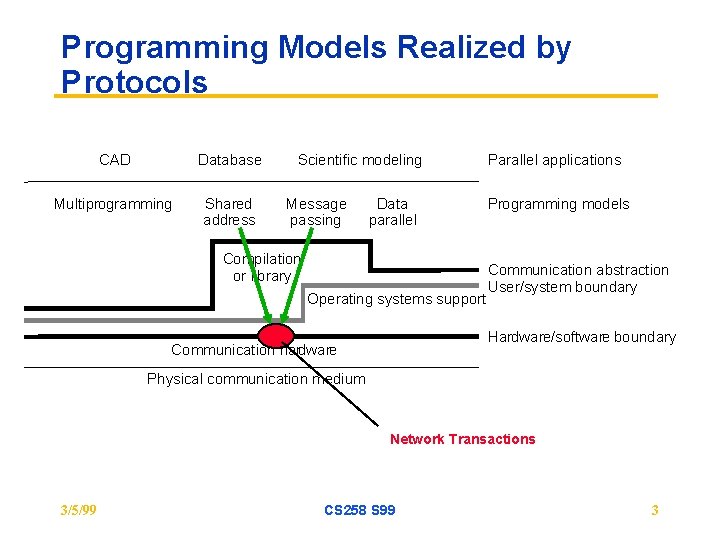
Programming Models Realized by Protocols CAD Database Multiprogramming Shared address Scientific modeling Message passing Data parallel Compilation or library Operating systems support Parallel applications Programming models Communication abstraction User/system boundary Hardware/software boundary Communication hardware Physical communication medium Network Transactions 3/5/99 CS 258 S 99 3
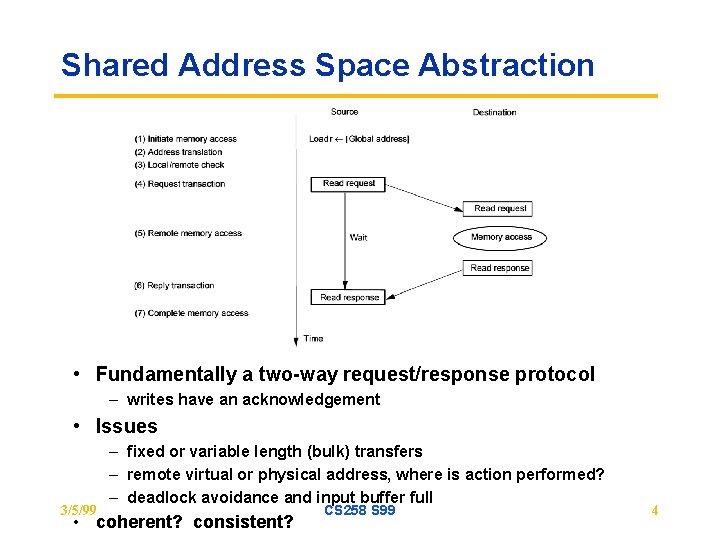
Shared Address Space Abstraction • Fundamentally a two-way request/response protocol – writes have an acknowledgement • Issues 3/5/99 – fixed or variable length (bulk) transfers – remote virtual or physical address, where is action performed? – deadlock avoidance and input buffer full • coherent? consistent? CS 258 S 99 4
The Fetch Deadlock Problem • Even if a node cannot issue a request, it must sink network transactions. • Incoming transaction may be a request, which will generate a response. • Closed system (finite buffering) 3/5/99 CS 258 S 99 5
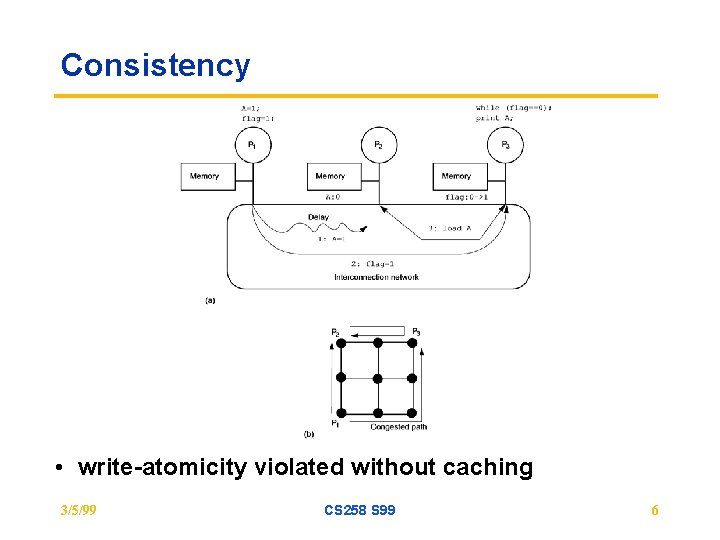
Consistency • write-atomicity violated without caching 3/5/99 CS 258 S 99 6
Key Properties of Shared Address Abstraction • Source and destination data addresses are specified by the source of the request – a degree of logical coupling and trust • no storage logically “outside the address space” » may employ temporary buffers for transport • Operations are fundamentally request response • Remote operation can be performed on remote memory – logically does not require intervention of the remote processor 3/5/99 CS 258 S 99 7
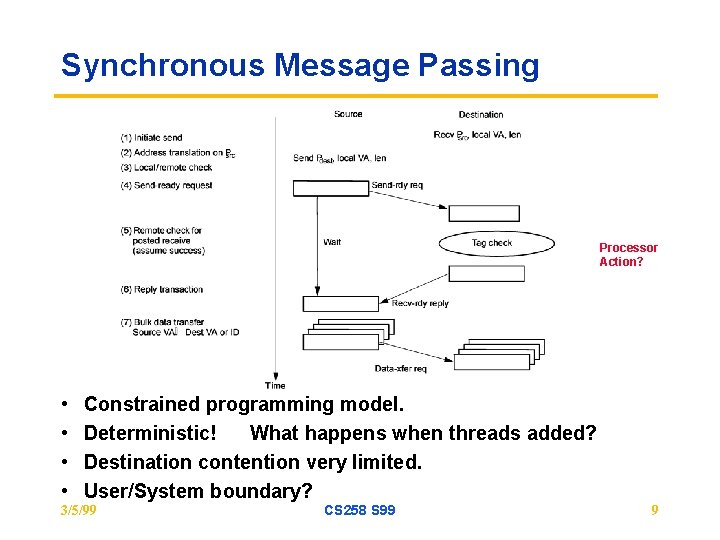
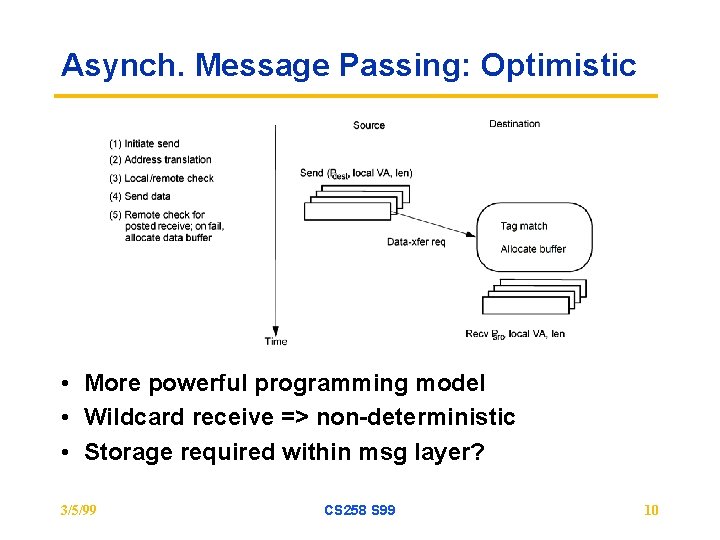
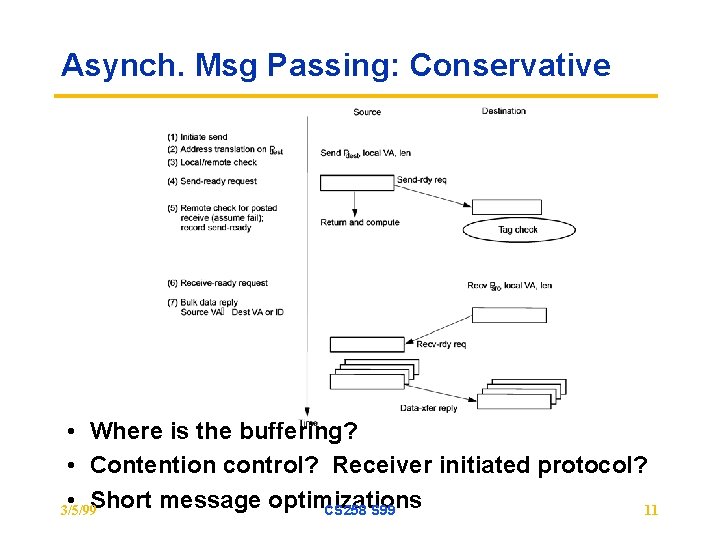
Message passing • Bulk transfers • Complex synchronization semantics – more complex protocols – More complex action • Synchronous – Send completes after matching recv and source data sent – Receive completes after data transfer complete from matching send • Asynchronous – Send completes after send buffer may be reused 3/5/99 CS 258 S 99 8
Synchronous Message Passing Processor Action? • • Constrained programming model. Deterministic! What happens when threads added? Destination contention very limited. User/System boundary? 3/5/99 CS 258 S 99 9
Asynch. Message Passing: Optimistic • More powerful programming model • Wildcard receive => non-deterministic • Storage required within msg layer? 3/5/99 CS 258 S 99 10
Asynch. Msg Passing: Conservative • Where is the buffering? • Contention control? Receiver initiated protocol? • Short message optimizations 3/5/99 11 CS 258 S 99
Key Features of Msg Passing Abstraction • Source knows send data address, dest. knows receive data address – after handshake they both know both • Arbitrary storage “outside the local address spaces” – may post many sends before any receives – non-blocking asynchronous sends reduces the requirement to an arbitrary number of descriptors » fine print says these are limited too • Fundamentally a 3 -phase transaction – includes a request / response – can use optimisitic 1 -phase in limited “Safe” cases » credit scheme 3/5/99 CS 258 S 99 12
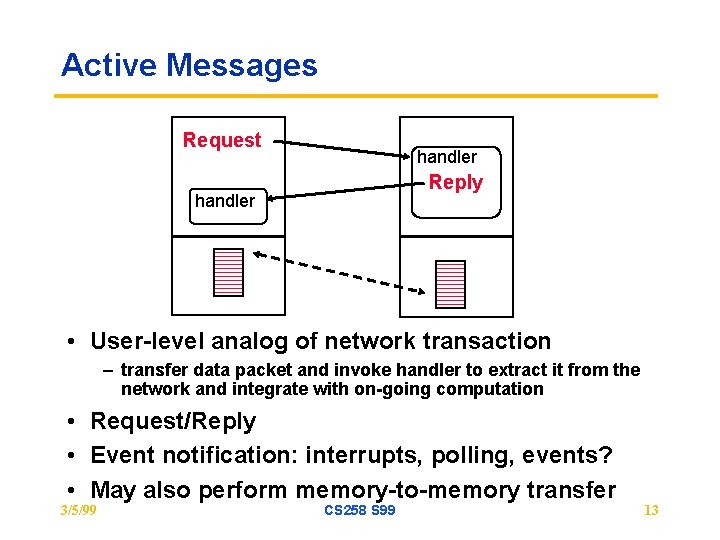
Active Messages Request handler Reply handler • User-level analog of network transaction – transfer data packet and invoke handler to extract it from the network and integrate with on-going computation • Request/Reply • Event notification: interrupts, polling, events? • May also perform memory-to-memory transfer 3/5/99 CS 258 S 99 13
Common Challenges • Input buffer overflow – N-1 queue over-commitment => must slow sources – reserve space per source (credit) » when available for reuse? • Ack or Higher level – Refuse input when full » backpressure in reliable network » tree saturation » deadlock free » what happens to traffic not bound for congested dest? – Reserve ack back channel – drop packets – Utilize higher-level semantics of programming model 3/5/99 CS 258 S 99 14
Challenges (cont) • Fetch Deadlock – For network to remain deadlock free, nodes must continue accepting messages, even when cannot source msgs – what if incoming transaction is a request? » Each may generate a response, which cannot be sent! » What happens when internal buffering is full? • logically independent request/reply networks – physical networks – virtual channels with separate input/output queues • bound requests and reserve input buffer space – K(P-1) requests + K responses per node – service discipline to avoid fetch deadlock? • NACK on input buffer full – NACK delivery? 3/5/99 CS 258 S 99 15
Challenges in Realizing Prog. Models in the Large • One-way transfer of information • No global knowledge, nor global control – barriers, scans, reduce, global-OR give fuzzy global state • Very large number of concurrent transactions • Management of input buffer resources – many sources can issue a request and over-commit destination before any see the effect • Latency is large enough that you are tempted to “take risks” – optimistic protocols – large transfers – dynamic allocation • Many more degrees of freedom in design and engineering of these system 3/5/99 CS 258 S 99 16
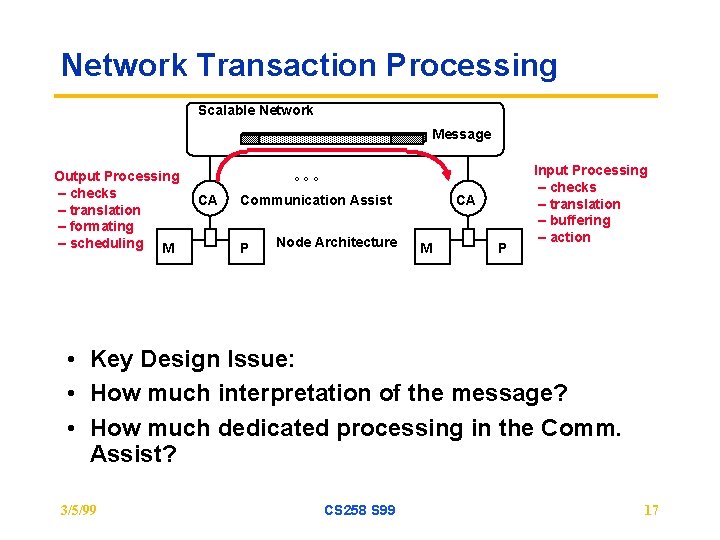
Network Transaction Processing Scalable Network Message Output Processing – checks – translation – formating – scheduling M CA °°° Communication Assist P Node Architecture CA M P Input Processing – checks – translation – buffering – action • Key Design Issue: • How much interpretation of the message? • How much dedicated processing in the Comm. Assist? 3/5/99 CS 258 S 99 17
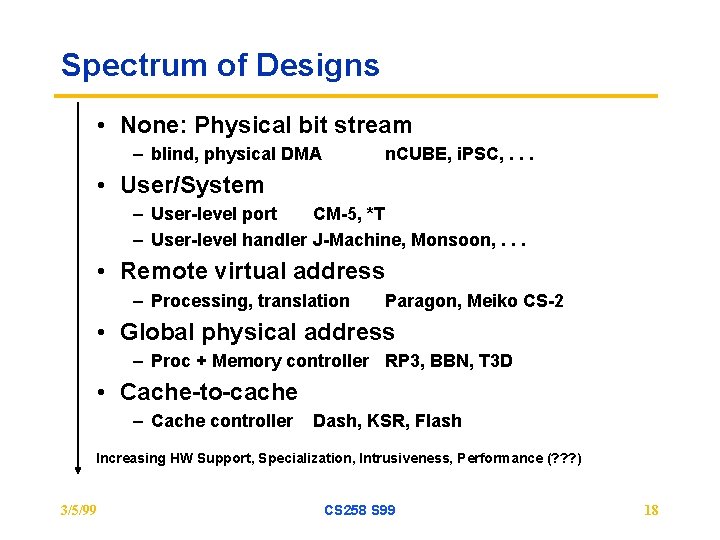
Spectrum of Designs • None: Physical bit stream – blind, physical DMA n. CUBE, i. PSC, . . . • User/System – User-level port CM-5, *T – User-level handler J-Machine, Monsoon, . . . • Remote virtual address – Processing, translation Paragon, Meiko CS-2 • Global physical address – Proc + Memory controller RP 3, BBN, T 3 D • Cache-to-cache – Cache controller Dash, KSR, Flash Increasing HW Support, Specialization, Intrusiveness, Performance (? ? ? ) 3/5/99 CS 258 S 99 18
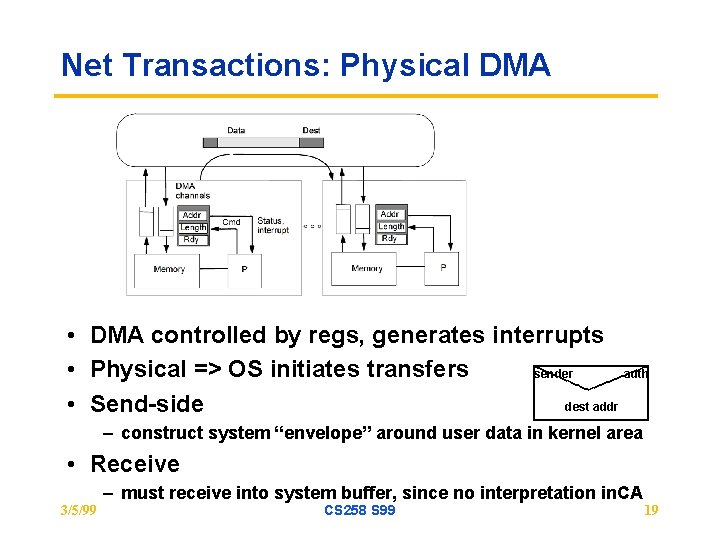
Net Transactions: Physical DMA • DMA controlled by regs, generates interrupts • Physical => OS initiates transfers sender auth dest addr • Send-side – construct system “envelope” around user data in kernel area • Receive 3/5/99 – must receive into system buffer, since no interpretation in. CA CS 258 S 99 19
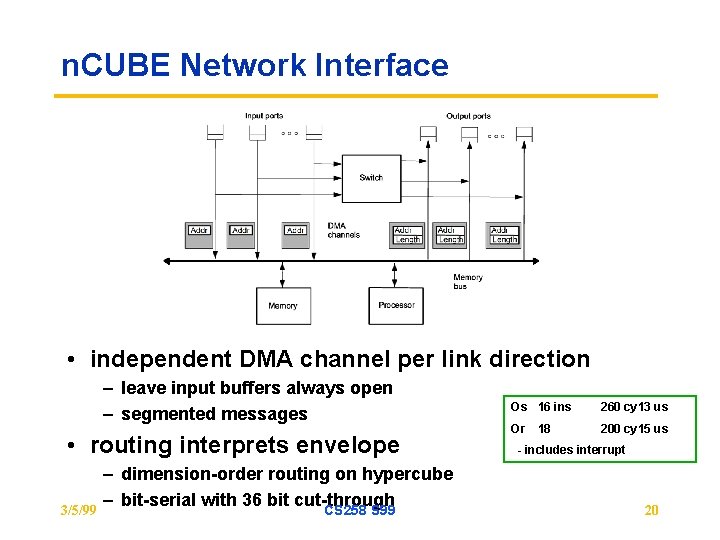
n. CUBE Network Interface • independent DMA channel per link direction – leave input buffers always open – segmented messages • routing interprets envelope 3/5/99 – dimension-order routing on hypercube – bit-serial with 36 bit cut-through CS 258 S 99 Os 16 ins 260 cy 13 us Or 200 cy 15 us 18 - includes interrupt 20
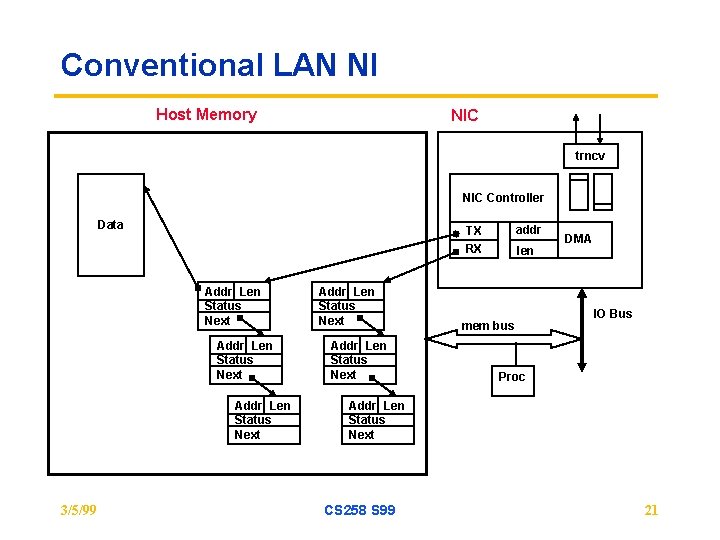
Conventional LAN NI Host Memory NIC trncv NIC Controller Data Addr Len Status Next 3/5/99 addr TX RX Addr Len Status Next len mem bus DMA IO Bus Proc Addr Len Status Next CS 258 S 99 21
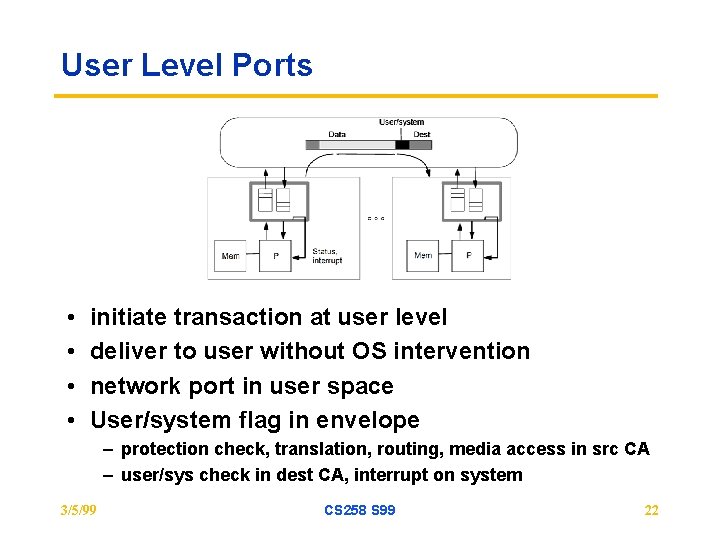
User Level Ports • • initiate transaction at user level deliver to user without OS intervention network port in user space User/system flag in envelope – protection check, translation, routing, media access in src CA – user/sys check in dest CA, interrupt on system 3/5/99 CS 258 S 99 22
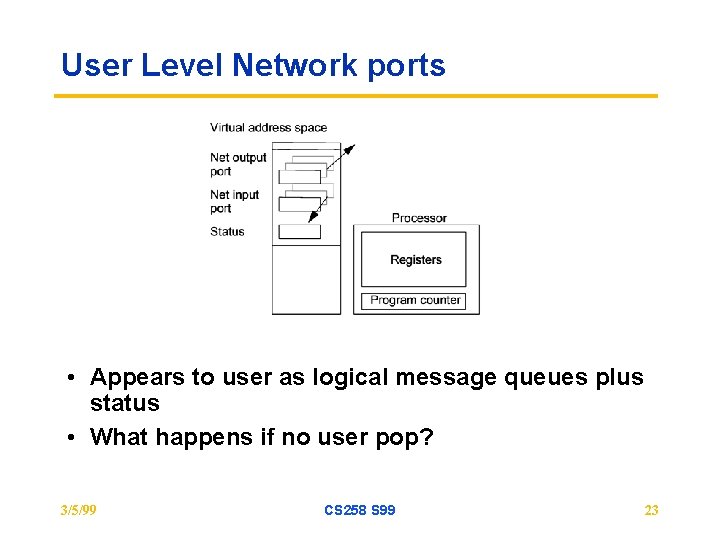
User Level Network ports • Appears to user as logical message queues plus status • What happens if no user pop? 3/5/99 CS 258 S 99 23
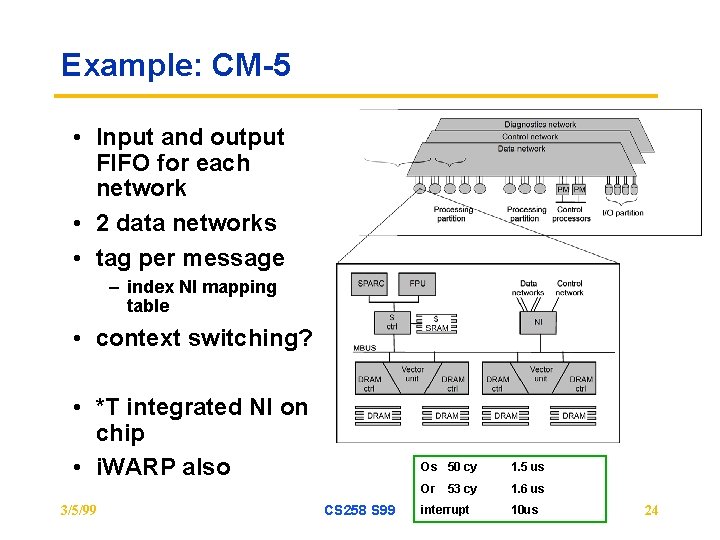
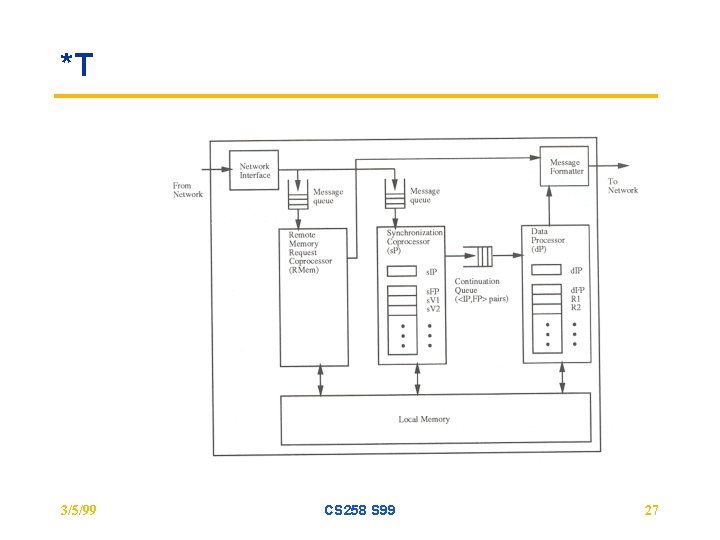
Example: CM-5 • Input and output FIFO for each network • 2 data networks • tag per message – index NI mapping table • context switching? • *T integrated NI on chip • i. WARP also 3/5/99 CS 258 S 99 Os 50 cy 1. 5 us Or 1. 6 us 53 cy interrupt 10 us 24
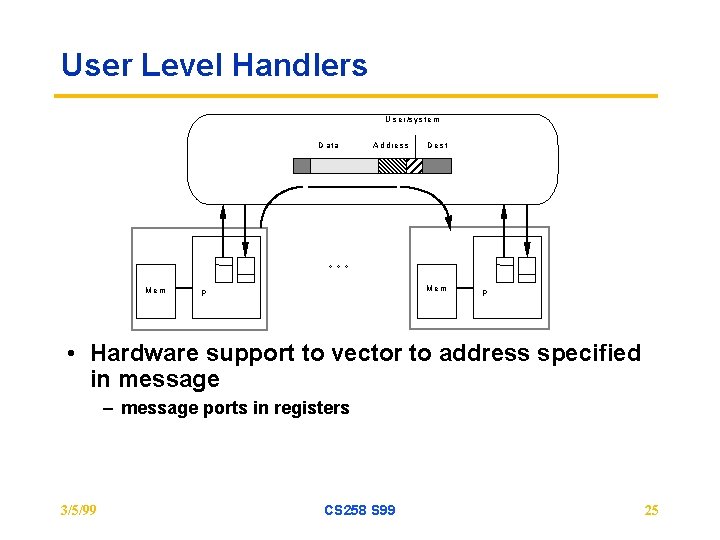
User Level Handlers U s e r /s y s te m D a ta A d d re s s D e st °° ° M em Mem P P • Hardware support to vector to address specified in message – message ports in registers 3/5/99 CS 258 S 99 25
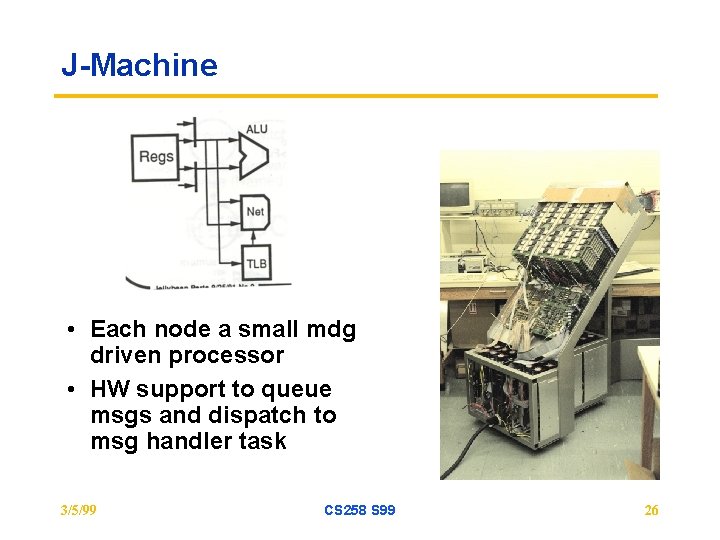
J-Machine • Each node a small mdg driven processor • HW support to queue msgs and dispatch to msg handler task 3/5/99 CS 258 S 99 26
*T 3/5/99 CS 258 S 99 27
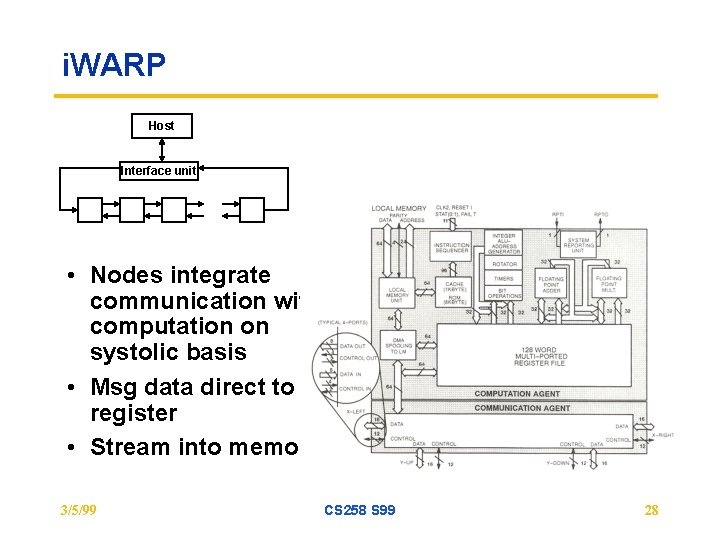
i. WARP Host Interface unit • Nodes integrate communication with computation on systolic basis • Msg data direct to register • Stream into memory 3/5/99 CS 258 S 99 28
Dedicated processing without dedicated hardware design 3/5/99 CS 258 S 99 29
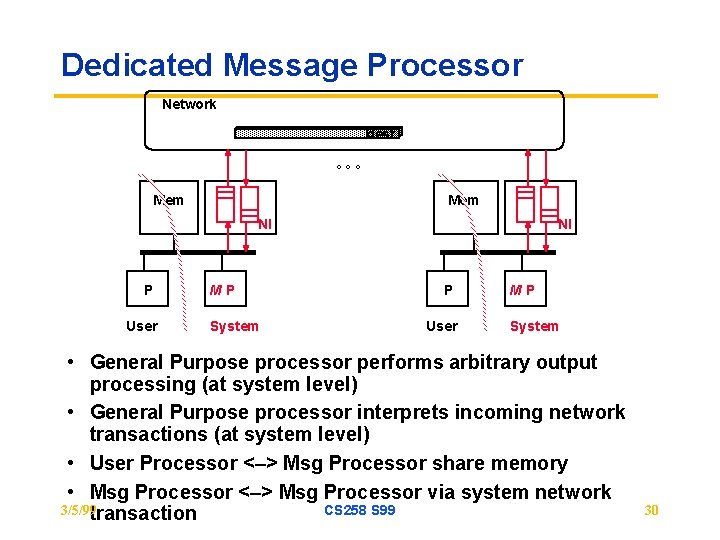
Dedicated Message Processor Network dest °°° Mem NI P User MP System • General Purpose processor performs arbitrary output processing (at system level) • General Purpose processor interprets incoming network transactions (at system level) • User Processor <–> Msg Processor share memory • Msg Processor <–> Msg Processor via system network 3/5/99 CS 258 S 99 transaction 30
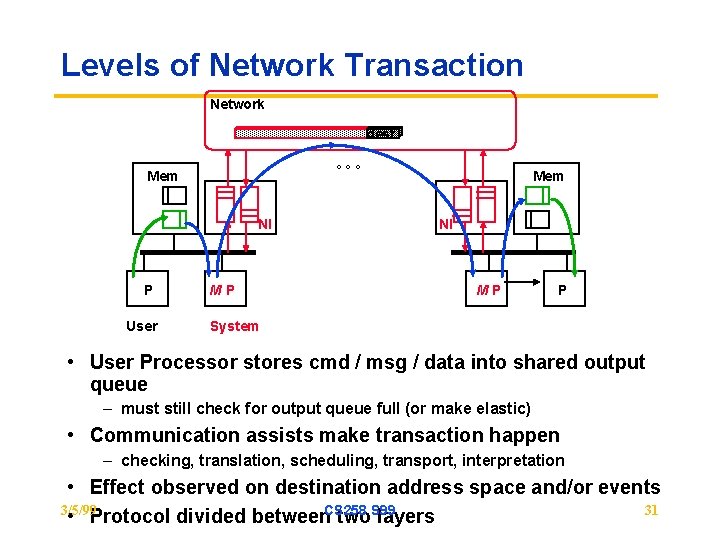
Levels of Network Transaction Network dest °°° Mem NI P User MP Mem NI MP P System • User Processor stores cmd / msg / data into shared output queue – must still check for output queue full (or make elastic) • Communication assists make transaction happen – checking, translation, scheduling, transport, interpretation • Effect observed on destination address space and/or events 3/5/99 31 • Protocol divided between. CS 258 two. S 99 layers
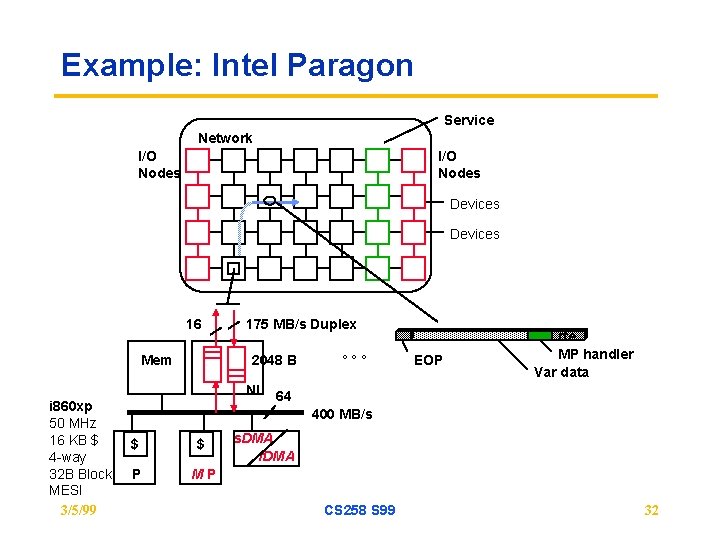
Example: Intel Paragon Service Network I/O Nodes Devices 16 Mem 175 MB/s Duplex 2048 B NI i 860 xp 50 MHz 16 KB $ 4 -way 32 B Block MESI 3/5/99 °°° EOP rte MP handler Var data 64 400 MB/s $ $ P MP s. DMA r. DMA CS 258 S 99 32
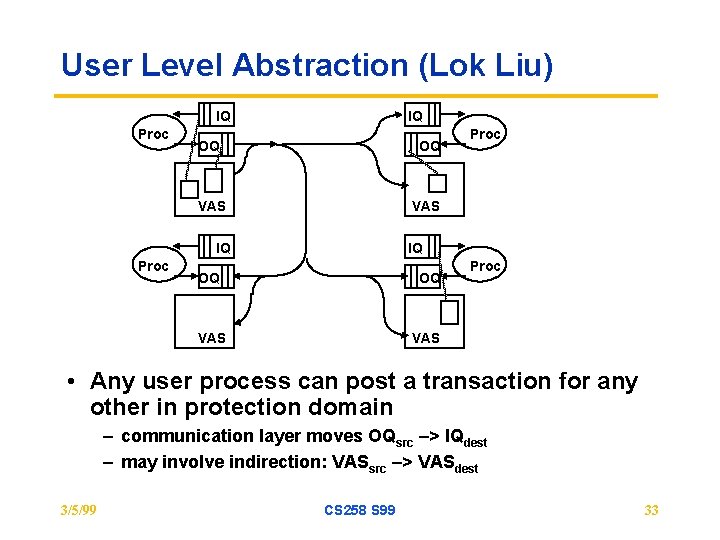
User Level Abstraction (Lok Liu) IQ Proc IQ OQ OQ VAS Proc • Any user process can post a transaction for any other in protection domain – communication layer moves OQsrc –> IQdest – may involve indirection: VASsrc –> VASdest 3/5/99 CS 258 S 99 33
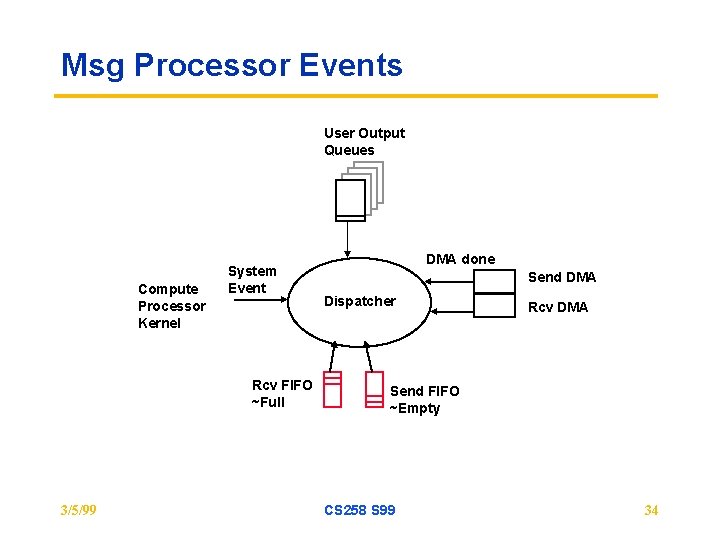
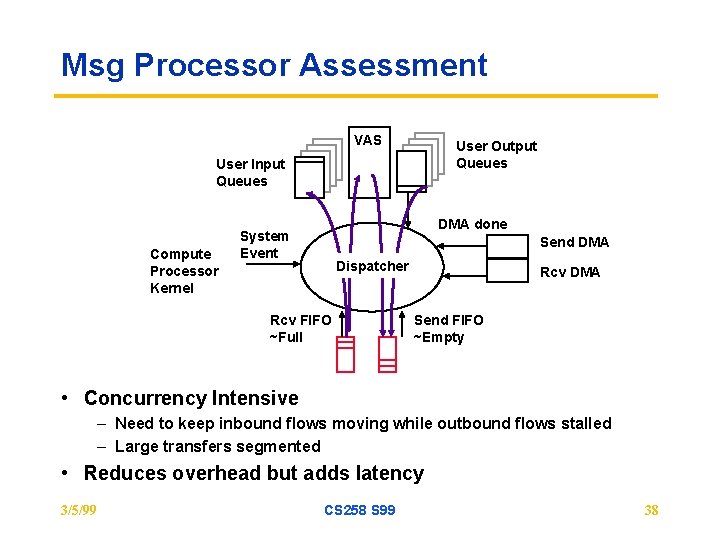
Msg Processor Events User Output Queues Compute Processor Kernel System Event Rcv FIFO ~Full 3/5/99 DMA done Send DMA Dispatcher Rcv DMA Send FIFO ~Empty CS 258 S 99 34
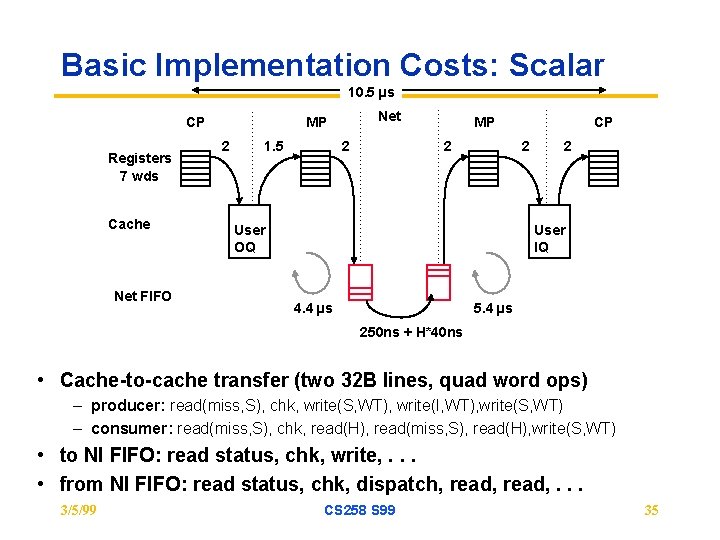
Basic Implementation Costs: Scalar 10. 5 µs CP Registers 7 wds Cache Net FIFO Net MP 2 1. 5 2 MP 2 CP 2 User OQ 2 User IQ 4. 4 µs 5. 4 µs 250 ns + H*40 ns • Cache-to-cache transfer (two 32 B lines, quad word ops) – producer: read(miss, S), chk, write(S, WT), write(I, WT), write(S, WT) – consumer: read(miss, S), chk, read(H), read(miss, S), read(H), write(S, WT) • to NI FIFO: read status, chk, write, . . . • from NI FIFO: read status, chk, dispatch, read, . . . 3/5/99 CS 258 S 99 35
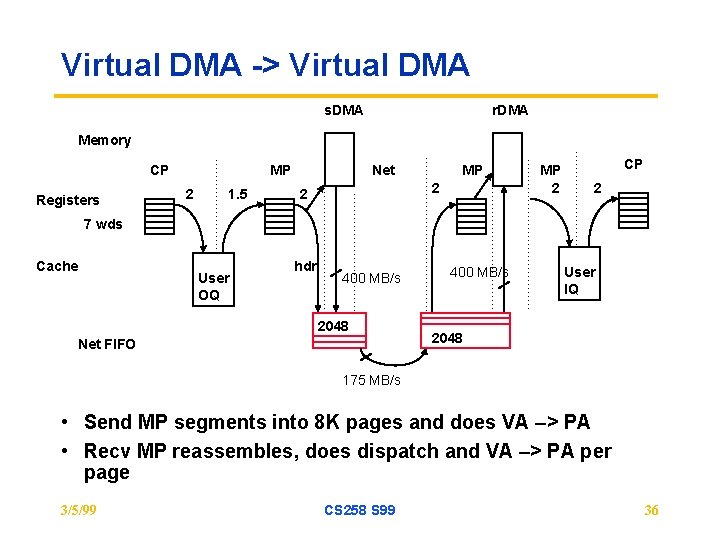
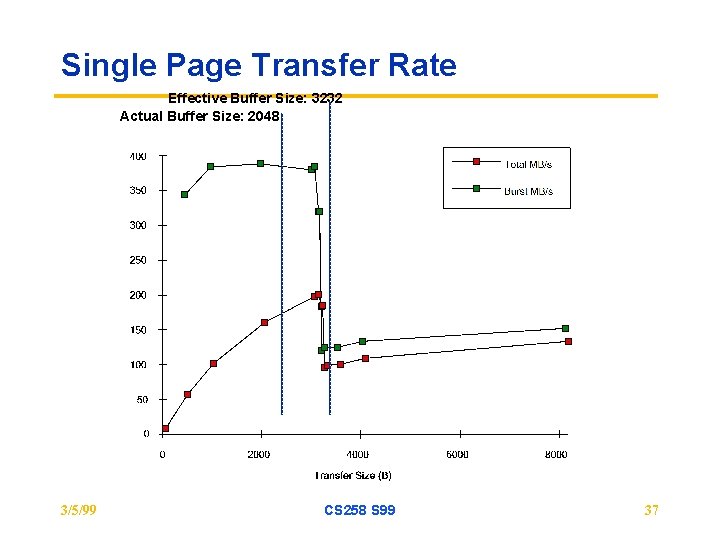
Virtual DMA -> Virtual DMA s. DMA r. DMA Memory CP Registers MP 2 1. 5 Net MP 2 2 MP 2 CP 2 7 wds Cache User OQ hdr 400 MB/s 2048 Net FIFO 400 MB/s User IQ 2048 175 MB/s • Send MP segments into 8 K pages and does VA –> PA • Recv MP reassembles, does dispatch and VA –> PA per page 3/5/99 CS 258 S 99 36
Single Page Transfer Rate Effective Buffer Size: 3232 Actual Buffer Size: 2048 3/5/99 CS 258 S 99 37
Msg Processor Assessment VAS User Output Queues User Input Queues Compute Processor Kernel DMA done System Event Send DMA Dispatcher Rcv FIFO ~Full Rcv DMA Send FIFO ~Empty • Concurrency Intensive – Need to keep inbound flows moving while outbound flows stalled – Large transfers segmented • Reduces overhead but adds latency 3/5/99 CS 258 S 99 38