
Realizing Programmable Matter Seth Copen Goldstein and Peter
Realizing Programmable Matter Seth Copen Goldstein and Peter Lee DARPA POCs: Jonathan Smith and Tom Wagner 2006 DARPA ISAT Study
What is Programmable Matter? August 17, 2006 ETC, 2006 2
What is Programmable Matter? A programmable material… …with actuation and sensing… …that can morph into shapes under software control… …and in reaction to external stimuli August 17, 2006 3
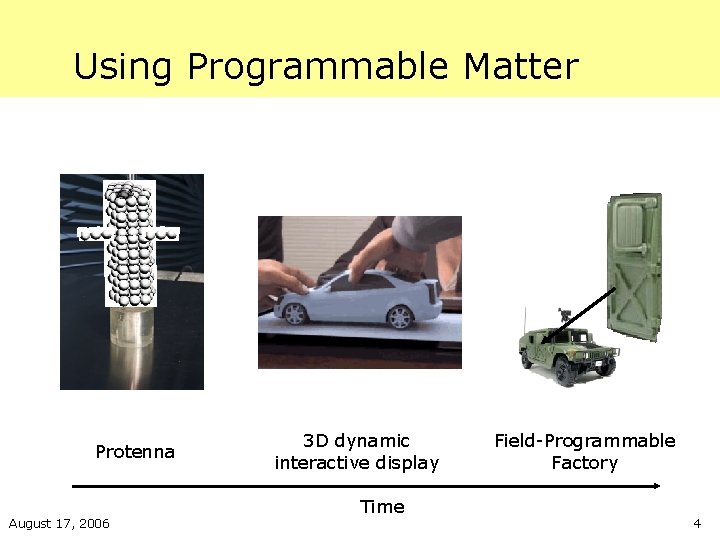
Using Programmable Matter Protenna August 17, 2006 3 D dynamic interactive display Time Field-Programmable Factory 4
Key questions Can we really make programmable matter? If we make it, can we write useful programs for it? Are there reasons to do this now? · What are potential applications? August 17, 2006 5
Can we really make programmable matter? When can we make programmable matter? What kind of “matter” will it be?
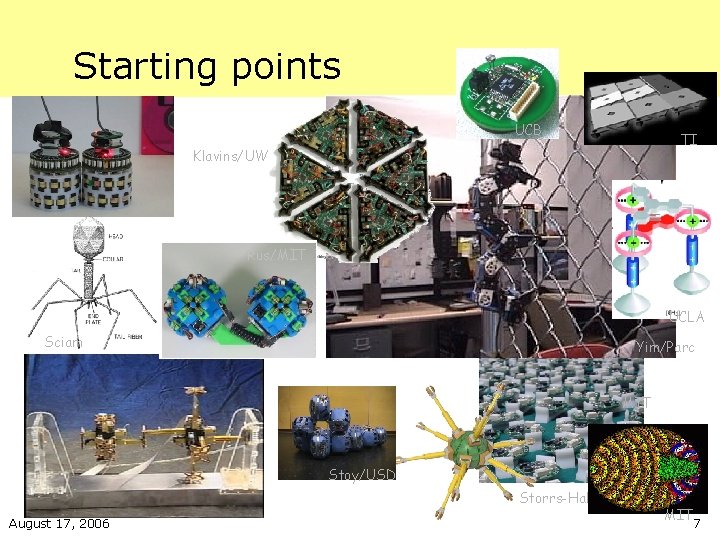
Starting points UCB TI Klavins/UW Rus/MIT Stoddart UCLA Sciam Yim/Parc MIT Stoy/USD Storrs-Hall/Rutgers August 17, 2006 MIT 7
A fundamental goal: Scaling Consider applications that involve rendering macroscale objects · High fidelity rendering implies · · sub-millimeter-scale units (voxels) massive numbers of units Units must be inexpensive · mass-produced · largely homogeneous · simple, possibly no moving parts August 17, 2006 8
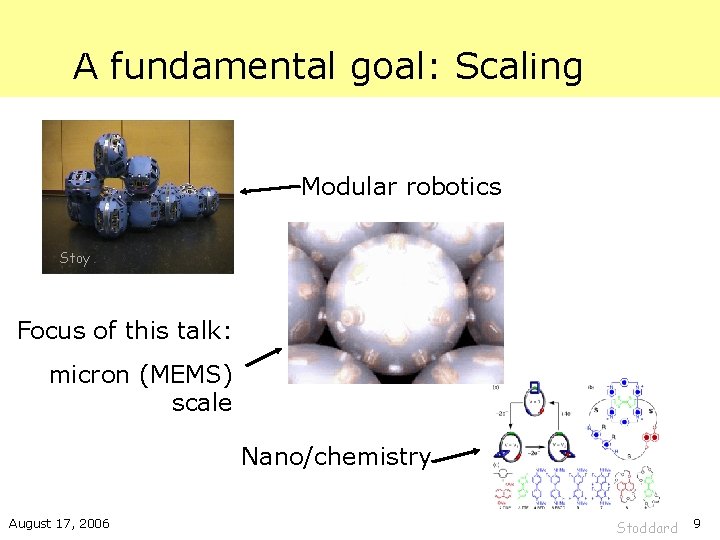
A fundamental goal: Scaling Modular robotics Stoy Focus of this talk: micron (MEMS) scale Nano/chemistry August 17, 2006 Stoddard 9
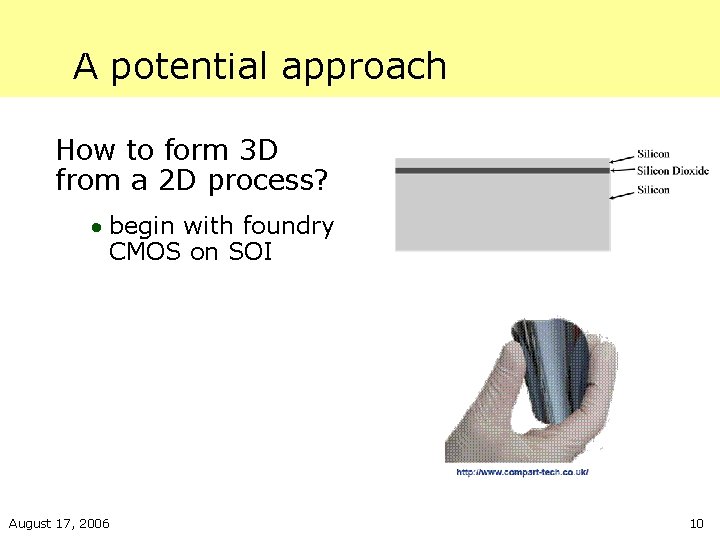
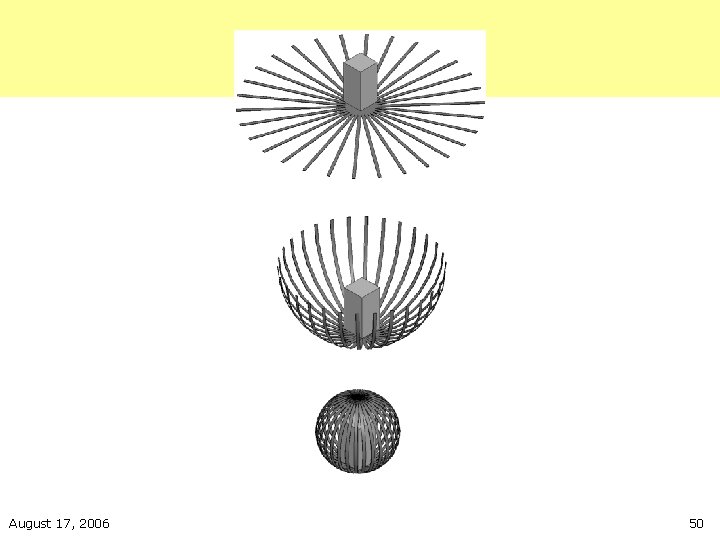
A potential approach How to form 3 D from a 2 D process? · begin with foundry CMOS on SOI August 17, 2006 10
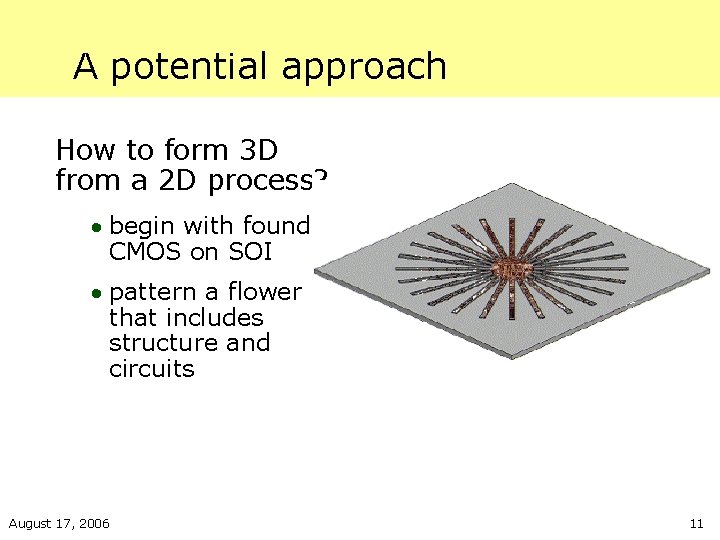
A potential approach How to form 3 D from a 2 D process? · begin with foundry CMOS on SOI Reid, AFRL · pattern a flower that includes structure and circuits August 17, 2006 11
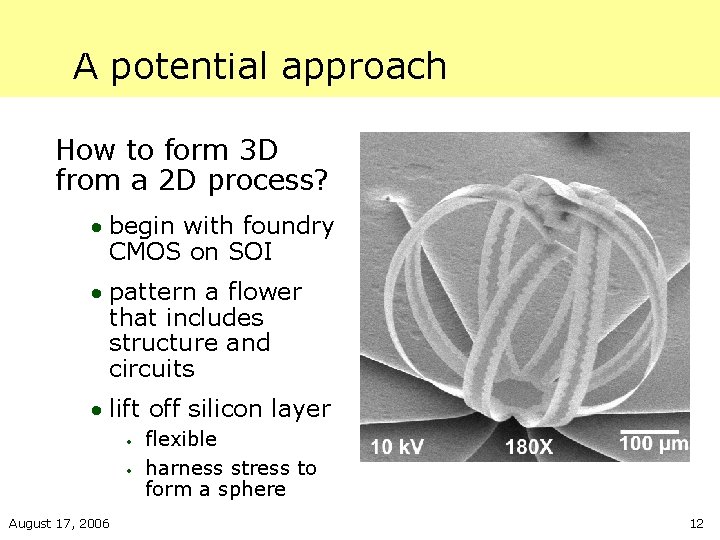
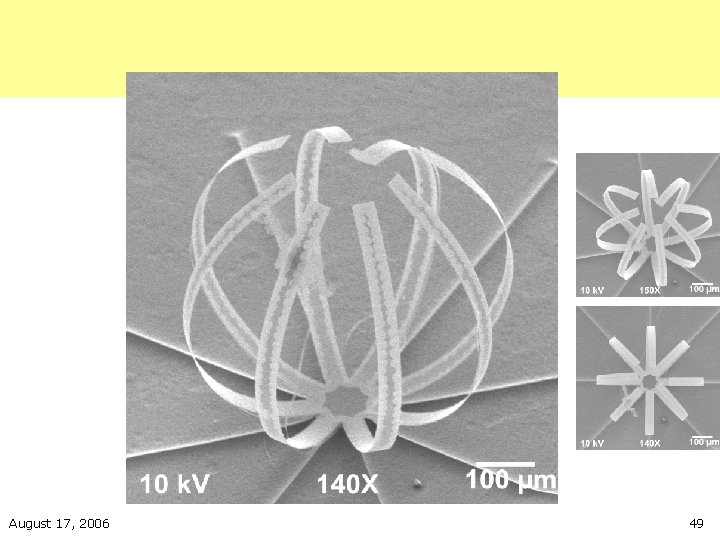
A potential approach How to form 3 D from a 2 D process? · begin with foundry CMOS on SOI · pattern a flower that includes structure and circuits · lift off silicon layer · · August 17, 2006 flexible harness stress to form a sphere 12
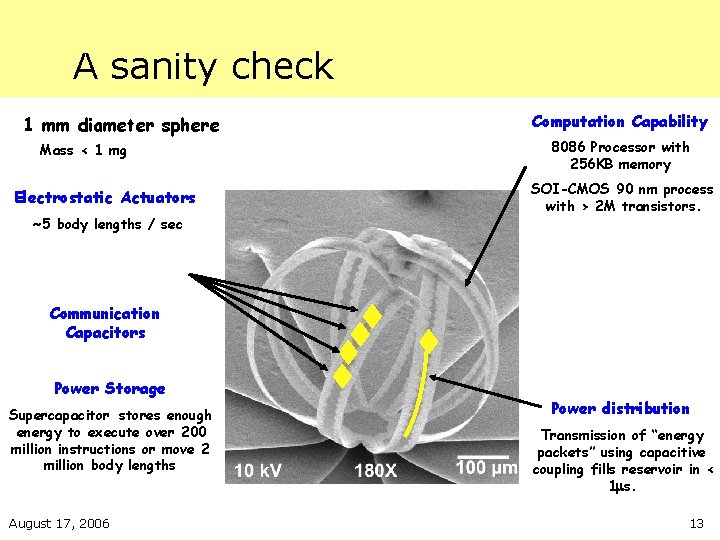
A sanity check 1 mm diameter sphere Mass < 1 mg Electrostatic Actuators ~5 body lengths / sec Computation Capability 8086 Processor with 256 KB memory SOI-CMOS 90 nm process with > 2 M transistors. Communication Capacitors Power Storage Supercapacitor stores enough energy to execute over 200 million instructions or move 2 million body lengths August 17, 2006 Power distribution Transmission of “energy packets” using capacitive coupling fills reservoir in < 1 s. 13
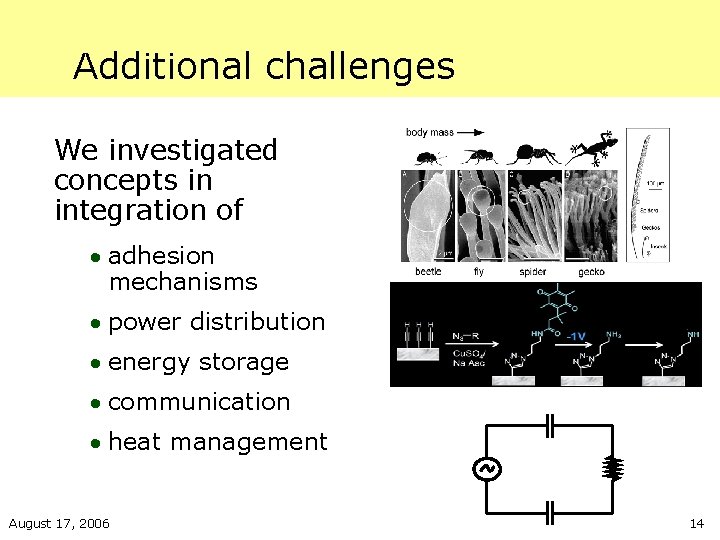
Additional challenges We investigated concepts in integration of · adhesion mechanisms · power distribution · energy storage · communication · heat management August 17, 2006 14
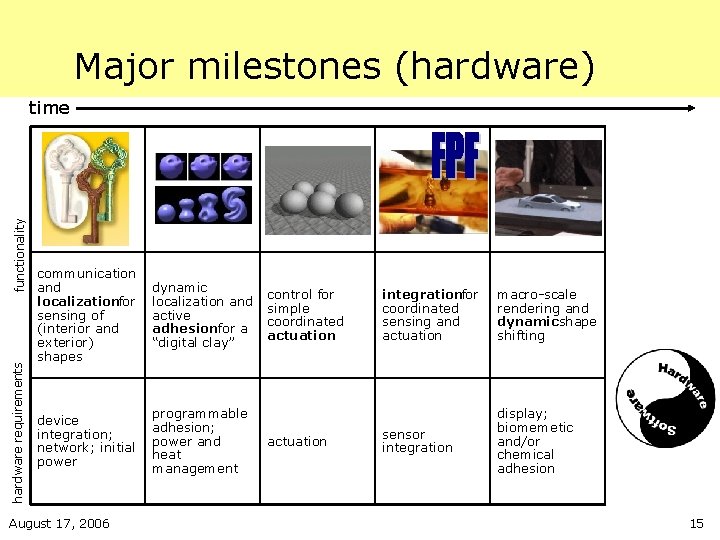
Major milestones (hardware) hardware requirements functionality time communication and localizationfor sensing of (interior and exterior) shapes dynamic localization and active adhesionfor a “digital clay” device integration; network; initial power programmable adhesion; power and heat management August 17, 2006 control for simple coordinated actuation integrationfor coordinated sensing and actuation macro-scale rendering and dynamicshape shifting general distributed programming model sensor integration display; biomemetic and/or chemical adhesion … 15

When can we make programmable matter? Soon. But then can we programmable matter?
Programming large machines Concepts in parallel, distributed, and high-performance computing · Can scale to thousands of nodes for “embarrassingly parallel” applications, … · …with known, regular interconnect But how do we program millions of mobile, interacting devices? August 17, 2006 17
Algorithms vs control Our study considered the programming problem at two levels · Programming the Ensemble: How does one think about coordination of millions of elements? · Programming the Unit: What is the programming model for a (single) element? August 17, 2006 18
Physical rendering To simplify our approach, we focus exclusively on physical rendering: · How to coordinate the movement of the units to form a desired physical shape Today: Motion planning · But with a large number of units, central motion planning is not tractable · A stochastic approach appears to be necessary August 17, 2006 19
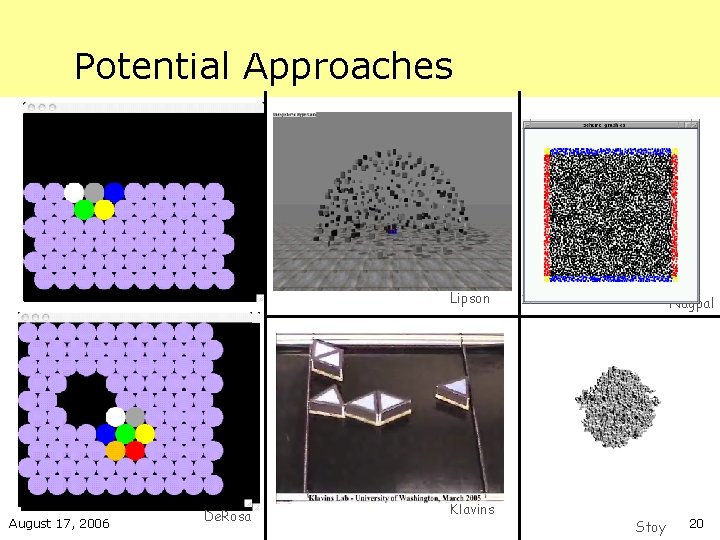
Potential Approaches Lipson August 17, 2006 De. Rosa Klavins Nagpal Stoy 20
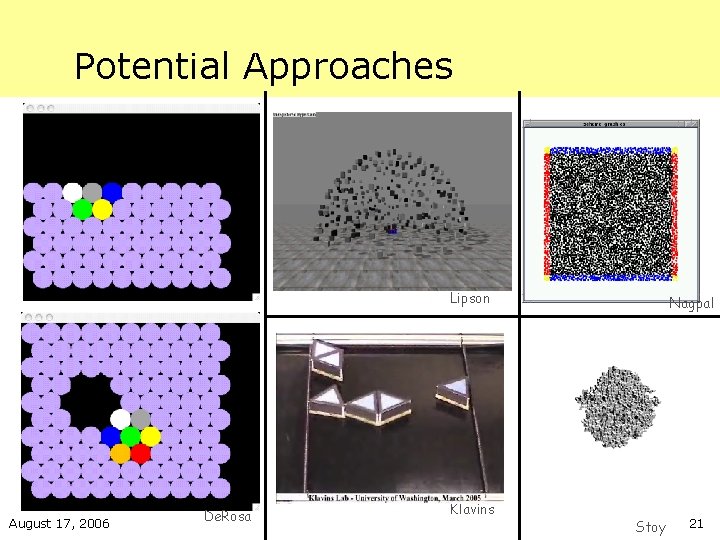
Potential Approaches Lipson August 17, 2006 De. Rosa Klavins Nagpal Stoy 21
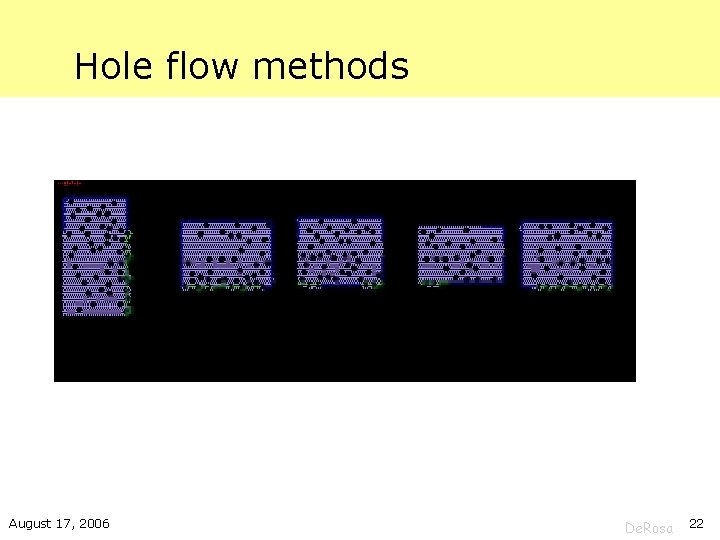
Hole flow methods August 17, 2006 De. Rosa 22
Rendering Conclusion: For rendering, a stochastic approach appears to have several advantages: · exploits large numbers · requires no central planning · simple specification · scale-independent · robust to failures in individual elements August 17, 2006 23
Embrace Stochastic Approaches Need reliable (but not exact) outcomes from unreliable components and information Information Based Complexity shows: when information is: · costly, · tainted, · partial Programmable Matter has: · costly communication, · noisy sensors, · no one unit has the whole picture Worst-case error bounds require exp-time. “with high-probability” error bounds require poly-time! Emerging paradigms for unit control · hybrid control Conner, CMU August 17, 2006 · Programming work · Advances in convexity 24
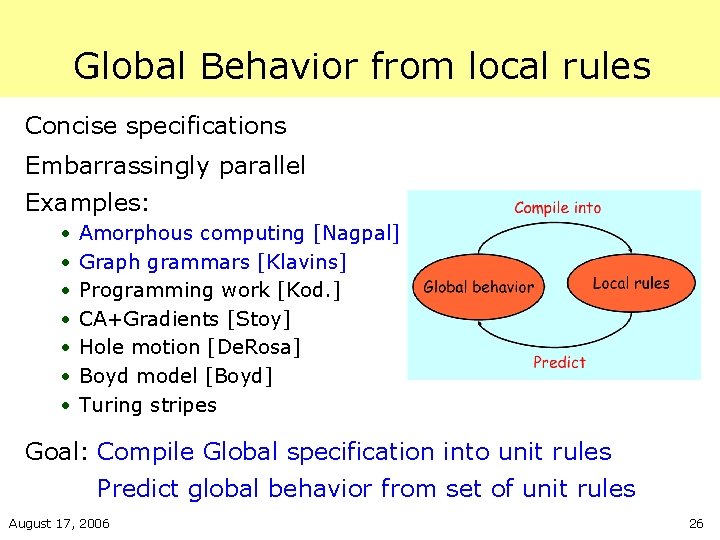
Global Behavior from local rules Concise specifications Embarrassingly parallel Examples: · · · · Amorphous computing [Nagpal] Graph grammars [Klavins] Programming work [Kod. ] CA+Gradients [Stoy] Hole motion [De. Rosa] Boyd model [Boyd] Turing stripes Goal: Compile Global specification into unit rules Predict global behavior from set of unit rules August 17, 2006 26
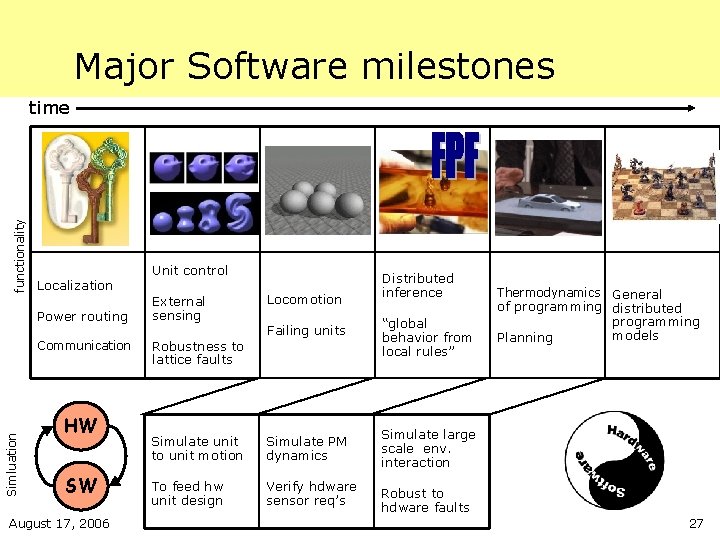
Major Software milestones functionality time Localization Power routing Simluation Communication HW SW August 17, 2006 Unit control External sensing Robustness to lattice faults Locomotion Failing units Simulate unit to unit motion Simulate PM dynamics To feed hw unit design Verify hdware sensor req’s Distributed inference “global behavior from local rules” Thermodynamics General of programming distributed programming models Planning Simulate large scale env. interaction Robust to hdware faults 27
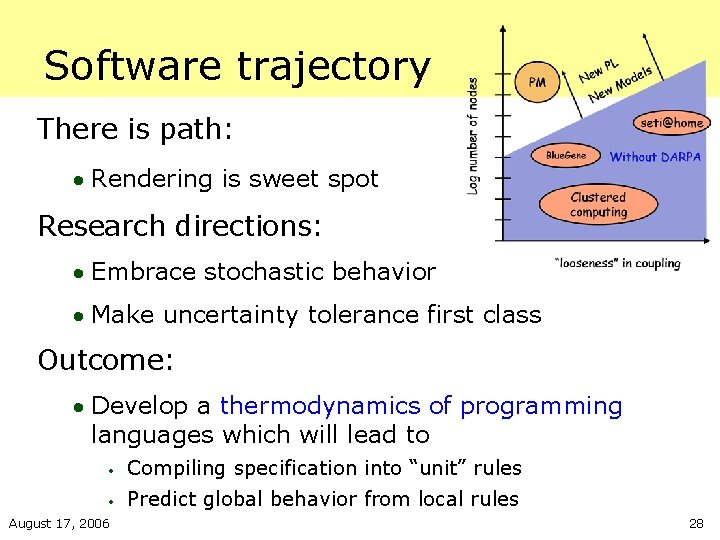
Software trajectory There is path: · Rendering is sweet spot Research directions: · Embrace stochastic behavior · Make uncertainty tolerance first class Outcome: · Develop a thermodynamics of programming languages which will lead to · Compiling specification into “unit” rules · Predict global behavior from local rules August 17, 2006 28
Why should DARPA invest in programmable matter? Would a soldier use an antenna made out of PM?
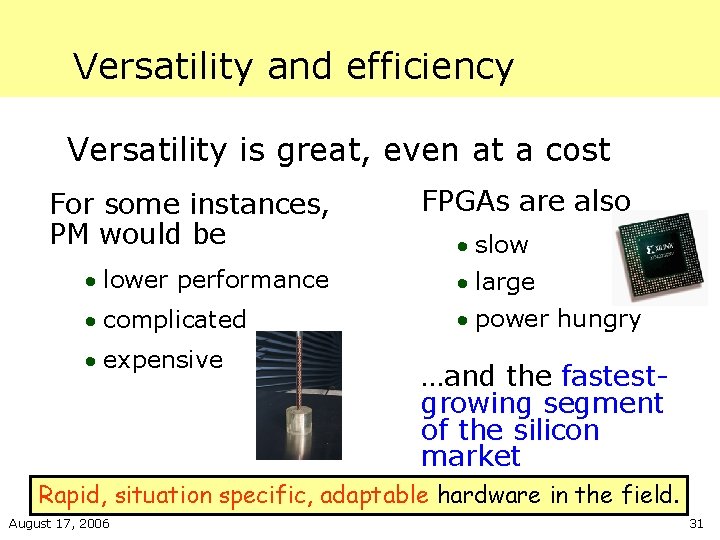
Versatility and efficiency Versatility is great, even at a cost For some instances, PM would be FPGAs are also · slow · lower performance · large · complicated · power hungry · expensive …and the fastestgrowing segment of the silicon market Rapid, situation specific, adaptable hardware in the field. August 17, 2006 31
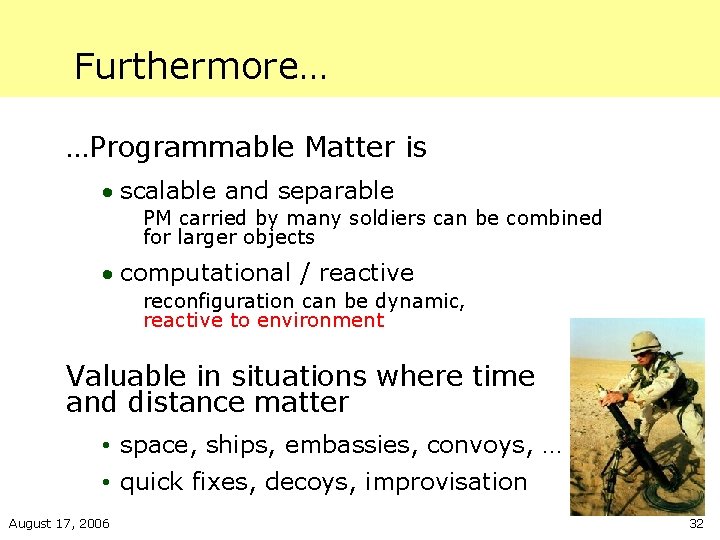
Furthermore… …Programmable Matter is · scalable and separable PM carried by many soldiers can be combined for larger objects · computational / reactive reconfiguration can be dynamic, reactive to environment Valuable in situations where time and distance matter • space, ships, embassies, convoys, … • quick fixes, decoys, improvisation August 17, 2006 32
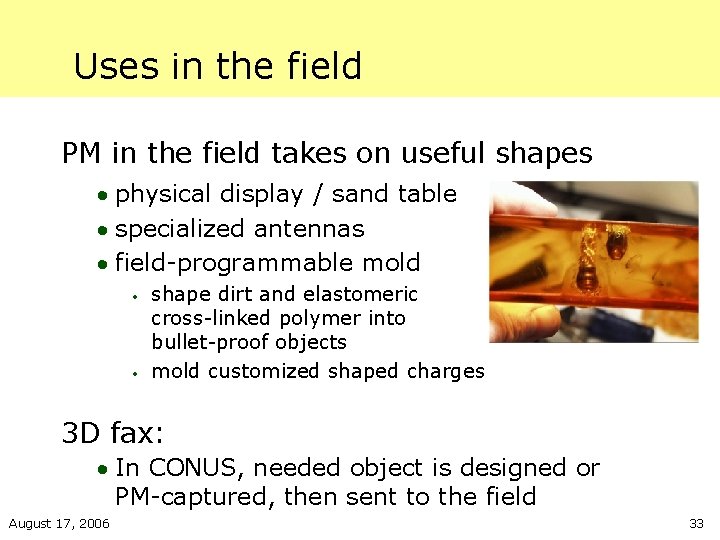
Uses in the field PM in the field takes on useful shapes · physical display / sand table · specialized antennas · field-programmable mold · · shape dirt and elastomeric cross-linked polymer into bullet-proof objects mold customized shaped charges 3 D fax: · In CONUS, needed object is designed or PM-captured, then sent to the field August 17, 2006 33
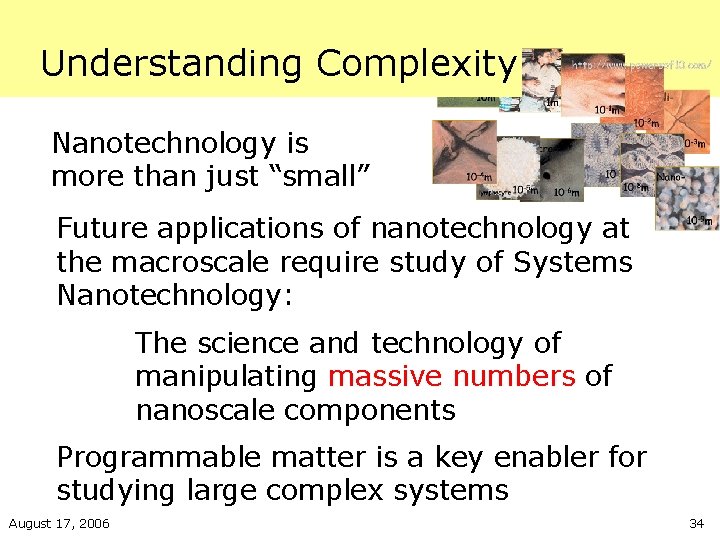
Understanding Complexity Nanotechnology is more than just “small” Future applications of nanotechnology at the macroscale require study of Systems Nanotechnology: The science and technology of manipulating massive numbers of nanoscale components Programmable matter is a key enabler for studying large complex systems August 17, 2006 34
Heilmeier questions What are we trying to do? · Build a programmable material that is able to morph into shapes, under software control and in reaction to external stimuli. Bring power of programming to the physical world. How is it done today? What are the limitations of current practice? · Preplanning, prepositioning, and many specialized objects. This means big loads and lack of flexibility to handle unforeseen needs. What is new in our approach & why do we think it can succeed? · Potential designs indicate feasibility of the hardware. Physical rendering is a “sweet spot” that is tractable, software-wise. Assuming we are successful, what difference will it make? · New capabilities in low-volume manufacturing and 3 D displays. Antennas may achieve radical improvements. New programming models for and understanding of large-scale systems. How long will it take? How much will it cost? · Basic units can be built in the near term. Integration of adhesion, sensing, locomotion several years later, leading to initial deployable applications in the 5 -10 year time frame. August 17, 2006 35
Conclusions Manufacturing PM elements poses challenges, but appears to be feasible and may lead to new 3 D concepts Software for PM applications, while raising significant questions, appears algorithmically feasible for physical rendering but still requires breakthroughs in distributed computing Application domain of rendering can form springboard for advances in models and languages for massively distributed programming of reality There are leap-ahead military applications, in both longer and shorter time frames August 17, 2006 36
Participants Tayo Akinwande (MIT)* Tom Knight (MIT)* Daniela Rus (MIT) Lorenzo Alvisi (UT-Austin) Dan Koditschek (UPenn) Vijay Saraswat (IBM) Michael Biercuk (BAH) Peter Lee (CMU)* Metin Sitti (CMU) Jason Campbell (Intel) Pat Lincoln (SRI)* Jonathan Smith (DARPA) Brad Chamberlain (Washington) Hod Lipson (Cornell) Bob Colwell (Intel) Bill Mark (SRI)* Andre De. Hon (UPenn)* Andrew Myers (Cornell)* John Evans (DARPA) Radhika Nagpal (Harvard) Gary Fedder (CMU) Karen Olson (IDA)* Alan Fenn (MIT-LL) George Pappas (UPenn) Stephanie Forrest (UNM) Keith Kotay (MIT) Seth Goldstein (CMU)* Zach Lemnios (MIT-LL)* Bob Tulis (SAIC)* James Heath (Cal. Tech) Kathy Mc. Donald (SOCOM) Tom Wagner (DARPA) Maurice Herlihy (Brown) Dan Radack (DARPA) Janet Ward (RDECOM) Peter Kind (IDA)* Rob Reid (AFRL) Mark Yim (UPenn) Eric Klavins (Washington) John Reif (Duke) Marc Zissman (MIT-LL)* August 17, 2006 Dan Stancil (CMU) Guy Steele (Sun) Allan Steinhardt (BBN) Gerry Sussman (MIT) Bill Swartout (ICT) David Tarditi (Microsoft) *ISAT member 37
BACKUP SLIDES FOLLOW August 17, 2006 38
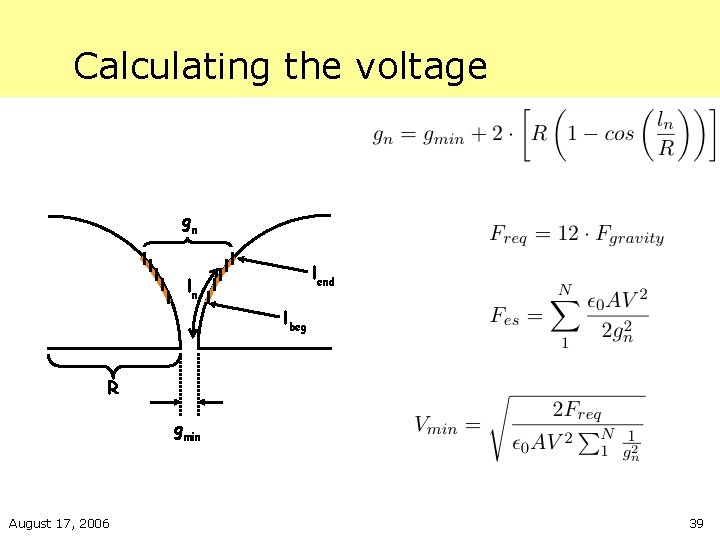
Calculating the voltage gn lend ln lbeg R gmin August 17, 2006 39
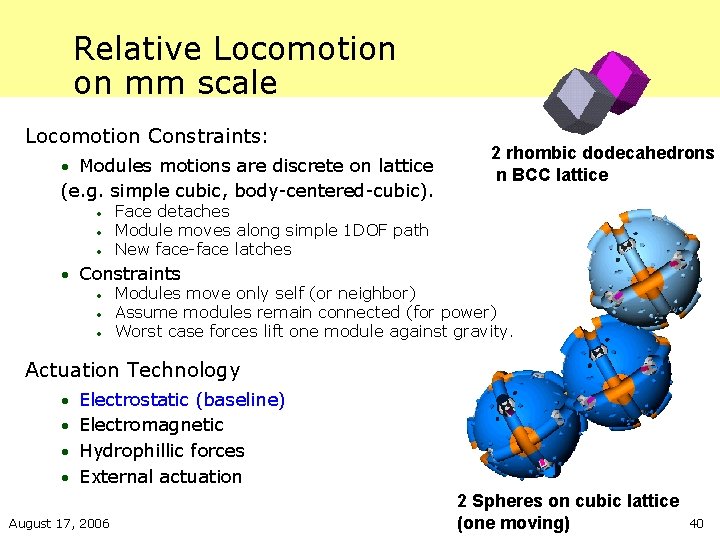
Relative Locomotion on mm scale Locomotion Constraints: · Modules motions are discrete on lattice (e. g. simple cubic, body-centered-cubic). · · · 2 rhombic dodecahedrons n BCC lattice Face detaches Module moves along simple 1 DOF path New face-face latches · Constraints · · · Modules move only self (or neighbor) Assume modules remain connected (for power) Worst case forces lift one module against gravity. Actuation Technology · · Electrostatic (baseline) Electromagnetic Hydrophillic forces External actuation August 17, 2006 2 Spheres on cubic lattice (one moving) 40
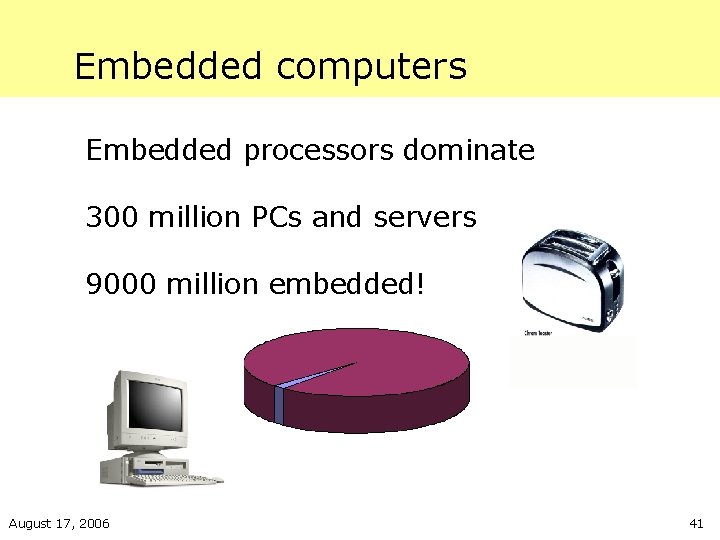
Embedded computers Embedded processors dominate 300 million PCs and servers 9000 million embedded! August 17, 2006 41
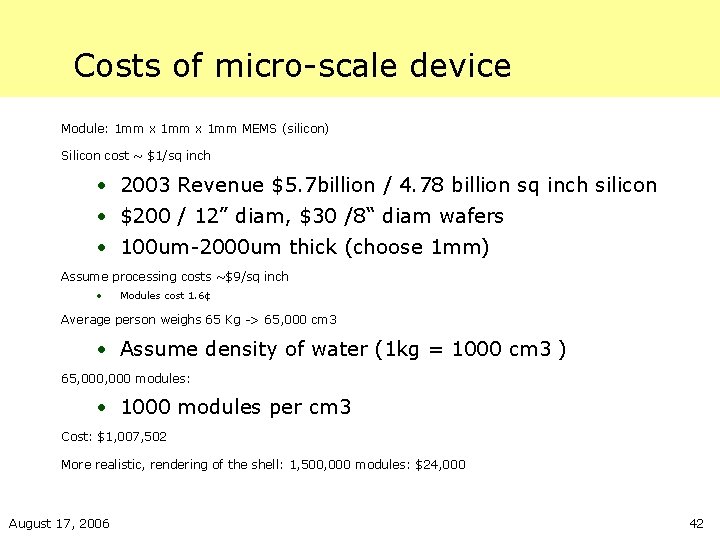
Costs of micro-scale device Module: 1 mm x 1 mm MEMS (silicon) Silicon cost ~ $1/sq inch · 2003 Revenue $5. 7 billion / 4. 78 billion sq inch silicon · $200 / 12” diam, $30 /8“ diam wafers · 100 um-2000 um thick (choose 1 mm) Assume processing costs ~$9/sq inch · Modules cost 1. 6¢ Average person weighs 65 Kg -> 65, 000 cm 3 · Assume density of water (1 kg = 1000 cm 3 ) 65, 000 modules: · 1000 modules per cm 3 Cost: $1, 007, 502 More realistic, rendering of the shell: 1, 500, 000 modules: $24, 000 August 17, 2006 42
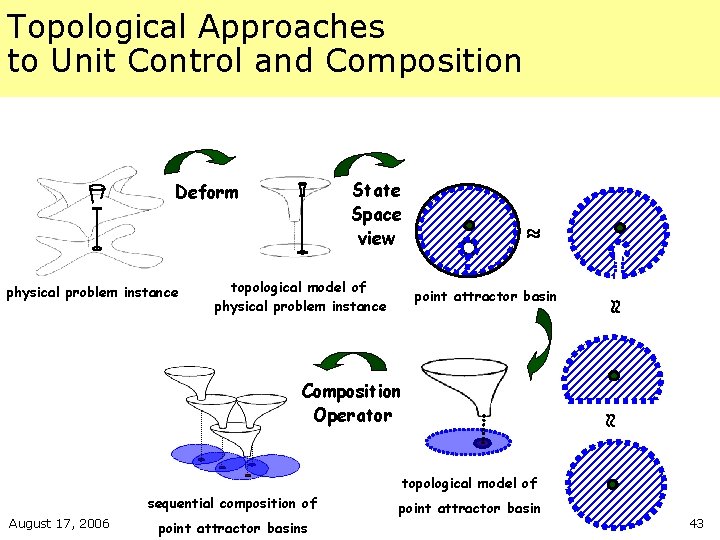
Topological Approaches to Unit Control and Composition State Space view Deform topological model of physical problem instance point attractor basin ¼ Composition Operator ¼ physical problem instance ¼ topological model of sequential composition of August 17, 2006 point attractor basins point attractor basin 43
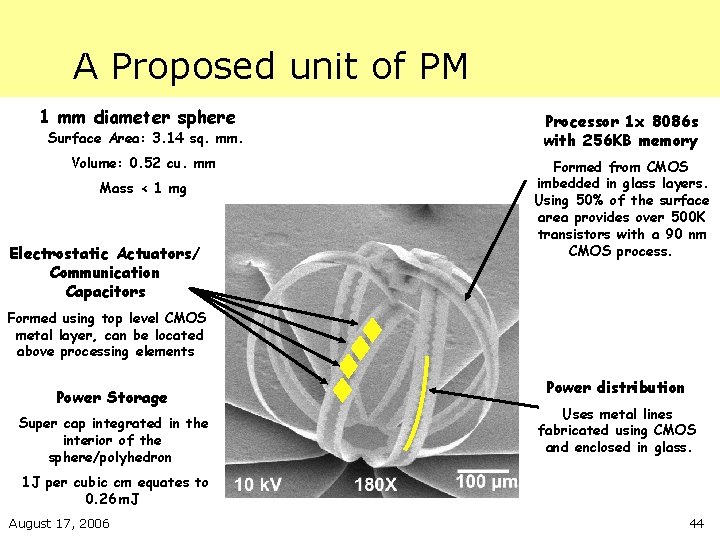
A Proposed unit of PM 1 mm diameter sphere Surface Area: 3. 14 sq. mm. Volume: 0. 52 cu. mm Mass < 1 mg Electrostatic Actuators/ Communication Capacitors Processor 1 x 8086 s with 256 KB memory Formed from CMOS imbedded in glass layers. Using 50% of the surface area provides over 500 K transistors with a 90 nm CMOS process. Formed using top level CMOS metal layer, can be located above processing elements Power Storage Super cap integrated in the interior of the sphere/polyhedron Power distribution Uses metal lines fabricated using CMOS and enclosed in glass. 1 J per cubic cm equates to 0. 26 m. J August 17, 2006 44
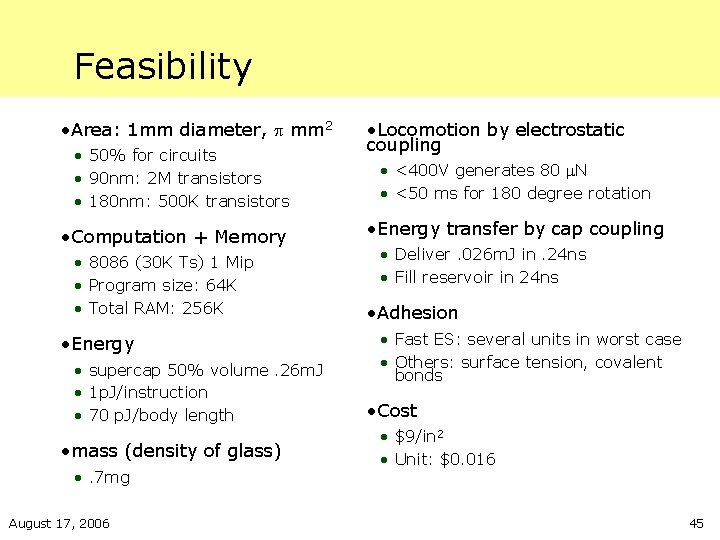
Feasibility • Area: 1 mm diameter, mm 2 · 50% for circuits · 90 nm: 2 M transistors · 180 nm: 500 K transistors • Computation + Memory · 8086 (30 K Ts) 1 Mip · Program size: 64 K · Total RAM: 256 K • Energy · supercap 50% volume. 26 m. J · 1 p. J/instruction · 70 p. J/body length • mass (density of glass) ·. 7 mg August 17, 2006 • Locomotion by electrostatic coupling · <400 V generates 80 N · <50 ms for 180 degree rotation • Energy transfer by cap coupling · Deliver. 026 m. J in. 24 ns · Fill reservoir in 24 ns • Adhesion · Fast ES: several units in worst case · Others: surface tension, covalent bonds • Cost · $9/in 2 · Unit: $0. 016 45
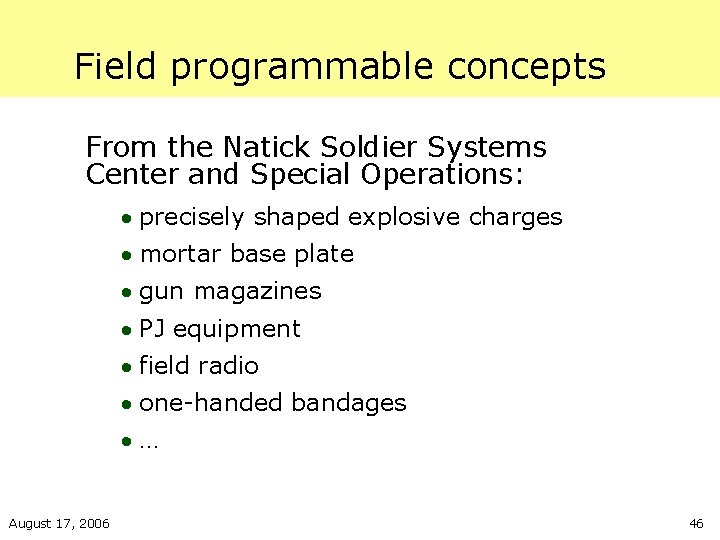
Field programmable concepts From the Natick Soldier Systems Center and Special Operations: · precisely shaped explosive charges · mortar base plate · gun magazines · PJ equipment · field radio · one-handed bandages ·… August 17, 2006 46
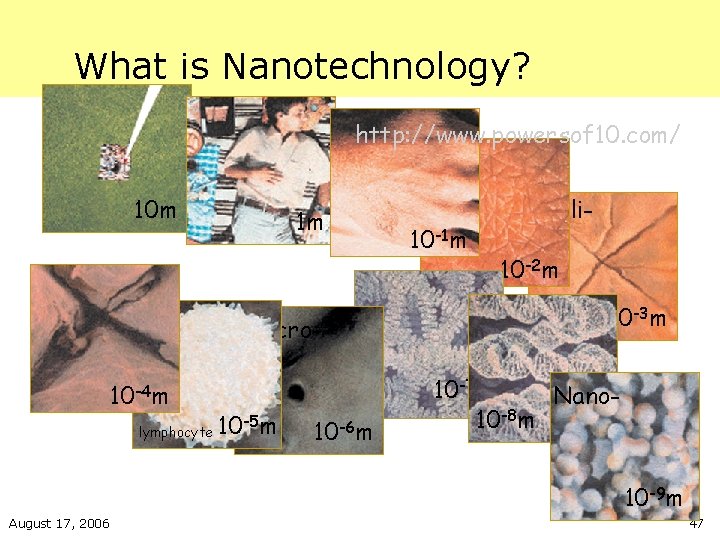
What is Nanotechnology? http: //www. powersof 10. com/ 10 m 1 m Micro 10 -4 m lymphocyte 10 -5 m 10 -6 m 10 -1 m Milli 10 -2 m 10 -3 m 10 -7 m Nano 10 -8 m 10 -9 m August 17, 2006 47
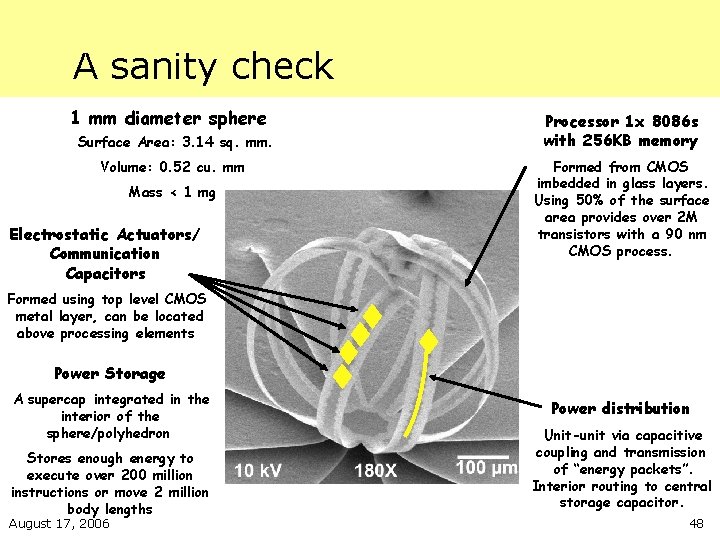
A sanity check 1 mm diameter sphere Surface Area: 3. 14 sq. mm. Volume: 0. 52 cu. mm Mass < 1 mg Electrostatic Actuators/ Communication Capacitors Processor 1 x 8086 s with 256 KB memory Formed from CMOS imbedded in glass layers. Using 50% of the surface area provides over 2 M transistors with a 90 nm CMOS process. Formed using top level CMOS metal layer, can be located above processing elements Power Storage A supercap integrated in the interior of the sphere/polyhedron Stores enough energy to execute over 200 million instructions or move 2 million body lengths August 17, 2006 Power distribution Unit-unit via capacitive coupling and transmission of “energy packets”. Interior routing to central storage capacitor. 48
August 17, 2006 49
August 17, 2006 50
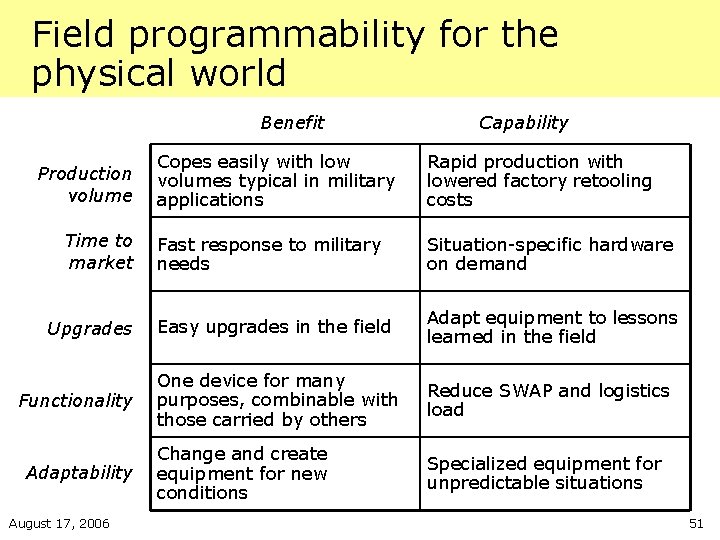
Field programmability for the physical world Benefit Production volume Time to market Upgrades Functionality Adaptability August 17, 2006 Capability Copes easily with low volumes typical in military applications Rapid production with lowered factory retooling costs Fast response to military needs Situation-specific hardware on demand Easy upgrades in the field Adapt equipment to lessons learned in the field One device for many purposes, combinable with those carried by others Reduce SWAP and logistics load Change and create equipment for new conditions Specialized equipment for unpredictable situations 51
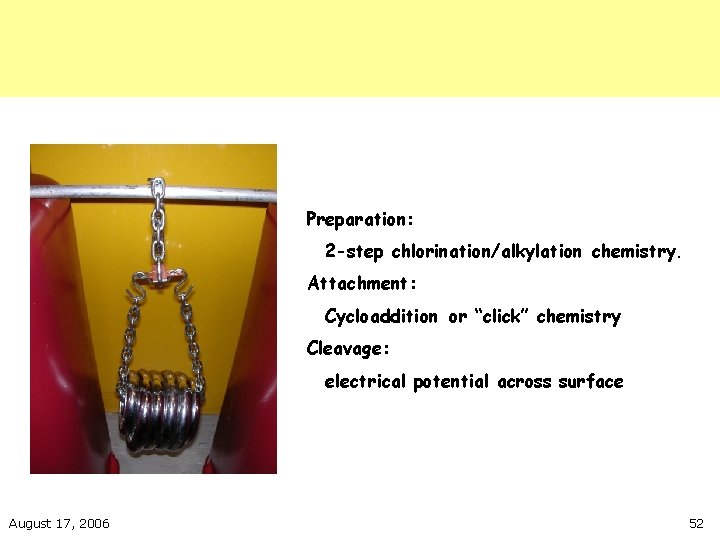
Preparation: 2 -step chlorination/alkylation chemistry. Attachment: Cycloaddition or “click” chemistry Cleavage: electrical potential across surface August 17, 2006 52
- Slides: 50