
Realizing Opportunities for English Language Learners Through State

![In the Words of Lily Wong Fillmore … “English language learners [ELLs] are provided](https://slidetodoc.com/presentation_image_h2/12b8e42138cb921892071064a0b40731/image-4.jpg "In the Words of Lily Wong Fillmore … “English language learners [ELLs] are provided")
- Slides: 40
Realizing Opportunities for English Language Learners Through State Academic Standards U. S. Department of Education Office of Career, Technical, and Adult Education Standards. Work, Inc. 2016
Welcome and Webinar Logistics § Ronna Spacone, Office of Career, Technical, and Adult Education (OCTAE) § Jennifer Bocchieri, Comm. Partners 2
Webinar Agenda § Introduction and review of agenda § New instructional imperatives, including observing a video of ELL instructional practices § Research on realizing opportunities for ELLs in reading, writing, speaking and listening, and language § Re-envisioning the education of adult ELLs § Questions and comments 3
In the Words of Lily Wong Fillmore … “English language learners [ELLs] are provided materials that are so greatly simplified that they provide virtually no exposure to the forms and structures of the language they should be learning … [There’s] a lot of attention and energy focused on turning ELLs into English speakers, and not nearly enough on educating them. What ELLs need are authentic and age-appropriate texts … with appropriate instructional support from teachers who know how to support language development. ” –- Lily Wong Fillmore, September 2010 4
Demographic Imperatives § According to the most recent data (2013 -2014) from the National Reporting Service, adult ELLs comprise a substantial proportion (more than 40%) of the population of adult students in the federally funded system. § Many states are experiencing exponential increases in ELL populations. § Accessing postsecondary education or workplace is especially challenging for ELLs because many cannot meet the entry requirements. Source: https: //wdcrobcolp 01. ed. gov/CFAPPS/OVAE/NRS/main. cfm 5
ELLs Bring Many Resources to Learning! § Knowing another language in our global economy is a good thing … a very good thing! § Many ELLs have first-language and literacy knowledge and skills that can boost their acquisition of English and learning more broadly: • ELLs who are literate in a first-language that shares cognates with English can apply that knowledge to second-language acquisition. • ELLs often have a heightened awareness of grammatical functions and effects because they use two or more languages. • ELLs can bring to bear conceptual knowledge they developed in their first language within their disciplinary studies. 6
Traditional Instructional Practices § Practice 1: Learning English is a bridge that ELLs must cross before they are allowed to study fields of genuine interest to them, such as science, literature, or history. § Practice 2: Left without access to the rich texts of academic disciplines, ELLs are often provided “mush” to read. 7
Why Have These Practices Endured? § Because they are based on the assumption that: • ELLs will be put off—frustrated—by anything that is too hard. • Adapted, decodable texts allow ELLs to read and access meaning on their own. § But, what is forgotten is that … • Simplified texts don’t offer students the complex syntax, vocabulary, or concepts they need to learn so that they can succeed. • Academic language can be learned only by noticing how it works in reading authentic texts—engaging with, thinking about, discussing, and writing about their content. 8
ELL Expert Contributions to College and Career Readiness Standards § Asked that the global and cultural diversity of the reading selections be strengthened. § Added aspects of comprehension monitoring, e. g. , ability to request clarification, confirm comprehension, ask questions. § Spoke forcefully in favor of incorporating literacy across the disciplines and helped to sustain their inclusion. § Added standards that require students to adapt their writing and speaking to a variety of contexts and communicative tasks. § Insisted that grammar and usage be acquired through communication and comprehension. 9
New Standards – New Imperatives § ELLs learn language best when they engage with content. § With support, ELLs must participate in classroom discourse focused on rich and exciting academic content. § The only way ELLs can gain the complex language skills they need to do anything in school—and in life—is by working with complex, demanding reading materials. § To meet the new standards, instruction must immerse ELLs in meaning-making language and literacy activities. § Instruction needs to capitalize on ELLs’ existing talents (Language 1, background knowledge, interests and motivations). 10
Bottom Line § Much more time and attention need to be placed on educating ELLs, not just on turning ELLs into English speakers. § Academic language is context-dependent—who is using it, what is being communicated, how it is being used, and what purpose it is being used for. And that means … ELLs can no longer be considered the sole responsibility of a small cadre of language specialists … preparing ELLs must become a shared responsibility with ABE teachers! 11
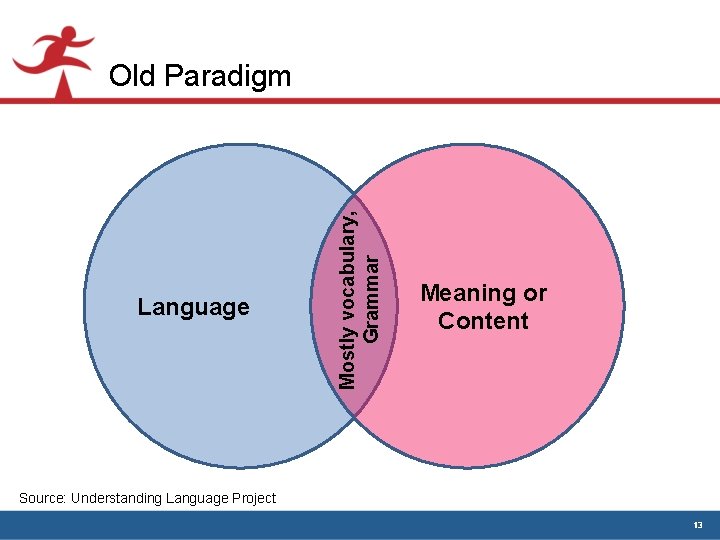
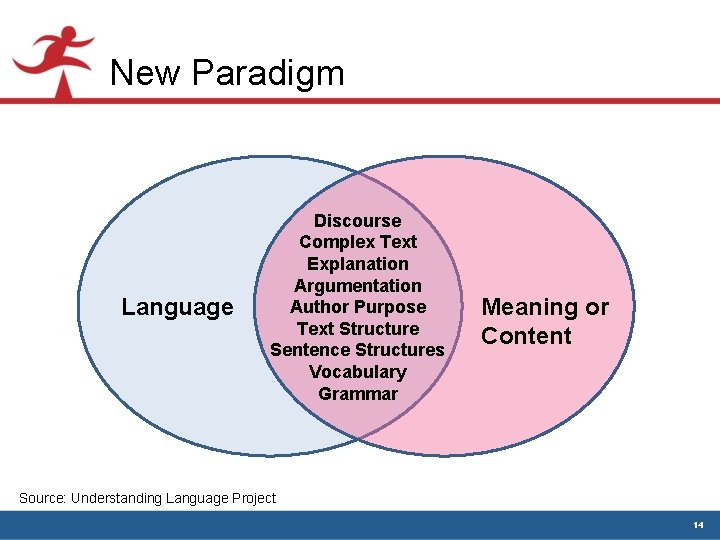
Relationship Between Language and Meaning or Content Language: We need to learn thousands of words. The words themselves often have multiple meanings and complex relationships with each other. Meaning or Content: We have to put these words together in phrases, sentences, charts, and diagrams to construct meaning. From words, we build explanations, narratives, discussions, and arguments. Language is an essential tool for connecting different pieces of what we know. 12
Language Mostly vocabulary, Grammar Old Paradigm Meaning or Content Source: Understanding Language Project 13
New Paradigm Language Discourse Complex Text Explanation Argumentation Author Purpose Text Structure Sentence Structures Vocabulary Grammar Meaning or Content Source: Understanding Language Project 14
Now let’s watch a Grade 8 video of an ELA/literacy classroom of ELL students … 15
Reading § CCR standards: • Require students to read and comprehend literature and informational texts of increasing complexity. • Challenge ELLs to accurately process intricate and complicated linguistic and cultural features while trying to comprehend content. 16
ELL research on reading tells us to … § Choose complex, authentic texts that: ü Are brief, interesting, and engaging for students. * ü Emphasize one or two complexity features at a time (e. g. , a lexically dense piece with a simpler grammatical structure). ü Connect to a given unit of study and build students’ knowledge of a topic. * ü Provide sufficient details and examples so that students are able to comprehend the passage. * ü Contain ideas that can be discussed from a variety of perspectives. * *Asterisks on slides 18 -29 represent practices evident in the ELL lesson video. 17
ELL research on reading (continued) § Read the text aloud at the start of the lesson, and then facilitate a discussion about the words in the text. * § Concentrate on a small set of academic vocabulary words in a given text for in-depth instruction over the course of several lessons. § Build on and expand ELLs’ knowledge about how different kinds of texts are structured. * § Provide necessary contextual information and leverage ELLs’ background knowledge without paraphrasing or “preempting” the text for students. 18
ELL research on reading (continued) § Offer readers more accessible texts (including those in a students Language 1) in preparation for reading more difficult texts on a topic. § Simplify wording of questions (e. g. , What does the author tell us about how this historical event affects Mexico today? How did Mexico change because of the Aztec period? )* § Provide additional instruction in small groups of three to five students who are struggling with language and literacy. * § Focus readers’ attention on meaning-critical grammatical structures (and how those might compare with how grammar is used to make similar meaning in students’ first languages). 19
Writing § CCR standards: • Require students to write different types of texts for varied audiences and purposes, analyze information, and present knowledge gained through research. • Challenge ELLs to use language skillfully to cite specific evidence when crafting arguments and writing reports. 20
ELL research on writing tells us to … § Give ELLs meaningful ideas to write about rather than mechanical exercises. * § Provide writing opportunities that are anchored in content to extend student learning and understanding. * § Strategically use tools—visuals and graphic organizers—to anchor instruction and to help students make sense of content. * § Use a set of instructional routines that support students as they generate and organize their ideas for writing and research. * 21
ELL research on writing (continued) § Provide substantive feedback to ELLs about the content of their writing at multiple points throughout the writing process (i. e. , focus on the instructional objective). § Provide ELLs with meaningful exposure to mentor texts to focus on language and text structure. § Allow ELLs to use their home languages or varieties of language during the writing process, including working and talking in pairs. * § Attend to the fact that some writing skills are affected by students’ linguistic and cultural backgrounds so they may not align with those in the standards. * 22
Writing and ELLs’ Cultural and Linguistic Backgrounds (Some Examples) § Typical Chinese style: Praises eloquent language and avoids making direct points or arguments. § Typical Arabic style: Does not tend to present different perspectives or counterarguments; does not challenge what is socially validated; and pays more attention to impressiveness than to logic and reasoning. § Typical Japanese style: Is restrained, undemonstrative, cautious, and understated. Flashes of insight are valued without the intermediary steps of syllogistic reasoning. § Typical Finnish style: Does not prepare the audience for what to expect or for the conclusions. § The rules of ‘articles’ and ‘tenses’ do not exist in many languages. Sources: http: //www. colorincolorado. org/blog/culture-and-writing-ells-ccss-part-2; Influence of Cultural and Linguistic Backgrounds on the Writing of Arabic and Japanese Students of English Bouchra Moujtahid; http: //www. ccsenet. org/elt 23
Speaking and Listening § CCR standards: • Require students to articulate their own and build on others’ ideas as well as demonstrate understanding of informal interactions and formal presentations. • Challenge ELLs to employ a range of listening comprehension and speech production strategies. 24
ELL research on speaking and listening tells us to … § Develop meaningful collaborative tasks that allow ELLs to use their full linguistic and cultural resources. * § Provide ELLs with daily opportunities to talk about content in pairs or small groups, anchored by topics in the text(s). * § Structure student groups and provide guidance to facilitate focused and targeted discussions (e. g. , have students cite evidence from the text to support a position). * 25
ELL research on speaking and listening (continued) § Allow ELLs to collaborate in their home languages as they work on tasks to be completed in English. * § Include listening comprehension activities designed to help ELLs arrive at a reasonable interpretation of extended discourse rather than process every word literally. * § Allow ELLs to engage productively using language that is still under development and may exhibit “non-native” or imperfect features. * 26
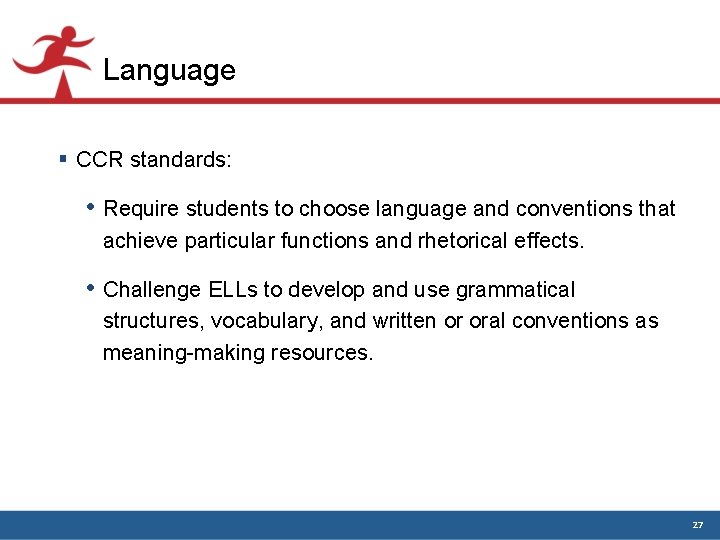
Language § CCR standards: • Require students to choose language and conventions that achieve particular functions and rhetorical effects. • Challenge ELLs to develop and use grammatical structures, vocabulary, and written or oral conventions as meaning-making resources. 27
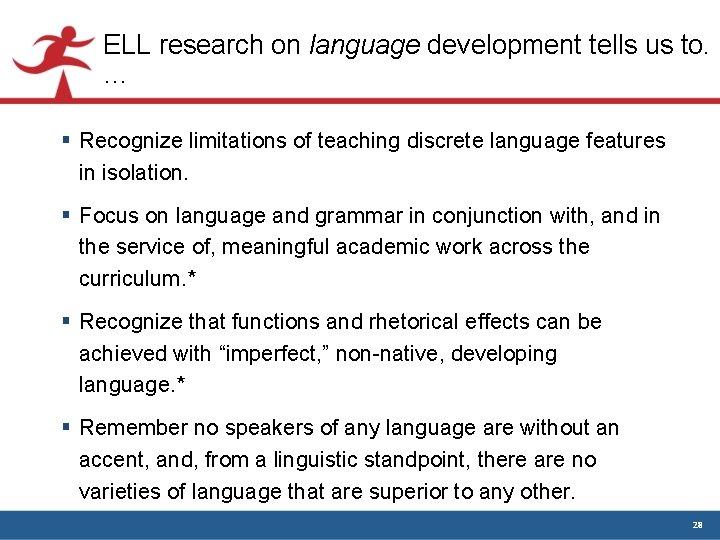
ELL research on language development tells us to. … § Recognize limitations of teaching discrete language features in isolation. § Focus on language and grammar in conjunction with, and in the service of, meaningful academic work across the curriculum. * § Recognize that functions and rhetorical effects can be achieved with “imperfect, ” non-native, developing language. * § Remember no speakers of any language are without an accent, and, from a linguistic standpoint, there are no varieties of language that are superior to any other. 28
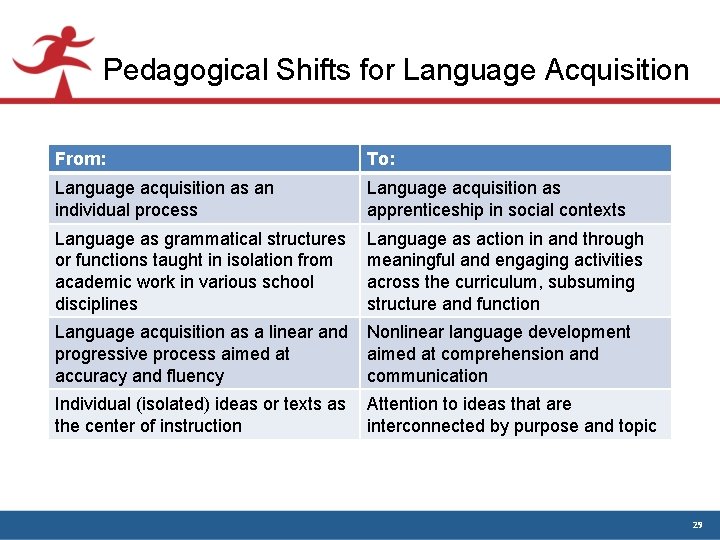
Pedagogical Shifts for Language Acquisition From: To: Language acquisition as an individual process Language acquisition as apprenticeship in social contexts Language as grammatical structures or functions taught in isolation from academic work in various school disciplines Language as action in and through meaningful and engaging activities across the curriculum, subsuming structure and function Language acquisition as a linear and progressive process aimed at accuracy and fluency Nonlinear language development aimed at comprehension and communication Individual (isolated) ideas or texts as the center of instruction Attention to ideas that are interconnected by purpose and topic 29
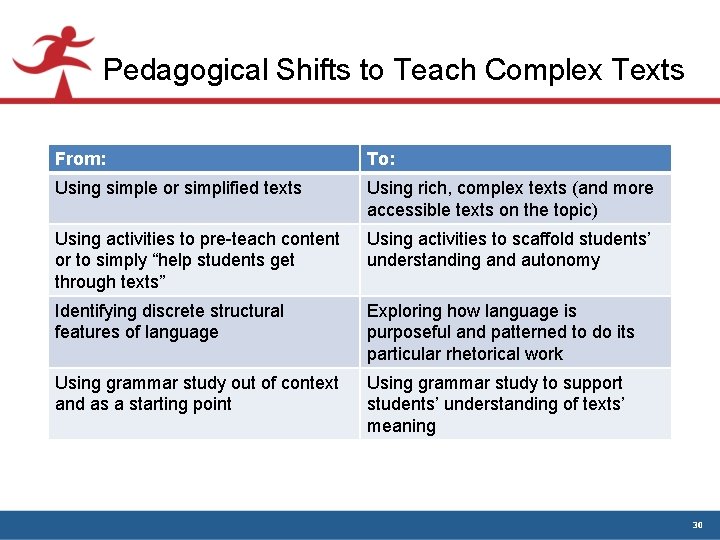
Pedagogical Shifts to Teach Complex Texts From: To: Using simple or simplified texts Using rich, complex texts (and more accessible texts on the topic) Using activities to pre-teach content or to simply “help students get through texts” Using activities to scaffold students’ understanding and autonomy Identifying discrete structural features of language Exploring how language is purposeful and patterned to do its particular rhetorical work Using grammar study out of context and as a starting point Using grammar study to support students’ understanding of texts’ meaning 30
ABE Teachers Are Challenged to: § View themselves as teachers of language and teachers of content. § Find ways to help students understand use language (oral and written) in ways that are valued in the content area. § Develop new ways to support students in using emerging and developing language in the classroom to perform in the content area. 31
ESL Teachers Are Challenged to: § Provide ELLs—especially those new to the United States— with additional support. § Re-envision their role and responsibility: • From: Teaching the forms and functions of a second language in isolation from disciplinary practices. • To: Preparing students for engagement in content area classes. 32
State and Program Leadership Are Challenged to: § Provide supports that focus on how to connect content to language instruction. § Provide time and structures that support ESL and content area teachers so they can coordinate and collaborate. § Build coherence so that all components of ELL instruction point in the same direction. 33
Publishers Are Challenged to: § Match materials to the new standards in ways that focus on greater use of language. § Move away from materials that simplify texts and tasks, and embrace materials that challenge ELLs. § Move beyond current strategies to make materials more accessible for ELLs (aside from glossaries and highlighted vocabulary) that currently do not address the language demands in the new standards. 34
10 Steps to Re-Envision ELL Education 1. ELLs and their teachers recognize that their knowledge of another language is an ability (not a disability). 2. Educators recognize that the development of English is fueled, not impeded, by students’ primary language skills. 3. ELLs have full access to disciplinary classes and engage in academic discourse before they have fully learned English. 4. ELLs meaningfully participate in those classes with “imperfect” language. 5. ELLs regularly engage with rich, authentic, level-appropriate complex texts. 35
Re-Envision Education of ELLs (continued) 6. ELLs engage in enriched rather than simplified communications. 7. ELLs are given quality instructional supports that do not supplant or compromise rigor or content. 8. ABE teachers are supported in figuring out how to attend to both content and language. 9. ABE and ESL teachers are provided ample time and supports to collaborate and coordinate their teaching of ELLs. 10. Teachers and students have materials that address the language demands within and provide supports for the new standards. 36
References and Resources § Understanding Language Project: http: //ell. stanford. edu/ § Bunch, Kibler, and Pimentel paper: http: //ell. stanford. edu/publication/realizing-opportunities-ellscommon-core-english-language-arts-and-disciplinary-literacy § Persuasion Across Time and Space: http: //ell. stanford. edu/teaching_resources/ela § Teaching Academic Content and Literacy to English Learners in Elementary and Middle School: http: //ies. ed. gov/ncee/wwc/Practice. Guide. aspx? sid=19 37
References and Resources § A Framework for Raising Expectations and Instructional Rigor for English Language Learners: http: //www. cgcs. org/cms/lib/DC 00001581/Centricity/Domain/4 /Framework for Raising Expectations. pdf § Framework for English Language Proficiency Development Standards Corresponding to the Common Core State Standards and the Next Generation Science Standards: http: //www. ccsso. org/Documents/2012/ELPD Framework Booklet-Final for web. pdf 38
Forthcoming Resources § English Language Proficiency Standards for Adult Education (Fall 2016) § Online professional development modules (2017) For more information, contact: Ronna Spacone Program Manager OCTAE Phone: 202 -245 -7755 ronna. spacone@ed. gov 39
Questions & Comments 40