
Realization of Ultrasonic Transducer Test SetUp Daan Timmers

- Slides: 31
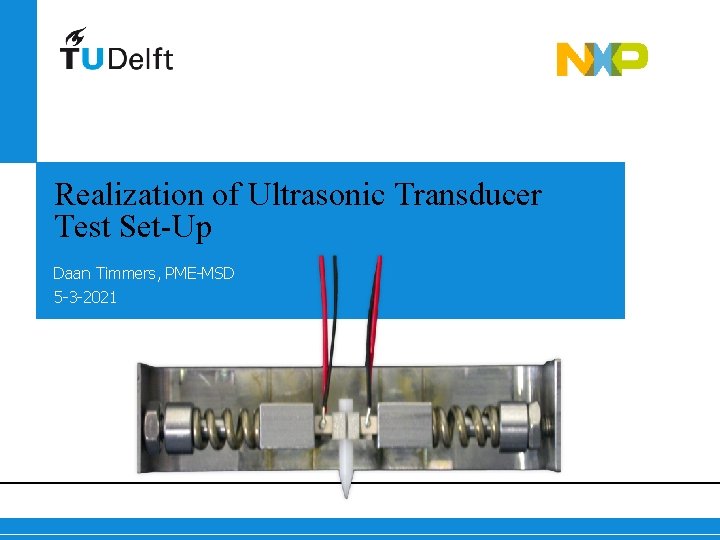
Realization of Ultrasonic Transducer Test Set-Up Daan Timmers, PME-MSD 5 -3 -2021
Contents • • Introduction in wire bonding Problem description Architecture Electromechanical model Mechanical design Results & Discussion Conclusions & Recommendations Realization of Ultrasonic Transducer Test Set-Up 2
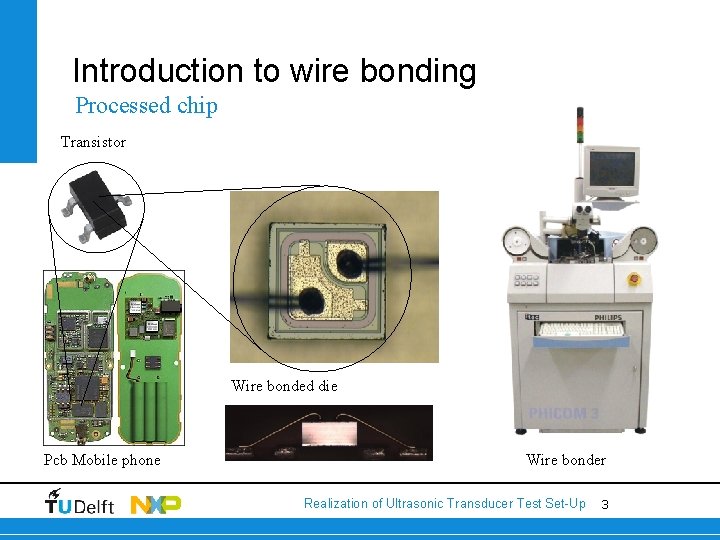
Introduction to wire bonding Processed chip Transistor Wire bonded die Pcb Mobile phone Wire bonder Realization of Ultrasonic Transducer Test Set-Up 3
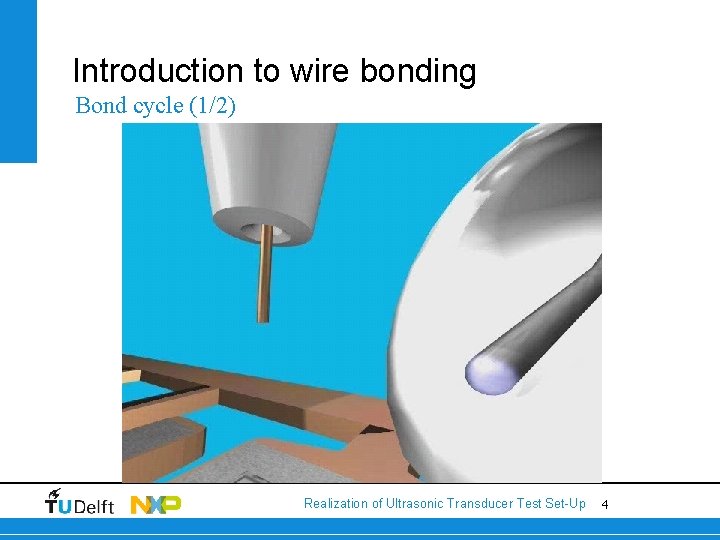
Introduction to wire bonding Bond cycle (1/2) Realization of Ultrasonic Transducer Test Set-Up 4
Introduction to wire bonding Bond cycle (2/2) Realization of Ultrasonic Transducer Test Set-Up 5
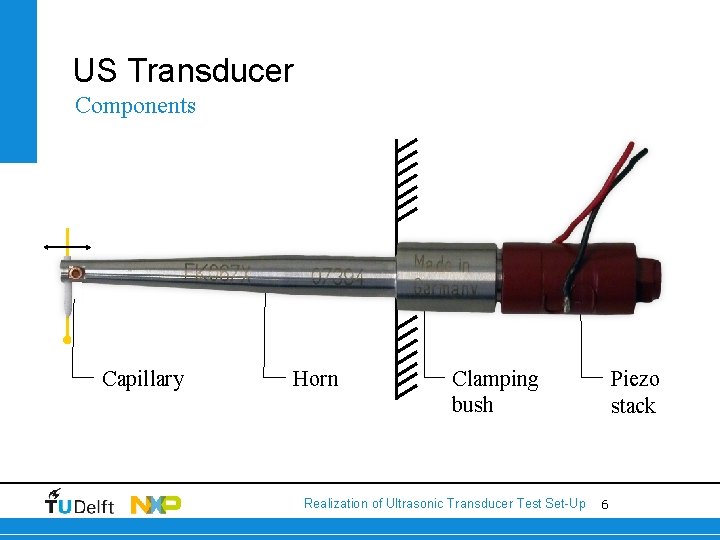
US Transducer Components Capillary Horn Clamping bush Realization of Ultrasonic Transducer Test Set-Up Piezo stack 6
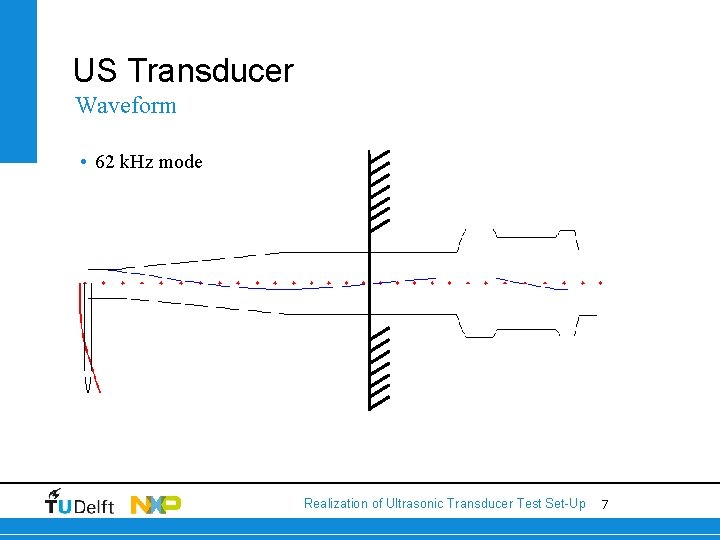
US Transducer Waveform • 62 k. Hz mode Realization of Ultrasonic Transducer Test Set-Up 7
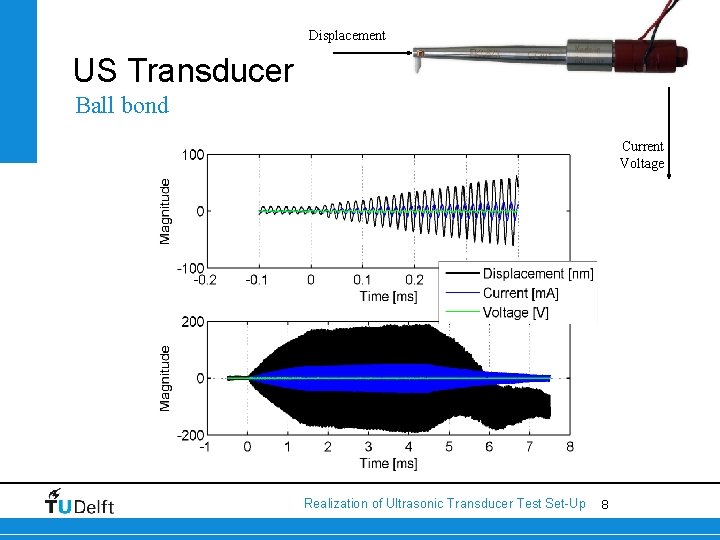
Displacement US Transducer Ball bond Current Voltage Realization of Ultrasonic Transducer Test Set-Up 8
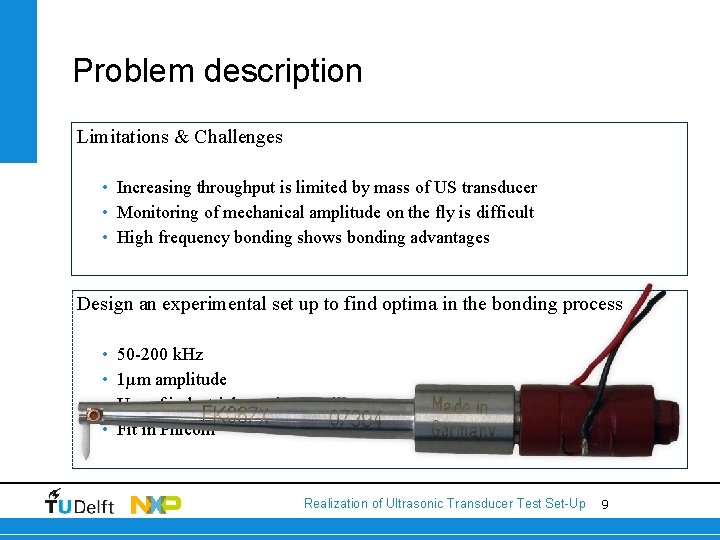
Problem description Limitations & Challenges • Increasing throughput is limited by mass of US transducer • Monitoring of mechanical amplitude on the fly is difficult • High frequency bonding shows bonding advantages Design an experimental set up to find optima in the bonding process • • 50 -200 k. Hz 1µm amplitude Use of industrial standard capillary Fit in Phicom Realization of Ultrasonic Transducer Test Set-Up 9
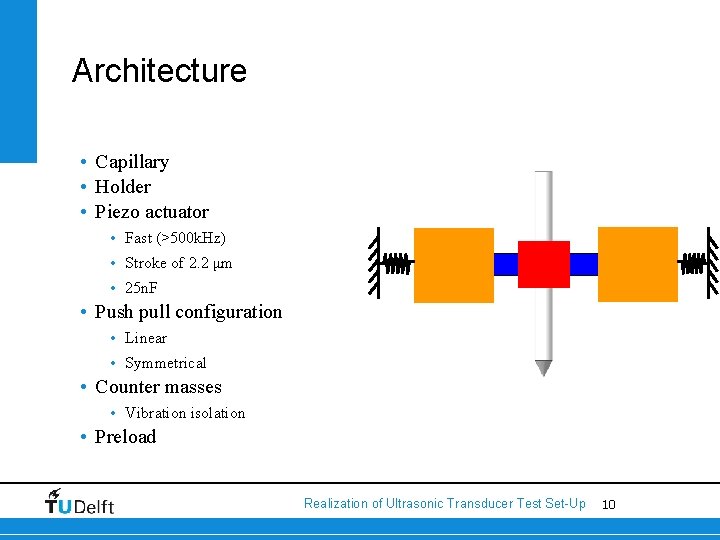
Architecture • Capillary • Holder • Piezo actuator • Fast (>500 k. Hz) • Stroke of 2. 2 μm • 25 n. F • Push pull configuration • Linear • Symmetrical • Counter masses • Vibration isolation • Preload Realization of Ultrasonic Transducer Test Set-Up 10
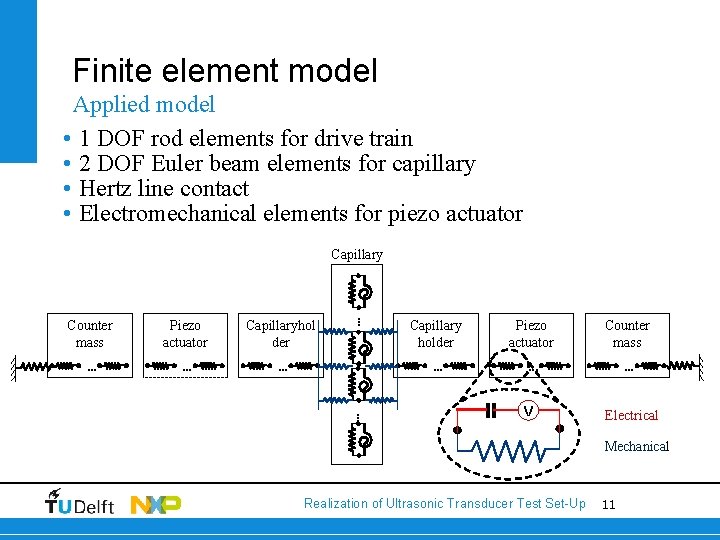
Finite element model Applied model • 1 DOF rod elements for drive train • 2 DOF Euler beam elements for capillary • Hertz line contact • Electromechanical elements for piezo actuator Capillary Piezo actuator Capillaryhol der . . . Counter mass Capillary holder Piezo actuator Counter mass . . . V Electrical Mechanical Realization of Ultrasonic Transducer Test Set-Up 11
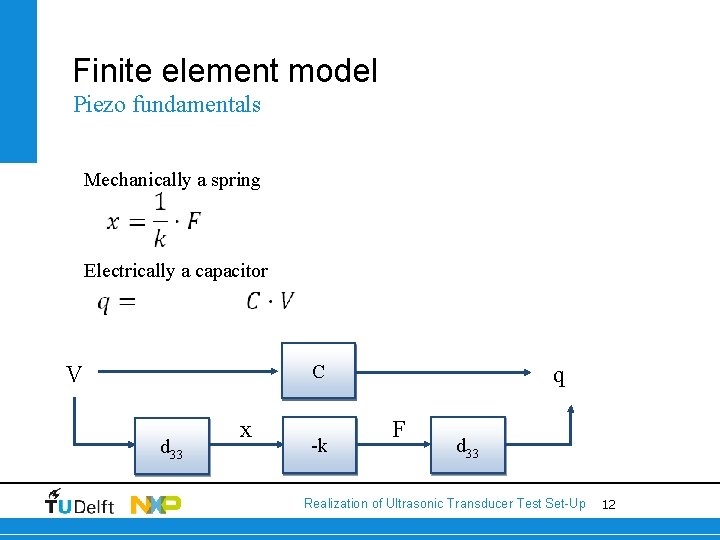
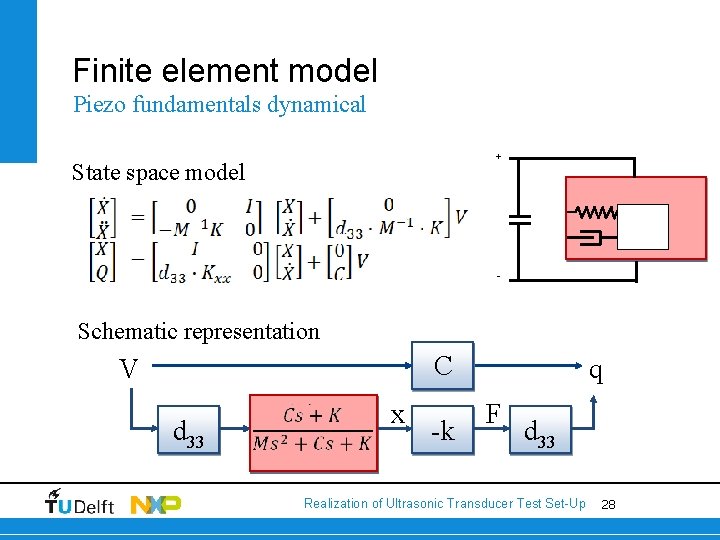
Finite element model Piezo fundamentals V=0 MAX V=V Mechanically a spring Electrically a capacitor V q q C d 33 x -k F d 33 Realization of Ultrasonic Transducer Test Set-Up 12
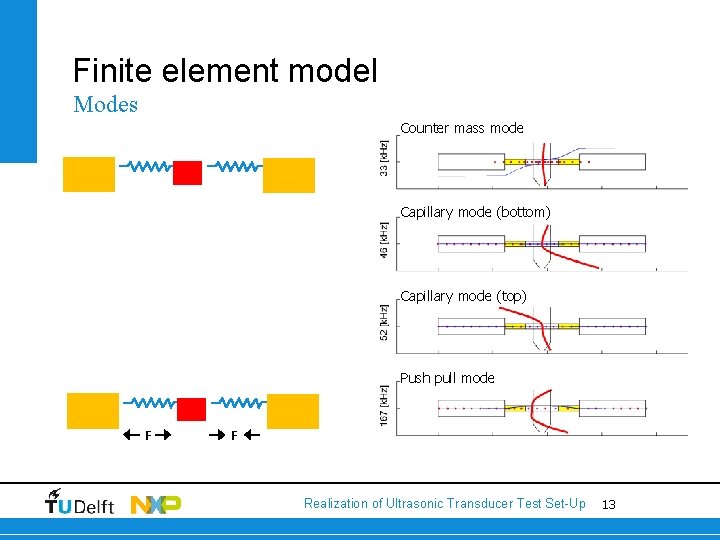
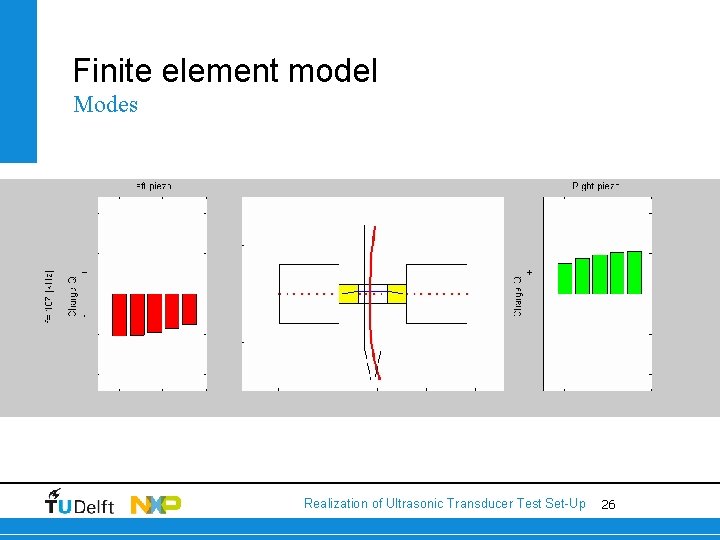
Finite element model Modes Counter mass mode Capillary mode (bottom) Capillary mode (top) Push pull mode F F Realization of Ultrasonic Transducer Test Set-Up 13
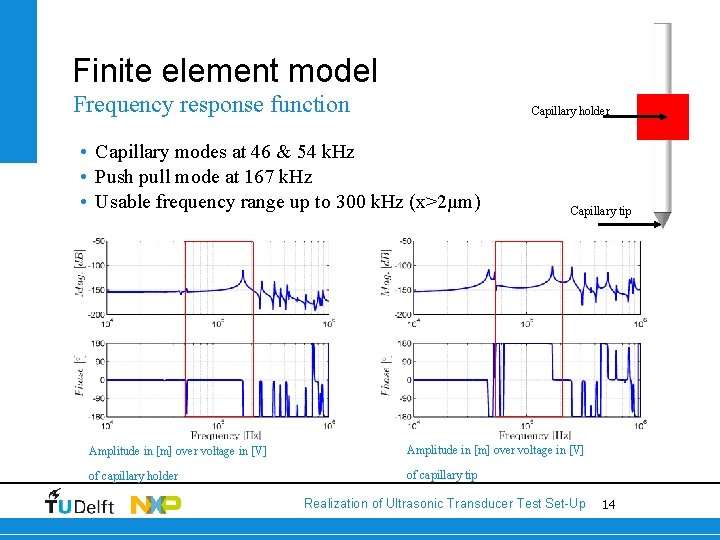
Finite element model Frequency response function Capillary holder • Capillary modes at 46 & 54 k. Hz • Push pull mode at 167 k. Hz • Usable frequency range up to 300 k. Hz (x>2µm) Capillary tip Amplitude in [m] over voltage in [V] of capillary holder of capillary tip Realization of Ultrasonic Transducer Test Set-Up 14
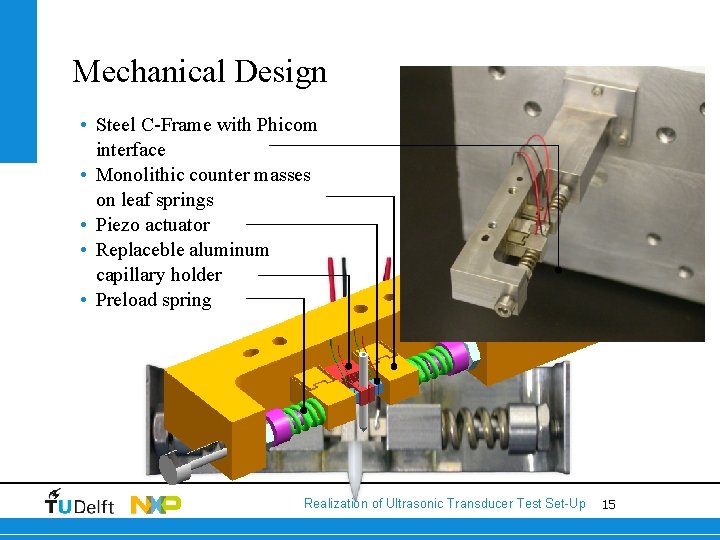
Mechanical Design • Steel C-Frame with Phicom interface • Monolithic counter masses on leaf springs • Piezo actuator • Replaceble aluminum capillary holder • Preload spring Realization of Ultrasonic Transducer Test Set-Up 15
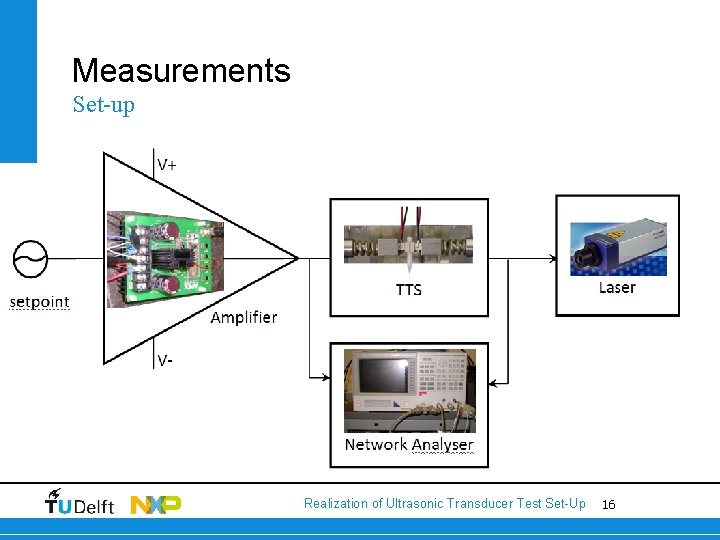
Measurements Set-up Realization of Ultrasonic Transducer Test Set-Up 16
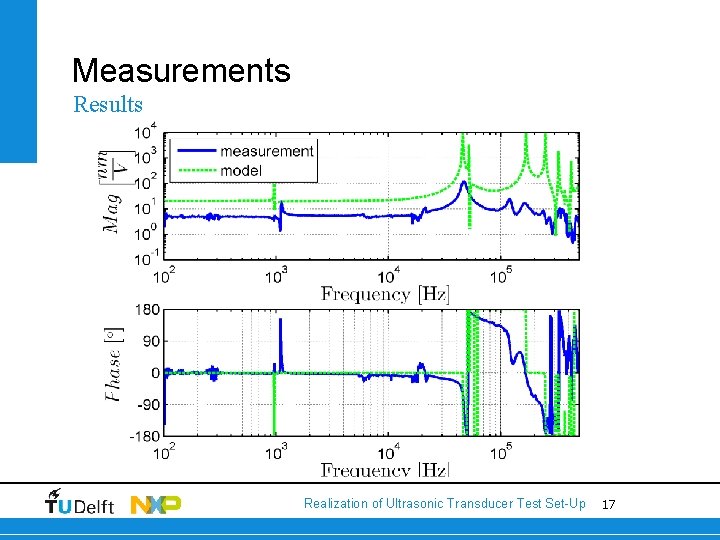
Measurements Results • Capillary modes and frame decoupling mode located according to model • Push pull mode shifted from 168 k. Hz to 120 k. Hz • Mechanical amplitude of 5 nm/V vs 20 nm/V • Counter mass mode at 22 k. Hz is excited Amplitude in [m] over voltage in [V] of capillary holder measured at 1 V RMS Realization of Ultrasonic Transducer Test Set-Up 17
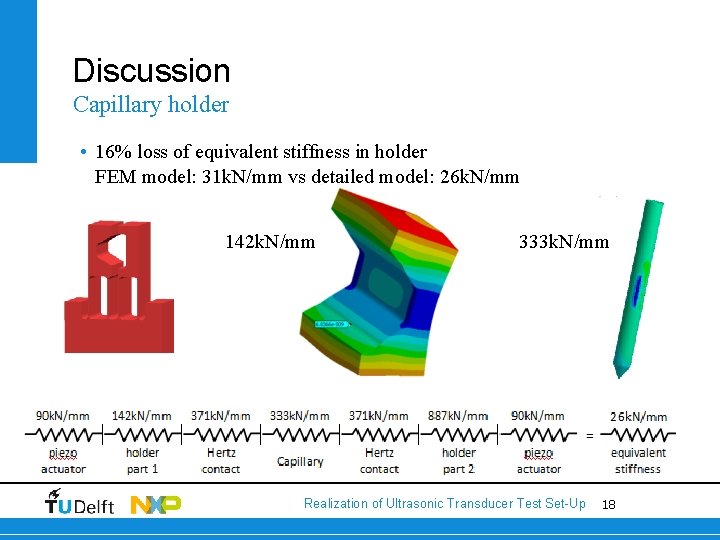
Discussion Capillary holder • 16% loss of equivalent stiffness in holder FEM model: 31 k. N/mm vs detailed model: 26 k. N/mm 142 k. N/mm 333 k. N/mm Realization of Ultrasonic Transducer Test Set-Up 18
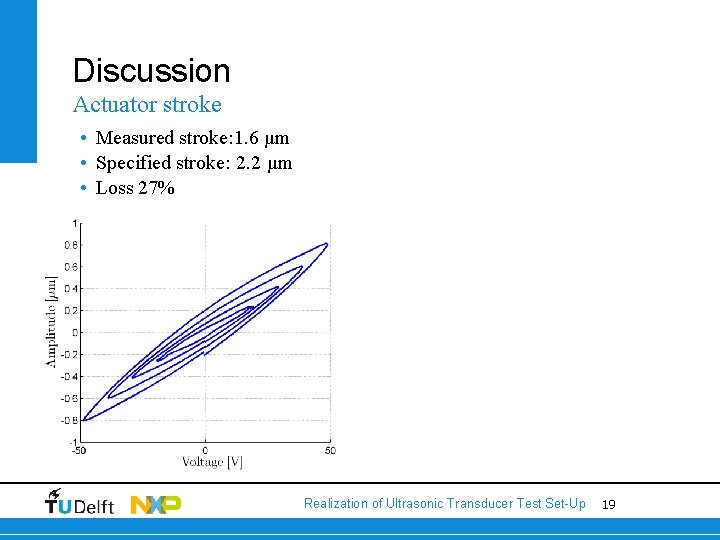
Discussion Actuator stroke • Measured stroke: 1. 6 µm • Specified stroke: 2. 2 µm • Loss 27% Realization of Ultrasonic Transducer Test Set-Up 19
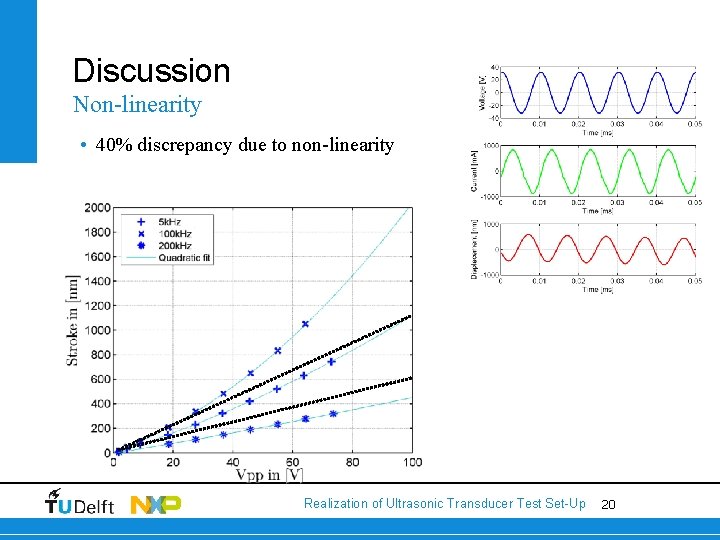
Discussion Non-linearity • 40% discrepancy due to non-linearity Realization of Ultrasonic Transducer Test Set-Up 20
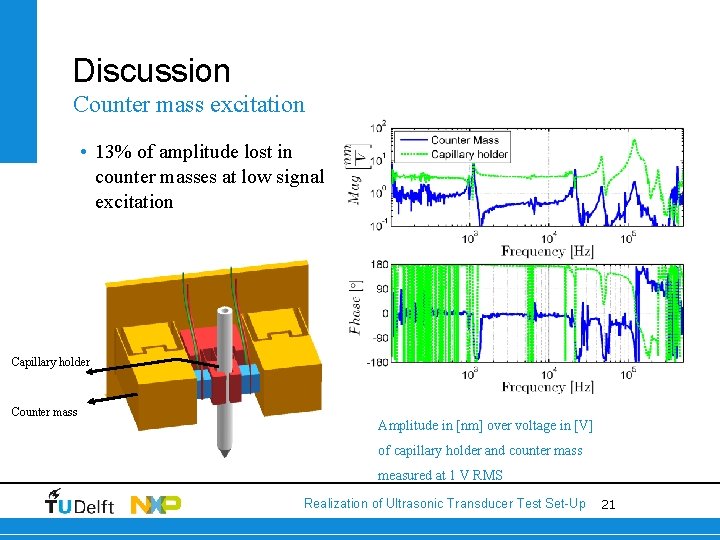
Discussion Counter mass excitation • 13% of amplitude lost in counter masses at low signal excitation Capillary holder Counter mass Amplitude in [nm] over voltage in [V] of capillary holder and counter mass measured at 1 V RMS Realization of Ultrasonic Transducer Test Set-Up 21
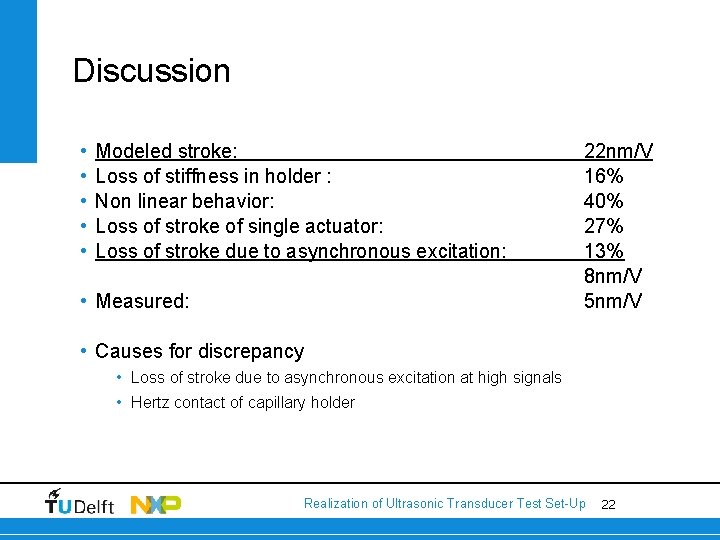
Discussion • • • Modeled stroke: Loss of stiffness in holder : Non linear behavior: Loss of stroke of single actuator: Loss of stroke due to asynchronous excitation: • Measured: 22 nm/V 16% 40% 27% 13% 8 nm/V 5 nm/V • Causes for discrepancy • Loss of stroke due to asynchronous excitation at high signals • Hertz contact of capillary holder Realization of Ultrasonic Transducer Test Set-Up 22
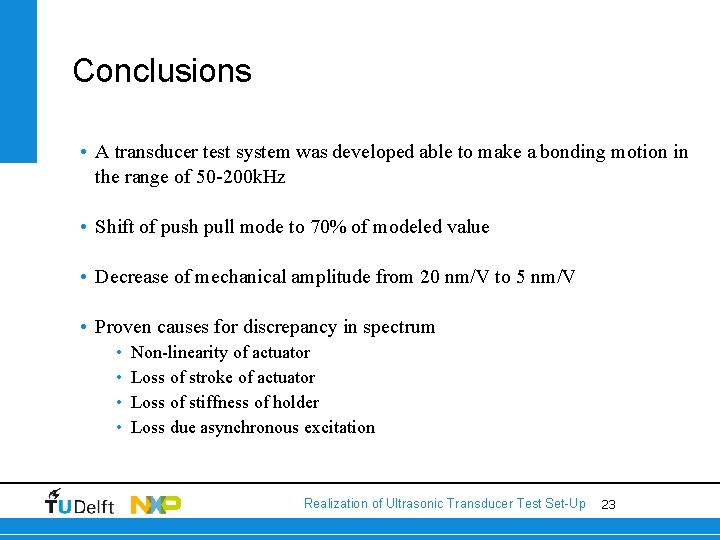
Conclusions • A transducer test system was developed able to make a bonding motion in the range of 50 -200 k. Hz • Shift of push pull mode to 70% of modeled value • Decrease of mechanical amplitude from 20 nm/V to 5 nm/V • Proven causes for discrepancy in spectrum • • Non-linearity of actuator Loss of stroke of actuator Loss of stiffness of holder Loss due asynchronous excitation Realization of Ultrasonic Transducer Test Set-Up 23
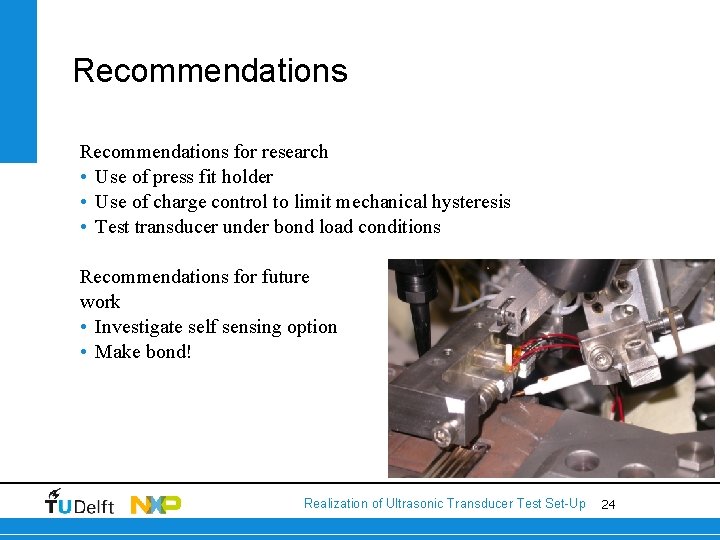
Recommendations for research • Use of press fit holder • Use of charge control to limit mechanical hysteresis • Test transducer under bond load conditions Recommendations for future work • Investigate self sensing option • Make bond! Realization of Ultrasonic Transducer Test Set-Up 24
n io st e ue Q tim Realization of Ultrasonic Transducer Test Set-Up 25
Finite element model Modes Realization of Ultrasonic Transducer Test Set-Up 26
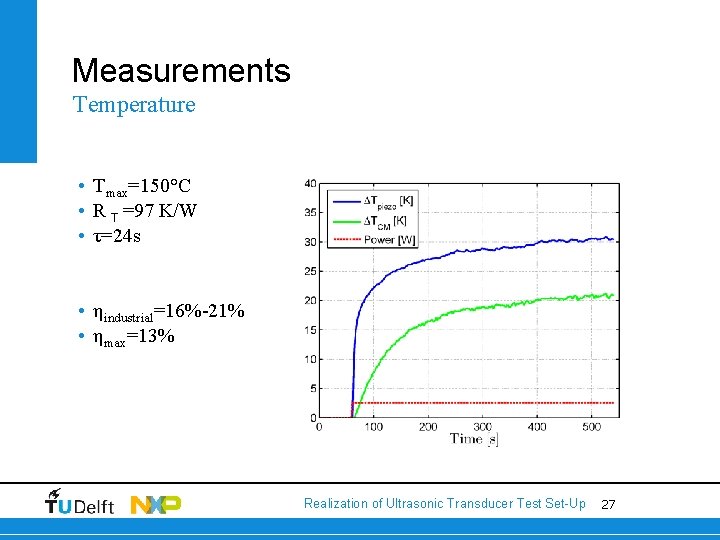
Measurements Temperature • Tmax=150°C • R T =97 K/W • τ=24 s • ηindustrial=16%-21% • ηmax=13% Realization of Ultrasonic Transducer Test Set-Up 27
Finite element model Piezo fundamentals dynamical + State space model - Schematic representation C V d 33 x x -k q F d 33 Realization of Ultrasonic Transducer Test Set-Up 28
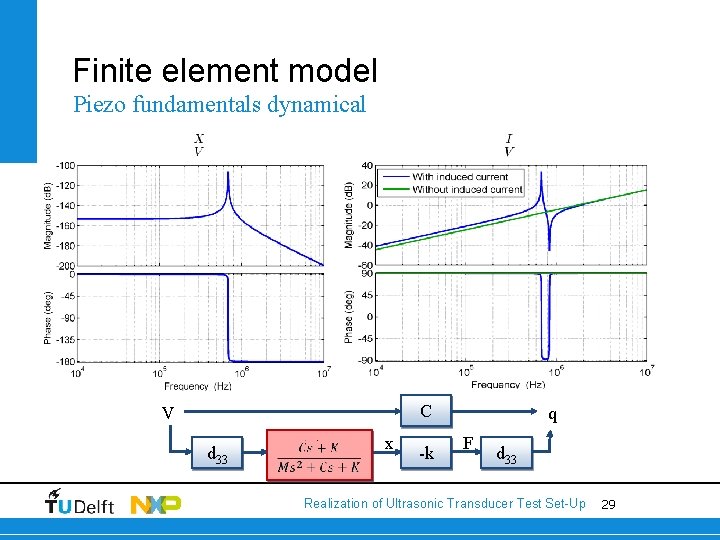
Finite element model Piezo fundamentals dynamical C V d 33 x x -k q F d 33 Realization of Ultrasonic Transducer Test Set-Up 29
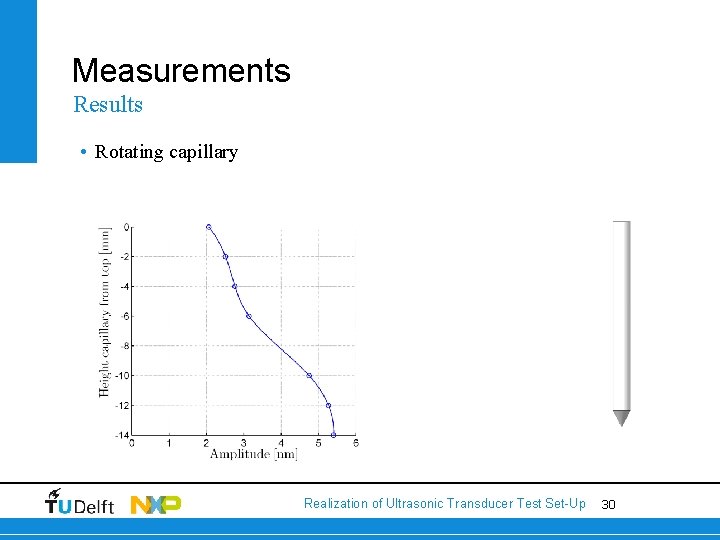
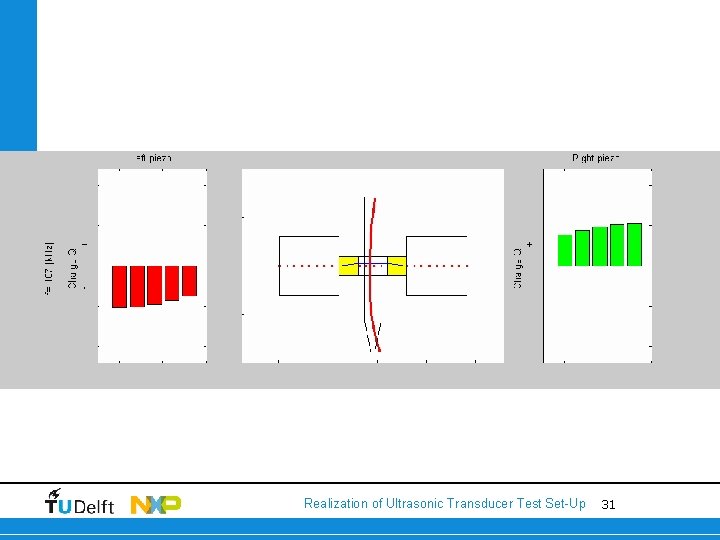
Measurements Results • Rotating capillary Realization of Ultrasonic Transducer Test Set-Up 30
Realization of Ultrasonic Transducer Test Set-Up 31