
Reality Mining Capturing Detailed Data on Human Networks
![Allen’s Studies in the 20 th Century [A 84] [AH 87] [A 97]](https://slidetodoc.com/presentation_image_h2/ca1492a0e389cd2e76eb5d790aa0af87/image-16.jpg "Allen’s Studies in the 20 th Century [A 84] [AH 87] [A 97]")
![Social Network Mapping Pairwise Conversation Interruption Detection - Mutual Information [B 02] - Non-Correlation](https://slidetodoc.com/presentation_image_h2/ca1492a0e389cd2e76eb5d790aa0af87/image-20.jpg "Social Network Mapping Pairwise Conversation Interruption Detection - Mutual Information [B 02] - Non-Correlation")
- Slides: 34
Reality Mining Capturing Detailed Data on Human Networks and Mapping the Organizational Cognitive Infrastructure Nathan Eagle Digital Anthropology The MIT Media Lab February 21, 2003
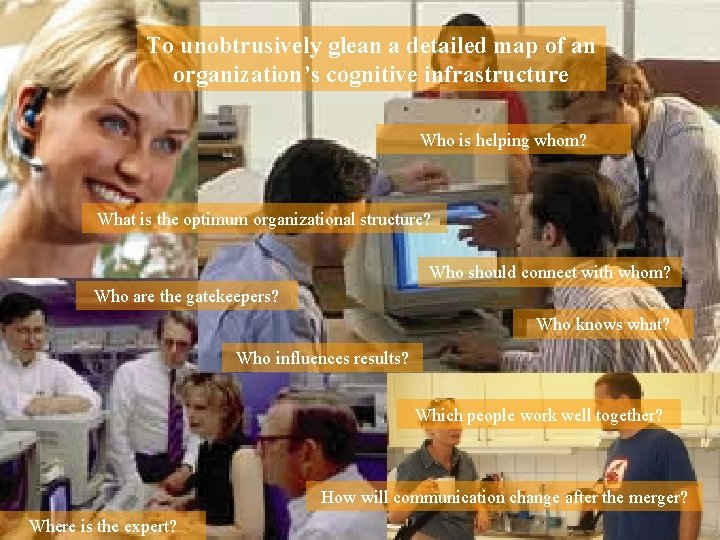
To unobtrusively glean a detailed map of an organization’s cognitive infrastructure From User to Group-Centric Who is helping whom? What is the optimum organizational structure? Who should connect with whom? Who are the gatekeepers? Who knows what? Who influences results? Which people work well together? How will communication change after the merger? Where is the expert?
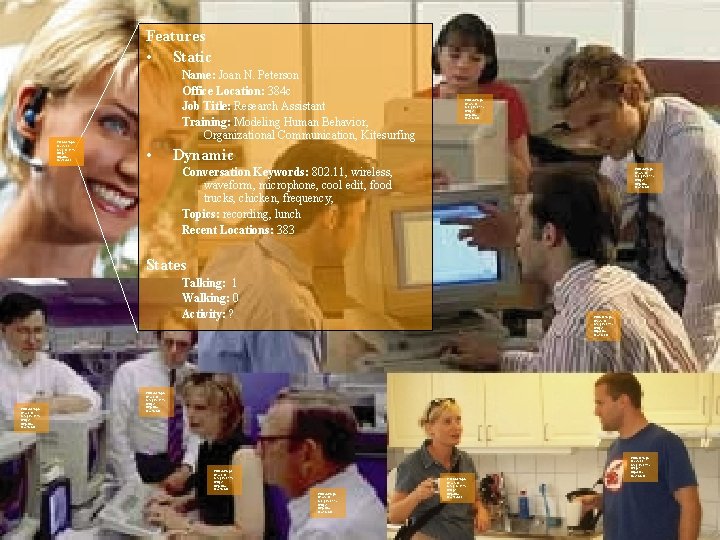
Features • Static Current Topic: Structural Intergrity of the Widget Expertise: Mechanical Name: Joan N. Peterson Office Location: 384 c Job Title: Research Assistant Training: Modeling Human Behavior, Organizational Communication, Kitesurfing • Current Topic: Structural Intergrity of the Widget Expertise: Mechanical Dynamic Conversation Keywords: 802. 11, wireless, waveform, microphone, cool edit, food trucks, chicken, frequency, Topics: recording, lunch Recent Locations: 383 Current Topic: Structural Intergrity of the Widget Expertise: Mechanical States Talking: 1 Walking: 0 Activity: ? Current Topic: Structural Intergrity of the Widget Expertise: Mechanical Current Topic: Structural Intergrity of the Widget Expertise: Mechanical
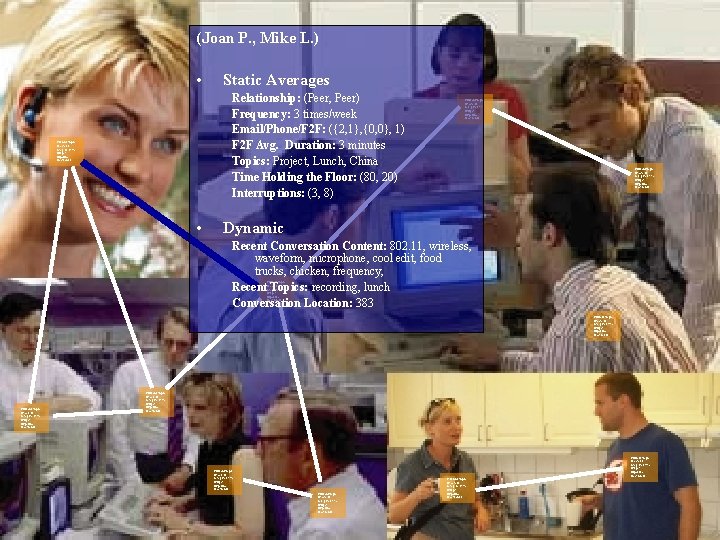
(Joan P. , Mike L. ) • Static Averages Relationship: (Peer, Peer) Frequency: 3 times/week Email/Phone/F 2 F: ({2, 1}, {0, 0}, 1) F 2 F Avg. Duration: 3 minutes Topics: Project, Lunch, China Time Holding the Floor: (80, 20) Interruptions: (3, 8) Current Topic: Structural Intergrity of the Widget Expertise: Mechanical • Current Topic: Structural Intergrity of the Widget Expertise: Mechanical Dynamic Recent Conversation Content: 802. 11, wireless, waveform, microphone, cool edit, food trucks, chicken, frequency, Recent Topics: recording, lunch Conversation Location: 383 Current Topic: Structural Intergrity of the Widget Expertise: Mechanical Current Topic: Structural Intergrity of the Widget Expertise: Mechanical
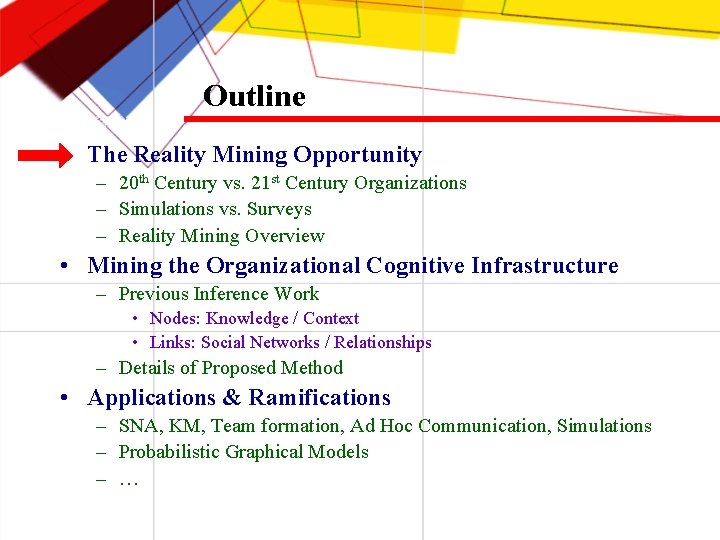
Outline • The Reality Mining Opportunity – 20 th Century vs. 21 st Century Organizations – Simulations vs. Surveys – Reality Mining Overview • Mining the Organizational Cognitive Infrastructure – Previous Inference Work • Nodes: Knowledge / Context • Links: Social Networks / Relationships – Details of Proposed Method • Applications & Ramifications – SNA, KM, Team formation, Ad Hoc Communication, Simulations – Probabilistic Graphical Models – …
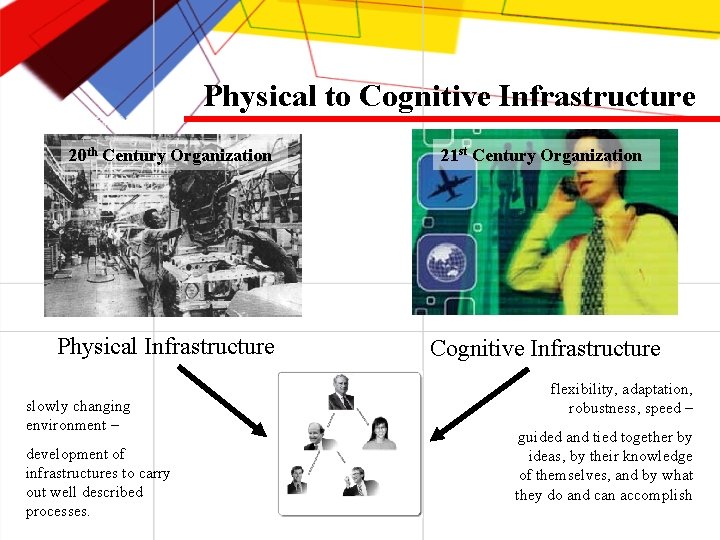
Physical to Cognitive Infrastructure 20 th Century Organization 21 st Century Organization Physical Infrastructure Cognitive Infrastructure slowly changing environment – development of infrastructures to carry out well described processes. flexibility, adaptation, robustness, speed – guided and tied together by ideas, by their knowledge of themselves, and by what they do and can accomplish
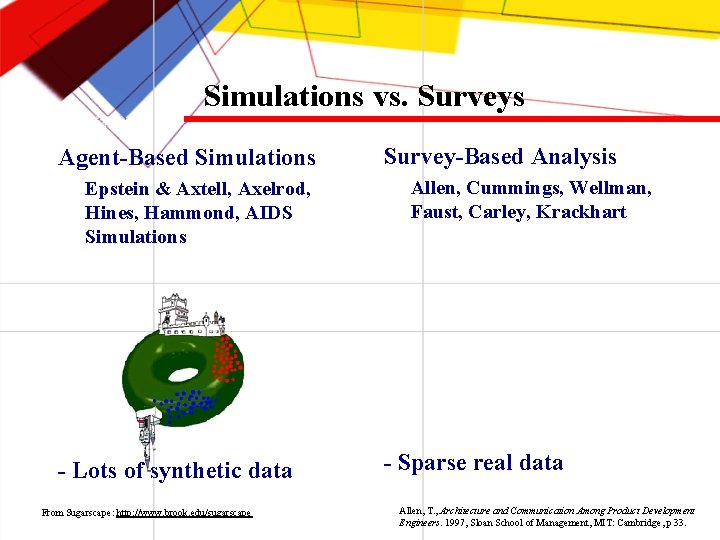
Simulations vs. Surveys Agent-Based Simulations Epstein & Axtell, Axelrod, Hines, Hammond, AIDS Simulations - Lots of synthetic data From Sugarscape: http: //www. brook. edu/sugarscape Survey-Based Analysis Allen, Cummings, Wellman, Faust, Carley, Krackhart - Sparse real data Allen, T. , Architecture and Communication Among Product Development Engineers. 1997, Sloan School of Management, MIT: Cambridge, p 33.
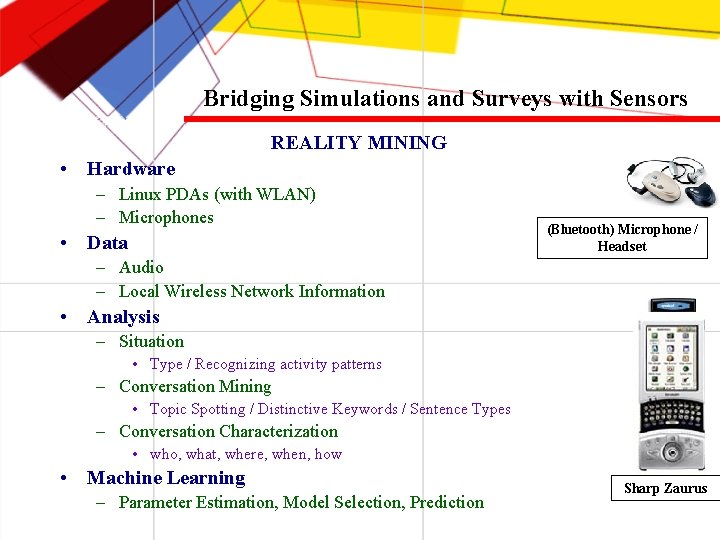
Bridging Simulations and Surveys with Sensors REALITY MINING • Hardware – Linux PDAs (with WLAN) – Microphones • Data (Bluetooth) Microphone / Headset – Audio – Local Wireless Network Information • Analysis – Situation • Type / Recognizing activity patterns – Conversation Mining • Topic Spotting / Distinctive Keywords / Sentence Types – Conversation Characterization • who, what, where, when, how • Machine Learning – Parameter Estimation, Model Selection, Prediction Sharp Zaurus
Why F 2 F Networks? Allen, T. , Architecture and Communication Among Product Development Engineers. 1997, Sloan School of Management, MIT: Cambridge, p 33.
Outline • The Reality Mining Opportunity – 20 th Century vs. 21 st Century Organizations – Simulations vs. Surveys – Reality Mining Overview • Mining the Organizational Cognitive Infrastructure – Previous Inference Work • Nodes: Knowledge / Context • Links: Social Networks / Relationships – Details of Proposed Method • Applications – SNA, KM, Team formation, Ad Hoc Communication, Simulations – Probabilistic Graphical Models – …
Inference on Individuals : Previous Work • Knowledge Inference – Self-Report: Traditional Knowledge Management – Email / Intranet: Shock (HP), Tacit, others? • Context Inference – Video: i. Sense (Clarkson 01) – Motion: MIThrill Inference Engine (De. Vaul 02) – Speech: Over. Hear (Eagle 02)
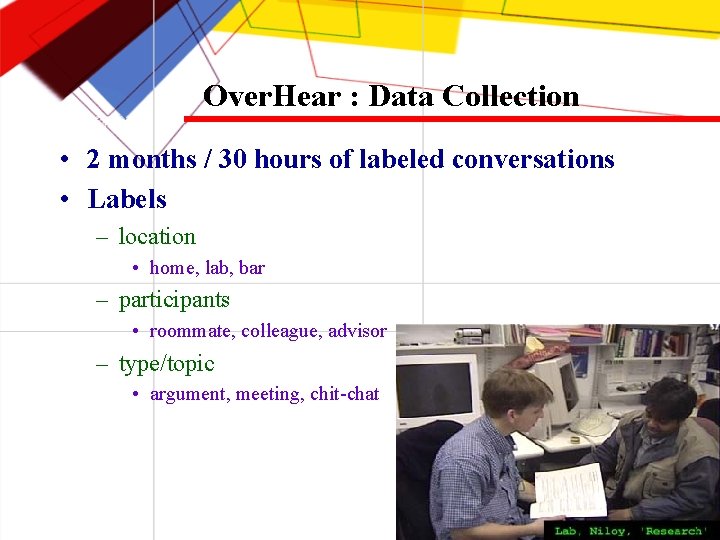
Over. Hear : Data Collection • 2 months / 30 hours of labeled conversations • Labels – location • home, lab, bar – participants • roommate, colleague, advisor – type/topic • argument, meeting, chit-chat
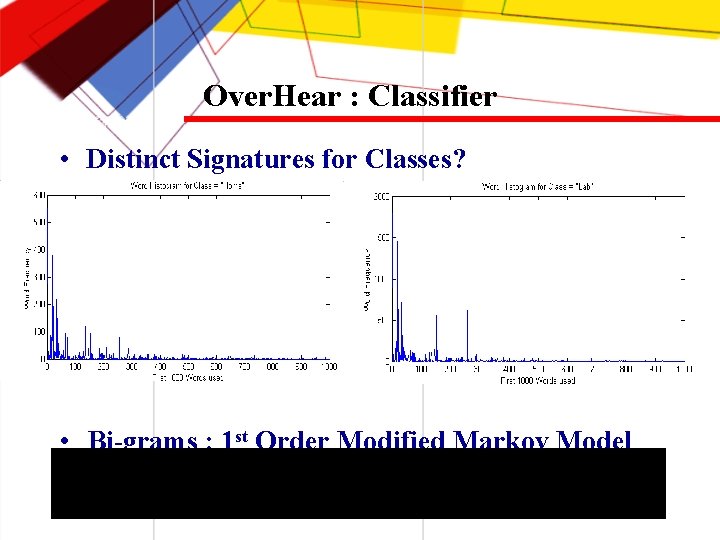
Over. Hear : Classifier • Distinct Signatures for Classes? • Bi-grams : 1 st Order Modified Markov Model
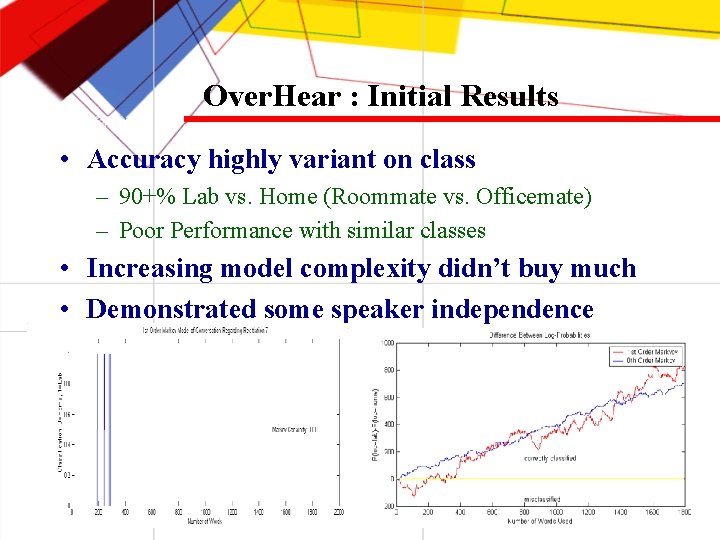
Over. Hear : Initial Results • Accuracy highly variant on class – 90+% Lab vs. Home (Roommate vs. Officemate) – Poor Performance with similar classes • Increasing model complexity didn’t buy much • Demonstrated some speaker independence – Media Lab students may have common priors
Relationship Inference : Previous Work • Relationship Inference / Conversation Analysis – Human Monitoring: (Drew, Heritage, Zimmerman) – Speech Features: Conversation Scene Analysis (Basu 02) • Social Network Inference – Surveys: Traditional Social Network Analysis – IR Sensors: Short. Cuts (Choudhury 02, Carley 99) – Affiliation Networks • Email Lists, Board of Directions, Journals, Projects – Theoretical: Small World / Complex Networks • Kleinberg: Local Information • Problems within Social Navigation Models
Allen’s Studies in the 20 th Century [A 84] [AH 87] [A 97]
Future Organizational Studies? ?
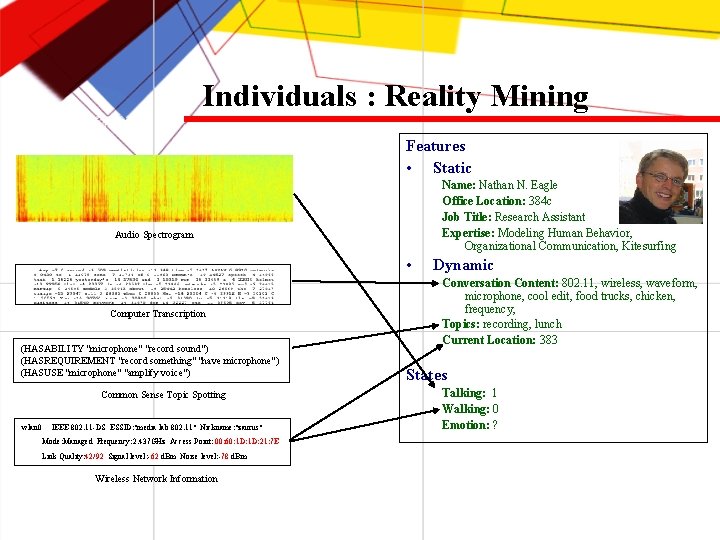
Individuals : Reality Mining Features • Static Name: Nathan N. Eagle Office Location: 384 c Job Title: Research Assistant Expertise: Modeling Human Behavior, Organizational Communication, Kitesurfing Audio Spectrogram • Computer Transcription (HASABILITY "microphone" "record sound") (HASREQUIREMENT "record something" "have microphone") (HASUSE "microphone" "amplify voice") Common Sense Topic Spotting wlan 0 IEEE 802. 11 -DS ESSID: "media lab 802. 11" Nickname: "zaurus" Mode: Managed Frequency: 2. 437 GHz Access Point: 00: 60: 1 D: 21: 7 E Link Quality: 42/92 Signal level: -62 d. Bm Noise level: -78 d. Bm Wireless Network Information Dynamic Conversation Content: 802. 11, wireless, waveform, microphone, cool edit, food trucks, chicken, frequency, Topics: recording, lunch Current Location: 383 States Talking: 1 Walking: 0 Emotion: ?
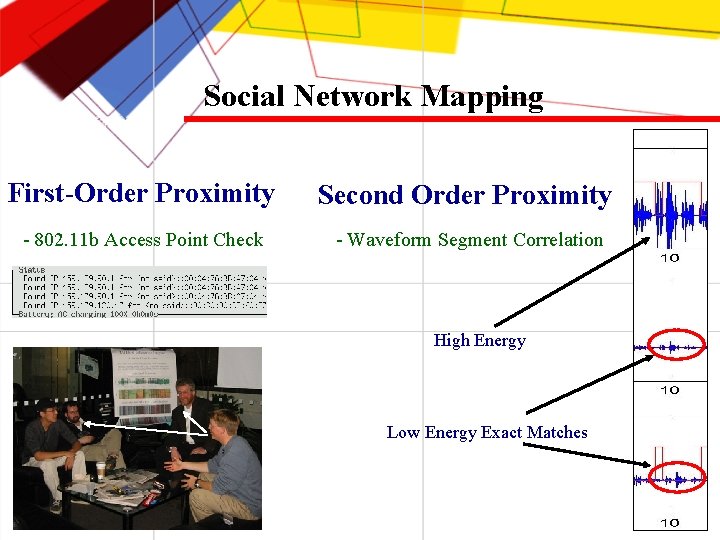
Social Network Mapping First-Order Proximity Second Order Proximity - 802. 11 b Access Point Check - Waveform Segment Correlation High Energy Low Energy Exact Matches
Social Network Mapping Pairwise Conversation Interruption Detection - Mutual Information [B 02] - Non-Correlation + Speaker Transition
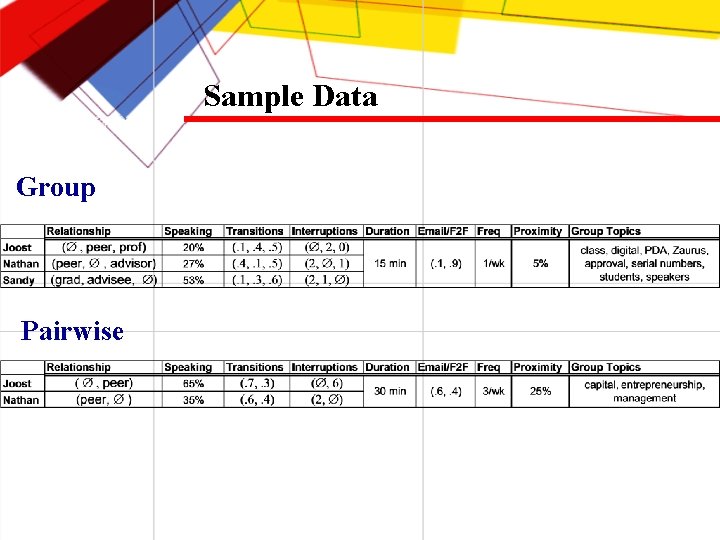
Sample Data Group Pairwise
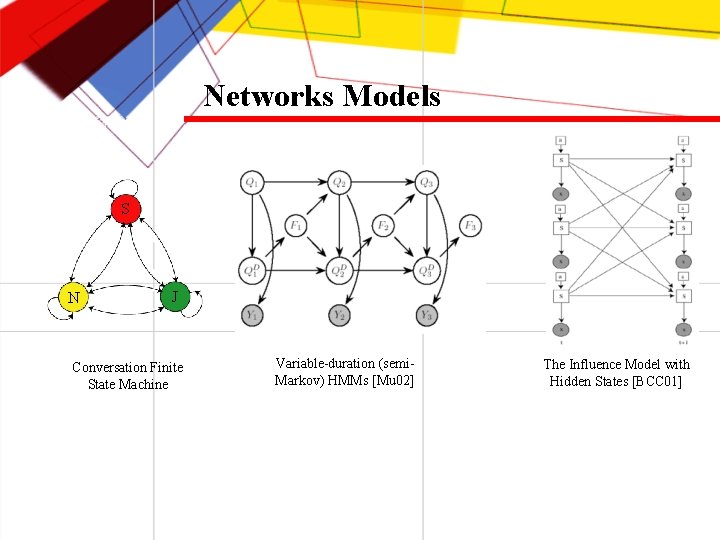
Networks Models S N J Conversation Finite State Machine Variable-duration (semi. Markov) HMMs [Mu 02] The Influence Model with Hidden States [BCC 01]
Initial Study : Project-based Class • • 10 -15 MIT graduate students 2 -3 hours/week, diverse team projects Email and F 2 F interactions recorded Interactions captured over three months
Outline • The Reality Mining Opportunity – 20 th Century vs. 21 st Century Organizations – Simulations vs. Surveys – Reality Mining Overview • Mining the Organizational Cognitive Infrastructure – Previous Inference Work • Nodes: Knowledge / Context • Links: Social Networks / Relationships – Details of Proposed Method • Applications – SNA, KM, Team formation, Ad Hoc Communication, Simulations – Probabilistic Graphical Models – …
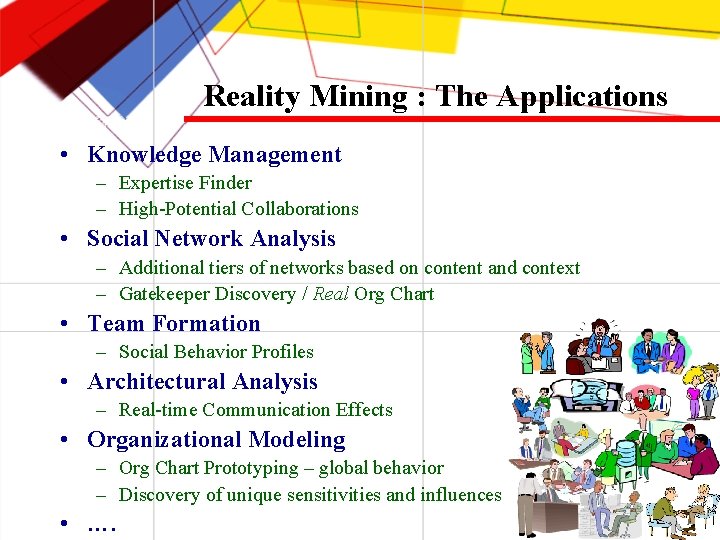
Reality Mining : The Applications • Knowledge Management – Expertise Finder – High-Potential Collaborations • Social Network Analysis – Additional tiers of networks based on content and context – Gatekeeper Discovery / Real Org Chart • Team Formation – Social Behavior Profiles • Architectural Analysis – Real-time Communication Effects • Organizational Modeling – Org Chart Prototyping – global behavior – Discovery of unique sensitivities and influences • ….
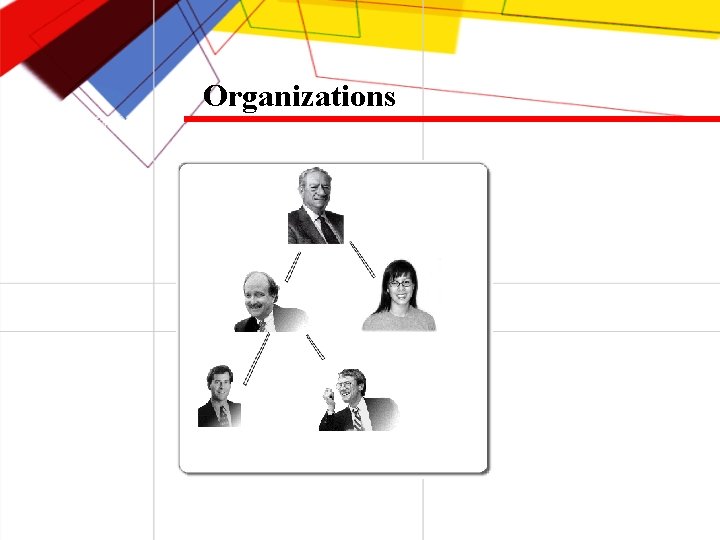
Organizations
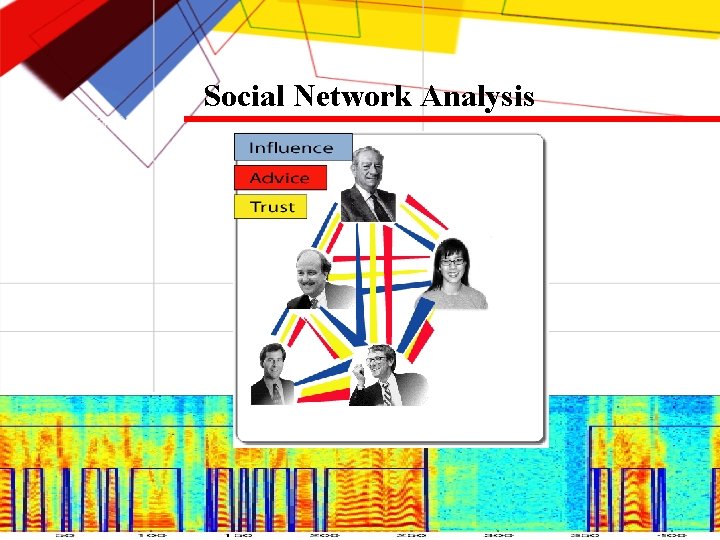
Social Network Analysis
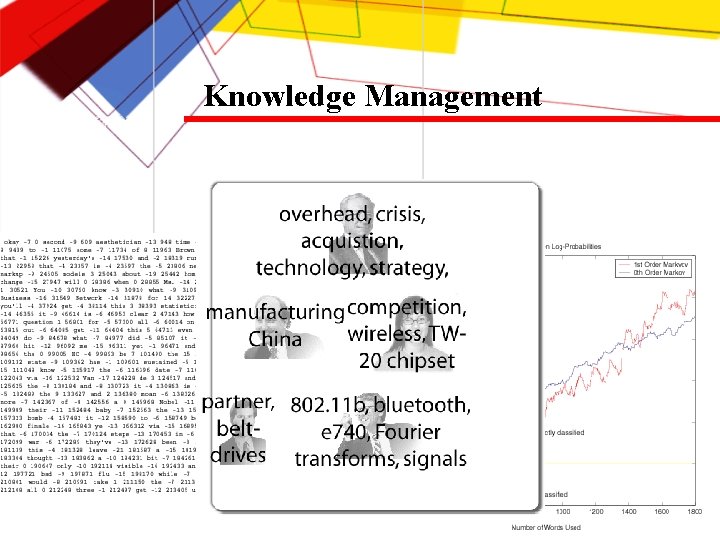
Knowledge Management
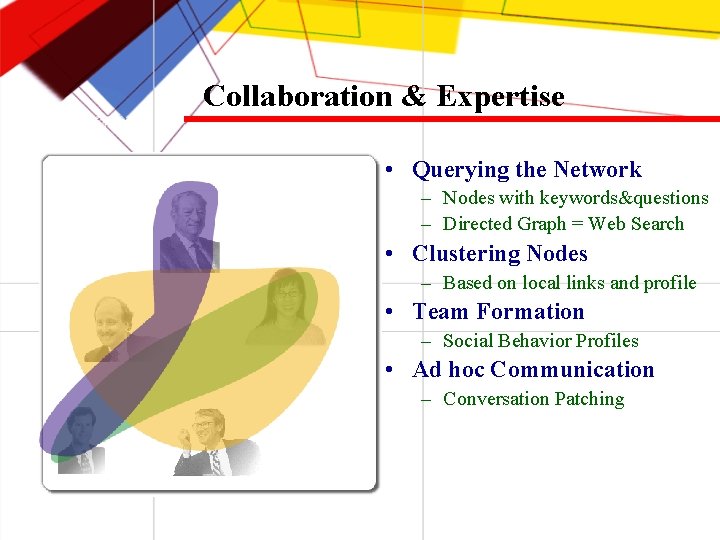
Collaboration & Expertise • Querying the Network – Nodes with keywords&questions – Directed Graph = Web Search • Clustering Nodes – Based on local links and profile • Team Formation – Social Behavior Profiles • Ad hoc Communication – Conversation Patching
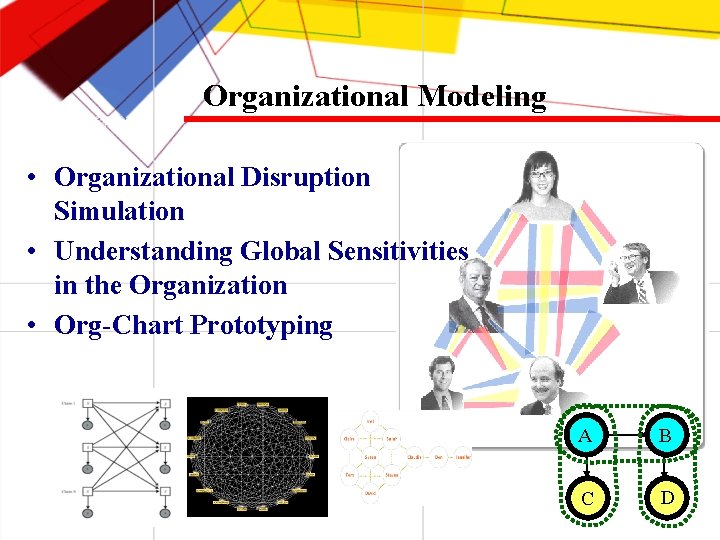
Organizational Modeling • Organizational Disruption Simulation • Understanding Global Sensitivities in the Organization • Org-Chart Prototyping A B C D
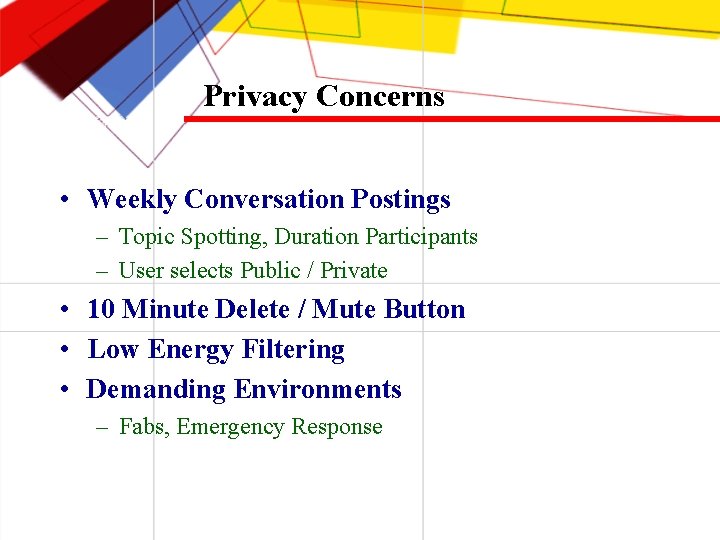
Privacy Concerns • Weekly Conversation Postings – Topic Spotting, Duration Participants – User selects Public / Private • 10 Minute Delete / Mute Button • Low Energy Filtering • Demanding Environments – Fabs, Emergency Response
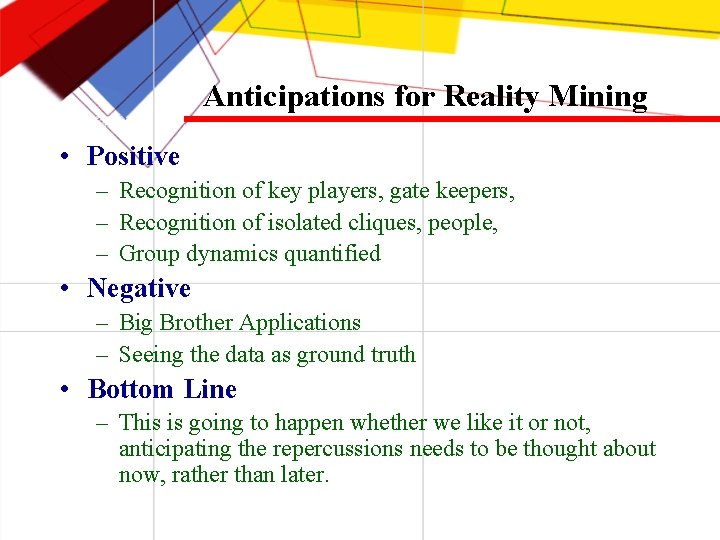
Anticipations for Reality Mining • Positive – Recognition of key players, gate keepers, – Recognition of isolated cliques, people, – Group dynamics quantified • Negative – Big Brother Applications – Seeing the data as ground truth • Bottom Line – This is going to happen whether we like it or not, anticipating the repercussions needs to be thought about now, rather than later.
Conclusions • There is an opportunity to deploy sociometric applications on the growing infrastructure of PDAs and mobile phones within the workplace • Details from this data can provide extensive information of an organization’s cognitive infrastructure. [BCC 01] Sumit Basu, Tanzeem Choudhury, Brian Clarkson and Alex Pentland. Learning Human Interactions with the Influence Model. MIT Media Lab Vision and Modeling TR#539, June 2001. [Mu 02] Murphy, K. Modeling Sequential Data using Graphical Models. Working Paper, MIT AI Lab, 2002 [AH 87] Allen, T. J. and O. Hauptman. The Influence of Communication Technologies on Organization Structure: A Conceptual Model for Future Research. Communication Research 14, 5, 1987, 575 -587. [A 97] Allen, T. , A rchitecture and Communication Among Product Development Engineers. Sloan School of Management, MIT: Cambridge, 1997, p 33. [A 84] Allen, T. J. , 1984 (1 st edition in 1977), Managing the Flow of Technology: Technology Transfer and the Dissemination of Technological I nformation within the R&D Organization, MIT Press, Mass.
Questions?