
Realistic Data Generation applications and possible implications for
Realistic Data Generation : applications and possible implications for burst search. Soma Mukherjee Centre for Gravitational Wave Astronomy Dept. of Physics and Astronomy University of Texas Brownsville LIGO-G 040362 -00 -Z Soma Mukherjee Burst F 2 F, Hanford, Aug. 14 '04
Why do we need a model ? Astrophysical searches estimate efficiency from playground data. Data is non-stationary. Externally triggered search (Gamma Ray Bursts with GW) – how representative is the ’off-source’ segment of the ‘onsource’ one ? Soma Mukherjee Burst F 2 F, Hanford, Aug. 14 '04
Data Modeling: assumptions Interferometric data has three components : lines, transients and noise floor. As a first approximation, the three components are independent and appear additively. n Physically different sources for each Basic idea is to split a channel into these components with mutual exclusion n Classify Transients, fit ARMA models to line amplitude and phase modulation, ARMA models for noise floor rms Soma Mukherjee Burst F 2 F, Hanford, Aug. 14 '04
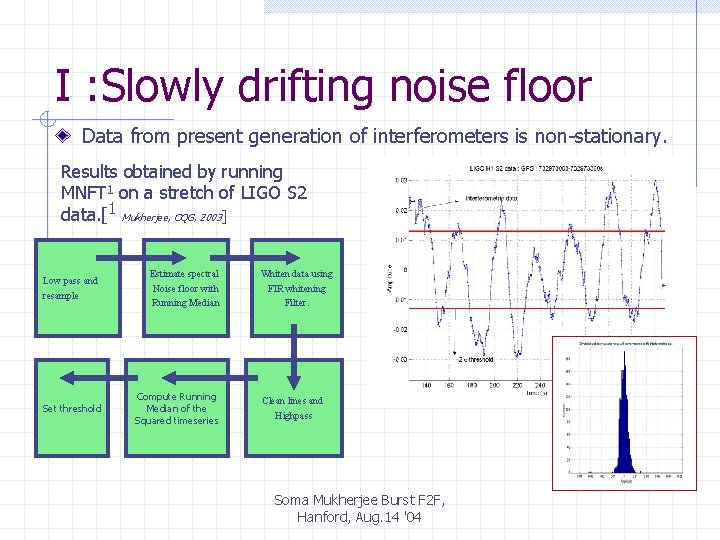
I : Slowly drifting noise floor Data from present generation of interferometers is non-stationary. Results obtained by running MNFT 1 on a stretch of LIGO S 2 data. [1 Mukherjee, CQG, 2003] Low pass and resample Estimate spectral Noise floor with Running Median Set threshold Compute Running Median of the Squared timeseries Whiten data using FIR whitening Filter. Clean lines and Highpass Soma Mukherjee Burst F 2 F, Hanford, Aug. 14 '04

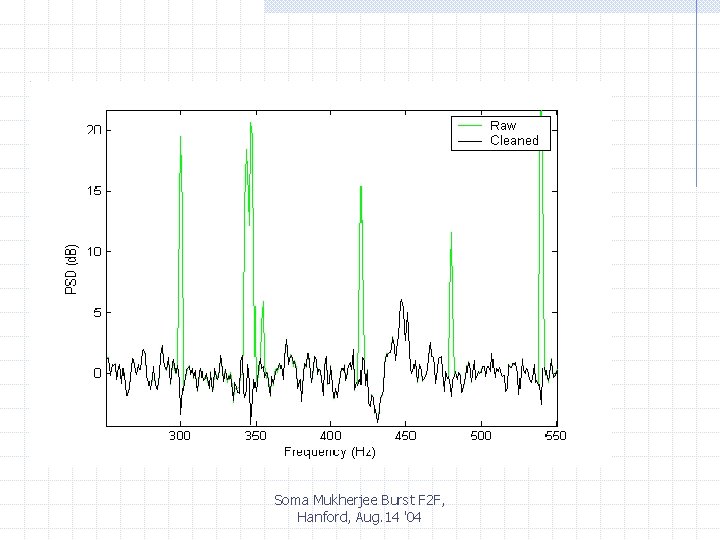
II : Modeling ALL lines MBLT 1 : Non-parametric Line estimation. [1 Mohanty CQG, 2001 ] Soma Mukherjee Burst F 2 F, Hanford, Aug. 14 '04
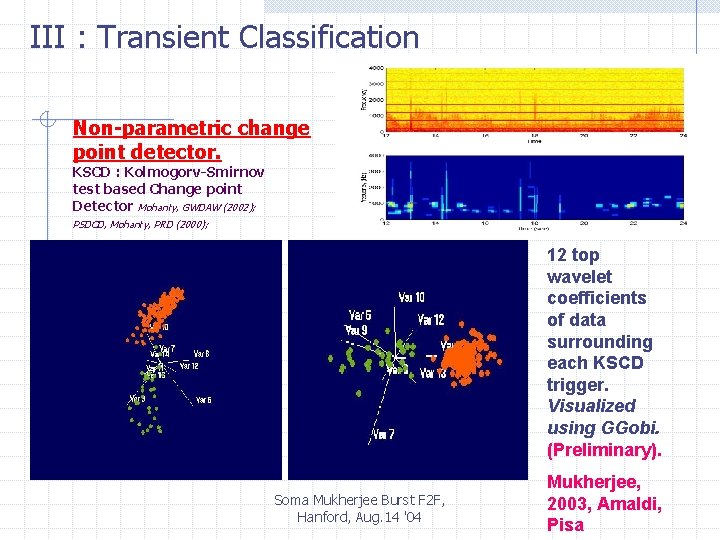
III : Transient Classification Non-parametric change point detector. KSCD : Kolmogorv-Smirnov test based Change point Detector Mohanty, GWDAW (2002); PSDCD, Mohanty, PRD (2000); 12 top wavelet coefficients of data surrounding each KSCD trigger. Visualized using GGobi. (Preliminary). Soma Mukherjee Burst F 2 F, Hanford, Aug. 14 '04 Mukherjee, 2003, Amaldi, Pisa
MNFT outline: Algorithm: 1. Low pass and resample given time series x(k). 2. Construct FIR filter that whitens the noise floor. 3. 4. 5. Resulting time series : w(k) Remove lines using notch filter. Cleaned time series : c(k) Track variation in second moment of c(k) using Running Median and apply smoothing (SRM). Obtain significance levels of the sampling distribution via Monte Carlo simulations. Soma Mukherjee Burst F 2 F, Hanford, Aug. 14 '04
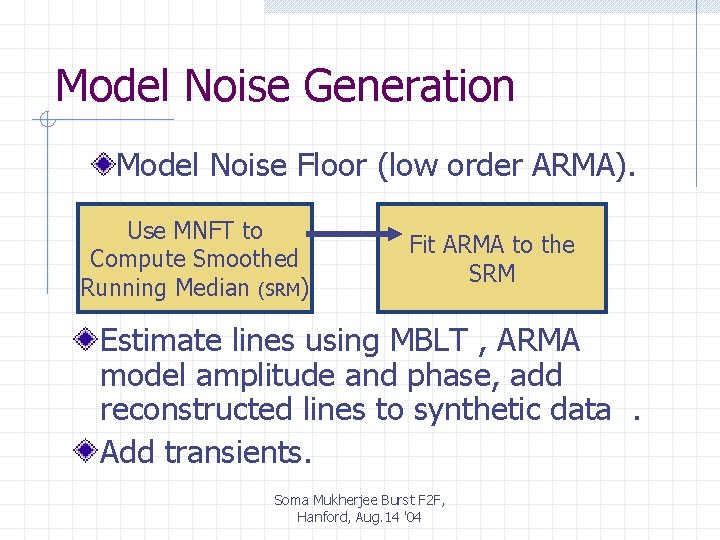
Model Noise Generation Model Noise Floor (low order ARMA). Use MNFT to Compute Smoothed Running Median (SRM) Fit ARMA to the SRM Estimate lines using MBLT , ARMA model amplitude and phase, add reconstructed lines to synthetic data. Add transients. Soma Mukherjee Burst F 2 F, Hanford, Aug. 14 '04
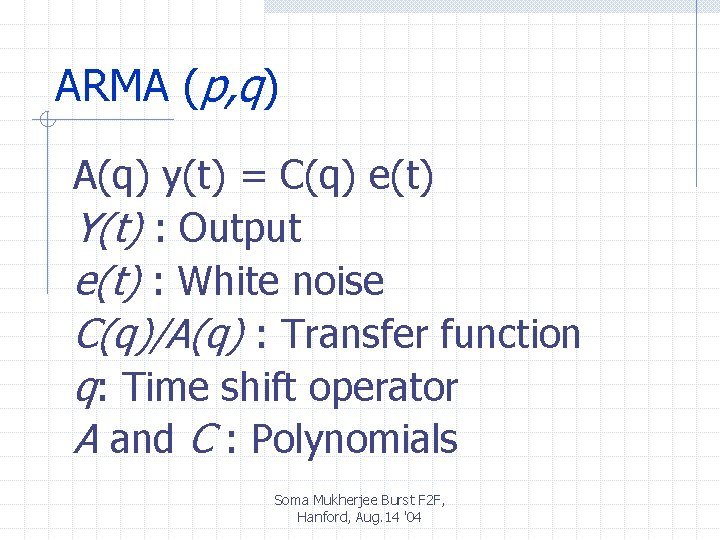
ARMA (p, q) A(q) y(t) = C(q) e(t) Y(t) : Output e(t) : White noise C(q)/A(q) : Transfer function q: Time shift operator A and C : Polynomials Soma Mukherjee Burst F 2 F, Hanford, Aug. 14 '04
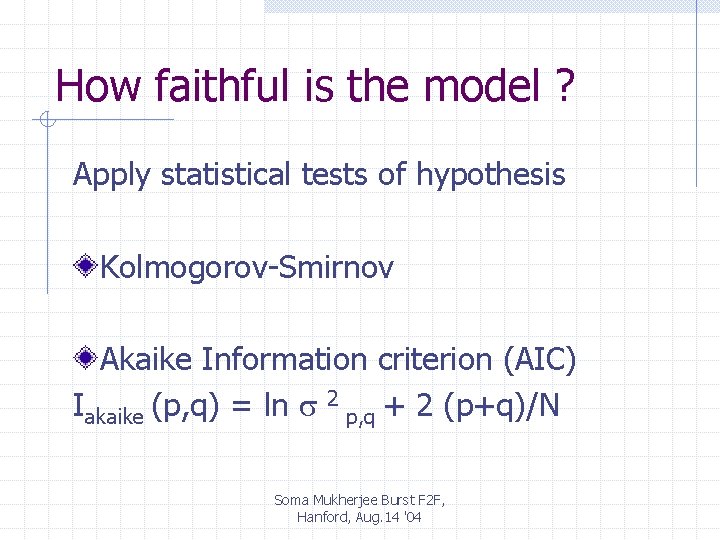
How faithful is the model ? Apply statistical tests of hypothesis Kolmogorov-Smirnov Akaike Information criterion (AIC) Iakaike (p, q) = ln s 2 p, q + 2 (p+q)/N Soma Mukherjee Burst F 2 F, Hanford, Aug. 14 '04
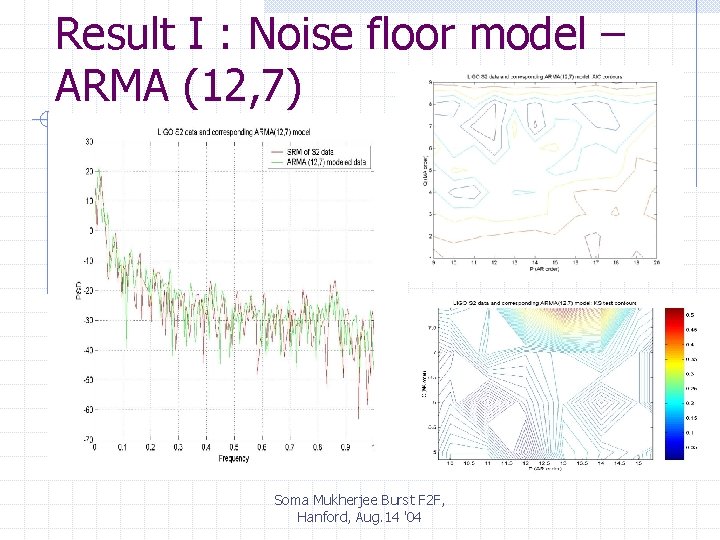
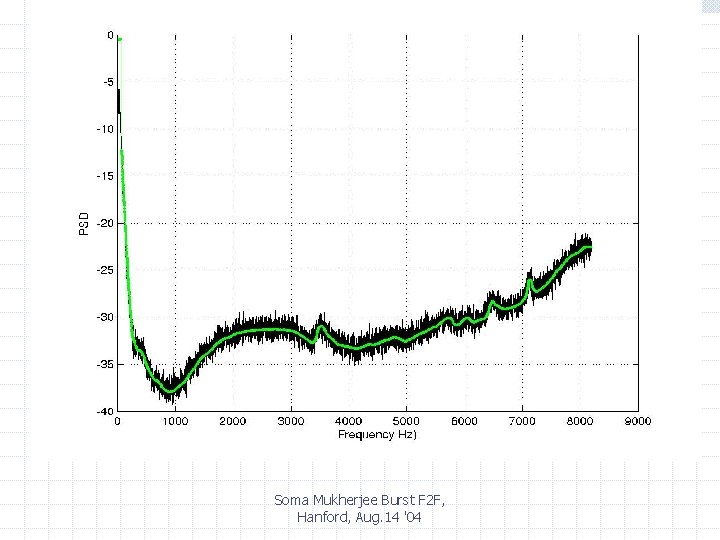
Result I : Noise floor model – ARMA (12, 7) Soma Mukherjee Burst F 2 F, Hanford, Aug. 14 '04
Soma Mukherjee Burst F 2 F, Hanford, Aug. 14 '04
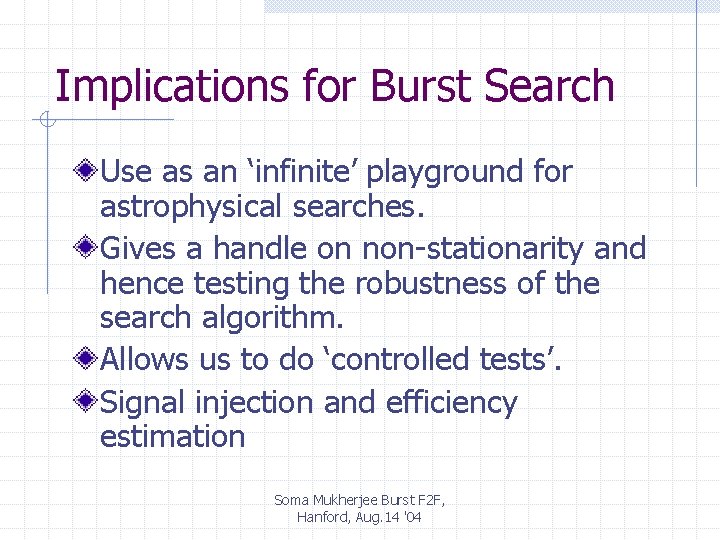
Implications for Burst Search Use as an ‘infinite’ playground for astrophysical searches. Gives a handle on non-stationarity and hence testing the robustness of the search algorithm. Allows us to do ‘controlled tests’. Signal injection and efficiency estimation Soma Mukherjee Burst F 2 F, Hanford, Aug. 14 '04
Existing modeled data 20, 000 s modeled S 2 data exists at suhail. ligo. caltech. edu. Contains 330 s. mat files of noise floor and lines separately. Script exists to allow the user to combine the noise floor and lines in the desired way. Soma Mukherjee Burst F 2 F, Hanford, Aug. 14 '04
Soma Mukherjee Burst F 2 F, Hanford, Aug. 14 '04
Further developments … To add transients. Generation of band limited noise. To write the output in Frames. To generate S 3 and S 4 segments. To carry out known waveform injection studies. Soma Mukherjee Burst F 2 F, Hanford, Aug. 14 '04
- Slides: 16