
REALISM VERSUS QUANTUM MECHANICS IMPLICATIONS OF SOME RECENT


- Slides: 20
REALISM VERSUS QUANTUM MECHANICS: IMPLICATIONS OF SOME RECENT EXPERIMENTS A. J. Leggett Department of Physics University of Illinois at Urbana-Champaign
QM 90 1 1. What do we mean by “realism” in physics? 2. Local realism: The EPR-Bell setup 3. Three recent EPR-Bell experiments* 4. Macrorealism: The temporal Bell inequalities (TBI) 5. A recent TBI experiment† (“Delft”) * B. Hensen et al. , Nature 526, 682 (2015) L. K. Shalm et al. Phys. Rev. Letters 115, 250402 (2015) (“NIST”) (IQOQI”) M. Giustina et al, Phys. Rev. Letters 115, 250401 (2015) (“NTT”) † G. C. Knee et al. , Nature Communications, DOI: 10. 1038/ncomms 13523 (2016)
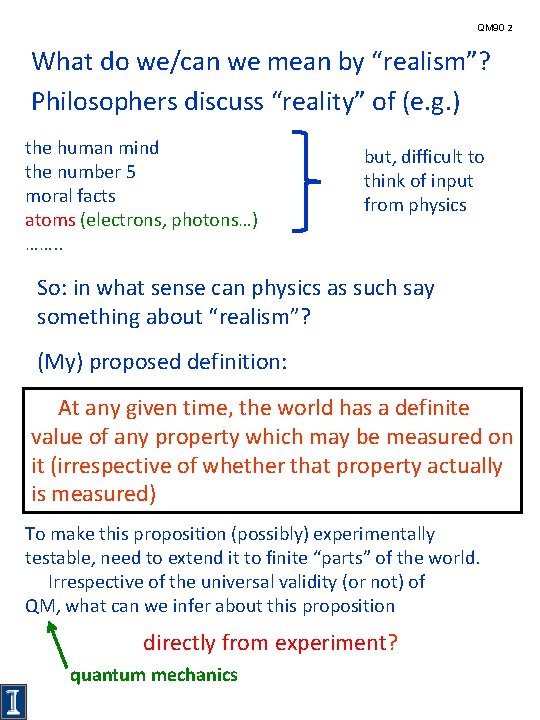
QM 90 2 What do we/can we mean by “realism”? Philosophers discuss “reality” of (e. g. ) the human mind the number 5 moral facts atoms (electrons, photons…) ……. . but, difficult to think of input from physics So: in what sense can physics as such say something about “realism”? (My) proposed definition: At any given time, the world has a definite value of any property which may be measured on it (irrespective of whether that property actually is measured) To make this proposition (possibly) experimentally testable, need to extend it to finite “parts” of the world. Irrespective of the universal validity (or not) of QM, what can we infer about this proposition directly from experiment? quantum mechanics
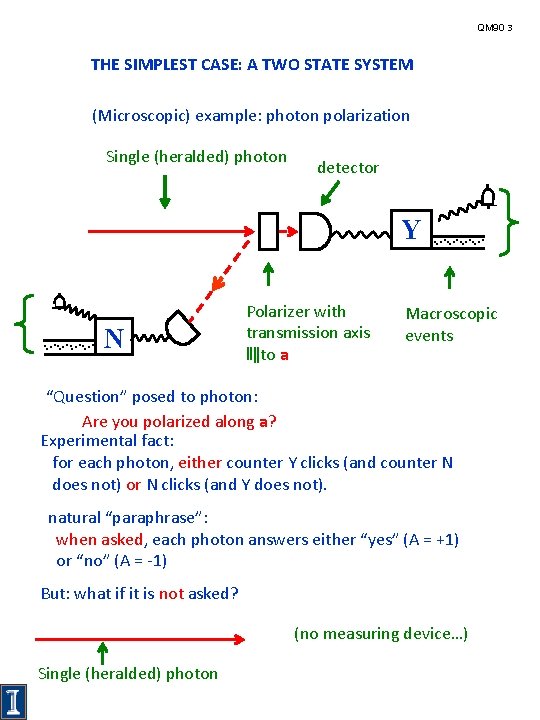
QM 90 3 THE SIMPLEST CASE: A TWO STATE SYSTEM (Microscopic) example: photon polarization Single (heralded) photon detector Y . . . . N Polarizer with transmission axis ‖‖to a . . . . Macroscopic events “Question” posed to photon: Are you polarized along a? Experimental fact: for each photon, either counter Y clicks (and counter N does not) or N clicks (and Y does not). natural “paraphrase”: when asked, each photon answers either “yes” (A = +1) or “no” (A = -1) But: what if it is not asked? (no measuring device…) Single (heralded) photon
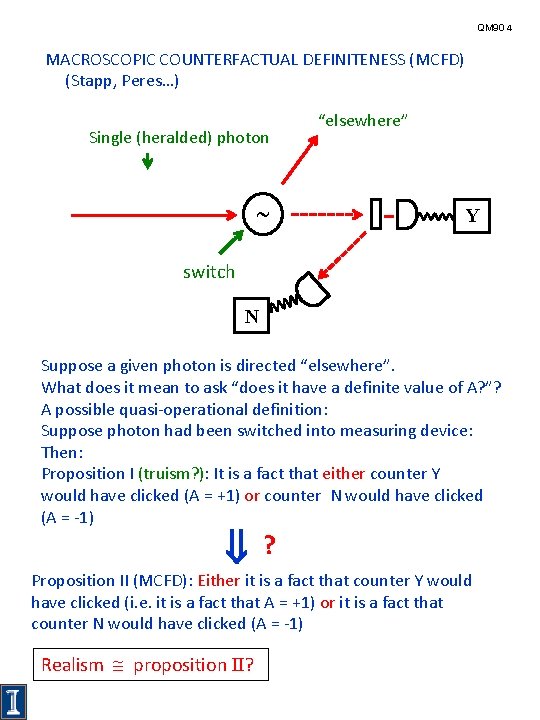
QM 90 4 MACROSCOPIC COUNTERFACTUAL DEFINITENESS (MCFD) (Stapp, Peres…) Single (heralded) photon ˜ “elsewhere” Y switch N Suppose a given photon is directed “elsewhere”. What does it mean to ask “does it have a definite value of A? ”? A possible quasi-operational definition: Suppose photon had been switched into measuring device: Then: Proposition I (truism? ): It is a fact that either counter Y would have clicked (A = +1) or counter N would have clicked (A = -1) ? Proposition II (MCFD): Either it is a fact that counter Y would have clicked (i. e. it is a fact that A = +1) or it is a fact that counter N would have clicked (A = -1) Realism proposition II?
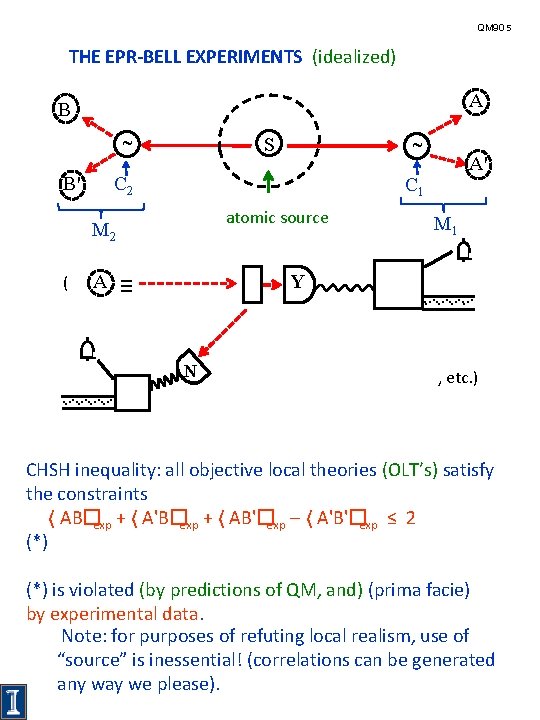
QM 90 5 THE EPR-BELL EXPERIMENTS (idealized) A B s ˜ C 2 B' A atomic source Y ≡ N. . . . A' C 1 M 2 ( ˜ M 1 . . . . , etc. ) CHSH inequality: all objective local theories (OLT’s) satisfy the constraints ⟨ AB�exp + ⟨ A'B�exp + ⟨ AB'�exp ⟨ A'B'�exp ≤ 2 (*) is violated (by predictions of QM, and) (prima facie) by experimental data. Note: for purposes of refuting local realism, use of “source” is inessential! (correlations can be generated any way we please).
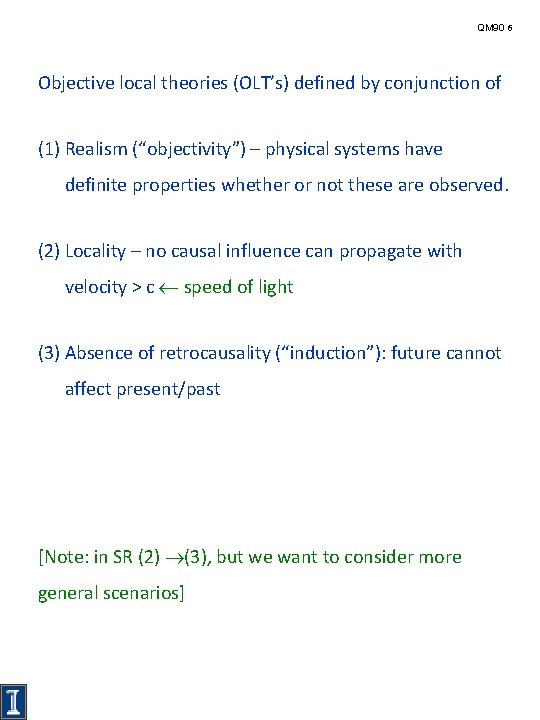
QM 90 6 Objective local theories (OLT’s) defined by conjunction of (1) Realism (“objectivity”) – physical systems have definite properties whether or not these are observed. (2) Locality – no causal influence can propagate with velocity > c speed of light (3) Absence of retrocausality (“induction”): future cannot affect present/past [Note: in SR (2) (3), but we want to consider more general scenarios]
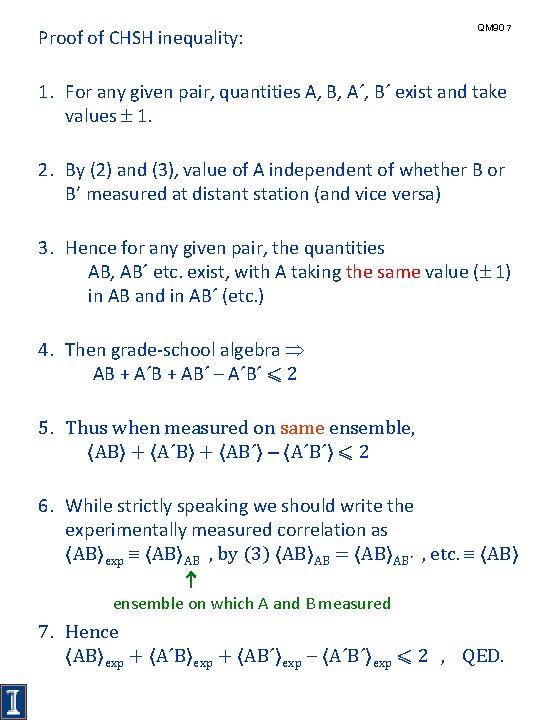
Proof of CHSH inequality: QM 90 7 1. For any given pair, quantities A, B, A´, B´ exist and take values 1. 2. By (2) and (3), value of A independent of whether B or B’ measured at distant station (and vice versa) 3. Hence for any given pair, the quantities AB, AB´ etc. exist, with A taking the same value ( 1) in AB and in AB´ (etc. ) 4. Then grade-school algebra AB + A´B + AB´ – A´B´ ⩽ 2 5. Thus when measured on same ensemble, ⟨AB⟩ + ⟨A´B⟩ + ⟨AB´⟩ ‒ ⟨A´B´⟩ ⩽ 2 6. While strictly speaking we should write the experimentally measured correlation as ⟨AB⟩exp ⟨AB⟩AB , by (3) ⟨AB⟩AB = ⟨AB⟩AB´ , etc. ⟨AB⟩ ensemble on which A and B measured 7. Hence ⟨AB⟩exp + ⟨A´B⟩exp + ⟨AB´⟩exp ⟨A´B´⟩exp ⩽ 2 , QED.
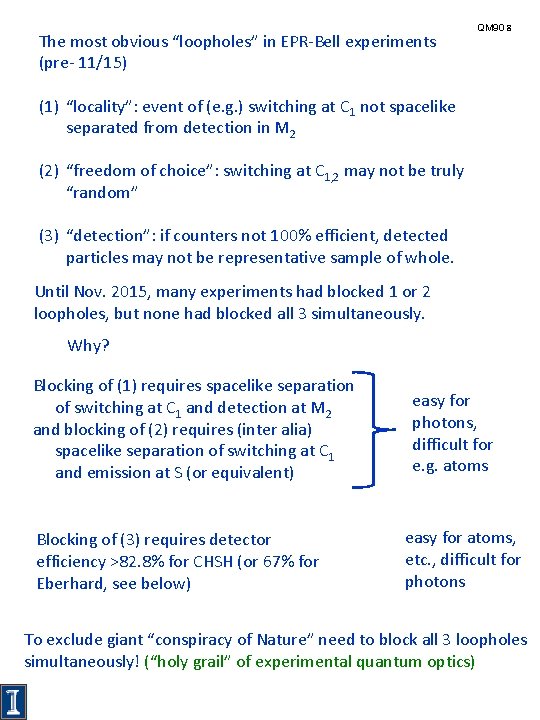
The most obvious “loopholes” in EPR-Bell experiments (pre- 11/15) QM 90 8 (1) “locality”: event of (e. g. ) switching at C 1 not spacelike separated from detection in M 2 (2) “freedom of choice”: switching at C 1, 2 may not be truly “random” (3) “detection”: if counters not 100% efficient, detected particles may not be representative sample of whole. Until Nov. 2015, many experiments had blocked 1 or 2 loopholes, but none had blocked all 3 simultaneously. Why? Blocking of (1) requires spacelike separation of switching at C 1 and detection at M 2 and blocking of (2) requires (inter alia) spacelike separation of switching at C 1 and emission at S (or equivalent) Blocking of (3) requires detector efficiency >82. 8% for CHSH (or 67% for Eberhard, see below) easy for photons, difficult for e. g. atoms easy for atoms, etc. , difficult for photons To exclude giant “conspiracy of Nature” need to block all 3 loopholes simultaneously! (“holy grail” of experimental quantum optics)
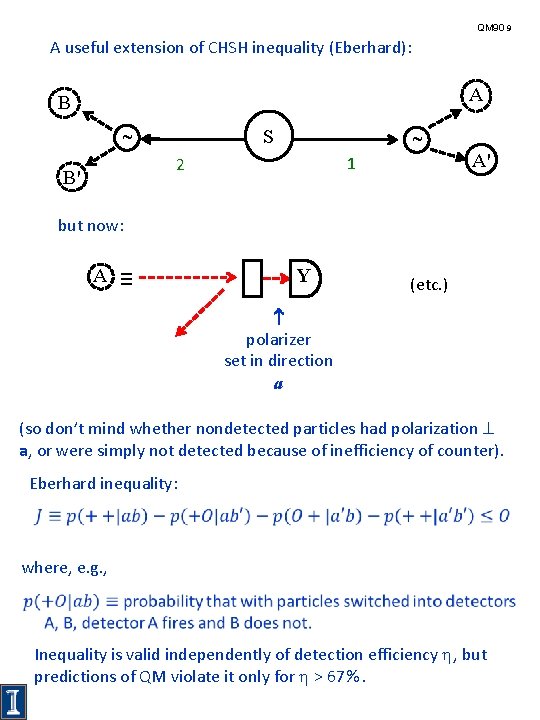
QM 90 9 A useful extension of CHSH inequality (Eberhard): A B ˜ B' s 1 2 ˜ A' but now: A ≡ Y (etc. ) polarizer set in direction a (so don’t mind whether nondetected particles had polarization a, or were simply not detected because of inefficiency of counter). Eberhard inequality: where, e. g. , Inequality is valid independently of detection efficiency , but predictions of QM violate it only for > 67%.
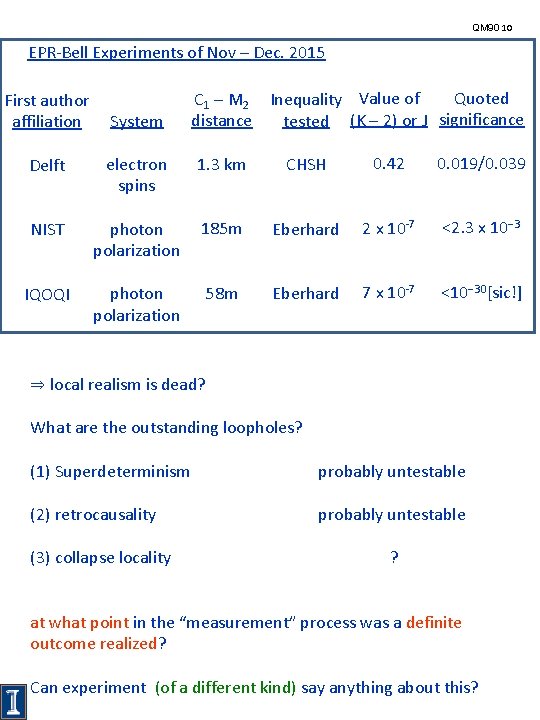
QM 90 10 EPR-Bell Experiments of Nov – Dec. 2015 First author affiliation System Quoted C 1 M 2 Inequality Value of distance tested (K 2) or J significance Delft electron spins 1. 3 km CHSH 0. 42 0. 019/0. 039 NIST photon polarization 185 m Eberhard 2 x 10 -7 <2. 3 x 10 3 IQOQI photon polarization 58 m Eberhard 7 x 10 -7 <10 30[sic!] ⇒ local realism is dead? What are the outstanding loopholes? (1) Superdeterminism probably untestable (2) retrocausality probably untestable (3) collapse locality ? at what point in the “measurement” process was a definite outcome realized? Can experiment (of a different kind) say anything about this?
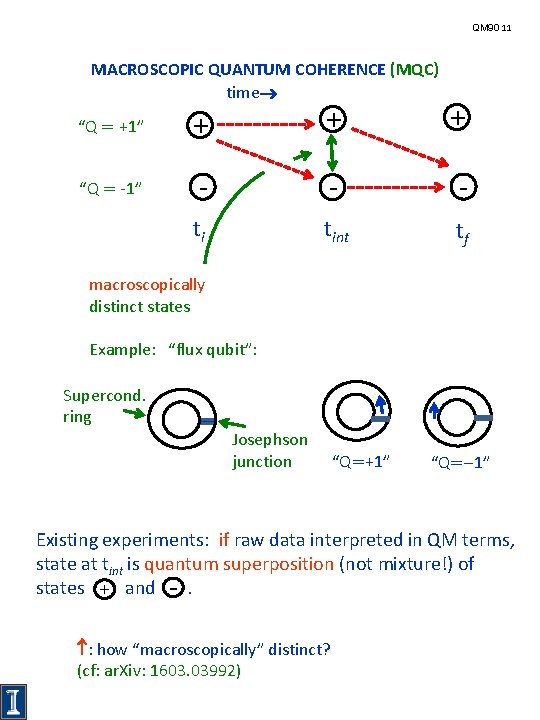
QM 90 11 MACROSCOPIC QUANTUM COHERENCE (MQC) time “Q = +1” + + + “Q = -1” - - - ti tint tf macroscopically distinct states Example: “flux qubit”: Supercond. ring Josephson junction “Q=+1” “Q= 1” Existing experiments: if raw data interpreted in QM terms, state at tint is quantum superposition (not mixture!) of states + and -. : how “macroscopically” distinct? (cf: ar. Xiv: 1603. 03992)
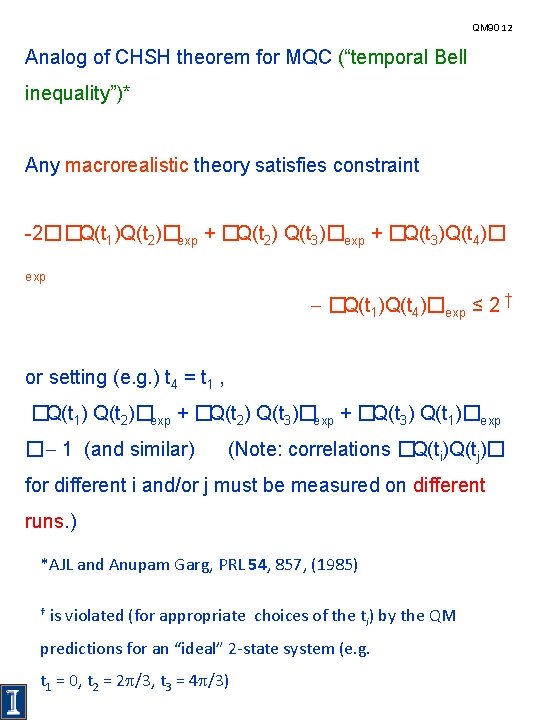
QM 90 12 Analog of CHSH theorem for MQC (“temporal Bell inequality”)* Any macrorealistic theory satisfies constraint -2��Q(t 1)Q(t 2)�exp + �Q(t 2) Q(t 3)�exp + �Q(t 3)Q(t 4)� exp �Q(t 1)Q(t 4)�exp ≤ 2 † or setting (e. g. ) t 4 = t 1 , �Q(t 1) Q(t 2)�exp + �Q(t 2) Q(t 3)�exp + �Q(t 3) Q(t 1)�exp � 1 (and similar) (Note: correlations �Q(ti)Q(tj)� for different i and/or j must be measured on different runs. ) *AJL and Anupam Garg, PRL 54, 857, (1985) † is violated (for appropriate choices of the ti) by the QM predictions for an “ideal” 2 -state system (e. g. t 1 = 0, t 2 = 2 /3, t 3 = 4 /3)
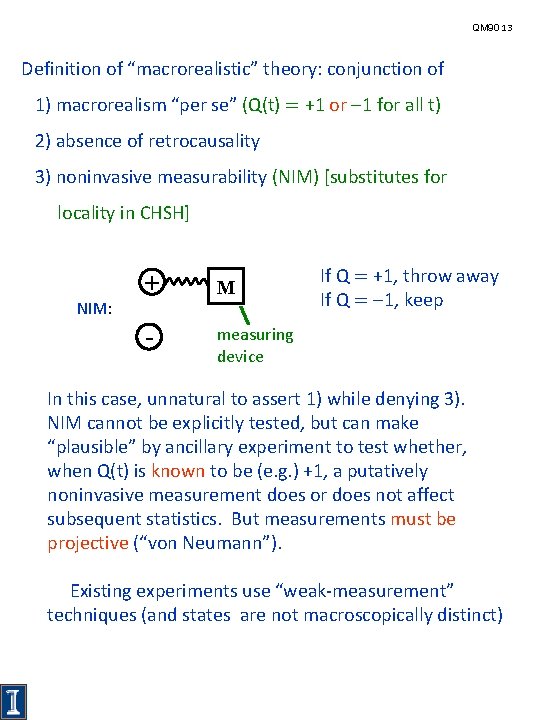
QM 90 13 Definition of “macrorealistic” theory: conjunction of 1) macrorealism “per se” (Q(t) = +1 or 1 for all t) 2) absence of retrocausality 3) noninvasive measurability (NIM) [substitutes for locality in CHSH] NIM: + - M If Q = +1, throw away If Q = 1, keep measuring device In this case, unnatural to assert 1) while denying 3). NIM cannot be explicitly tested, but can make “plausible” by ancillary experiment to test whether, when Q(t) is known to be (e. g. ) +1, a putatively noninvasive measurement does or does not affect subsequent statistics. But measurements must be projective (“von Neumann”). Existing experiments use “weak-measurement” techniques (and states are not macroscopically distinct)
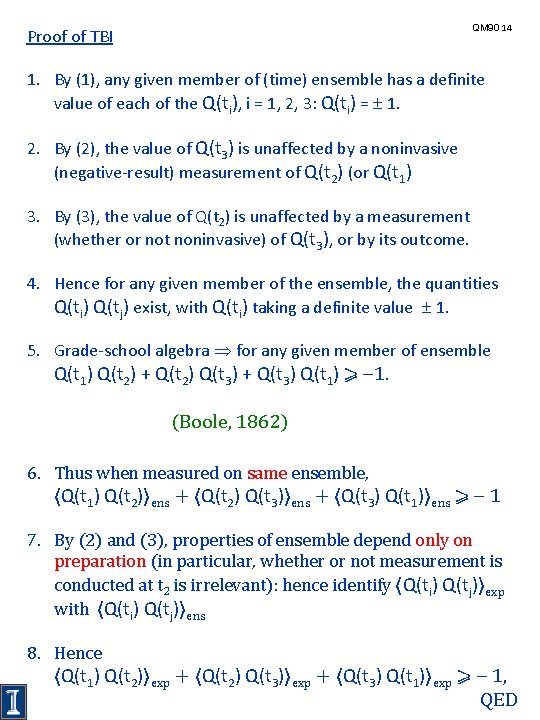
QM 90 14 Proof of TBI 1. By (1), any given member of (time) ensemble has a definite value of each of the Q(ti), i = 1, 2, 3: Q(ti) = 1. 2. By (2), the value of Q(t 3) is unaffected by a noninvasive (negative-result) measurement of Q(t 2) (or Q(t 1) 3. By (3), the value of Q(t 2) is unaffected by a measurement (whether or not noninvasive) of Q(t 3), or by its outcome. 4. Hence for any given member of the ensemble, the quantities Q(ti) Q(tj) exist, with Q(ti) taking a definite value 1. 5. Grade-school algebra for any given member of ensemble Q(t 1) Q(t 2) + Q(t 2) Q(t 3) + Q(t 3) Q(t 1) ⩾ 1. (Boole, 1862) 6. Thus when measured on same ensemble, ⟨Q(t 1) Q(t 2)⟩ens + ⟨Q(t 2) Q(t 3)⟩ens + ⟨Q(t 3) Q(t 1)⟩ens ⩾ 1 7. By (2) and (3), properties of ensemble depend only on preparation (in particular, whether or not measurement is conducted at t 2 is irrelevant): hence identify ⟨Q(ti) Q(tj)⟩exp with ⟨Q(ti) Q(tj)⟩ens 8. Hence ⟨Q(t 1) Q(t 2)⟩exp + ⟨Q(t 2) Q(t 3)⟩exp + ⟨Q(t 3) Q(t 1)⟩exp ⩾ 1, QED
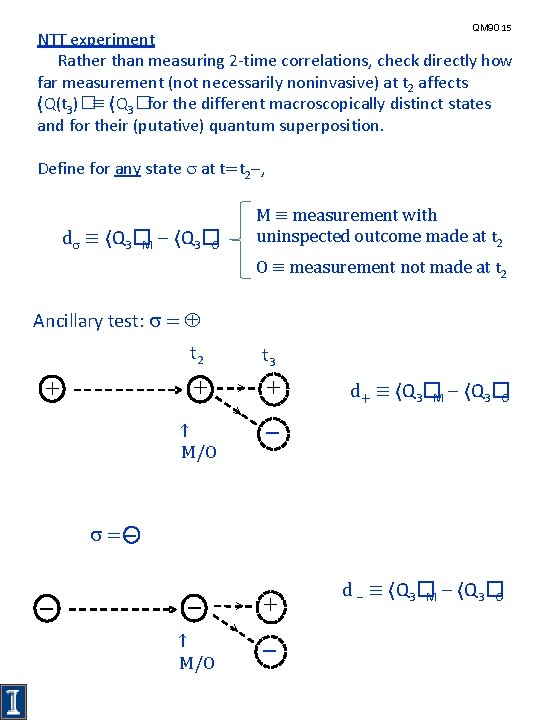
QM 90 15 NTT experiment Rather than measuring 2 -time correlations, check directly how far measurement (not necessarily noninvasive) at t 2 affects ⟨Q(t 3)�≡ ⟨Q 3�for the different macroscopically distinct states and for their (putative) quantum superposition. Define for any state at t=t 2 , M ≡ measurement with uninspected outcome made at t 2 d ≡ ⟨Q 3�M ⟨Q 3�O O ≡ measurement not made at t 2 Ancillary test: = t 2 + + t 3 > > ↑ M/O + d+ ≡ ⟨Q 3�M ⟨Q 3�O = ↑ M/O > > + d ≡ ⟨Q 3�M ⟨Q 3�O
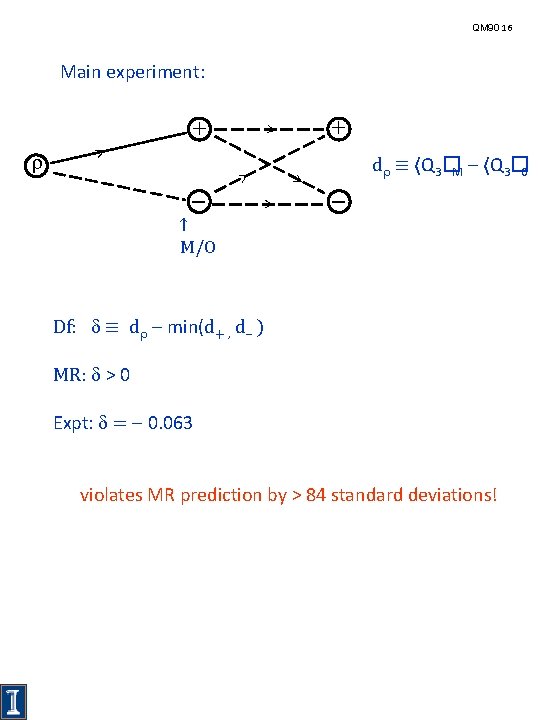
QM 90 16 Main experiment: > + + > > d ≡ ⟨Q 3�M ⟨Q 3� 0 ↑ M/O Df: ≡ d min(d+ , d ) MR: > 0 Expt: = 0. 063 violates MR prediction by > 84 standard deviations!
CONCLUSION QM 90 17 Recap: our tentative definition of “realism” was by proposition II. Either it is a fact that counter Y would have clicked, or it is a fact that counter N would have clicked. This is the statement of macroscopic counterfactual definitions. So: Do counterfactual statements have truth-values? (common sense, legal system. . . assume so!) A possible view on the meaning of counterfactuals* “If kangaroos had no tails, they would topple over” seems to mean something like this: in any possible state of affairs in which kangaroos have no tails, and which resembles our actual state of affairs as much as kangaroos having no tails permits it to, the kangaroos topple over. *David K. Lewis, Counterfactuals, Harvard U. P. 1975
QM 90 18 So. . . is it the case that in any experiment in which “everything else is the same” but we measure A instead of A´, we always get (say) +1? Alas, no! (and NTT experiment shows this is not simply “amplification” of a microscopic indeterminacy, it is true even at a (semi-) macroscopic level). Is determinacy even possible in the absence of determinism? Either way, we may eventually have to conclude. . .
QM 90 19 EVEN AT THE EVERYDAY LEVEL, THERE IS NO SUCH THING AS “WOULD HAVE”!