
Realism Regionalism Local Color 1865 1910 What is
- Slides: 20
Realism Regionalism & Local Color 1865 -1910
What is realism? n n n Broadly defined, a literary technique devoted to "the faithful representation of reality" A reaction against romanticism No longer about westward expansion Instead about working a job, feeding a family, and dealing with the hand you were dealt Few literary devices or elevated language so it was accessible to the average man
Some Key Influences n n n Rapid growth after the Civil War Increasing rates of democracy and literacy Rapid growth in industrialism and urbanization An expanding population base due to immigration Greater divide between the rich and the poor Larger and more literate working class – Need for literature that reflected their lives
Local Color/Regional Literature n Local color or regional literature focuses on the characters, dialect, customs, topography, and other features particular to a specific region. n Between the Civil War and the end of the nineteenth century, this mode of writing became dominant in American literature.
Regional Literature n n Regional literature incorporates the broader concept of sectional differences within a locale. For example, in The Adventures of Huckleberry Finn, Mark Twain makes use of several distinct dialects to represent the differences of various groups living in the region.
Impacts n Contributed to the reunification of the country after the Civil War n Helped build a national identity n Contributed to the narrative of unified nationhood that late nineteenthcentury America sought to construct
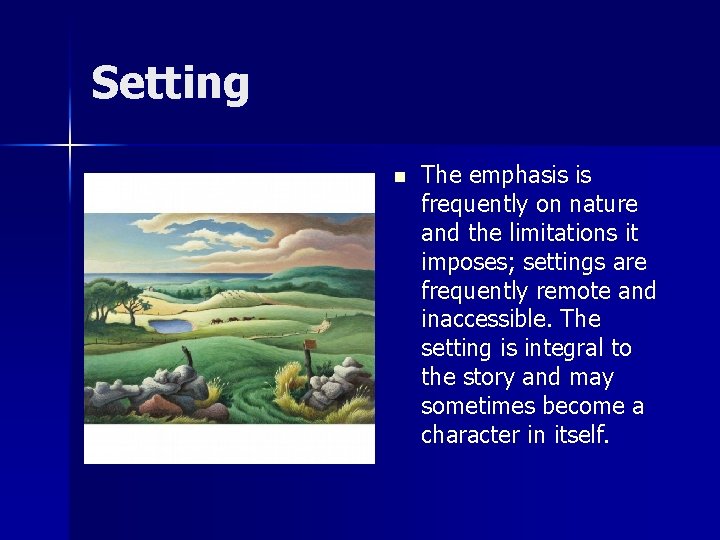
Setting n The emphasis is frequently on nature and the limitations it imposes; settings are frequently remote and inaccessible. The setting is integral to the story and may sometimes become a character in itself.
Characters n n Local color stories tend to be concerned with the character of the district or region rather than with the individual: characters may become character types, sometimes quaint or stereotypical. The characters are marked by their adherence to the old ways, by dialect, and by particular personality traits central to the region.
Narrator n The narrator is typically an educated observer from the world beyond who learns something from the characters while preserving a sometimes sympathetic, sometimes ironic distance from them. n The narrator serves as mediator between the rural folk of the tale and the urban audience to whom the tale is directed.
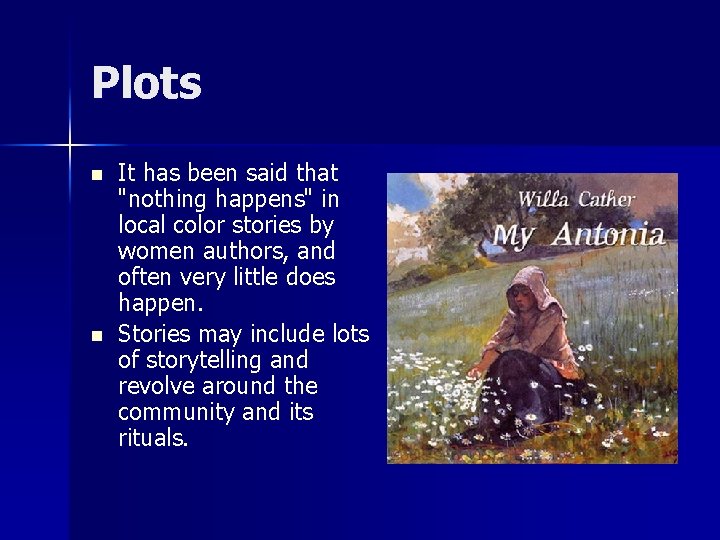
Plots n n It has been said that "nothing happens" in local color stories by women authors, and often very little does happen. Stories may include lots of storytelling and revolve around the community and its rituals.
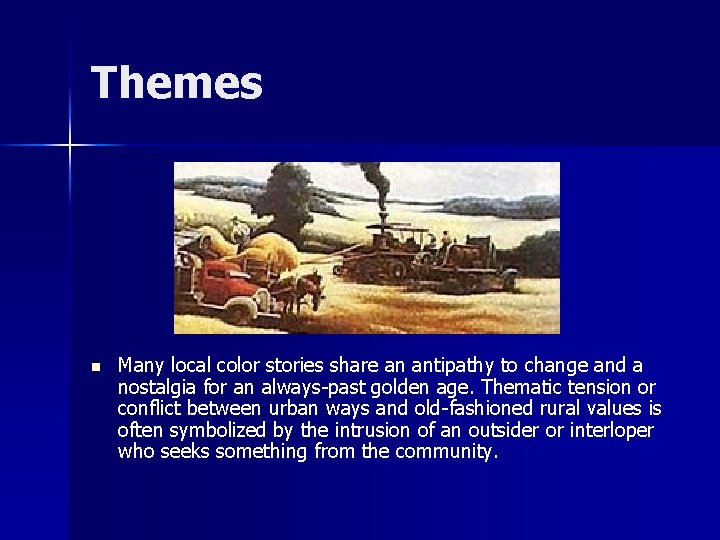
Themes n Many local color stories share an antipathy to change and a nostalgia for an always-past golden age. Thematic tension or conflict between urban ways and old-fashioned rural values is often symbolized by the intrusion of an outsider or interloper who seeks something from the community.
Shared Techniques n n n Use of dialect to establish credibility and authenticity of regional characters. Use of detailed description, especially of small, seemingly insignificant details central to an understanding of the region. Frequent use of a frame story in which the narrator hears some tale of the region.
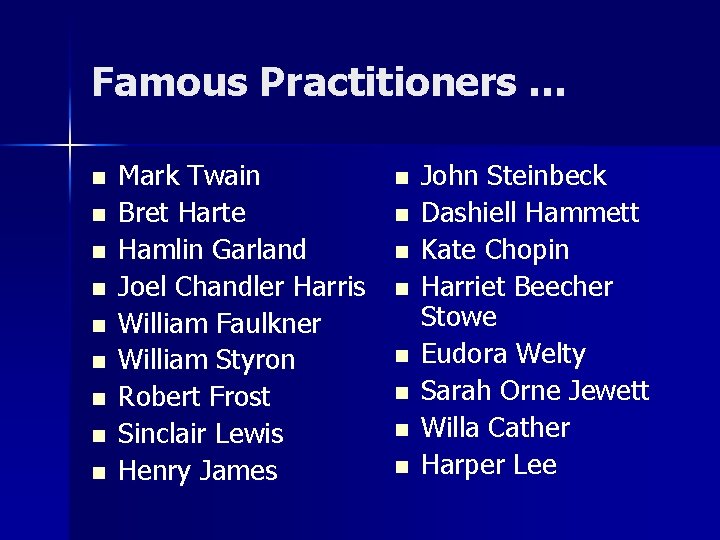
Famous Practitioners … n n n n n Mark Twain Bret Harte Hamlin Garland Joel Chandler Harris William Faulkner William Styron Robert Frost Sinclair Lewis Henry James n n n n John Steinbeck Dashiell Hammett Kate Chopin Harriet Beecher Stowe Eudora Welty Sarah Orne Jewett Willa Cather Harper Lee
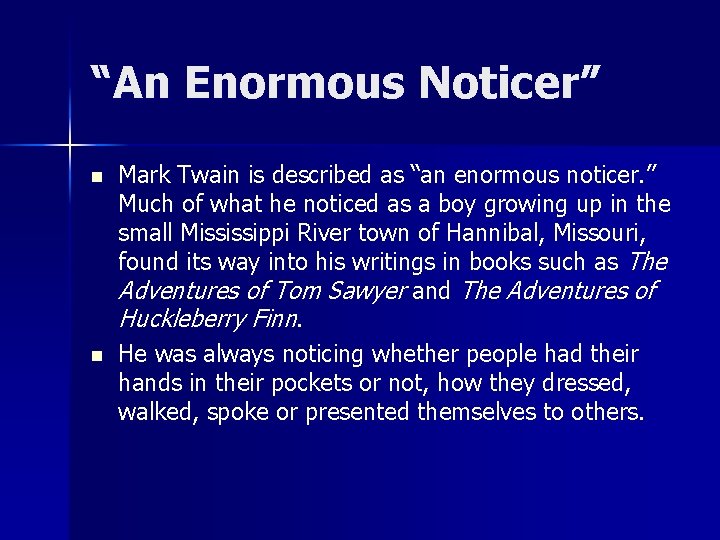
“An Enormous Noticer” n n Mark Twain is described as “an enormous noticer. ” Much of what he noticed as a boy growing up in the small Mississippi River town of Hannibal, Missouri, found its way into his writings in books such as The Adventures of Tom Sawyer and The Adventures of Huckleberry Finn. He was always noticing whether people had their hands in their pockets or not, how they dressed, walked, spoke or presented themselves to others.
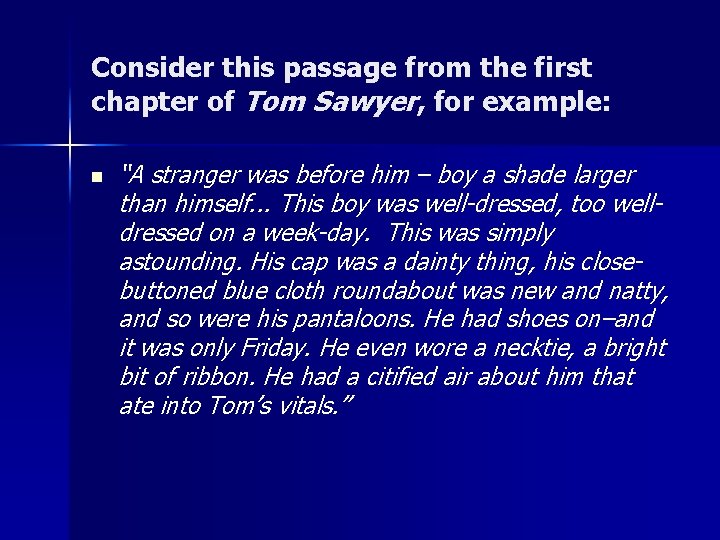
Consider this passage from the first chapter of Tom Sawyer, for example: n “A stranger was before him – boy a shade larger than himself. . . This boy was well-dressed, too welldressed on a week-day. This was simply astounding. His cap was a dainty thing, his closebuttoned blue cloth roundabout was new and natty, and so were his pantaloons. He had shoes on–and it was only Friday. He even wore a necktie, a bright bit of ribbon. He had a citified air about him that ate into Tom’s vitals. ”
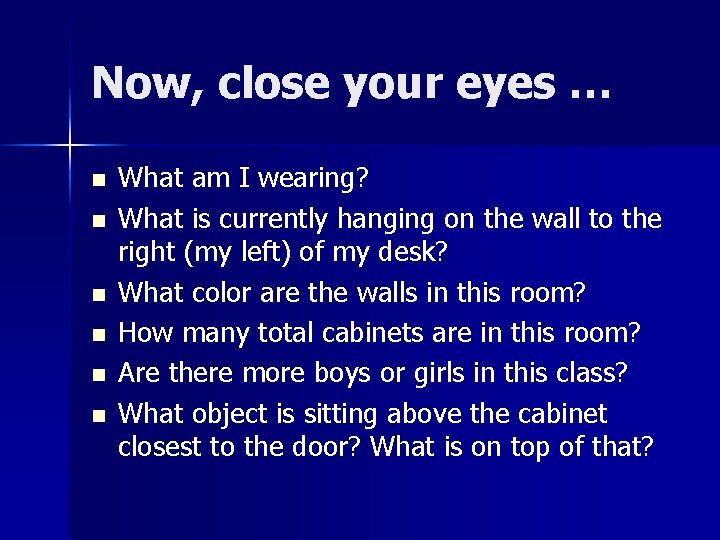
Now, close your eyes … n n n What am I wearing? What is currently hanging on the wall to the right (my left) of my desk? What color are the walls in this room? How many total cabinets are in this room? Are there more boys or girls in this class? What object is sitting above the cabinet closest to the door? What is on top of that?
Situational Irony What actually happens is the direct opposite of what is expected to happen n NOT IRONIC n – Alanis Morisette’s “Ironic” – Coincidences – Bad luck
Examples of Situational Irony Check the weather; it’s going to be sunny all day! n Go outside and wash your car n Starts to downpour despite the weather forecast, ruining your nice, clean car n
Examples of Situational Irony In Shrek, we expect Fiona to be taken by Robin Hood’s Merry Men if Shrek can’t defend her n The “damsel in distress” is the one who is actually able to save herself and kicks butt n
Examples of Situational Irony n ABUNDANT in Arrested Development