
REALISM NATURALISM REALISM v The attempt in literature
- Slides: 15
REALISM & NATURALISM
REALISM v The attempt in literature and art to represent life as it really is, without sentimentalizing or idealizing it. v Realistic writing often depicts the everyday life and speech of ordinary people
REALIST THEMES v Experience of the commonplace v Focus on the middle class v Industrial revolution v Interactions between different classes and countries v Complex ethical choices v Ordinary characters are studied in depth
REALIST CHARACTERS v Shared guilt or responsibility v Not extraordinary, everyday people, middle class folk v No distinctive heroes or villains, mix of strengths and flaws v Motivated by survival, greed, self-preservation, materialistic v Deep connection with nature, each other, social class & past v Intricate and layered v Democratic, open to change and experimentation
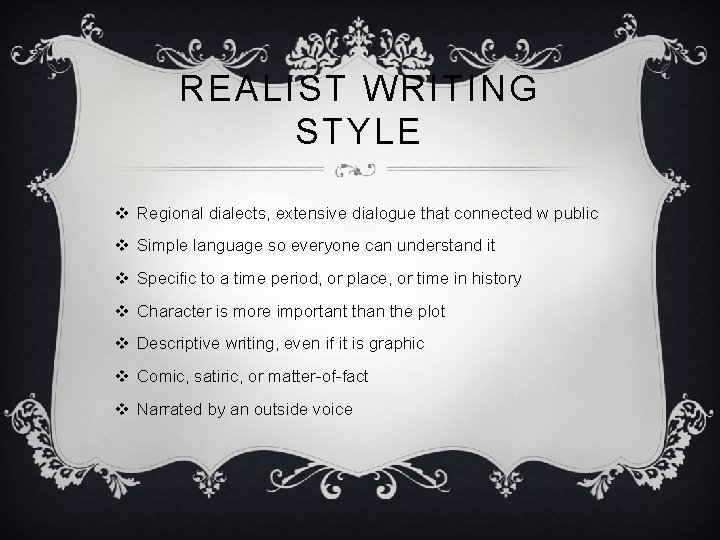
REALIST WRITING STYLE v Regional dialects, extensive dialogue that connected w public v Simple language so everyone can understand it v Specific to a time period, or place, or time in history v Character is more important than the plot v Descriptive writing, even if it is graphic v Comic, satiric, or matter-of-fact v Narrated by an outside voice
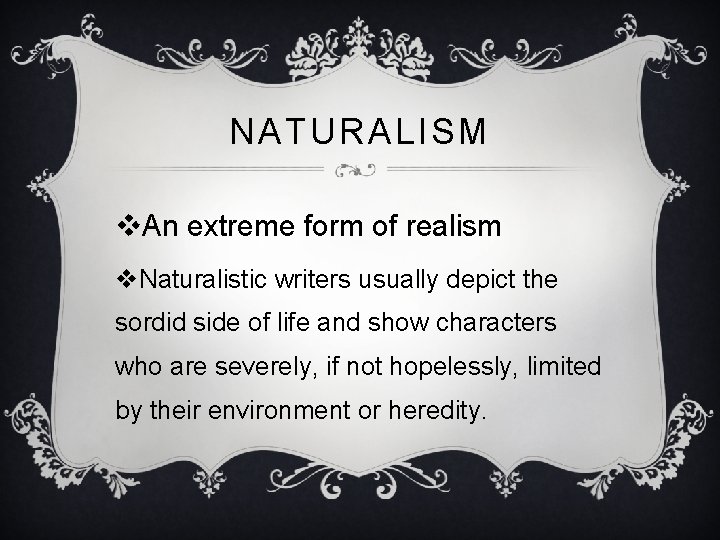
NATURALISM v. An extreme form of realism v. Naturalistic writers usually depict the sordid side of life and show characters who are severely, if not hopelessly, limited by their environment or heredity.
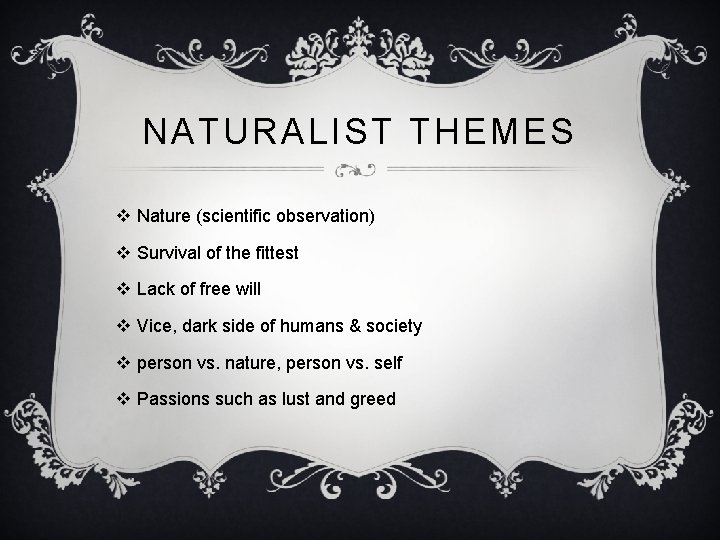
NATURALIST THEMES v Nature (scientific observation) v Survival of the fittest v Lack of free will v Vice, dark side of humans & society v person vs. nature, person vs. self v Passions such as lust and greed
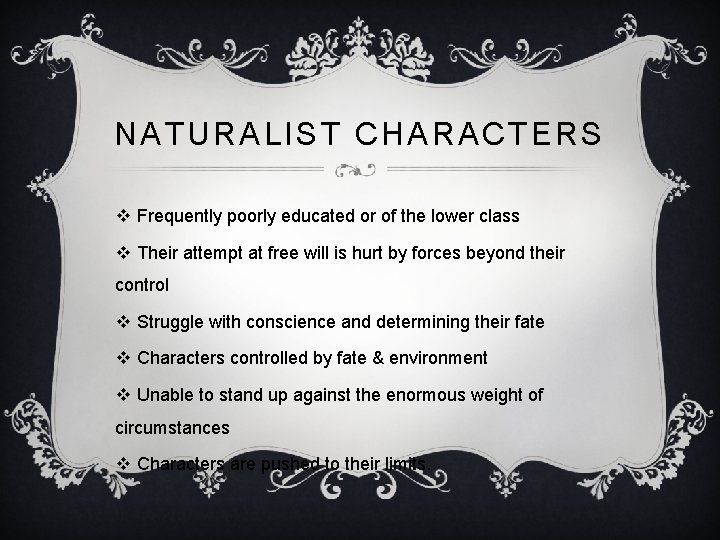
NATURALIST CHARACTERS v Frequently poorly educated or of the lower class v Their attempt at free will is hurt by forces beyond their control v Struggle with conscience and determining their fate v Characters controlled by fate & environment v Unable to stand up against the enormous weight of circumstances v Characters are pushed to their limits.
NATURALIST CHARACTERS v Heredity & environment control the individual v Rejection of the supernatural v Nature vs. nurture v Chance, fate & destiny v Poverty, crime, violence, racism, intolerance, disease, corruption, urban squalor, industrialism, prostitution
NATURALIST WRITING STYLE v No sugar coating v Objective narrator v Plot twist at the end v Detailed violence v Formal language, piling on of images v Attention to setting to the point of saturation
KEY TERMS v Verisimilitude-the appearance of truth v Brute within-strong, warring emotions, and a fight for survival v Vernacular- the language or dialect spoken by the people of a particular region v Determinism- belief that events are determined by forces beyond the control of human beings; all events have sufficient causes v Social Darwinism- survival of the fittest
KEY TERMS v Mimesis- imitation of the real world, as by re-creating instances of human action and events portraying objects found in nature v Muckrakers-American journalists & novelists who exposed corruption in big business and government
ROMANTICISM 19 th century art and literature that tends to emphasize feelings and imagination over reason and facts. Romanticism attempts to show life as we might imagine it to be, or think it should be. It favors the picturesque, the emotional, the exotic, and the mysterious. It often glorifies nature and upholds the idea that people are basically good.
ROMANTICISM v Emotional matter in an imaginative form v Liberalism in literature v Imagination v Emotion v Freedom v Subjectivity (intentness on internal thoughts, internal reality) v Individualism v Spontaneity (resulting from a natural impulse, unplanned)
ROMANTICISM CONT’ v Freedom from rules v Solitary life over life in society v Imagination is superior to reason v Devotion to beauty v Love and worship of nature v Fascination with the past – myths and mysticism of the middle ages v Mysticism =spiritual intuition of truths believed to transcend ordinary understanding