
REALISM MAIN ASSUMPTIONS PROGENITORS AND PRACTICALITY OF THE
- Slides: 17
REALISM MAIN ASSUMPTIONS, PROGENITORS AND PRACTICALITY OF THE IR THEORY
4 REALISTS ASSUMPTIONS • 1)National security and survival are the most important objectives • 2) False human nature • 3) IR are conflictual • 4) Skepticism about IR progress (based on domestic politic observations)
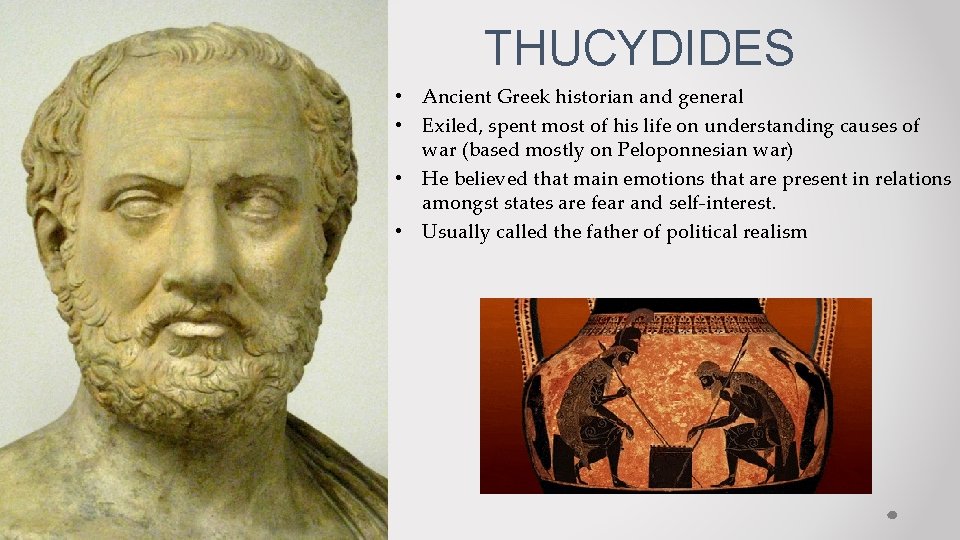
THUCYDIDES • Ancient Greek historian and general • Exiled, spent most of his life on understanding causes of war (based mostly on Peloponnesian war) • He believed that main emotions that are present in relations amongst states are fear and self-interest. • Usually called the father of political realism
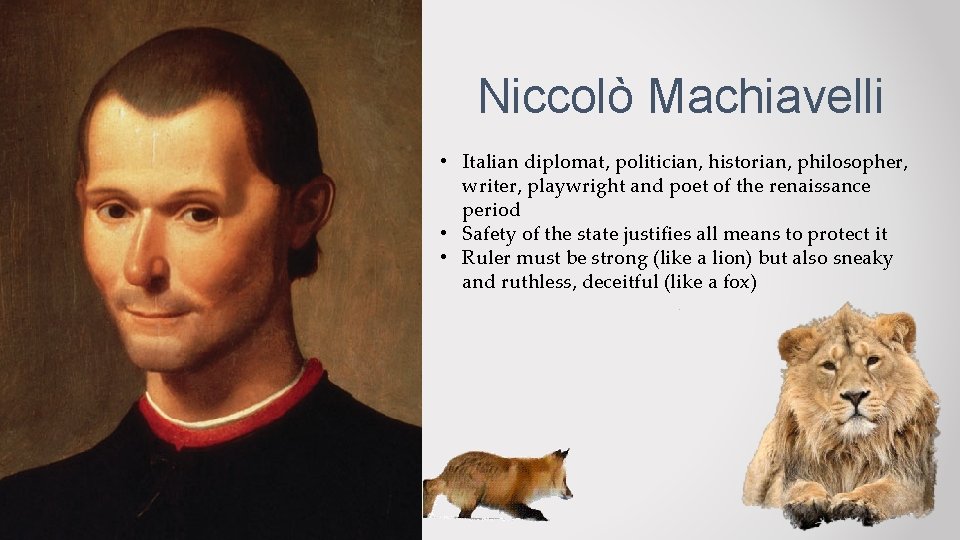
Niccolò Machiavelli • Italian diplomat, politician, historian, philosopher, writer, playwright and poet of the renaissance period • Safety of the state justifies all means to protect it • Ruler must be strong (like a lion) but also sneaky and ruthless, deceitful (like a fox)
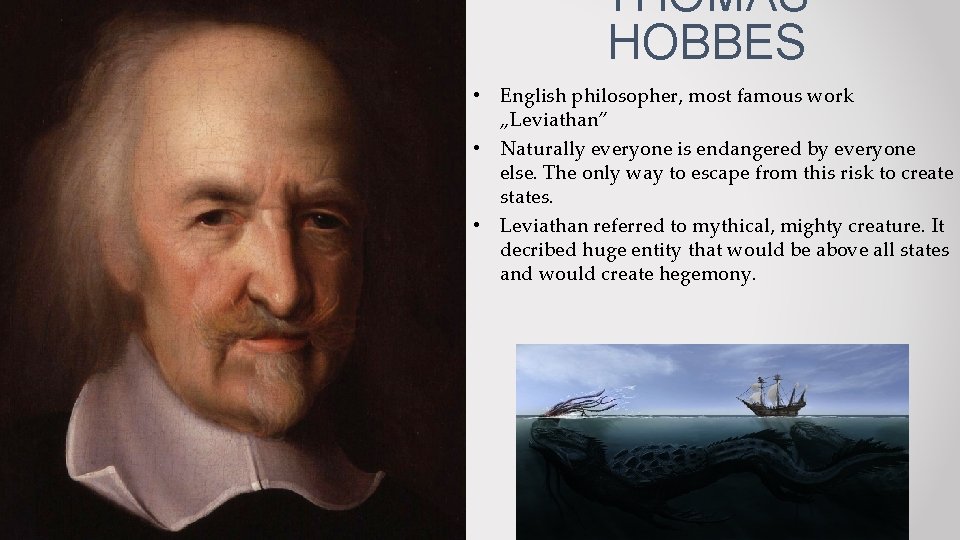
THOMAS HOBBES • English philosopher, most famous work „Leviathan” • Naturally everyone is endangered by everyone else. The only way to escape from this risk to create states. • Leviathan referred to mythical, mighty creature. It decribed huge entity that would be above all states and would create hegemony.
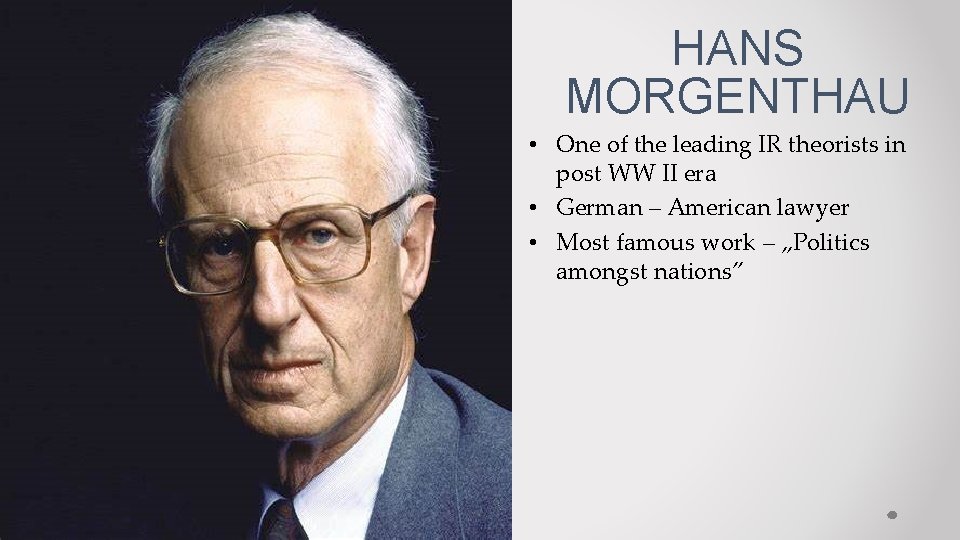
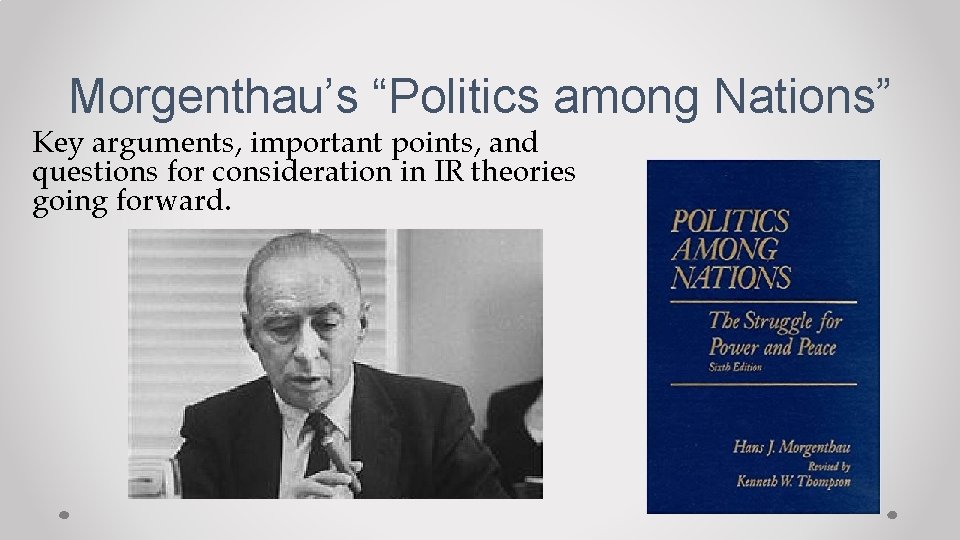
HANS MORGENTHAU • One of the leading IR theorists in post WW II era • German – American lawyer • Most famous work – „Politics amongst nations”
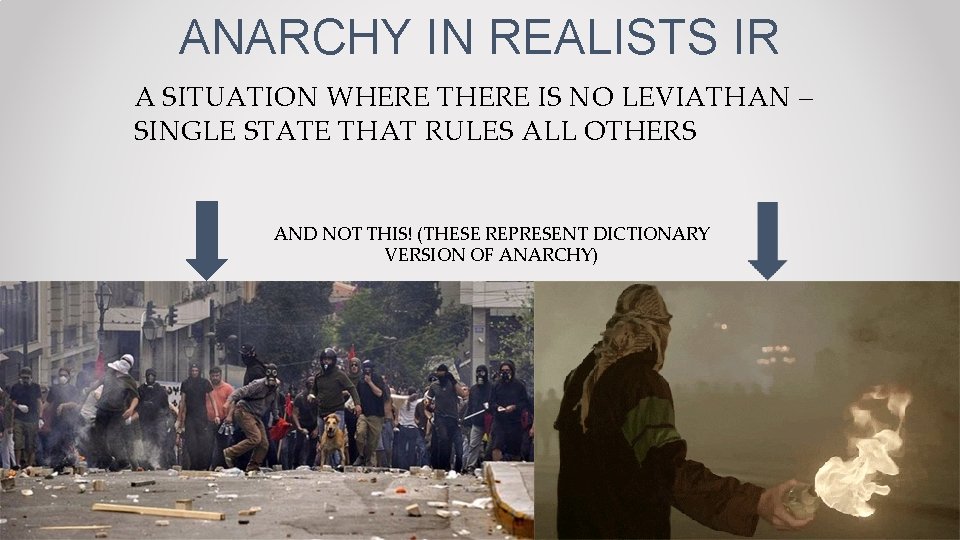
ANARCHY IN REALISTS IR A SITUATION WHERE THERE IS NO LEVIATHAN – SINGLE STATE THAT RULES ALL OTHERS AND NOT THIS! (THESE REPRESENT DICTIONARY VERSION OF ANARCHY)
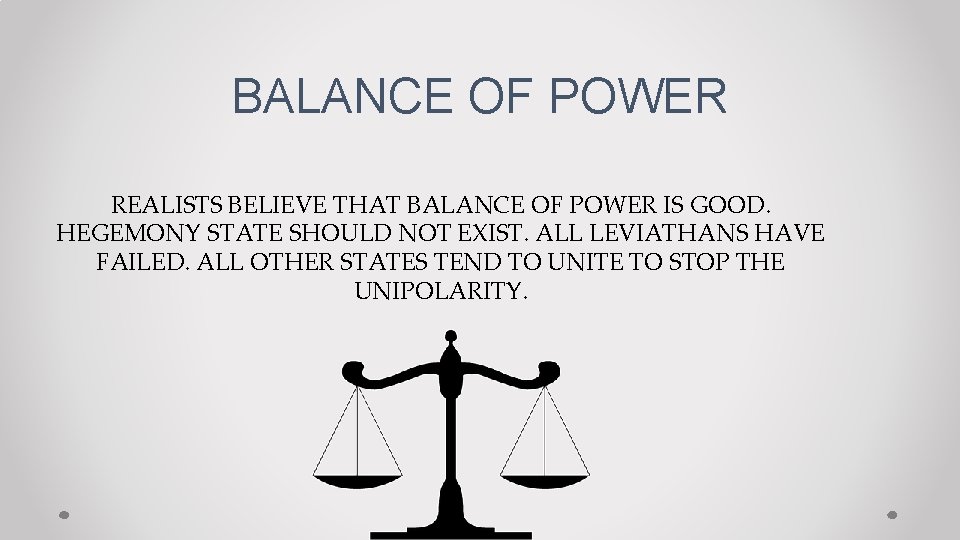
BALANCE OF POWER REALISTS BELIEVE THAT BALANCE OF POWER IS GOOD. HEGEMONY STATE SHOULD NOT EXIST. ALL LEVIATHANS HAVE FAILED. ALL OTHER STATES TEND TO UNITE TO STOP THE UNIPOLARITY.
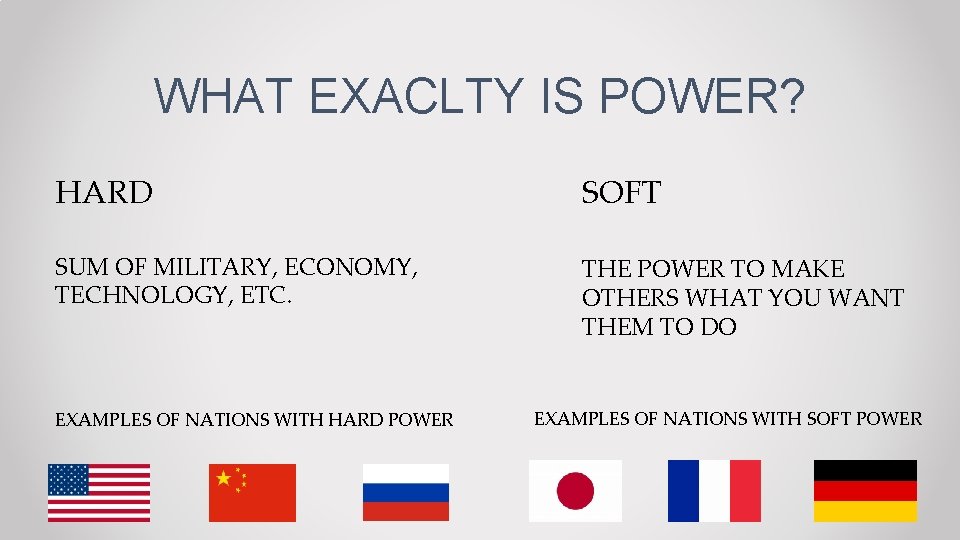
WHAT EXACLTY IS POWER? HARD SOFT SUM OF MILITARY, ECONOMY, TECHNOLOGY, ETC. THE POWER TO MAKE OTHERS WHAT YOU WANT THEM TO DO EXAMPLES OF NATIONS WITH HARD POWER EXAMPLES OF NATIONS WITH SOFT POWER
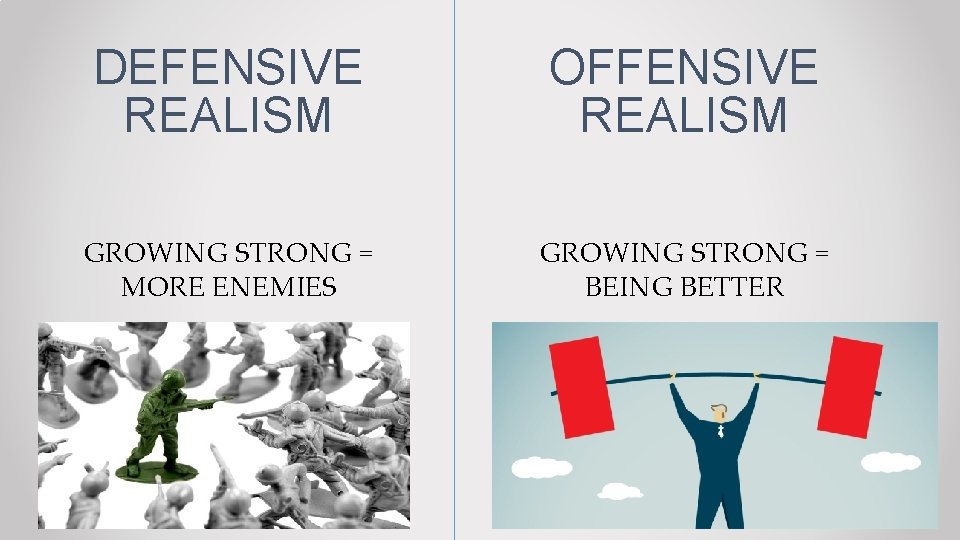
DEFENSIVE REALISM OFFENSIVE REALISM GROWING STRONG = MORE ENEMIES GROWING STRONG = BEING BETTER
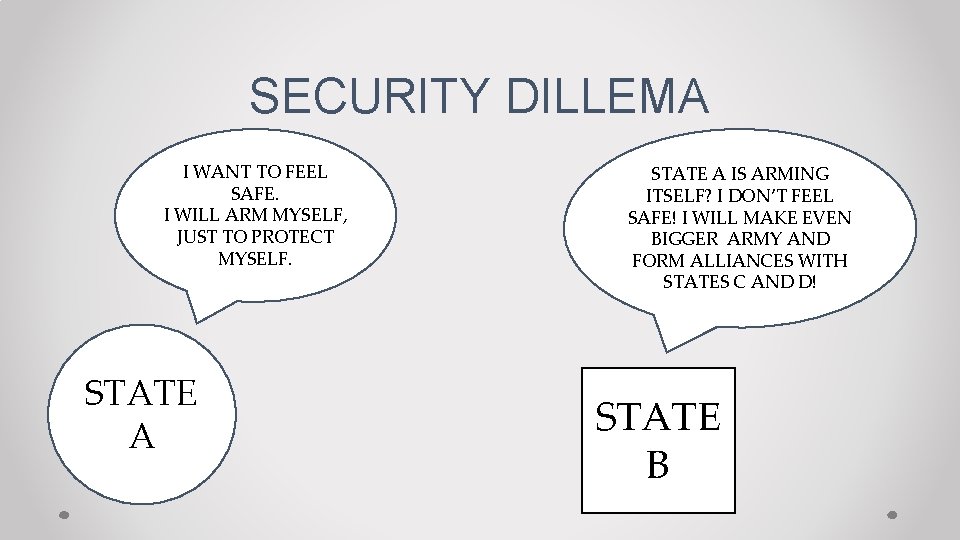
SECURITY DILLEMA I WANT TO FEEL SAFE. I WILL ARM MYSELF, JUST TO PROTECT MYSELF. STATE A IS ARMING ITSELF? I DON’T FEEL SAFE! I WILL MAKE EVEN BIGGER ARMY AND FORM ALLIANCES WITH STATES C AND D! STATE B
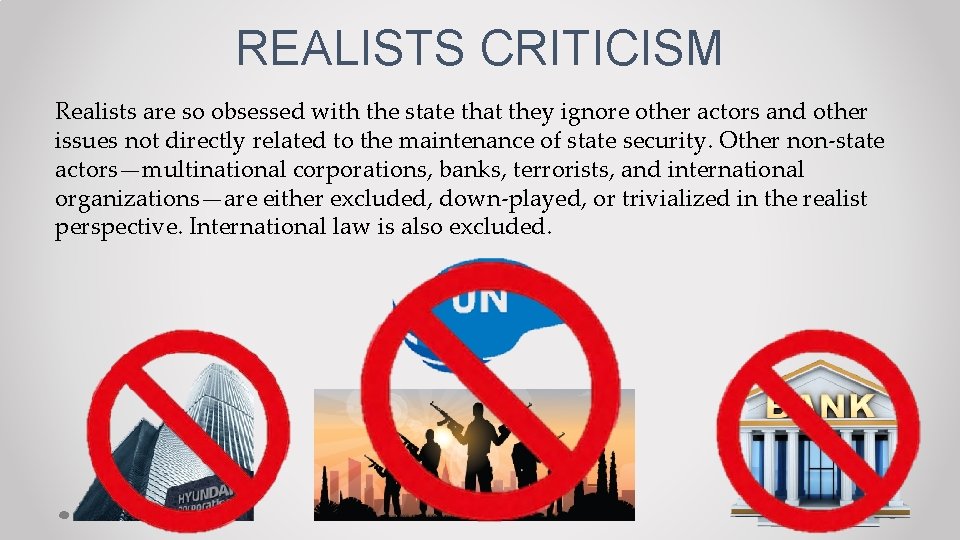
REALISTS CRITICISM Realists are so obsessed with the state that they ignore other actors and other issues not directly related to the maintenance of state security. Other non-state actors—multinational corporations, banks, terrorists, and international organizations—are either excluded, down-played, or trivialized in the realist perspective. International law is also excluded.
Morgenthau’s “Politics among Nations” Key arguments, important points, and questions for consideration in IR theories going forward.
Power is pivotal • Morgenthau highlights incredibly well why power is pivotal and inescapable in IR and international politics. • The single-variable structure (i. e. power) is well grounded in political and intellectual history, and cannot be easily disposed by any opposing structure. • Reinhold Niebuhr aptly put it, “There has never been a scheme of justice in history which did not have a balance of power at its foundation. Concrete conceptions of power and interest are observable and reliable, and offer a reliable guide for understanding conflicts and their solutions. ” • Morgenthau convincingly rejects consideration of principles (i. e. behaviouralist theories) arguing that they are unobservable in operation, and no system can assign them scientific predictability. We can also see cases of national leaders pursuing, with vigour, policies that could only terminate in disaster. • He uses the example of foreign policies (Status Quo, imperialism, and ambiguous) to highlight the need to “see through these ideological disguises” (Page 113) and to see the power politics in operation. • Key challenge; How can we ever move away from power as the only important consideration in IR, particularly in explaining IR, rather than presenting a normative theory?
Demolition of Utopian Ideals in IR • Faith in the moral force of public opinion, faith in the harmony of interests between states, and faith in organisations such as the UN to replace the rule of force with the rule of law- all convincingly rebuked by Morgenthau. The UN has failed to deter great powers from acting in their interests (p 296); i) Power is decentralised at international level, ii) no community interest nor balance, iii) no arbitrary power (like a state in the domestic sphere) to uphold rules. • Maritime law has allowed states to use the imprecise nature of international law for their own benefits – power is their consideration (Page 299) • Enforcement of law at the International level always comes back to power and political considerations – Belgium 1914 vs Finland 1939 vs Korea 1950. • “South Korea is an ally of the US… so American policy will do nothing to harm its relation with that state. The defence of human rights cannot be consistently applied in foreign policy because it can and must come into conflict with other interests. ” (page 277). • • • Disarmament fails too (totally for conventional weapons, mostly fails for nuclear)- “the quantity and disposition of conventional weapons have a direct bearing upon the distribution of military power. Since the nations concerned compete for military advantage, an agreement on the control of conventional weapons would signify the end of competition” (page 440). • Key challenge- History shows all nonpower devices to be ineffective in limiting international aggression. How can we move to any system based on non-power devices to eliminate international aggression?
Morality in private and public as separate • Key consideration for states-people should be their own citizens – welfare and security- therefore statecraft is ethically compromised. • “Moral rules operate within the consciences of individual men”(page 266)- who do you even hold accountable when responsibility is shared in a govt, or among a population voting for a govt- “there is no individual conscience from which what we call the international morality of Great Britain or of any other nation could emanate”. • • Highly critical of the Wilson doctrine (page 276) due to; 1) Unenforceability – ‘we can tell the Soviet Union, from time to time… but once we have said this we will find that there is very little more we can do”. 2) US has many interests throughout the world, of which “human rights is only one, and not the most important one at that”. We only need to look at the treatment of China v Korea v Russia. The US finds itself in a “Quixotic position”. • • • There is a need to do things that would be ethically questionable in the private realm but right in the international world of power politics. • Key Challenge; How can we talk of ethical/ normative behaviour in the realm of IR? What is the meaning of “Human Rights” if they’re constantly subservient to power?
Problems (? ) with Morgenthau • Regime type- does he dismiss this too readily? If we take liberal democratic peace theory to be at least somewhat true, was Wilson pursuing the national interest by focusing on the spread of Democracy? • Robert Kaufman; “Would a democratic China or Iraq also not be less of a threat than current regimes? ”. Even if the establishment of liberal democracies didn’t ensure peace in Western Europe post-WWII, surely it helped. (http: //yalejournal. org/wp-content/uploads/2011/01/061202 kaufman. pdf) • Raymond Aron; “Is this true that states, whatever their regime, pursue the same kind of foreign policy” and that the foreign policies of Napoleon or Stalin are essentially identical to those of Hitler, Louis XVI or Nicholas II, amounting to no more than the struggle for power? (Aron, Raymond, 1966. Peace and War: A Theory of International Relations, trans. Richard Howard and Annette Baker Fox, Garden City, New York: Doubleday. ) • Does Morgenthau underplay the extent to which leaders in democratic countries have to play to their domestic electorate? Perhaps Morgenthau too harshly severs the domestic and international.