
Realism And Impressionism 1850 1895 The Artist as
- Slides: 28
Realism And Impressionism 1850 -1895 The Artist as Himself
• Industrial Revolution spread to the US and throughout Europe-plastics, machinery, chemicals, and oil- URBANIZATION-improving health and living conditions in the cities • Increased emphasis on science- Darwinism- theory of natural selectionhighly controversial- contributed to secularism • Became a social issue to justify racism, imperialism, nationalism, and militarism -by this time, most of the world was sectioned off and colonialized • Marx and Engels-goal was to create a socialist state- seizure of power by working class and the destruction of capitalism- emphasized class conflict and was instrumental in the rise of Labor Unions • Technological change and exposure to other cultures brought about modernismwestern culture’s lack of permanence • Modernist artists seek to capture the images and sensibility of their age, critical examination of the idea of art itself • Realism- reevaluation of reality- sights and experiences of everyday contemporary life- from the idea of empiricism- subject matter was expandedpeasants and working class • Realism-departed from illusionism- paintings were defined by the paint’s application as well as the subject matter
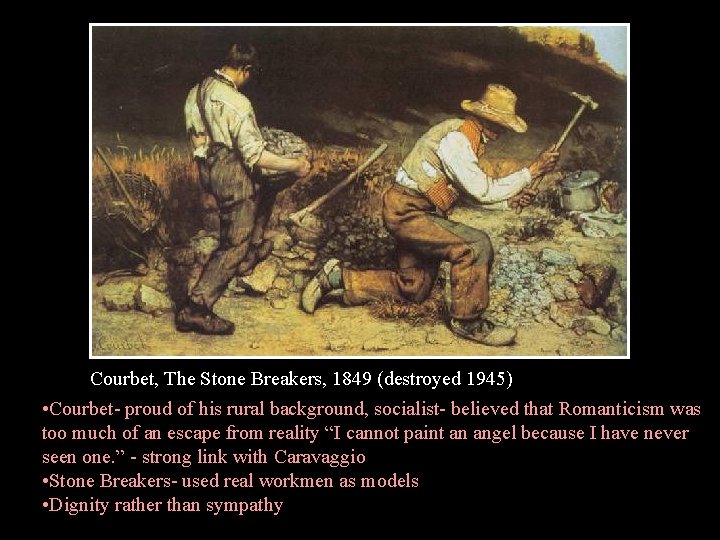
Courbet, The Stone Breakers, 1849 (destroyed 1945) • Courbet- proud of his rural background, socialist- believed that Romanticism was too much of an escape from reality “I cannot paint an angel because I have never seen one. ” - strong link with Caravaggio • Stone Breakers- used real workmen as models • Dignity rather than sympathy
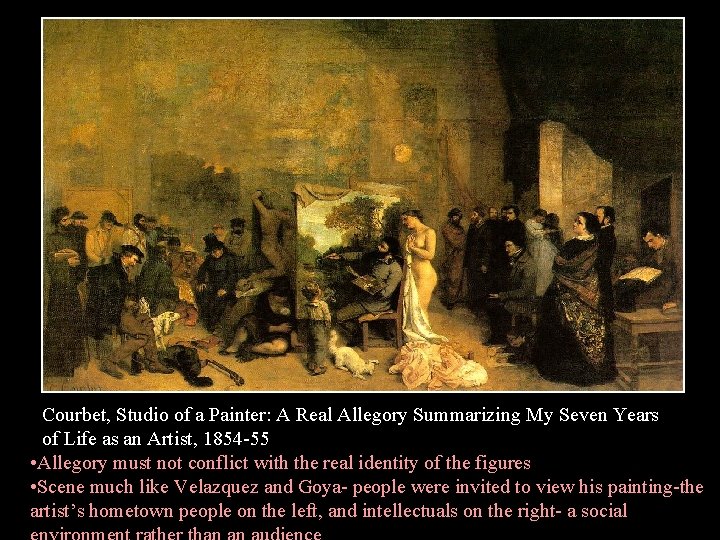
Courbet, Studio of a Painter: A Real Allegory Summarizing My Seven Years of Life as an Artist, 1854 -55 • Allegory must not conflict with the real identity of the figures • Scene much like Velazquez and Goya- people were invited to view his painting-the artist’s hometown people on the left, and intellectuals on the right- a social
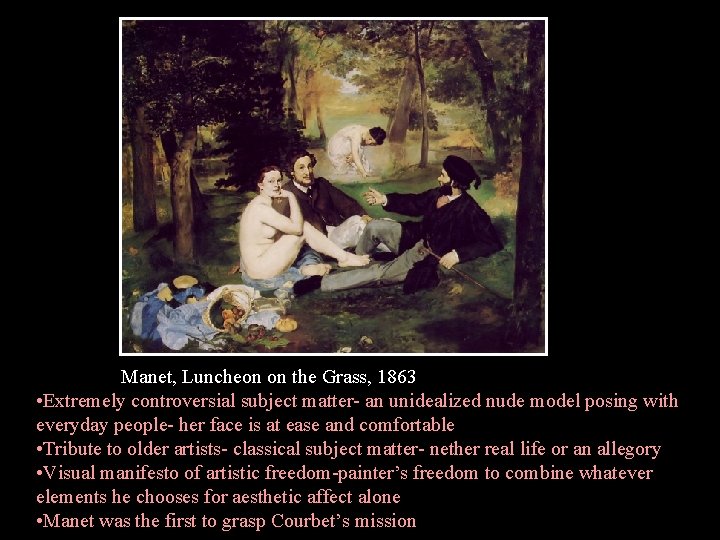
Manet, Luncheon on the Grass, 1863 • Extremely controversial subject matter- an unidealized nude model posing with everyday people- her face is at ease and comfortable • Tribute to older artists- classical subject matter- nether real life or an allegory • Visual manifesto of artistic freedom-painter’s freedom to combine whatever elements he chooses for aesthetic affect alone • Manet was the first to grasp Courbet’s mission
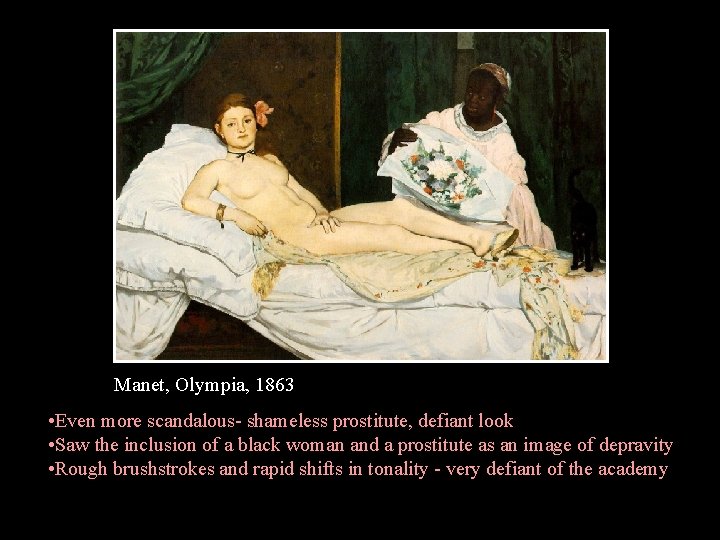
Manet, Olympia, 1863 • Even more scandalous- shameless prostitute, defiant look • Saw the inclusion of a black woman and a prostitute as an image of depravity • Rough brushstrokes and rapid shifts in tonality - very defiant of the academy
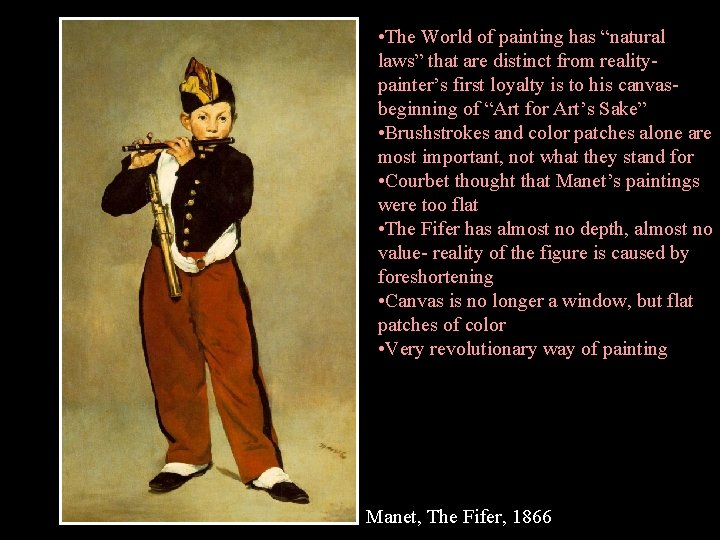
• The World of painting has “natural laws” that are distinct from realitypainter’s first loyalty is to his canvasbeginning of “Art for Art’s Sake” • Brushstrokes and color patches alone are most important, not what they stand for • Courbet thought that Manet’s paintings were too flat • The Fifer has almost no depth, almost no value- reality of the figure is caused by foreshortening • Canvas is no longer a window, but flat patches of color • Very revolutionary way of painting Manet, The Fifer, 1866
Impressionism. Not just pretty pictures!! An Art Revolution of Epic Proportions!! • Reaction against the invention of the camera • the Renaissance idea of the canvas being a window is dead • Canvas is now a surface covered with pigments-Manet first decided this but he refused to call his artwork Impressionist • New technology brought need for change- the camera, the railroad system, the all-important paint tube!!
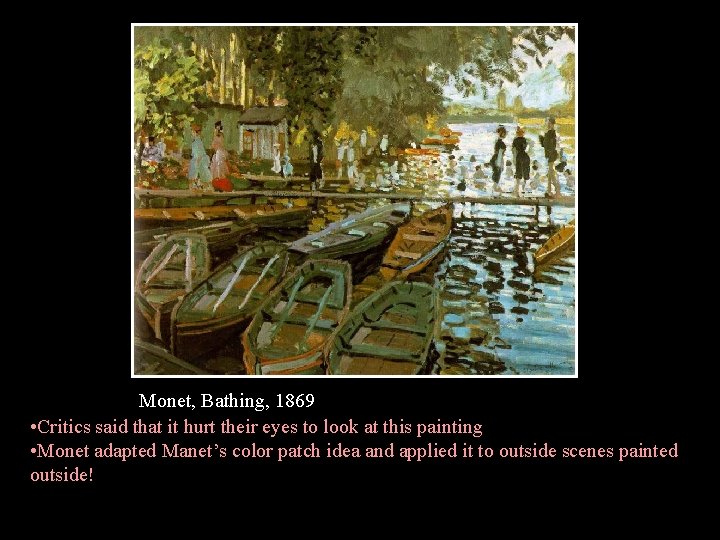
Monet, Bathing, 1869 • Critics said that it hurt their eyes to look at this painting • Monet adapted Manet’s color patch idea and applied it to outside scenes painted outside!
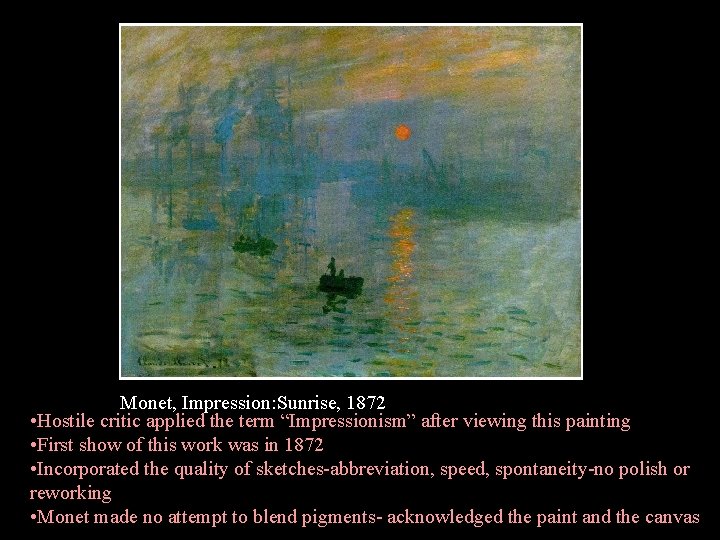
Monet, Impression: Sunrise, 1872 • Hostile critic applied the term “Impressionism” after viewing this painting • First show of this work was in 1872 • Incorporated the quality of sketches-abbreviation, speed, spontaneity-no polish or reworking • Monet made no attempt to blend pigments- acknowledged the paint and the canvas
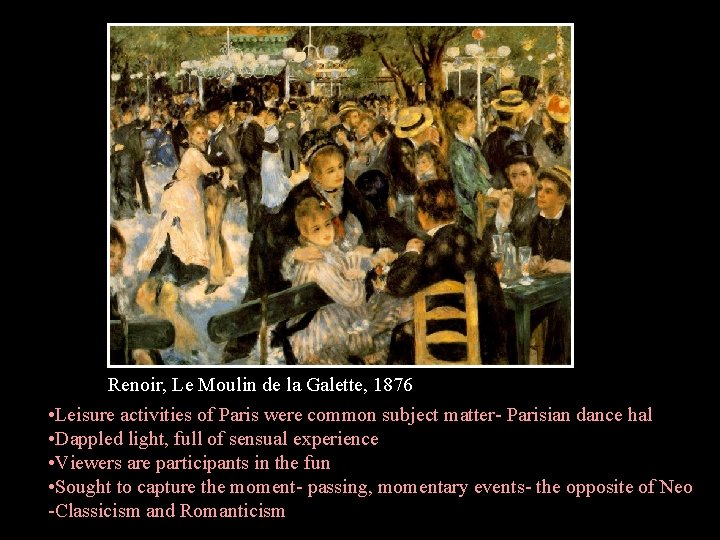
Renoir, Le Moulin de la Galette, 1876 • Leisure activities of Paris were common subject matter- Parisian dance hal • Dappled light, full of sensual experience • Viewers are participants in the fun • Sought to capture the moment- passing, momentary events- the opposite of Neo -Classicism and Romanticism
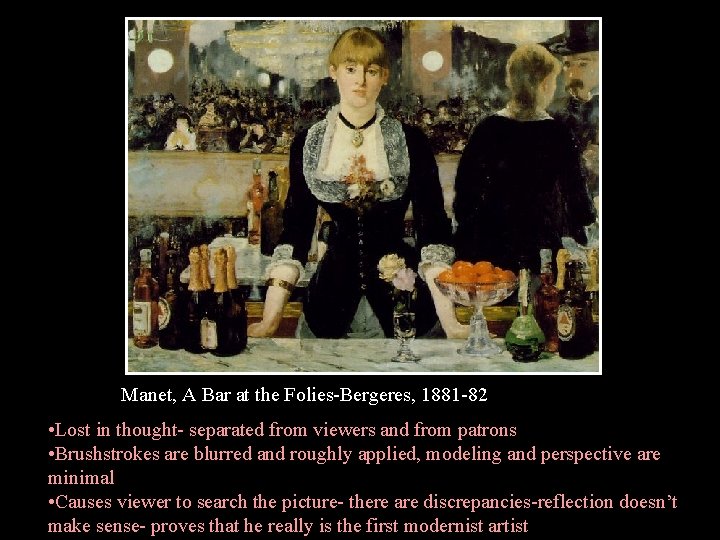
Manet, A Bar at the Folies-Bergeres, 1881 -82 • Lost in thought- separated from viewers and from patrons • Brushstrokes are blurred and roughly applied, modeling and perspective are minimal • Causes viewer to search the picture- there are discrepancies-reflection doesn’t make sense- proves that he really is the first modernist artist
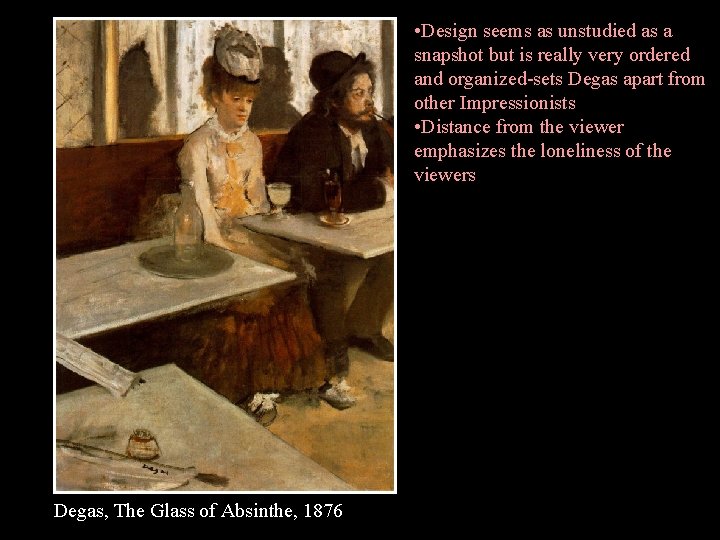
• Design seems as unstudied as a snapshot but is really very ordered and organized-sets Degas apart from other Impressionists • Distance from the viewer emphasizes the loneliness of the viewers Degas, The Glass of Absinthe, 1876
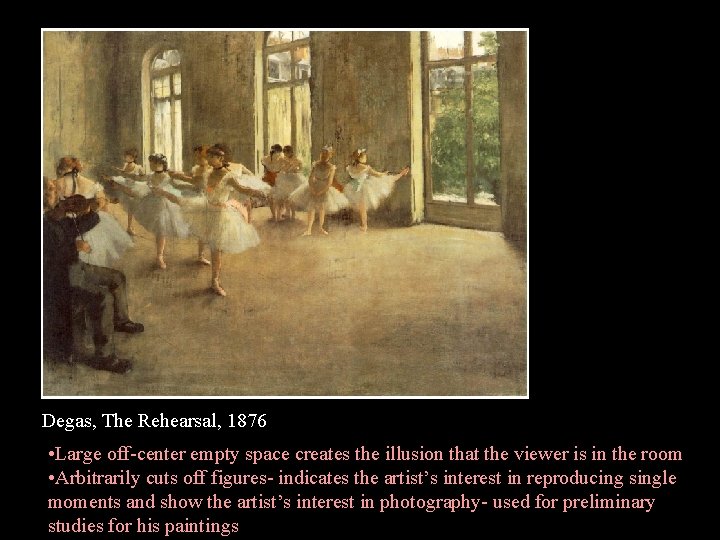
Degas, The Rehearsal, 1876 • Large off-center empty space creates the illusion that the viewer is in the room • Arbitrarily cuts off figures- indicates the artist’s interest in reproducing single moments and show the artist’s interest in photography- used for preliminary studies for his paintings
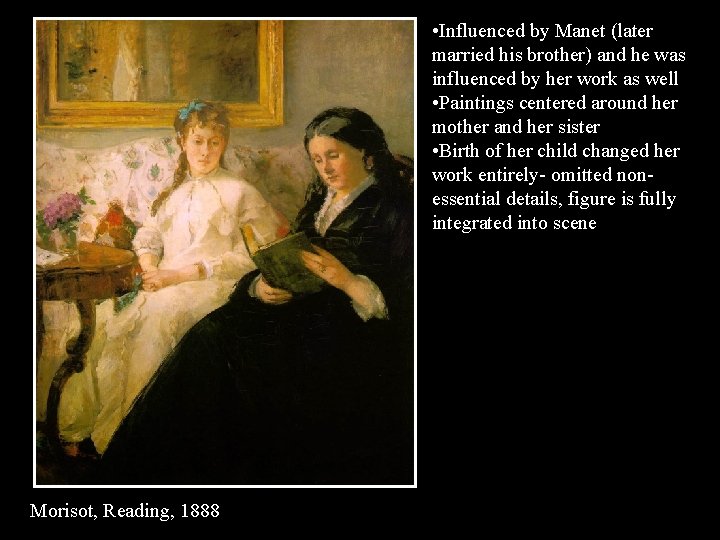
• Influenced by Manet (later married his brother) and he was influenced by her work as well • Paintings centered around her mother and her sister • Birth of her child changed her work entirely- omitted nonessential details, figure is fully integrated into scene Morisot, Reading, 1888
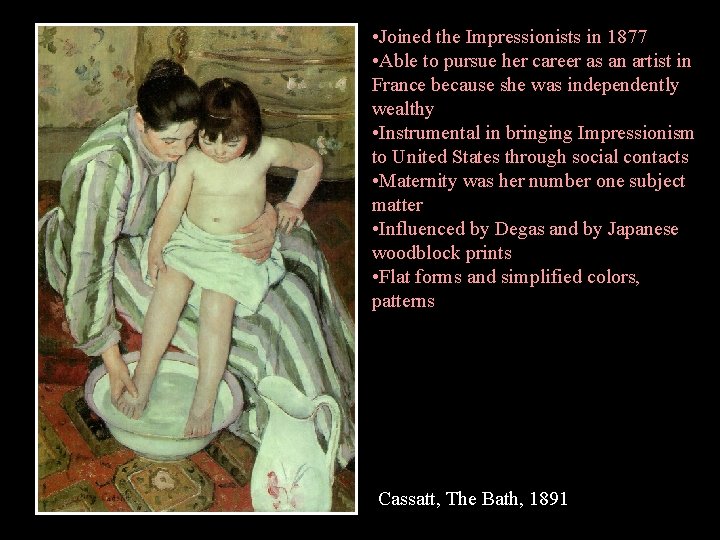
• Joined the Impressionists in 1877 • Able to pursue her career as an artist in France because she was independently wealthy • Instrumental in bringing Impressionism to United States through social contacts • Maternity was her number one subject matter • Influenced by Degas and by Japanese woodblock prints • Flat forms and simplified colors, patterns Cassatt, The Bath, 1891
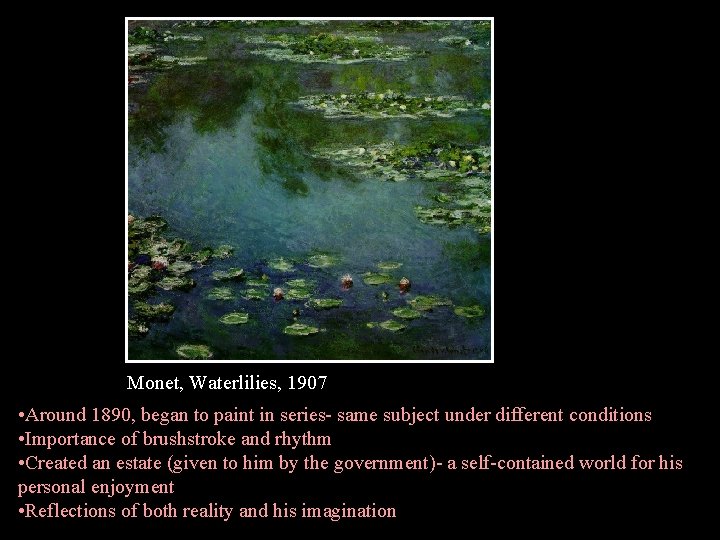
Monet, Waterlilies, 1907 • Around 1890, began to paint in series- same subject under different conditions • Importance of brushstroke and rhythm • Created an estate (given to him by the government)- a self-contained world for his personal enjoyment • Reflections of both reality and his imagination
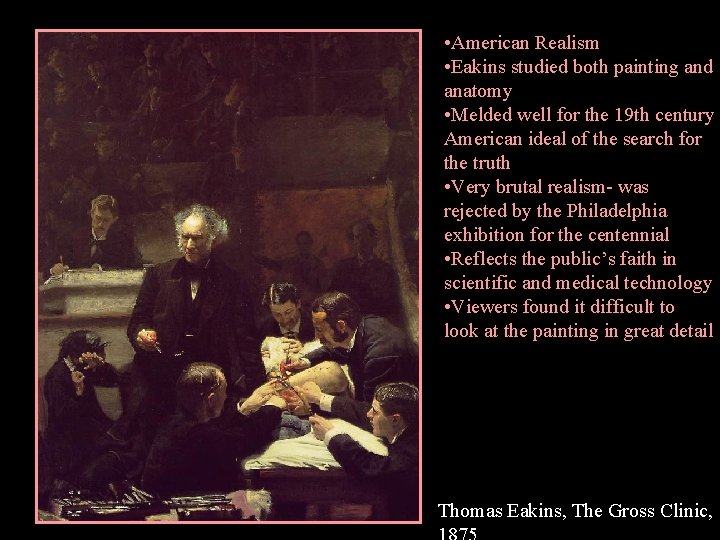
• American Realism • Eakins studied both painting and anatomy • Melded well for the 19 th century American ideal of the search for the truth • Very brutal realism- was rejected by the Philadelphia exhibition for the centennial • Reflects the public’s faith in scientific and medical technology • Viewers found it difficult to look at the painting in great detail Thomas Eakins, The Gross Clinic,
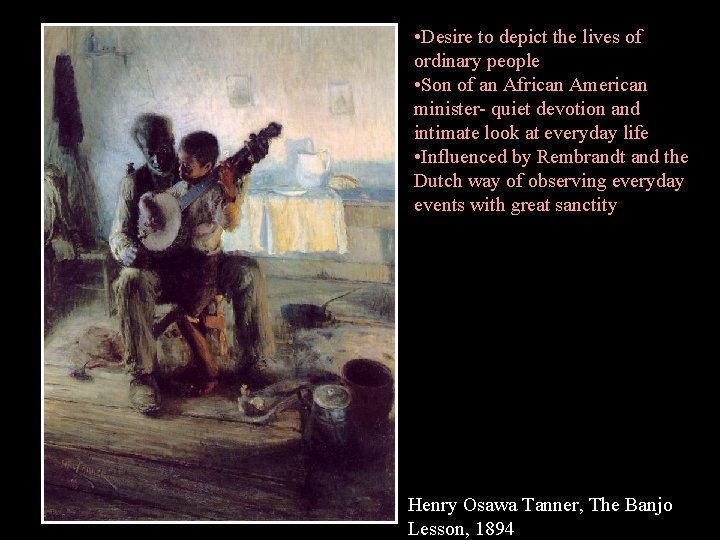
• Desire to depict the lives of ordinary people • Son of an African American minister- quiet devotion and intimate look at everyday life • Influenced by Rembrandt and the Dutch way of observing everyday events with great sanctity Henry Osawa Tanner, The Banjo Lesson, 1894
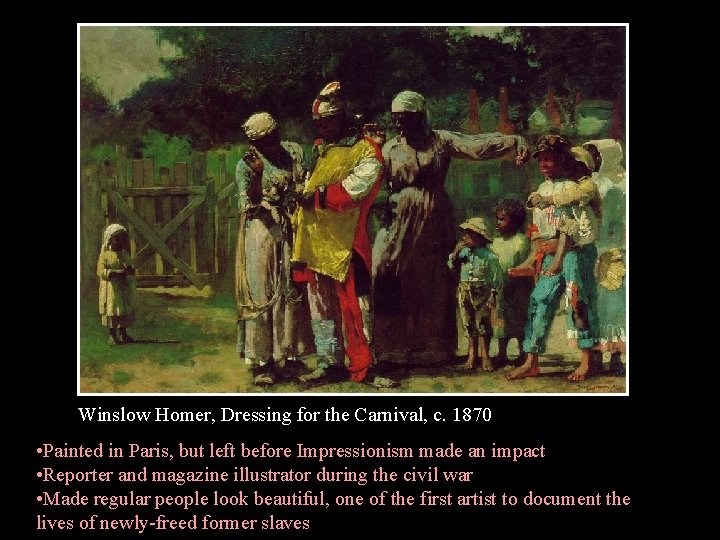
Winslow Homer, Dressing for the Carnival, c. 1870 • Painted in Paris, but left before Impressionism made an impact • Reporter and magazine illustrator during the civil war • Made regular people look beautiful, one of the first artist to document the lives of newly-freed former slaves
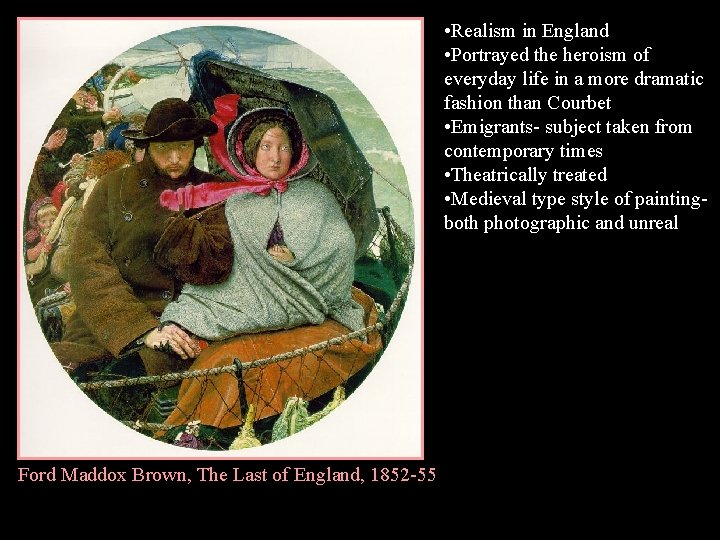
• Realism in England • Portrayed the heroism of everyday life in a more dramatic fashion than Courbet • Emigrants- subject taken from contemporary times • Theatrically treated • Medieval type style of paintingboth photographic and unreal Ford Maddox Brown, The Last of England, 1852 -55
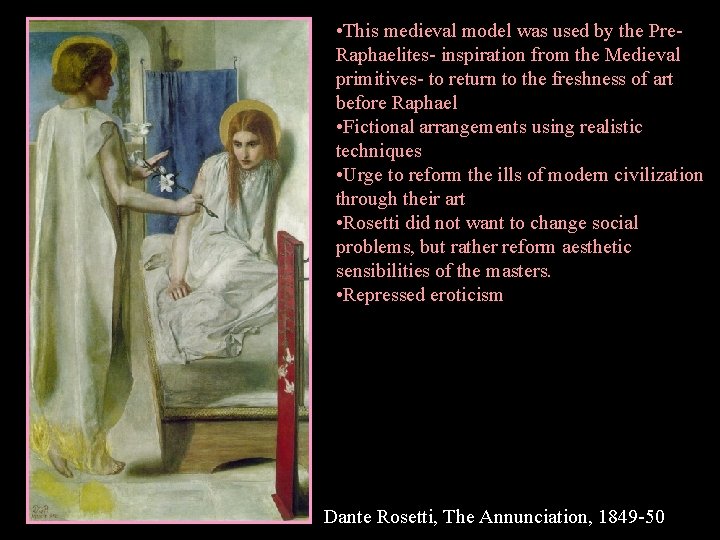
• This medieval model was used by the Pre. Raphaelites- inspiration from the Medieval primitives- to return to the freshness of art before Raphael • Fictional arrangements using realistic techniques • Urge to reform the ills of modern civilization through their art • Rosetti did not want to change social problems, but rather reform aesthetic sensibilities of the masters. • Repressed eroticism Dante Rosetti, The Annunciation, 1849 -50
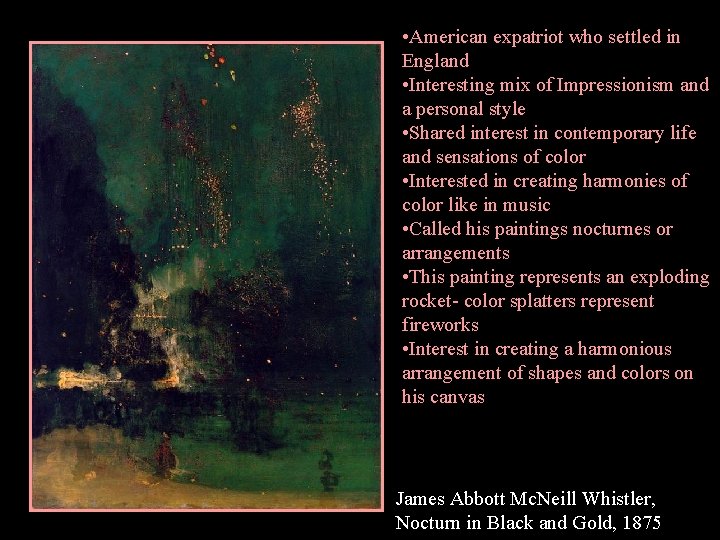
• American expatriot who settled in England • Interesting mix of Impressionism and a personal style • Shared interest in contemporary life and sensations of color • Interested in creating harmonies of color like in music • Called his paintings nocturnes or arrangements • This painting represents an exploding rocket- color splatters represent fireworks • Interest in creating a harmonious arrangement of shapes and colors on his canvas James Abbott Mc. Neill Whistler, Nocturn in Black and Gold, 1875
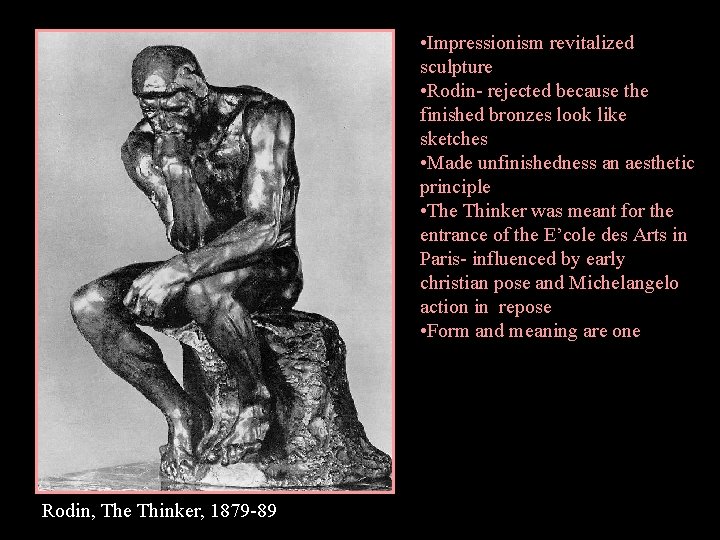
• Impressionism revitalized sculpture • Rodin- rejected because the finished bronzes look like sketches • Made unfinishedness an aesthetic principle • The Thinker was meant for the entrance of the E’cole des Arts in Paris- influenced by early christian pose and Michelangelo action in repose • Form and meaning are one Rodin, The Thinker, 1879 -89
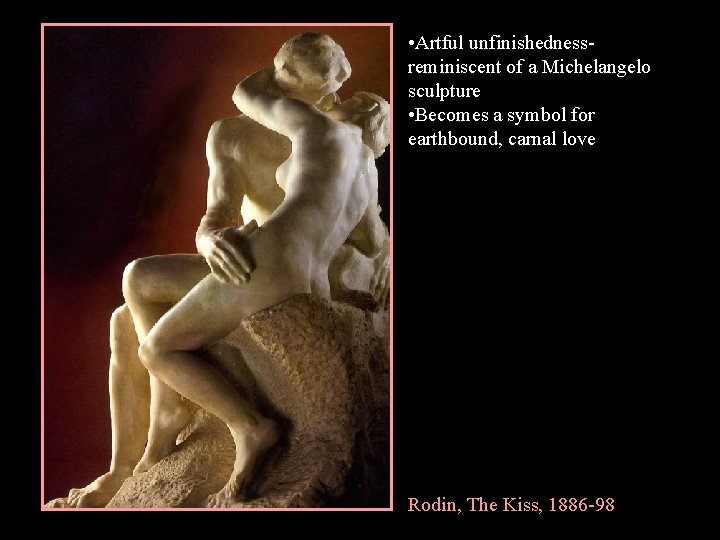
• Artful unfinishednessreminiscent of a Michelangelo sculpture • Becomes a symbol for earthbound, carnal love Rodin, The Kiss, 1886 -98
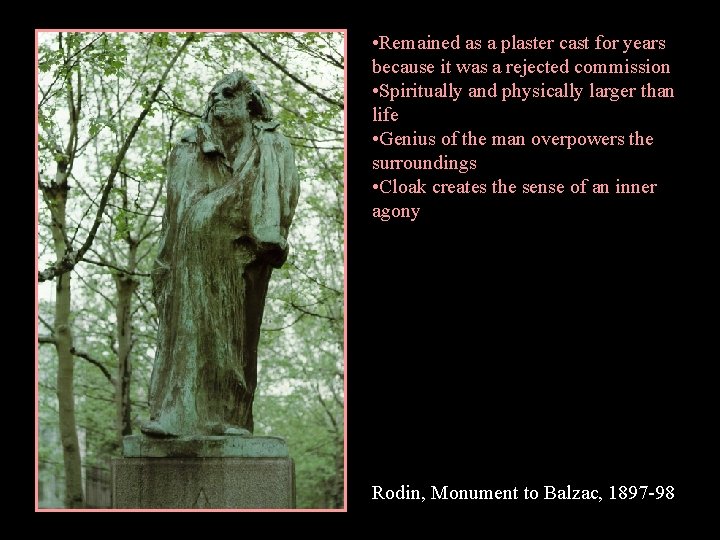
• Remained as a plaster cast for years because it was a rejected commission • Spiritually and physically larger than life • Genius of the man overpowers the surroundings • Cloak creates the sense of an inner agony Rodin, Monument to Balzac, 1897 -98
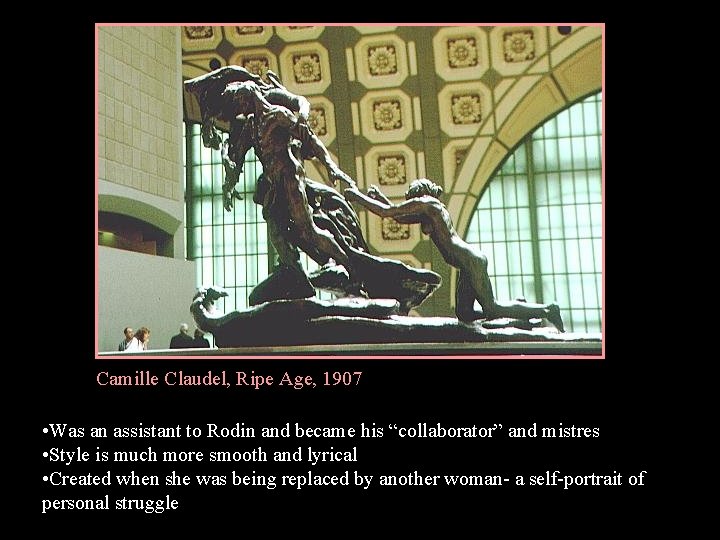
Camille Claudel, Ripe Age, 1907 • Was an assistant to Rodin and became his “collaborator” and mistres • Style is much more smooth and lyrical • Created when she was being replaced by another woman- a self-portrait of personal struggle
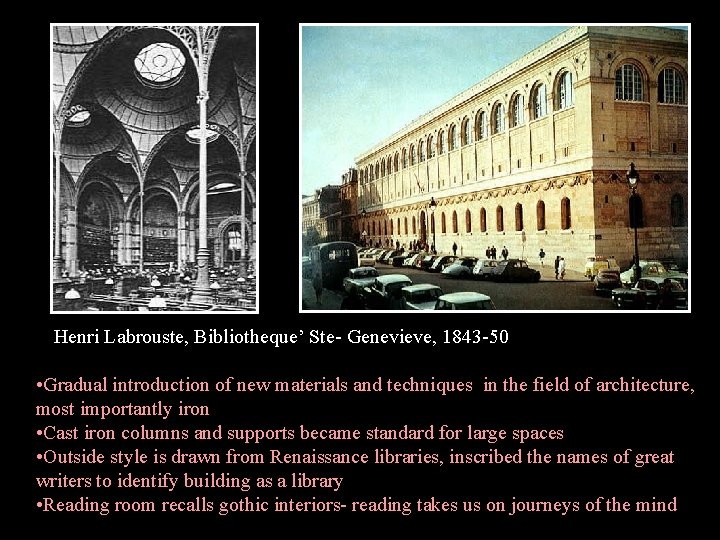
Henri Labrouste, Bibliotheque’ Ste- Genevieve, 1843 -50 • Gradual introduction of new materials and techniques in the field of architecture, most importantly iron • Cast iron columns and supports became standard for large spaces • Outside style is drawn from Renaissance libraries, inscribed the names of great writers to identify building as a library • Reading room recalls gothic interiors- reading takes us on journeys of the mind