
Real world geography real world learning One of

- Slides: 12
Real world geography, real world learning • One of the challenges and a power of geography is that it is about the world, yet the real world is changing, as is our understanding of it, so our curriculum should not be a reproduction of what we were taught 10, 20 or 30 years ago. Arthur Kelly, PG Number 61, Autumn 2006, pp 8 -9
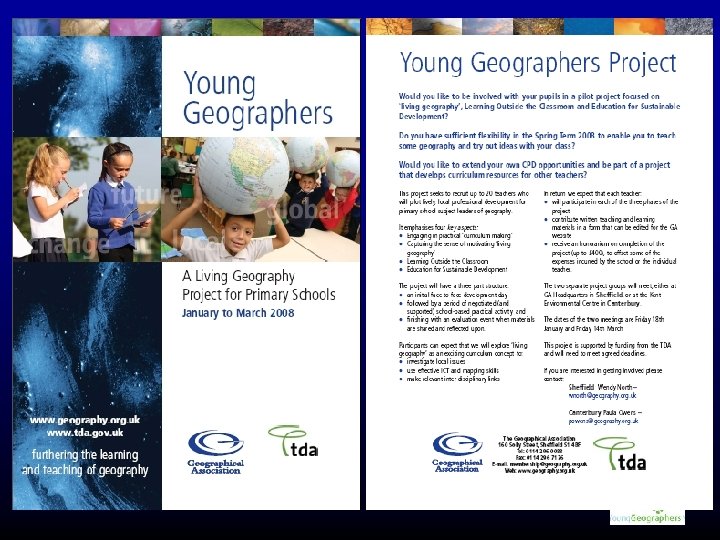
The Young Geographers Project emphasises four key aspects: • Practical `curriculum making’ • Capturing the sense of motivating 'living geography' • Learning Outside the Classroom • Education for Sustainable Development
Living Geography • 'Living Geography' is geography which is alive and relevant. It supports and encourages curiosity about the wider world through an enquiry approach and develops pupils' ability to give creative and critical responses to everyday issues. In this way, it is bound up with education for sustainable development (ESD) and has a strong fieldwork component to underpin active engagement.
Living Geography • Geography that is made to come alive for children • It builds on an understanding of children’s `everyday geographies’ and helps to enhance geographical imagination and thinking • Concerned with their lives, their futures, their world • Often starts with local but is set in the context of the global (community) • Concerned with how their world is changing and whether this will lead to a more sustainable future for ALL
Living geography - starts with me in my community Identity: • Who am I? • Where do I come from? • Who is my family? • What is my ‘story’? • Who are the people around me? • Where do they come from? What is their ‘story’?
… and how our identity is shaped by the geography that is all around us My place in the world: • Where do I live? • How does it look? • How do I feel about it? http: //www. quikmaps. com/full/47961 Y 5 Methodist J & I, Wakefield
… places that we respond to through feelings • our emotional response J • Possibly the STRONGEST component of our Geographical Imagination
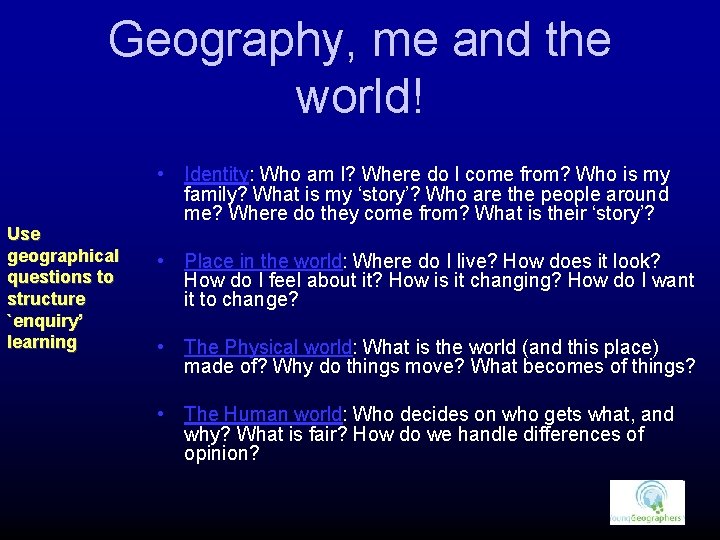
Geography, me and the world! Use geographical questions to structure `enquiry’ learning • Identity: Who am I? Where do I come from? Who is my family? What is my ‘story’? Who are the people around me? Where do they come from? What is their ‘story’? • Place in the world: Where do I live? How does it look? How do I feel about it? How is it changing? How do I want it to change? • The Physical world: What is the world (and this place) made of? Why do things move? What becomes of things? • The Human world: Who decides on who gets what, and why? What is fair? How do we handle differences of opinion?
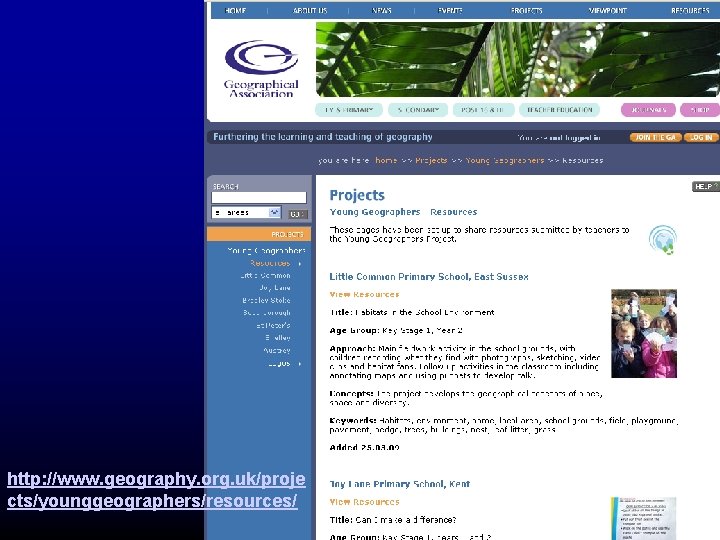
http: //www. geography. org. uk/proje cts/younggeographers/resources/