
Real vs Nominal GDP GDP is the value
- Slides: 15
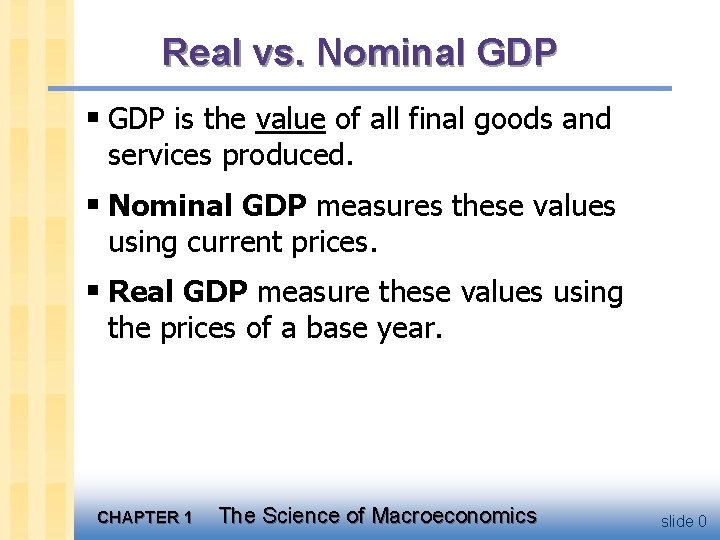
Real vs. Nominal GDP § GDP is the value of all final goods and services produced. § Nominal GDP measures these values using current prices. § Real GDP measure these values using the prices of a base year. CHAPTER 1 The Science of Macroeconomics slide 0
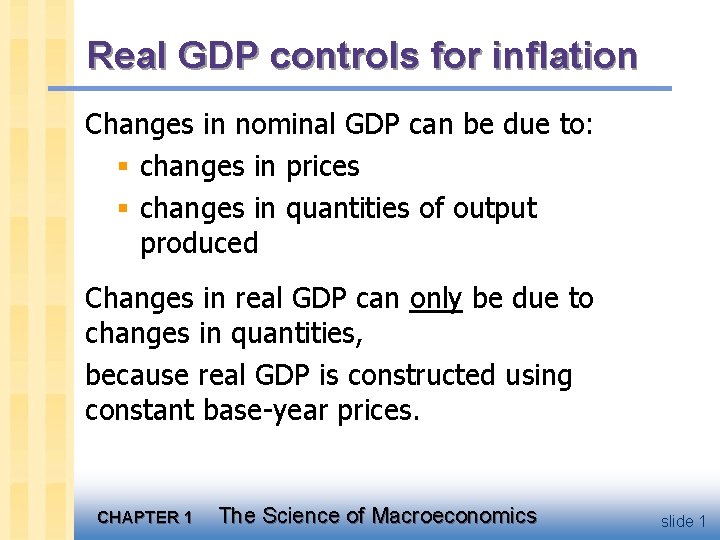
Real GDP controls for inflation Changes in nominal GDP can be due to: § changes in prices § changes in quantities of output produced Changes in real GDP can only be due to changes in quantities, because real GDP is constructed using constant base-year prices. CHAPTER 1 The Science of Macroeconomics slide 1
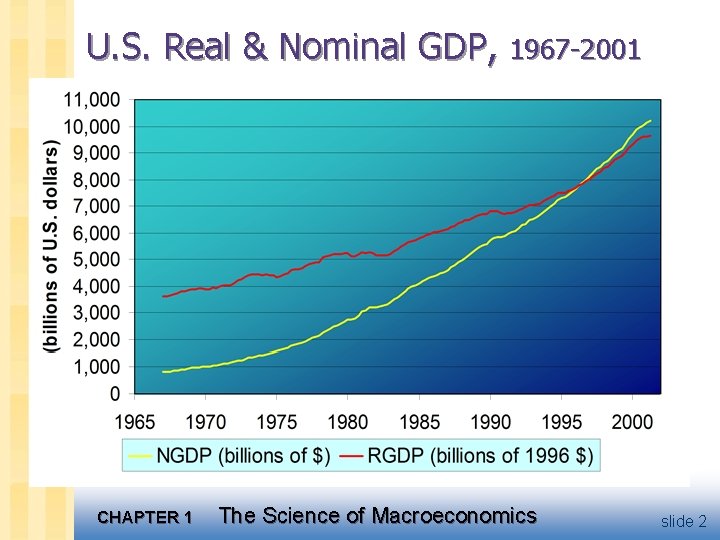
U. S. Real & Nominal GDP, 1967 -2001 CHAPTER 1 The Science of Macroeconomics slide 2
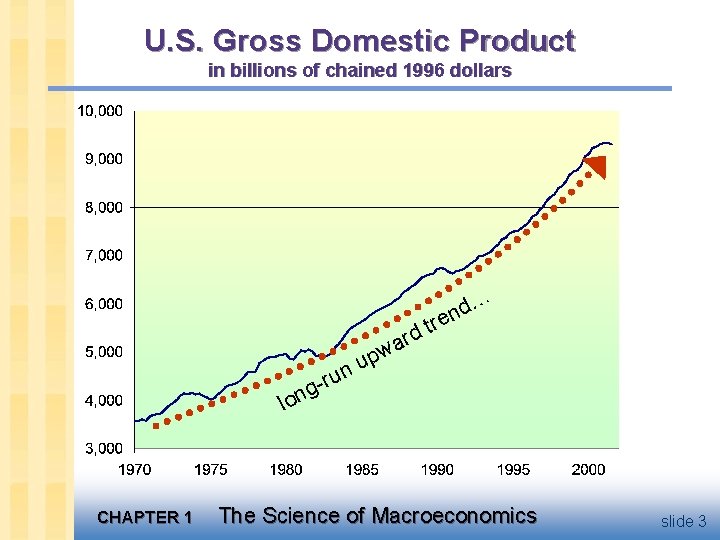
U. S. Gross Domestic Product in billions of chained 1996 dollars … d n e r t d r a w p nu u g-r n lo CHAPTER 1 The Science of Macroeconomics slide 3
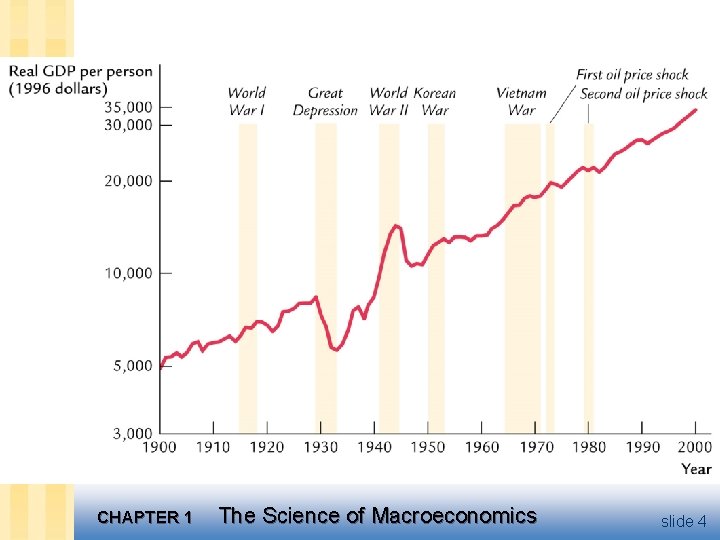
CHAPTER 1 The Science of Macroeconomics slide 4
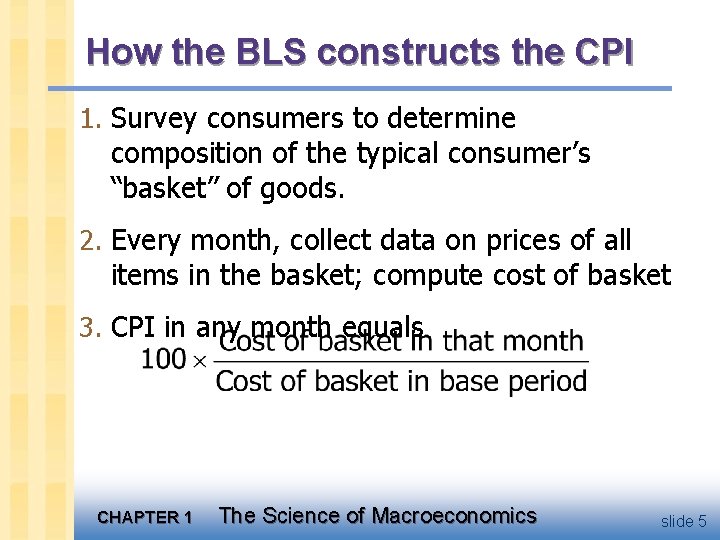
How the BLS constructs the CPI 1. Survey consumers to determine composition of the typical consumer’s “basket” of goods. 2. Every month, collect data on prices of all items in the basket; compute cost of basket 3. CPI in any month equals CHAPTER 1 The Science of Macroeconomics slide 5
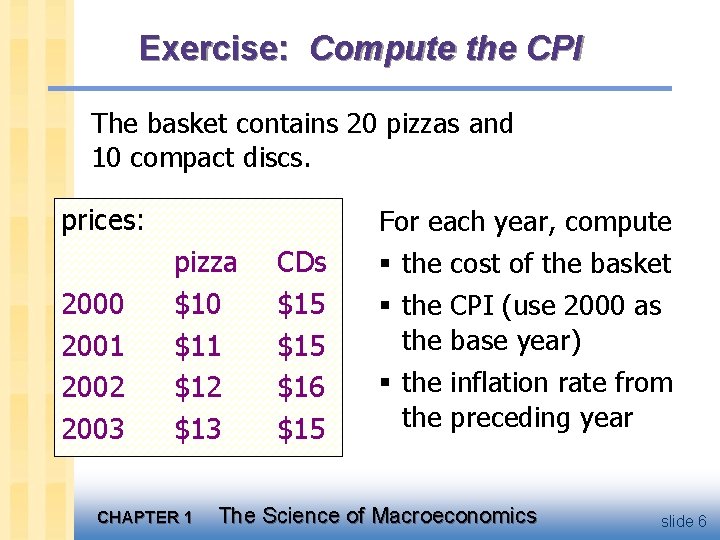
Exercise: Compute the CPI The basket contains 20 pizzas and 10 compact discs. prices: 2000 2001 2002 2003 pizza $10 $11 $12 $13 CHAPTER 1 CDs $15 $16 $15 For each year, compute § the cost of the basket § the CPI (use 2000 as the base year) § the inflation rate from the preceding year The Science of Macroeconomics slide 6
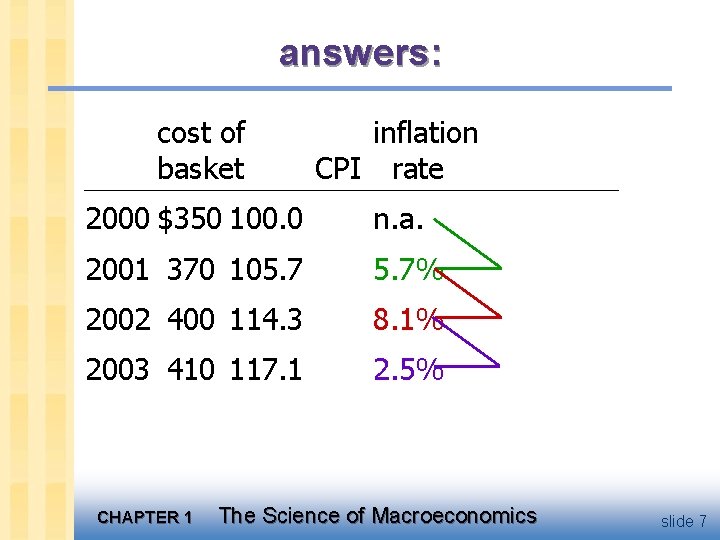
answers: cost of basket inflation CPI rate 2000 $350 100. 0 n. a. 2001 370 105. 7% 2002 400 114. 3 8. 1% 2003 410 117. 1 2. 5% CHAPTER 1 The Science of Macroeconomics slide 7
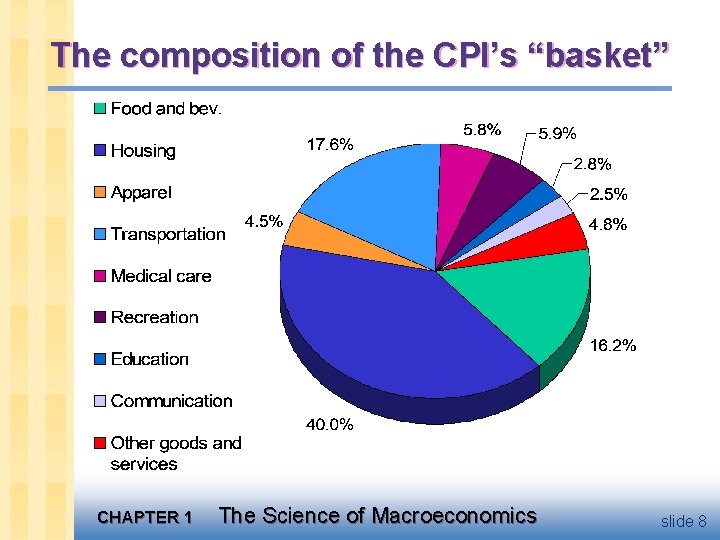
The composition of the CPI’s “basket” CHAPTER 1 The Science of Macroeconomics slide 8
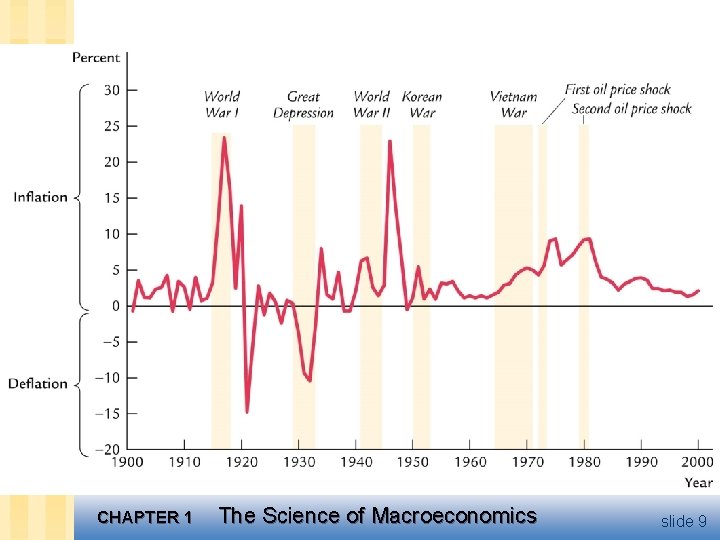
CHAPTER 1 The Science of Macroeconomics slide 9
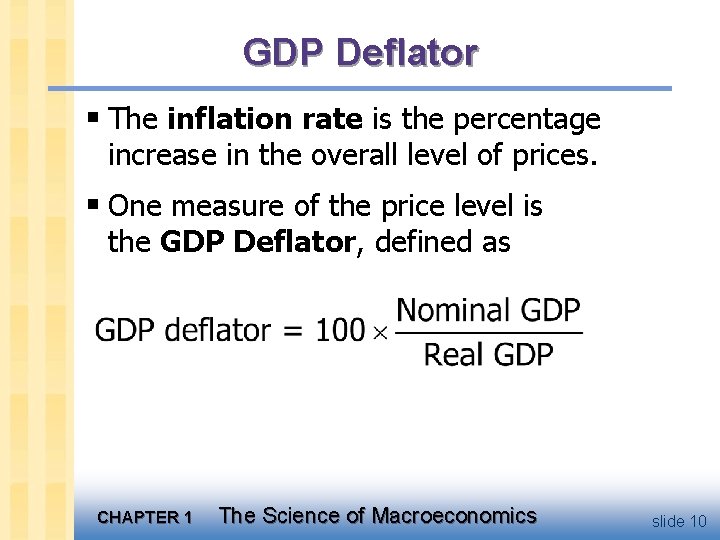
GDP Deflator § The inflation rate is the percentage increase in the overall level of prices. § One measure of the price level is the GDP Deflator, defined as CHAPTER 1 The Science of Macroeconomics slide 10
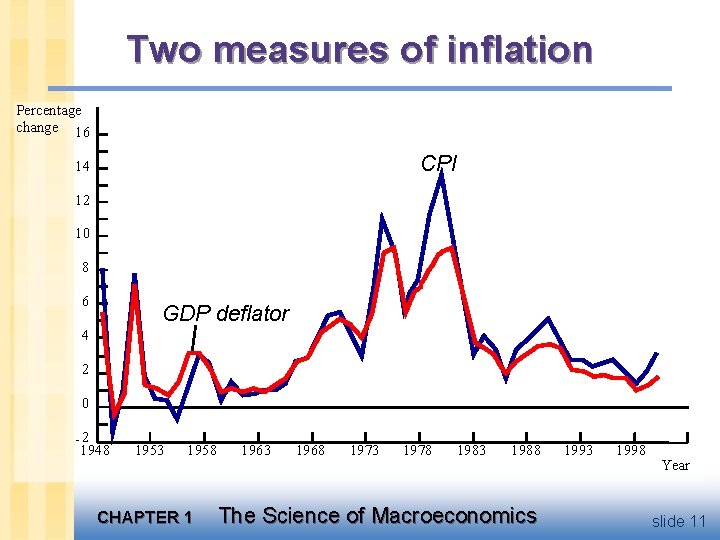
Two measures of inflation Percentage change 16 CPI 14 12 10 8 6 GDP deflator 4 2 0 -2 1948 1953 1958 CHAPTER 1 1963 1968 1973 1978 1983 1988 The Science of Macroeconomics 1993 1998 Year slide 11
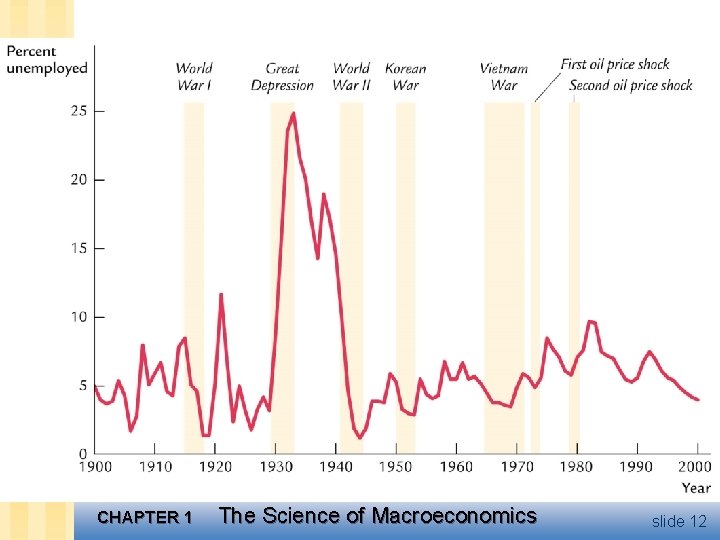
CHAPTER 1 The Science of Macroeconomics slide 12
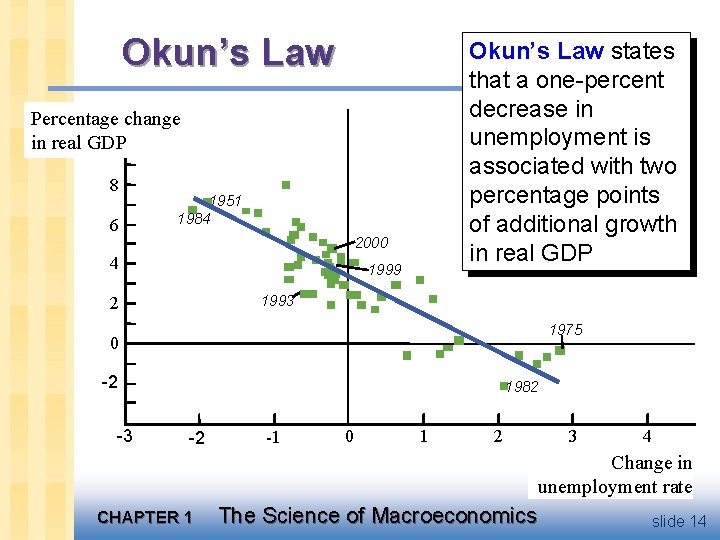
Okun’s Law § Employed workers help produce GDP, while unemployed workers do not. So one would expect a negative relationship between unemployment and real GDP. § This relationship is clear in the data… CHAPTER 1 The Science of Macroeconomics slide 13
Okun’s Law states that a one-percent decrease in unemployment is associated with two percentage points of additional growth in real GDP Percentage change 10 in real GDP 8 6 1951 1984 2000 4 1999 1993 2 1975 0 -2 -3 1982 -2 -1 0 1 2 3 4 Change in unemployment rate CHAPTER 1 The Science of Macroeconomics slide 14