
Real space RG and the emergence of topological






- Slides: 70
Real space RG and the emergence of topological order Michael Levin Harvard University Cody Nave MIT
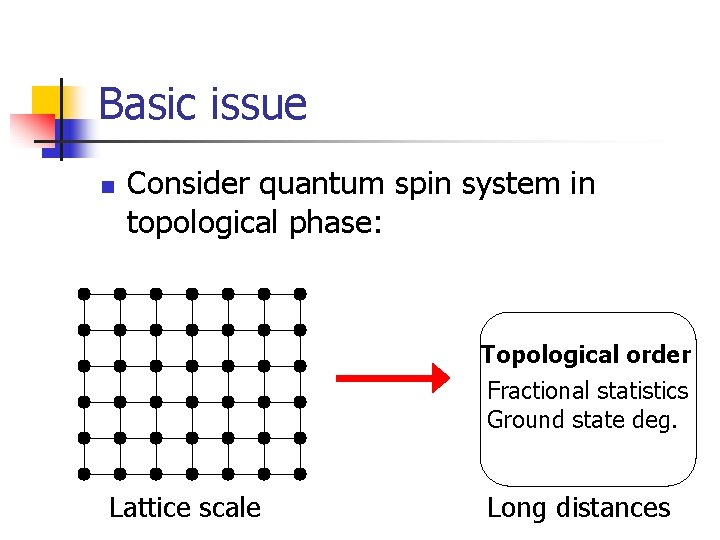
Basic issue n Consider quantum spin system in topological phase: Topological order Fractional statistics Ground state deg. Lattice scale Long distances
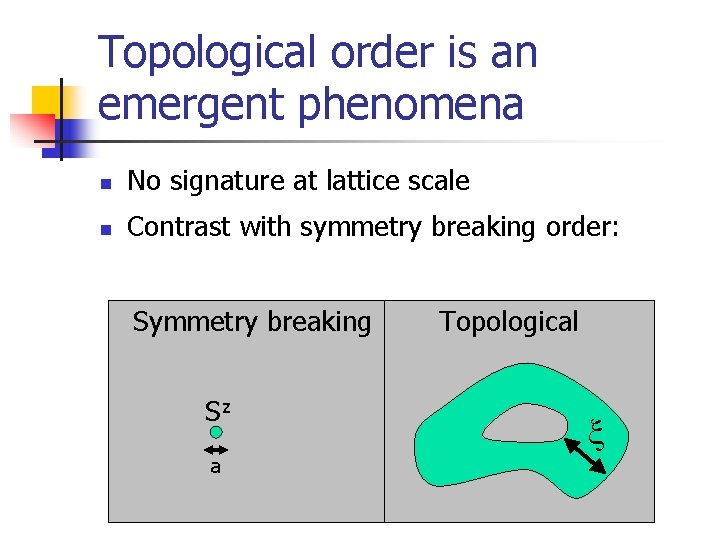
Topological order is an emergent phenomena n No signature at lattice scale n Contrast with symmetry breaking order:
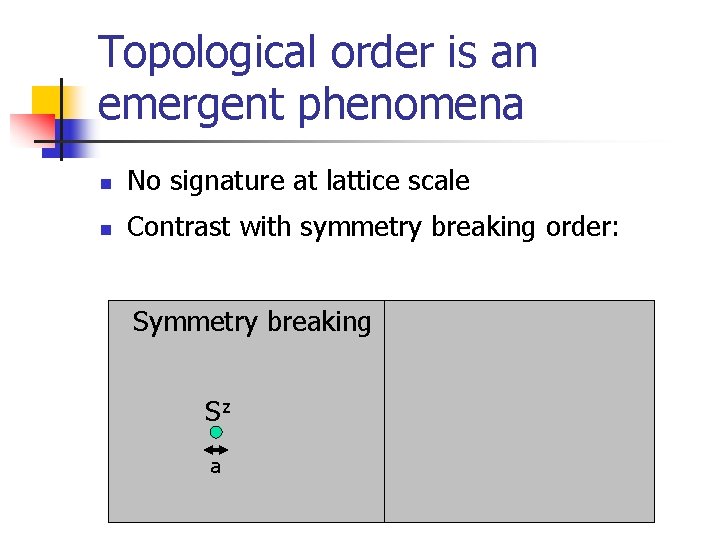
Topological order is an emergent phenomena n No signature at lattice scale n Contrast with symmetry breaking order: Symmetry breaking Sz a Topological
Topological order is an emergent phenomena n No signature at lattice scale n Contrast with symmetry breaking order: Symmetry breaking Sz a Topological
Problem n Hard to probe topological order - e. g. numerical simulations n Even harder to predict topological order - Very limited analytic methods - Only understand exactly soluble string -net (e. g. Turaev-Viro ) models where = a
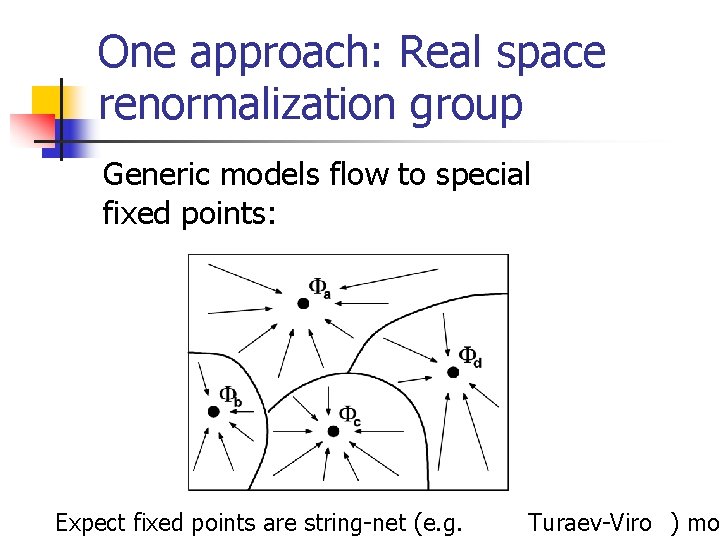
One approach: Real space renormalization group Generic models flow to special fixed points: Expect fixed points are string-net (e. g. Turaev-Viro ) mo
Outline I. RG method for (1+1)D models A. Describe basic method B. Explain physical picture (and relation to DMRG) C. Classify fixed points II. Suggest a generalization to (2+1)D A. Fixed points exactly soluble stringnet models (e. g. Turaev-Viro )
Hamiltonian vs. path integral approach n n Want to do RG on (1+1)D quantum lattice models Could do RG on (H, ) (DMRG) Instead, RG on 2 D “classical” lattice models (e. g. Ising model) with potentially complex weights n
Tensor network models n n Very general class of lattice models Examples: - Ising model - Potts model - Six vertex model
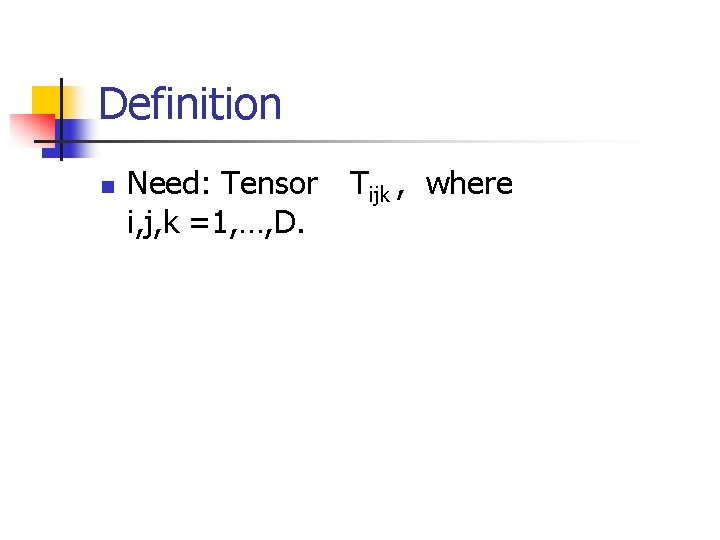
Definition n Need: Tensor Tijk , where i, j, k =1, …, D.
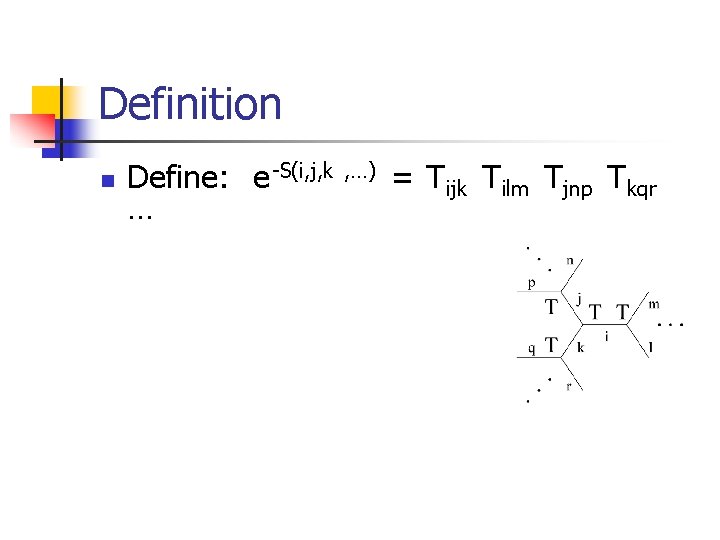
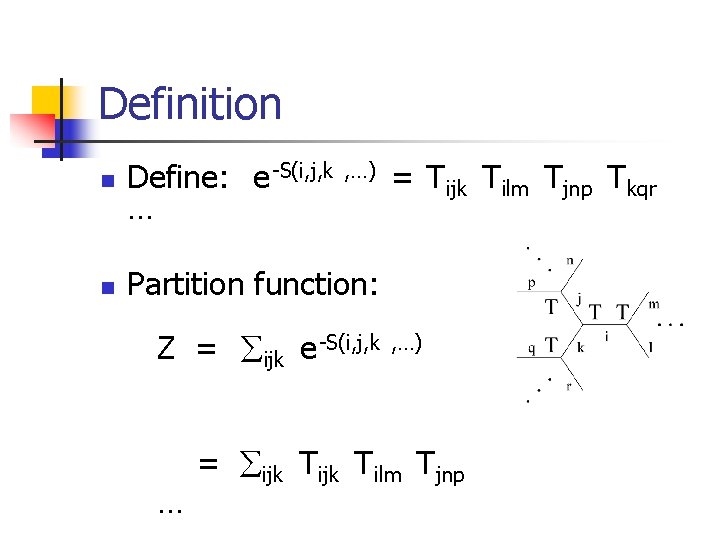
Definition n Define: e -S(i, j, k … , …) = Tijk Tilm Tjnp Tkqr
Definition n Define: e -S(i, j, k … n Partition function: , …) Z = ijk e -S(i, j, k … = Tijk Tilm Tjnp Tkqr , …) = ijk Tilm Tjnp
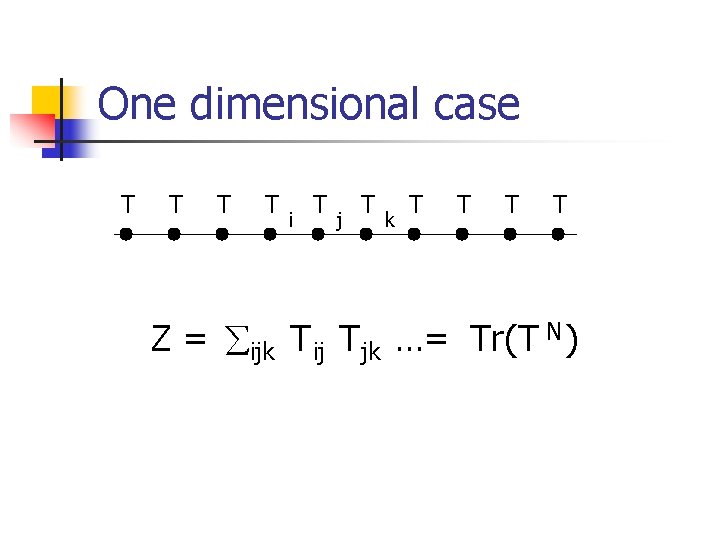
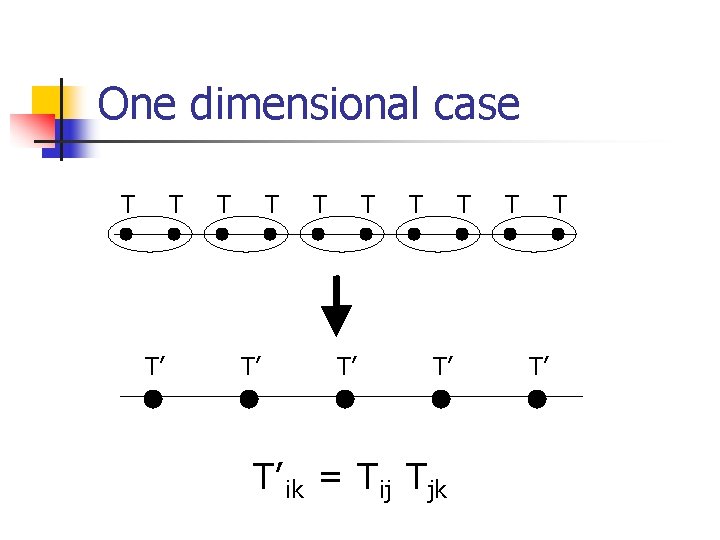
One dimensional case T T i T j T k T T Z = ijk Tij Tjk …= Tr(T N )
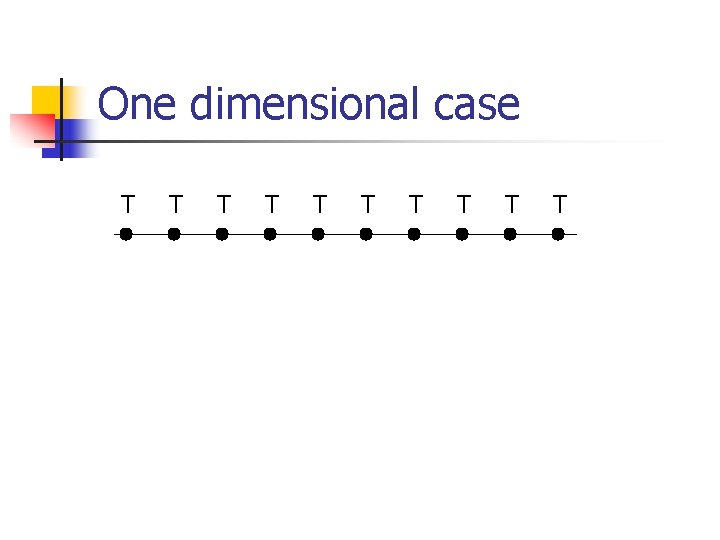
One dimensional case T T T T T
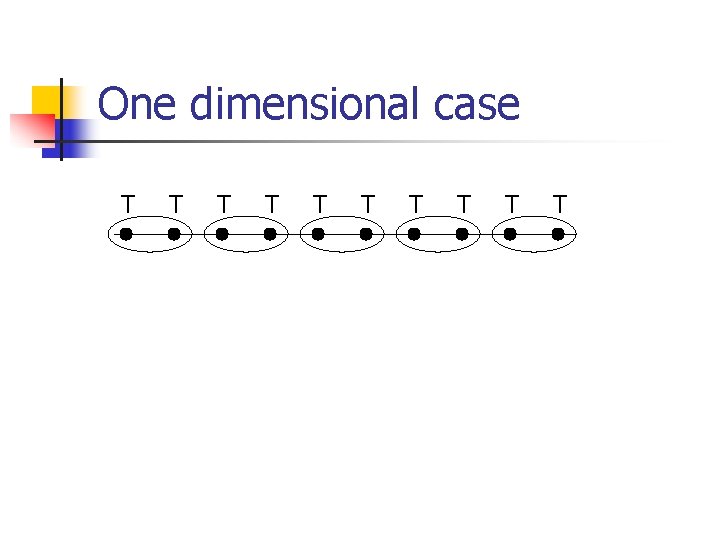
One dimensional case T T T T T
One dimensional case T T T’ T’ ik = Tij Tjk T T T’
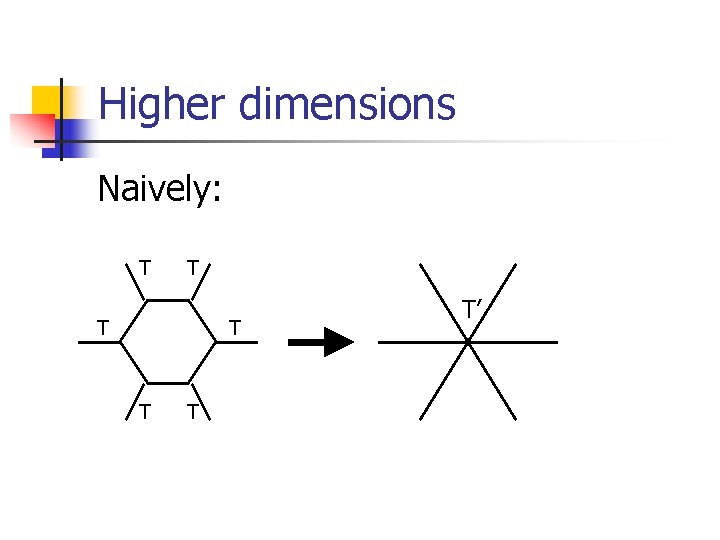
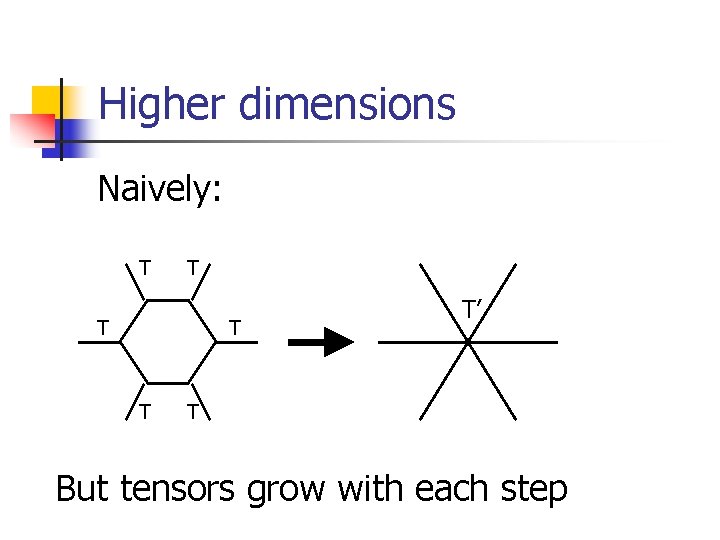
Higher dimensions Naively: T T T T’
Higher dimensions Naively: T T T’ T But tensors grow with each step
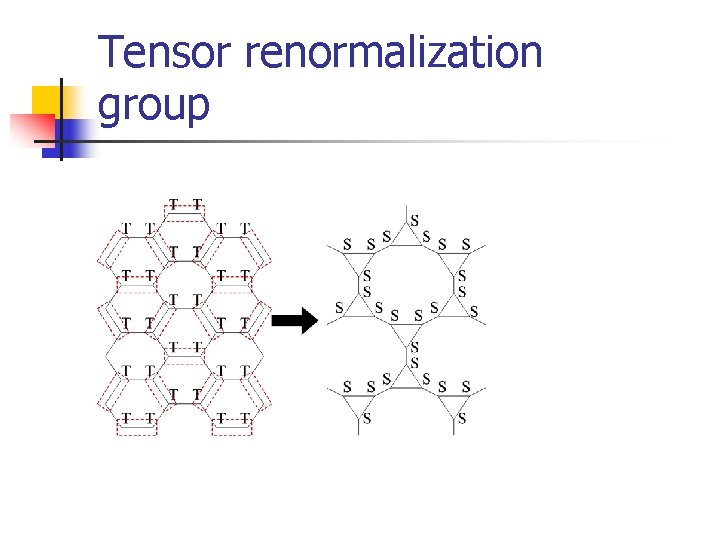
Tensor renormalization group
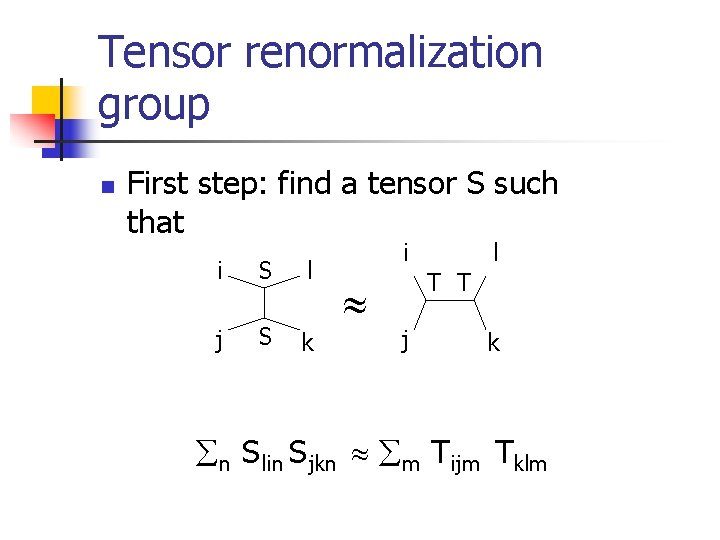
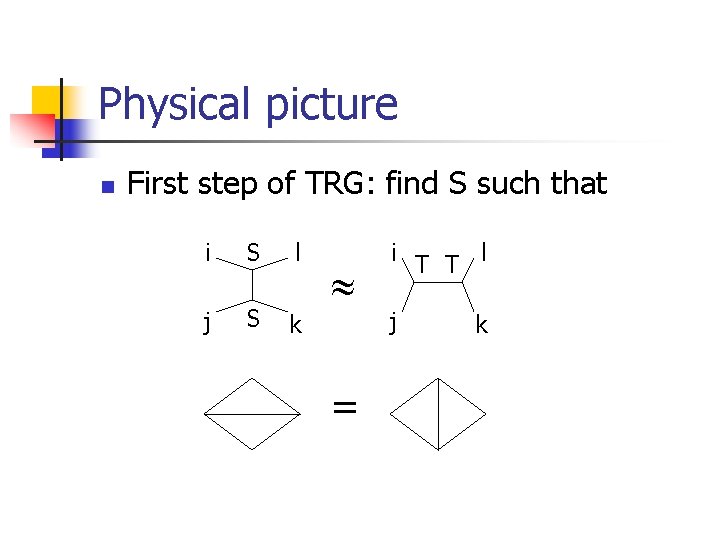
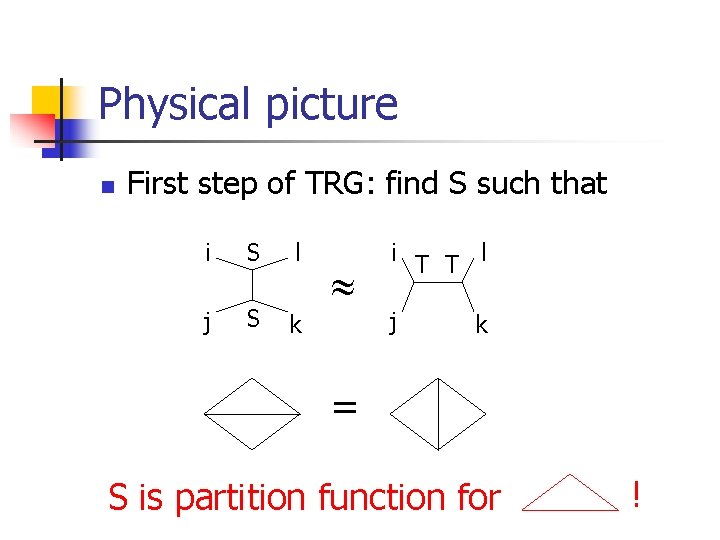
Tensor renormalization group n First step: find a tensor S such that i S l j S k i l T T j k n S lin S jkn m Tijm Tklm
Tensor renormalization group
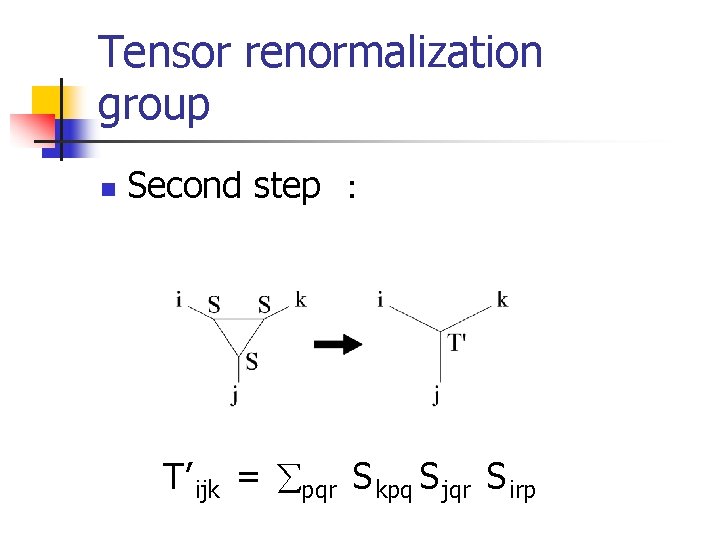
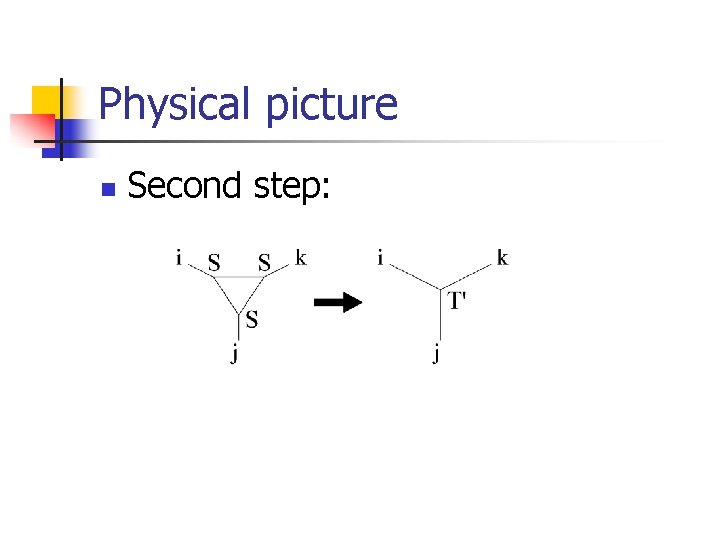
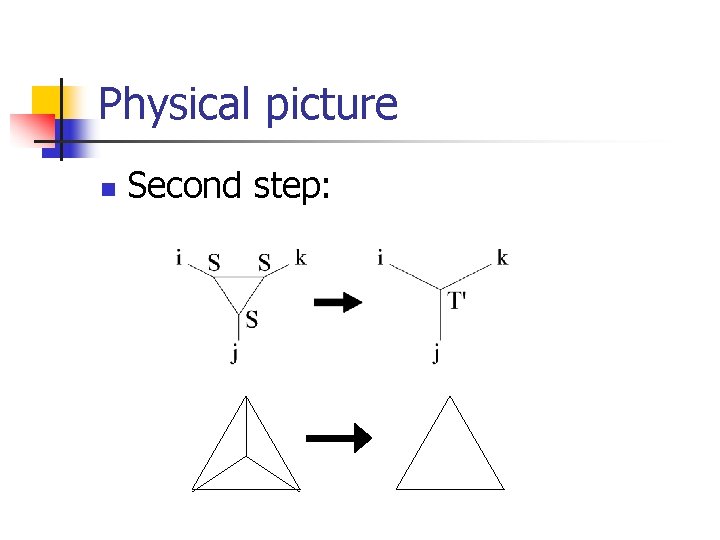
Tensor renormalization group n Second step : T’ ijk = pqr S kpq S jqr S irp
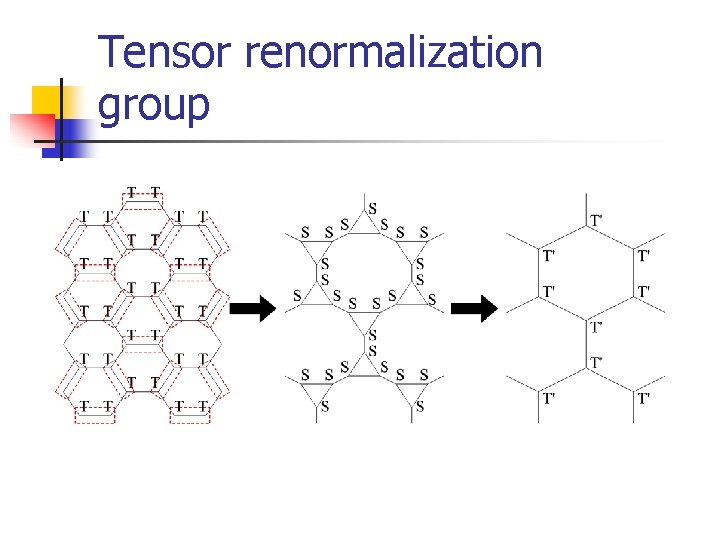
Tensor renormalization group
Tensor renormalization group n n n Iterate: T T’’ … Efficiently compute partition function Z Fixed point T physics * captures universal
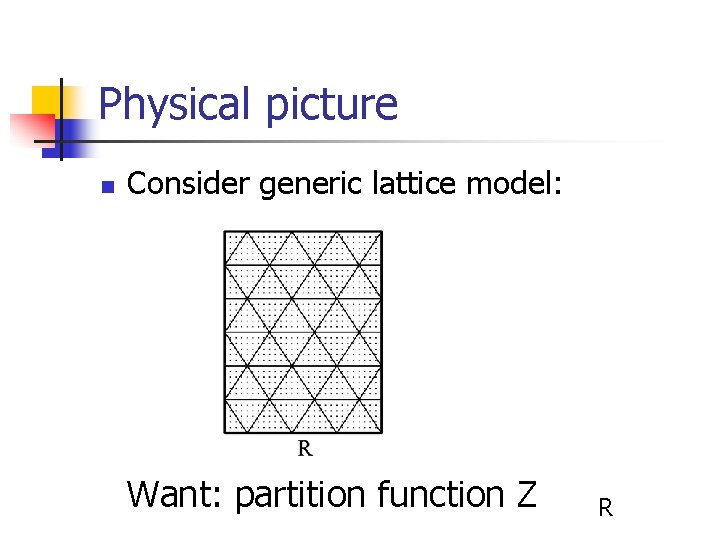
Physical picture n Consider generic lattice model: Want: partition function Z R
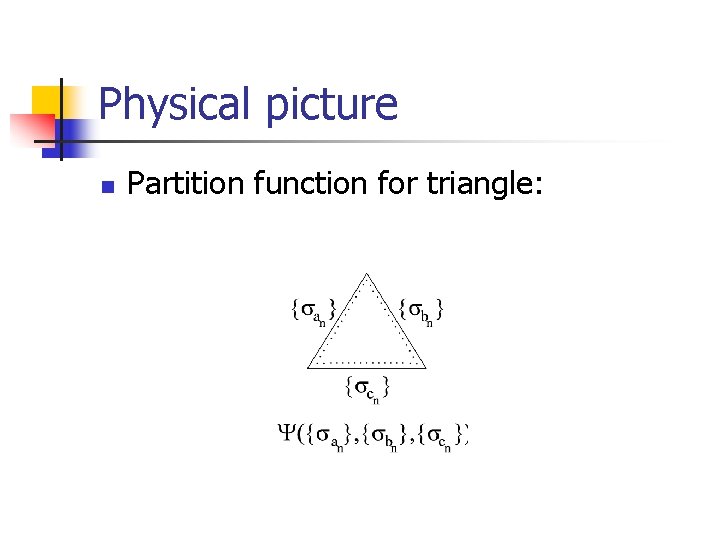
Physical picture n Partition function for triangle:
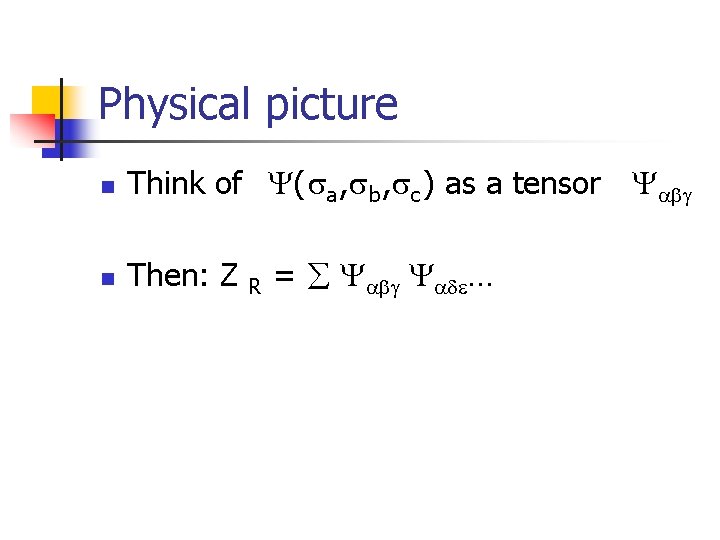
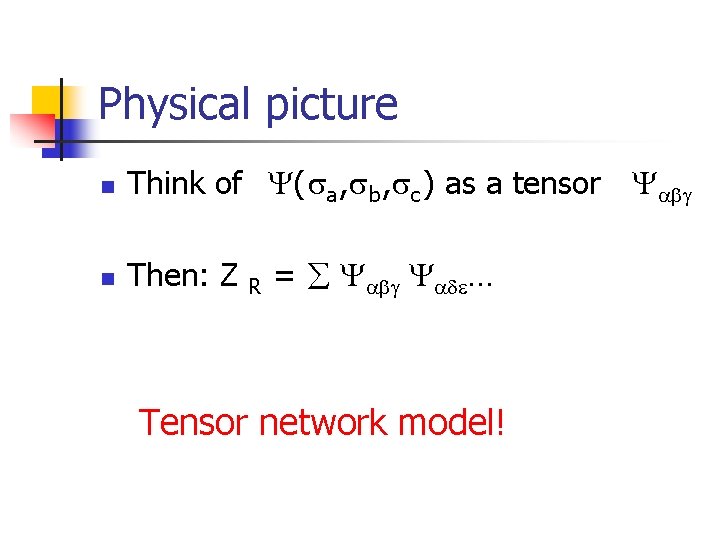
Physical picture n Think of ( a , b , c ) as a tensor n Then: Z R = …
Physical picture n Think of ( a , b , c ) as a tensor n Then: Z R = … Tensor network model!
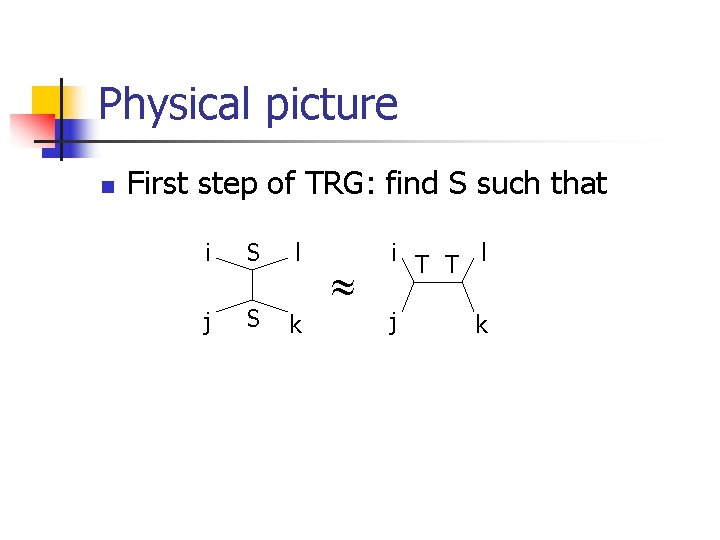
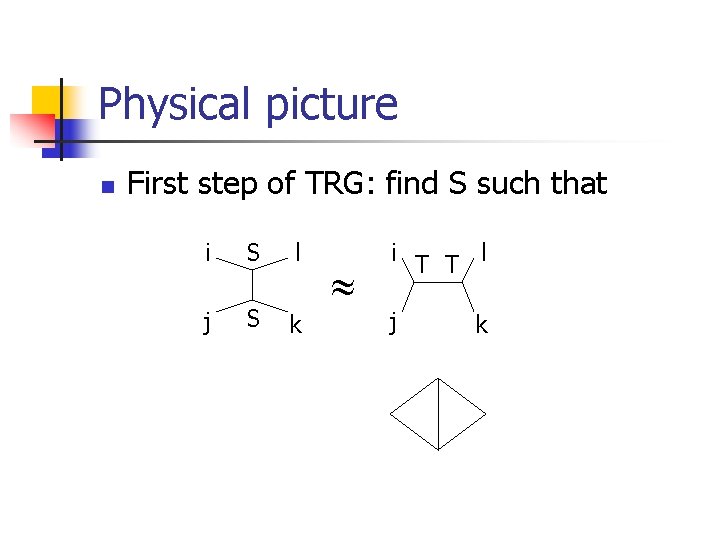
Physical picture n First step of TRG: find S such that i S l j S k i T T l j k
Physical picture n First step of TRG: find S such that i S l j S k i T T l j k
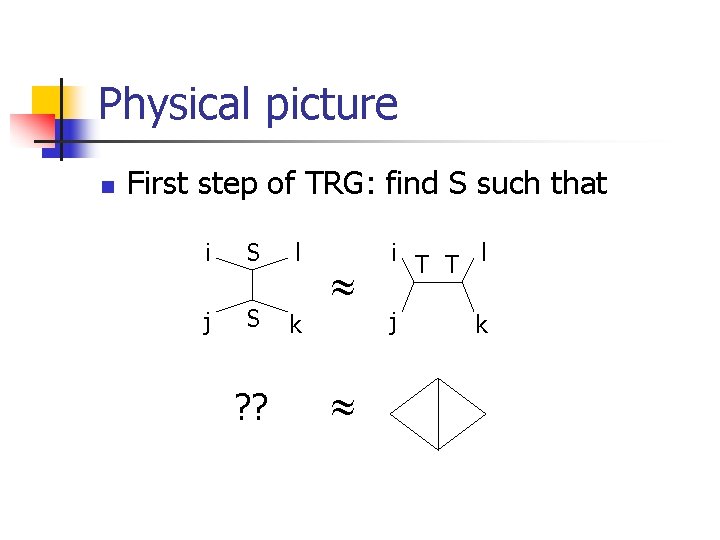
Physical picture n First step of TRG: find S such that i S l j S k ? ? i T T l j k
Physical picture n First step of TRG: find S such that i S l j S k = i T T l j k
Physical picture n First step of TRG: find S such that i S l j S k i T T l j k = S is partition function for !
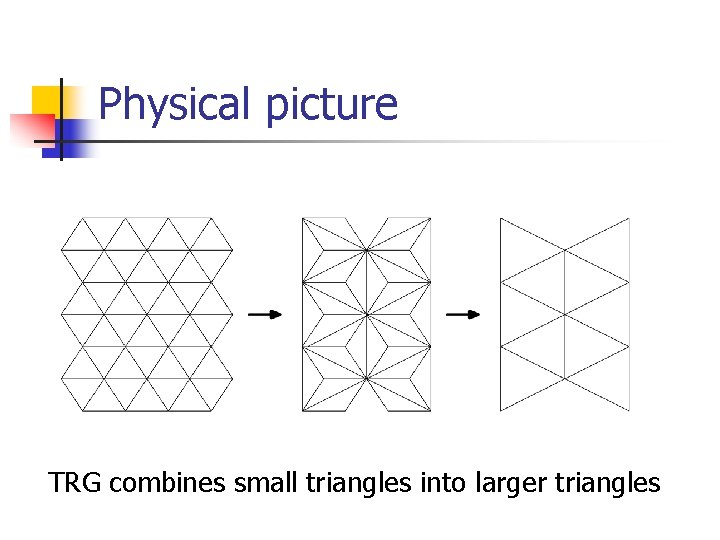
Physical picture n Second step:
Physical picture n Second step:
Physical picture TRG combines small triangles into larger triangles
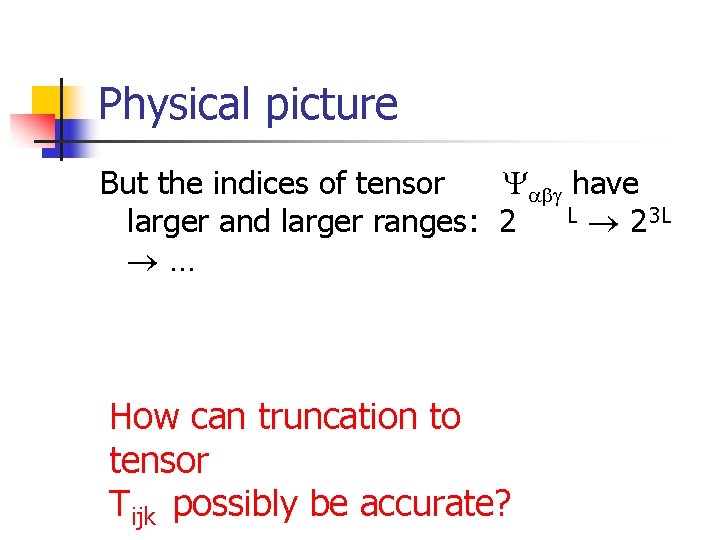
Physical picture But the indices of tensor have L 2 3 L larger and larger ranges: 2 … How can truncation to tensor Tijk possibly be accurate?
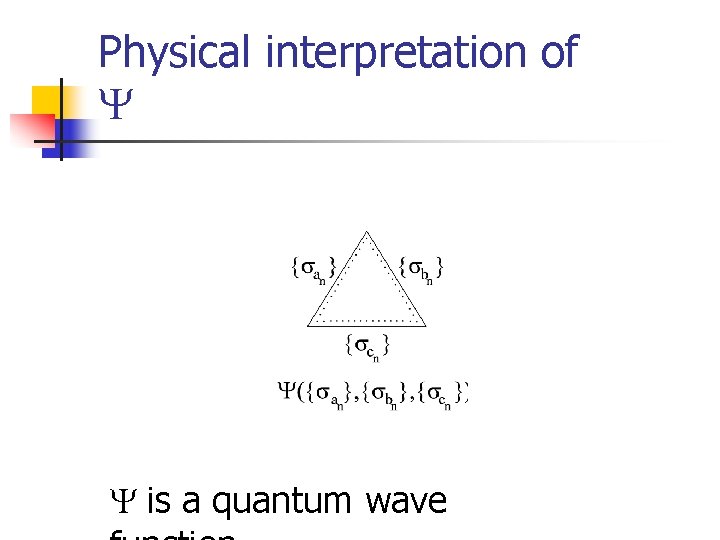
Physical interpretation of is a quantum wave
Non-critical case n System non-critical is a ground state of gapped Hamiltonian is weakly entangled: as L , entanglement entropy S const.
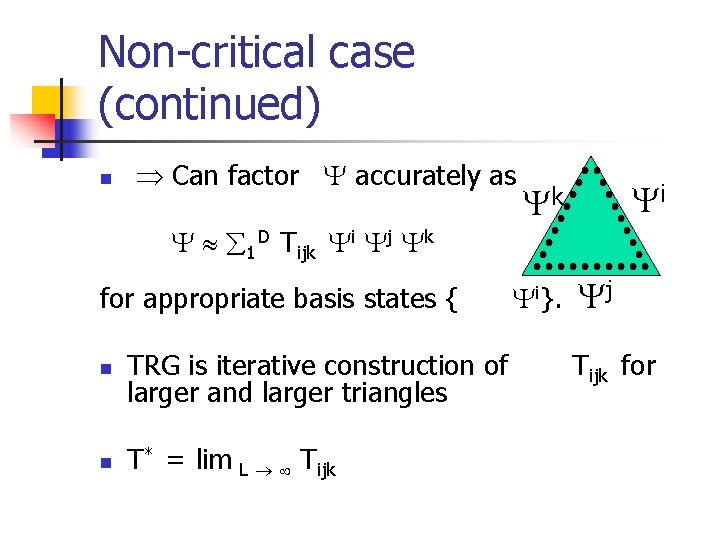
Non-critical case (continued) n Can factor accurately as i k 1 D Tijk i j k for appropriate basis states { n TRG is iterative construction of larger and larger triangles n T* = lim L Tijk i }. j Tijk for
Critical case is a gapless ground state as L , S ~ log L n n Method breaks down at criticality n Analogous to breakdown of DMRG
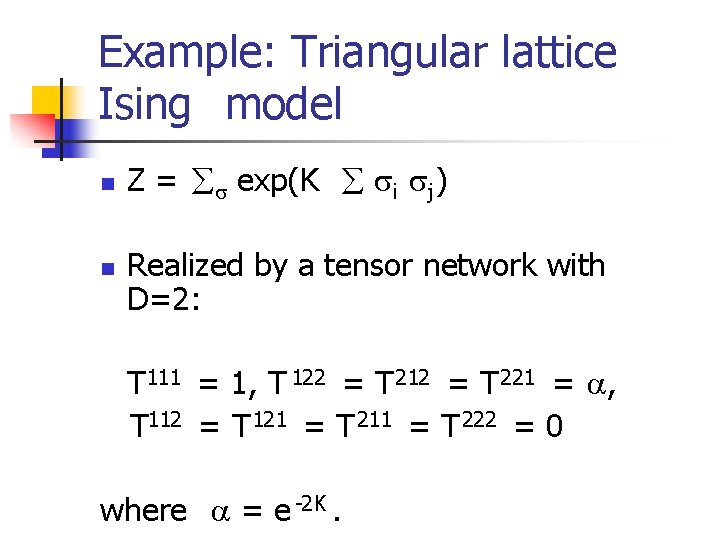
Example: Triangular lattice Ising model n n Z = exp(K i j ) Realized by a tensor network with D=2: T 111 = 1, T 122 = T 212 = T 221 = , T 112 = T 121 = T 211 = T 222 = 0 where = e -2 K.
Example: Triangular lattice Ising model
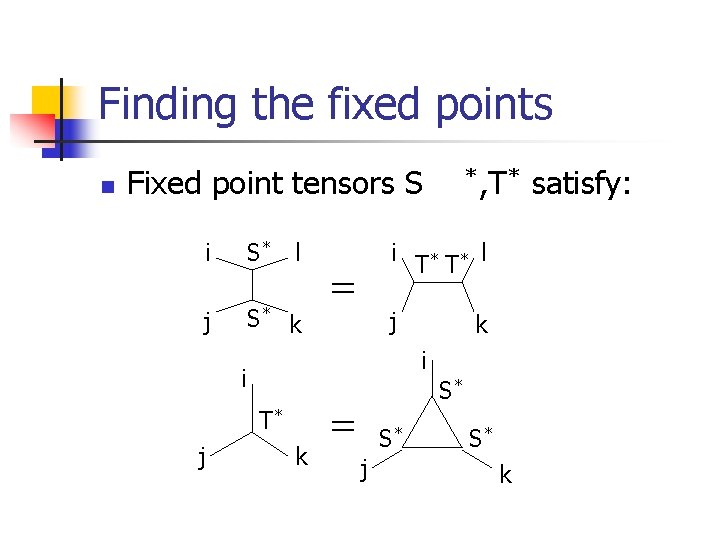
Finding the fixed points n Fixed point tensors S i S* l j S* k i T* T* l = j k i i T* j * , T * k S* = S* j S* k satisfy:
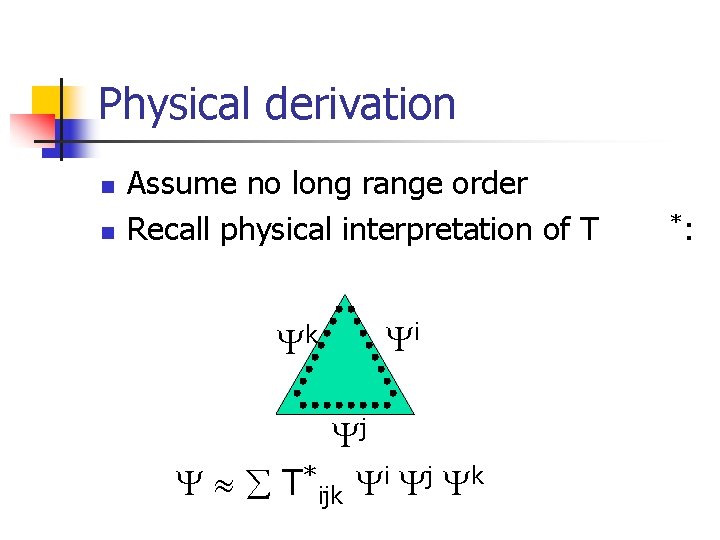
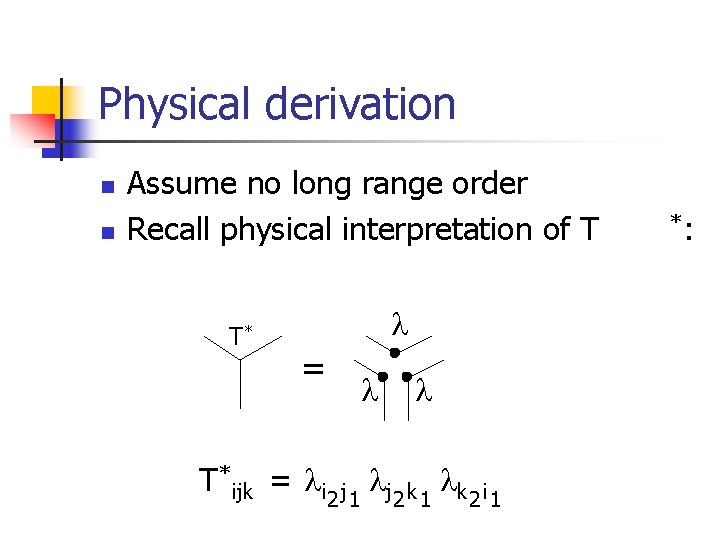
Physical derivation n n Assume no long range order Recall physical interpretation of T k i j T* ijk i j k *:
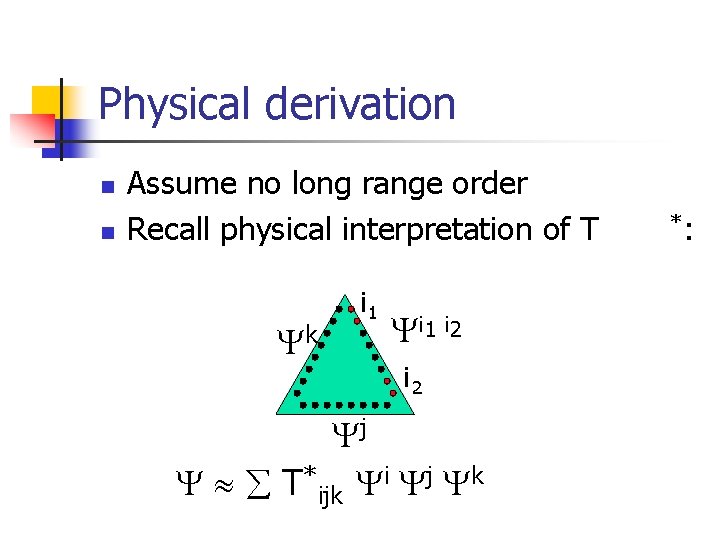
Physical derivation n n Assume no long range order Recall physical interpretation of T k i 1 i 2 j T* ijk i j k *:
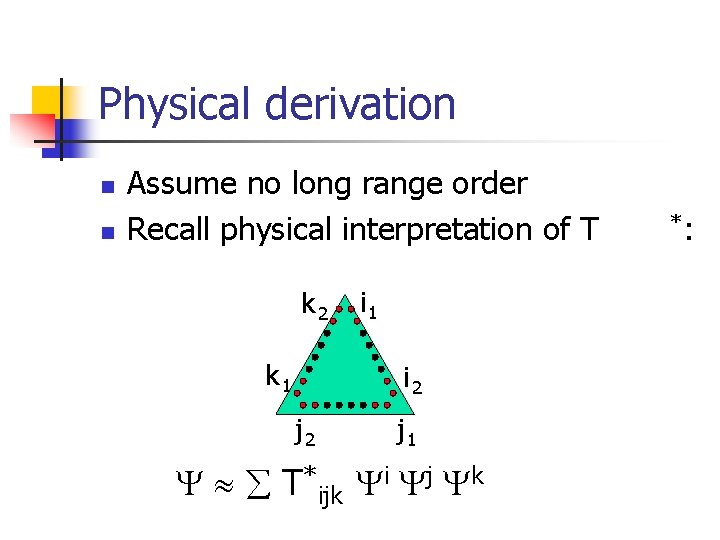
Physical derivation n n Assume no long range order Recall physical interpretation of T k 2 k 1 i 2 j 1 T* ijk i j k *:
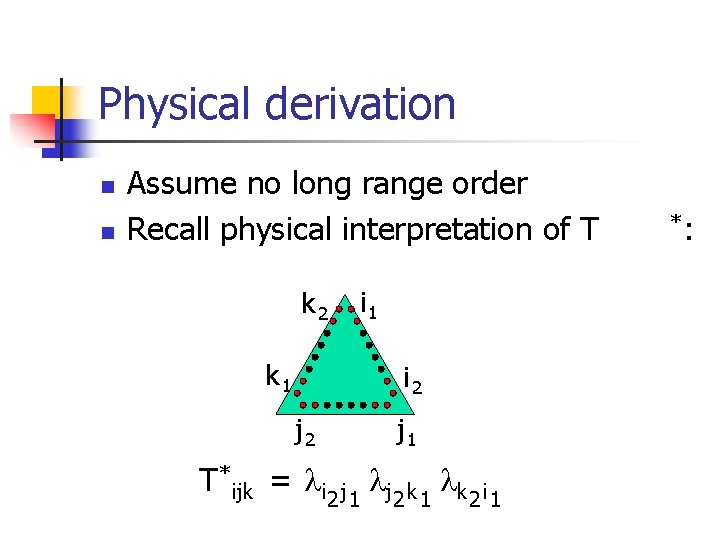
Physical derivation n n Assume no long range order Recall physical interpretation of T k 2 k 1 i 2 j 1 T* ijk = i 2 j 1 j 2 k 1 k 2 i 1 *:
Physical derivation n n Assume no long range order Recall physical interpretation of T T* = T* ijk = i 2 j 1 j 2 k 1 k 2 i 1 *:
Fixed point solutions n Are these actually solutions? Yes.
Fixed point solutions n n n Are these actually solutions? Yes. But we have too many solutions! What’s going on?
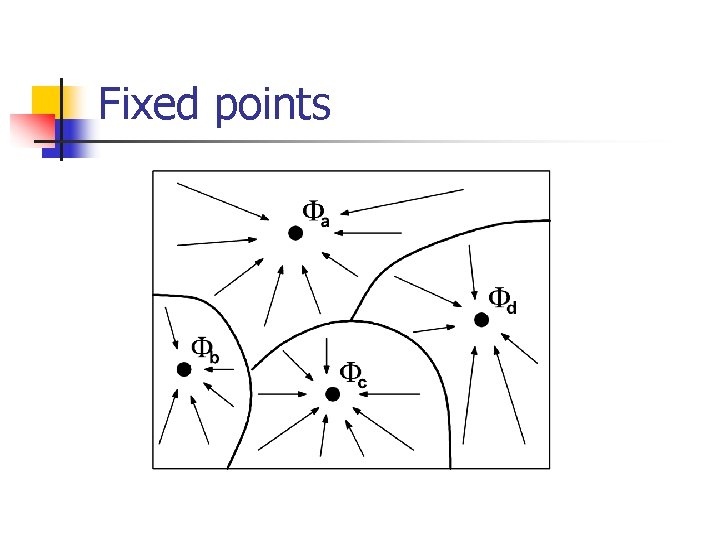
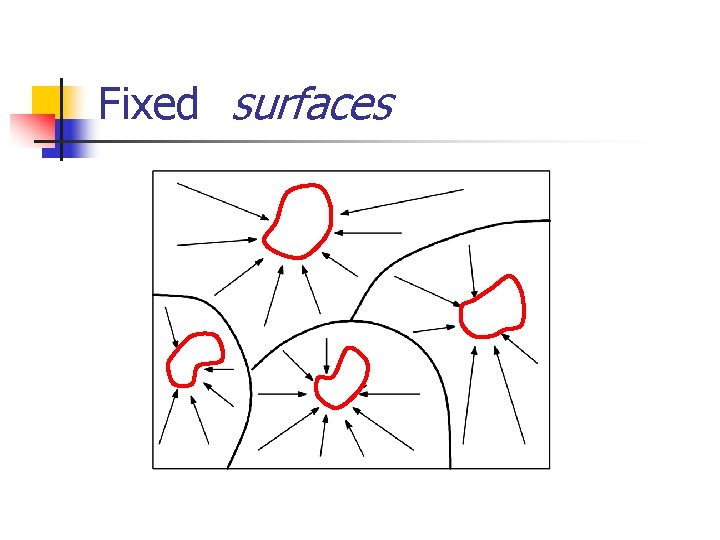
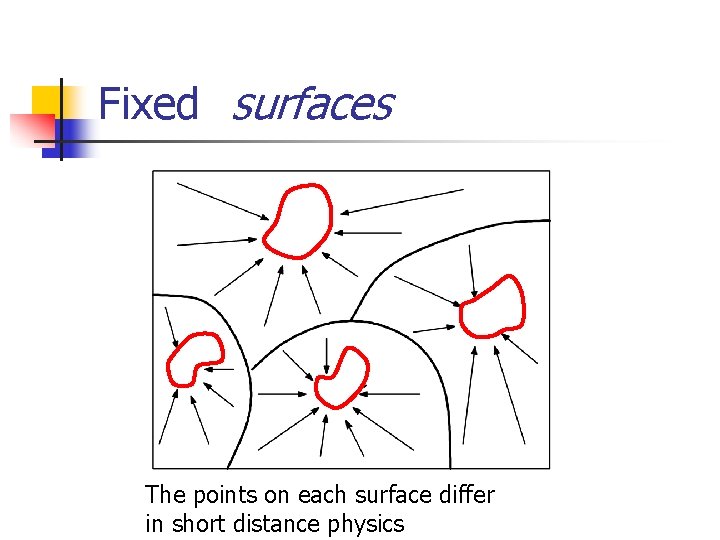
Fixed point solutions n n n Are these actually solutions? Yes. But we have too many solutions! What’s going on? Coarse graining is incomplete! Fixed point still contains some lattice scale physics
Fixed points
Fixed surfaces
Fixed surfaces The points on each surface differ in short distance physics
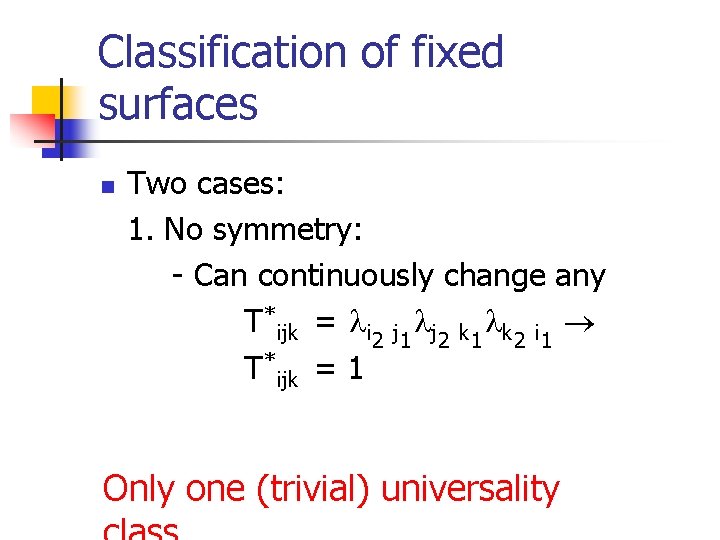
Classification of fixed surfaces n Two cases: 1. No symmetry: - Can continuously change any T* ijk = i 2 j 1 j 2 k 1 k 2 i 1 T* ijk = 1 Only one (trivial) universality
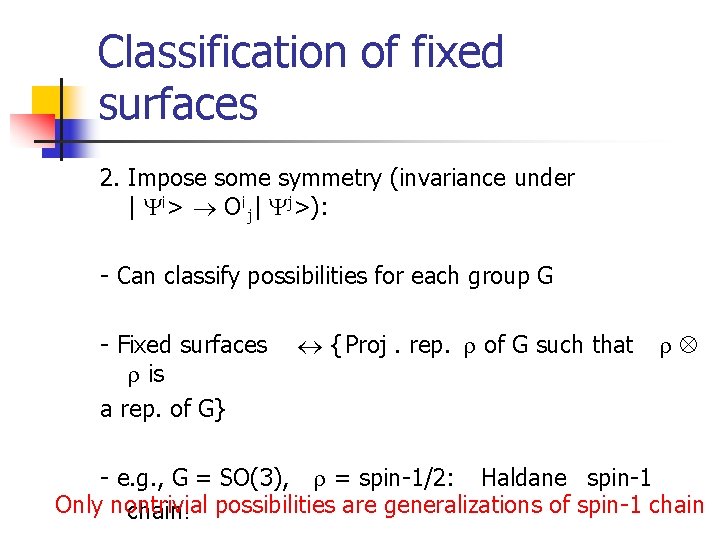
Classification of fixed surfaces 2. Impose some symmetry (invariance under | i > O i j | j >): - Can classify possibilities for each group G - Fixed surfaces is a rep. of G} { Proj. rep. of G such that - e. g. , G = SO(3), = spin-1/2: Haldane spin-1 Only nontrivial chain! possibilities are generalizations of spin-1 chain
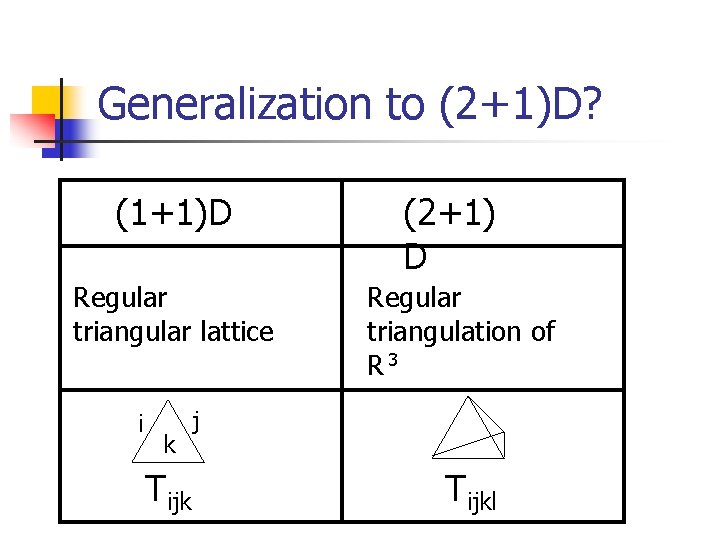
Generalization to (2+1)D? (1+1)D (2+1) D
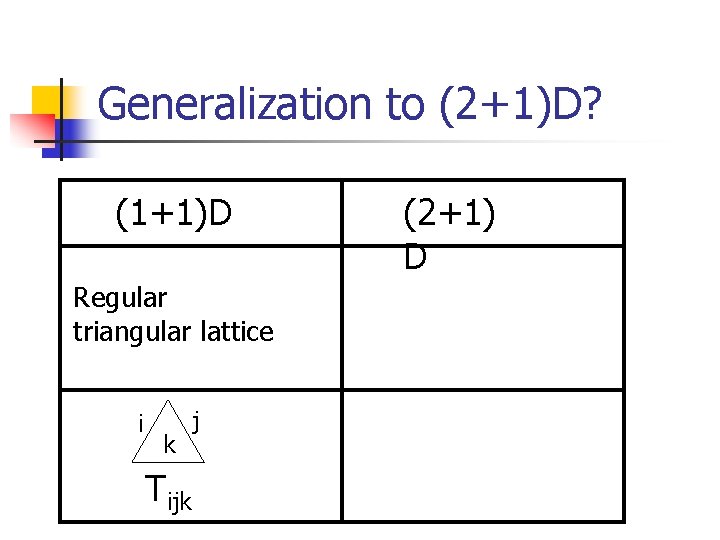
Generalization to (2+1)D? (1+1)D Regular triangular lattice i k Tijk j (2+1) D
Generalization to (2+1)D? (1+1)D Regular triangular lattice i k Tijk (2+1) D Regular triangulation of R 3 j Tijkl
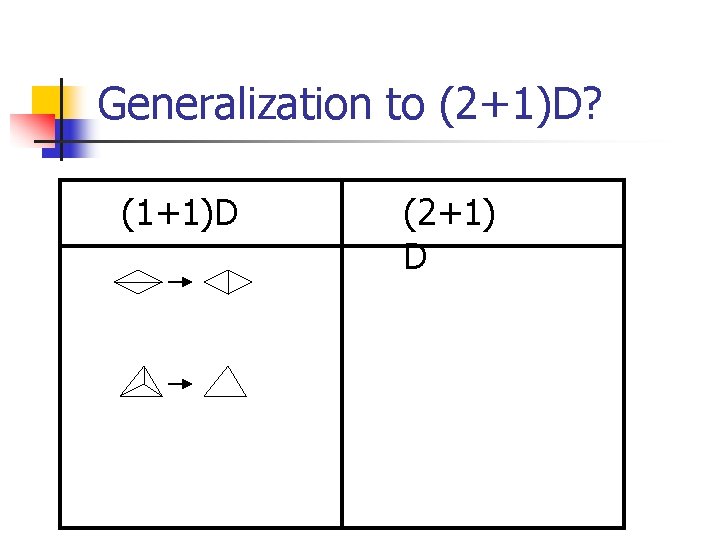
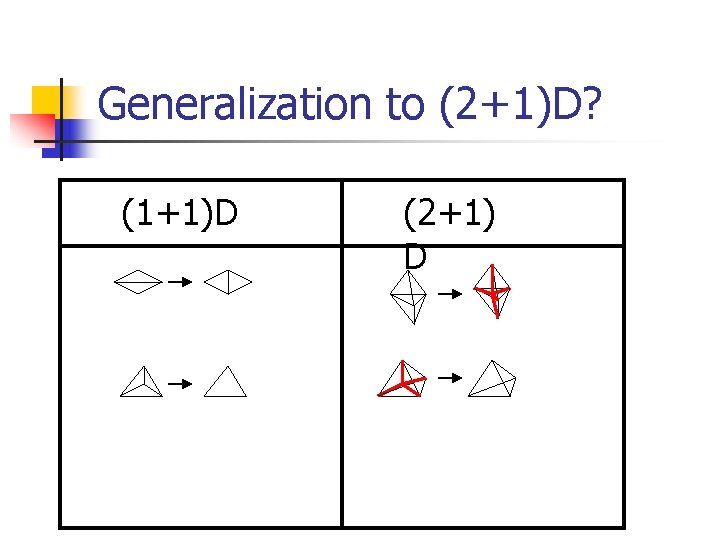
Generalization to (2+1)D? (1+1)D (2+1) D
Generalization to (2+1)D? (1+1)D (2+1) D
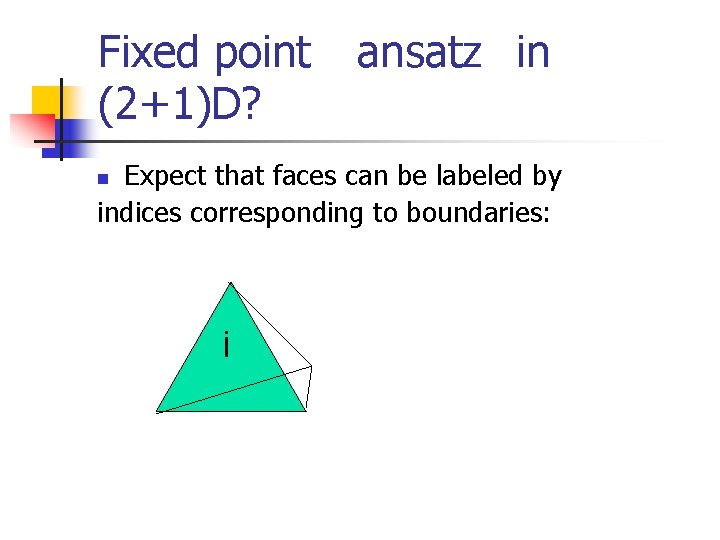
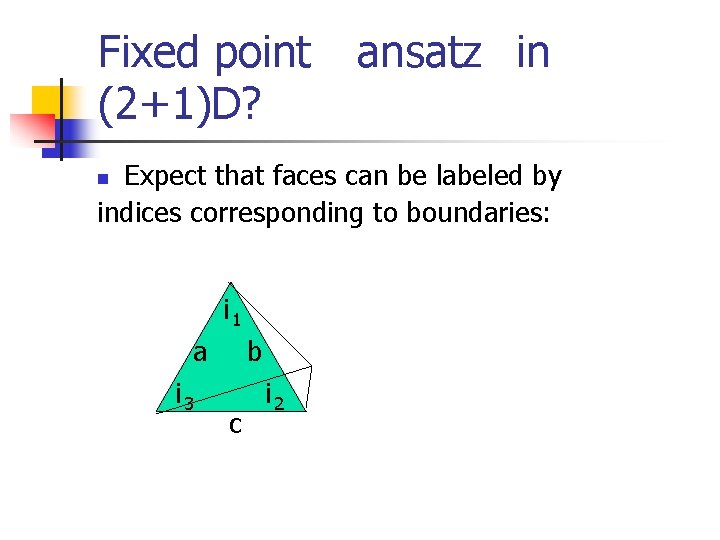
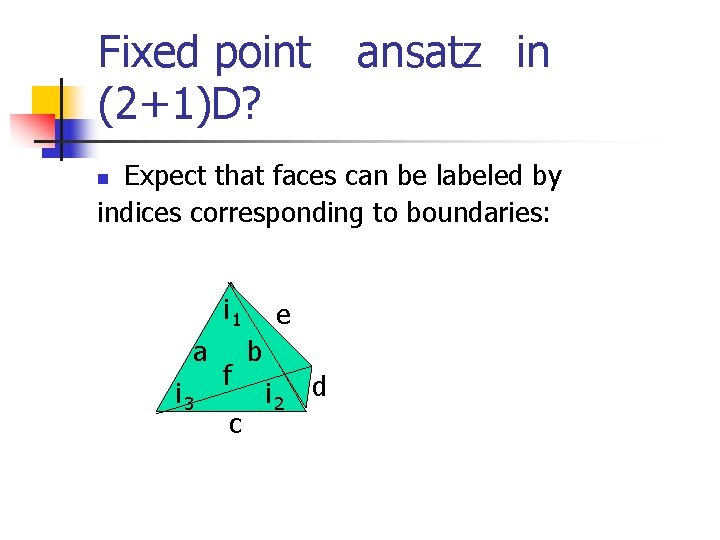
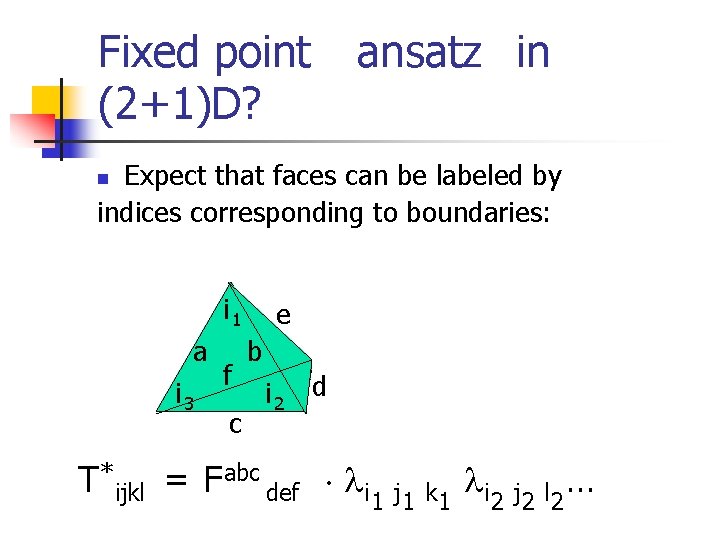
Fixed point (2+1)D? ansatz in Expect that faces can be labeled by indices corresponding to boundaries: n i
Fixed point (2+1)D? ansatz in Expect that faces can be labeled by indices corresponding to boundaries: n i 1 a i 3 b c i 2
Fixed point (2+1)D? ansatz in Expect that faces can be labeled by indices corresponding to boundaries: n i 1 a i 3 f c e b i 2 d
Fixed point (2+1)D? ansatz in Expect that faces can be labeled by indices corresponding to boundaries: n i 1 a i 3 f c e b i 2 d T* ijkl = F abc def i 1 j 1 k 1 i 2 j 2 l 2 …
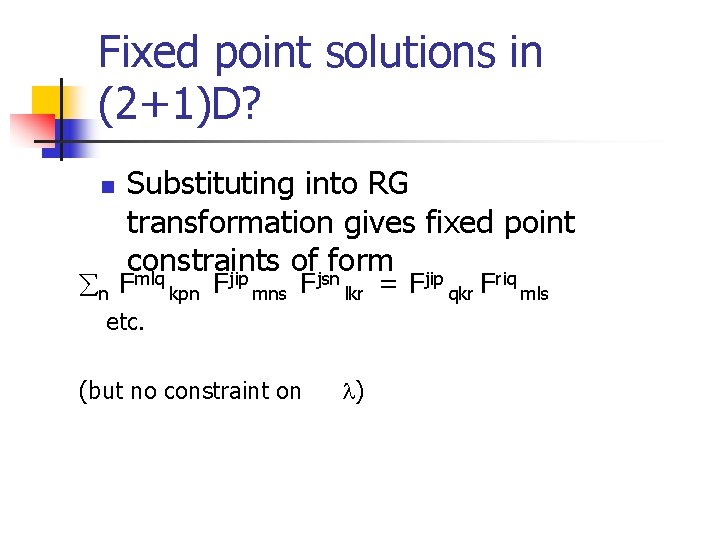
Fixed point solutions in (2+1)D? n Substituting into RG transformation gives fixed point constraints of form mlq jip jsn jip riq n F kpn F mns F lkr etc. (but no constraint on ) =F qkr F mls
Fixed point solutions in (2+1)D? n Substituting into RG transformation gives fixed point constraints of form mlq jip jsn jip riq n F kpn F mns F lkr =F qkr F mls etc. (but no constraint on ) Exactly constraints for Turaev. Viro (or string-net) models!
Conclusion n n TRG approach gives: 1. Understanding of emergence of topological order. 2. Classification of fixed points 3. Powerful numerical method in (1+1)D Does it work in (2+1)D?