
Real Numbers and Their Properties Ch 1 2
Real Numbers and Their Properties Ch 1. 2 C. N. Colón Geometry St. Barnabas H. S. Bronx, NY
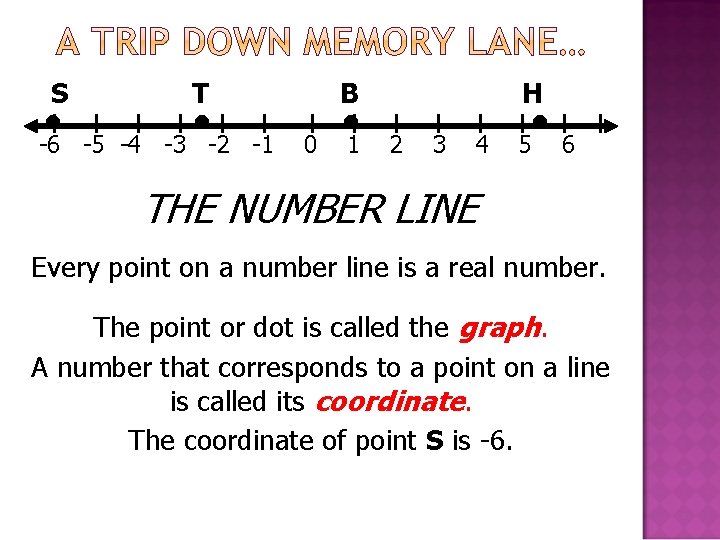
S ● T ● -6 -5 -4 -3 -2 -1 B 0 ● 1 H 2 3 4 ● 5 6 THE NUMBER LINE Every point on a number line is a real number. The point or dot is called the graph. A number that corresponds to a point on a line is called its coordinate. The coordinate of point S is -6.
They govern addition and multiplication 1. 2. 3. 4. 5. 6. 7. Closure Property Commutative Property Associative Property Identity Property Inverse Property Distributive Property Multiplication Property of Zero
Closure Property of ADDITION The sum of two real numbers is a real number. For example: 8 + 7. 5 = 15. 5 All three numbers are real numbers! Closure Property of MULTIPLICATION The product of two real numbers is a real number. For example: 12 x 2. 2 = 26. 4 Again, all three numbers are real numbers!
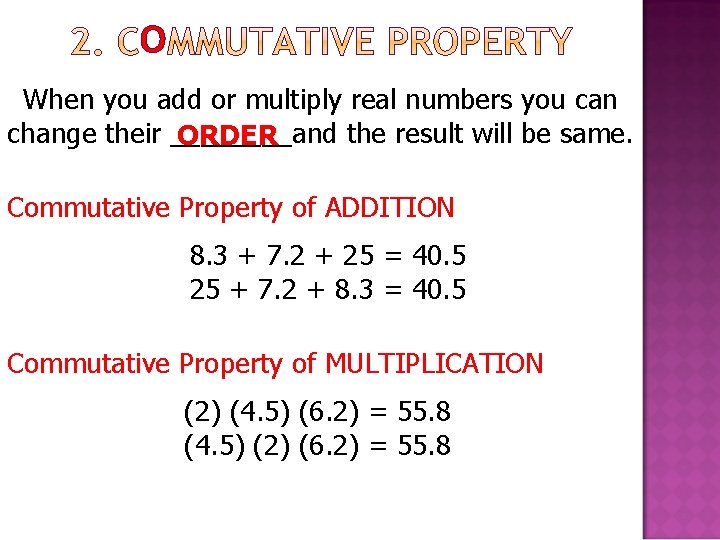
O When you add or multiply real numbers you can change their ____and the result will be same. ORDER Commutative Property of ADDITION 8. 3 + 7. 2 + 25 = 40. 5 25 + 7. 2 + 8. 3 = 40. 5 Commutative Property of MULTIPLICATION (2) (4. 5) (6. 2) = 55. 8 (4. 5) (2) (6. 2) = 55. 8
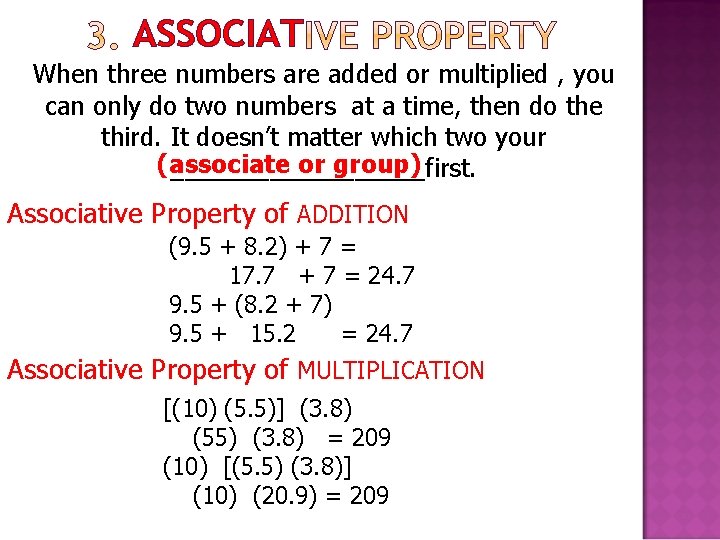
ASSOCIAT When three numbers are added or multiplied , you can only do two numbers at a time, then do the third. It doesn’t matter which two your (associate or group) _________first. Associative Property of ADDITION (9. 5 + 8. 2) + 7 = 17. 7 + 7 = 24. 7 9. 5 + (8. 2 + 7) 9. 5 + 15. 2 = 24. 7 Associative Property of MULTIPLICATION [(10) (5. 5)] (3. 8) (55) (3. 8) = 209 (10) [(5. 5) (3. 8)] (10) (20. 9) = 209
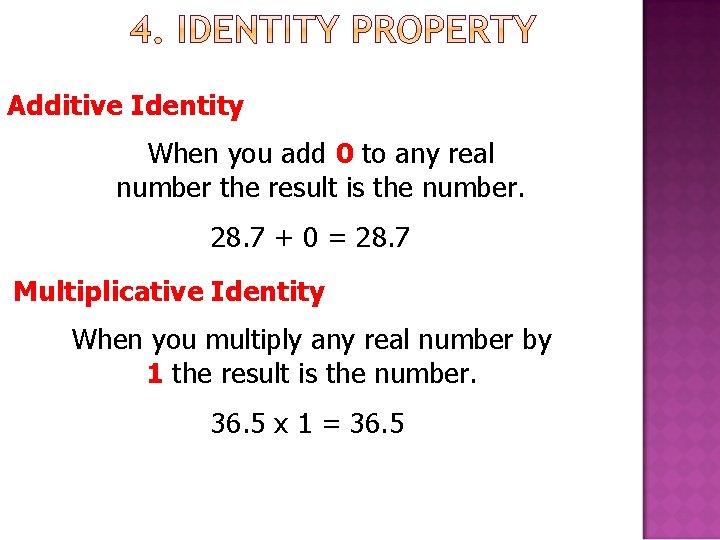
Additive Identity When you add 0 to any real number the result is the number. 28. 7 + 0 = 28. 7 Multiplicative Identity When you multiply any real number by 1 the result is the number. 36. 5 x 1 = 36. 5

Additive Inverse Two real numbers are additive inverses if their sum is the additive identity, 0. 18 + (-18) = 0 Multiplicative Inverse Two real numbers are multiplicative inverses if their product is the multiplicative identity, 1. 16 =1
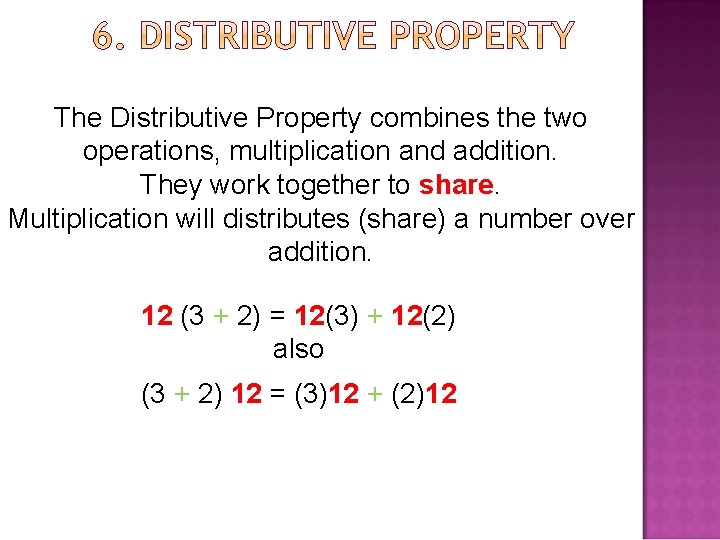
The Distributive Property combines the two operations, multiplication and addition. They work together to share. Multiplication will distributes (share) a number over addition. 12 (3 + 2) = 12(3) + 12(2) also (3 + 2) 12 = (3)12 + (2)12
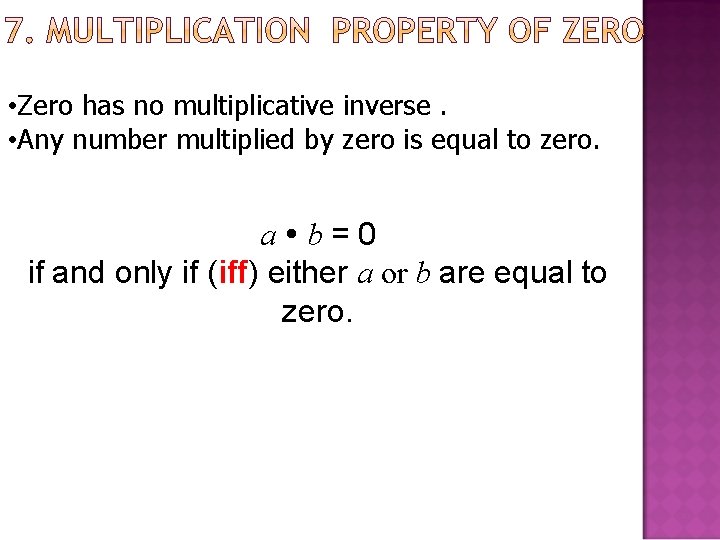
• Zero has no multiplicative inverse. • Any number multiplied by zero is equal to zero. a b=0 if and only if (iff) either a or b are equal to zero.
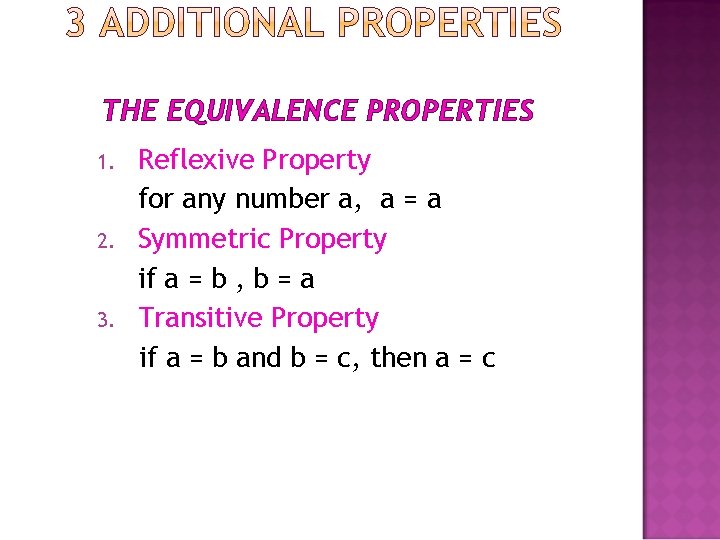
THE EQUIVALENCE PROPERTIES 1. 2. 3. Reflexive Property for any number a, a = a Symmetric Property if a = b , b = a Transitive Property if a = b and b = c, then a = c

Read pp. 3 -6, p. 6 #1 -18(e)
- Slides: 12