
Real Memory Management by Asst Lec Amal A

Real Memory Management by Asst. Lec. Amal A. Maryoosh
Memory Management Strategies These strategies are designed to obtain the best possible use of main memory. They are divided into: 1. Fetch strategies: determine when to move the next piece of a program or data to main memory from secondary storage. We divide them into: demand fetch strategy. anticipatory fetch strategy. 2. Placement strategies: determine where in main memory the system should place incoming program or data pieces, first fit, best fit, and worst fit. 3. Replacement strategies: when memory is too full to accommodate a new program, the system must remove some (or all) of a program or data that currently resides in memory.
Contiguous Vs. Noncontiguous Memory Allocation Contiguous Memory Allocation: to execute a program in early computer systems, the system operator or the operating system had to find enough contiguous main memory to accommodate the entire program. If the program was larger than the available memory then the system could not execute it. Non-Contiguous Memory Allocation: a program is divided into blocks or segments that the system may place in non-adjacent slots in main memory. This allows making use of holes (unused gaps) in memory that would be too small to hold whole programs.
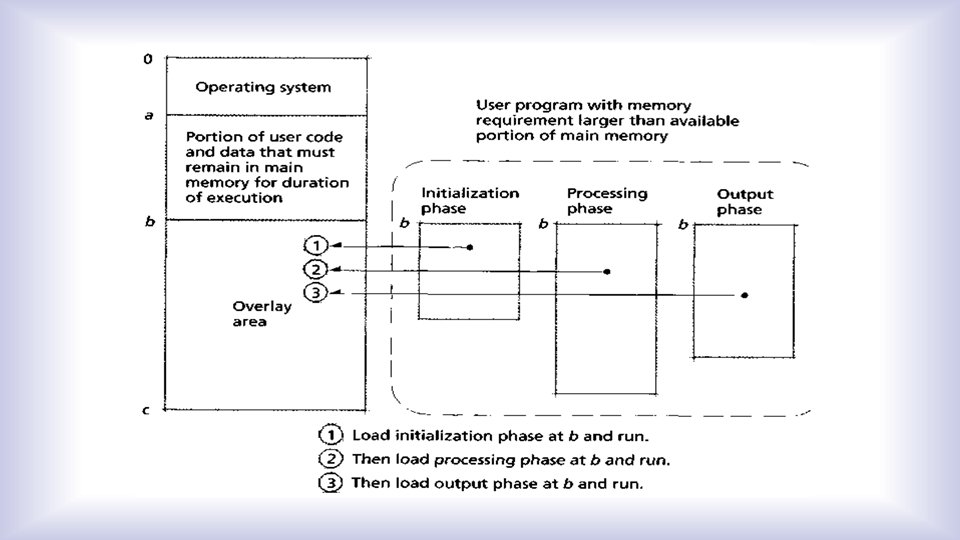
Overlays One way in which a software designer could overcome the memory limitations was to create overlays, which allowed the system to execute programs larger than main memory.

Swapping
Protection in a Single-User System Without protection, the process may alter the operating system. The protection can be implemented with a single boundary register built into the processor. The boundary register contains the memory address at which the user's program begins. Each time a process references a memory address, the system determines if the request is for an address greater than or equal to that stored in the boundary register. If so, the system services the request. If not, then the program is trying to access the operating system. The system intercepts the request and terminates the process with an appropriate error message.
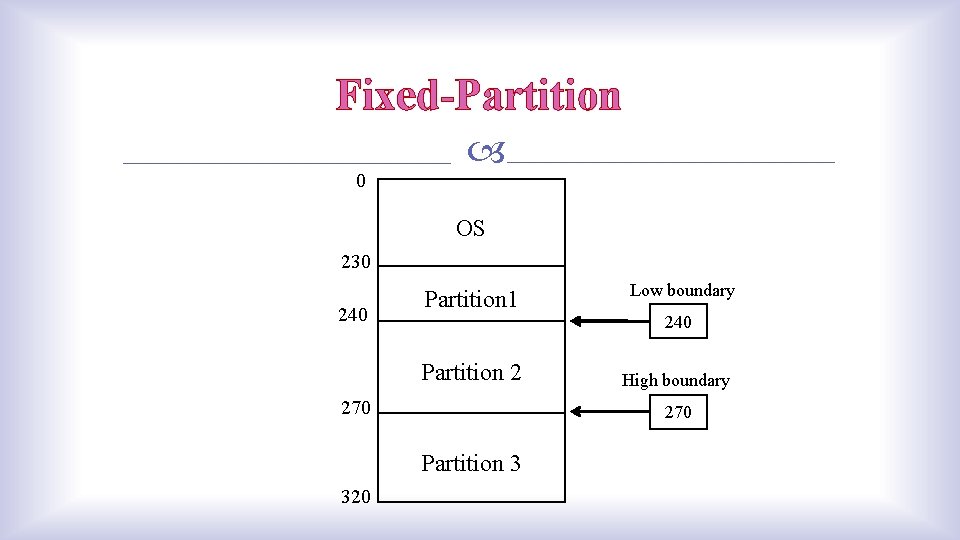
Fixed-Partition 0 OS 230 240 Partition 1 240 Partition 2 270 High boundary 270 Partition 3 320 Low boundary
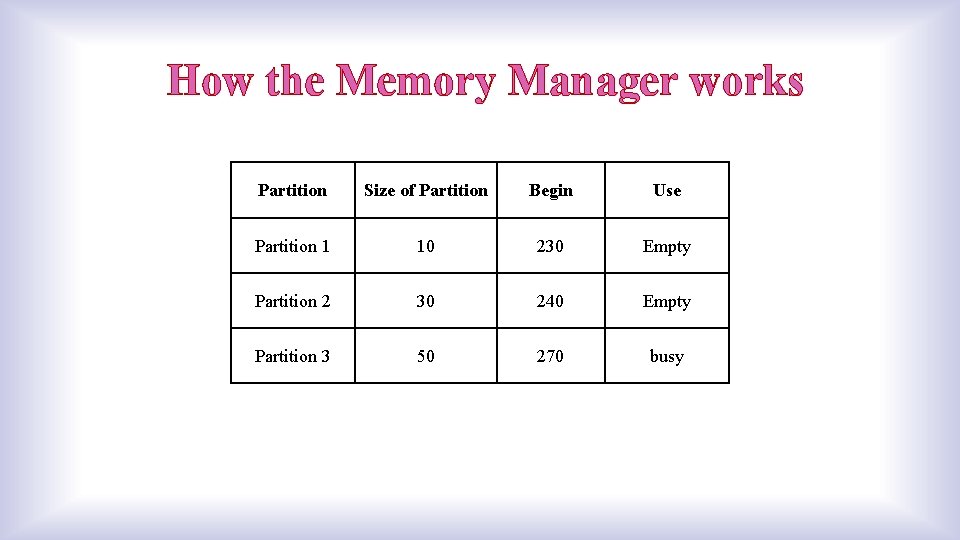
How the Memory Manager works Partition Size of Partition Begin Use Partition 1 10 230 Empty Partition 2 30 240 Empty Partition 3 50 270 busy
Fixed-Partition Multiprogramming The earliest multiprogramming systems used fixed partition multiprogramming. The system divides main memory into a number of fixed size partitions each partition holds a single job. In the earliest multiprogramming systems, the programmer translated a job using an absolute assembler or compiler. It meant that a job had its precise location in memory determined before it was launched and could run only in a specific partition. If the programs partition was occupied then that job had to wait even if other partitions were available.
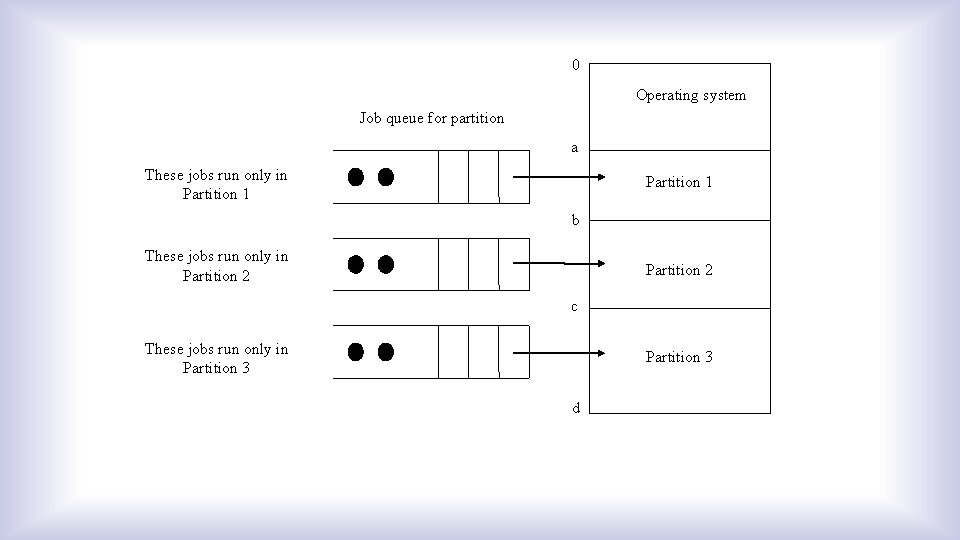
0 Operating system These jobs run only in Partition 1 These jobs run only in Partition 2 Job queue for partition a Partition 1 b Partition 2 c These jobs run only in Partition 3 d
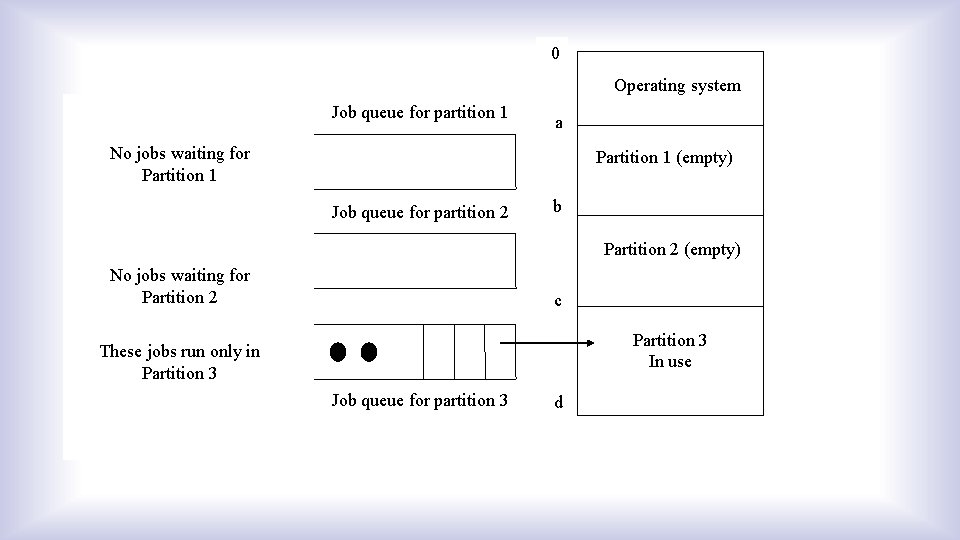
0 Operating system No jobs waiting for Partition 1 Job queue for partition 1 a Partition 1 (empty) Job queue for partition 2 b Partition 2 (empty) No jobs waiting for Partition 2 c Partition 3 In use These jobs run only in Partition 3 Job queue for partition 3 d
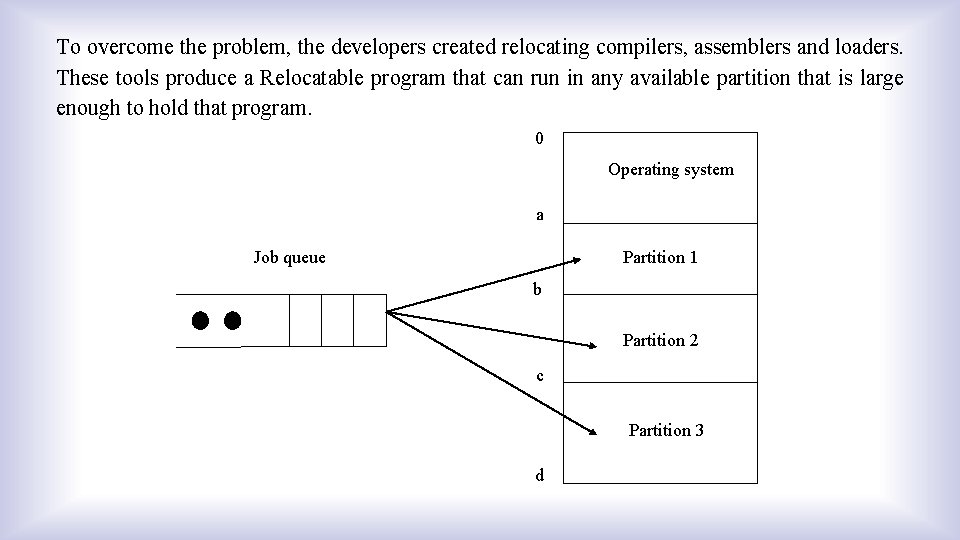
To overcome the problem, the developers created relocating compilers, assemblers and loaders. These tools produce a Relocatable program that can run in any available partition that is large enough to hold that program. 0 Operating system a Job queue Partition 1 b Partition 2 c Partition 3 d
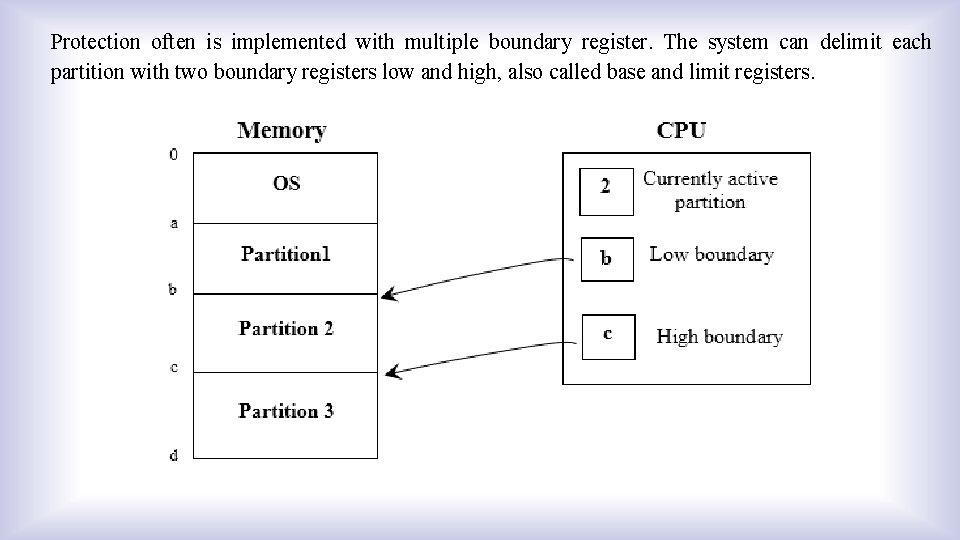
Protection often is implemented with multiple boundary register. The system can delimit each partition with two boundary registers low and high, also called base and limit registers.
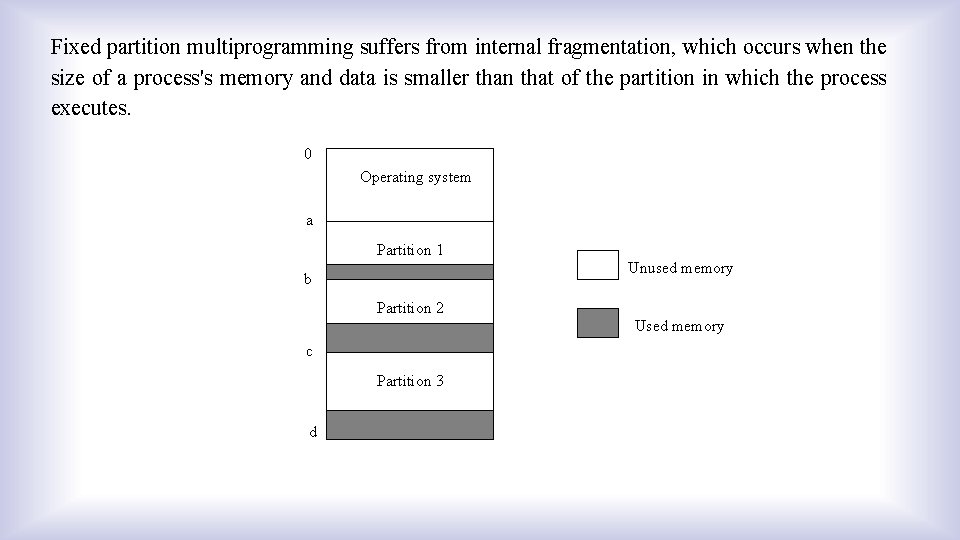
Fixed partition multiprogramming suffers from internal fragmentation, which occurs when the size of a process's memory and data is smaller than that of the partition in which the process executes. 0 Operating system a Partition 1 b Partition 2 c Partition 3 d Unused memory Used memory
Variable-Partition Multiprogramming Fixed-partition multiprogramming imposes restrictions on a system that result in inefficient resource use. For example, a partition may be too small to accommodate a waiting process, or so large that the system loses considerable resources to internal fragmentation. An obvious improvement, operating system designers decided, would be to allow a process to occupy only as much space as needed (up to the amount of available main memory). This scheme is called variable-partition multiprogramming.
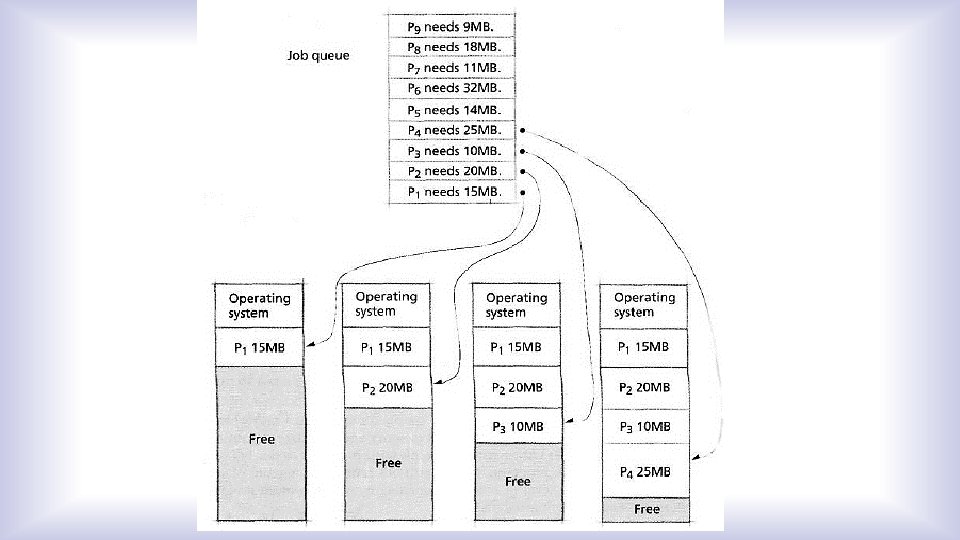
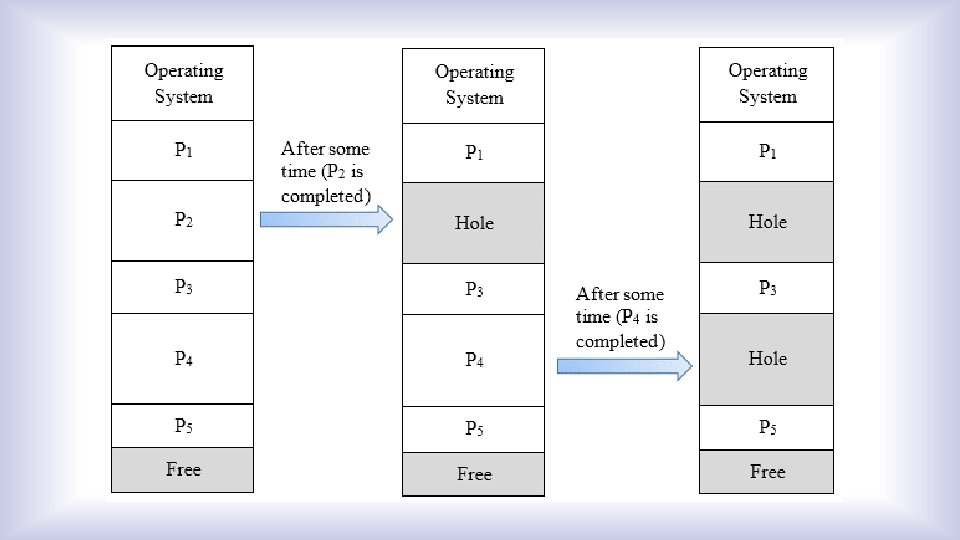
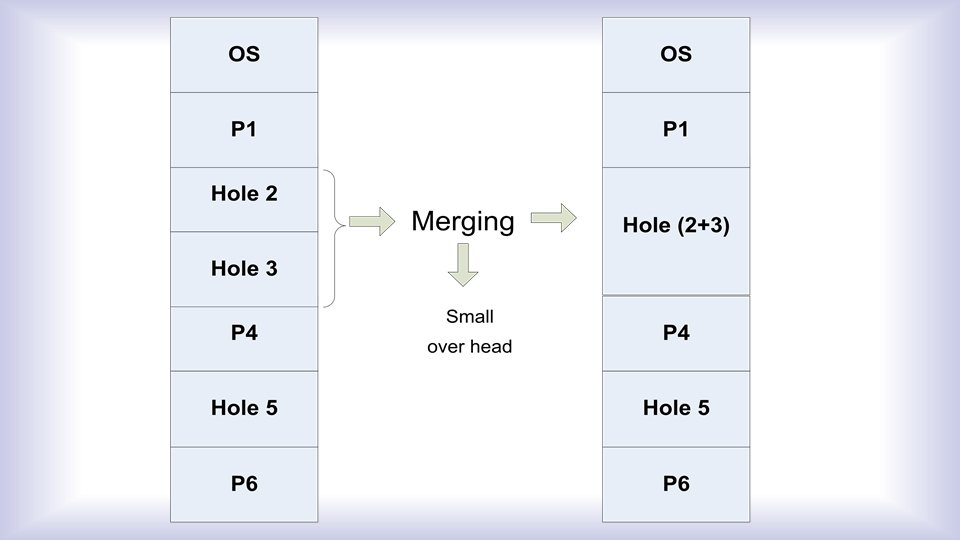
Variable-Partition Multiprogramming The process of merging adjacent holes to form a single, larger hole is called coalescing (merge things). The system reclaims the largest possible contiguous blocks of memory.
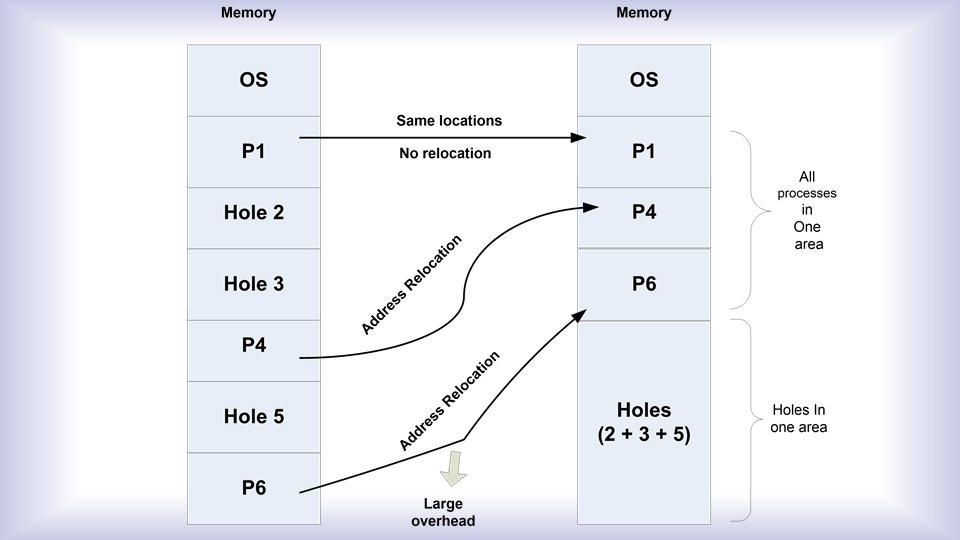
Variable-Partition Multiprogramming Another technique for reducing external fragmentation is called memory compaction (defragmentation). This relocates all occupied areas of memory to one end of main memory. Now all of the available free memory is contiguous. The drawbacks are: Overhead consumes system resources. The system must cease (stop something) all other computation during compaction which results in erratic response times for interactive users.
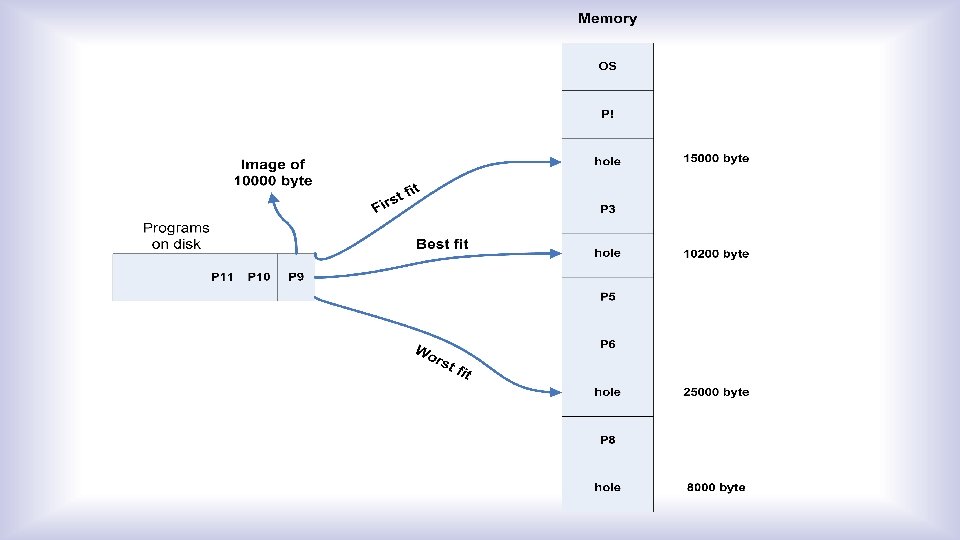
Memory Placement Strategies Determines where in main memory to place incoming programs and data. The main strategies are: Best fit: place the job in the smallest possible hole. The disadvantage is that the rest of hole will not be enough for new job. First fit: place the job in the first suitable hole. The advantage is low overhead i. e. small CPU wasted time in implementing the strategy. Worst fit: place the job in the largest available hole. The rest of hole may be still enough for new job.
- Slides: 24