
REAL LIFE MODELS FOR EXPONENTS AND RADICALS BY

REAL LIFE MODELS FOR EXPONENTS AND RADICALS BY ANNA TERESHCHENKO, PRE-DIPLOMA MATH 10 SKILL BUILDING
HISTORY OF EXPONENTS AND RADICALS Radicals Exponents The word itself comes from Latin, expo, meaning “out of”, and ponere, meaning “place” The first recorded modern use of exponents in mathematics was in a book called "Arithemetica Integra, " written in 1544 by English author and mathematician Michael Stifel While not 100 percent certain, it appears the idea of squaring or cubing goes all the way back to Babylonian times, the earliest known mention was found on a tablet dating to the 23 rd Century BC The term radical comes from the Latin radix meaning “root” The symbol that looks like a check originated in Germany in the 1500’s In the 1500’s, Christoph Rudolff introduced the radical sign without a roof in the first German textbook on Algebra
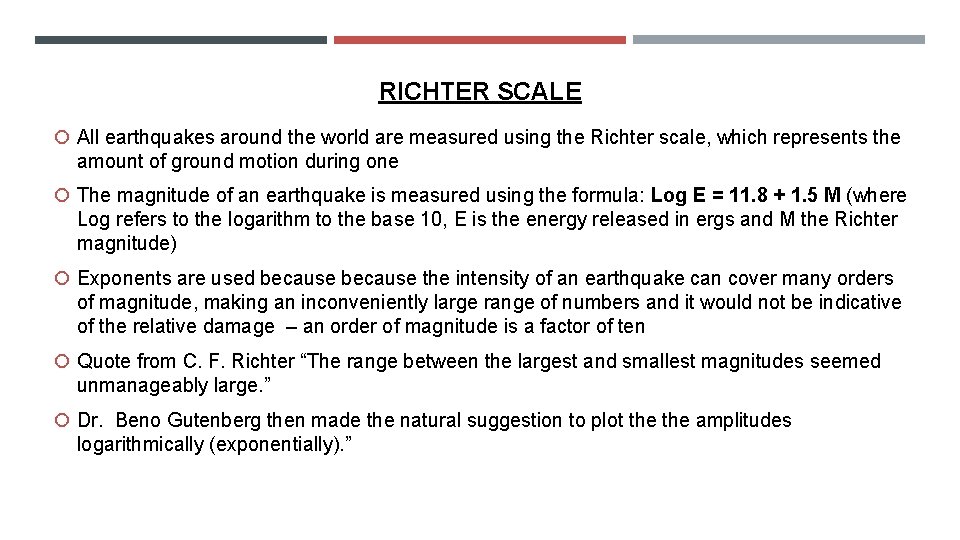
RICHTER SCALE All earthquakes around the world are measured using the Richter scale, which represents the amount of ground motion during one The magnitude of an earthquake is measured using the formula: Log E = 11. 8 + 1. 5 M (where Log refers to the logarithm to the base 10, E is the energy released in ergs and M the Richter magnitude) Exponents are used because the intensity of an earthquake can cover many orders of magnitude, making an inconveniently large range of numbers and it would not be indicative of the relative damage – an order of magnitude is a factor of ten Quote from C. F. Richter “The range between the largest and smallest magnitudes seemed unmanageably large. ” Dr. Beno Gutenberg then made the natural suggestion to plot the amplitudes logarithmically (exponentially). ”
PH SCALE The scale was originally introduced by the Danish biochemist S. P. L. Sorenson in 1909 It uses exponents because each whole p. H value below 7 is ten times more acidic than the next higher value. For example, p. H 4 is ten times more acidic than p. H 5 and 100 times (10 times 10) more acidic than p. H 6 On this scale, an upward shift by one integral number represents a ten-fold decrease in value The p. H is the logarithm (to the base 10) of the reciprocal of the hydrogen ion concentration Though p. H is generally expressed without units, it is not an arbitrary scale; the number arises from a definition based on the activity of hydrogen ions in the solution
COMPUTER ENGINEERING Exponents are mainly used in binary, coding and in computer memory systems Mainly used to compress data, for reliable storing and communicating data The modern binary number system was studied in Europe in the 16 th and 17 th centuries by Thomas Harriot, Juan Caramel y Lobkowitz, and Gottfried Binary is a universal computer language, which is used to write data such as the instructions that computer processors use, or the digital text you read every day. A binary number is a number expressed in the base-2 numeral system or binary numeral system, which uses only two symbols: typically "0" (zero) and "1" (one). The base-2 numeral system is a positional notation with a radix of 2
HOW DOES THIS SHARED KNOWLEDGE ENABLE US TO BE GLOBAL CITIZENS IN BEING PROACTIVE STEWARDS OF PLANET EARTH? Binary numbers are important because using them instead of the decimal system simplifies the design of computers and related technologies, which nowadays are used in our daily lives The Richter scale helps us detect and understand earthquakes which can help us protect ourselves from any major ones. p. H is an incredibly important parameter that is measured in nearly every water quality application. It plays a role in the taste (acid = fresh, neutral = bland, and alkaline = inedible) and the preservation of food. In environmental sampling and monitoring, high or low p. H values can be indicative of pollution. These are just some of the applications in which p. H plays a critical role.
- Slides: 6