
Ready To Retire Presented by University Human Resources
Ready To Retire Presented by: University Human Resources Benefits, Employee Wellness and Work-Life Programs Information shared in this document/presentation is presented based on current law and plan design. This information is subject to change based on changing laws and plan regulation. The prevailing laws/regulation shall supersede the information presented.
TODAY’S AGENDA • 1 - 1: 30 Welcome & R 2 R Overview • 1: 30 - 2: 20 Medicare & the State Health Plan • 2: 20 – 3 Hyatt Legal- Planning in Retirement • 3 - 3: 15 Break • 3: 15 - 4: 30 Retirement Break-out Sessions • 4: 30 – 5 Staying Connected

Benefits Team Gareth Washington Director Britt Hurst Benefits Consultant Kaprina Mitchell Senior Benefits Consultant Margot Henion Senior Benefits Consultant Merari Valencia Retirement Program Specialist Monique Merriweather-Yarborough Benefits Consultant
Things to Consider Your finances Can you afford to retire? When you add up your sources of income, will you have enough to last you the nearly 20 years you could enjoy in retirement? Also think about major expenses, such as a mortgage. Remember that retirement may bring new expenses, like travel or health care. Your family Do you still have children to support, or family to visit with your new free time? If you’re married, you’ll need savings and a vision that works for both of you. Your lifestyle If your goal is to enjoy retirement, how will you spend your days? Hobbies, travel and even another job all impact how much money you’ll need for your retirement. Your health Whether you are healthy now or know that you’ll have health issues to address in retirement, you need to be prepared to spend more on health care. According to the AARP, a 65 -year-old couple retiring this year will need approximately $240, 000 to cover future medical costs, not including the costs of long-term care. Your home Do you plan to stay in your home? If so, you may need to renovate. Would you rather downsize, or join a retirement community?
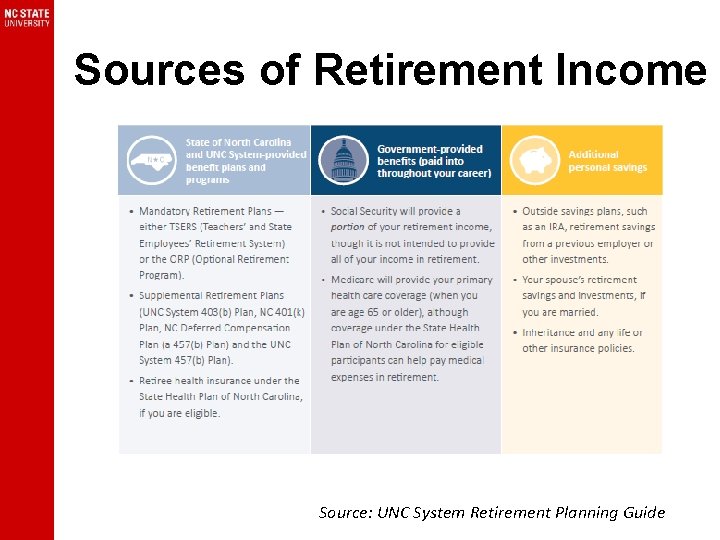
Sources of Retirement Income Source: UNC System Retirement Planning Guide
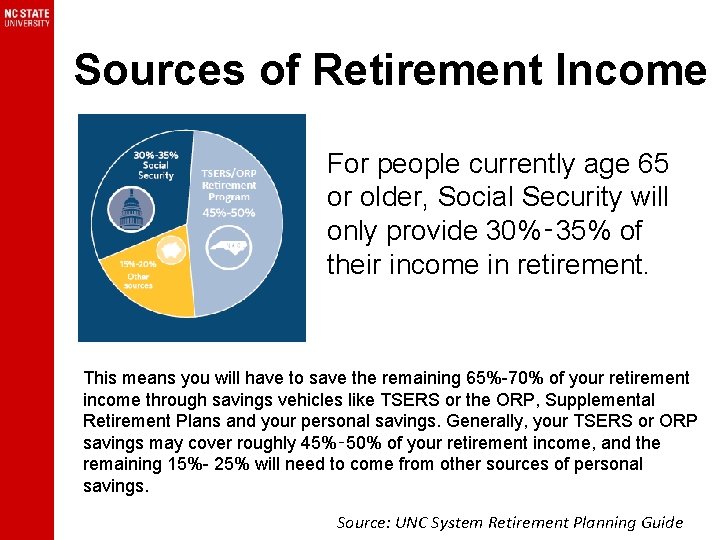
Sources of Retirement Income For people currently age 65 or older, Social Security will only provide 30%‑ 35% of their income in retirement. This means you will have to save the remaining 65%-70% of your retirement income through savings vehicles like TSERS or the ORP, Supplemental Retirement Plans and your personal savings. Generally, your TSERS or ORP savings may cover roughly 45%‑ 50% of your retirement income, and the remaining 15%- 25% will need to come from other sources of personal savings. Source: UNC System Retirement Planning Guide
On-Campus Financial Planners Meet with representatives from our retirement plan vendors for financial and retirement related advice. Fidelity Investments- ORP, 403(b) and 457 Plans Cleo Morgan | 919. 500. 1056 | cleo. morgan@fmr. com TIAA- ORP, 403(b) and 457 Plans La. Freita Whitehead | 919. 687. 5233 | lwhitehead@tiaa. org Prudential- NC 401(k) & NC 457 Plans Christy Kelly | 919. 602. 8226. | christy. kelly@prudential. com CAPTRUST is a third-party, independent group of advisors working with the UNC System. Contact CAPTRUST directly at 1 -800 -967 -9948
Adjusting to Retirement Finding Purpose Many people have trouble adjusting to retirement because their identity and most of their support system is aligned with their work schedule and work friends. Consider what your purpose will be in retirement and redefine yourself. Think about what matters most to you; retirement is a time to explore one’s self. • Finding a part time job in an area of interest • Volunteering • Learning a new skill/hobby Coping Emotionally Some individuals go through a honeymoon period after retirement: the first month is a great, but the subsequent months are when those negative emotions start to arise. Others may become depressed prior to retirement in anticipation of the major life change that is about to take place. Everyone experiences retirement differently, but it is important to know that sadness, depression, anxiety and grief are very common reactions.
Tips for a Healthy Retirement Keep Physically Fit • • • Gardening, climbing stairs or taking your grandchildren to the park are just a few examples of non-traditional workout opportunities. Consider taking up an activity like golf or bowling that requires some physical exertion. Have your spouse, significant other or a friend join your exercising. Having someone else to exercise with can provide you with the extra motivation you need. Keep Fiscally Fit • • • Be diligent in keeping track of your savings, IRAs, 401(k), pension, Social Security and other sources of income. Be aware of movement in the stock market if you still have investments in publicly traded companies. Make and stick to a budget that does not draw too heavily on your savings and investments. Keep Learning Many retired adults enjoy learning new skills or hobbies. Some people take classes at local community colleges or join community clubs and organizations that sponsor the activities that interest them.
Tips for a Healthy Retirement Keep in Contact • • Stay in contact with friends, family and former co-workers through phone calls, letters or email. Make plans to meet friends and acquaintances for lunch or dinner each week. Volunteer with local volunteer groups, religious organizations or civic groups. Visit your family, children, or spend time with your grandchildren. Travel to someplace you have never been before. Keep…Working? Recent studies indicate that more than one-third of all people who retire from their careers end up taking a new job. Many people take jobs that have absolutely nothing to do with their prior careers. Others even try to go into business for themselves. Faculty and Staff Assistance Program (FASAP) Call: 866. 467. 0467 Go online: guidanceresources. com TDD: 800. 697. 0353 Your NC State Web ID: FASAP
BREAK ORP participants please go to Room 3222
Talking About TSERS (Teachers’ and State Employees’ Retirement System)
Talking About TSERS • • • Defined Benefit Plan ORBIT Eligibility Benefit Formula Payment Options • • • Survivor Benefits Creditable Service How to Retire Taxes Returning To Work
TSERS - Defined Benefit Plan • Traditional pension plan • Defines a benefit upon retirement • Employer/employee mix of money into a general pension fund • Employee doesn’t bear any risk or control investments • Not an IRA, 401(k), or 403(b)
Where It All Begins - ORBIT www. myncretirement. com Members can find information on benefits, current news, links to recent legislation and access their personal retirement account via ORBIT Members also have access a Custom Benefit Estimator Tool
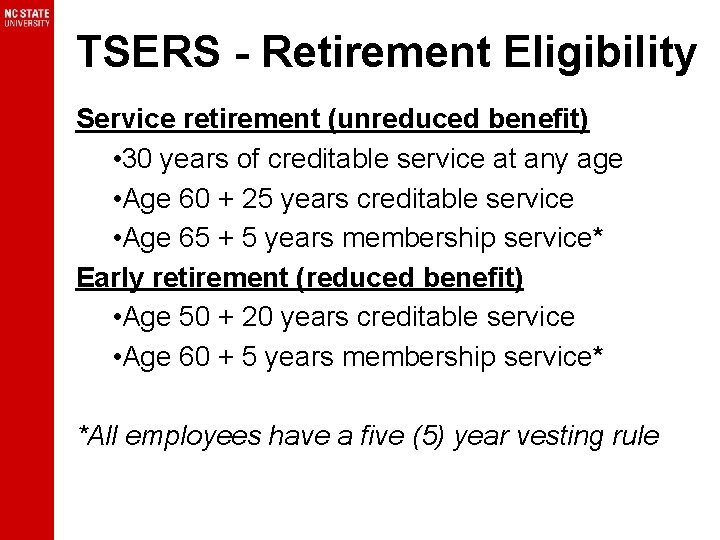
TSERS - Retirement Eligibility Service retirement (unreduced benefit) • 30 years of creditable service at any age • Age 60 + 25 years creditable service • Age 65 + 5 years membership service* Early retirement (reduced benefit) • Age 50 + 20 years creditable service • Age 60 + 5 years membership service* *All employees have a five (5) year vesting rule
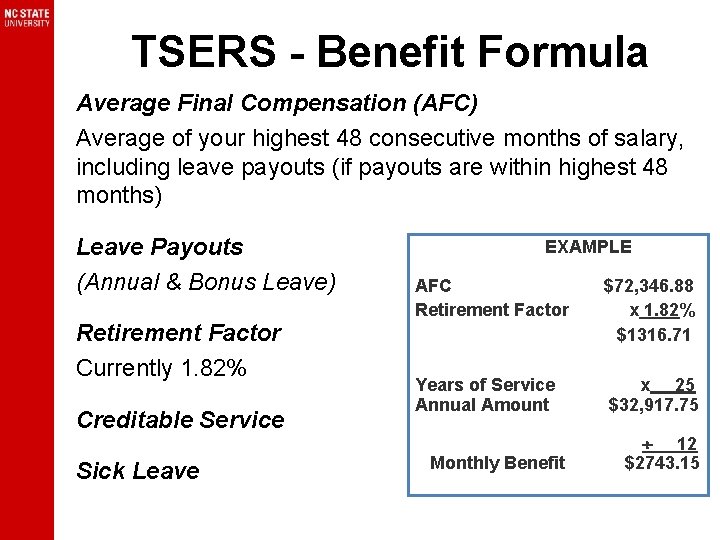
TSERS - Benefit Formula Average Final Compensation (AFC) Average of your highest 48 consecutive months of salary, including leave payouts (if payouts are within highest 48 months) Leave Payouts (Annual & Bonus Leave) Retirement Factor Currently 1. 82% Creditable Service Sick Leave EXAMPLE AFC $72, 346. 88 Retirement Factor x 1. 82% $1316. 71 Years of Service x 25 Annual Amount $32, 917. 75 12 Monthly Benefit $2743. 15
TSERS - Benefit Formula Average Final Compensation (AFC) is the average of your highest-paid consecutive 48 months of salary. If these highest-paid months include the final payment for unused vacation leave, bonus leave and/or pro-rated longevity, your average final compensation will be increased by these payouts. **Does not have to be your last 48 months of salary. Note: If your highest-paid consecutive 48 months of salary are not immediately prior to retirement, these payouts will not be counted in your AFC
TSERS - Leave Payouts Annual Leave Payout caps at 240 hours (prorated based on FTE and appointment length) Bonus Leave Payout of Bonus Leave, no cap
TSERS – Sick Leave Conversion Converting Sick Leave (based on a 1. 0 FTE): 8 hours = 1 day 20 days = 1 month of credit TSERS participants receive one month of service credit for every 20 days of sick leave, plus one month for any portion remaining as long as it’s more than one hour Example: 1649 hours of Sick Leave 1649 hrs / 8 hrs = 206 days / 20 days = 10. 3 months = 11 months of credit No limit on sick leave/ Cannot age you
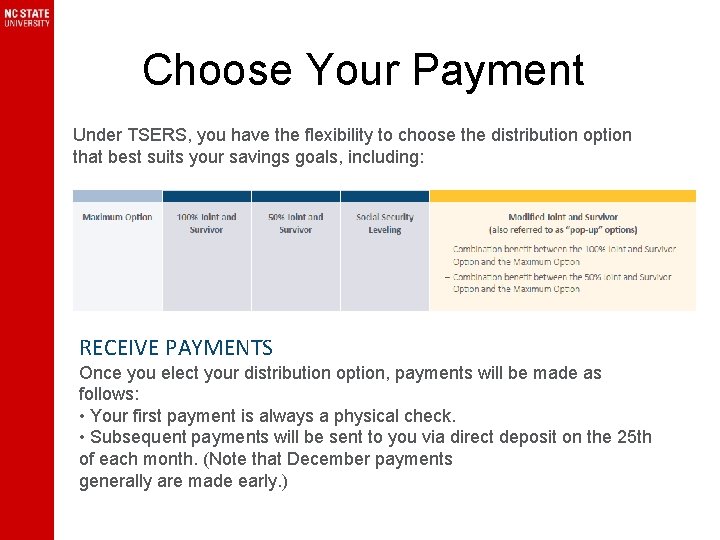
Choose Your Payment Under TSERS, you have the flexibility to choose the distribution option that best suits your savings goals, including: RECEIVE PAYMENTS Once you elect your distribution option, payments will be made as follows: • Your first payment is always a physical check. • Subsequent payments will be sent to you via direct deposit on the 25 th of each month. (Note that December payments generally are made early. )
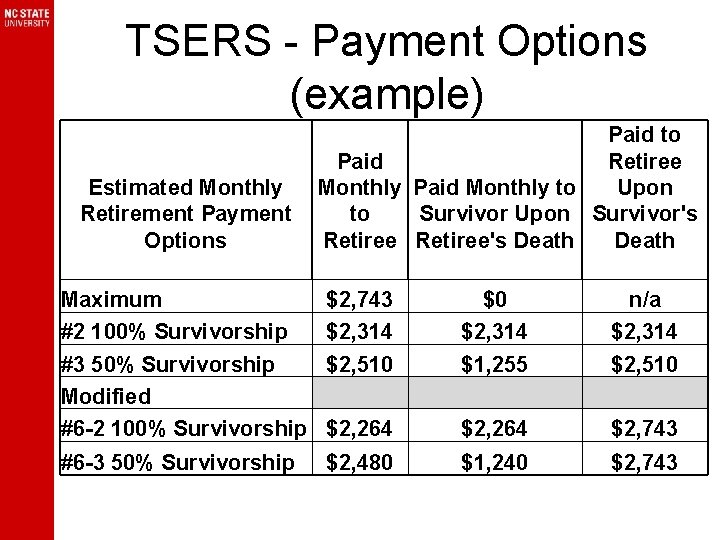
TSERS - Payment Options (example) Paid to Paid Retiree Estimated Monthly Paid Monthly to Upon Retirement Payment Survivor Upon Survivor's to Options Retiree's Death Maximum $2, 743 $0 n/a #2 100% Survivorship $2, 314 #3 50% Survivorship $2, 510 $1, 255 $2, 510 Modified #6 -2 100% Survivorship $2, 264 $2, 743 #6 -3 50% Survivorship $2, 480 $1, 240 $2, 743
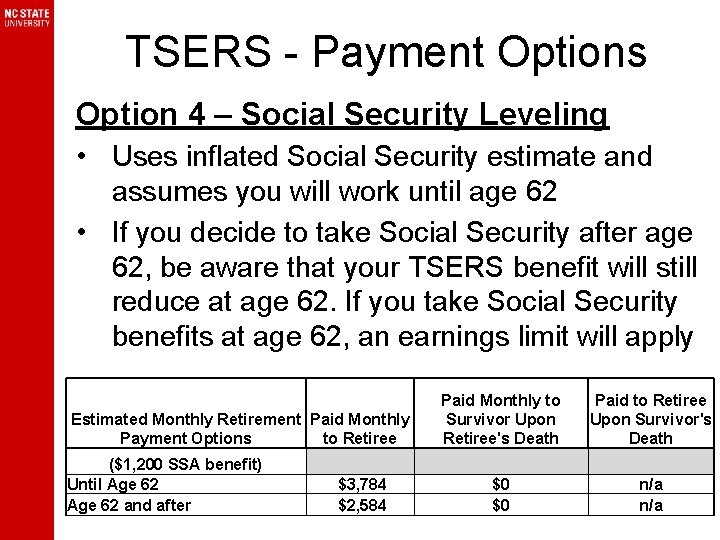
TSERS - Payment Options Option 4 – Social Security Leveling • Uses inflated Social Security estimate and assumes you will work until age 62 • If you decide to take Social Security after age 62, be aware that your TSERS benefit will still reduce at age 62. If you take Social Security benefits at age 62, an earnings limit will apply Estimated Monthly Retirement Paid Monthly Payment Options to Retiree ($1, 200 SSA benefit) Until Age 62 and after $3, 784 $2, 584 Paid Monthly to Survivor Upon Retiree's Death Paid to Retiree Upon Survivor's Death $0 $0 n/a
What should a retiree consider when choosing a payment option?
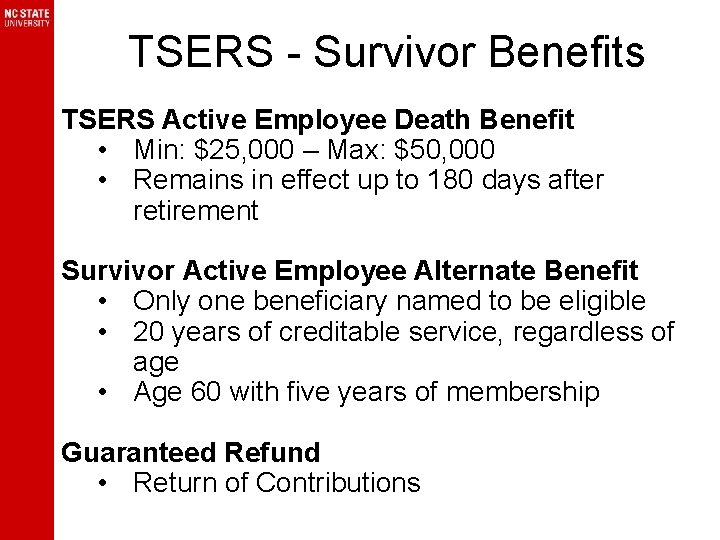
TSERS - Survivor Benefits TSERS Active Employee Death Benefit • Min: $25, 000 – Max: $50, 000 • Remains in effect up to 180 days after retirement Survivor Active Employee Alternate Benefit • Only one beneficiary named to be eligible • 20 years of creditable service, regardless of age • Age 60 with five years of membership Guaranteed Refund • Return of Contributions
TSERS - Survivor Benefits Met. Life Group Term Life Insurance • NC State retirees can continue up to $150 k at same age-based rate per current coverage at retirement Contributory Death Benefit • Optional $10, 000 Benefit • Retiree pays the full cost of this benefit that can be deducted from retirement check
TSERS - Creditable Service • Purchasing Service Credit Military, withdrawn service, “out of state” government service, state government temporary or part-time service, etc. • How much to buy • Determine value • How to purchase • Plan to plan transfer Visit ORBIT at www. myncretirement. com
TSERS & TAXES STATE TAXES The amount of the distribution subject to North Carolina state income tax is the amount that is reportable for income tax. Additionally, certain amounts may be taxexempt based on the Bailey Settlement (as explained below). The Bailey Settlement As a result of the North Carolina Supreme Court’s decision in Bailey v. State of North Carolina, you may be exempt from NC state income taxes under TSERS or the ORP if you retire and reside in North Carolina and you: • Participated in TSERS and had five years of membership service (are vested) as of August 12, 1989, or • Enrolled in the ORP prior to August 12, 1989. For more information, contact your HR Benefits Representative, or visit the NC Department of Revenue website at www. dornc. com. You also may wish to speak with your tax or financial advisor.
TSERS - Returning To Work Break In Service Rules • 6 -month break in service is MANDATORY • Direct vs. indirect employment with a State Agency • No independent contractor work for the State • Revoke retirement • Pay back benefits • Lose retiree health insurance
TSERS - Returning to Work Permanent Employment with State of North Carolina (30> hours/wk) • Retirement benefit & retiree health insurance ends • Employer pays active health insurance • Employee begins retirement contributions again Permanent/Temporary Employment (<30 hr/wk) • Earnings allowance applies and is greater of the following: • 50% of gross 12 -month pre-retirement salary (excluding termination payments), or • $33, 560 Retiree Earnings Cap (2019)
TSERS - Returning to Work Part-time/Temporary Employment (>30 hr/wk) As amended, G. S 135 -48 -41(j) states that if a re-hired retiree works 30 or more hours per week and becomes eligible for health insurance under the Affordable Care Act (ACA), then the re-hired retiree becomes ineligible for retiree health insurance coverage The re-hired retiree is not required to elect the ACA plan, but they will be canceled from the retiree health insurance plan
ORBIT and Retirement www. myncretirement. com Active (and Former) Employees • Must establish user ORBIT user. ID and password • View account history • View account contributions • Calculate retirement estimates • Change beneficiaries
ORBIT and Retirement www. myncretirement. com Retirees • View monthly payments • Enroll in your healthcare and make changes during Annual Enrollment • Change tax withholding • Change address
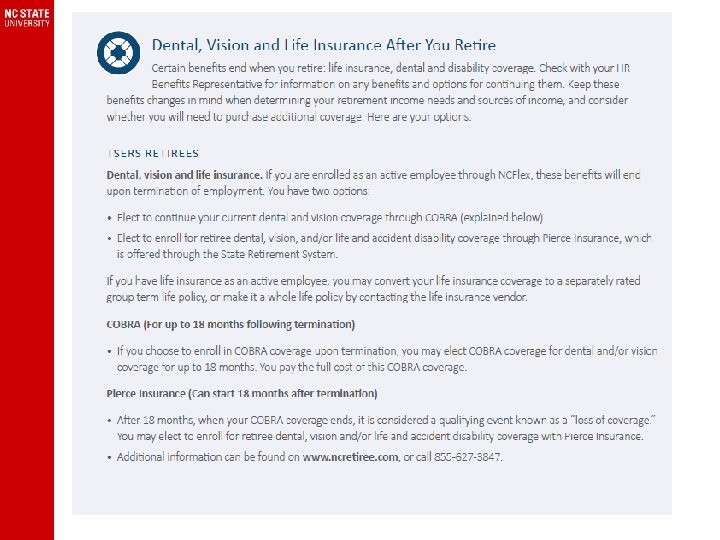
Other Benefit Programs NC Retirement Systems Supplemental Benefits TSERS retirees only (Pension Deduction) Dental and Vision Insurance www. ncretiree. com – NC Retired Governmental Employees Association AD&D, Dental, and Vision Insurance www. ncrgea. com
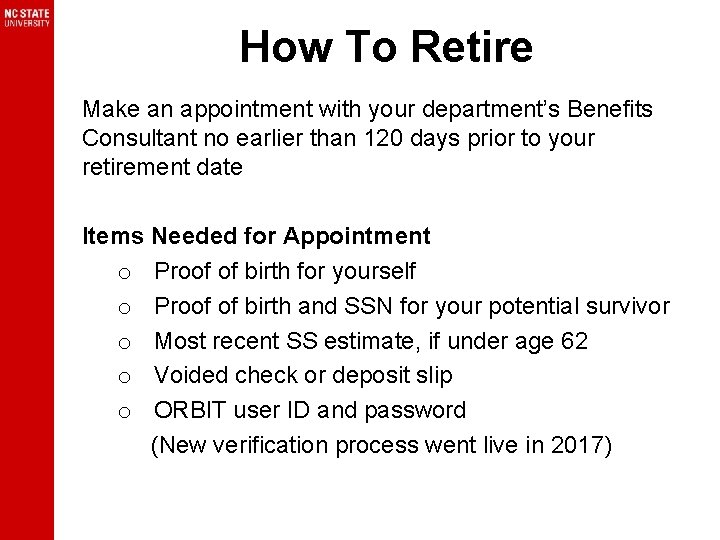
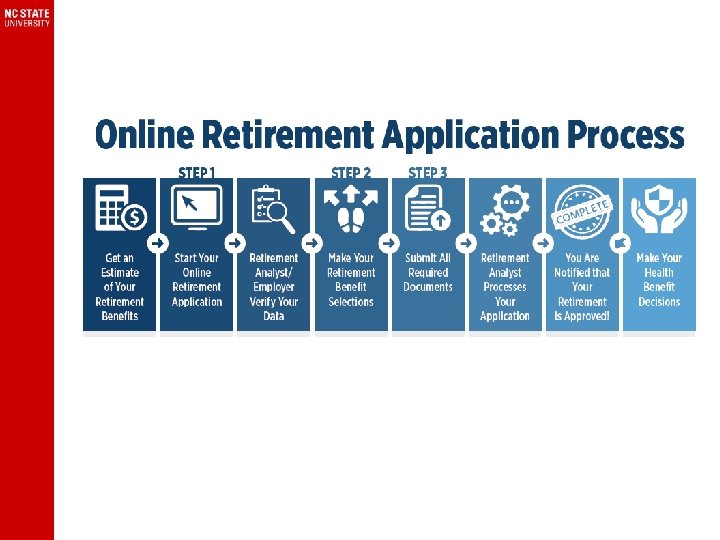
How To Retire Make an appointment with your department’s Benefits Consultant no earlier than 120 days prior to your retirement date Items Needed for Appointment o Proof of birth for yourself o Proof of birth and SSN for your potential survivor o Most recent SS estimate, if under age 62 o Voided check or deposit slip o ORBIT user ID and password (New verification process went live in 2017)
Questions
Staying Connected
As a Retiree… You may obtain a Retiree Parking Permit for an annual fee or purchase daily passes Submit a Permit Authorization Form for Retired Employees signed by your Department Head or representative. Form authorizes the purchase of an “R” permit for an annual fee. Retirees may renew online via credit card with access code from renewal assignment letter. Retired employees who receive compensation from the University are not eligible for an “R” permit. You may retain your Wolfpack One Card to use the library, continue your Carmichael Gym membership and be eligible for cultural and sporting event discounts Email: Retirees may retain their NC State email account at the discretion of their department management. A department HR representative will submit a no-pay action in the HR System to maintain access.
As a Retiree… Wolf. Perks: The Wolf. Perks Program is designed to save NC State University Faculty & Staff money on products and services both locally and nationally. Take a moment to browse through the many offers available to you and your family throughout the Wolf. Perks program. Cultural Events: Arts NC State is the collective organization for all six of NC State University’s performing and visual arts programs and five supporting units. Ticket Central is the centralized box office for the visual and performing arts programs. Key Haven Campground: Key Haven is a large wooded site on a peninsula at Kerr Lake. It is available for camping, picnicking, boating, and enjoying nature. Athletics: Please contact the Athletics Ticket Office for ticket options available only to retired NC State faculty and staff at 919 -865 -1510
As a Retiree… Osher Lifelong Learning Institute: The Osher Lifelong Learning Institute (OLLI) at NC State provides non-credit short courses, study trips, and special events for adults aged 50. All retirees receive a free one year membership. University Temporary Services: Being retired is not an end, but a starting point for new opportunities. Begin a new adventure where it all started with University Temporary Services. If you are interested in temporary employment at NC State through University Temporary Services, review the current vacancies and apply for the positions that best match your professional experience. Feel free to contact the UTS Office directly at 919515 -7060. Emeritus Status (Faculty and Senior Administrators): Any tenured full-time faculty member, Special Faculty, SAAO Tier I or II who has served for ten or more years State University is eligible to apply for emeritus status. Status is granted to retiring full-time faculty and administrators in recognition of dedicated service.
Steps to Retirement • 120 days before you want to retire, make an appointment with your HR Benefits Consultant • Your Benefits Consultant will guide you through the retirement process • Typically, January and July are the most popular retirement months
Visit our Retirement Planning Website https: //benefits. hr. ncsu. edu/retirement/
- Slides: 44