
Ready for a fold Thinking 101 2016 Geri

- Slides: 65
Ready for a fold? Thinking 101 2016 Geri Lorway Folding
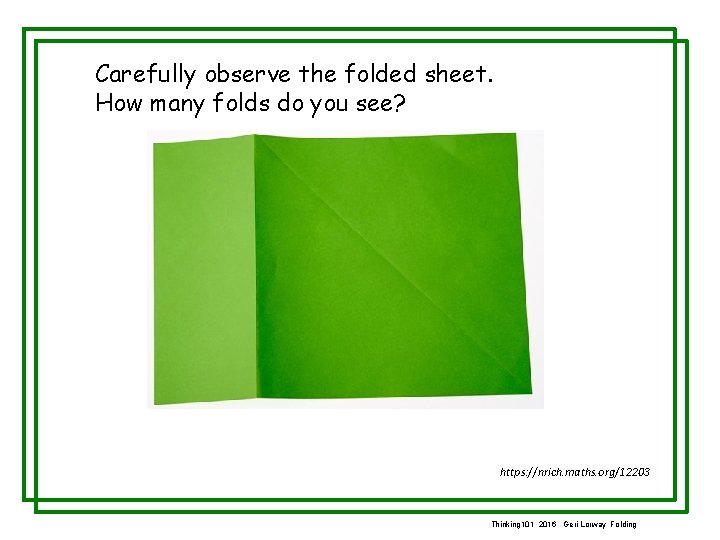
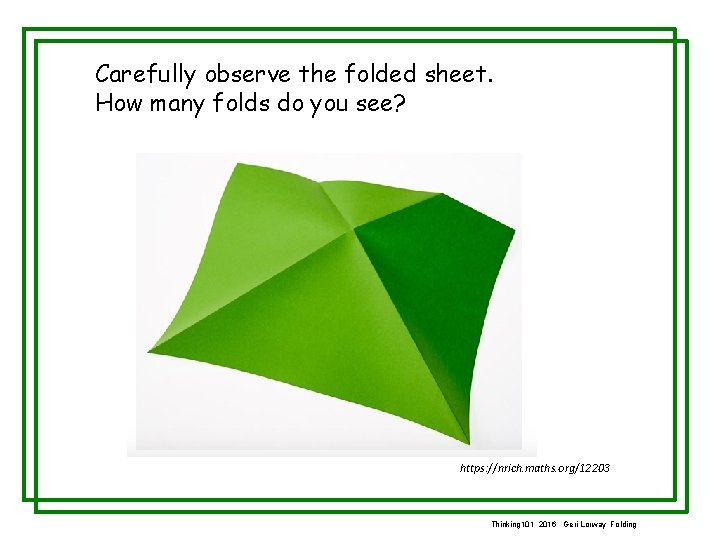
Carefully observe the folded sheet. How many folds do you see? https: //nrich. maths. org/12203 Thinking 101 2016 Geri Lorway Folding
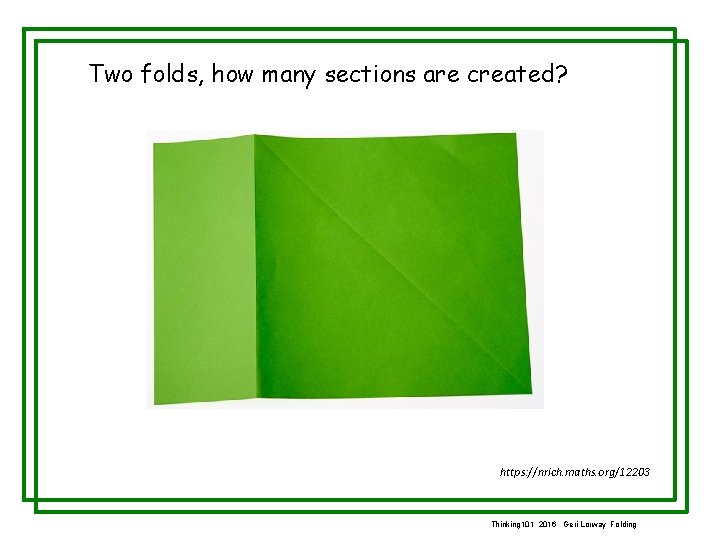
Two folds, how many sections are created? https: //nrich. maths. org/12203 Thinking 101 2016 Geri Lorway Folding
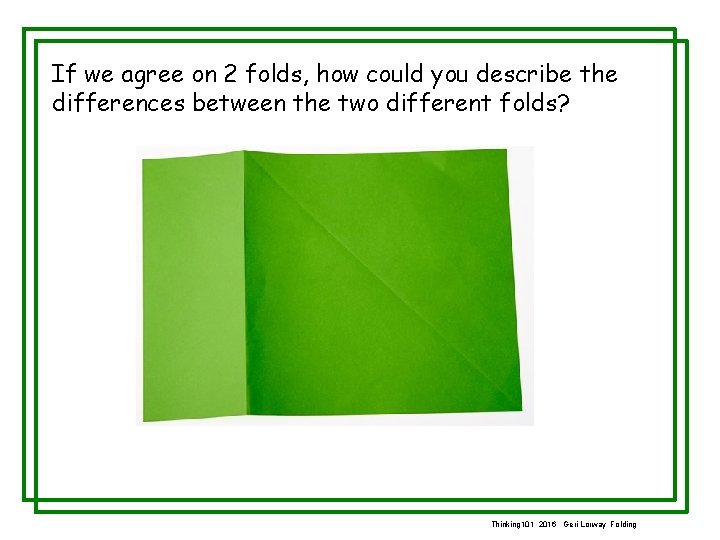
If we agree on 2 folds, how could you describe the differences between the two different folds? Thinking 101 2016 Geri Lorway Folding
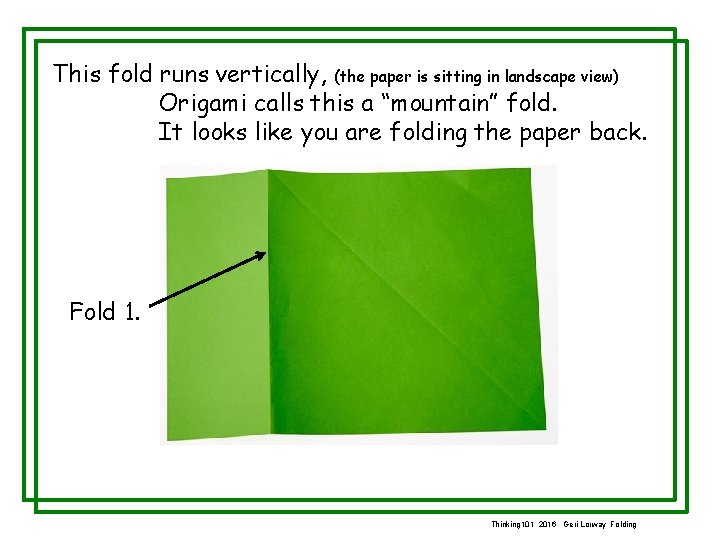
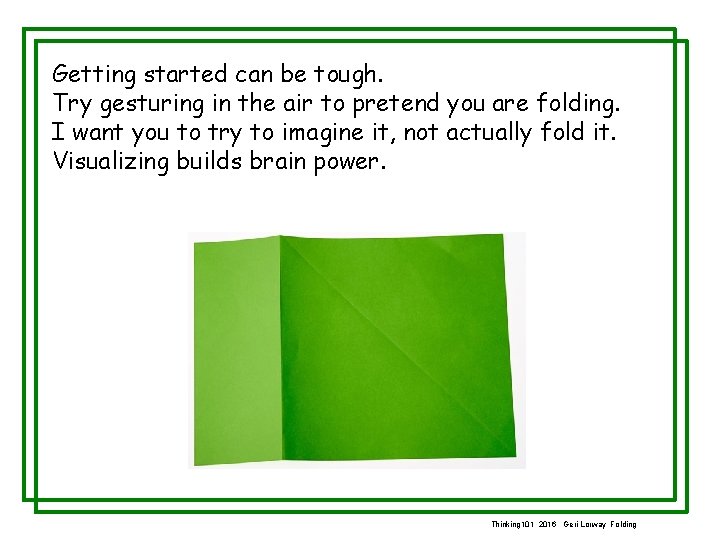
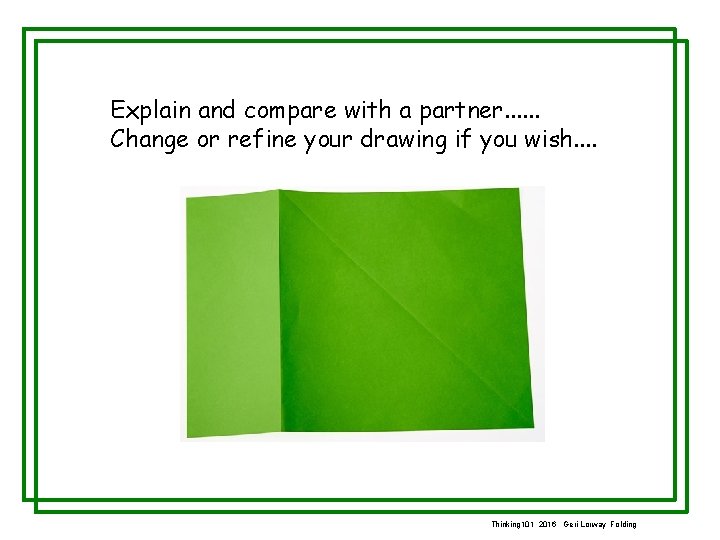
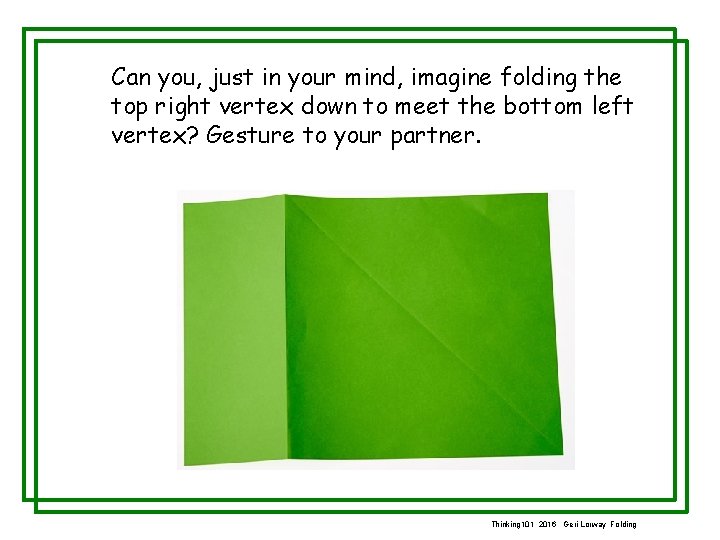
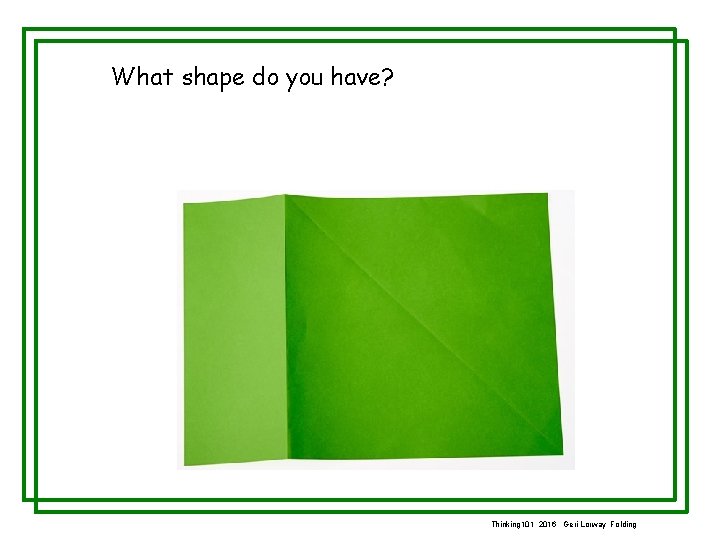
This fold runs vertically, (the paper is sitting in landscape view) Origami calls this a “mountain” fold. It looks like you are folding the paper back. Fold 1. Thinking 101 2016 Geri Lorway Folding
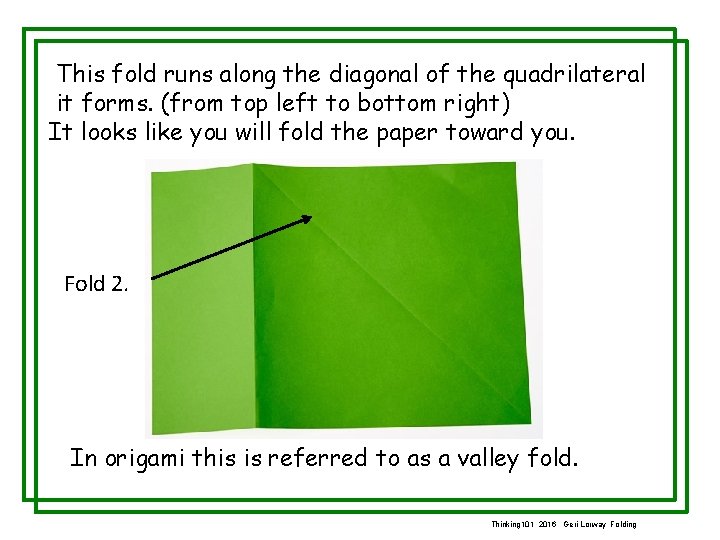
This fold runs along the diagonal of the quadrilateral it forms. (from top left to bottom right) It looks like you will fold the paper toward you. Fold 2. In origami this is referred to as a valley fold. Thinking 101 2016 Geri Lorway Folding
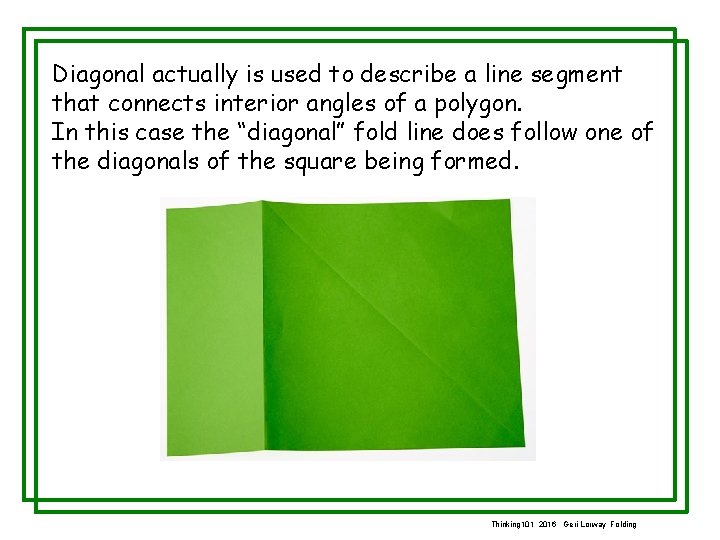
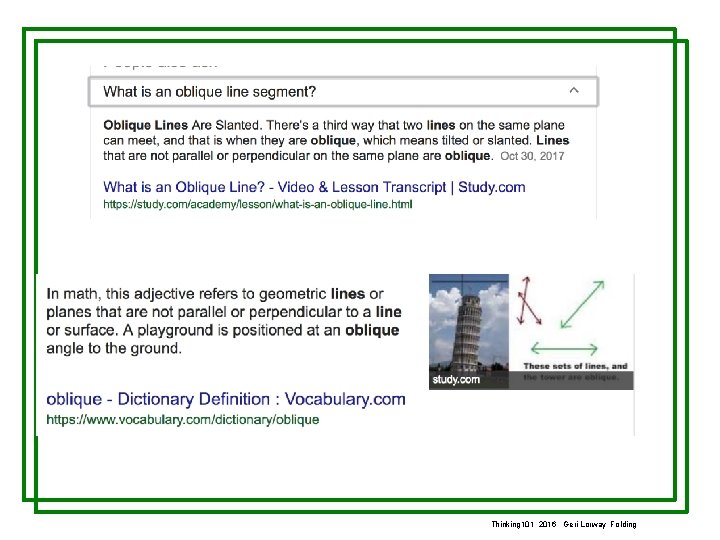
Diagonal actually is used to describe a line segment that connects interior angles of a polygon. In this case the “diagonal” fold line does follow one of the diagonals of the square being formed. Thinking 101 2016 Geri Lorway Folding
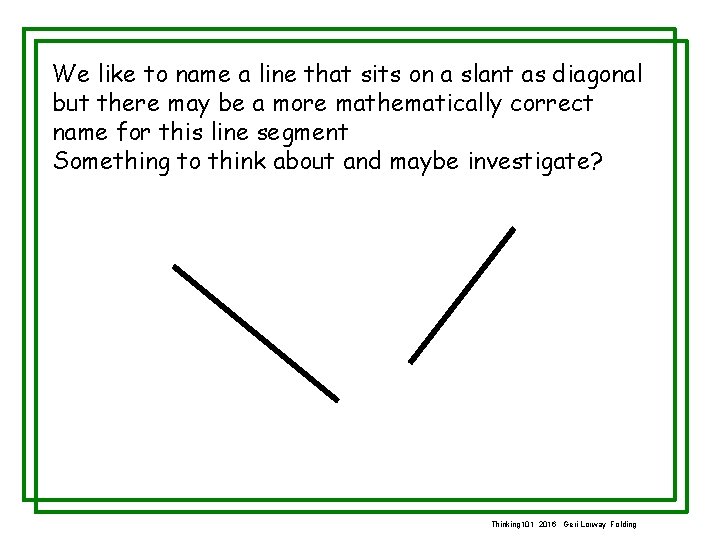
We like to name a line that sits on a slant as diagonal but there may be a more mathematically correct name for this line segment Something to think about and maybe investigate? Thinking 101 2016 Geri Lorway Folding
Thinking 101 2016 Geri Lorway Folding
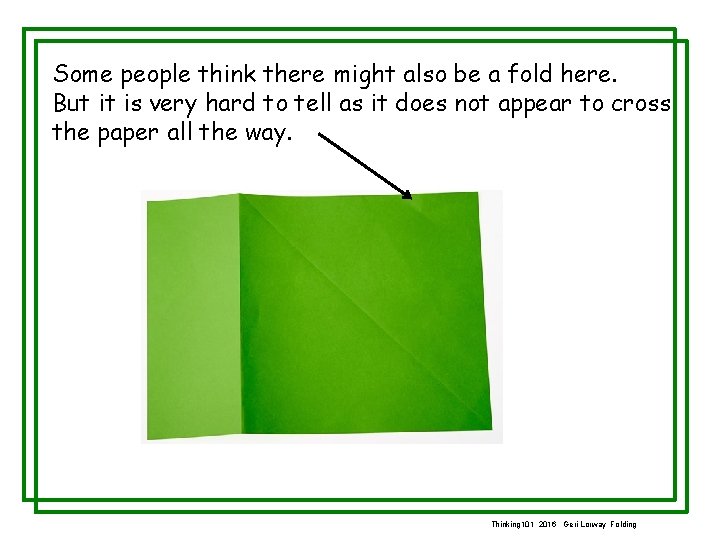
Some people think there might also be a fold here. But it is very hard to tell as it does not appear to cross the paper all the way. Thinking 101 2016 Geri Lorway Folding
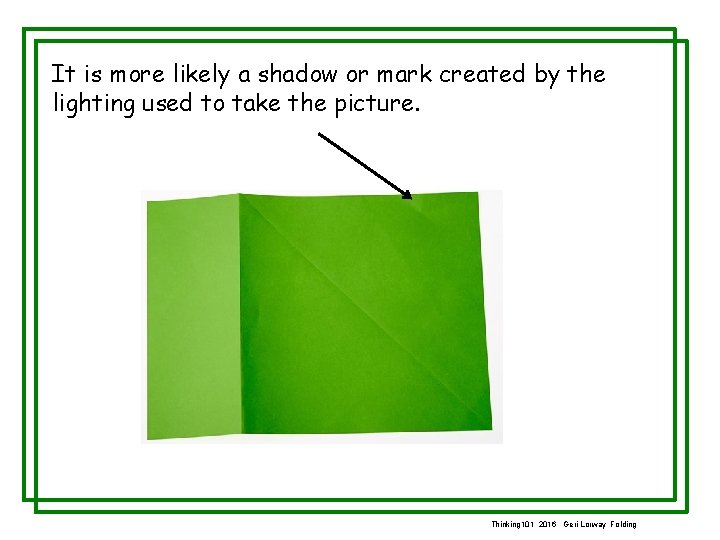
It is more likely a shadow or mark created by the lighting used to take the picture. Thinking 101 2016 Geri Lorway Folding
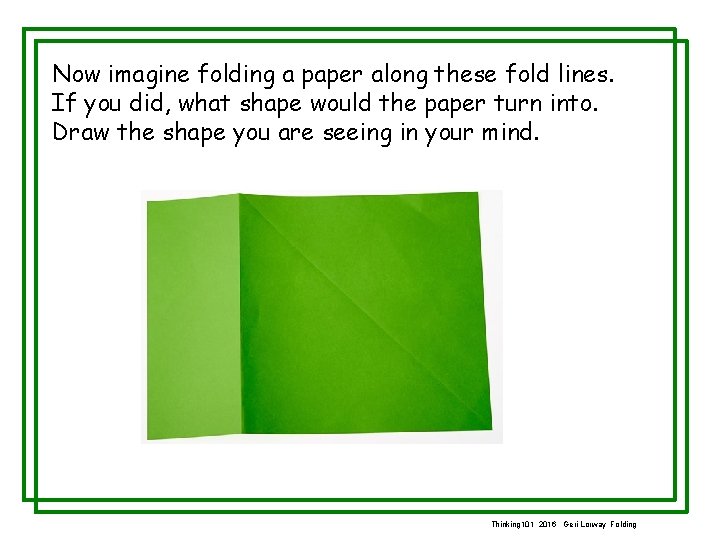
Now imagine folding a paper along these fold lines. If you did, what shape would the paper turn into. Draw the shape you are seeing in your mind. Thinking 101 2016 Geri Lorway Folding
Getting started can be tough. Try gesturing in the air to pretend you are folding. I want you to try to imagine it, not actually fold it. Visualizing builds brain power. Thinking 101 2016 Geri Lorway Folding
Explain and compare with a partner. . . Change or refine your drawing if you wish. . Thinking 101 2016 Geri Lorway Folding
Can you, just in your mind, imagine folding the top right vertex down to meet the bottom left vertex? Gesture to your partner. Thinking 101 2016 Geri Lorway Folding
What shape do you have? Thinking 101 2016 Geri Lorway Folding
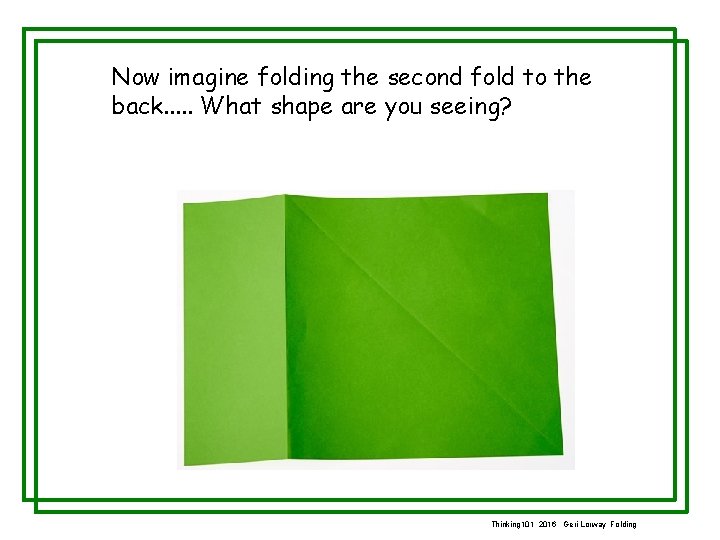
Now imagine folding the second fold to the back. . . What shape are you seeing? Thinking 101 2016 Geri Lorway Folding
Fold to see if your visualization was accurate. . . Thinking 101 2016 Geri Lorway Folding
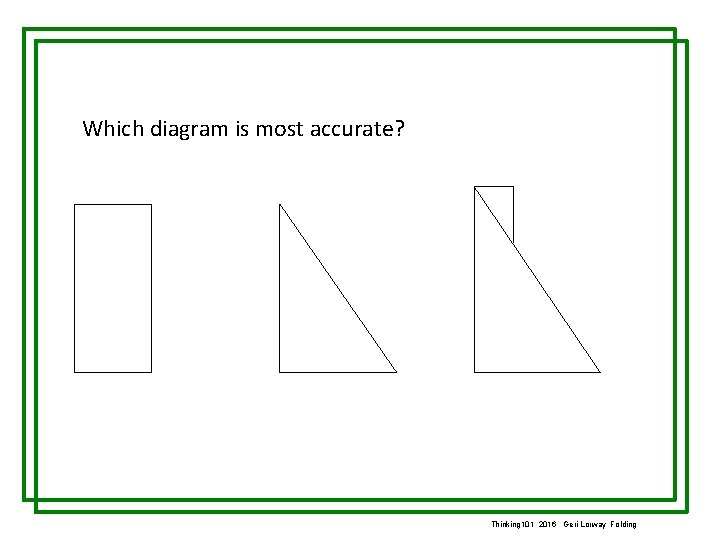
Which diagram is most accurate? Thinking 101 2016 Geri Lorway Folding
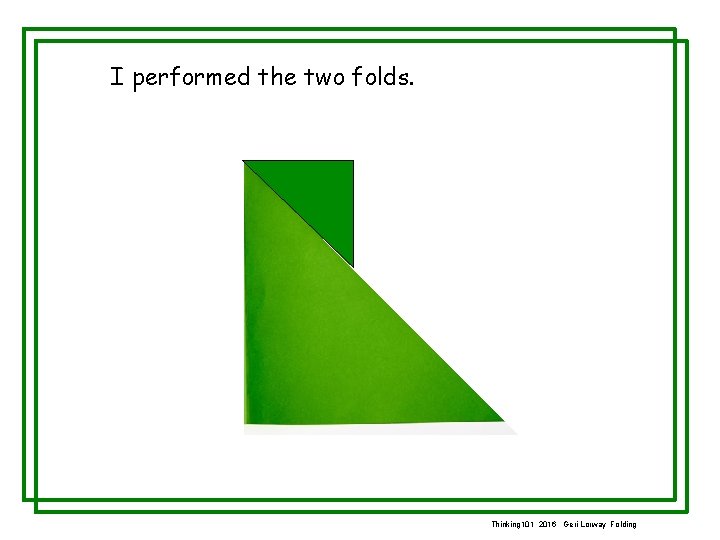
I performed the two folds. Thinking 101 2016 Geri Lorway Folding
Here’s a new one? Thinking 101 2016 Geri Lorway Folding
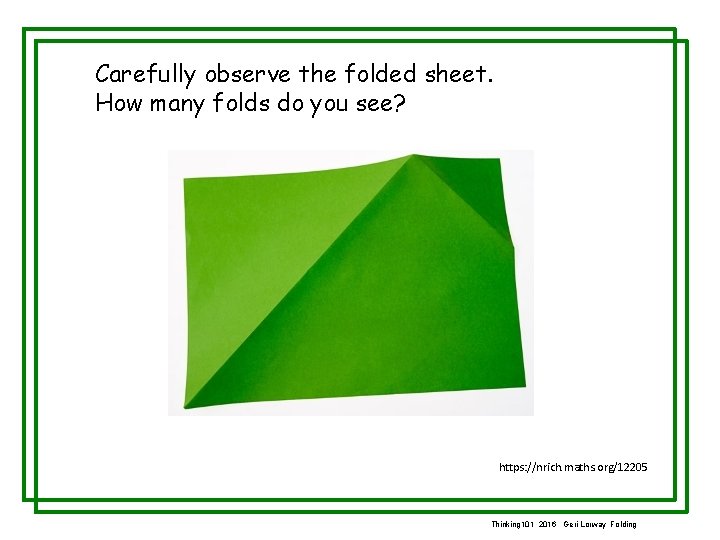
Carefully observe the folded sheet. How many folds do you see? https: //nrich. maths. org/12205 Thinking 101 2016 Geri Lorway Folding
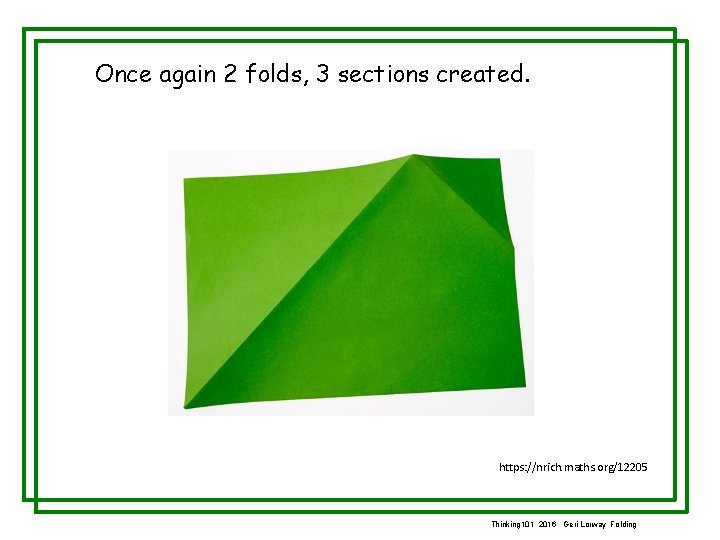
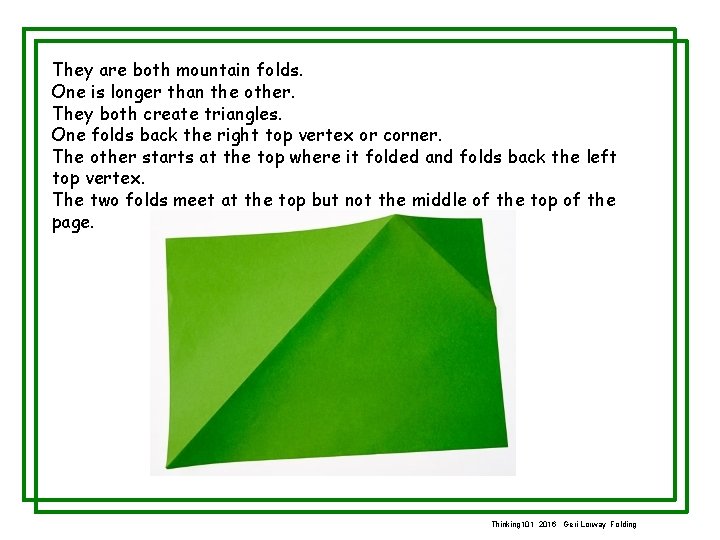
Once again 2 folds, 3 sections created. https: //nrich. maths. org/12205 Thinking 101 2016 Geri Lorway Folding
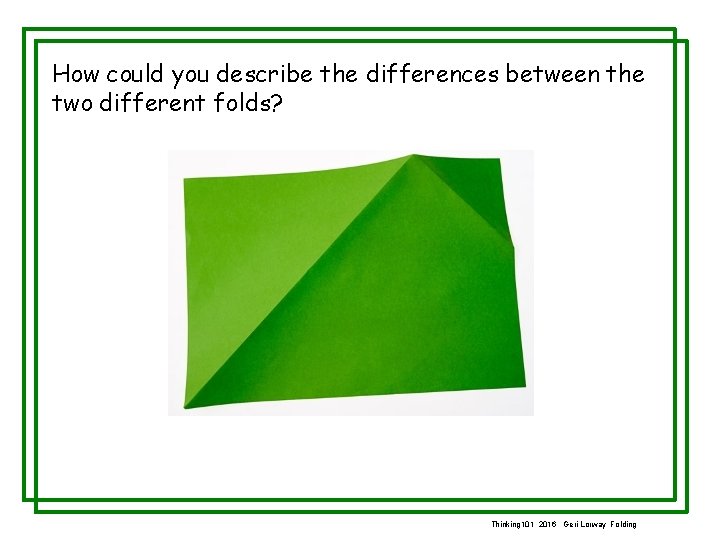
How could you describe the differences between the two different folds? Thinking 101 2016 Geri Lorway Folding
They are both mountain folds. One is longer than the other. They both create triangles. One folds back the right top vertex or corner. The other starts at the top where it folded and folds back the left top vertex. The two folds meet at the top but not the middle of the top of the page. Thinking 101 2016 Geri Lorway Folding
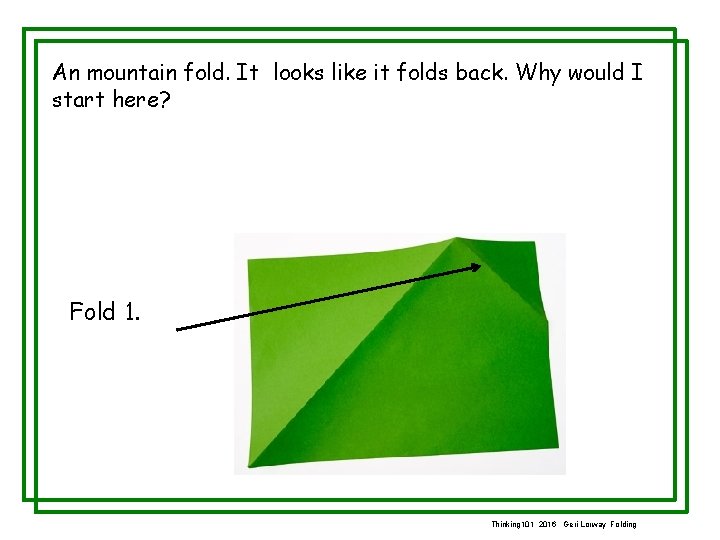
An mountain fold. It looks like it folds back. Why would I start here? Fold 1. Thinking 101 2016 Geri Lorway Folding
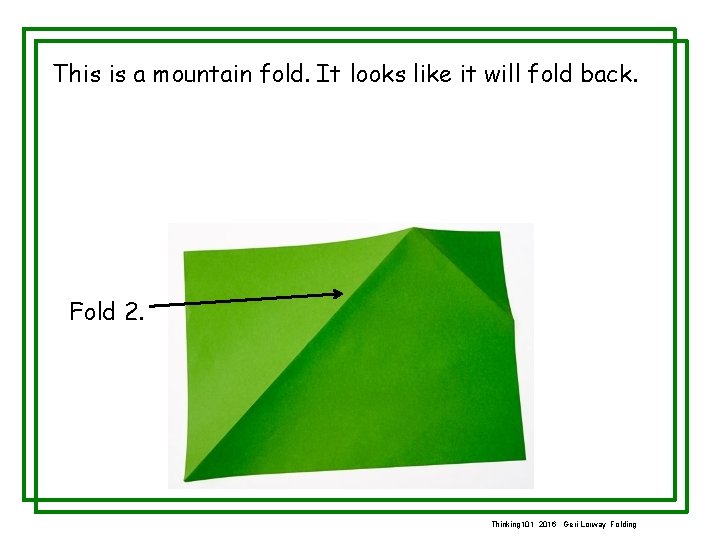
This is a mountain fold. It looks like it will fold back. Fold 2. Thinking 101 2016 Geri Lorway Folding
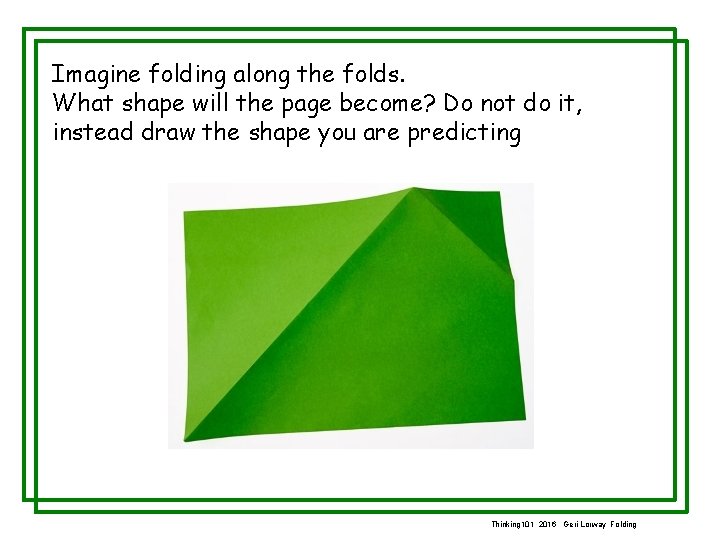
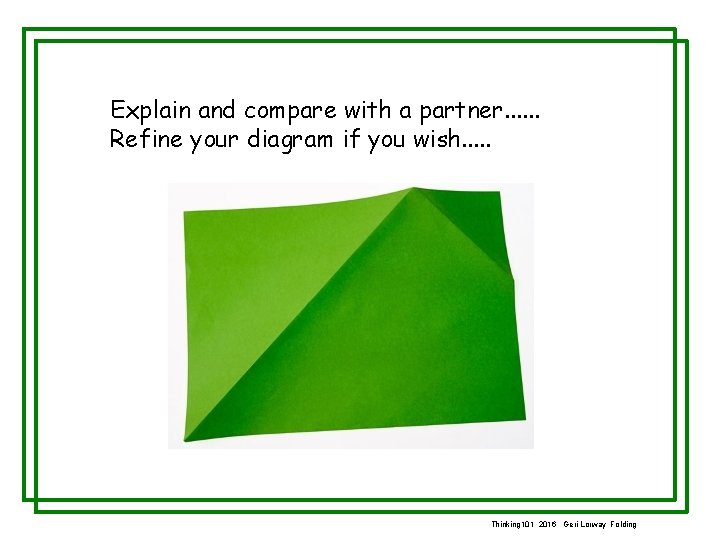
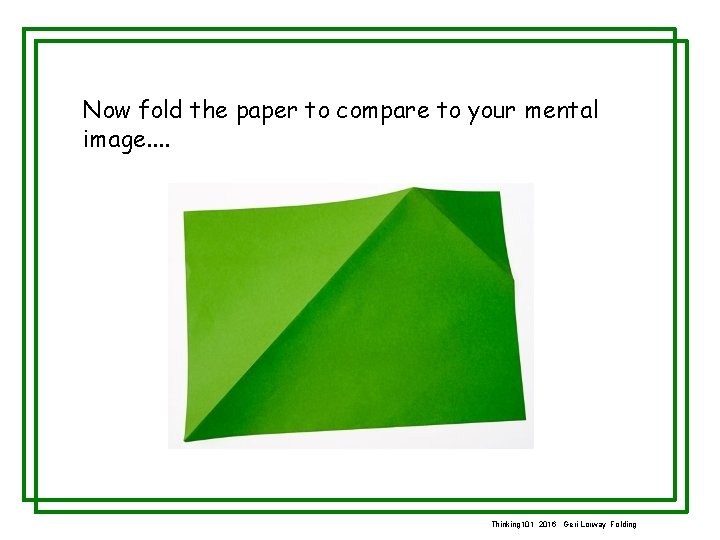
Imagine folding along the folds. What shape will the page become? Do not do it, instead draw the shape you are predicting Thinking 101 2016 Geri Lorway Folding
Explain and compare with a partner. . . Refine your diagram if you wish. . . Thinking 101 2016 Geri Lorway Folding
Now fold the paper to compare to your mental image. . Thinking 101 2016 Geri Lorway Folding
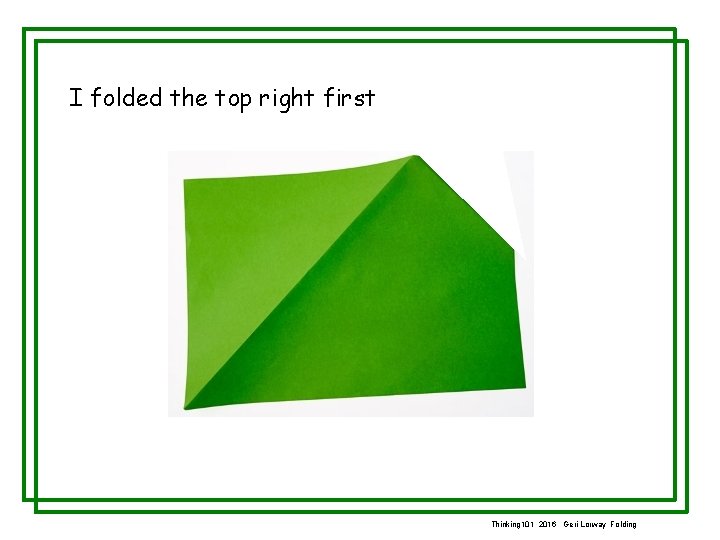
I folded the top right first Thinking 101 2016 Geri Lorway Folding
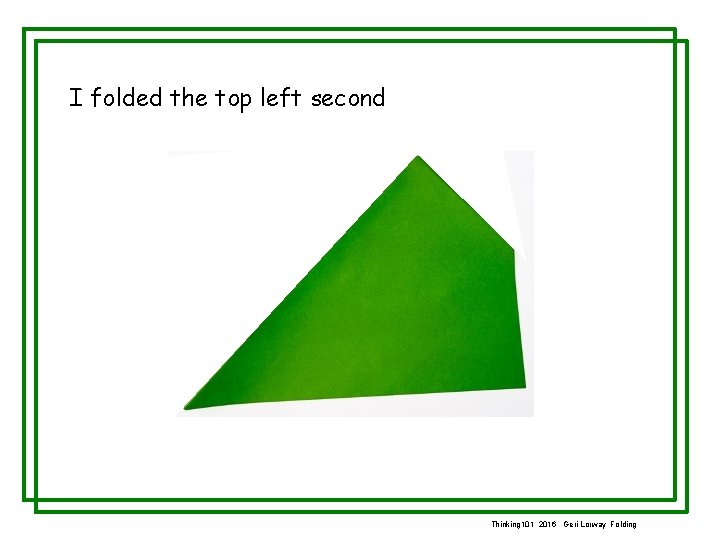
I folded the top left second Thinking 101 2016 Geri Lorway Folding
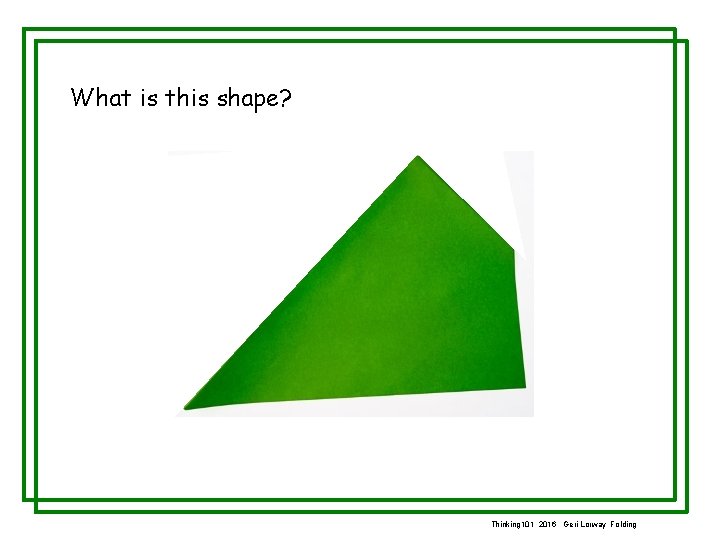
What is this shape? Thinking 101 2016 Geri Lorway Folding
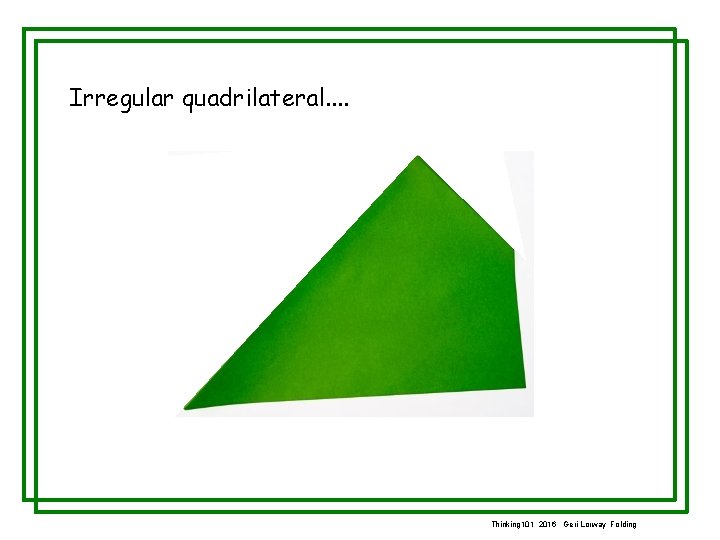
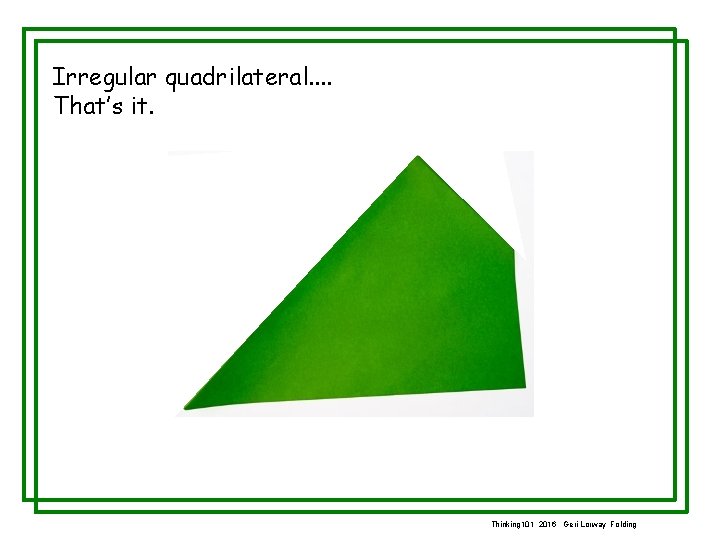
Irregular quadrilateral. . Thinking 101 2016 Geri Lorway Folding
Irregular quadrilateral. . That’s it. Thinking 101 2016 Geri Lorway Folding
Ready for a new one? Thinking 101 2016 Geri Lorway Folding
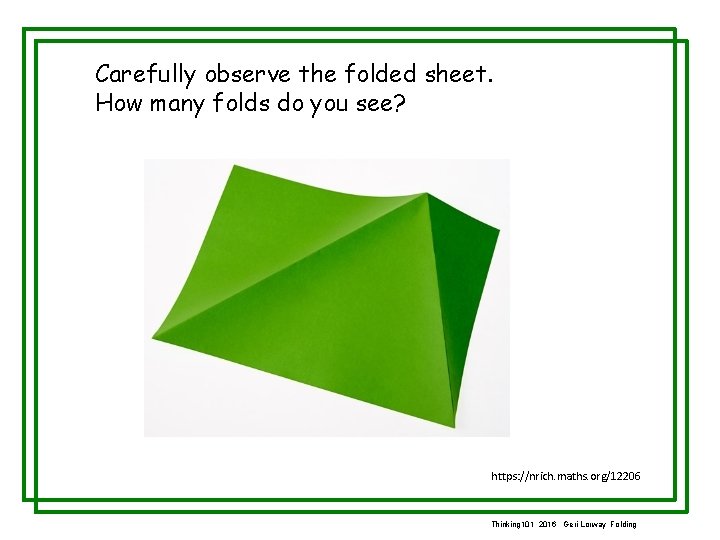
Carefully observe the folded sheet. How many folds do you see? https: //nrich. maths. org/12206 Thinking 101 2016 Geri Lorway Folding
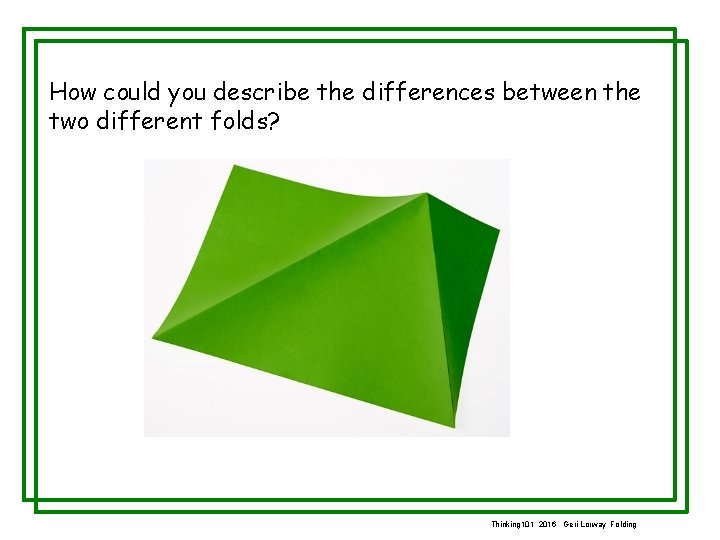
How could you describe the differences between the two different folds? Thinking 101 2016 Geri Lorway Folding
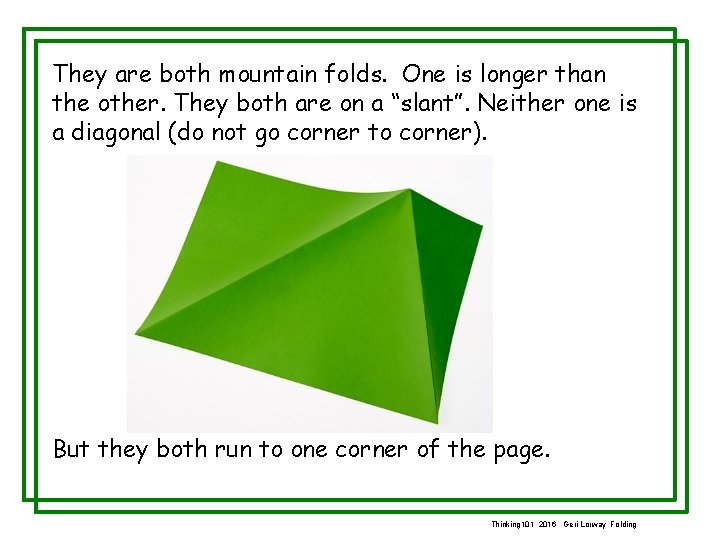
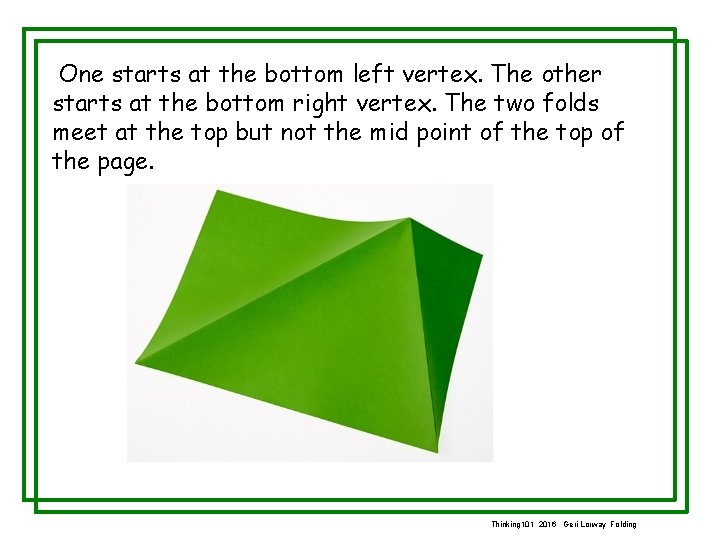
They are both mountain folds. One is longer than the other. They both are on a “slant”. Neither one is a diagonal (do not go corner to corner). But they both run to one corner of the page. Thinking 101 2016 Geri Lorway Folding
One starts at the bottom left vertex. The other starts at the bottom right vertex. The two folds meet at the top but not the mid point of the top of the page. Thinking 101 2016 Geri Lorway Folding
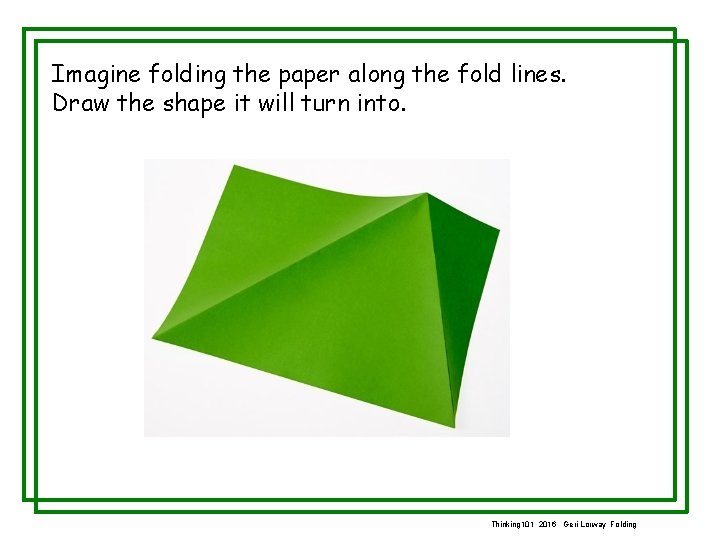
Imagine folding the paper along the fold lines. Draw the shape it will turn into. Thinking 101 2016 Geri Lorway Folding
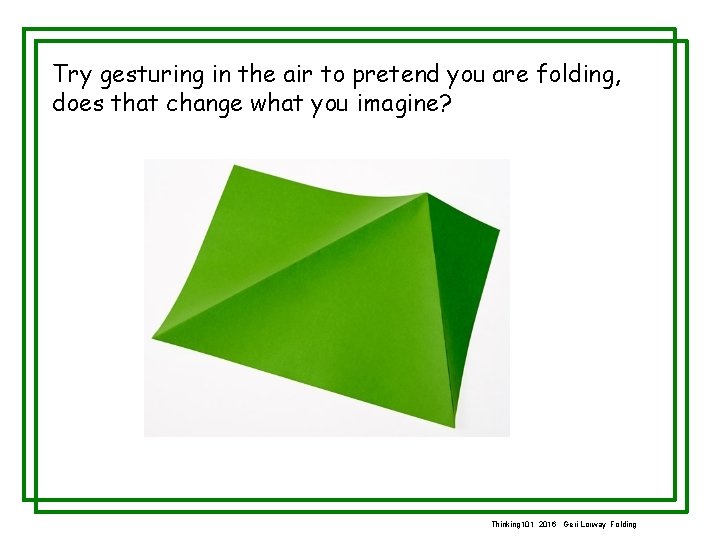
Try gesturing in the air to pretend you are folding, does that change what you imagine? Thinking 101 2016 Geri Lorway Folding
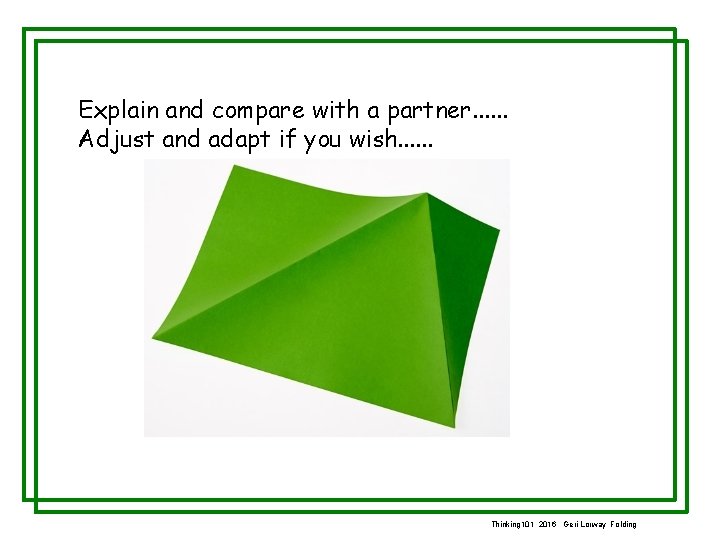
Explain and compare with a partner. . . Adjust and adapt if you wish. . . Thinking 101 2016 Geri Lorway Folding
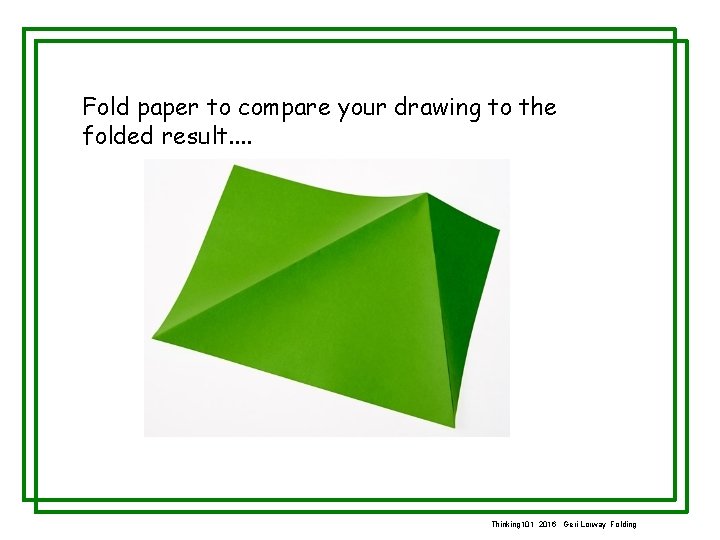
Fold paper to compare your drawing to the folded result. . Thinking 101 2016 Geri Lorway Folding
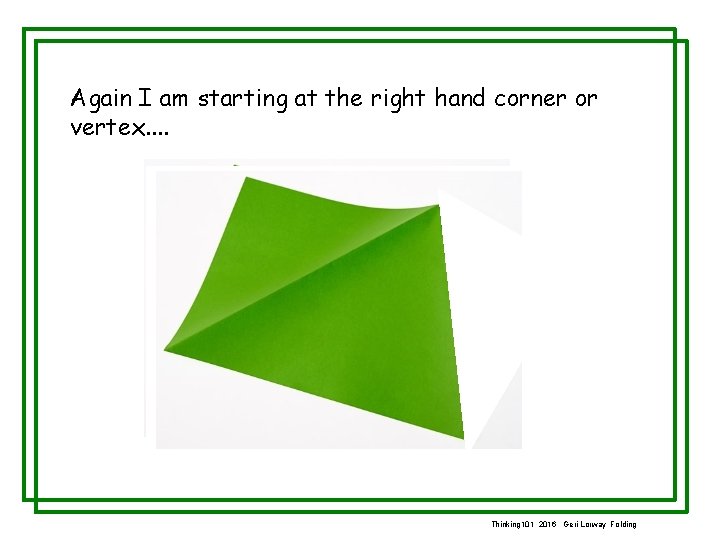
Again I am starting at the right hand corner or vertex. . Thinking 101 2016 Geri Lorway Folding
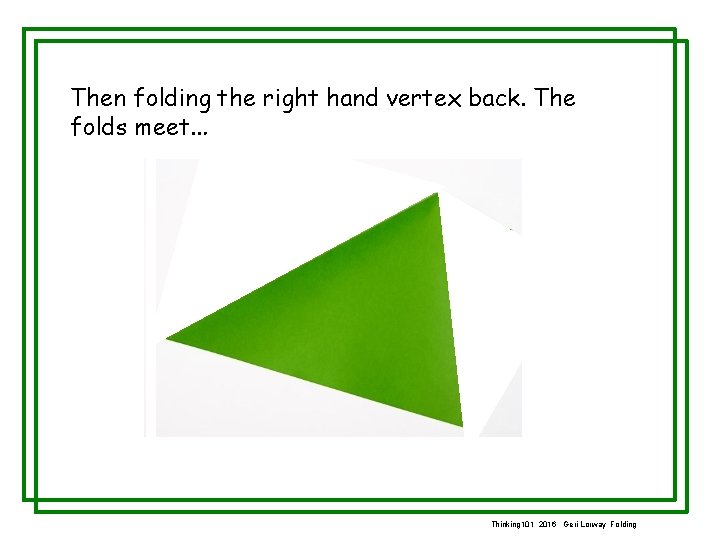
Then folding the right hand vertex back. The folds meet. . . Thinking 101 2016 Geri Lorway Folding
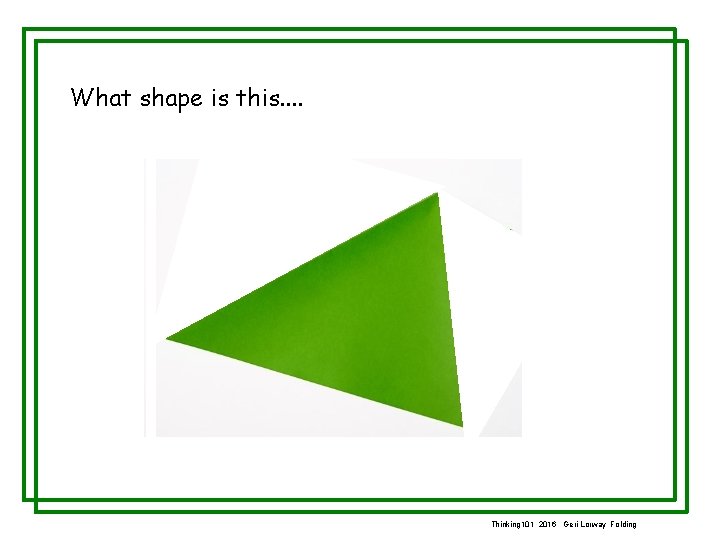
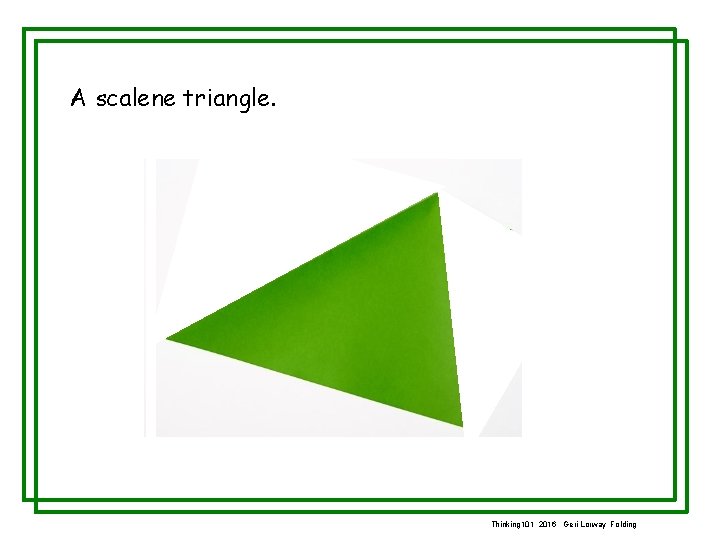
What shape is this. . Thinking 101 2016 Geri Lorway Folding
A scalene triangle. Thinking 101 2016 Geri Lorway Folding
Ready for a new fold? Thinking 101 2016 Geri Lorway Folding
Carefully observe the folded sheet. How many folds do you see? https: //nrich. maths. org/12203 Thinking 101 2016 Geri Lorway Folding
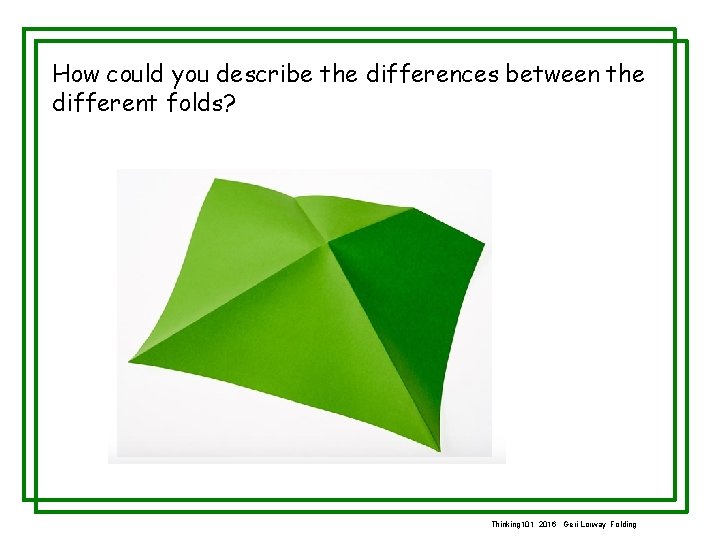
How could you describe the differences between the different folds? Thinking 101 2016 Geri Lorway Folding
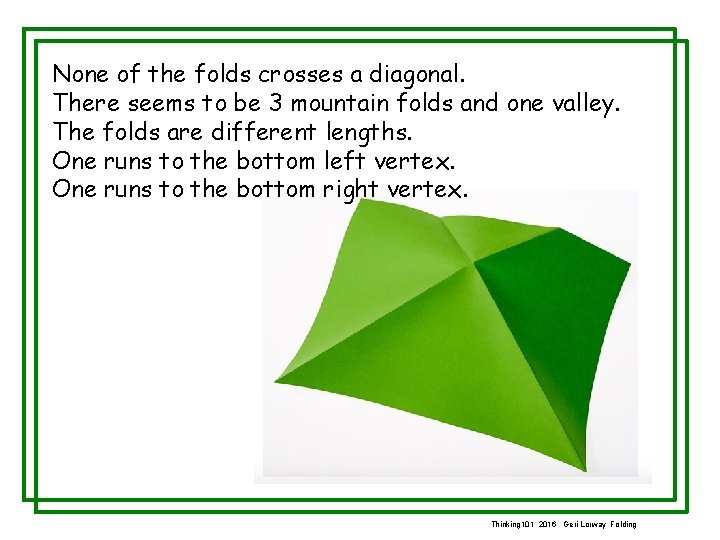
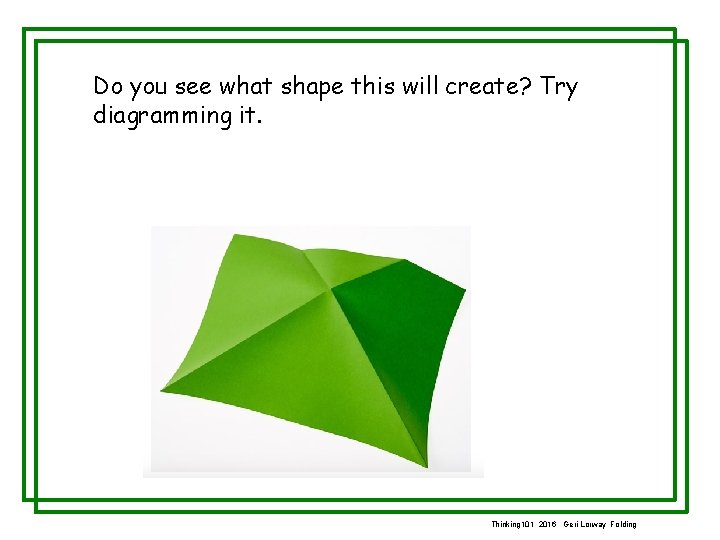
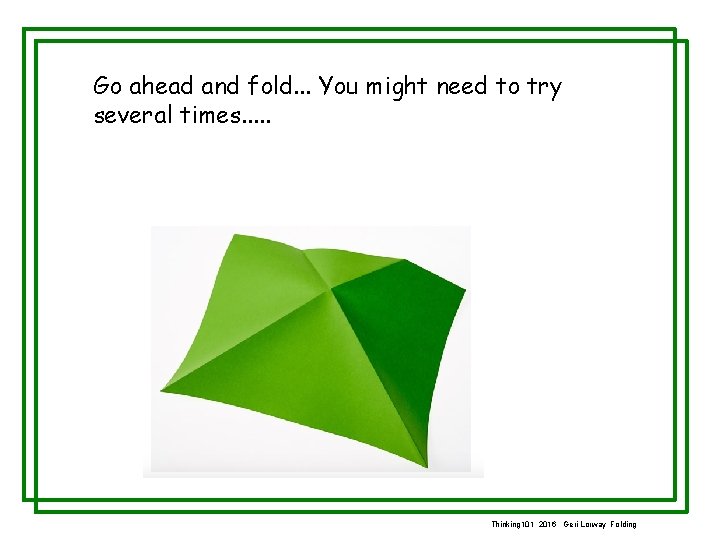
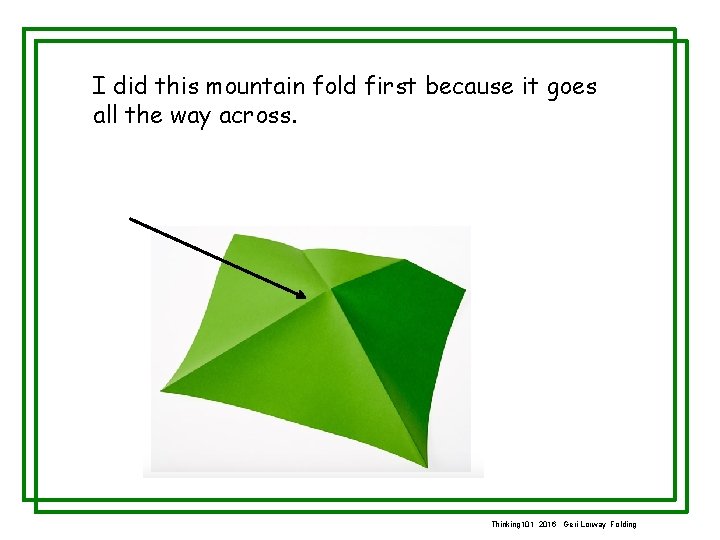
None of the folds crosses a diagonal. There seems to be 3 mountain folds and one valley. The folds are different lengths. One runs to the bottom left vertex. One runs to the bottom right vertex. Thinking 101 2016 Geri Lorway Folding
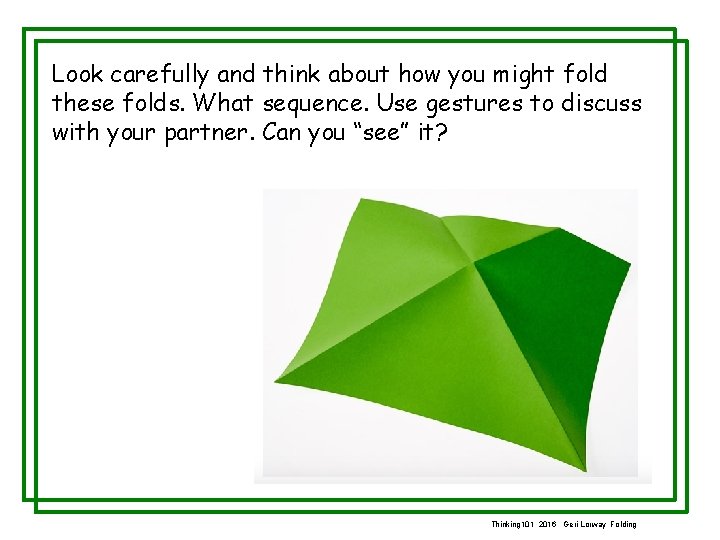
Look carefully and think about how you might fold these folds. What sequence. Use gestures to discuss with your partner. Can you “see” it? Thinking 101 2016 Geri Lorway Folding
Do you see what shape this will create? Try diagramming it. Thinking 101 2016 Geri Lorway Folding
Go ahead and fold. . . You might need to try several times. . . Thinking 101 2016 Geri Lorway Folding
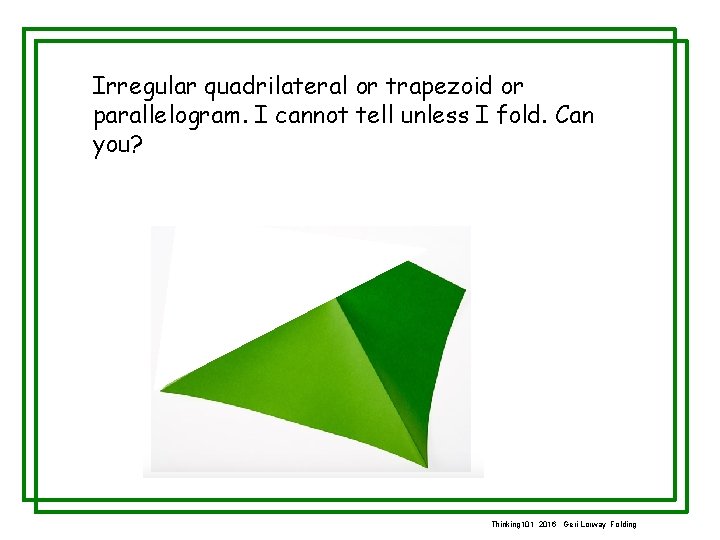
I did this mountain fold first because it goes all the way across. Thinking 101 2016 Geri Lorway Folding
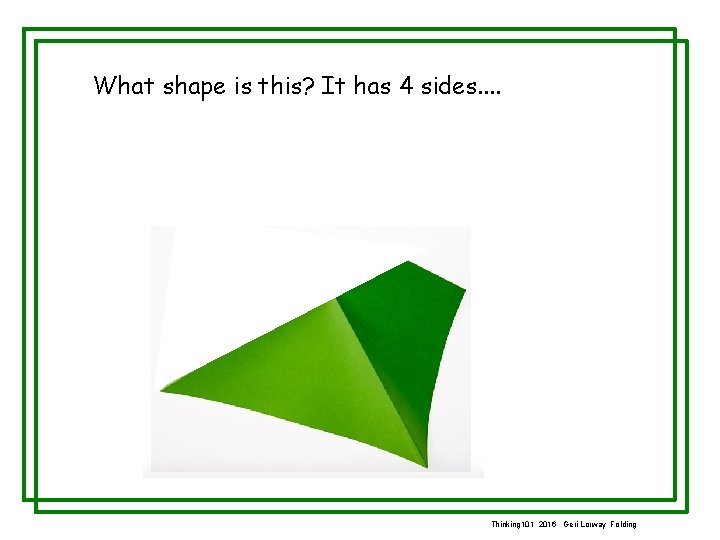
What shape is this? It has 4 sides. . Thinking 101 2016 Geri Lorway Folding
Irregular quadrilateral or trapezoid or parallelogram. I cannot tell unless I fold. Can you? Thinking 101 2016 Geri Lorway Folding
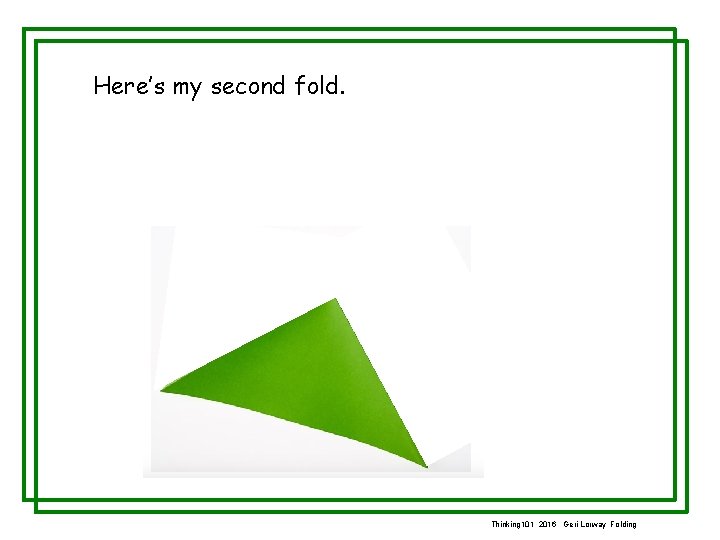
Here’s my second fold. Thinking 101 2016 Geri Lorway Folding
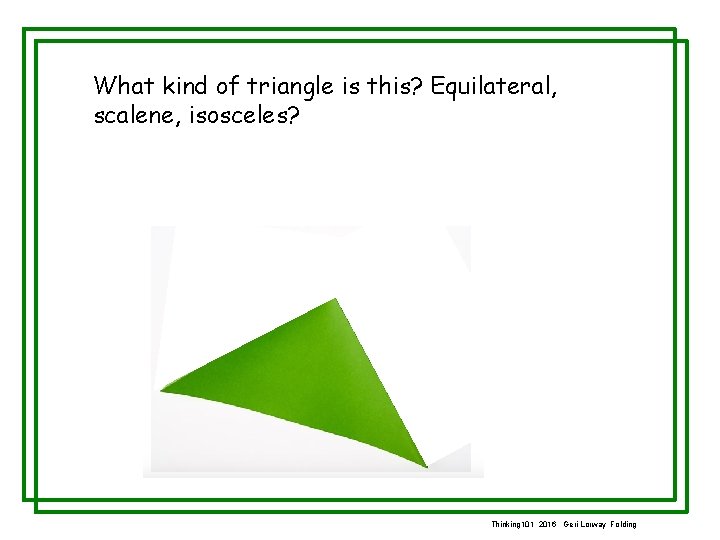
What kind of triangle is this? Equilateral, scalene, isosceles? Thinking 101 2016 Geri Lorway Folding
You have completed 4 Green Paper folds. Time to make your own. Take a picture and build a set of questions. Thinking 101 2016 Geri Lorway Folding
Mix and Cheng, 2012, gave students tasks that practiced spatial reasoning skills. The tasks had nothing to do with numbers. Paper folding is one such task. Thinking 101 2016 Geri Lorway Folding
After several weeks, they checked the students’ arithmetic skills and found there was a very clear improvement. especially on missing number questions like 5 + ? = 8 Thinking 101 2016 Geri Lorway Folding
Paper folding improves your ability to reason and think. It increases achievement in both mathematics and science. It makes you smarter. Thinking 101 2016 Geri Lorway Folding
https: //nrich. maths. org/12236 I found these folded shapes at nrich math. . . They have some great tasks and problems. Thinking 101 2016 Geri Lorway Folding