
ReadWrite Web Revolution Dr Steve Broskoske Misericordia University
Read/Write Web Revolution Dr. Steve Broskoske Misericordia University
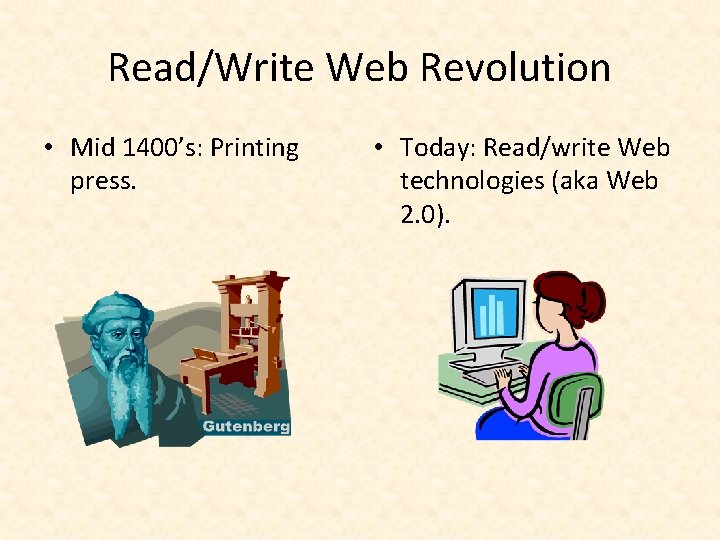
Read/Write Web Revolution • Mid 1400’s: Printing press. • Today: Read/write Web technologies (aka Web 2. 0).
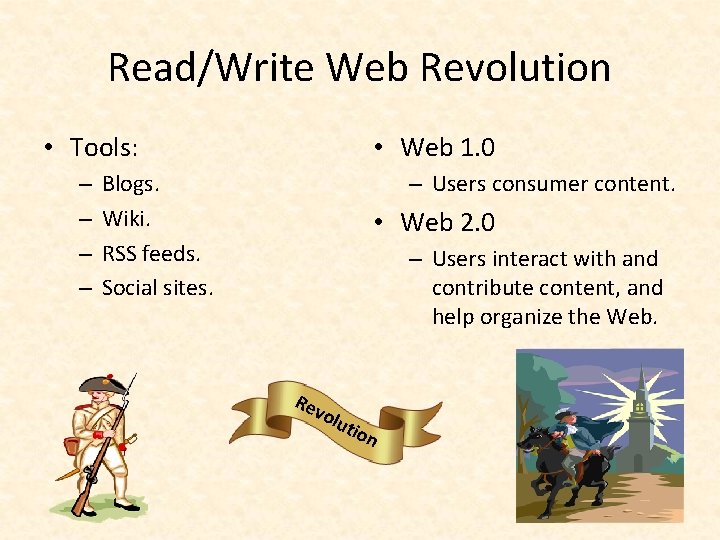
Read/Write Web Revolution • Tools: – – • Web 1. 0 Blogs. Wiki. RSS feeds. Social sites. – Users consumer content. • Web 2. 0 – Users interact with and contribute content, and help organize the Web. Re vol uti on
Read/Write Web Revolution • Amazon. com – Sells products. – Displays popular items. – Ask for input/feedback from consumers. – Provide customized choices based on buying habits. Users add value to the Web.

Read/Write Web Revolution • Users help construct knowledge (contribute) vs. being passive absorbers. • Content is constantly updated by everyone vs. occasionally by experts. • Through tags and other devices, users help to organize the material based on how people use the material. • Collaboration can motivate and excite.
New Literacies • • Evaluating and editing content. Use of publishing outlets. Management of information. Collaboration skills.
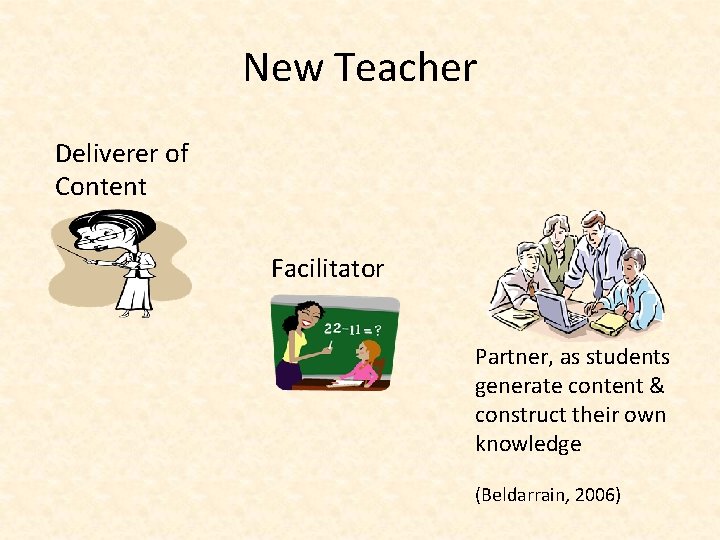
New Teacher Deliverer of Content Facilitator Partner, as students generate content & construct their own knowledge (Beldarrain, 2006)
Changing Environment Information scarcity: • Memorizing of facts is important. • Controlling access to scarce resources gives power. • Teaching involves exposing students to information and info. sources. Information abundance: • Memorizing of facts is unimportant. • Ability to locate and evaluate info. is important. • Ability to recognize patterns and make connections is important. Education is changing from memorizing to locating and harnessing information.
Connectivism • Learning is no longer a personal activity performed in isolation within an information scarce environment. • Connectivism is a new educational theory that reflects this fact and the understanding that certain skills and tools will be required. Re vol uti on
Wiki: Collaborative Web Pages
What Is Wiki? • Wiki – Comes from the Hawaiian term, wiki (meaning "quick"). – Wiki is a “quick” Web page that readers of the Web page can edit. Just press the “edit” button. First Wiki was created in 1995.
Changes in Communication and News • How many people don’t trust Wikipedia as a primary news/info. source? Wikipedia (and the Web) is becoming the sum of all human knowledge and experience.
Reasons for Validity of Wikipedia • • Everyone uses it. Many editors. Becoming a trusted source Easy to track the editors and remove vandalism. APA (version 6) recognizes the following sources: Newsgroup, online forum comment, electronic mailing list message, web log post, video file.
c A p ou r G y it vit Wiki. Media Foundation Products • Wiki. Media Foundation offers many “sister projects” to Wikipedia: – Commons – Wiki. Quote – Wiki. Species – Wiki. News – Wiki. Books – Wikiversity – Wiktionary – Wiki. Source In a small group, briefly explore these products. What do they offer? How could a teacher use these in his/her classroom? Wiki. Media Foundation Products
Using Wiki in the Classroom • Students learn: – Democratic process of knowledge construction. – To negotiate meaning, relevance, wording, accuracy. – To respect intellectual property, and the work and ideas of others.
Using Wiki in the Classroom • Benefits to students: – Facilitates collaboration. – Allows students to learn from the work of other students (along with edits by the teacher). – Enhances student motivation. – Can provide more student control and independence in learning activity. – Allows students to participate in a meaningful, real-life project (work could be made public).
When Creating a Wiki 1. Add your material. – In addition to text, you can add links, files, graphics, and much more! 2. Help to edit/organize the material. – Help make the page look like one cohesive document vs. a collection of individual contributions.
Wiki Assignment In Mod 1, we stated that many hot topics in the field of education deal with technology. 1) From the list of online educational technology journals provided, select and read one article that describes a current important topic in educational technology. 2) In your own words, briefly (in one paragraph) describe the issue and its significance to education (e. g. , how might it might affect students and/or teachers). Add this information to this Wiki. 3) Then, as a group, let's organize the page so that it provides a cohesive list of hot topics in educational technology.
Orientation to Wiki • Blackboard – In Blackboard, find our Wiki in module 2. – Let’s get a Wiki orientation. Blackboard Wiki
Blog: First and Very Versatile Web 2. 0 Tool
Blogs • blog: Shortened form of the word weblog. Blogs are Web-based journal pages which are added one at a time, with the most recent on top. • Blog posts normally allow readers (many times members) to comment on each post, opening the possibility for dialogue.
How Are Blogs Being Used? • Provide content/news/information. • Update information on software/hardware products. • Allow people to interact with the news. Citizens Voice Times Leader One Teacher’s blog
Ways to Use Blogs • Students can: – Post material to show/document their progress on a project. – Post material that they learn as they research a topic. – Make comments about each other’s writing/work (peer reviews). Promotes critical, analytical, and reflective thinking.
Ways to Use Blogs • Teachers can: – Create a online book discussion. – Have students reflect on progress of a projectbased learning activity. – Post examples of student work for parents. – Build a class newsletter. – Have students comment on news items or issues. (Richardson, 2009)
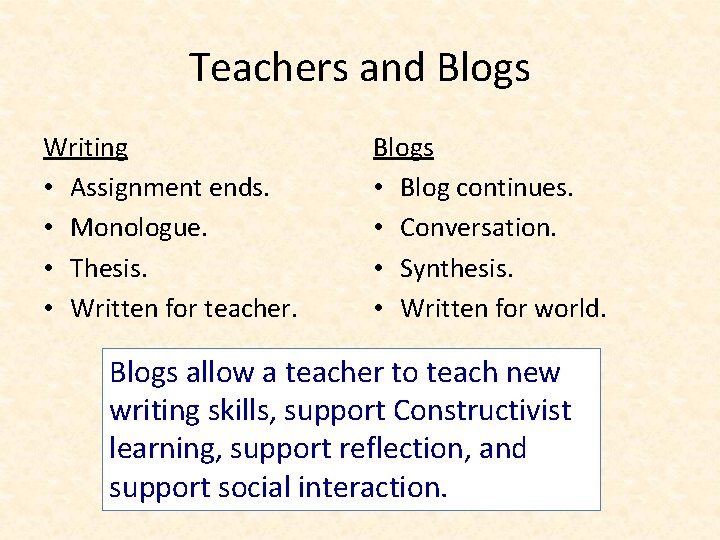
Teachers and Blogs Writing • Assignment ends. • Monologue. • Thesis. • Written for teacher. Blogs • Blog continues. • Conversation. • Synthesis. • Written for world. Blogs allow a teacher to teach new writing skills, support Constructivist learning, support reflection, and support social interaction.
c A p G rou y it vit How Are Blogs Used in Education? • In a small group, examine of the blogs at the following link and determine how blogs are being used in the classroom. Educational Technology Blogs Educational Blogs
Blog Assignment • Blog: Incorporating Technology into Teaching • Throughout this semester we will consider many different technological tools that can be used in teaching. Make several posts (at least 5) over time as you discover new technology tools. For each blog post, briefly discuss: – What is the name of the technology? – How does the technology work? What does it do? – How/why might I use this tool in teaching?
Review • Read/write Web 2. 0 revolution! • Considered these technologies: – Wiki. – Blog. We will be examining and experimenting with more interactive technologies that can be used in the classroom throughout the course.
- Slides: 28