
Readout With Lab VIEW Arun Veeramani National Instruments
Readout With Lab. VIEW Arun Veeramani National Instruments
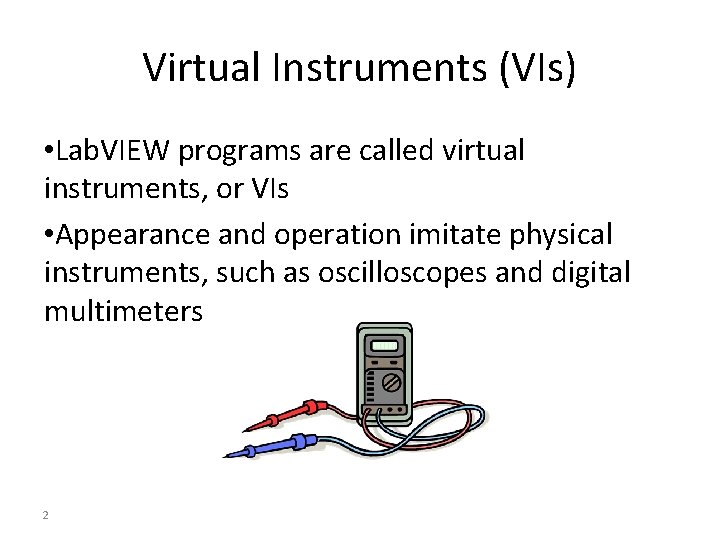
Virtual Instruments (VIs) • Lab. VIEW programs are called virtual instruments, or VIs • Appearance and operation imitate physical instruments, such as oscilloscopes and digital multimeters 2
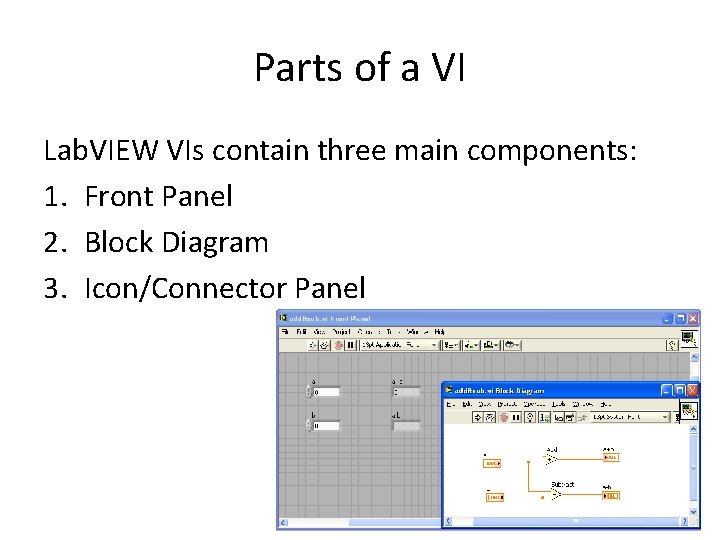
Parts of a VI Lab. VIEW VIs contain three main components: 1. Front Panel 2. Block Diagram 3. Icon/Connector Panel
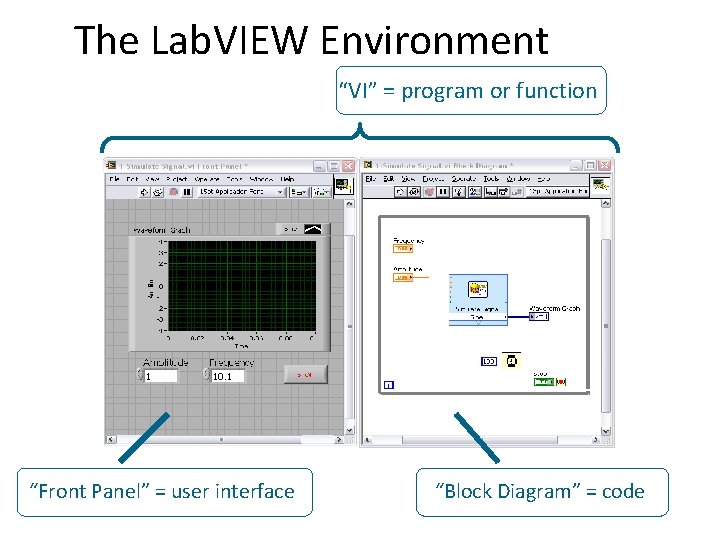
The Lab. VIEW Environment “VI” = program or function “Front Panel” = user interface “Block Diagram” = code
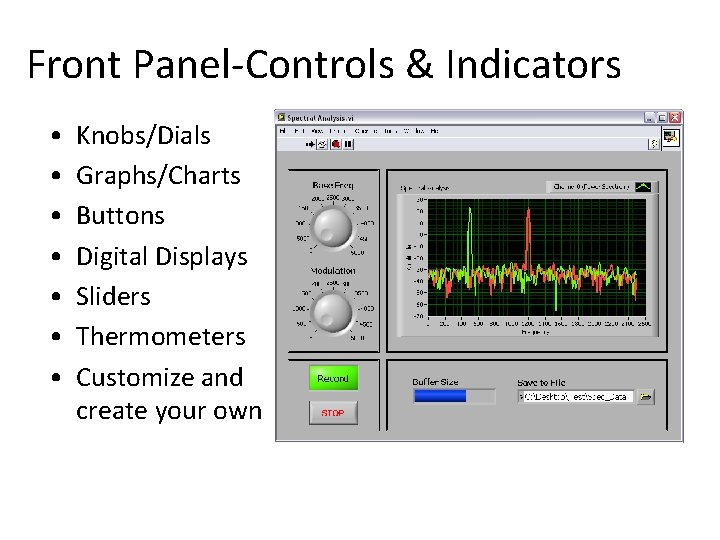
Front Panel-Controls & Indicators • • Knobs/Dials Graphs/Charts Buttons Digital Displays Sliders Thermometers Customize and create your own
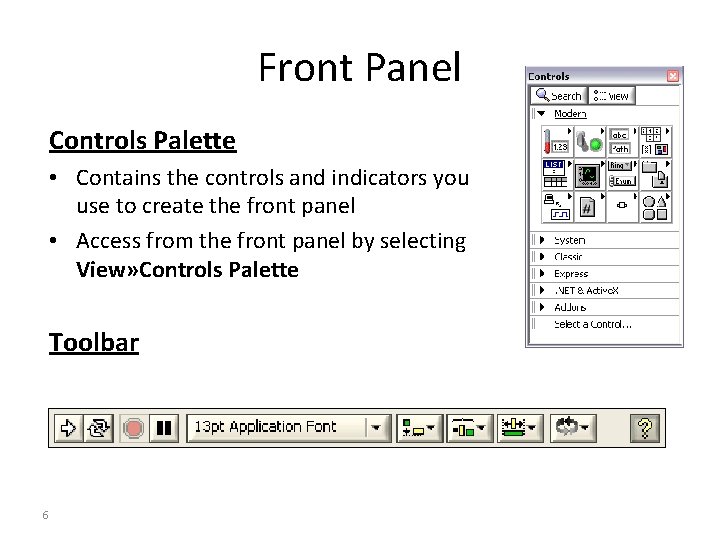
Front Panel Controls Palette • Contains the controls and indicators you use to create the front panel • Access from the front panel by selecting View» Controls Palette Toolbar 6
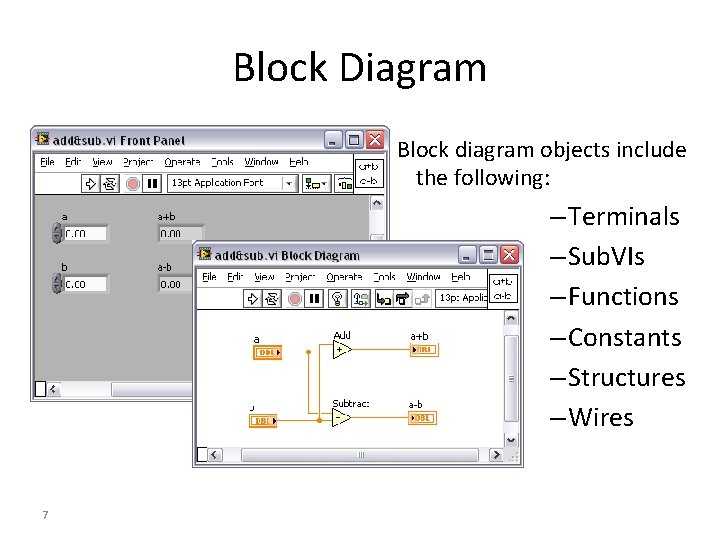
Block Diagram Block diagram objects include the following: – Terminals – Sub. VIs – Functions – Constants – Structures – Wires 7
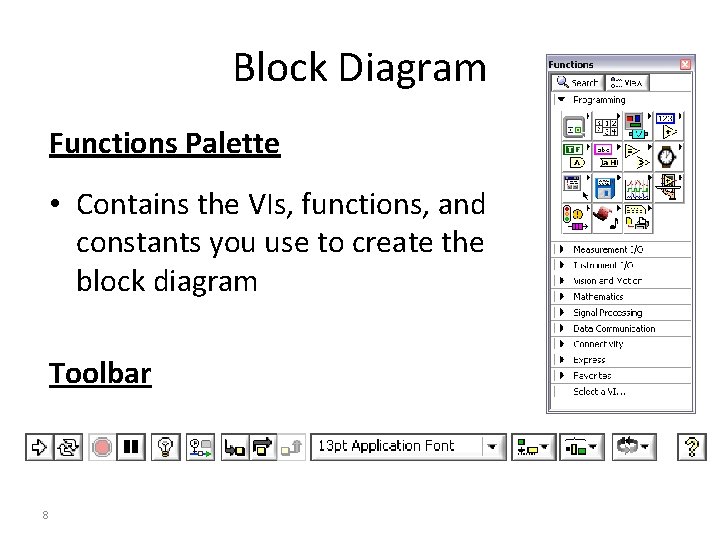
Block Diagram Functions Palette • Contains the VIs, functions, and constants you use to create the block diagram Toolbar 8
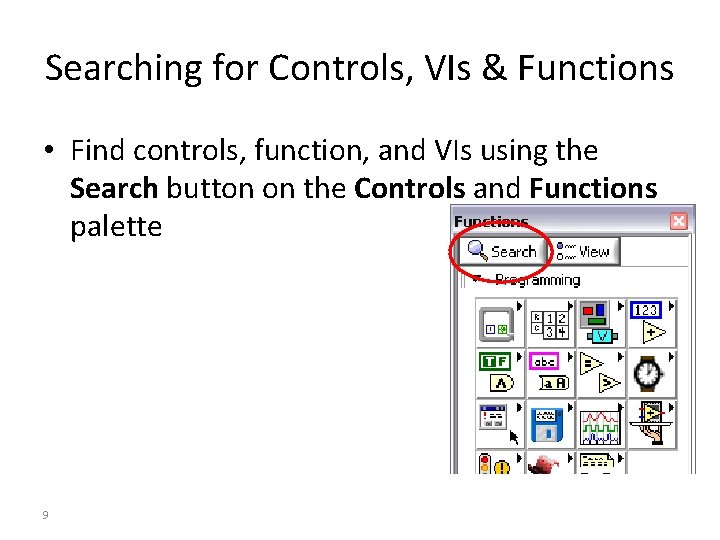
Searching for Controls, VIs & Functions • Find controls, function, and VIs using the Search button on the Controls and Functions palette 9
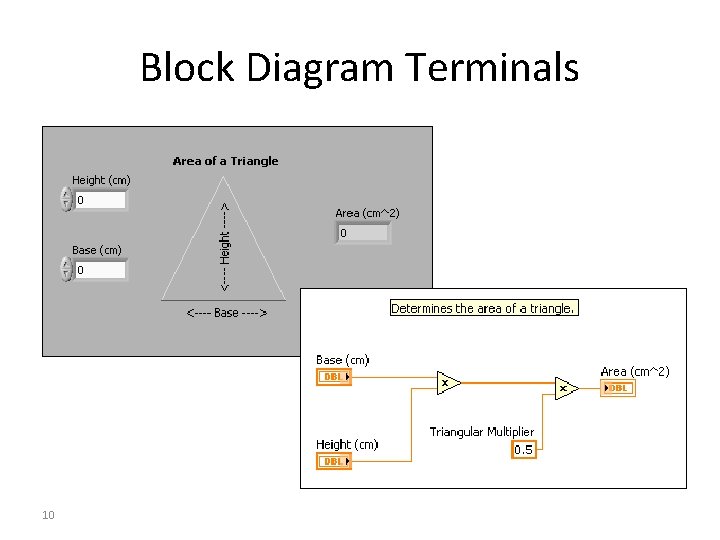
Block Diagram Terminals 10
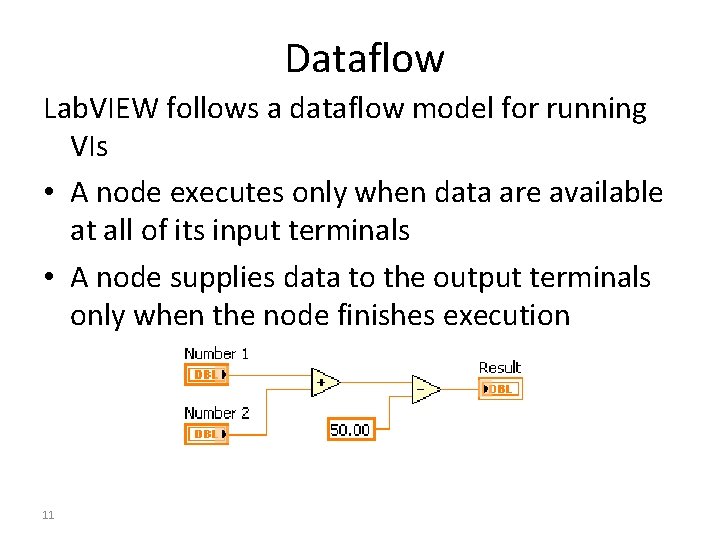
Dataflow Lab. VIEW follows a dataflow model for running VIs • A node executes only when data are available at all of its input terminals • A node supplies data to the output terminals only when the node finishes execution 11
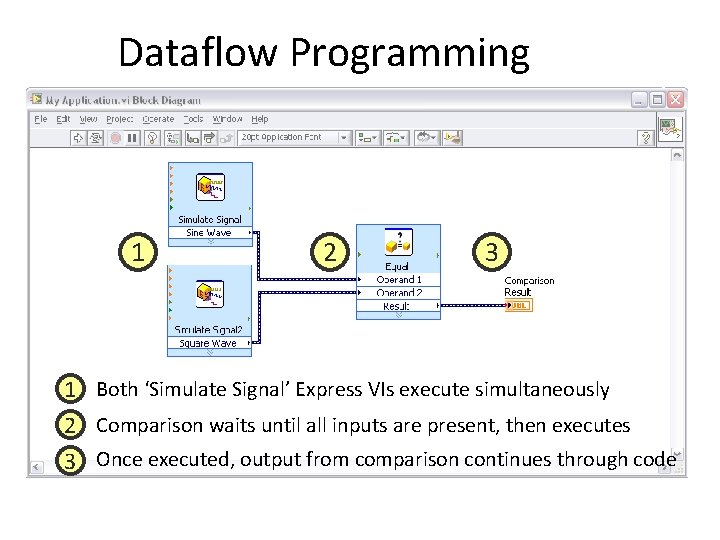
1 2 k oc a m Bl agr Di Dataflow Programming 3 1 Both ‘Simulate Signal’ Express VIs execute simultaneously 2 Comparison waits until all inputs are present, then executes 3 Once executed, output from comparison continues through code
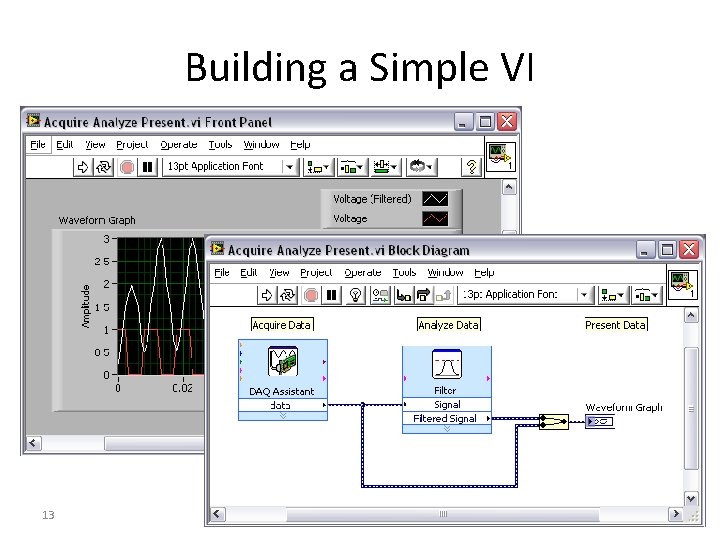
Building a Simple VI 13
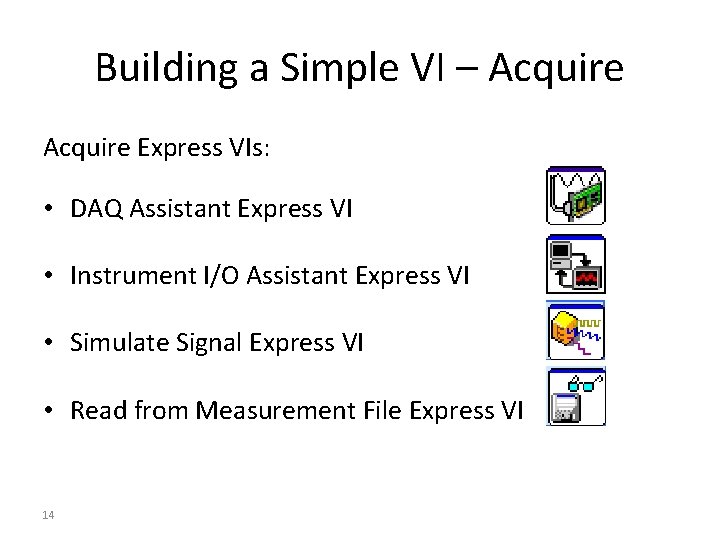
Building a Simple VI – Acquire Express VIs: • DAQ Assistant Express VI • Instrument I/O Assistant Express VI • Simulate Signal Express VI • Read from Measurement File Express VI 14
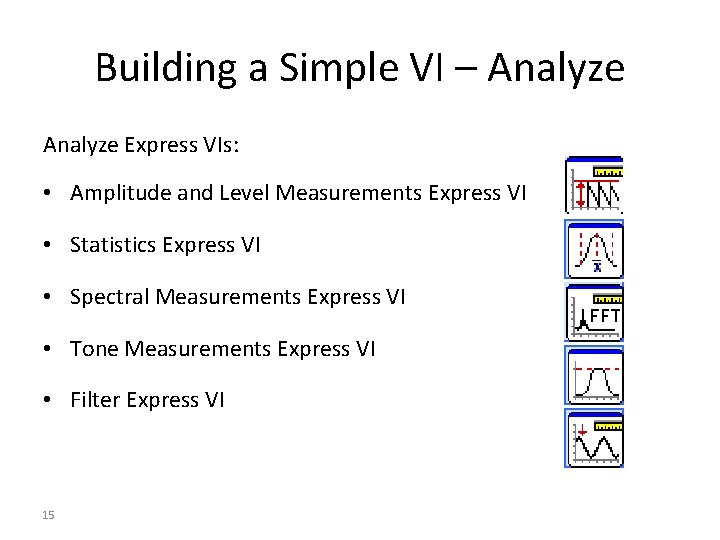
Building a Simple VI – Analyze Express VIs: • Amplitude and Level Measurements Express VI • Statistics Express VI • Spectral Measurements Express VI • Tone Measurements Express VI • Filter Express VI 15
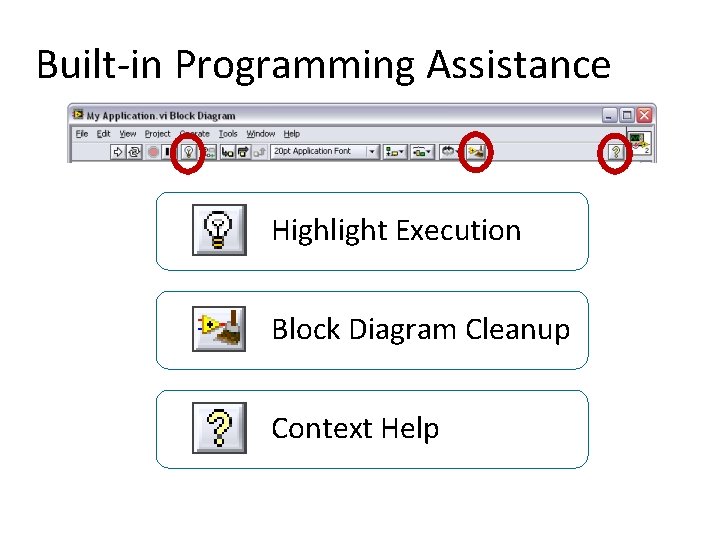
Built-in Programming Assistance Highlight Execution Block Diagram Cleanup Context Help
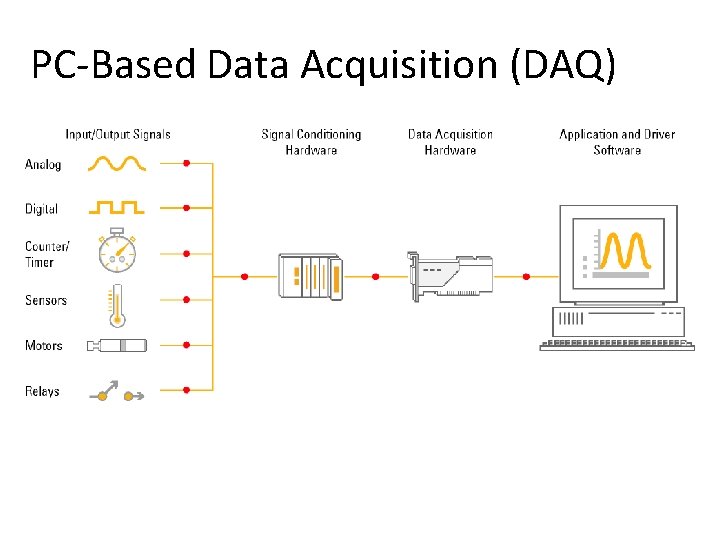
PC-Based Data Acquisition (DAQ)
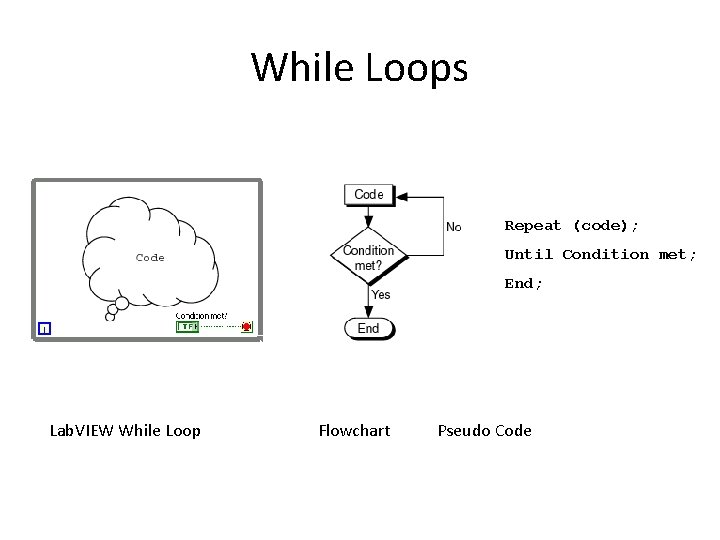
While Loops Repeat (code); Until Condition met; End; Lab. VIEW While Loop Flowchart Pseudo Code
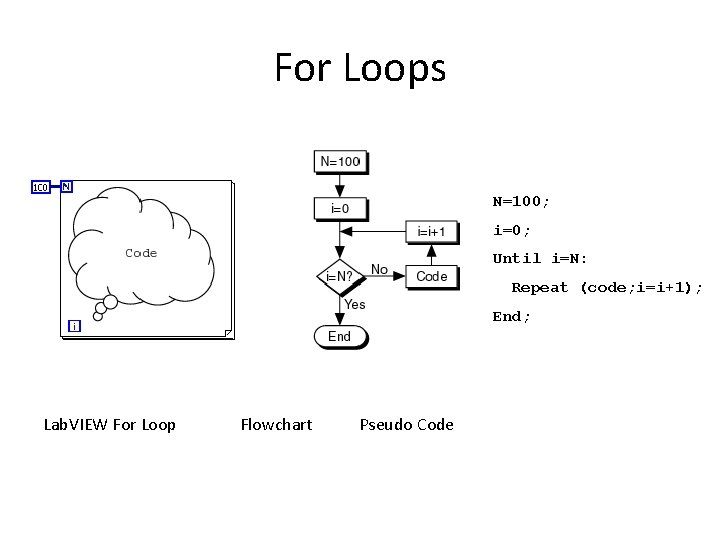
For Loops N=100; i=0; Until i=N: Repeat (code; i=i+1); End; Lab. VIEW For Loop Flowchart Pseudo Code
Timing a VI Why do you need timing in a VI? • Control the frequency at which a loop executes • Provide the processor with time to complete other tasks, such as processing the user interface
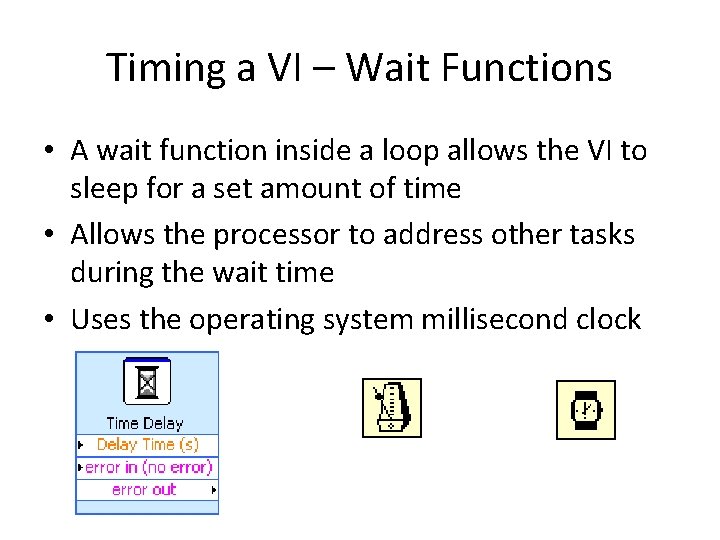
Timing a VI – Wait Functions • A wait function inside a loop allows the VI to sleep for a set amount of time • Allows the processor to address other tasks during the wait time • Uses the operating system millisecond clock
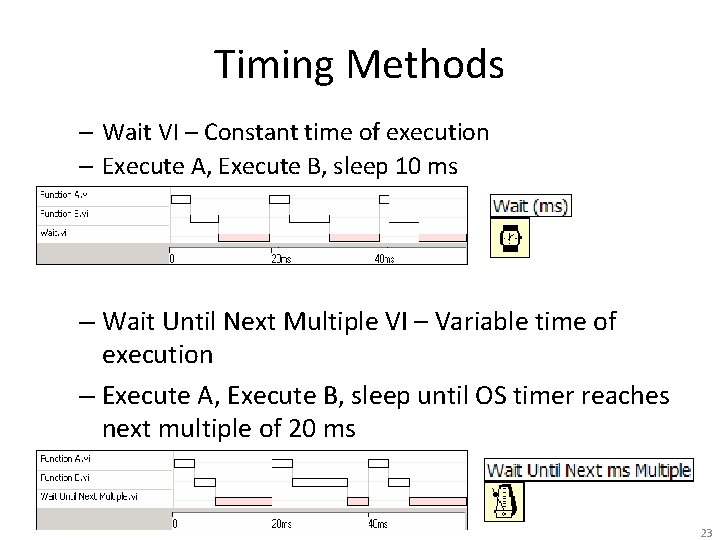
Timing Methods – Wait VI – Constant time of execution – Execute A, Execute B, sleep 10 ms – Wait Until Next Multiple VI – Variable time of execution – Execute A, Execute B, sleep until OS timer reaches next multiple of 20 ms 23
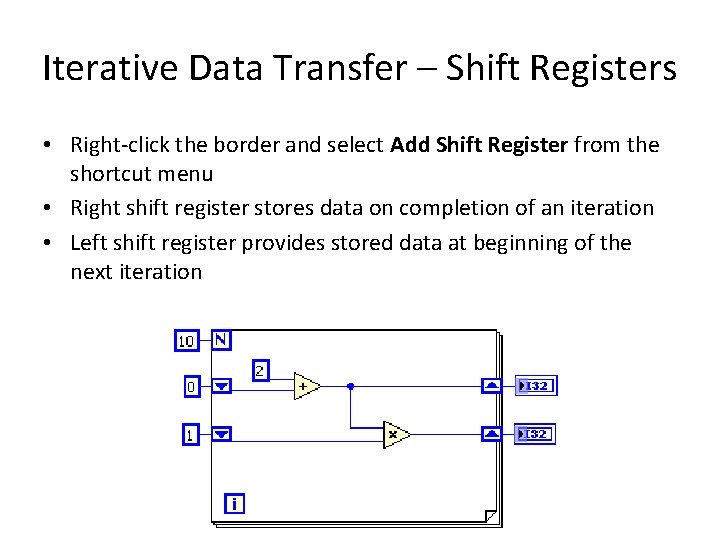
Iterative Data Transfer – Shift Registers • Right-click the border and select Add Shift Register from the shortcut menu • Right shift register stores data on completion of an iteration • Left shift register provides stored data at beginning of the next iteration
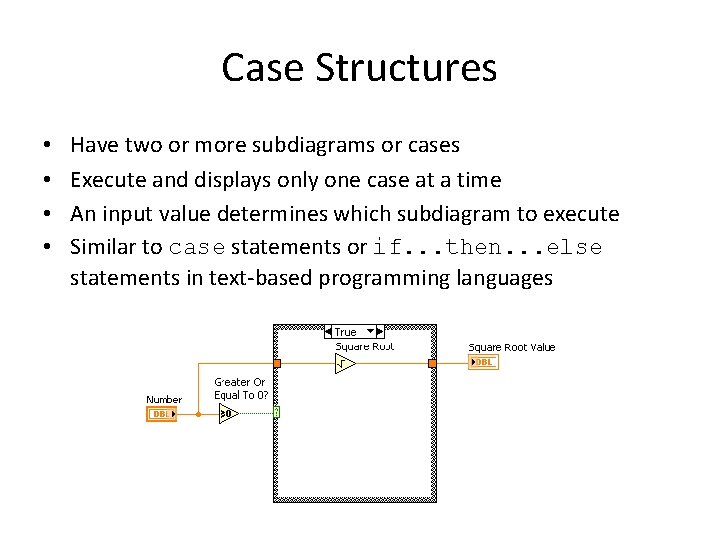
Case Structures • • Have two or more subdiagrams or cases Execute and displays only one case at a time An input value determines which subdiagram to execute Similar to case statements or if. . . then. . . else statements in text-based programming languages
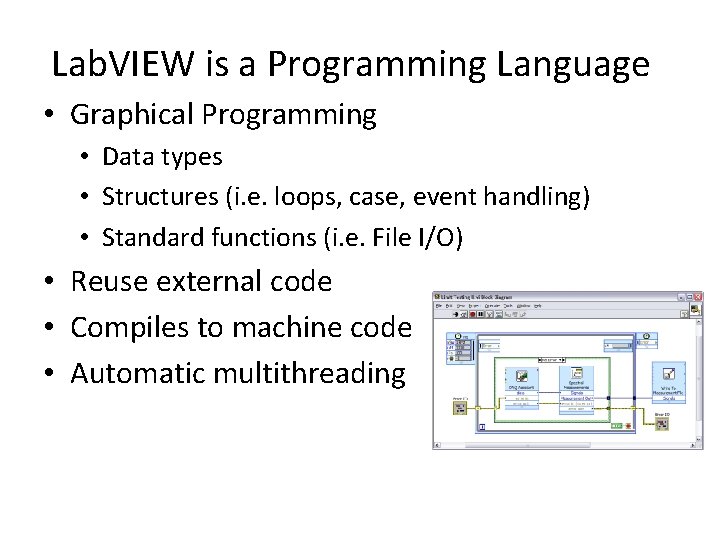
Lab. VIEW is a Programming Language • Graphical Programming • Data types • Structures (i. e. loops, case, event handling) • Standard functions (i. e. File I/O) • Reuse external code • Compiles to machine code • Automatic multithreading
Parallelism – Often, you need to program multiple tasks so that they execute at the same time – In Lab. VIEW, tasks can run in parallel if they do not have a data dependency between them, and if they do not use the same shared resource
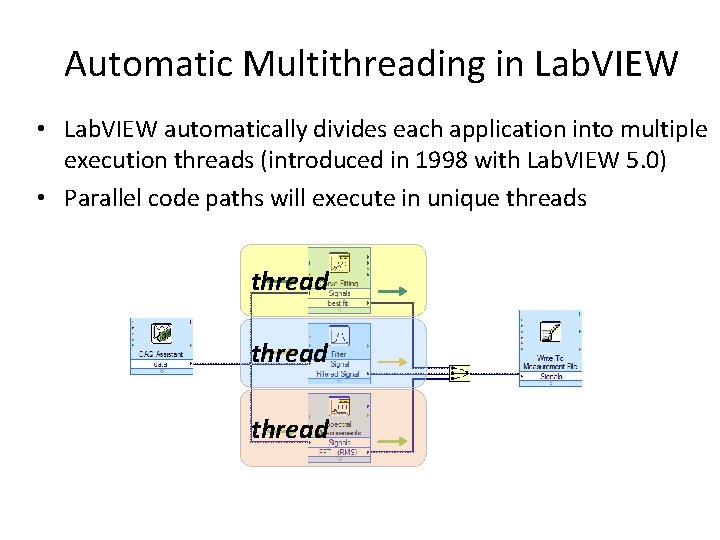
Automatic Multithreading in Lab. VIEW • Lab. VIEW automatically divides each application into multiple execution threads (introduced in 1998 with Lab. VIEW 5. 0) • Parallel code paths will execute in unique threads thread
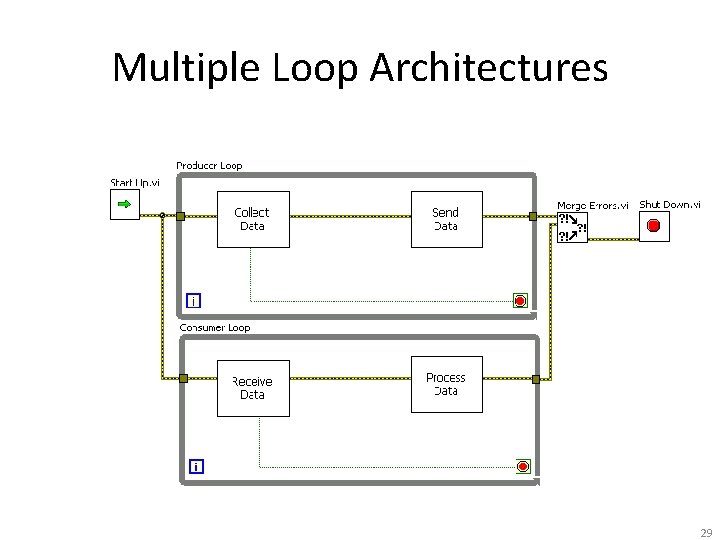
Multiple Loop Architectures 29
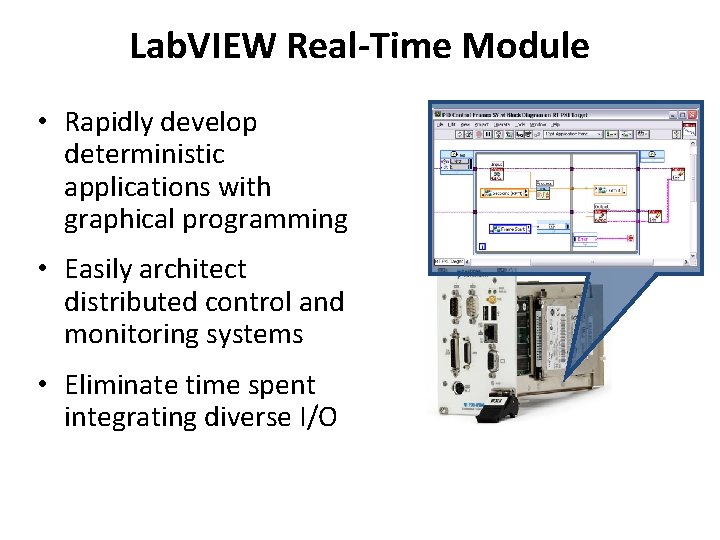
Lab. VIEW Real-Time Module • Rapidly develop deterministic applications with graphical programming • Easily architect distributed control and monitoring systems • Eliminate time spent integrating diverse I/O
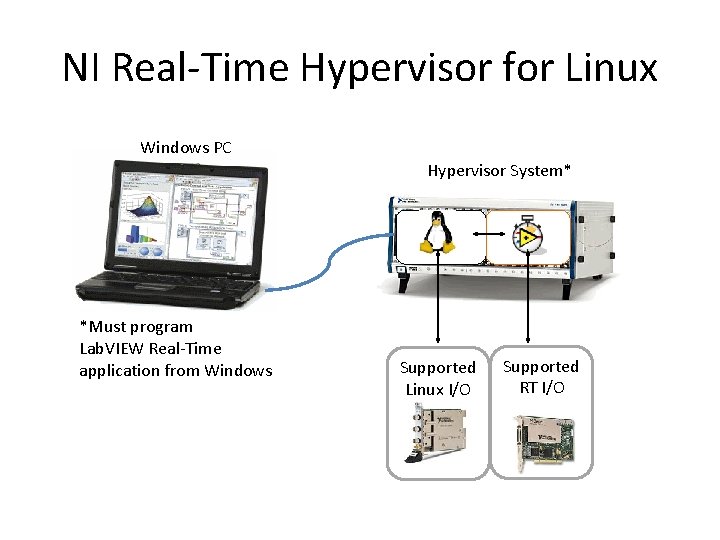
NI Real-Time Hypervisor for Linux Windows PC Hypervisor System* *Must program Lab. VIEW Real-Time application from Windows Supported Linux I/O Supported RT I/O
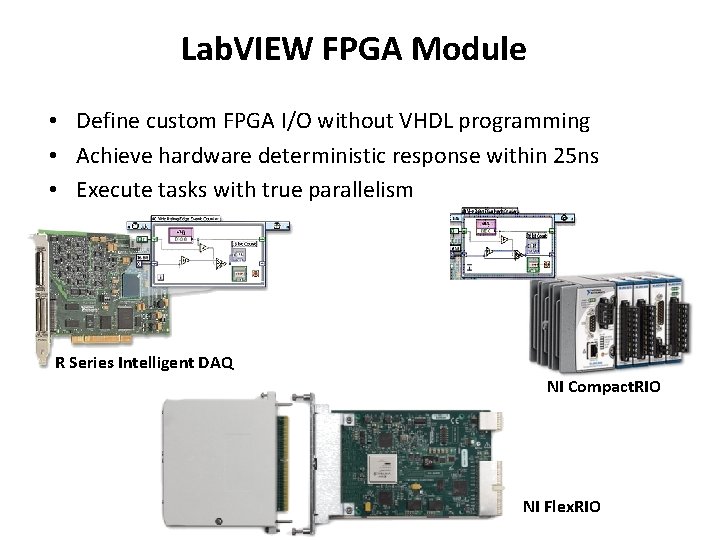
Lab. VIEW FPGA Module • Define custom FPGA I/O without VHDL programming • Achieve hardware deterministic response within 25 ns • Execute tasks with true parallelism R Series Intelligent DAQ NI Compact. RIO NI Flex. RIO
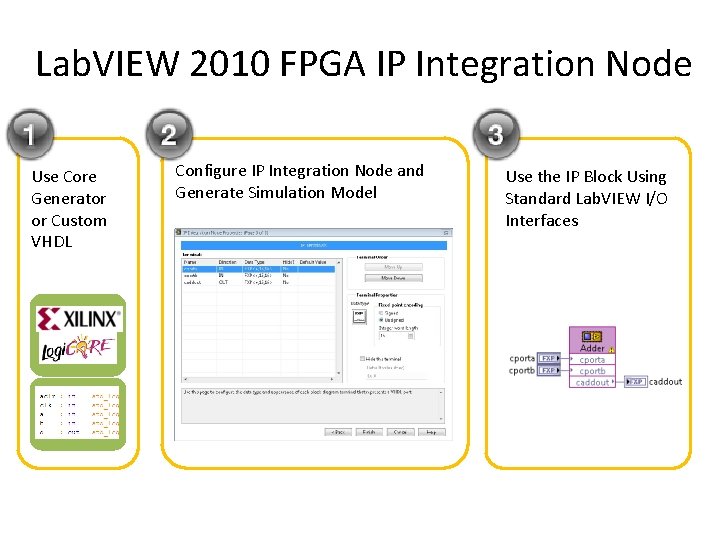
Lab. VIEW 2010 FPGA IP Integration Node Use Core Generator or Custom VHDL Configure IP Integration Node and Generate Simulation Model Use the IP Block Using Standard Lab. VIEW I/O Interfaces
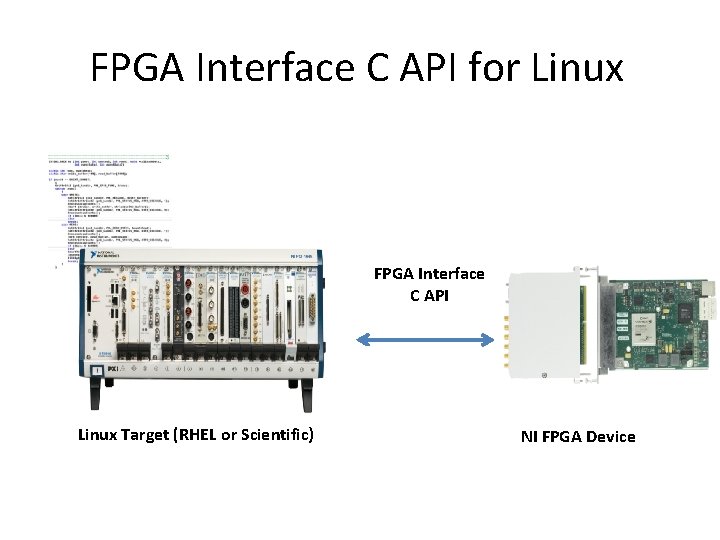
FPGA Interface C API for Linux FPGA Interface C API Linux Target (RHEL or Scientific) NI FPGA Device
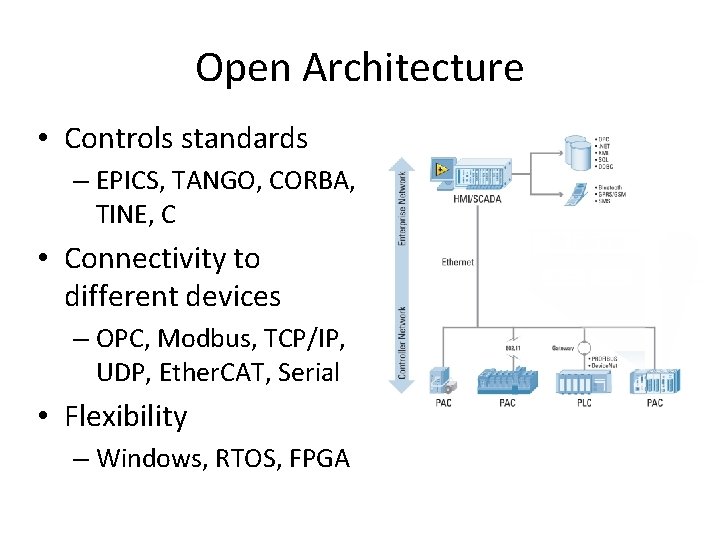
Open Architecture • Controls standards – EPICS, TANGO, CORBA, TINE, C • Connectivity to different devices – OPC, Modbus, TCP/IP, UDP, Ether. CAT, Serial • Flexibility – Windows, RTOS, FPGA
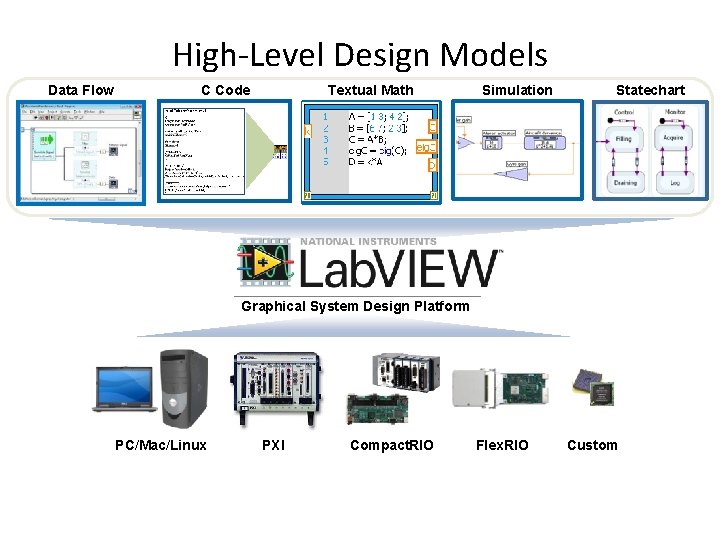
High-Level Design Models Data Flow C Code Textual Math Simulation Statechart Graphical System Design Platform PC/Mac/Linux PXI Compact. RIO Flex. RIO Custom
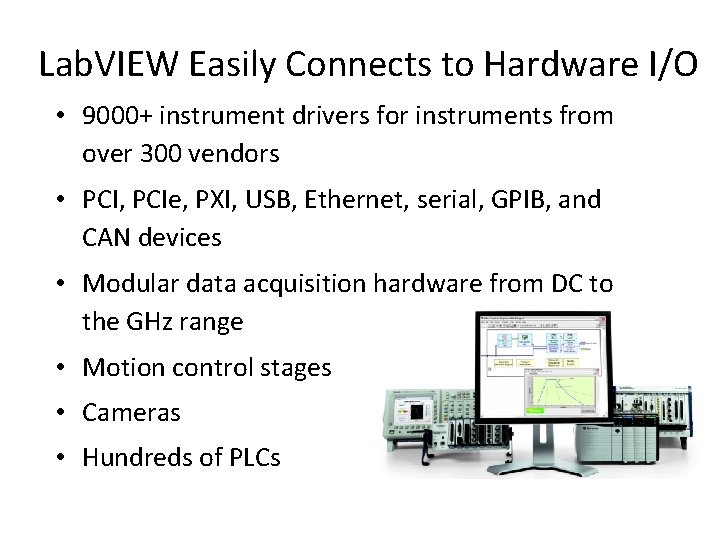
Lab. VIEW Easily Connects to Hardware I/O • 9000+ instrument drivers for instruments from over 300 vendors • PCI, PCIe, PXI, USB, Ethernet, serial, GPIB, and CAN devices • Modular data acquisition hardware from DC to the GHz range • Motion control stages • Cameras • Hundreds of PLCs
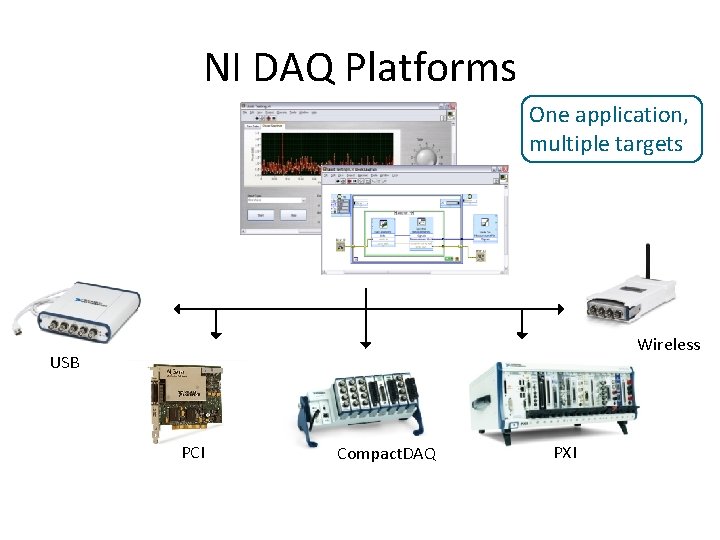
NI DAQ Platforms One application, multiple targets Wireless USB PCI Compact. DAQ PXI
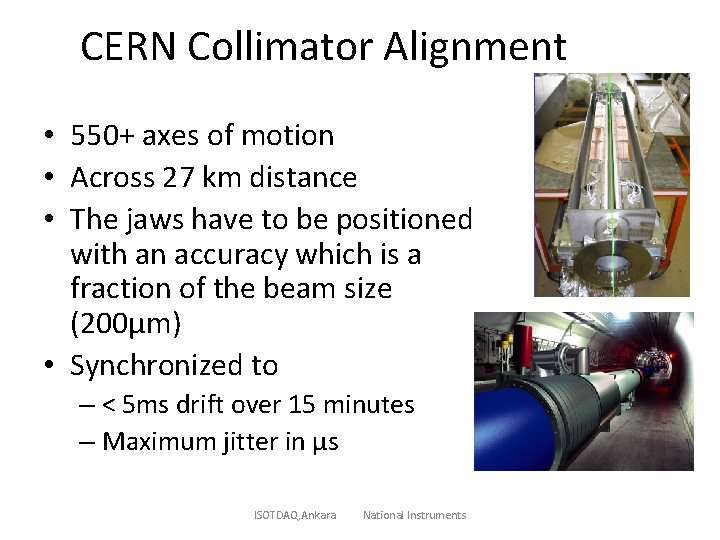
CERN Collimator Alignment • 550+ axes of motion • Across 27 km distance • The jaws have to be positioned with an accuracy which is a fraction of the beam size (200μm) • Synchronized to – < 5 ms drift over 15 minutes – Maximum jitter in μs ISOTDAQ, Ankara National Instruments
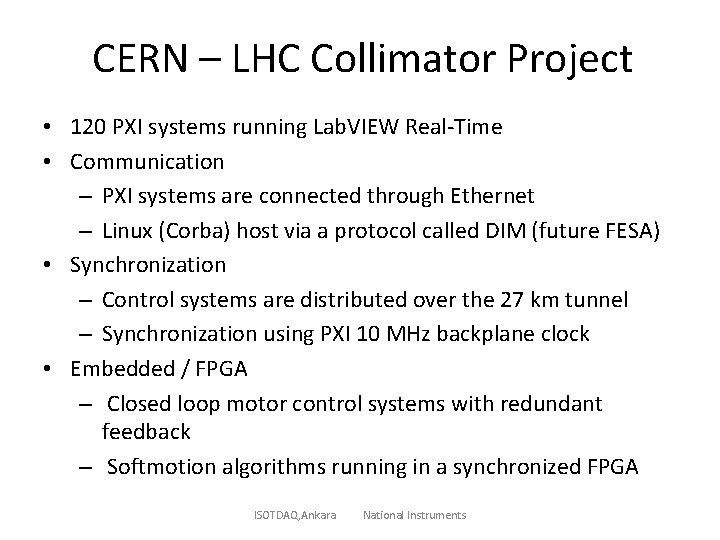
CERN – LHC Collimator Project • 120 PXI systems running Lab. VIEW Real-Time • Communication – PXI systems are connected through Ethernet – Linux (Corba) host via a protocol called DIM (future FESA) • Synchronization – Control systems are distributed over the 27 km tunnel – Synchronization using PXI 10 MHz backplane clock • Embedded / FPGA – Closed loop motor control systems with redundant feedback – Softmotion algorithms running in a synchronized FPGA ISOTDAQ, Ankara National Instruments
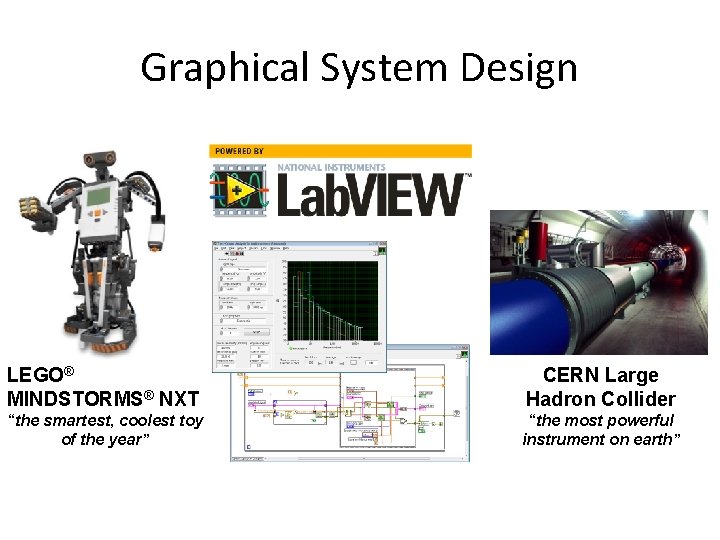
Graphical System Design LEGO® MINDSTORMS® NXT CERN Large Hadron Collider “the smartest, coolest toy of the year” “the most powerful instrument on earth”

THANK YOU!
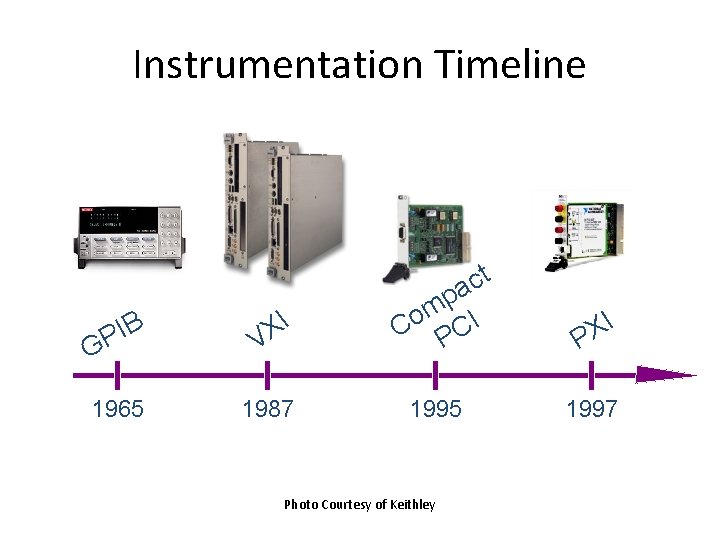
Instrumentation Timeline PIB I X V 1965 1987 G t c a p m I o C PC 1995 Photo Courtesy of Keithley I X P 1997
What is PXI? • PXI = PCI e. Xtensions for Instrumentation • Open specification governed by the PXI Systems Alliance (PXISA) and introduced in 1997 • PC-based platform optimized for test, measurement, and control • PCI electrical-bus with the rugged, modular, Eurocard mechanical packaging of Compact. PCI • Advanced timing and synchronization features ISOTDAQ, Ankara National Instruments
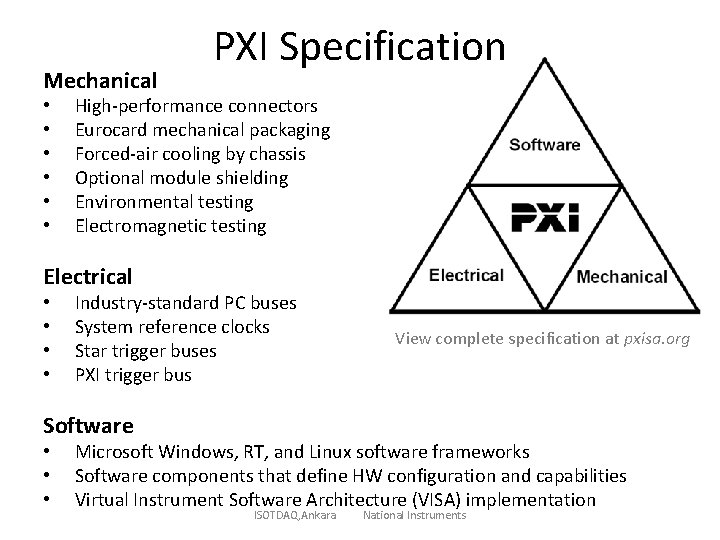
Mechanical • • • PXI Specification High-performance connectors Eurocard mechanical packaging Forced-air cooling by chassis Optional module shielding Environmental testing Electromagnetic testing Electrical • • Industry-standard PC buses System reference clocks Star trigger buses PXI trigger bus View complete specification at pxisa. org Software • • • Microsoft Windows, RT, and Linux software frameworks Software components that define HW configuration and capabilities Virtual Instrument Software Architecture (VISA) implementation ISOTDAQ, Ankara National Instruments
PXI Systems Alliance (PXISA) • Founded in 1998 • PXISA goals: – Maintain the PXI specification – Ensure interoperability – Promote the PXI standard • 70+ members comprise the PXISA • PXISA web site (www. pxisa. org) – Specifications – Tutorials, application notes, and white papers – Locate member companies and products ISOTDAQ, Ankara National Instruments
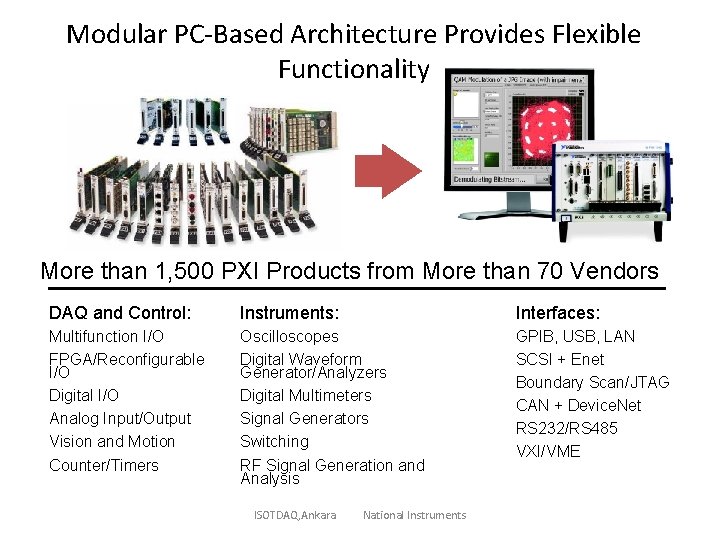
Modular PC-Based Architecture Provides Flexible Functionality More than 1, 500 PXI Products from More than 70 Vendors DAQ and Control: Instruments: Interfaces: Multifunction I/O FPGA/Reconfigurable I/O Digital I/O Analog Input/Output Vision and Motion Counter/Timers Oscilloscopes Digital Waveform Generator/Analyzers Digital Multimeters Signal Generators Switching RF Signal Generation and Analysis GPIB, USB, LAN SCSI + Enet Boundary Scan/JTAG CAN + Device. Net RS 232/RS 485 VXI/VME ISOTDAQ, Ankara National Instruments
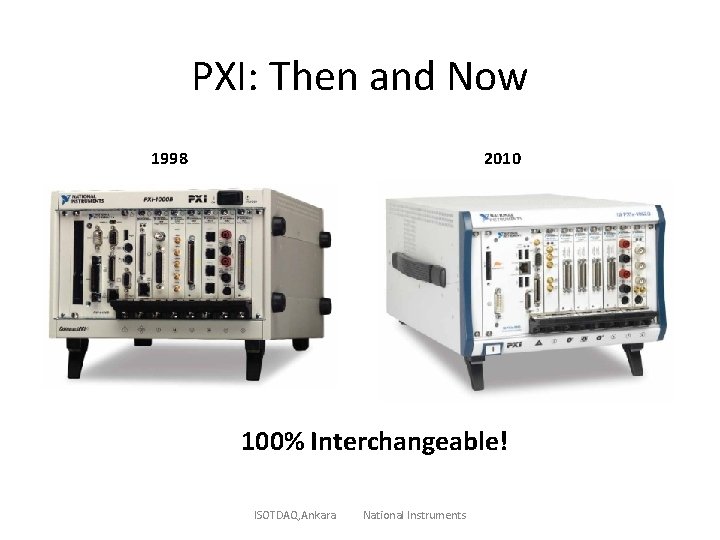
PXI: Then and Now 2010 1998 100% Interchangeable! ISOTDAQ, Ankara National Instruments
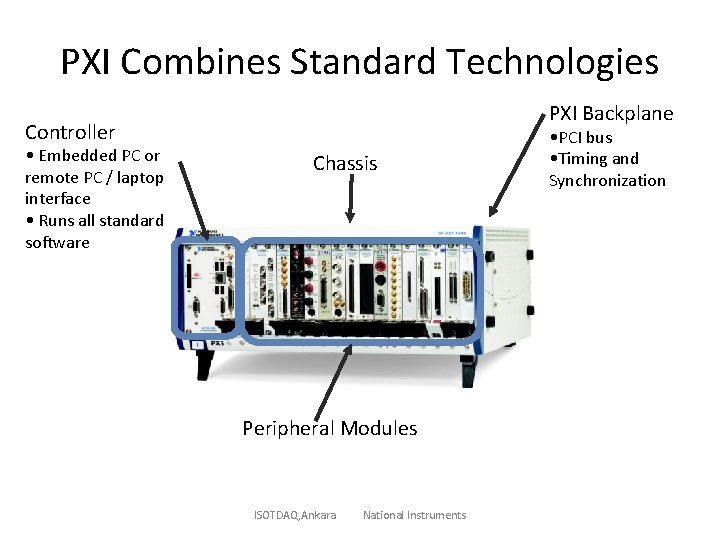
PXI Combines Standard Technologies PXI Backplane Controller • Embedded PC or remote PC / laptop interface • Runs all standard software Chassis Peripheral Modules ISOTDAQ, Ankara National Instruments • PCI bus • Timing and Synchronization
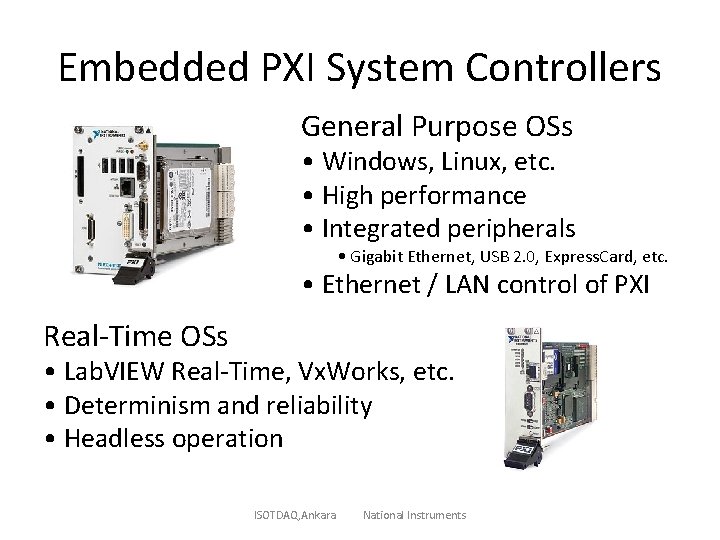
Embedded PXI System Controllers General Purpose OSs • Windows, Linux, etc. • High performance • Integrated peripherals • Gigabit Ethernet, USB 2. 0, Express. Card, etc. • Ethernet / LAN control of PXI Real-Time OSs • Lab. VIEW Real-Time, Vx. Works, etc. • Determinism and reliability • Headless operation ISOTDAQ, Ankara National Instruments
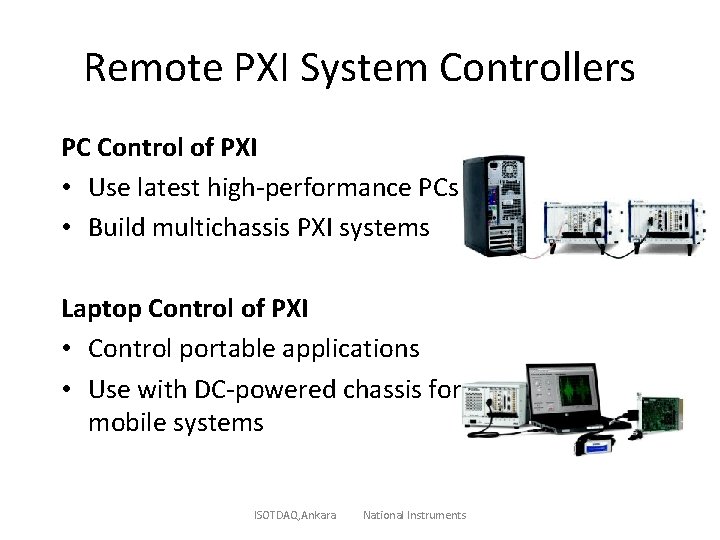
Remote PXI System Controllers PC Control of PXI • Use latest high-performance PCs • Build multichassis PXI systems Laptop Control of PXI • Control portable applications • Use with DC-powered chassis for mobile systems ISOTDAQ, Ankara National Instruments
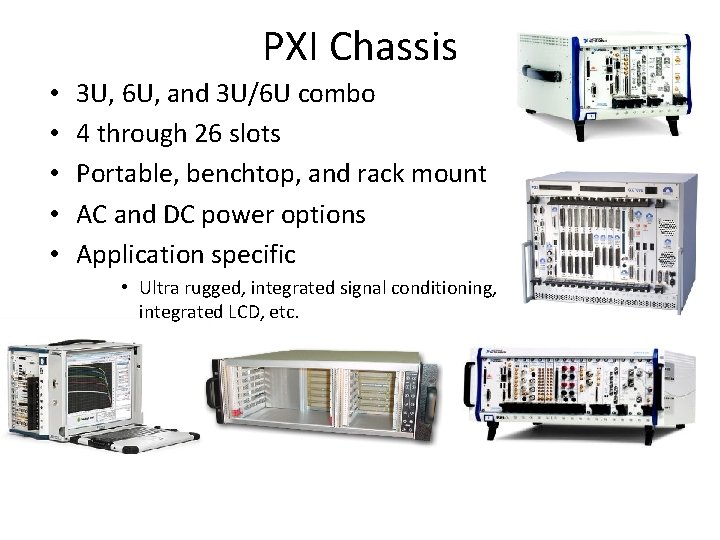
PXI Chassis • • • 3 U, 6 U, and 3 U/6 U combo 4 through 26 slots Portable, benchtop, and rack mount AC and DC power options Application specific • Ultra rugged, integrated signal conditioning, integrated LCD, etc.
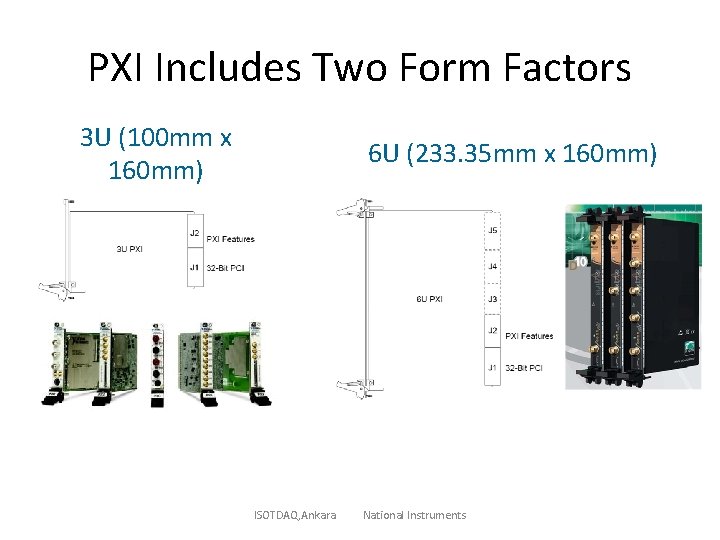
PXI Includes Two Form Factors 3 U (100 mm x 160 mm) 6 U (233. 35 mm x 160 mm) ISOTDAQ, Ankara National Instruments
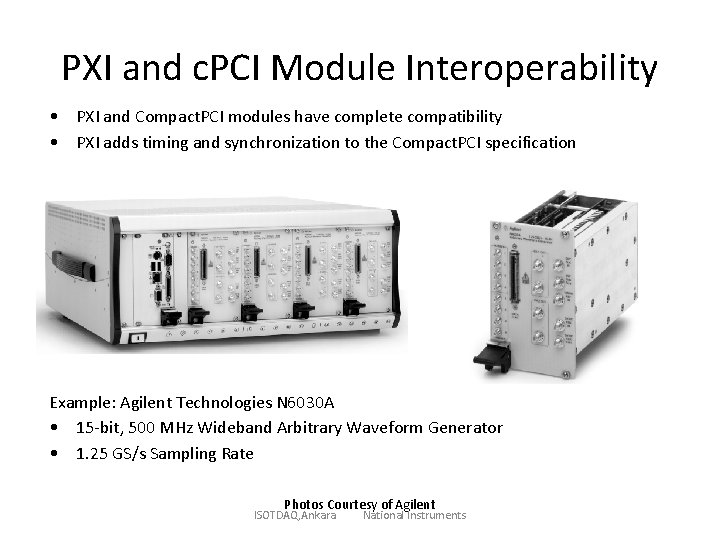
PXI and c. PCI Module Interoperability • PXI and Compact. PCI modules have complete compatibility • PXI adds timing and synchronization to the Compact. PCI specification Example: Agilent Technologies N 6030 A • 15 -bit, 500 MHz Wideband Arbitrary Waveform Generator • 1. 25 GS/s Sampling Rate Photos Courtesy of Agilent ISOTDAQ, Ankara National Instruments
Trigger with PXI
Signal vs. Time-Based Synchronization – Signal-based • Clocks and triggers physically connected between systems • Potentially the highest-precision synchronization – Time-based • Multiple systems synchronize to a common time reference • Sync systems in large proximity i. e. World Wide • Events, triggers and clocks can be generated based on this reference • Signals can be timestamped and correlated in postprocessing ISOTDAQ, Ankara National Instruments
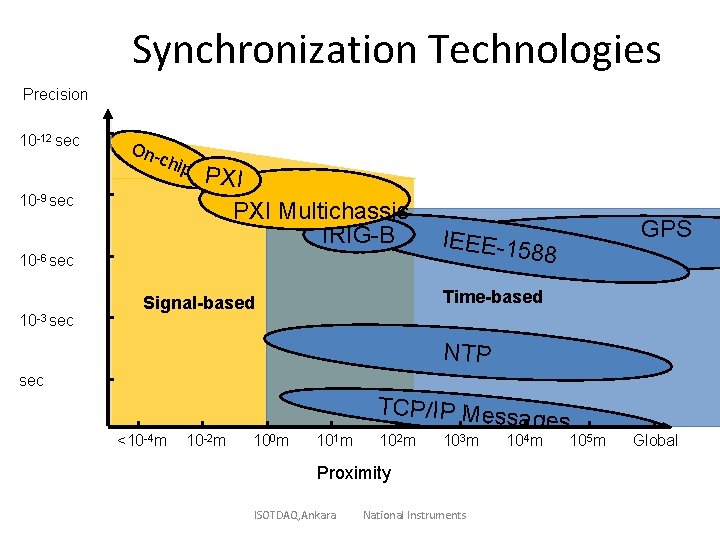
Synchronization Technologies Precision 10 -12 sec On- chip 10 -9 sec PXI Multichassis IRIG-B 10 -6 sec 10 -3 sec GPS IEEE-15 88 Time-based Signal-based NTP sec TCP/IP Mess <10 -4 m 10 -2 m 100 m 101 m 102 m 103 m Proximity ISOTDAQ, Ankara National Instruments ages 104 m 105 m Global
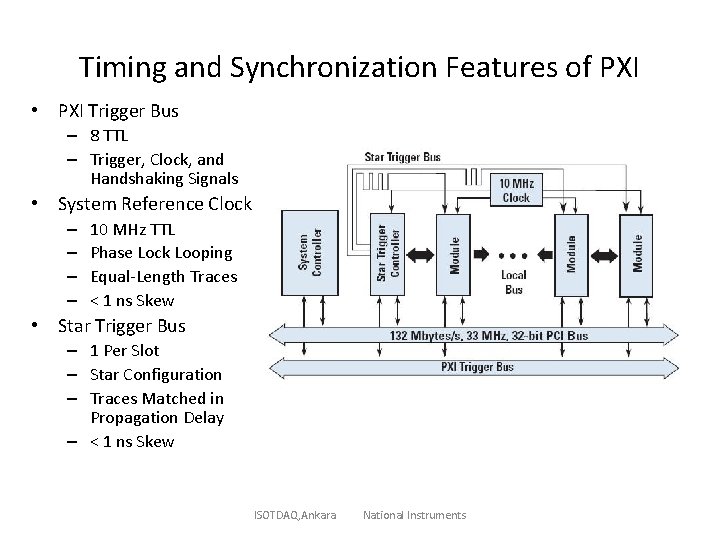
Timing and Synchronization Features of PXI • PXI Trigger Bus – 8 TTL – Trigger, Clock, and Handshaking Signals • System Reference Clock – – 10 MHz TTL Phase Lock Looping Equal-Length Traces < 1 ns Skew • Star Trigger Bus – 1 Per Slot – Star Configuration – Traces Matched in Propagation Delay – < 1 ns Skew ISOTDAQ, Ankara National Instruments
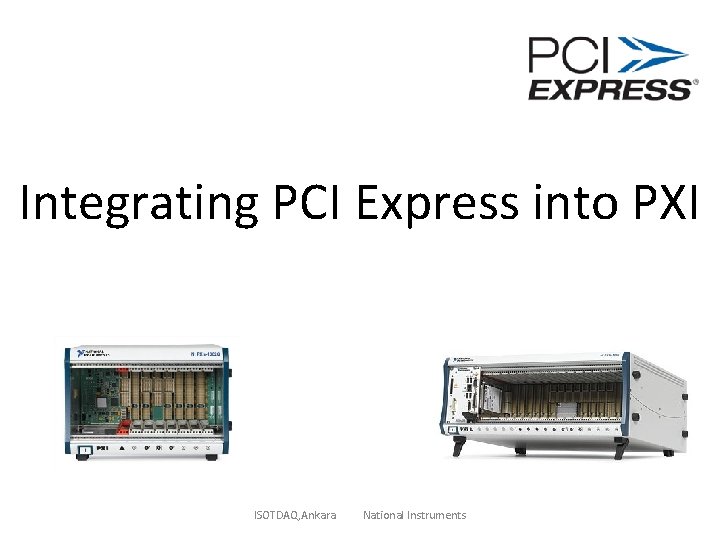
Integrating PCI Express into PXI ISOTDAQ, Ankara National Instruments
PCI Express Advantages • • • High throughput (up to > 4 GB/s) Software compatibility Scalable bandwidth Dedicated bandwidth per slot Peer-to-peer communication Long life (20+ years in mainstream market) ISOTDAQ, Ankara National Instruments
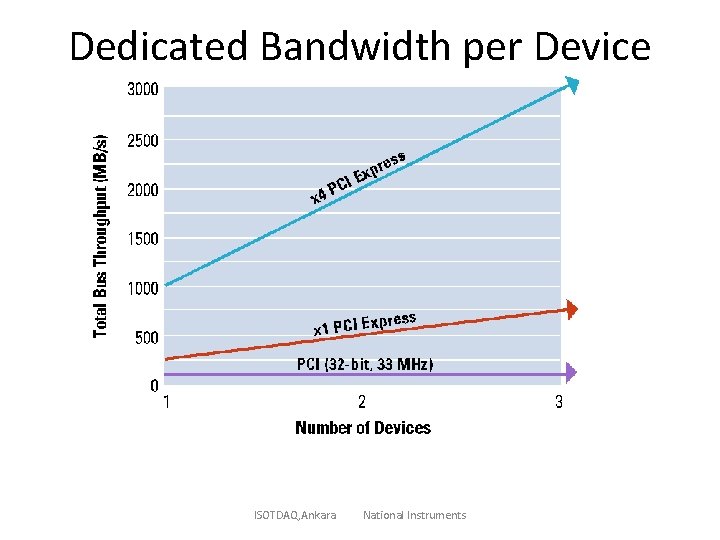
Dedicated Bandwidth per Device ISOTDAQ, Ankara National Instruments
Integrating PCI Express into the PXI Backplane • Up to 2 GB/s dedicated bandwidth per slot • Enhanced synchronization capabilities – 100 MHz differential clock, differential triggering • Backwards compatibility – Complete software compatibility – Hybrid slot definition - install modules with either PCI or PCI Express signaling in a single slot ISOTDAQ, Ankara National Instruments
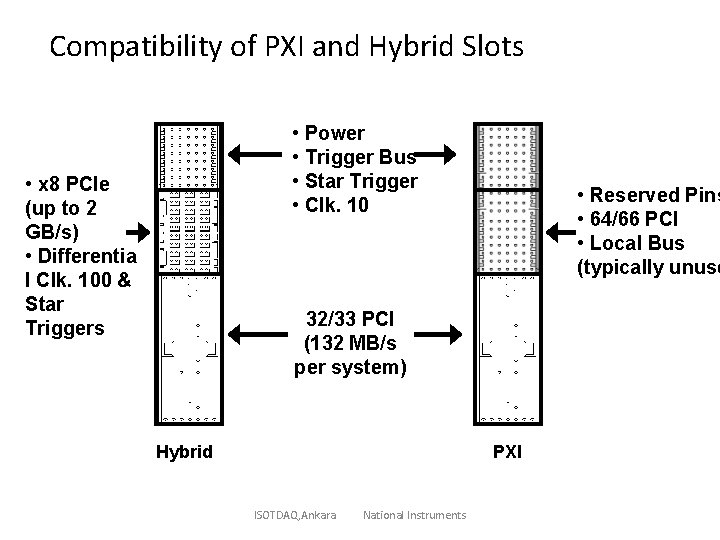
Compatibility of PXI and Hybrid Slots • Power • Trigger Bus • Star Trigger • Clk. 10 • x 8 PCIe (up to 2 GB/s) • Differentia l Clk. 100 & Star Triggers • Reserved Pins • 64/66 PCI • Local Bus (typically unuse 32/33 PCI (132 MB/s per system) Hybrid PXI ISOTDAQ, Ankara National Instruments
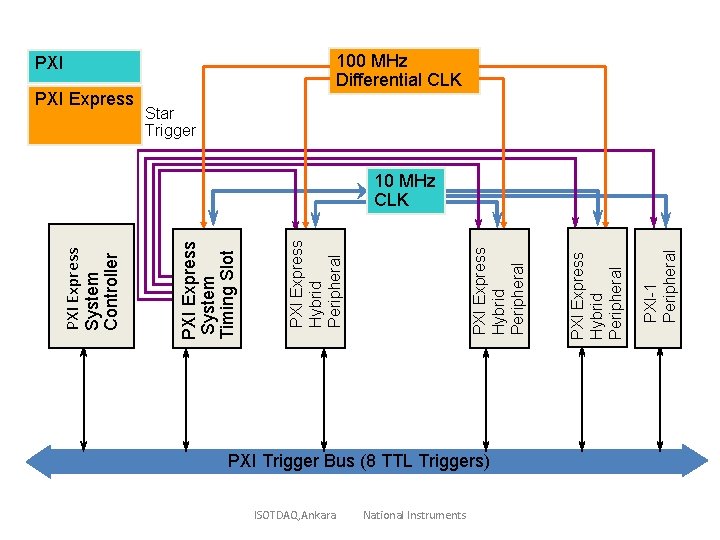
PXI Trigger Bus (8 TTL Triggers) ISOTDAQ, Ankara National Instruments PXI-1 Peripheral PXI Express Hybrid Peripheral PXI Express Star Express PXI Express Hybrid Peripheral PXI Express System Timing Slot PXI Express System Controller PXI 100 MHz Differential CLK Trigger 10 MHz CLK
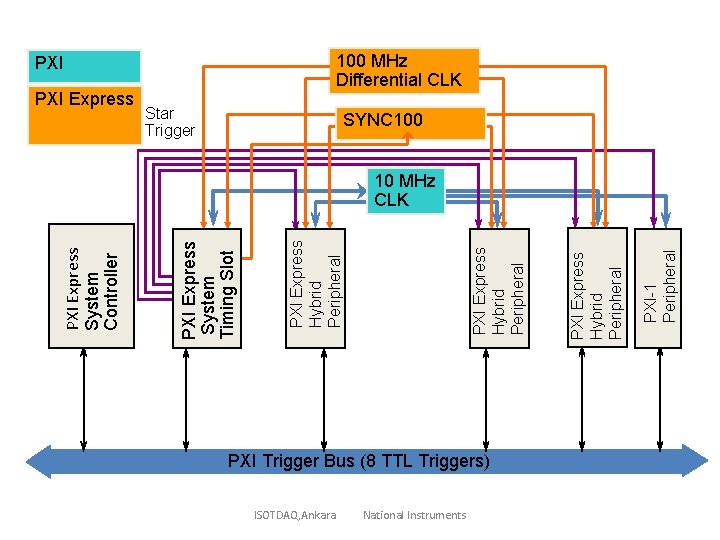
PXI Trigger Bus (8 TTL Triggers) ISOTDAQ, Ankara National Instruments PXI-1 Peripheral PXI Express Hybrid Peripheral Star Trigger PXI Express Hybrid Peripheral PXI Express System Timing Slot PXI Express System Controller PXI 100 MHz Differential CLK SYNC 100 10 MHz CLK
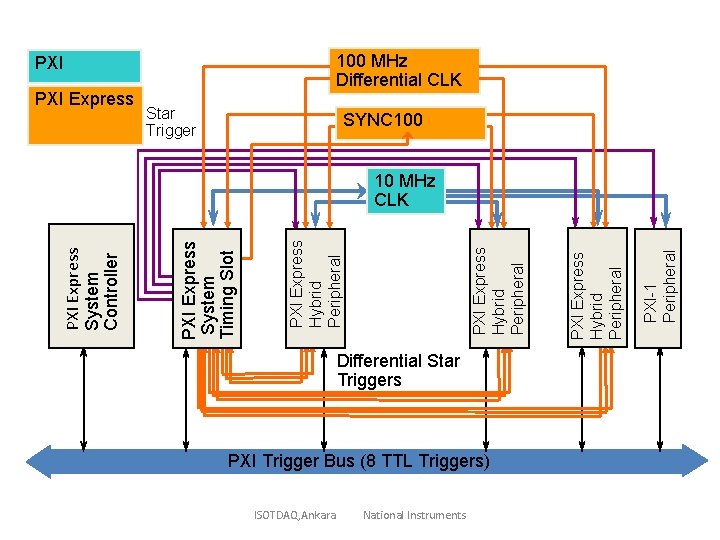
100 MHz Differential CLK PXI Express Star Trigger SYNC 100 Differential Star Triggers PXI Trigger Bus (8 TTL Triggers) ISOTDAQ, Ankara National Instruments PXI-1 Peripheral PXI Express Hybrid Peripheral PXI Express System Timing Slot PXI Express System Controller 10 MHz CLK
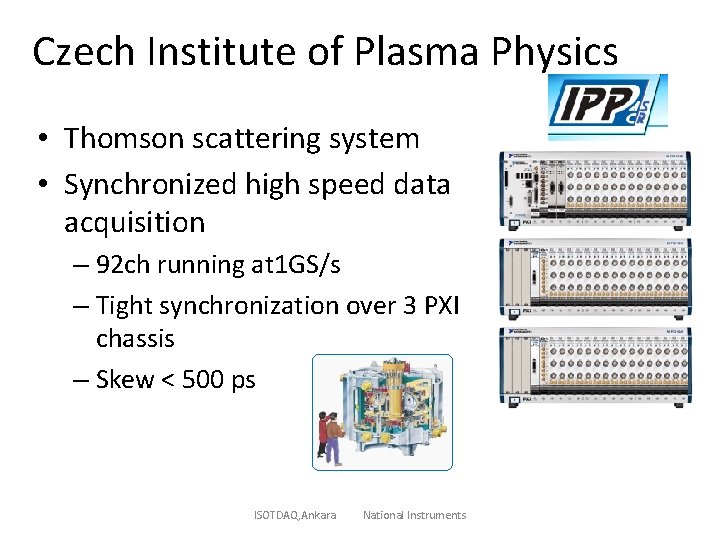
Czech Institute of Plasma Physics • Thomson scattering system • Synchronized high speed data acquisition – 92 ch running at 1 GS/s – Tight synchronization over 3 PXI chassis – Skew < 500 ps ISOTDAQ, Ankara National Instruments
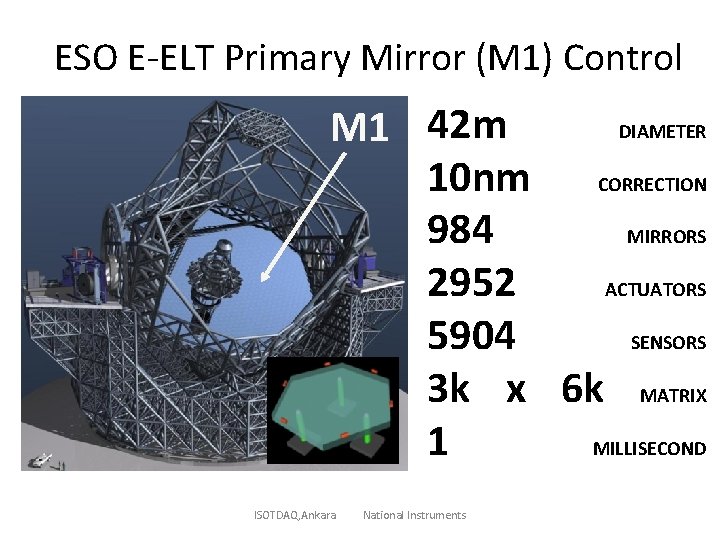
ESO E-ELT Primary Mirror (M 1) Control DIAMETER M 1 42 m 10 nm CORRECTION 984 MIRRORS 2952 ACTUATORS 5904 SENSORS 3 k x 6 k MATRIX 1 MILLISECOND ISOTDAQ, Ankara National Instruments
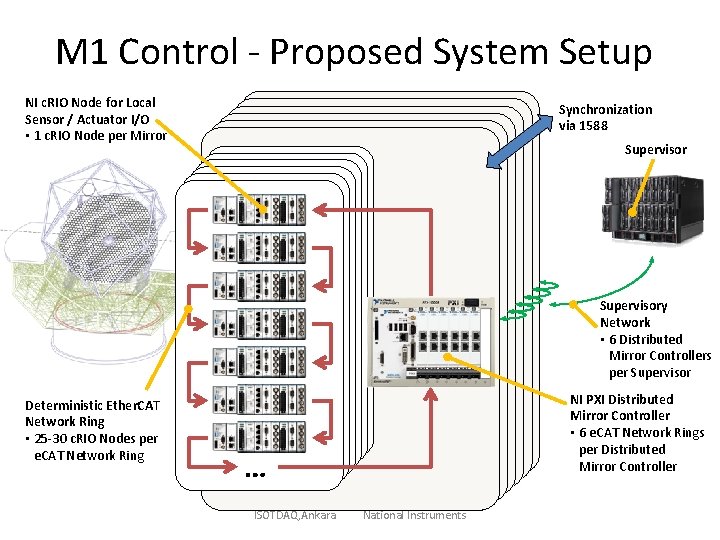
M 1 Control - Proposed System Setup NI c. RIO Node for Local Sensor / Actuator I/O • 1 c. RIO Node per Mirror Synchronization via 1588 Supervisory Network • 6 Distributed Mirror Controllers per Supervisor Deterministic Ether. CAT Network Ring • 25 -30 c. RIO Nodes per e. CAT Network Ring NI PXI Distributed Mirror Controller • 6 e. CAT Network Rings per Distributed Mirror Controller … ISOTDAQ, Ankara National Instruments
PXI Express Summary • Continual extension of the PXI platform • Improves PXI platform performance – Increased throughput – Improved latency and synchronization • PXI Express maintains backwards compatibility with PXI – Software compatibility – Hardware compatibility with hybrid slots and hybrid systems ISOTDAQ, Ankara National Instruments
Multicore Programming
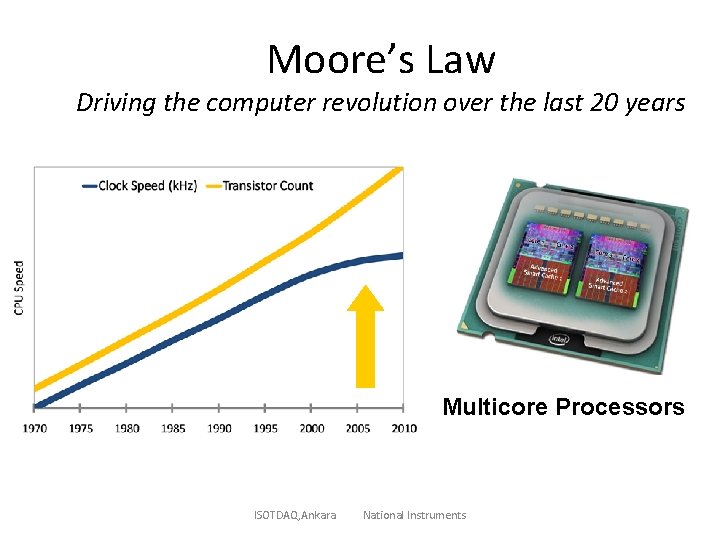
Moore’s Law Driving the computer revolution over the last 20 years Multicore Processors ISOTDAQ, Ankara National Instruments
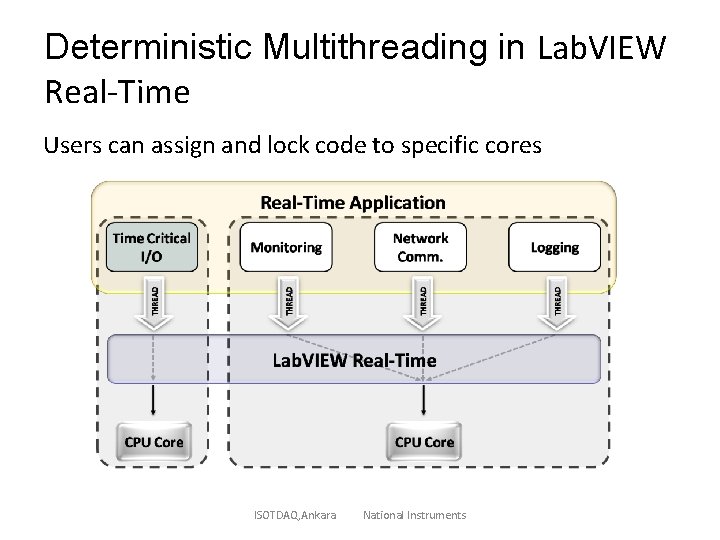
Deterministic Multithreading in Lab. VIEW Real-Time Users can assign and lock code to specific cores ISOTDAQ, Ankara National Instruments
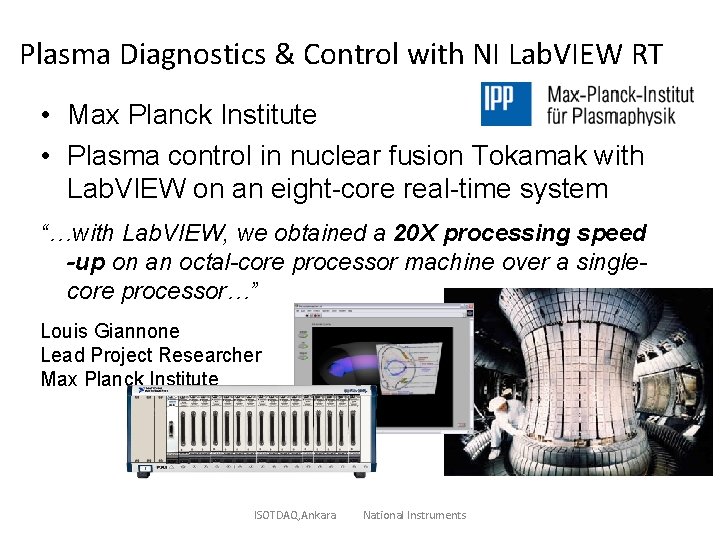
Plasma Diagnostics & Control with NI Lab. VIEW RT • Max Planck Institute • Plasma control in nuclear fusion Tokamak with Lab. VIEW on an eight-core real-time system “…with Lab. VIEW, we obtained a 20 X processing speed -up on an octal-core processor machine over a singlecore processor…” Louis Giannone Lead Project Researcher Max Planck Institute ISOTDAQ, Ankara National Instruments
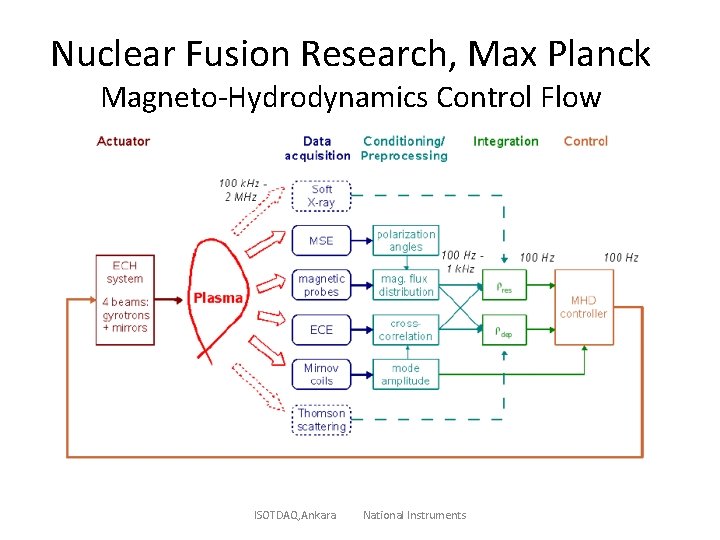
Nuclear Fusion Research, Max Planck Magneto-Hydrodynamics Control Flow ISOTDAQ, Ankara National Instruments
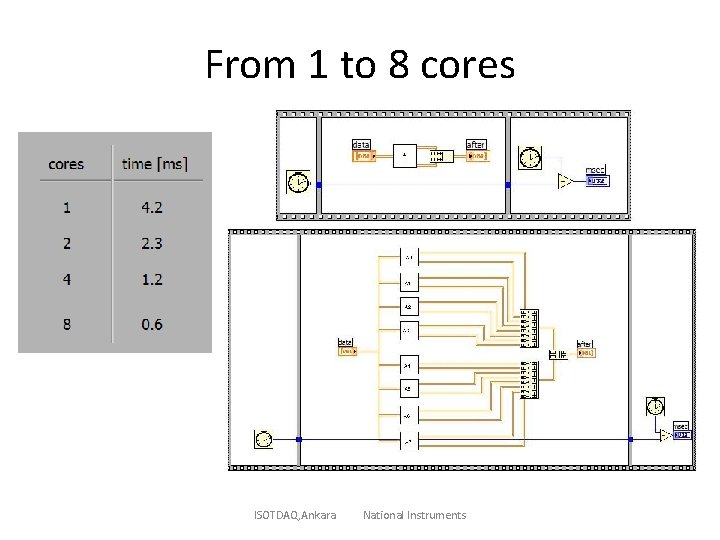
From 1 to 8 cores ISOTDAQ, Ankara National Instruments
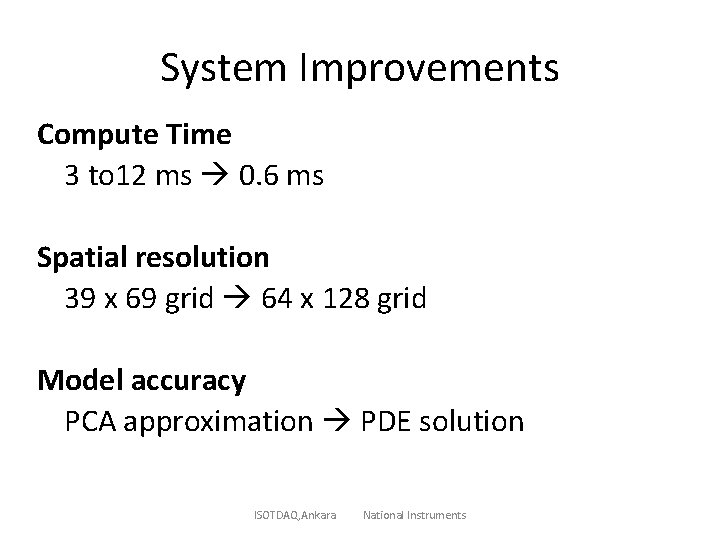
System Improvements Compute Time 3 to 12 ms 0. 6 ms Spatial resolution 39 x 69 grid 64 x 128 grid Model accuracy PCA approximation PDE solution ISOTDAQ, Ankara National Instruments
DAQ & Control with FPGA
Factors Driving Need for Custom Hardware • • • Very tight control loops Onboard signal processing Specialized communication protocols Custom flexible timing Massively parallel processing ISOTDAQ, Ankara National Instruments
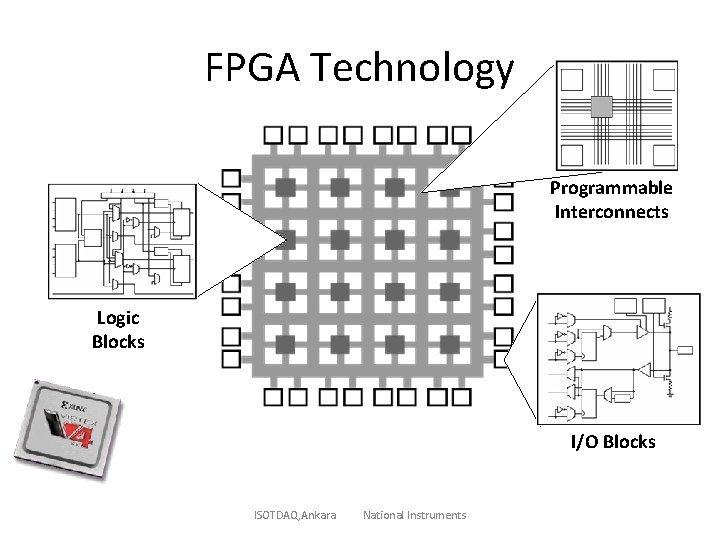
FPGA Technology Programmable Interconnects Logic Blocks I/O Blocks ISOTDAQ, Ankara National Instruments
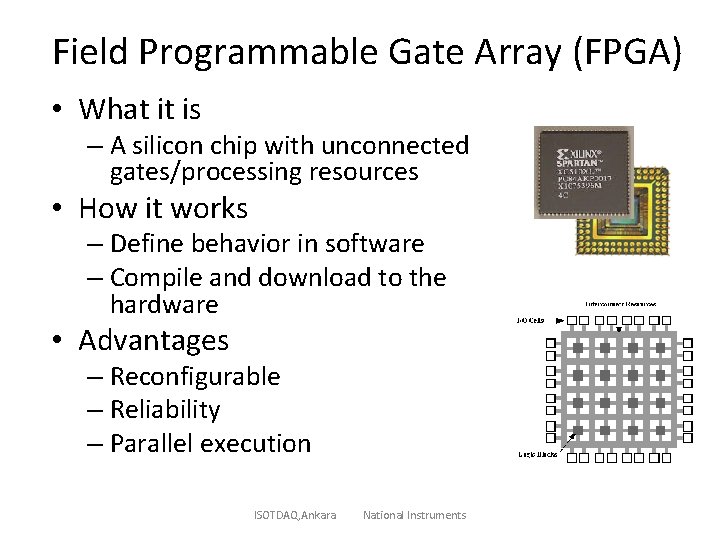
Field Programmable Gate Array (FPGA) • What it is – A silicon chip with unconnected gates/processing resources • How it works – Define behavior in software – Compile and download to the hardware • Advantages – Reconfigurable – Reliability – Parallel execution ISOTDAQ, Ankara National Instruments
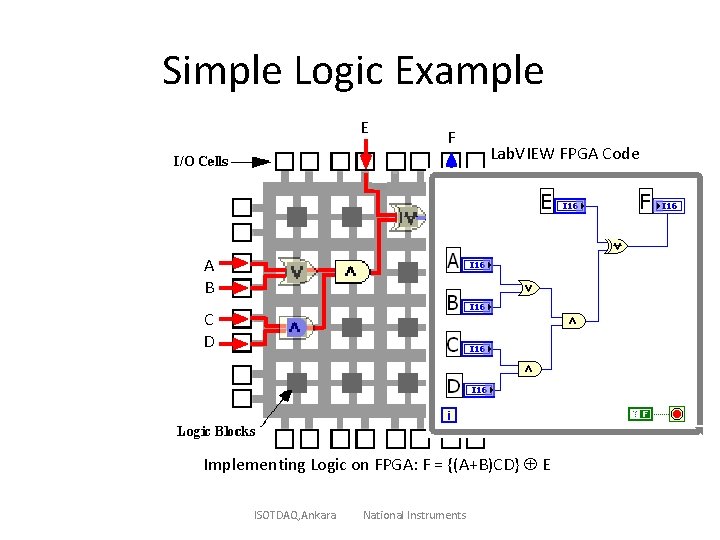
Simple Logic Example E F Lab. VIEW FPGA Code A B C D Implementing Logic on FPGA: F = {(A+B)CD} E ISOTDAQ, Ankara National Instruments
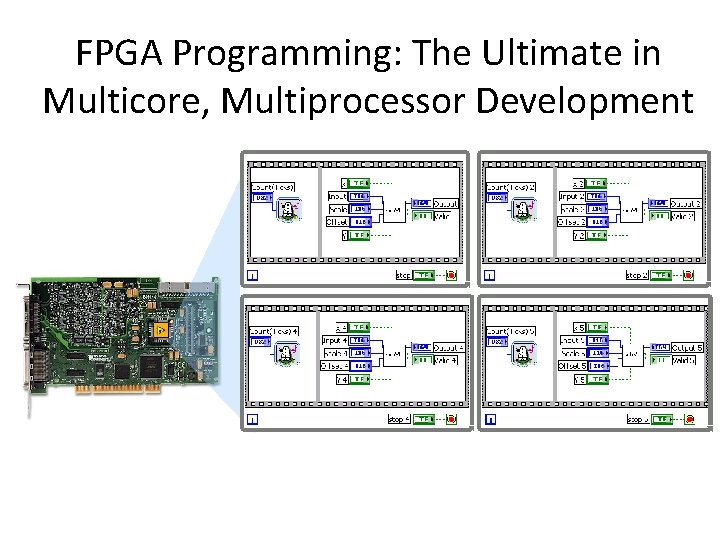
FPGA Programming: The Ultimate in Multicore, Multiprocessor Development
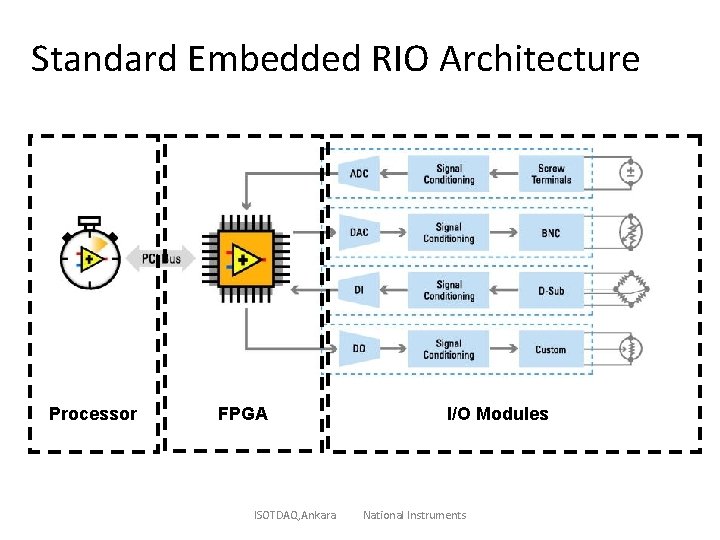
Standard Embedded RIO Architecture Processor FPGA ISOTDAQ, Ankara I/O Modules National Instruments
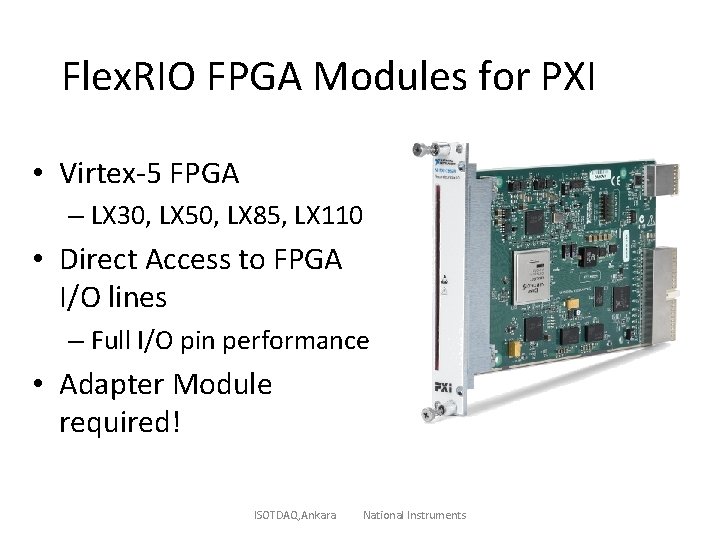
Flex. RIO FPGA Modules for PXI • Virtex-5 FPGA – LX 30, LX 50, LX 85, LX 110 • Direct Access to FPGA I/O lines – Full I/O pin performance • Adapter Module required! ISOTDAQ, Ankara National Instruments
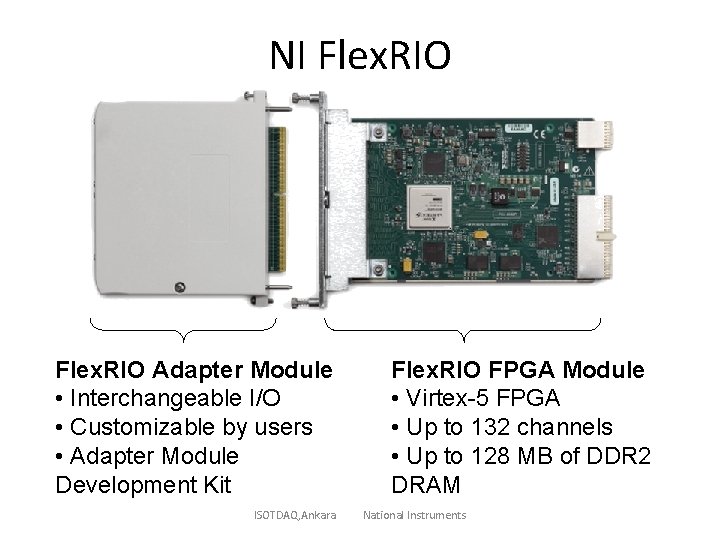
NI Flex. RIO Adapter Module • Interchangeable I/O • Customizable by users • Adapter Module Development Kit ISOTDAQ, Ankara Flex. RIO FPGA Module • Virtex-5 FPGA • Up to 132 channels • Up to 128 MB of DDR 2 DRAM National Instruments
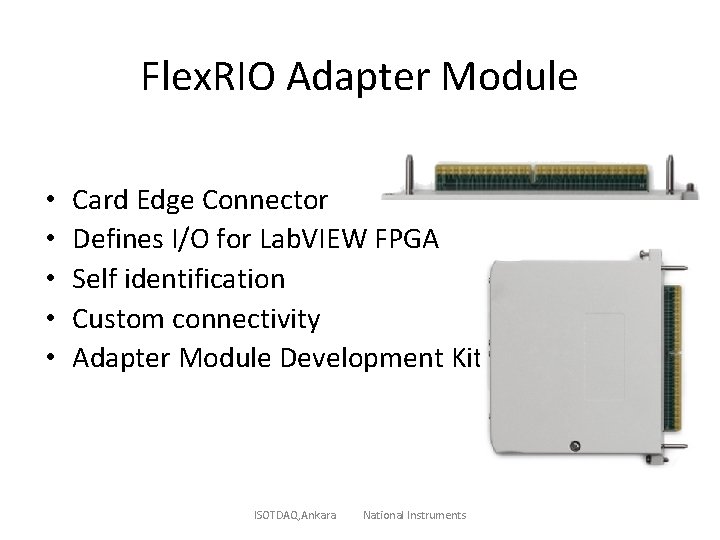
Flex. RIO Adapter Module • • • Card Edge Connector Defines I/O for Lab. VIEW FPGA Self identification Custom connectivity Adapter Module Development Kit ISOTDAQ, Ankara National Instruments
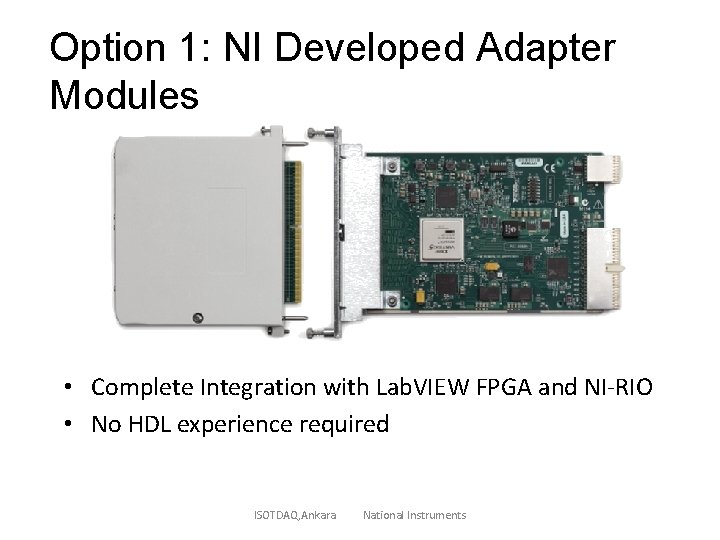
Option 1: NI Developed Adapter Modules • Complete Integration with Lab. VIEW FPGA and NI-RIO • No HDL experience required ISOTDAQ, Ankara National Instruments
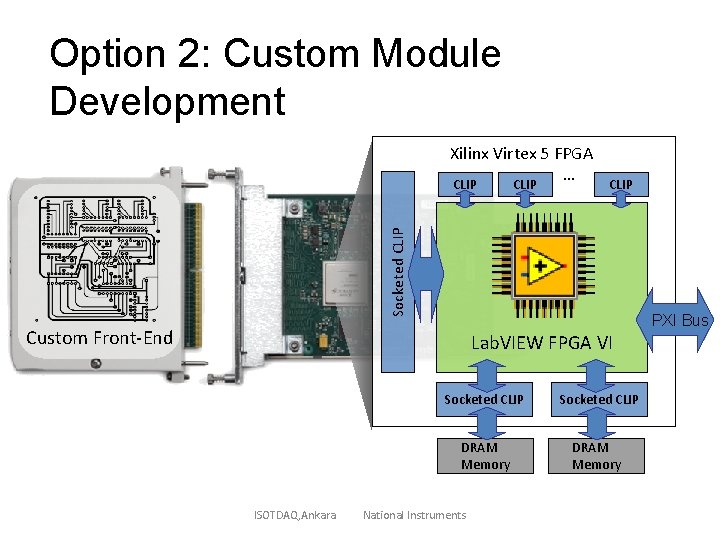
Option 2: Custom Module Development CLIP Socketed CLIP Xilinx Virtex 5 FPGA … CLIP PXI Bus Custom Front-End Lab. VIEW FPGA VI ISOTDAQ, Ankara Socketed CLIP DRAM Memory National Instruments
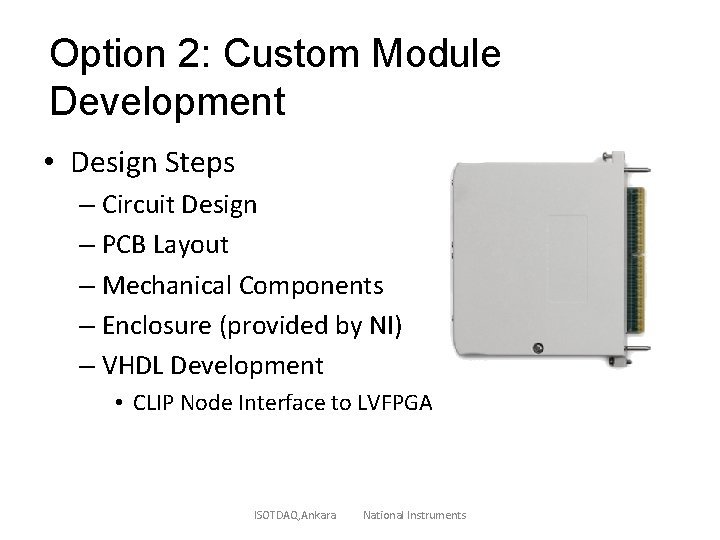
Option 2: Custom Module Development • Design Steps – Circuit Design – PCB Layout – Mechanical Components – Enclosure (provided by NI) – VHDL Development • CLIP Node Interface to LVFPGA ISOTDAQ, Ankara National Instruments
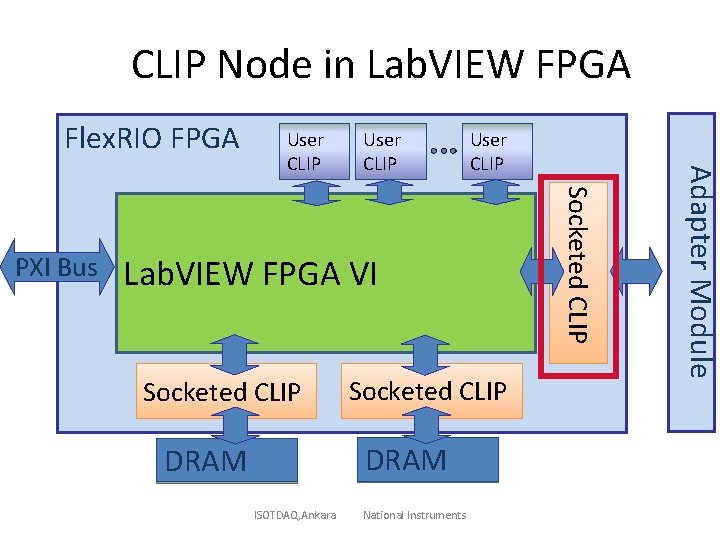
CLIP Node in Lab. VIEW FPGA Flex. RIO FPGA User CLIP Lab. VIEW FPGA VI Socketed CLIP DRAM ISOTDAQ, Ankara National Instruments Adapter Module User CLIP Socketed CLIP PXI Bus User CLIP
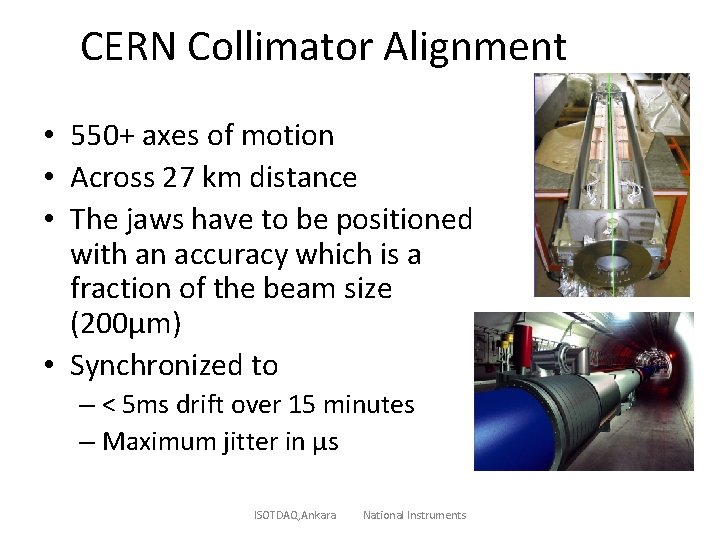
CERN Collimator Alignment • 550+ axes of motion • Across 27 km distance • The jaws have to be positioned with an accuracy which is a fraction of the beam size (200μm) • Synchronized to – < 5 ms drift over 15 minutes – Maximum jitter in μs ISOTDAQ, Ankara National Instruments
CERN – LHC Collimator Project • 120 PXI systems running Lab. VIEW Real-Time • Communication – PXI systems are connected through Ethernet – Linux (Corba) host via a protocol called DIM (future FESA) • Synchronization – Control systems are distributed over the 27 km tunnel – Synchronization using PXI 10 MHz backplane clock • Embedded / FPGA – Closed loop motor control systems with redundant feedback – Softmotion algorithms running in a synchronized FPGA ISOTDAQ, Ankara National Instruments
Questions ISOTDAQ, Ankara National Instruments
- Slides: 93