
Readings From English Newspapers And Magazines for students
- Slides: 35
Readings From English Newspapers And Magazines for students to do: 1. to browse at least 1 issue of English newspaper every 2 weeks (read intensively 1, 200 words /week) 2. a team work of 5 students as a group to produce and edit one issue newspaper 3. news report individually or as a group in class 4. to do your homework every week
Teaching Objectives 1. 2. 3. 4. To learn about the basic concepts in English Journalism To grasp some techniques in reading and understanding English Newspapers and magazines To expand their English vocabulary including the acronym of the well-known international organizations and associations, and professional terms through reading some English newspapers published in China as well as some online English news of some leading newspaper presses. To broaden their horizon
Readings From English Newspapers And Magazines Teaching Method 1. Investigate the students’ knowledge about the basic concepts about the mass media and then teach them what they have no idea of. 2. Assign students to read some English newspapers of China, such as 21 st Century, China Daily, Shanghai Daily, etc. and require them to report some important news in class 3. Lead the students to participate in commentary on current affairs and encourage them to present their discussion in class.
Warm-up Activity • Do you read any English newspapers or magazines? And what kind of news articles attract you? • Why do you enroll in this class?
Warm-up Questions Do you know any major American and British newspapers? (Unit 2) 2. Do you know any major American and British magazines? (Unit 2) 3. How do you usually read a newspaper or a magazine? Do you read from the very beginning to the end (from the Frontpage to the last page)? (Unit 3, 4, 5) 1.
Unit One Basic Concepts in English Journalism
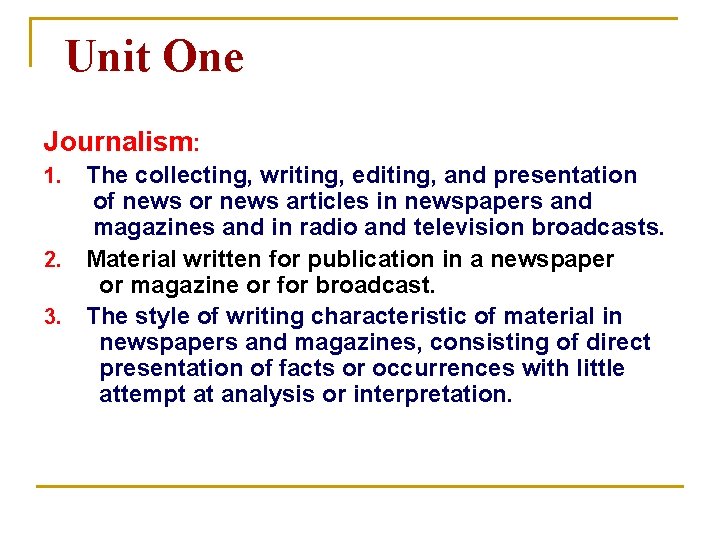
Unit One Journalism: The collecting, writing, editing, and presentation of news or news articles in newspapers and magazines and in radio and television broadcasts. 2. Material written for publication in a newspaper or magazine or for broadcast. 3. The style of writing characteristic of material in newspapers and magazines, consisting of direct presentation of facts or occurrences with little attempt at analysis or interpretation. 1.
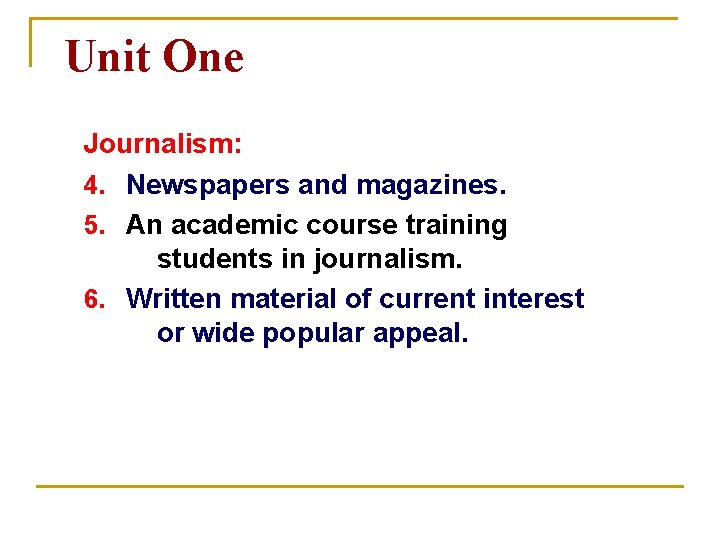
Unit One Journalism: 4. Newspapers and magazines. 5. An academic course training students in journalism. 6. Written material of current interest or wide popular appeal.
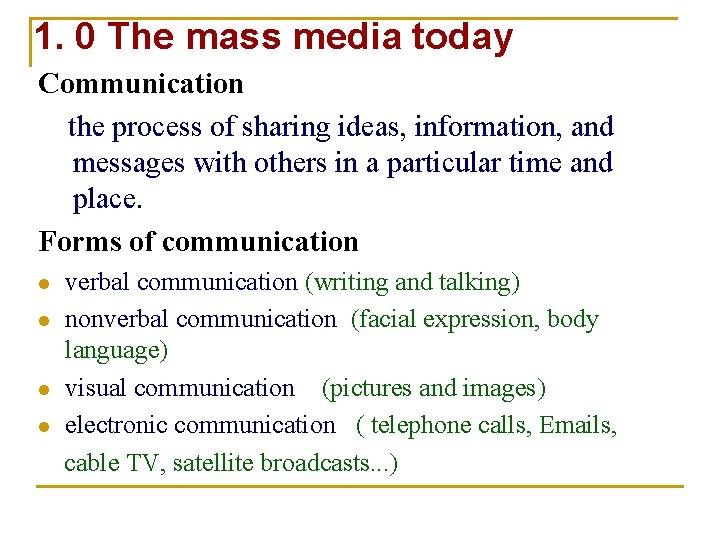
1. 0 The mass media today Communication the process of sharing ideas, information, and messages with others in a particular time and place. Forms of communication l l verbal communication (writing and talking) nonverbal communication (facial expression, body language) visual communication (pictures and images) electronic communication ( telephone calls, Emails, cable TV, satellite broadcasts. . . )
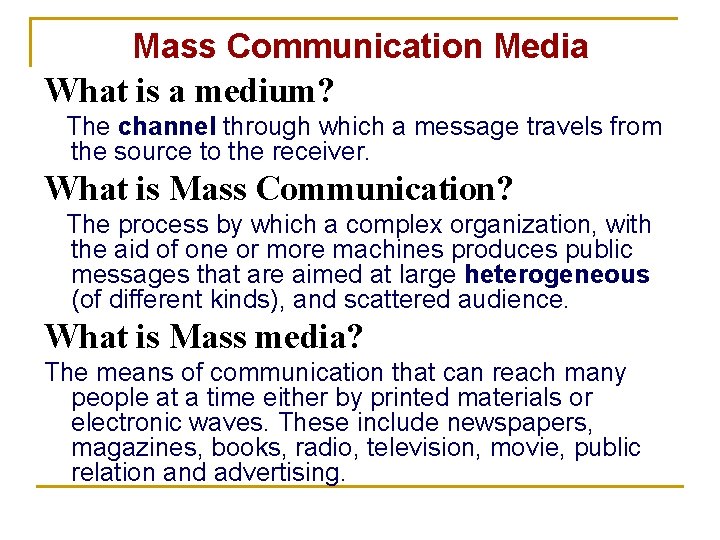
Mass Communication Media What is a medium? The channel through which a message travels from the source to the receiver. What is Mass Communication? The process by which a complex organization, with the aid of one or more machines produces public messages that are aimed at large heterogeneous (of different kinds), and scattered audience. What is Mass media? The means of communication that can reach many people at a time either by printed materials or electronic waves. These include newspapers, magazines, books, radio, television, movie, public relation and advertising.
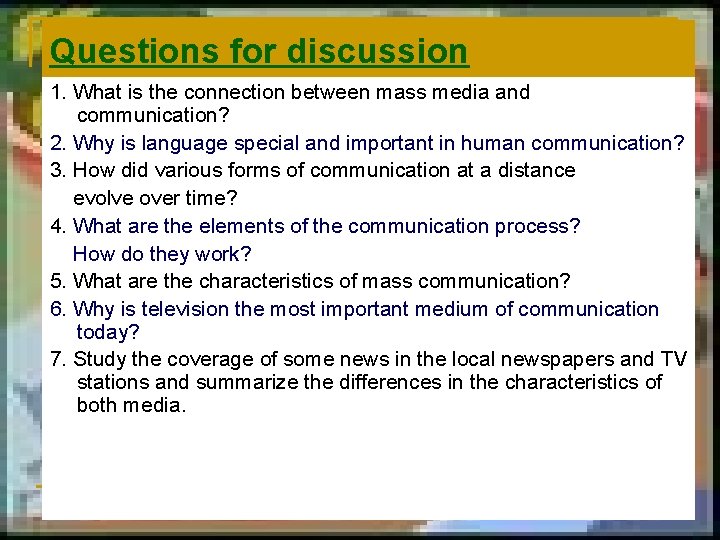
Questions for discussion 1. What is the connection between mass media and communication? 2. Why is language special and important in human communication? 3. How did various forms of communication at a distance evolve over time? 4. What are the elements of the communication process? How do they work? 5. What are the characteristics of mass communication? 6. Why is television the most important medium of communication today? 7. Study the coverage of some news in the local newspapers and TV stations and summarize the differences in the characteristics of both media.
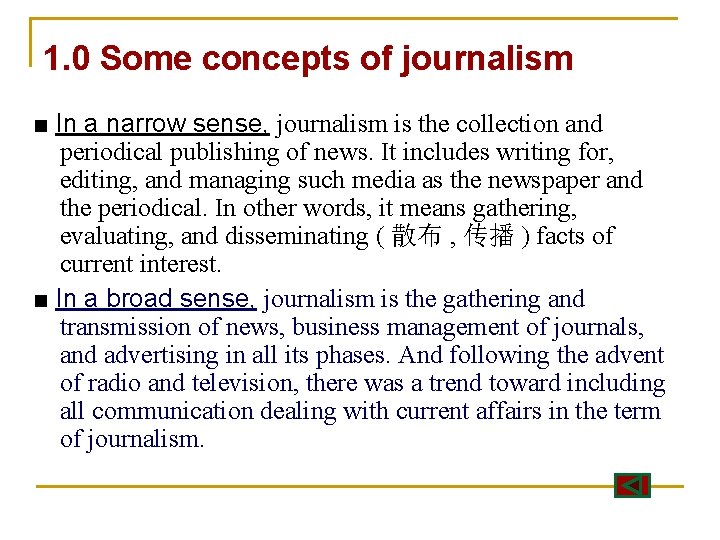
1. 0 Some concepts of journalism ■ In a narrow sense, journalism is the collection and periodical publishing of news. It includes writing for, editing, and managing such media as the newspaper and the periodical. In other words, it means gathering, evaluating, and disseminating ( 散布 , 传播 ) facts of current interest. ■ In a broad sense, journalism is the gathering and transmission of news, business management of journals, and advertising in all its phases. And following the advent of radio and television, there was a trend toward including all communication dealing with current affairs in the term of journalism.
1. 1. 1 News and Elements of News A folk definition: News is something you haven’t heard before( man bites dog); news is what editors and reporters say it is. n A more accurate definition: News is information that is published in mass media about recent events in the country or world or in a particular area of activity. n Question: How do you understand “news is different things to different people”?
1. 1. 2 News value and public interest News value refers to the importance of the facts and details in the news that satisfy the public’s interest in news. Public interest means the degree of attention that readers pay to the news reports. Newspaper editors determine the newsworthiness of a report by the following principles:
A) Timeliness Is it a recent development or is it old news? B) Proximity接近, 亲近 Is the story relevant to local readers? C) Conflicts Is the issue developing? Has it been resolved or does anybody care?
D) Prominence (eminence)突出, 显著 Are noteworthy people involved? E) Consequence or impact What effect will the story have on readers? F) Human interest Does it contain unique, interesting elements? Emotions of readers: curious, dramatic, etc.
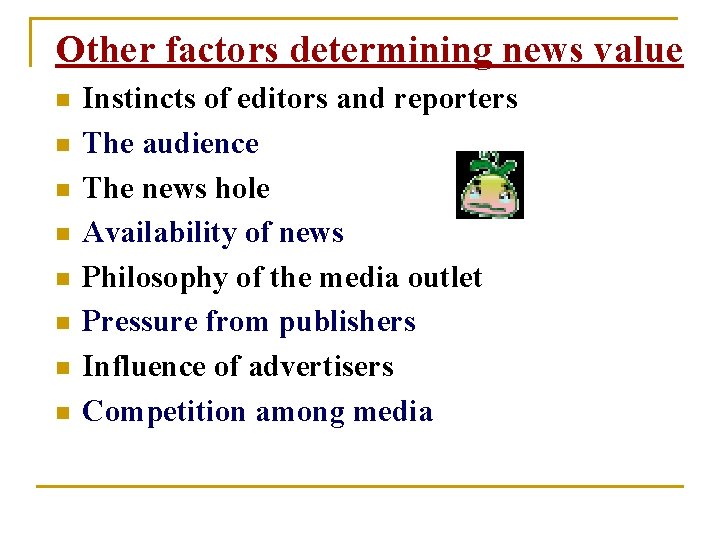
Other factors determining news value n n n n Instincts of editors and reporters The audience The news hole Availability of news Philosophy of the media outlet Pressure from publishers Influence of advertisers Competition among media
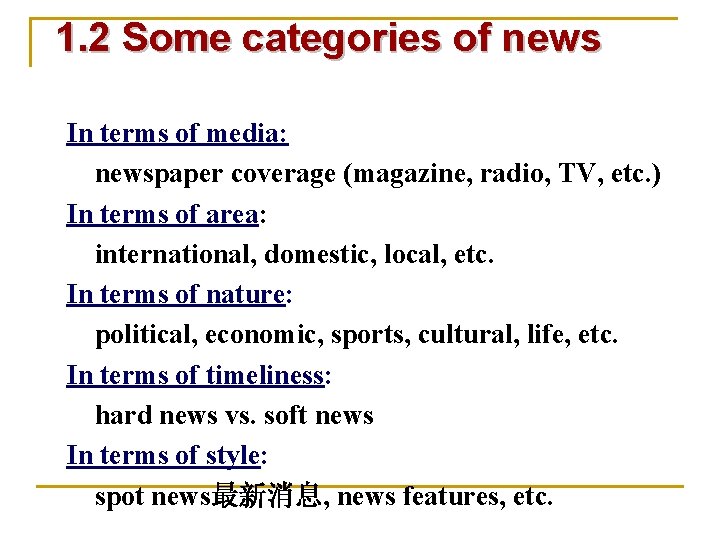
1. 2 Some categories of news In terms of media: newspaper coverage (magazine, radio, TV, etc. ) In terms of area: international, domestic, local, etc. In terms of nature: political, economic, sports, cultural, life, etc. In terms of timeliness: hard news vs. soft news In terms of style: spot news最新消息, news features, etc.
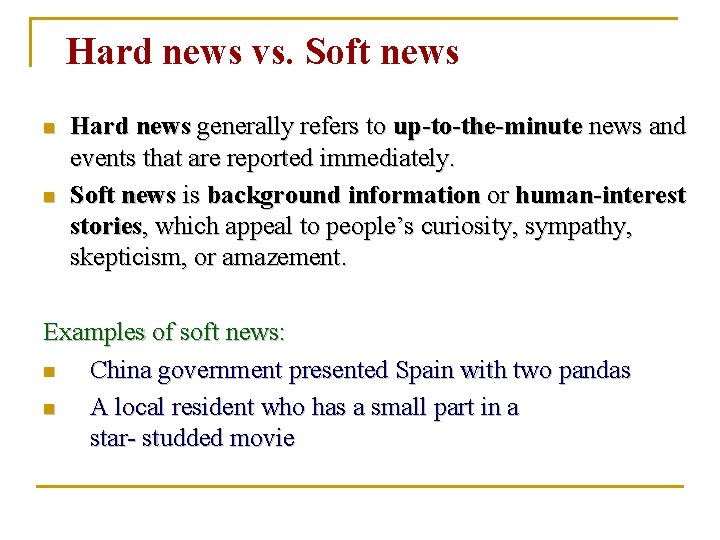
Hard news vs. Soft news n n Hard news generally refers to up-to-the-minute news and events that are reported immediately. Soft news is background information or human-interest stories, which appeal to people’s curiosity, sympathy, skepticism, or amazement. Examples of soft news: n China government presented Spain with two pandas n A local resident who has a small part in a star- studded movie
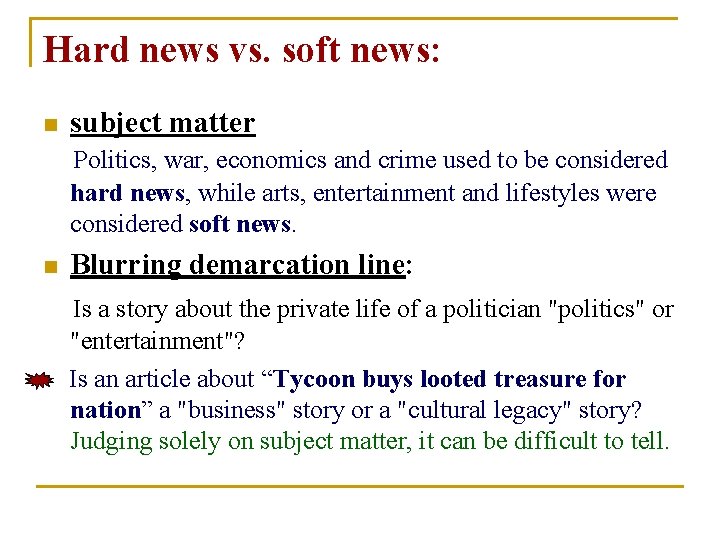
Hard news vs. soft news: n subject matter Politics, war, economics and crime used to be considered hard news, while arts, entertainment and lifestyles were considered soft news. n Blurring demarcation line: Is a story about the private life of a politician "politics" or "entertainment"? Is an article about “Tycoon buys looted treasure for nation” a "business" story or a "cultural legacy" story? Judging solely on subject matter, it can be difficult to tell.
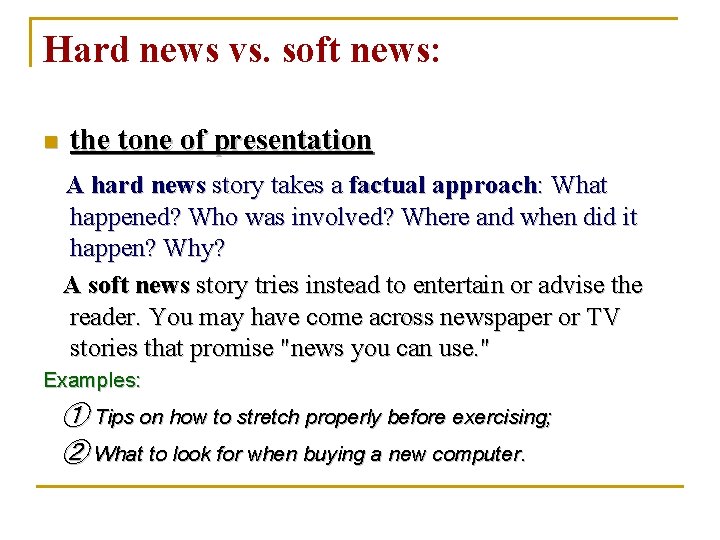
Hard news vs. soft news: n the tone of presentation A hard news story takes a factual approach: What happened? Who was involved? Where and when did it happen? Why? A soft news story tries instead to entertain or advise the reader. You may have come across newspaper or TV stories that promise "news you can use. " Examples: ① Tips on how to stretch properly before exercising; ② What to look for when buying a new computer.
In-class exercise To classify hard news & soft news: Shanghai Daily
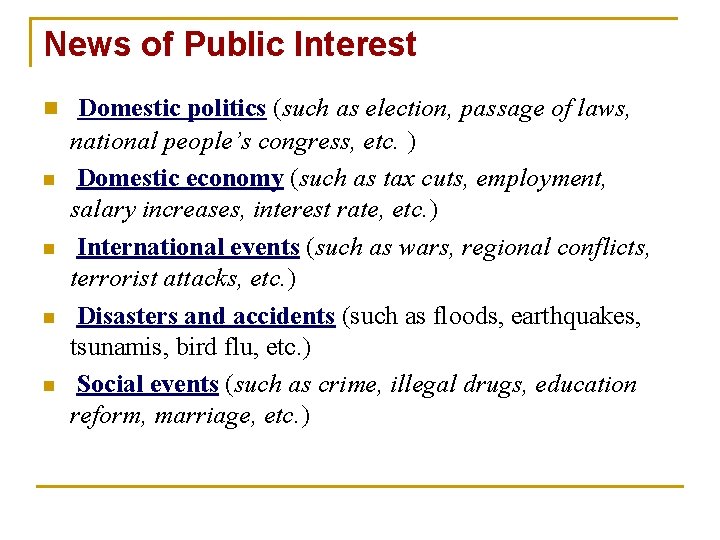
News of Public Interest n n n Domestic politics (such as election, passage of laws, national people’s congress, etc. ) Domestic economy (such as tax cuts, employment, salary increases, interest rate, etc. ) International events (such as wars, regional conflicts, terrorist attacks, etc. ) Disasters and accidents (such as floods, earthquakes, tsunamis, bird flu, etc. ) Social events (such as crime, illegal drugs, education reform, marriage, etc. )
Questions for Discussion 1. What is news? What are some categories of news? 2. What are the source and nature of news? 3. What kinds of news are people generally interested in? 4. What are the five elements of news? How are they presented in a news story?
Questions for discussion 1. What is news value? What are some basic elements of news value? 2. What are the aspects of news that can catch and reflect the public interest? 3. Can the news reports in a western newspaper be truly "fair and objective"? Why? 4. What is eminence or prominence in the newsworthiness? What are the other factors that determine whether news story is pursued and finally published in a local newspaper?
1. 5 Legal and Ethical Issues of Journalism Legal areas of particular concern to reporters: 1. libel (诽谤) 2. newsroom searches 3. protection of (news) sources 4. invasion of privacy 5. free press controversy
① What is libel? Libel is published defamation of character. It is writing or pictures that expose a person to hatred, shame, disgrace, contempt or ridicule, and that injure a person’s reputation. Libelous words unprofessional corrupt blockhead incompetent dishonest scoundrel无赖 unethical disreputable deadhead cheating unprincipled fool
② Newsroom search --- a case In 1971, four police officers entered the offices of the Stanford Daily, the campus newspaper of Stanford University, and produced a search warrant authorizing them to search for photographs of a clash between demonstrators and police that the Daily had covered the day before. The newspaper brought suit against the authorities. In 1978, the Supreme Court ruled that the search was legal.
③ Protection of news sources n n n Jailing of reporters for refusing to cooperate with the government to divulge confidential information is not common, but it happens. Journalists typically keep excellent records of information, some of which is never published or broadcast Requests and searches for information by the government and others can compromise a journalist’s neutrality
③ Protection of news sources n Journalist’s need to be able to do their work without fear of outside forces gaining access to the information they gather.
④ Invasion of privacy What is privacy? The right of the individual to be protected against intrusion into his personal life or affairs, or those of his family, by direct physical means or by publication of information.
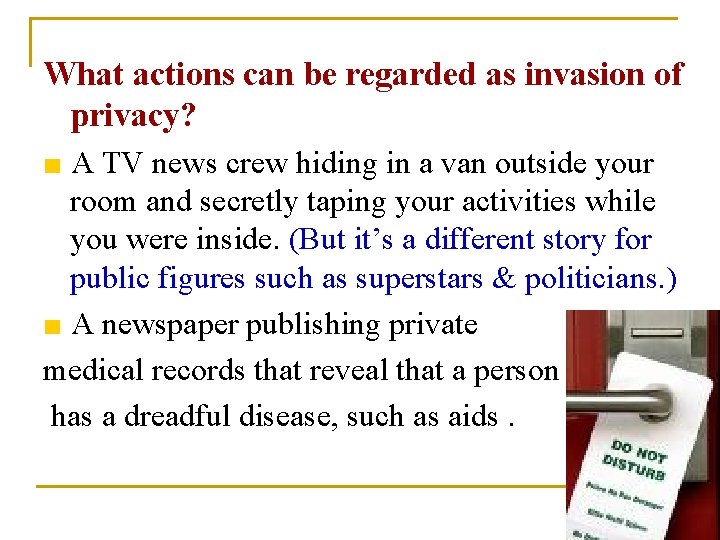
What actions can be regarded as invasion of privacy? ■ A TV news crew hiding in a van outside your room and secretly taping your activities while you were inside. (But it’s a different story for public figures such as superstars & politicians. ) ■ A newspaper publishing private medical records that reveal that a person has a dreadful disease, such as aids.
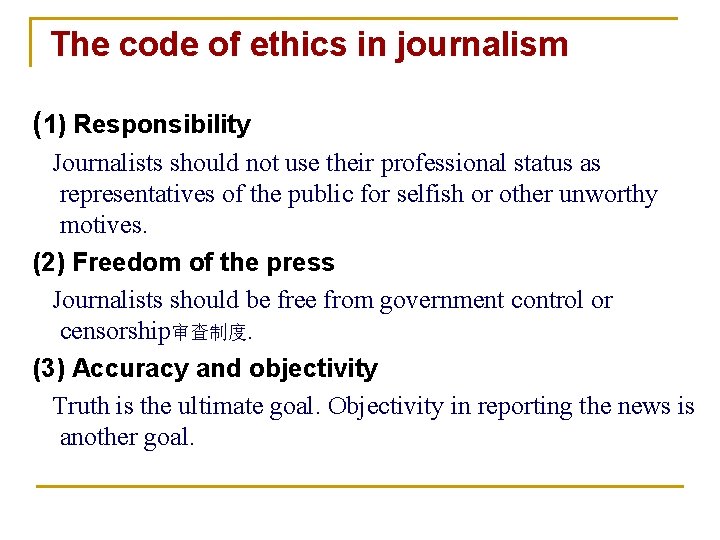
The code of ethics in journalism (1) Responsibility Journalists should not use their professional status as representatives of the public for selfish or other unworthy motives. (2) Freedom of the press Journalists should be free from government control or censorship审查制度. (3) Accuracy and objectivity Truth is the ultimate goal. Objectivity in reporting the news is another goal.
Questions for Discussion 1. What are the common legal issues related to journalism? 2. What is the code of ethics for journalists? 3. What is called "freedom of the press"? Why has it been increasingly challenged?
Homework 1. Compare the front page of an English newspaper and a Chinese newspaper. What are the similarities and differences? Where are the stories placed on the page? 2. Choose some examples from the English newspapers you have read to illustrate the legal and ethical issues of journalism, and to explain the nature of “freedom of press”.