
Reading Your Science Textbook Strategies for comprehension Purpose
Reading Your Science Textbook Strategies for comprehension
Purpose • Always read the objectives for the Chapter and for the section that you are currently reading. • You must have a “Purpose” for reading the material.
Headings/Subheadings • Read through the headings followed by the subheadings • Start thinking about how the chapter is organized by looking at headings. • Keep in mind that some headings are different colors.
Vocabulary • Look at the bold print words and try to pronounce them before you start reading. • You will have better fluency and therefore better understanding if you struggle through the difficult words before you start reading.
Pictures/Charts/Graphs • Read the descriptions of pictures, charts and graphs before reading. • This will give you a visual representation of what you will be reading about.
Super Six Bookmark • We will be using this bookmark to remind us of the Super Six Comprehension Strategies – – – Make Connections Predict/Infer Ask Questions Monitor Summarize Evaluate
Make Connections • I know …. about this topic – Prior knowledge • This reminds me of – Something in my life – Something I read previously – Some knowledge about the world
Predict/Infer • I think this is about…. . I know this because the clues I see are…. . • I inferred …. . by using the clues…. . and what I already knew about……
Ask Questions • I am wondering …. . • What could a teacher ask me? – Who, what, where, when, why • I would like to ask the author about….
Monitor • Does the reading make sense? • What are the difficult words and ideas? • How can you fix up the problem? – Reread, read on, look for parts you know)
Summarize • I can summarize the main ideas and events in a few sentences. • The principle or law is …… • Now I think …. .
Evaluate • How do I rate the reading material, author’s style, ideas, and my reading?
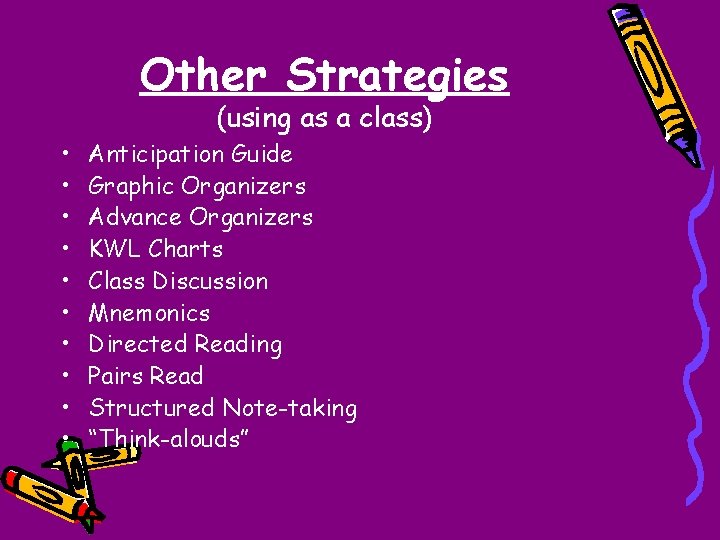
Other Strategies • • • (using as a class) Anticipation Guide Graphic Organizers Advance Organizers KWL Charts Class Discussion Mnemonics Directed Reading Pairs Read Structured Note-taking “Think-alouds”
- Slides: 13