
Reading Writing and Math at Home Supporting Your
- Slides: 13
Reading, Writing and Math at Home Supporting Your Child’s Learning Carrie Seguin, Linda Coughlin, Tanya Sesbreno
The more support the family provides for their child’s learning at home, the more likely the child will do well in school and continue their educational journey. Reading and Writing With Your Child (K-6), 2012
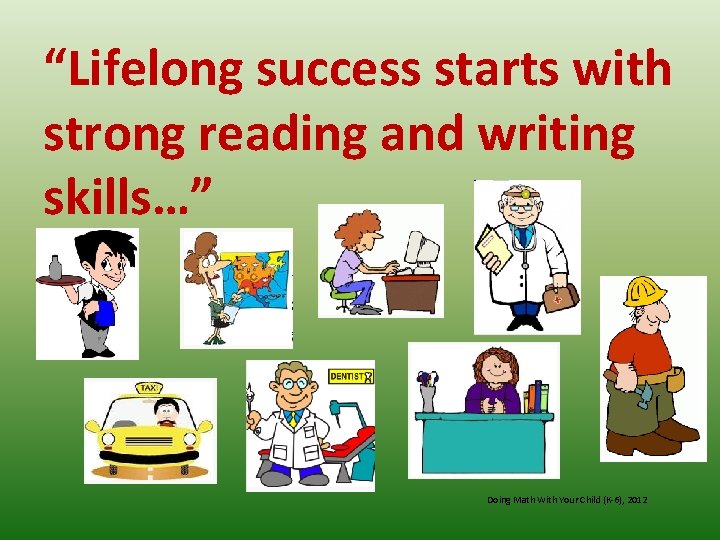
“Lifelong success starts with strong reading and writing skills…” Doing Math With Your Child (K-6), 2012
HOW CAN I HELP AT HOME WITH READING AND WRITING? • Talk to your child about what they are reading and about day-to-day problems and solutions • Encourage critical reading by asking questions, talking about meaning, and summarizing key points of a text • Read with your child every day and let them see you reading and writing in real-world situations
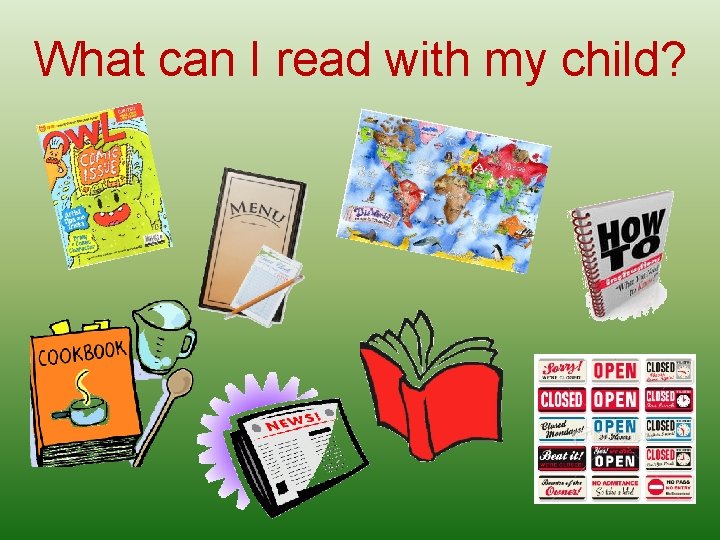
What can I read with my child?
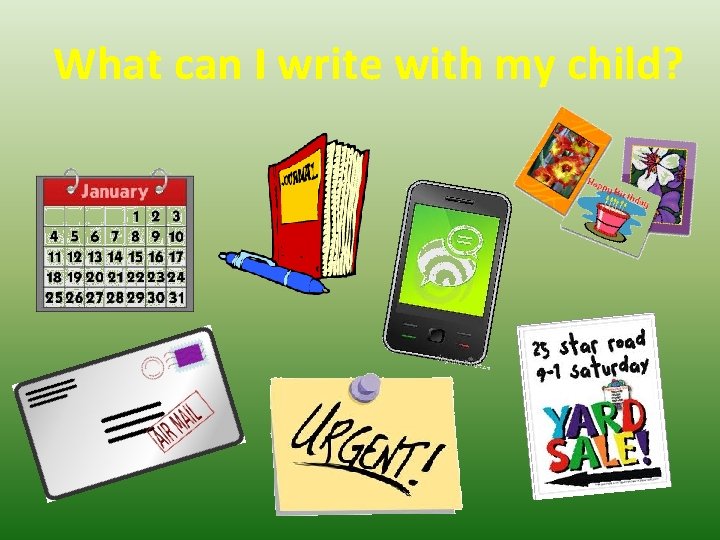
What can I write with my child?
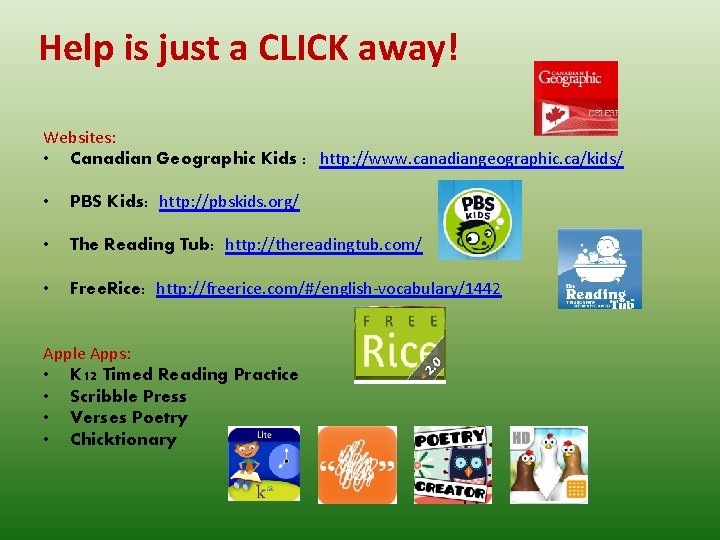
Help is just a CLICK away! Websites: • Canadian Geographic Kids : http: //www. canadiangeographic. ca/kids/ • PBS Kids: http: //pbskids. org/ • The Reading Tub: http: //thereadingtub. com/ • Free. Rice: http: //freerice. com/#/english-vocabulary/1442 Apple Apps: • K 12 Timed Reading Practice • Scribble Press • Verses Poetry • Chicktionary
“Understanding mathematics builds confidence and opens doors to many jobs and careers…” Doing Math With Your Child (K-6), 2012
HOW CAN I HELP AT HOME WITH MATH? • Demonstrate and model a positive attitude about math and how you use it in everyday life • Involve your child in using numbers to solve problems and make everyday decisions involving math • Invent and play games or do projects that use math language and practice math concepts • Be open to the strategies that your child uses to solve math problems • Use household items to help your child practice counting, patterning, measuring, sorting, and calculating (eg. beans, coins, blocks, pasta, cutlery, tape, toothpicks, etc. )
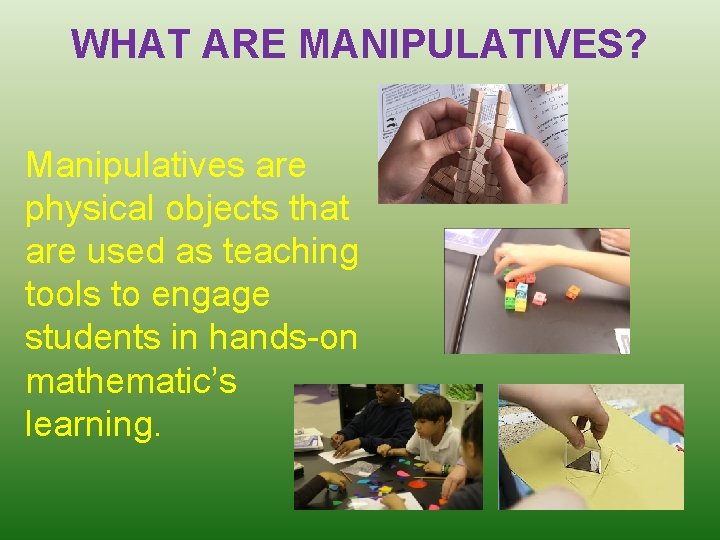
WHAT ARE MANIPULATIVES? Manipulatives are physical objects that are used as teaching tools to engage students in hands-on mathematic’s learning.
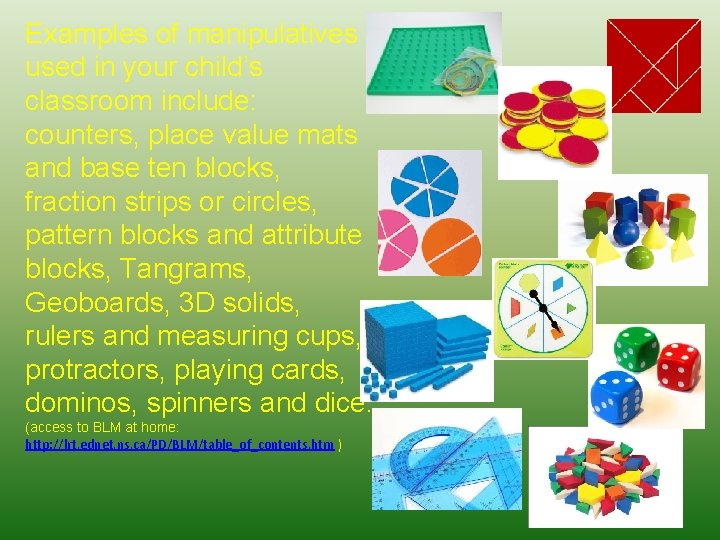
Examples of manipulatives used in your child’s classroom include: counters, place value mats and base ten blocks, fraction strips or circles, pattern blocks and attribute blocks, Tangrams, Geoboards, 3 D solids, rulers and measuring cups, protractors, playing cards, dominos, spinners and dice. (access to BLM at home: http: //lrt. ednet. ns. ca/PD/BLM/table_of_contents. htm )
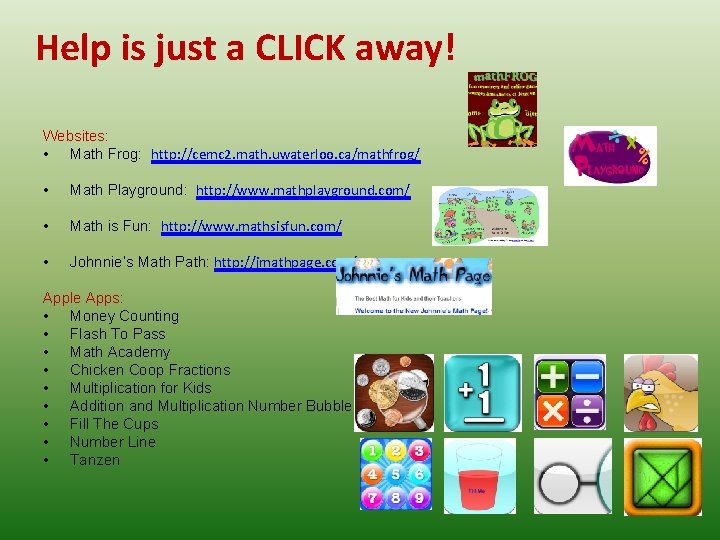
Help is just a CLICK away! Websites: • Math Frog: http: //cemc 2. math. uwaterloo. ca/mathfrog/ • Math Playground: http: //www. mathplayground. com/ • Math is Fun: http: //www. mathsisfun. com/ • Johnnie’s Math Path: http: //jmathpage. com/ Apple Apps: • Money Counting • Flash To Pass • Math Academy • Chicken Coop Fractions • Multiplication for Kids • Addition and Multiplication Number Bubble • Fill The Cups • Number Line • Tanzen
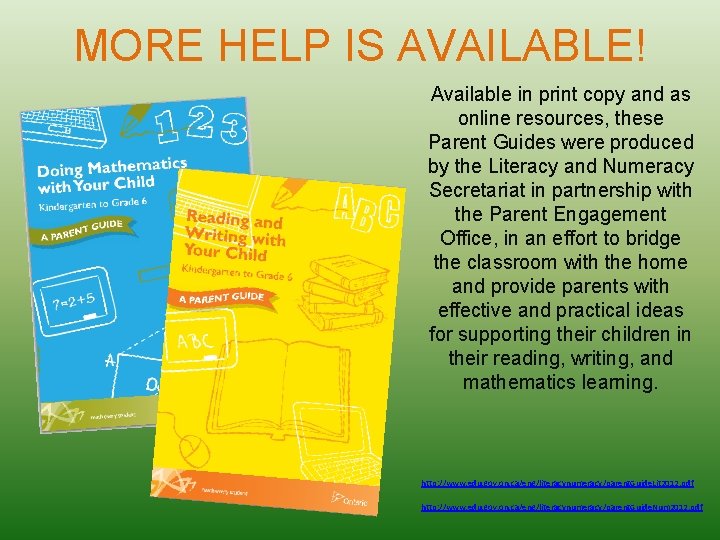
MORE HELP IS AVAILABLE! Available in print copy and as online resources, these Parent Guides were produced by the Literacy and Numeracy Secretariat in partnership with the Parent Engagement Office, in an effort to bridge the classroom with the home and provide parents with effective and practical ideas for supporting their children in their reading, writing, and mathematics learning. http: //www. edu. gov. on. ca/eng/literacynumeracy/parent. Guide. Lit 2012. pdf http: //www. edu. gov. on. ca/eng/literacynumeracy/parent. Guide. Num 2012. pdf