
Reading vs critical reading We read every day
- Slides: 17
Reading vs. critical reading • We read every day. We read cereal boxes, posters, tweets. But there is a difference between reading and critical reading. When we read critically, we question what we read. What is the author saying here? Is this statistic correct? Why is the author using this specific word/phrase? Why is the author writing this essay? • Critical reading is only an extended and focused version of the kind of thinking we all do every day when we set out to solve problems: we gather evidence, we examine options, we look at advantages and disadvantages, and we weigh others’ opinions for possible bias. • What are some ways to read more critically? • One way to read critically is to ask questions.
Reading as Inquiry – questions to ask • Explore and Explain • What is this text saying? • What does this information mean? • Who is this article intended for? (audience) • Why is the author writing? (purpose) • What are some of the words/phrases that I need to look up? (context) • Evaluate and Reflect • What do I think about what the author is saying? • What value is this reading challenging? • Does this author have any assumptions?
Week 2 Reading Assignment • Please read Nick Walker’s “Throw Away the Master’s Tools: Liberating Ourselves from the Pathology Paradigm. ” The PDF file is uploaded on D 2 L – Contents – Readings. Engage with the text critically – I would encourage everyone to take notes. • The following slides are designed to get you started thinking about reading critically. Analyze closely and ask questions.
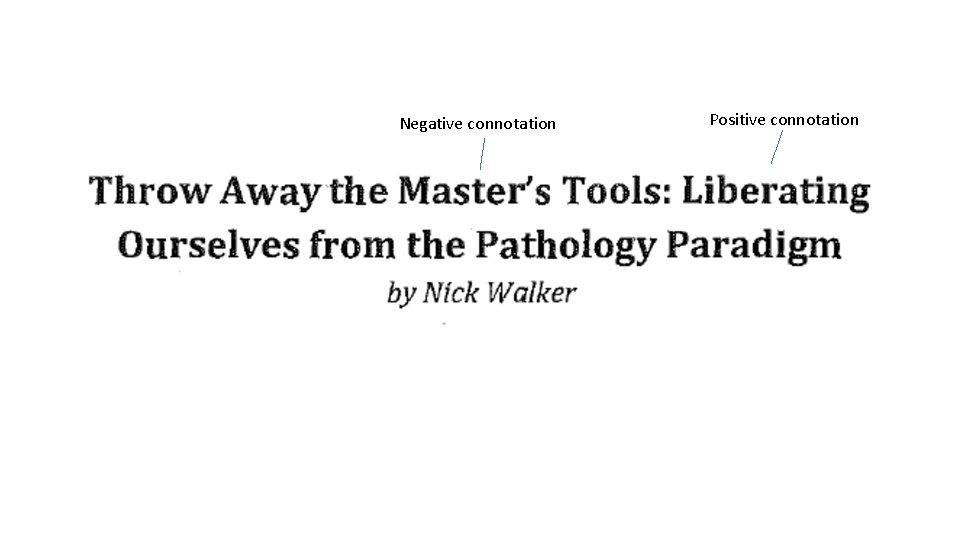
Negative connotation Positive connotation
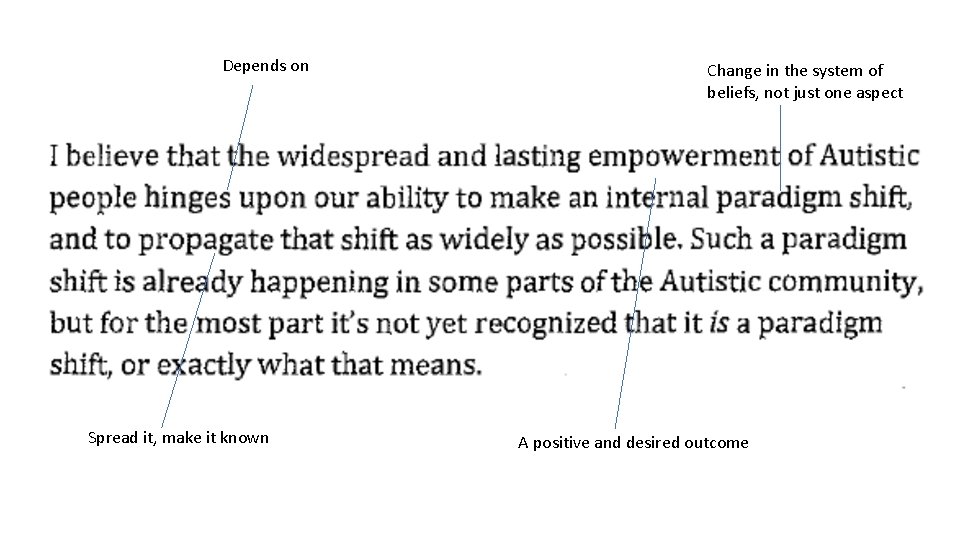
Depends on Spread it, make it known Change in the system of beliefs, not just one aspect A positive and desired outcome
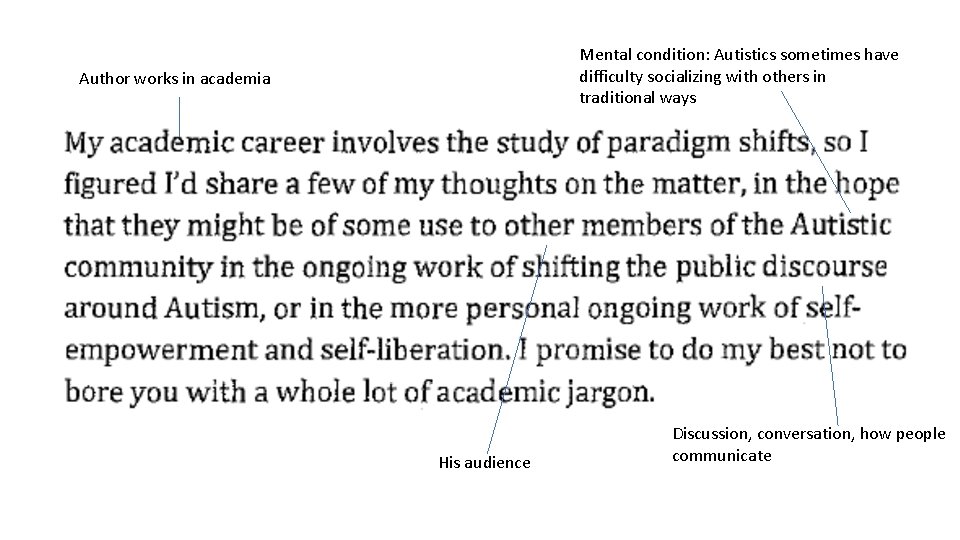
Mental condition: Autistics sometimes have difficulty socializing with others in traditional ways Author works in academia His audience Discussion, conversation, how people communicate
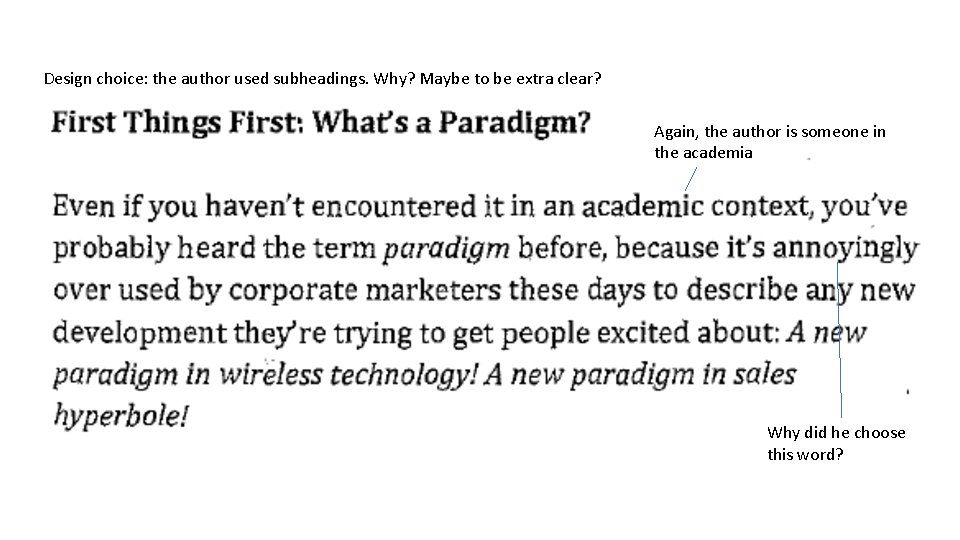
Design choice: the author used subheadings. Why? Maybe to be extra clear? Again, the author is someone in the academia Why did he choose this word?
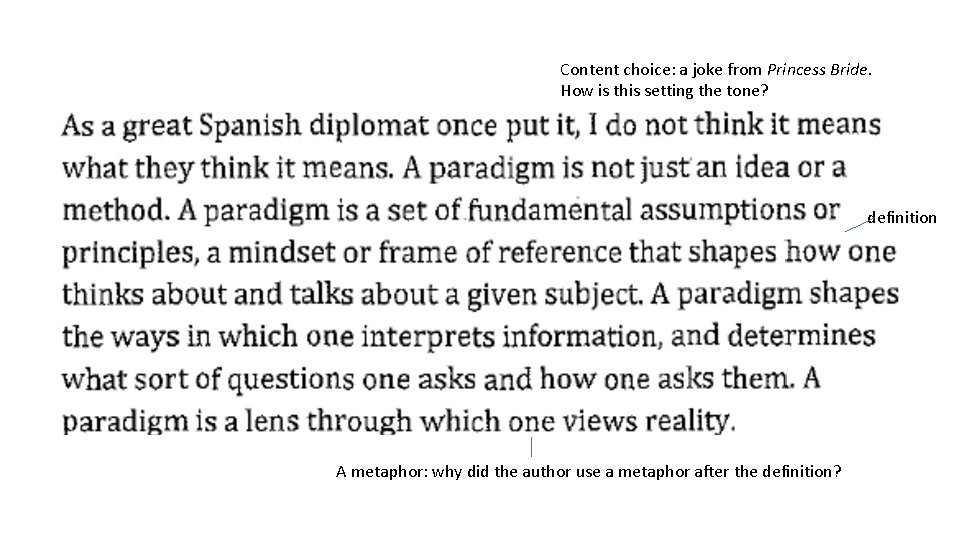
Content choice: a joke from Princess Bride. How is this setting the tone? definition A metaphor: why did the author use a metaphor after the definition?
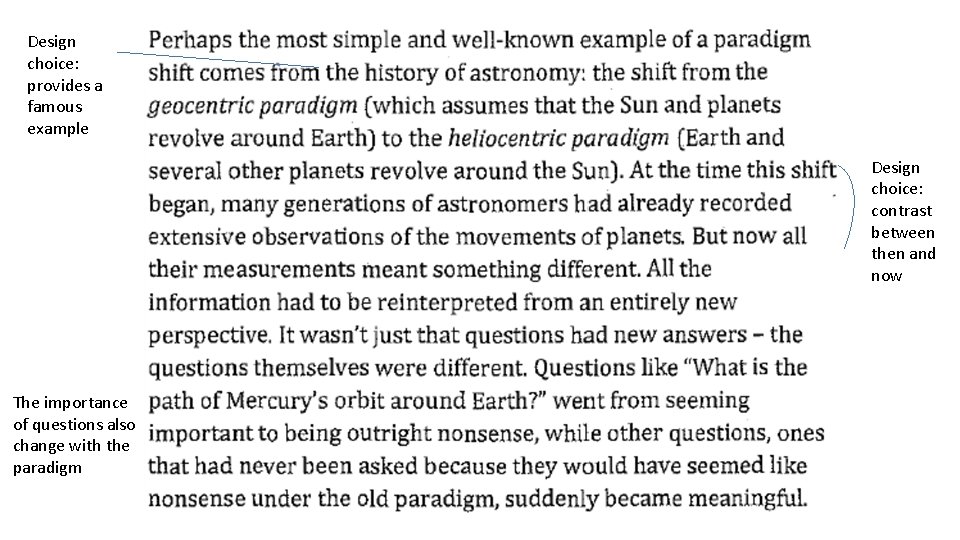
Design choice: provides a famous example Design choice: contrast between then and now The importance of questions also change with the paradigm
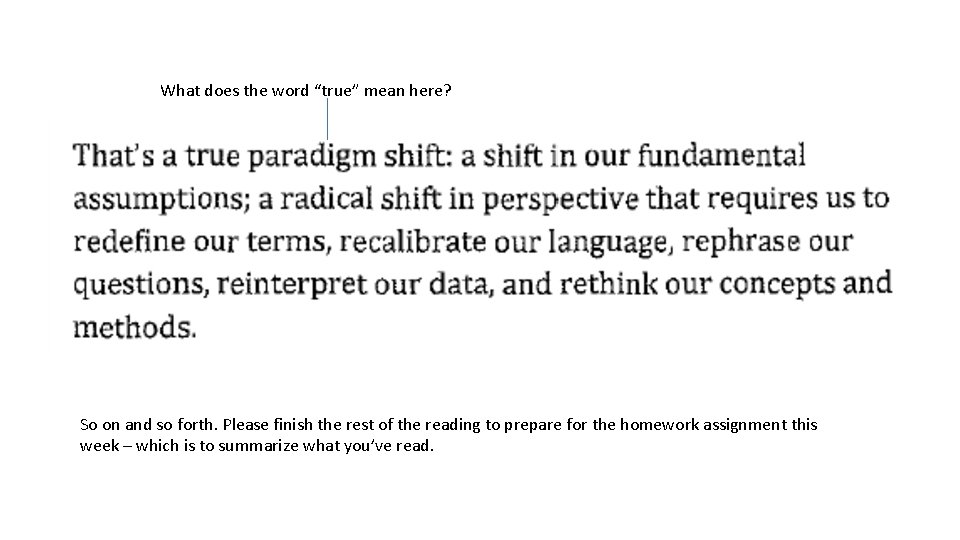
What does the word “true” mean here? So on and so forth. Please finish the rest of the reading to prepare for the homework assignment this week – which is to summarize what you’ve read.
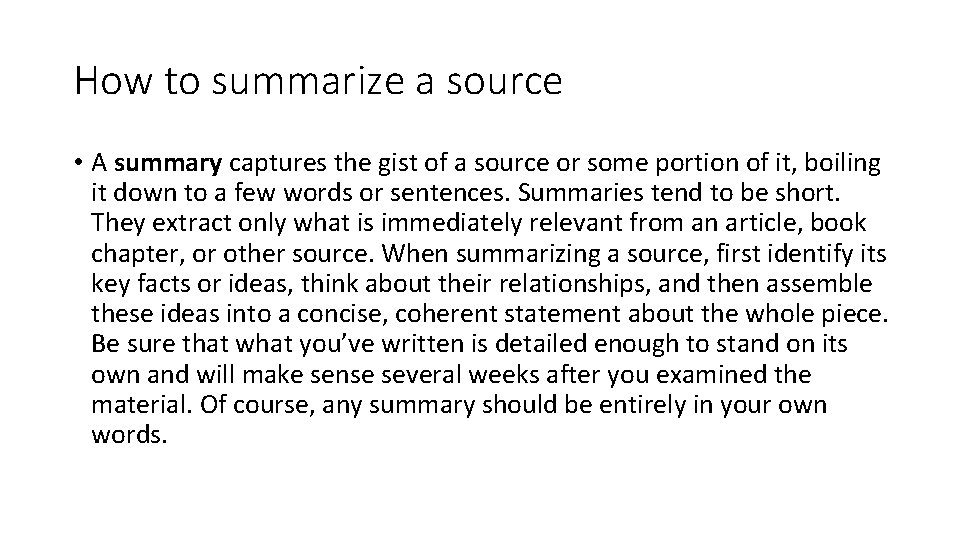
How to summarize a source • A summary captures the gist of a source or some portion of it, boiling it down to a few words or sentences. Summaries tend to be short. They extract only what is immediately relevant from an article, book chapter, or other source. When summarizing a source, first identify its key facts or ideas, think about their relationships, and then assemble these ideas into a concise, coherent statement about the whole piece. Be sure that what you’ve written is detailed enough to stand on its own and will make sense several weeks after you examined the material. Of course, any summary should be entirely in your own words.
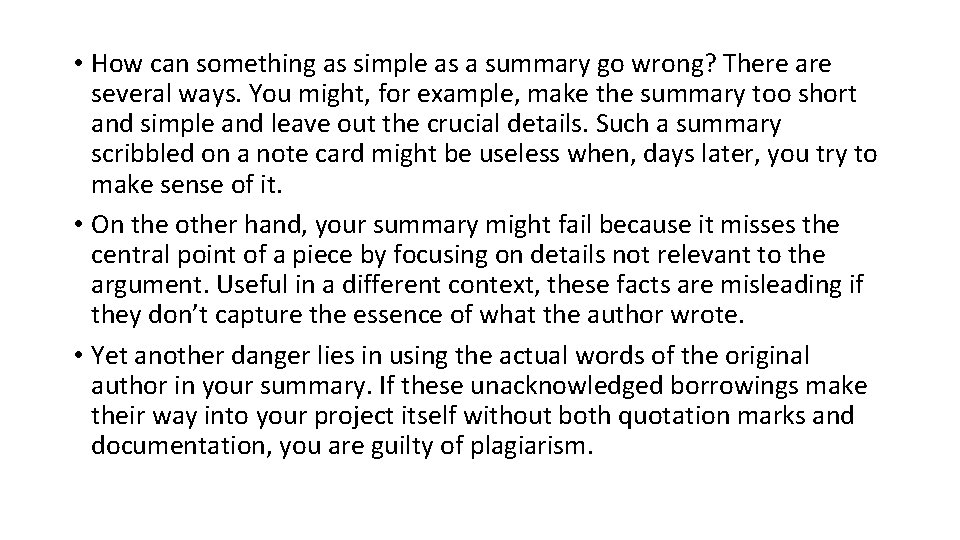
• How can something as simple as a summary go wrong? There are several ways. You might, for example, make the summary too short and simple and leave out the crucial details. Such a summary scribbled on a note card might be useless when, days later, you try to make sense of it. • On the other hand, your summary might fail because it misses the central point of a piece by focusing on details not relevant to the argument. Useful in a different context, these facts are misleading if they don’t capture the essence of what the author wrote. • Yet another danger lies in using the actual words of the original author in your summary. If these unacknowledged borrowings make their way into your project itself without both quotation marks and documentation, you are guilty of plagiarism.
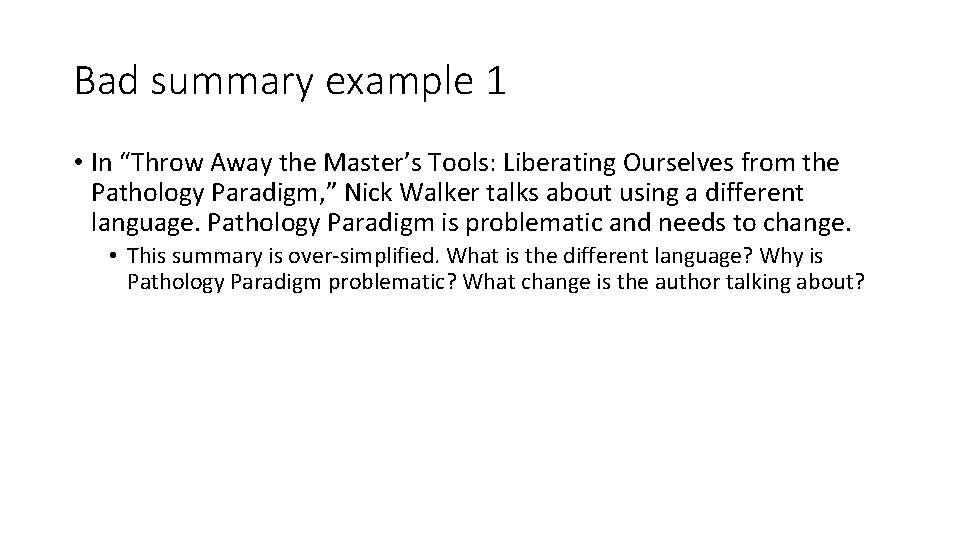
Bad summary example 1 • In “Throw Away the Master’s Tools: Liberating Ourselves from the Pathology Paradigm, ” Nick Walker talks about using a different language. Pathology Paradigm is problematic and needs to change. • This summary is over-simplified. What is the different language? Why is Pathology Paradigm problematic? What change is the author talking about?
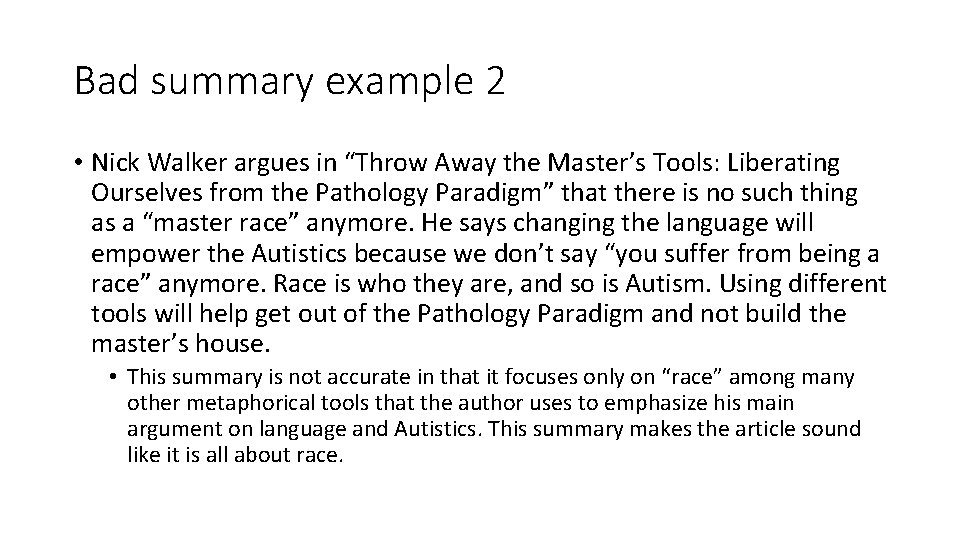
Bad summary example 2 • Nick Walker argues in “Throw Away the Master’s Tools: Liberating Ourselves from the Pathology Paradigm” that there is no such thing as a “master race” anymore. He says changing the language will empower the Autistics because we don’t say “you suffer from being a race” anymore. Race is who they are, and so is Autism. Using different tools will help get out of the Pathology Paradigm and not build the master’s house. • This summary is not accurate in that it focuses only on “race” among many other metaphorical tools that the author uses to emphasize his main argument on language and Autistics. This summary makes the article sound like it is all about race.
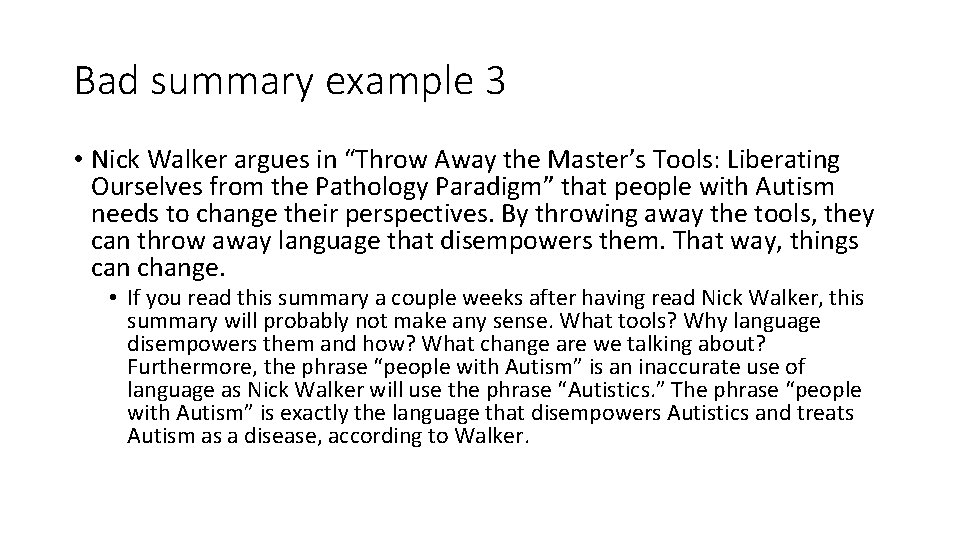
Bad summary example 3 • Nick Walker argues in “Throw Away the Master’s Tools: Liberating Ourselves from the Pathology Paradigm” that people with Autism needs to change their perspectives. By throwing away the tools, they can throw away language that disempowers them. That way, things can change. • If you read this summary a couple weeks after having read Nick Walker, this summary will probably not make any sense. What tools? Why language disempowers them and how? What change are we talking about? Furthermore, the phrase “people with Autism” is an inaccurate use of language as Nick Walker will use the phrase “Autistics. ” The phrase “people with Autism” is exactly the language that disempowers Autistics and treats Autism as a disease, according to Walker.
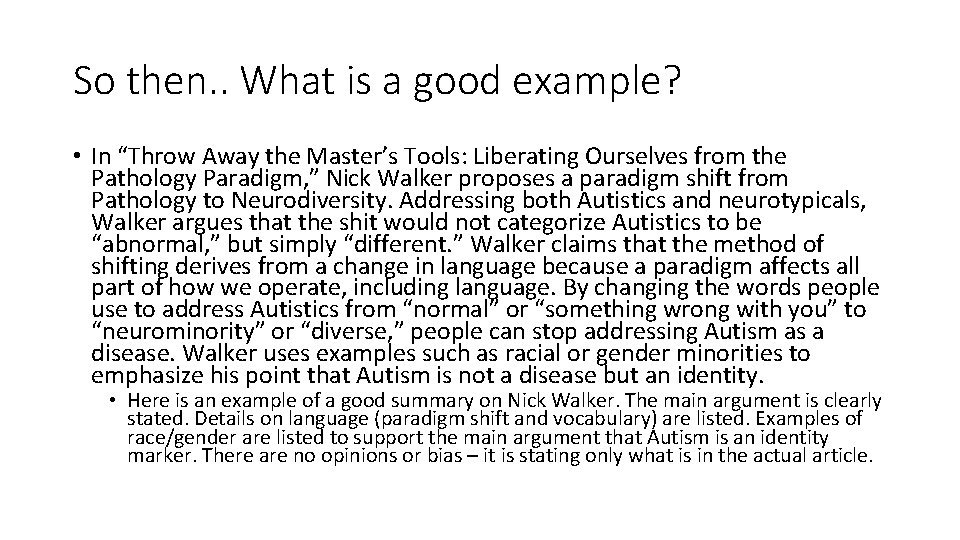
So then. . What is a good example? • In “Throw Away the Master’s Tools: Liberating Ourselves from the Pathology Paradigm, ” Nick Walker proposes a paradigm shift from Pathology to Neurodiversity. Addressing both Autistics and neurotypicals, Walker argues that the shit would not categorize Autistics to be “abnormal, ” but simply “different. ” Walker claims that the method of shifting derives from a change in language because a paradigm affects all part of how we operate, including language. By changing the words people use to address Autistics from “normal” or “something wrong with you” to “neurominority” or “diverse, ” people can stop addressing Autism as a disease. Walker uses examples such as racial or gender minorities to emphasize his point that Autism is not a disease but an identity. • Here is an example of a good summary on Nick Walker. The main argument is clearly stated. Details on language (paradigm shift and vocabulary) are listed. Examples of race/gender are listed to support the main argument that Autism is an identity marker. There are no opinions or bias – it is stating only what is in the actual article.
Week 2 Homework to Upload • For discussions board this week, write a couple sentences on “What makes a good summary? ” What needs to be in a good summary? What needs to be left out in a good summary? What makes a good summary good? (And what makes a bad summary bad? ) Respond to each other’s posts. • On D 2 L Dropbox, upload your Nick Walker summaries on Word documents. The summary should be less than 300 words.