
Reading the poem Read a poem more than
- Slides: 16
Reading the poem • Read a poem more than once. • Keep a dictionary by you and use it. • Read the poem aloud so as to hear the sounds of the words in your mind. • Always pay careful attention to what the poem is saying.
Poetry has four dimensions: • Intellectual • Sensuous • Emotional • Imaginative
These dimensions are conveyed through the use of various modes of expression: connotation, imagery, metaphor, simile, symbol, paradox, irony, allusion, sound repetition, rhythm, and pattern.
vconnotation – an idea or a feeling that a word suggests in addition to its literal meaning and denotations She is feeling blue. What is the connotation of «blue» ? All the world’s a stage, And all the men and women merely players; They have their exits and their entrances; And one man in his time plays many parts … (from As You Like It by W. Shakespeare) What do the «stage» , «players» and «parts» connote?
vimagery –a mental picture created in such a way that it appeals to our senses Where are the songs of Spring? Ay, where are they? Think not of them, thou hast thy music too, -While barred clouds bloom the soft-dying day, And touch the stubble-plains with rosy hue; Then in a wailful choir the small gnats mourn Among the river sallows, borne aloft Or sinking as the light wind lives or dies; And full-grown lambs loud bleat from hilly bourn; Hedge-crickets sing; and now with treble soft The redbreast whistles from a garden-croft, And gathering swallows twitter in the skies. (from John Keats’ «To Autumn» )
vmetaphor – a figure of speech in which one thing is identified with another (e. g. She was a tower of strength during the crisis) But thy eternal summer shall not fade … (from Shakespeare’s Sonnet 18 – «Shall I Compare Thee to a Summer’s Day» )
“Metaphors” by Sylvia Plath I’m a riddle in nine syllables, An elephant, a ponderous house, A melon strolling on two tendrils. O red fruit, ivory, fine timbers! This loaf’s big with its yeasty rising. Money’s new-minted in this fat purse. I’m a means, a stage, a cow in calf. I’ve eaten a bag of green apples, Boarded the train there’s no getting off.
vsimile – a figure of speech in which two unlike things are compared (e. g. He chattered like a magpie) O my Luve’s like a red, red rose That’s newly sprung in June; O my Luve’s like the melodie That’s sweetly played in tune. (from «Red Rose» by Robert Burns) I wandered lonely as a cloud that floats on high o’er vales and hills. (from «The Daffodils» by William Wordsworth)
vsymbol – something which is used to suggest or represent something else (e. g. A dove is a symbol of peace) In the spring I asked the daisies If his words were true, And the clever, clear-eyed daisies Always knew. Now the fields are brown and barren, Bitter autumn blows, And of all the stupid asters Not one knows. ( «Wild Asters» by Sara Teasdale)
vparadox – bringing together two distant words or phrases The child is the father of the man. (from «Rainbow» by William Wordsworth)
virony – a figure of speech that indicates a difference between appearance and reality Water water everywhere, Nor any drop to drink. (from «The Rime of the Ancient Mariner» by Samuel Taylor Coleridge)
vallusion – is a brief and indirect reference to a person, place, or a literary work Sylvan historian, who canst thus express A flowery tale more sweetly than our rhyme: What leaf-fringed legend haunts about thy shape Of deities or mortals, or of both, In Tempe or the dales of Arcady? ” (from «Ode to a Grecian Urn» by John Keats )
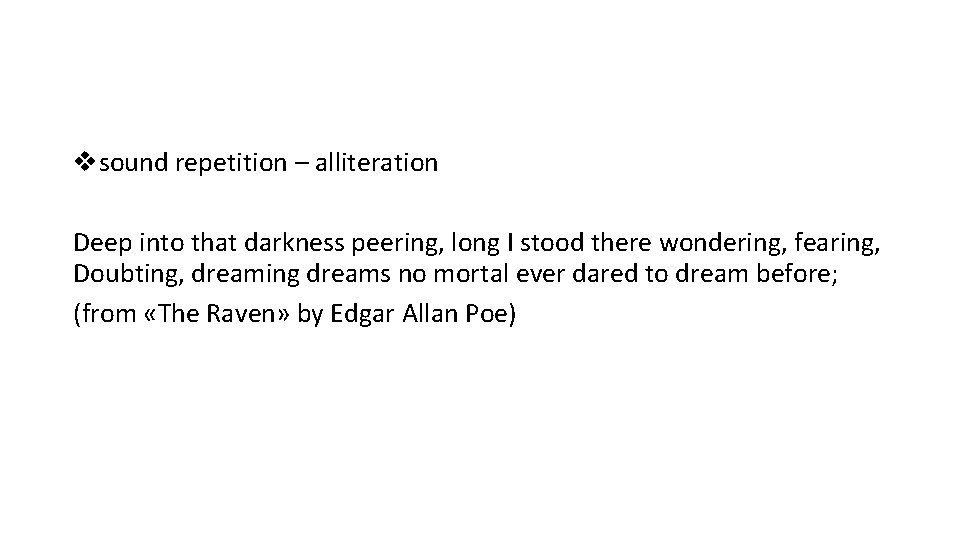
vsound repetition – alliteration Deep into that darkness peering, long I stood there wondering, fearing, Doubting, dreaming dreams no mortal ever dared to dream before; (from «The Raven» by Edgar Allan Poe)
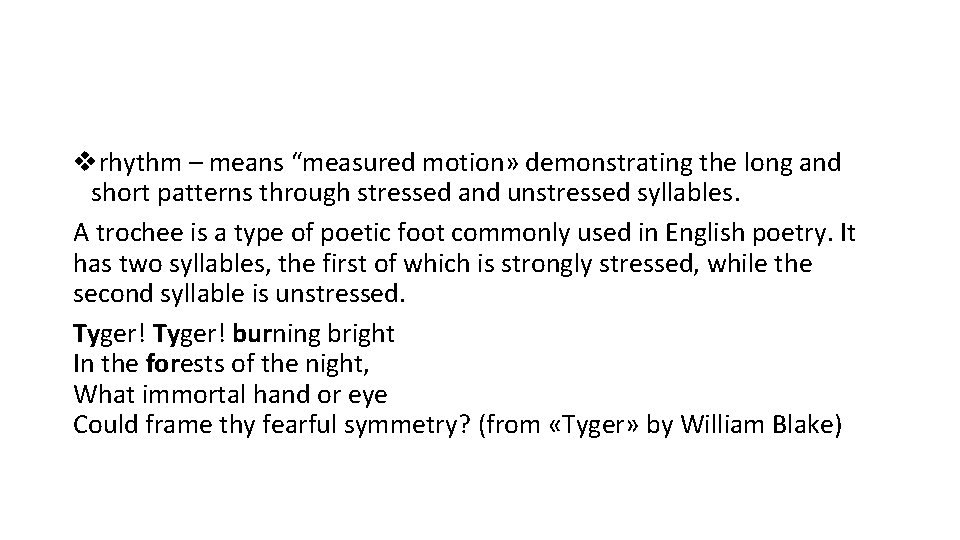
vrhythm – means “measured motion» demonstrating the long and short patterns through stressed and unstressed syllables. A trochee is a type of poetic foot commonly used in English poetry. It has two syllables, the first of which is strongly stressed, while the second syllable is unstressed. Tyger! burning bright In the forests of the night, What immortal hand or eye Could frame thy fearful symmetry? (from «Tyger» by William Blake)
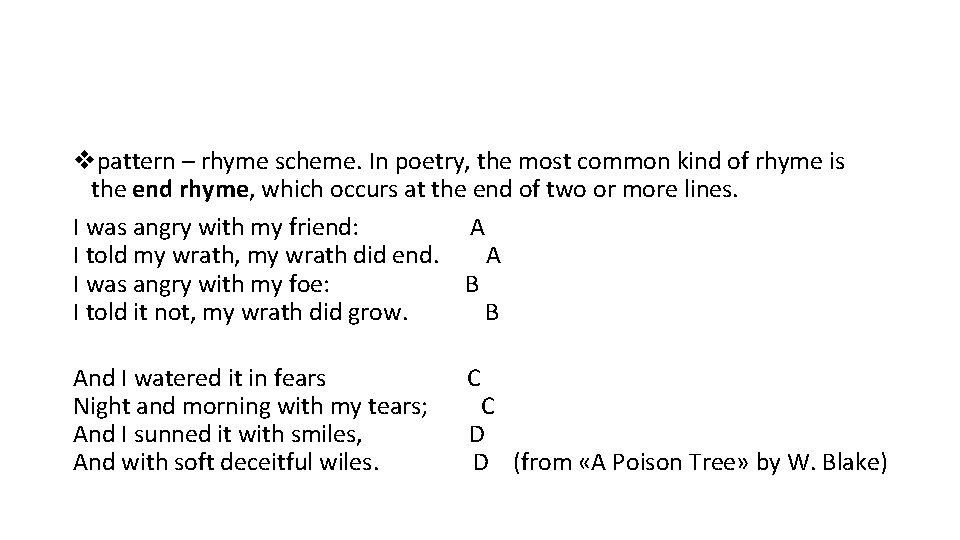
vpattern – rhyme scheme. In poetry, the most common kind of rhyme is the end rhyme, which occurs at the end of two or more lines. I was angry with my friend: A I told my wrath, my wrath did end. A I was angry with my foe: B I told it not, my wrath did grow. B And I watered it in fears Night and morning with my tears; And I sunned it with smiles, And with soft deceitful wiles. C C D D (from «A Poison Tree» by W. Blake)
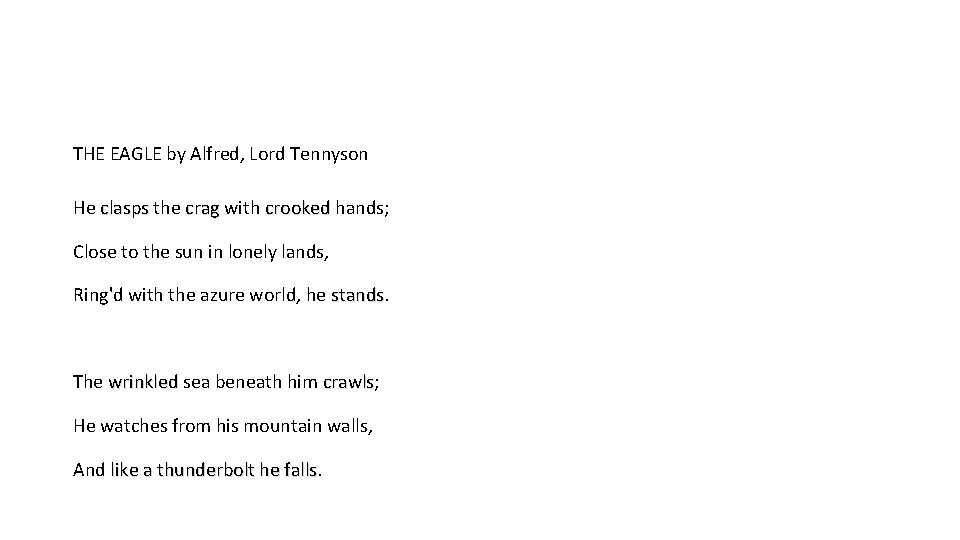
THE EAGLE by Alfred, Lord Tennyson He clasps the crag with crooked hands; Close to the sun in lonely lands, Ring'd with the azure world, he stands The wrinkled sea beneath him crawls; crawls He watches from his mountain walls, And like a thunderbolt he falls