
READING Reading does not develop naturally and calls
- Slides: 29
READING “Reading does not develop naturally and calls on specific areas in the brain for language processing. Reading is highly dependent on language development and quality instruction. Teachers with a strong foundation of knowledge enhanced by scientifically based reading research, from which to make judgments about what to teach, how to teach it, when to teach it, and to whom ensure a successful outcome when working with all students but especially with students at risk of failing to learn to read or with those who have already fallen behind…Appropriate instruction is language based— intensive, systematic, direct, and comprehensive…” J. Birsh Multisensory Teaching of Basic Language Skills, Birsh
Objectives • Look at the five components of reading • Review foundations of DIBELS assessment • Interpret DIBELS student data • Create an effective instructional plan for students based on data • Use strategies and materials effectively in intervention activities
Prevention… n n n One of the most significant findings is how important early intervention is to averting later problems for students at risk of reading difficulties (Torgesen 2004. ) It is considerably more efficient and effective to deliver intervention earlier rather than later in the elementary school years (NICHD)…it takes four times as long to remediate a student with poor reading skills in fourth grade as in late kindergarten or early first grade (Lyon & Fletcher 2001. ) That means the earlier we can provide reading help to a student, the less time that student will need to catch up (Hall 2006) DIBELS is a predictor of reading success, the data should be used to guide instruction…
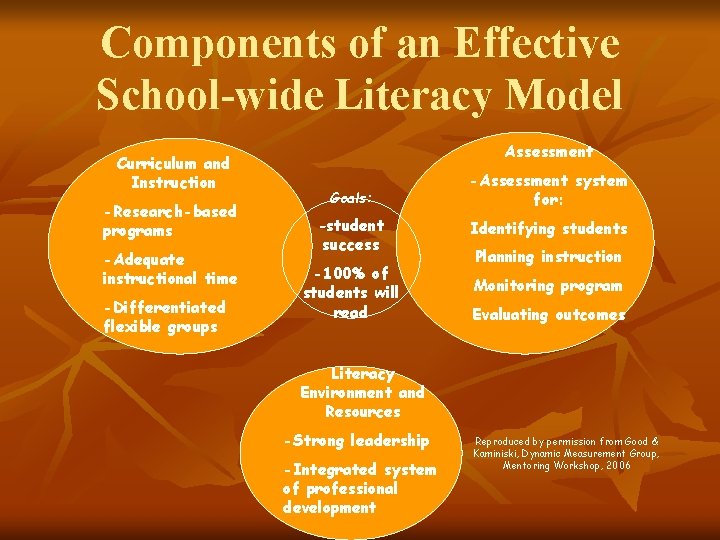
Components of an Effective School-wide Literacy Model Curriculum and Instruction -Research-based programs -Adequate instructional time -Differentiated flexible groups Assessment Goals: -Assessment system for: -student Identifying students success -100% of students will read Planning instruction Monitoring program Evaluating outcomes Literacy Environment and Resources -Strong leadership -Integrated system of professional development Reproduced by permission from Good & Kaminiski, Dynamic Measurement Group, Mentoring Workshop, 2006
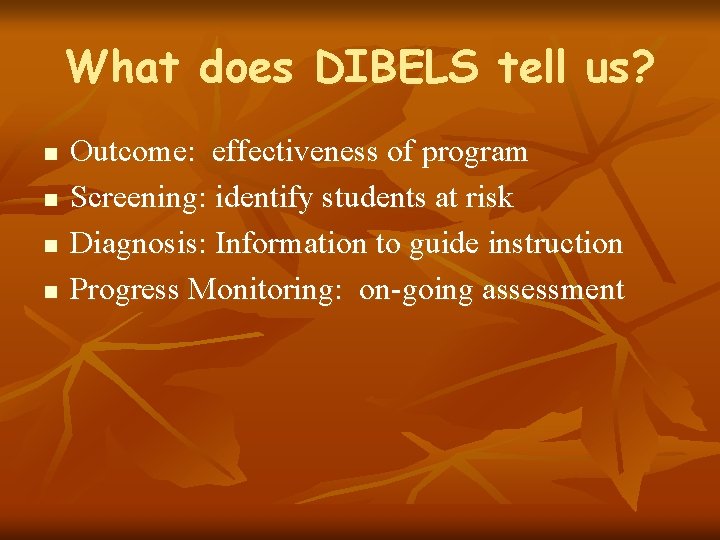
What does DIBELS tell us? n n Outcome: effectiveness of program Screening: identify students at risk Diagnosis: Information to guide instruction Progress Monitoring: on-going assessment
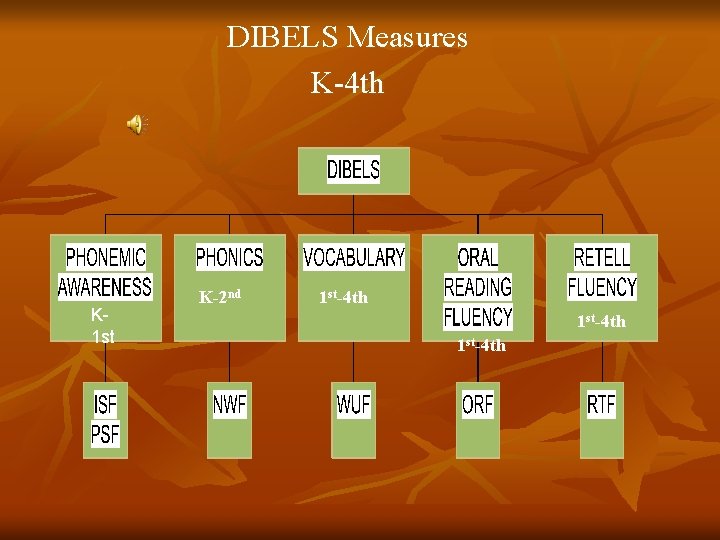
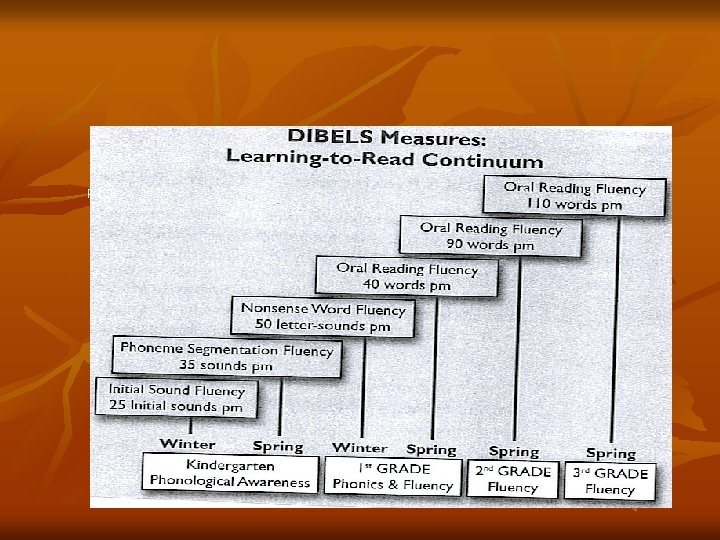
DIBELS Measures K-4 th K 1 st K-2 nd 1 st-4 th
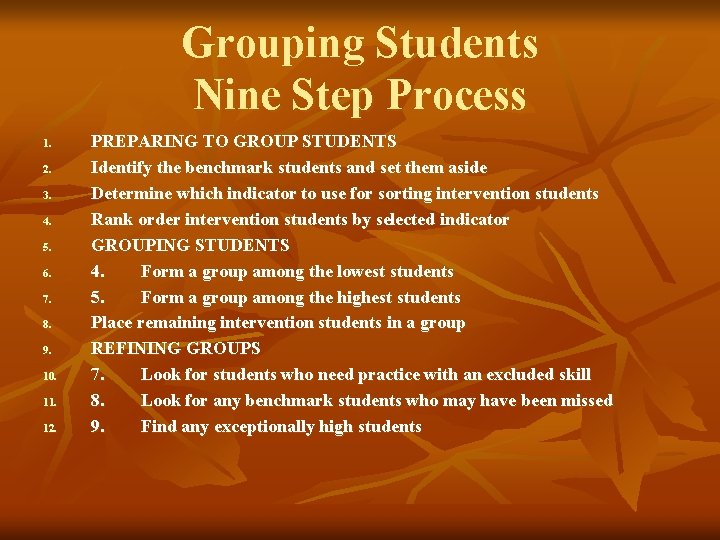
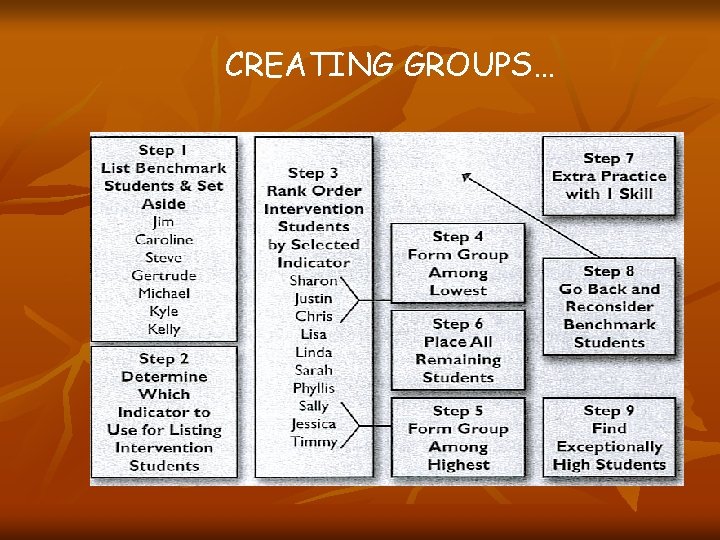
Grouping Students Nine Step Process 1. 2. 3. 4. 5. 6. 7. 8. 9. 10. 11. 12. PREPARING TO GROUP STUDENTS Identify the benchmark students and set them aside Determine which indicator to use for sorting intervention students Rank order intervention students by selected indicator GROUPING STUDENTS 4. Form a group among the lowest students 5. Form a group among the highest students Place remaining intervention students in a group REFINING GROUPS 7. Look for students who need practice with an excluded skill 8. Look for any benchmark students who may have been missed 9. Find any exceptionally high students
CREATING GROUPS…
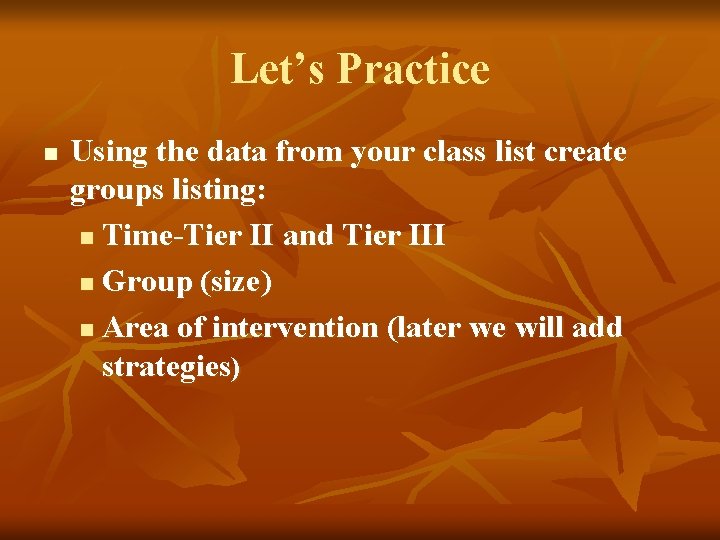
Let’s Practice n Using the data from your class list create groups listing: n Time-Tier II and Tier III n Group (size) n Area of intervention (later we will add strategies)
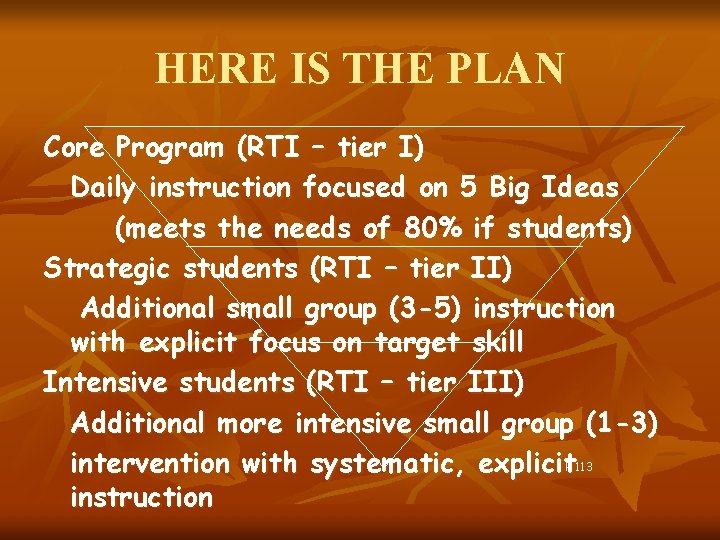
HERE IS THE PLAN Core Program (RTI – tier I) Daily instruction focused on 5 Big Ideas (meets the needs of 80% if students) Strategic students (RTI – tier II) Additional small group (3 -5) instruction with explicit focus on target skill Intensive students (RTI – tier III) Additional more intensive small group (1 -3) intervention with systematic, explicit. P 113 instruction
P 125
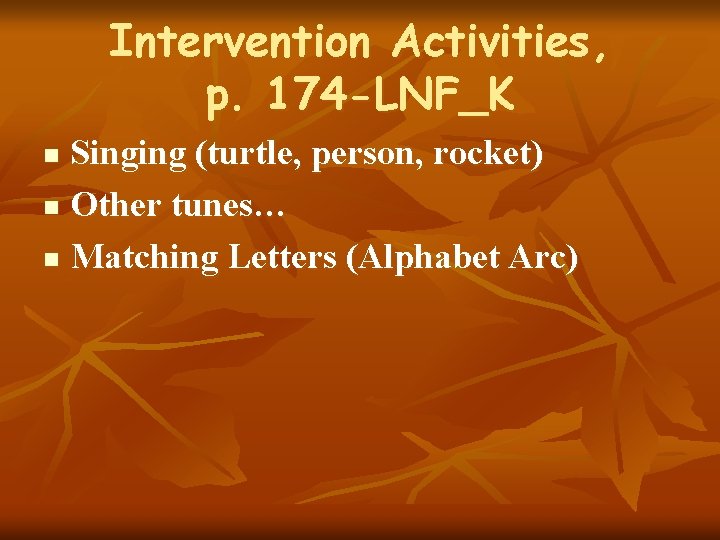
Intervention Activities, p. 174 -LNF_K Singing (turtle, person, rocket) n Other tunes… n Matching Letters (Alphabet Arc) n
Phonemic Awareness n The ability to hear and produce individual phonemes
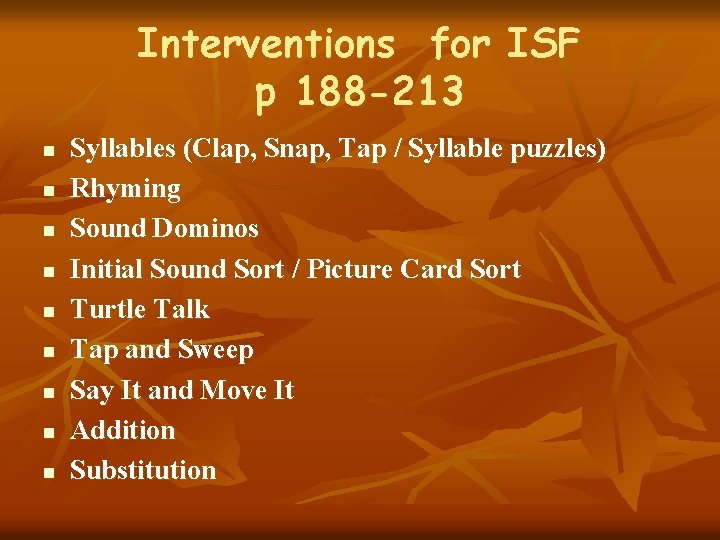
Interventions for ISF p 188 -213 n n n n n Syllables (Clap, Snap, Tap / Syllable puzzles) Rhyming Sound Dominos Initial Sound Sort / Picture Card Sort Turtle Talk Tap and Sweep Say It and Move It Addition Substitution
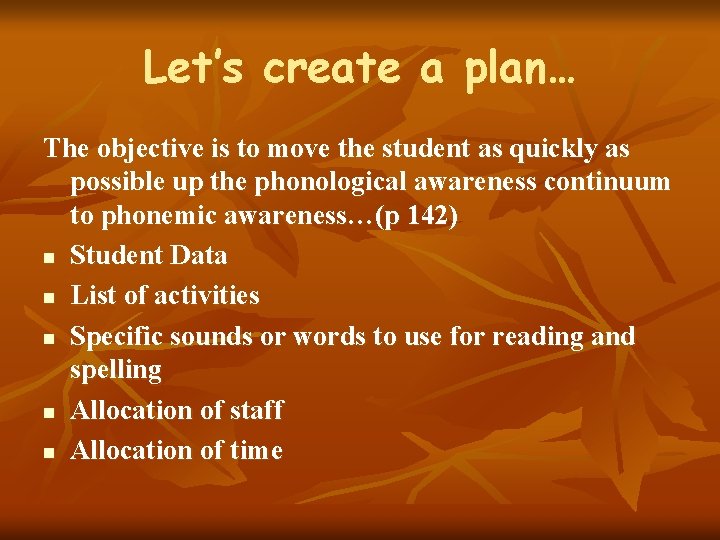
Let’s create a plan… The objective is to move the student as quickly as possible up the phonological awareness continuum to phonemic awareness…(p 142) n Student Data n List of activities n Specific sounds or words to use for reading and spelling n Allocation of staff n Allocation of time
Phonics Alphabetic Principle The ability to recognize the relationship between the letter symbol and the letter sound n “…systematic phonics instruction is the direct teaching of a set of letter-sound relationships in a clearly defined sequence. The set includes the major sound/spelling relationships of both consonants and vowels. ” NRP, Put Reading First n Nonsense words because… -if real words, could be from memory? ? ? Never Ever use the DIBELS materials for practice! Don’t teach the test – teach the SKILL! n I’ve Dibel’d, p 275
Interventions p 221 -246 n n n Letter-Sound Cards Touch and Say (blending…. ) Stamp Mat Word Chains Multisyllabic words Decodable Text
Oral Reading Fluency The results suggest that the three separate components of oral reading ability (accuracy, rate and fluency) are very much related to each other and to reading comprehension, as measured by the main NAEP assessment. “Fluent” readers in this study were likely to read higher percentages of words accurately, to read the passage at a faster rate, and to have scored higher, on average, on the NAEP reading assessment than “nonfluent” readers. More than one-half of the students read the passage fluently, with a fairly high degree of accuracy, and at a rate of at least 105 words per minute. However, a group of students whose average scale score and labored oral reading performance suggested they were struggling also demonstrated, on average, the lowest performance on measures of accuracy, rate, and fluency. Executive Summary from the 2002 National Assessment of Education Progress (NCES) which includes a report from the NAEP 2002 Special Study of Oral Reading (fourth-graders)
What is Oral Reading Fluency? n Fluency is the ability to read a text accurately and quickly. When fluent readers read silently, they recognize words automatically. They group words in ways that help them gain meaning from what they read. Fluent readers read aloud effortlessly and with expression. Their reading sounds natural, as if they are speaking. Armbruster et al. 2001, 22, NRP Put Reading First I’ve Dibel’d…p. 247
What causes dysfluent reading? n n n Low proportion of words recognized by sight Variations in processing speed of known words Low speed when reading unfamiliar words Using context to identify words Low speed when identifying word meanings
Interventions for ORF p 253 • Repeated oral readings (Read Naturally) • Partner read • Echo read • Fluency drills • Fluency phones “Self-phones”
Interventions for Vocabulary p 263 n n Robust Vocabulary Instruction Colors and Shapes of Language Vocabulary Map Human Word Web
Comprehension n “The goal of all reading instruction is to help students ultimately be able to read fluently with comprehension. ” Hall, 2006
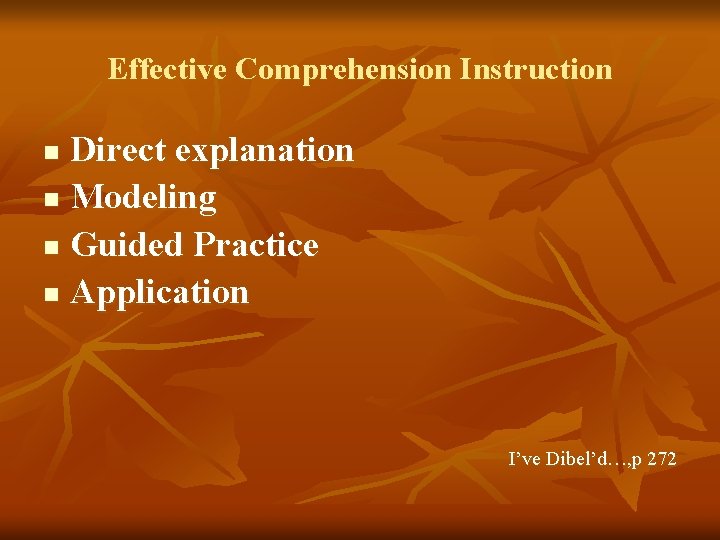
Effective Comprehension Instruction Direct explanation n Modeling n Guided Practice n Application n I’ve Dibel’d…, p 272
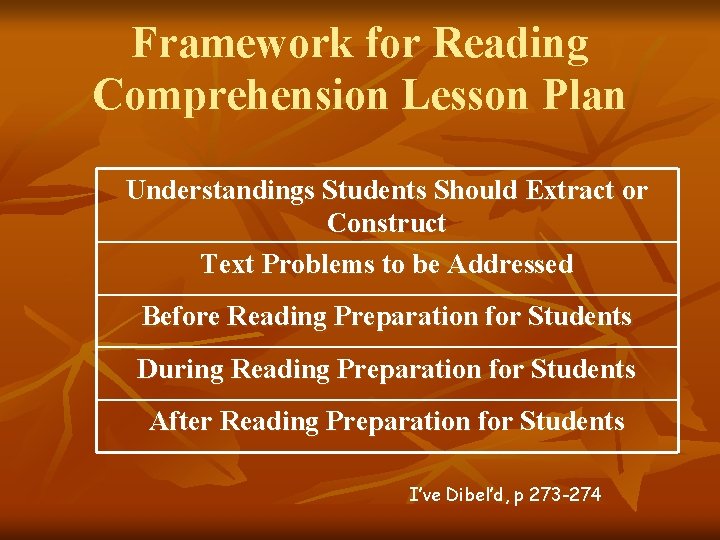
Framework for Reading Comprehension Lesson Plan Understandings Students Should Extract or Construct Text Problems to be Addressed Before Reading Preparation for Students During Reading Preparation for Students After Reading Preparation for Students I’ve Dibel’d, p 273 -274
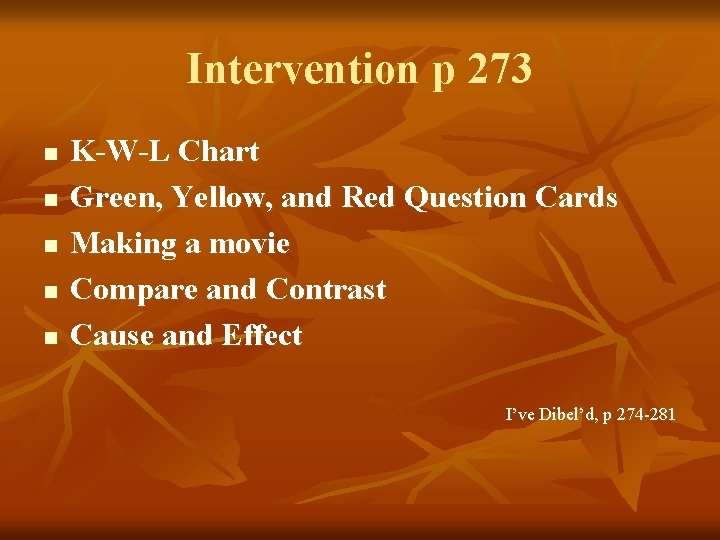
Intervention p 273 n n n K-W-L Chart Green, Yellow, and Red Question Cards Making a movie Compare and Contrast Cause and Effect I’ve Dibel’d, p 274 -281
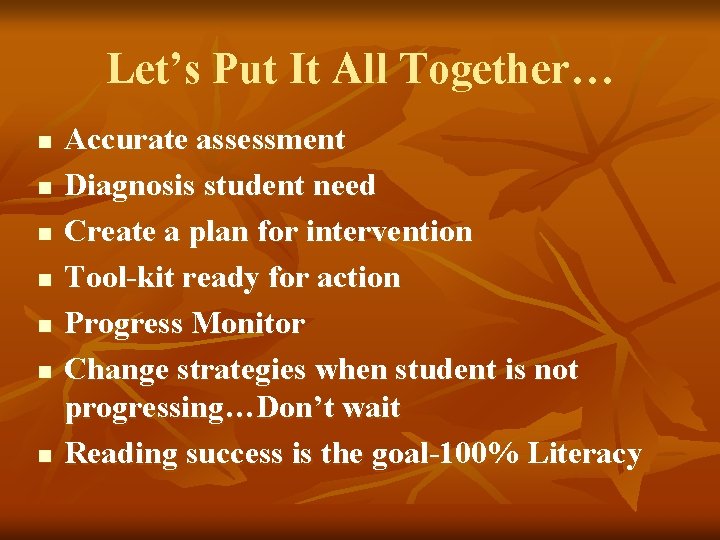
Let’s Put It All Together… n n n n Accurate assessment Diagnosis student need Create a plan for intervention Tool-kit ready for action Progress Monitor Change strategies when student is not progressing…Don’t wait Reading success is the goal-100% Literacy
YOU are the KEY n n n n n DID is a word of achievement; WON’T is a word of retreat MIGHT is a word of bereavement CAN’T is a word of defeat OUGHT is a word of duty TRY is a word each hour WILL is a word of beauty CAN is a word of power WHICH WORD DO YOU USE OFTEN?