
Reading Project Week 6 End of Reading Activities
- Slides: 11
Reading Project Week 6 End of Reading Activities
Week 6 • You should be close to completing the reading or your novel by now. If you have still got a lot more to read, then you need to make completing your book your priority. • If you have already read the whole thing then you have plenty of time to produce some imaginative and informed end-ofreading activities. Completing reading your novel should be your priority, but when you have completed it, you can choose from the following activities:
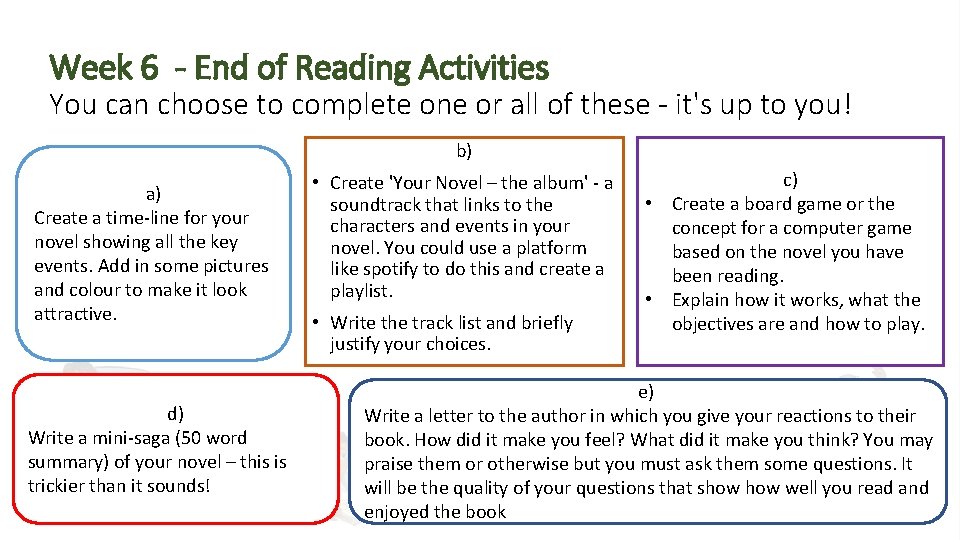
Week 6 - End of Reading Activities You can choose to complete one or all of these - it's up to you! b) a) Create a time-line for your novel showing all the key events. Add in some pictures and colour to make it look attractive. d) Write a mini-saga (50 word summary) of your novel – this is trickier than it sounds! • Create 'Your Novel – the album' - a soundtrack that links to the characters and events in your novel. You could use a platform like spotify to do this and create a playlist. • Write the track list and briefly justify your choices. c) • Create a board game or the concept for a computer game based on the novel you have been reading. • Explain how it works, what the objectives are and how to play. e) Write a letter to the author in which you give your reactions to their book. How did it make you feel? What did it make you think? You may praise them or otherwise but you must ask them some questions. It will be the quality of your questions that show well you read and enjoyed the book
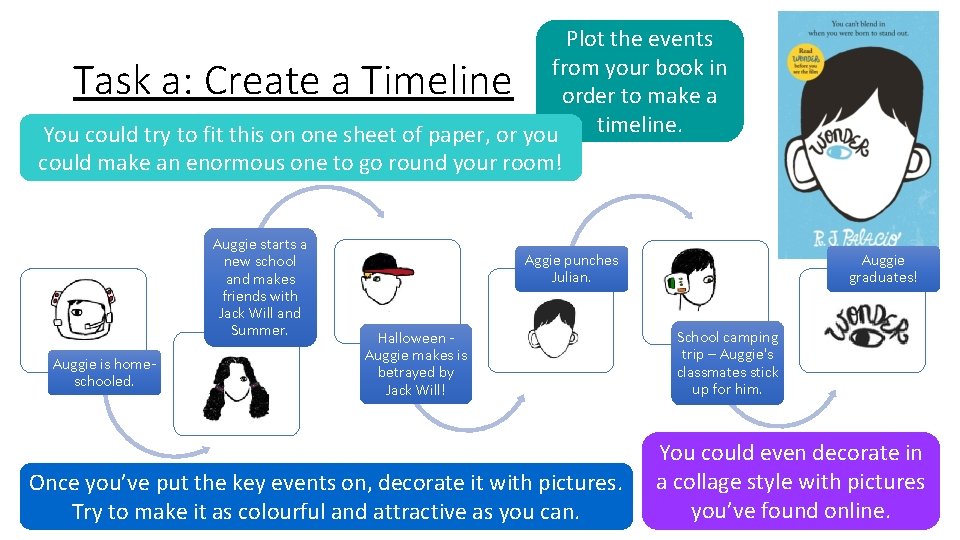
Plot the events from your book in order to make a You could try to fit this on one sheet of paper, or you timeline. Task a: Create a Timeline could make an enormous one to go round your room! Auggie starts a new school and makes friends with Jack Will and Summer. Auggie is homeschooled. Aggie punches Julian. Halloween - Auggie makes is betrayed by Jack Will! Once you’ve put the key events on, decorate it with pictures. Try to make it as colourful and attractive as you can. Auggie graduates! School camping trip – Auggie's classmates stick up for him. You could even decorate in a collage style with pictures you’ve found online.
Task e: Letter to an author – hints and tips • The next few slides will guide you through a letter to an author using a simple five paragraph structure. You will also be given some possible ways you could begin each paragraph – but feel free to change these suggestions if you have other ideas. • You could choose to write this letter simply as an English task – but, if you wanted to send an actual copy of your letter to your chosen author, some fan mail addresses can be found on the following website: http: //www. fanmail. biz/author/a/5. html
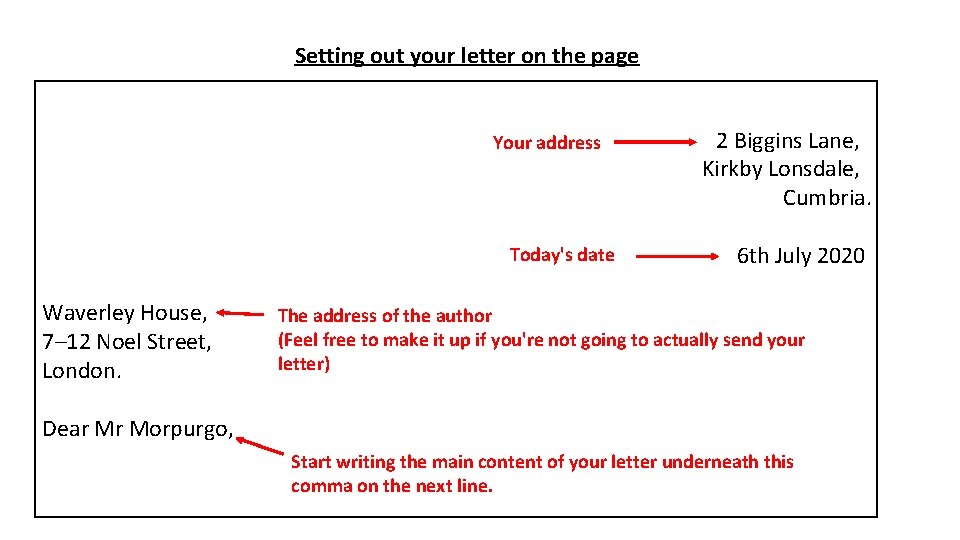
Setting out your letter on the page Your address Today's date Waverley House, 7– 12 Noel Street, London. Dear Mr Morpurgo, 2 Biggins Lane, Kirkby Lonsdale, Cumbria. 6 th July 2020 The address of the author (Feel free to make it up if you're not going to actually send your letter) Start writing the main content of your letter underneath this comma on the next line.
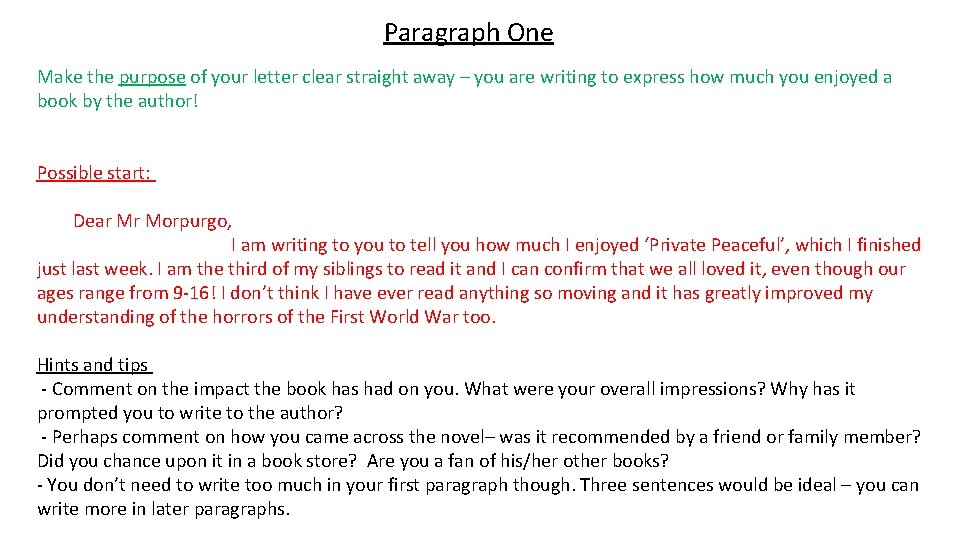
Paragraph One Make the purpose of your letter clear straight away – you are writing to express how much you enjoyed a book by the author! Possible start: Dear Mr Morpurgo, I am writing to you to tell you how much I enjoyed ‘Private Peaceful’, which I finished just last week. I am the third of my siblings to read it and I can confirm that we all loved it, even though our ages range from 9 -16! I don’t think I have ever read anything so moving and it has greatly improved my understanding of the horrors of the First World War too. Hints and tips - Comment on the impact the book has had on you. What were your overall impressions? Why has it prompted you to write to the author? - Perhaps comment on how you came across the novel– was it recommended by a friend or family member? Did you chance upon it in a book store? Are you a fan of his/her other books? - You don’t need to write too much in your first paragraph though. Three sentences would be ideal – you can write more in later paragraphs.
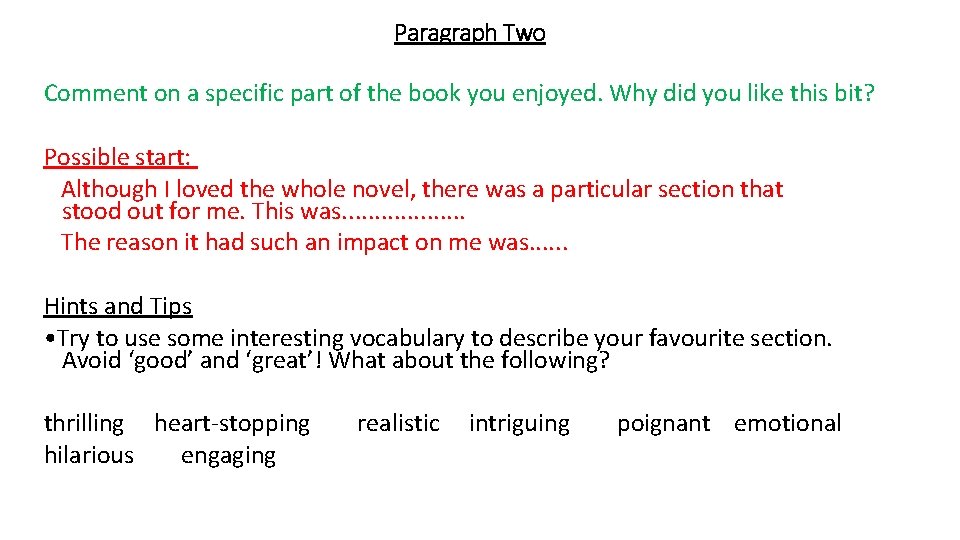
Paragraph Two Comment on a specific part of the book you enjoyed. Why did you like this bit? Possible start: Although I loved the whole novel, there was a particular section that stood out for me. This was. . . . . The reason it had such an impact on me was. . . Hints and Tips • Try to use some interesting vocabulary to describe your favourite section. Avoid ‘good’ and ‘great’! What about the following? thrilling heart-stopping realistic intriguing poignant emotional hilarious engaging
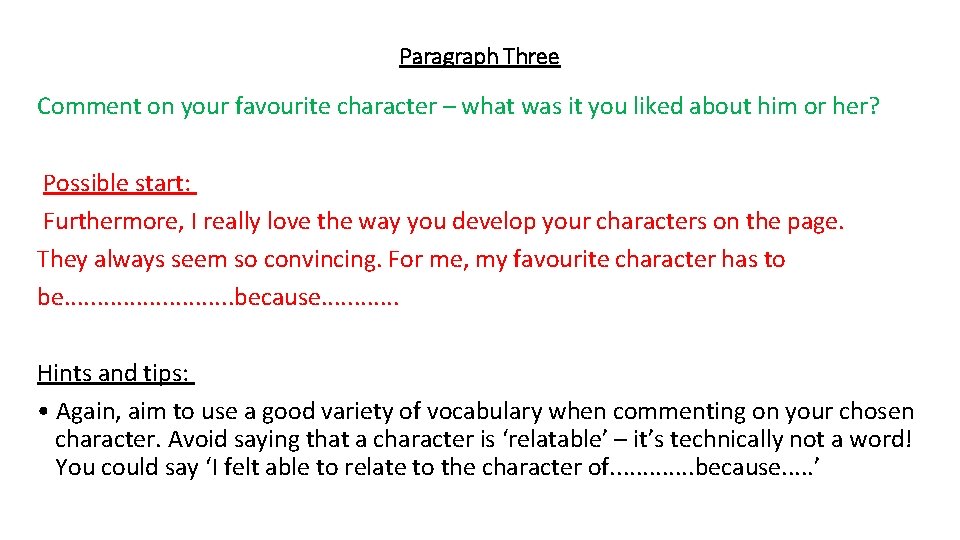
Paragraph Three Comment on your favourite character – what was it you liked about him or her? Possible start: Furthermore, I really love the way you develop your characters on the page. They always seem so convincing. For me, my favourite character has to be. . . because. . . Hints and tips: • Again, aim to use a good variety of vocabulary when commenting on your chosen character. Avoid saying that a character is ‘relatable’ – it’s technically not a word! You could say ‘I felt able to relate to the character of. . . because. . . ’
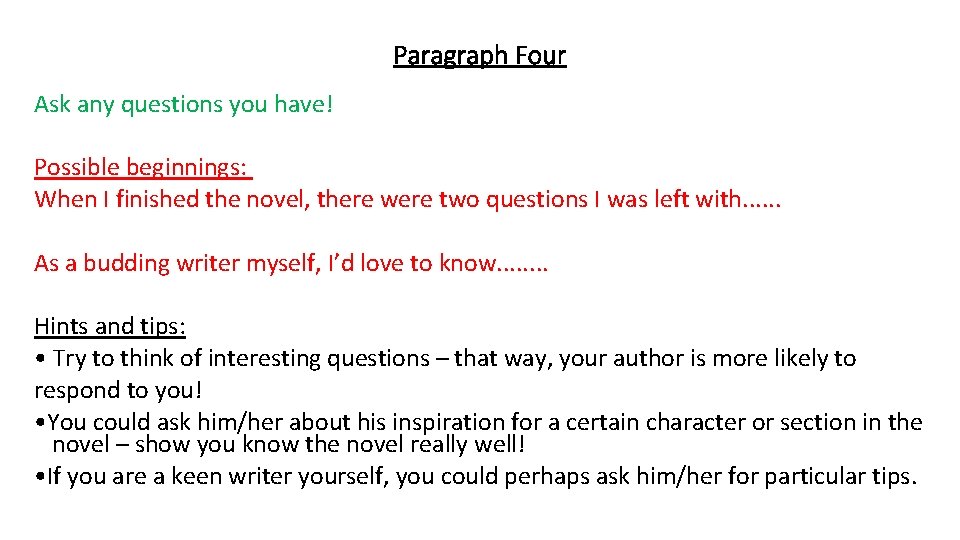
Paragraph Four Ask any questions you have! Possible beginnings: When I finished the novel, there were two questions I was left with. . . As a budding writer myself, I’d love to know. . . . Hints and tips: • Try to think of interesting questions – that way, your author is more likely to respond to you! • You could ask him/her about his inspiration for a certain character or section in the novel – show you know the novel really well! • If you are a keen writer yourself, you could perhaps ask him/her for particular tips.
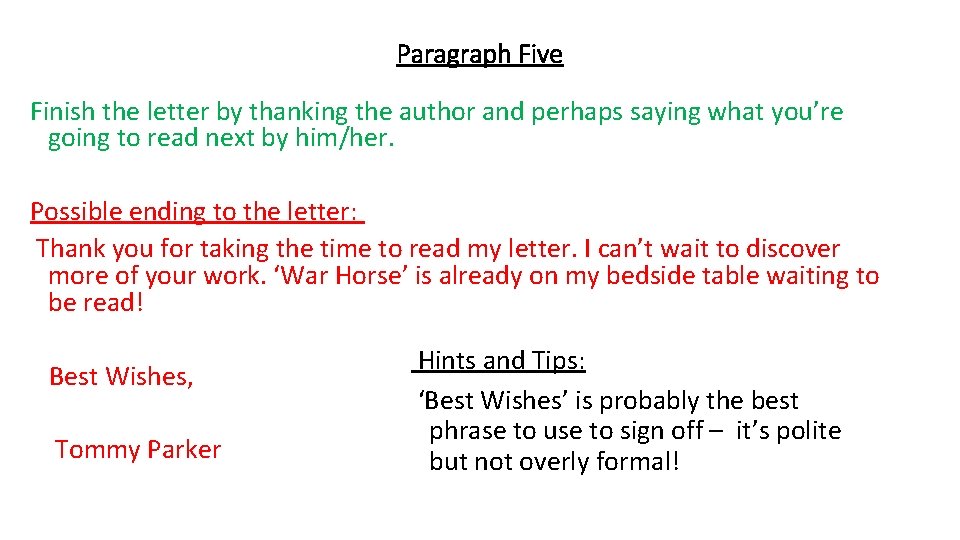
Paragraph Five Finish the letter by thanking the author and perhaps saying what you’re going to read next by him/her. Possible ending to the letter: Thank you for taking the time to read my letter. I can’t wait to discover more of your work. ‘War Horse’ is already on my bedside table waiting to be read! Hints and Tips: Best Wishes, ‘Best Wishes’ is probably the best phrase to use to sign off – it’s polite Tommy Parker but not overly formal!