
Reading program Lesson Plan example 8 Book 28
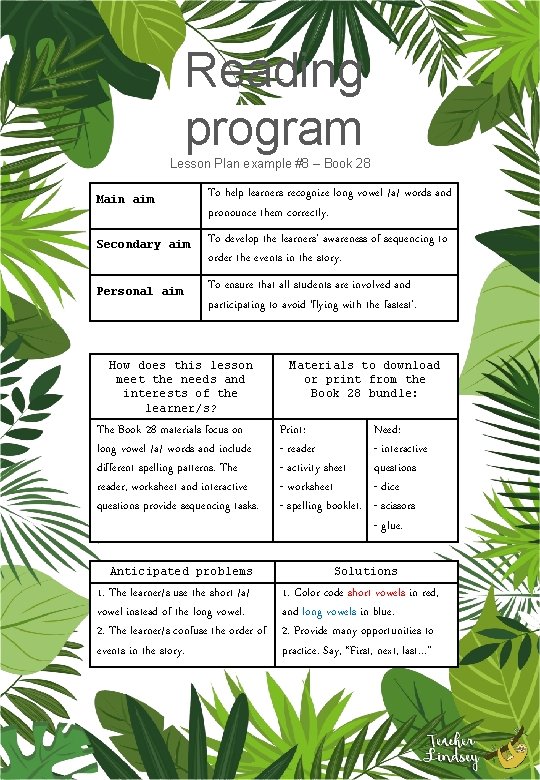
Reading program Lesson Plan example #8 – Book 28 Main aim Secondary aim Personal aim To help learners recognize long vowel /a/ words and pronounce them correctly. To develop the learners’ awareness of sequencing to order the events in the story. To ensure that all students are involved and participating to avoid ‘flying with the fastest’. How does this lesson meet the needs and interests of the learner/s? The Book 28 materials focus on long vowel /a/ words and include different spelling patterns. The reader, worksheet and interactive questions provide sequencing tasks. Anticipated problems 1. The learner/s use the short /a/ vowel instead of the long vowel. 2. The learner/s confuse the order of events in the story. Materials to download or print from the Book 28 bundle: Print: - reader - activity sheet - worksheet - spelling booklet. Need: - interactive questions - dice - scissors - glue. Solutions 1. Color code short vowels in red, and long vowels in blue. 2. Provide many opportunities to practice. Say, “First, next, last…”

Reading program Lesson Plan example #8 – Book 28 Stage Aim Procedure 1. Lead-in To help learners develop the vocabulary and pronunciation of long vowel /a/ words. - Pair up learners and show them the activity sheet. - Pre-teach the vocabulary and drill pronunciation. - Ask them to take turns to roll the dice, then say the word. Student A colors in one color, Student B chooses a different color. Continue until all colored. - Monitor and finish activity once first pair are done. 2. Reading task To help learners practice reading long vowel /a/ words, and notice the order of events. - Hand out the readers (one to each student). - Ask individuals to read aloud. Listen but do not interrupt – use finger correction and gestures, e. g. move hands apart to show it is a long vowel. - Repeat correct pronunciation together as a class. - Read story again together. Work on fluency. 3. Comprehension To allow learners to demonstrate a deeper understanding of the text. - Ask learners to complete q’s in their readers alone. - Help the students that need more support. - Ask early finishers to check their answers, color in the images (if bnw reader) and find the hiding sloth! - Elicit answers from individuals and mark books together. Students mark their own in another color. - Provide more feedback if one area was difficult, e. g. draw a timeline to explain sequencing events. 4. Extension activity To review sequencing and long vowel /a/ words. - Create work stations and allow students to work together in a controlled practice. Ensure that the grouping allows everyone to get involved. - Some pairs/small groups do Interactive Questions. - Others complete the sequencing worksheet. - Monitor carefully and encourage participation. - Swap halfway. Ask students how they found tasks. - Group feedback – review any common
- Slides: 2