
Reading Phonics in Reception Aims of the session


- Slides: 24
Reading & Phonics in Reception
Aims of the session • To share how phonics is taught. • To develop parents’ confidence in helping their children with phonics and reading • To teach the basics of phonics and some useful phonics terms • To outline the different stages in phonic development • To show examples of activities and resources we use to teach phonics
What is phonics and how can I help my child at home?
Phonics lessons • Phonics is used in the teaching of reading • The children have a 30 minute phonics session on a Tuesday, Wednesday, Thursday & Friday • Lessons include a range of games, songs, rhymes and reading • We follow the Letters and Sounds Programme supplemented by Jolly Phonics actions and songs • There are 6 phonics phases which the children work through from Nursery to Year 2
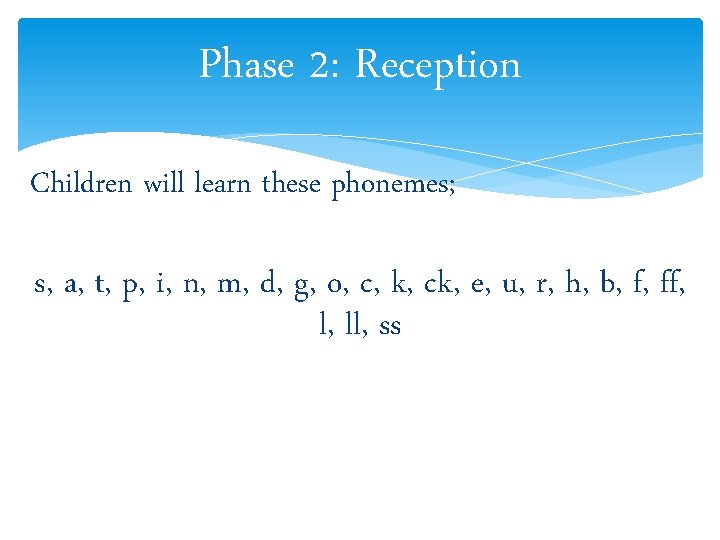
Phase 2: Reception Children will learn these phonemes; s, a, t, p, i, n, m, d, g, o, c, k, ck, e, u, r, h, b, f, ff, l, ll, ss
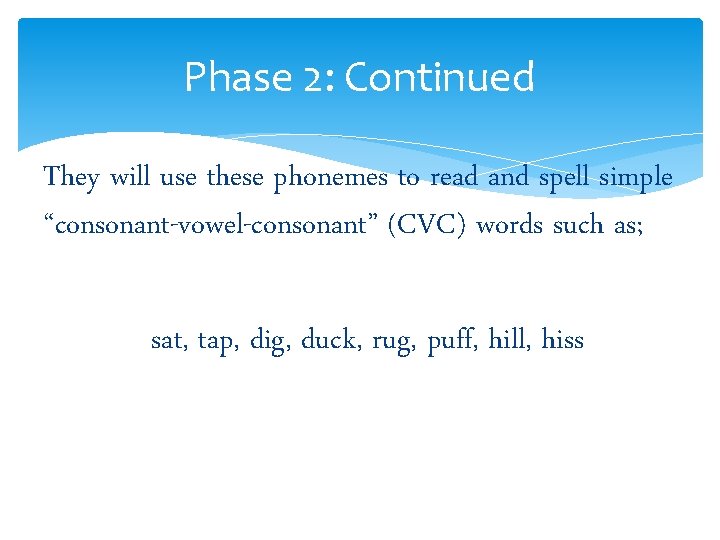
Phase 2: Continued They will use these phonemes to read and spell simple “consonant-vowel-consonant” (CVC) words such as; sat, tap, dig, duck, rug, puff, hill, hiss
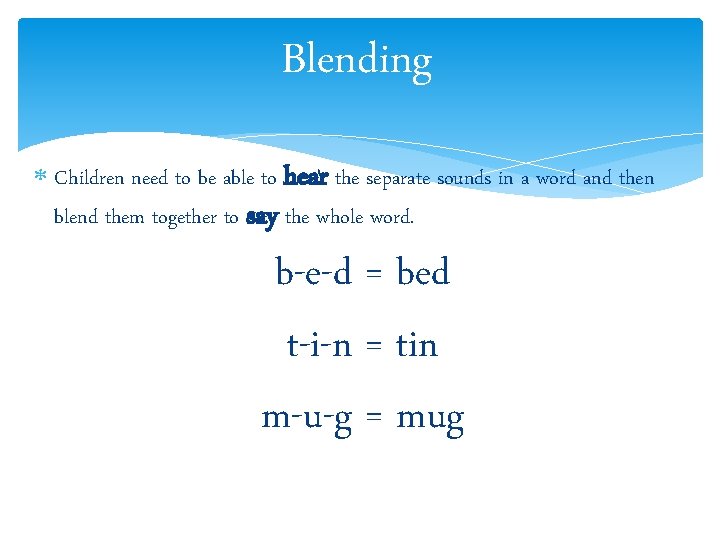
Blending Children need to be able to hear the separate sounds in a word and then blend them together to say the whole word. b-e-d = bed t-i-n = tin m-u-g = mug
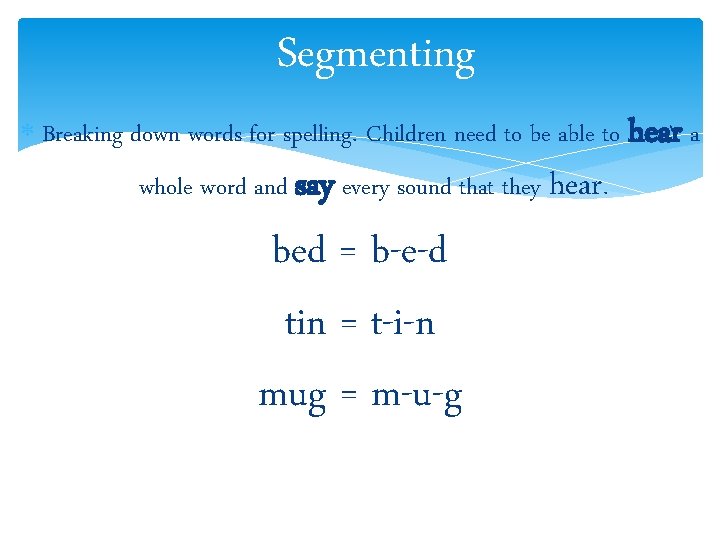
Segmenting Breaking down words for spelling. Children need to be able to hear a whole word and say every sound that they hear. bed = b-e-d tin = t-i-n mug = m-u-g
Phonemes are sounds that can be heard in words e. g. c-a-t The word cat has 3 phonemes
Grapheme This is how a phoneme is written down.
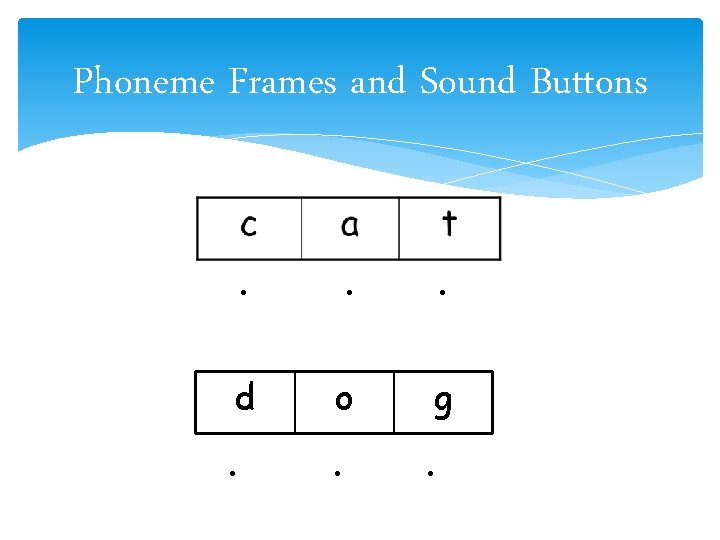
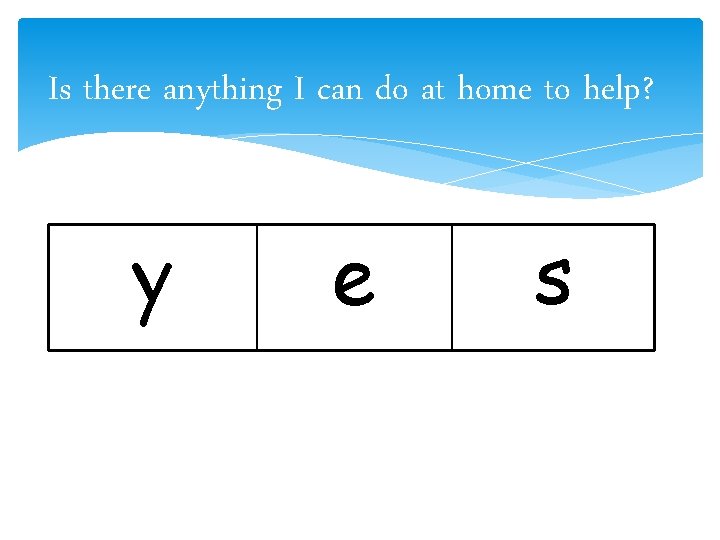
Phoneme Frames and Sound Buttons. . . d o g . . .
Tricky Words Tricky words are words that cannot be blended or segmented because they are irregular. For example; no, go, the, into
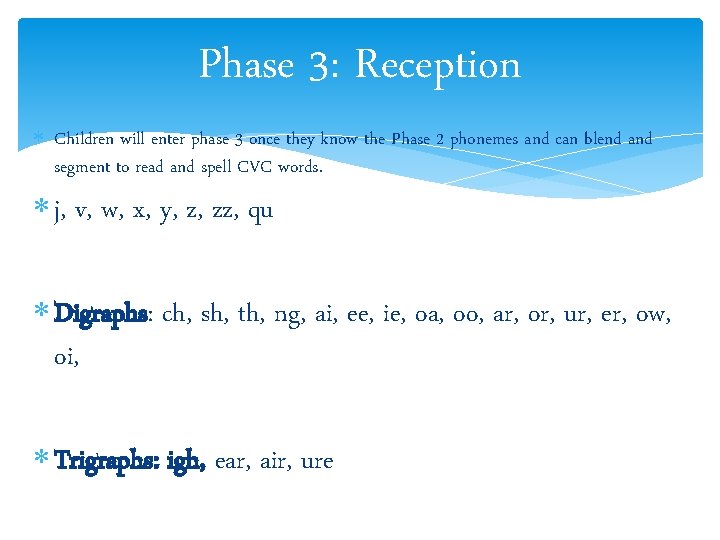
Phase 3: Reception Children will enter phase 3 once they know the Phase 2 phonemes and can blend and segment to read and spell CVC words. j, v, w, x, y, z, zz, qu Digraphs: ch, sh, th, ng, ai, ee, ie, oa, oo, ar, or, ur, er, ow, oi, Trigraphs: igh, ear, air, ure
Phase 3 Continued They will use these digraphs, trigraphs and the phonemes from Phase 2 to read and spell words such as: chip, shop, thin, ring, pain, feet, night, boat, boot, look, farm, fork, burn, town, coin, dear, fair, sure
Is there anything I can do at home to help? y e s
When spelling, encourage your child to think about what sounds they can hear not the letter name. Help your child with their phonics homework each week Ask your children to teach you the sounds and actions that they have been learning each week. Encourage your child to recognise letters in their environment; street names, signs, packets, brand labels. Turn finding letters into a competition e. g. Who can spot the most m’s on a walk to the shops? Play phonics games on websites such as Cbeebies, Phonics. Play, Alphablocks
Make sure that your child sees you reading. Children like to copy what their parents do, if they see you reading then they are more likely to want to read too. Read with your child every day and write a comment in their home school diary. Make up your own stories together. Remember bed time stories are an important and special time together. Visit the library so that your child regularly gets to see new books. Remember not all reading is done from a book.
Phonics Homework • Coloured wallet contains a handwriting book, a sound book and a sight word book. Please make sure the homework wallet is in your child’s book bag every day • Phoneme frame helps with blending and segmenting • New sets of letters will be given throughout the term
Phonics Homework • The children will hand in their purple sound books on a Monday morning so that Mrs Hill can stick the 4 sounds in that the children will be learning that week.
Reception Words • 70 high frequency words • Children will be given a purple book with the first set of words in – when we feel that the children are familiar with the words more added. These need to be practised at home.
Reading Books • The children are currently being introduced to the Oxford Reading Tree characters. • Reading Record book – this allows staff to keep a record and write comments in but every time you read with your child please write a comment in too. The children will get a star for each comment. • Vital that you hear your child read as often as possible – 5/10 minutes a day.
Reading Books • Please keep reading book and reading record book in your child's school bag and return every day. Reading day will be a Friday.
Reading is fun! • Focus this year at St. Bede’s is to encourage children to read for pleasure – reading is an extremely important skill for life.
P. S • Be vigilant with pencil grip and please use writing pencils and coloured pencils for colouring in. • Proud Cloud • Toy fund – 50 p every Monday please • Book bags and coats in everyday – please check bags for letters • Please return clothing if your child has an accident • Junk modelling materials • Only 1 bag to be brought into school; ideally a book bag • Children come already dressed in their P. E kits on a Tuesday • School website – Reception Class page