
Reading in Reception Year 1 and 2 Today
- Slides: 38
Reading in Reception, Year 1 and 2 ‘Today a reader tomorrow a leader’ Margaret Fuller ‘A child who reads will be an adult who thinks’ Unknown
What is reading? Reading is one of the most important skills we teach children. Reading has 2 components • Word recognition – the ability to recognise words in and out of context and the ability to apply phonics • Comprehension – the ability to process text, understand its meaning, and to integrate with what the reader already knows. Comprehension is a big focus in year 2.
What is the importance of reading? ‘We want children to learn to read so they can read to learn for the rest of their lives’. • Learning to read is about listening and understanding, as well as working out what is printed on the page. • Through hearing stories, children are exposed to a wide range of words. This helps them build their own vocabulary and improve their understanding when they listen, which is vital as they start to read. • It gives children a better understanding of the world, people and cultures. • Through reading you build a more solid foundation for communication. • Reading develops a child’s imagination. • Reading helps children develop empathy.
How important are early reading skills? • When children learn to read at an early age they have greater general knowledge, wider vocabulary and become more fluent readers. • Children have an improved attention span and better concentration. • Their proficiency in reading helps them to comprehend what they read.
What are the characteristics of reading? • Word reading • Reading fluency – expression, intonation and punctuation • Pace and rhythm • Vocabulary • Background knowledge • Working memory • Comprehension
How do we teach reading at English Martyrs in Reception and KS 1? We teach reading through: • A language rich environment • Phonics • Word recognition/flashcards • Vocabulary • Spoken language • Comprehension • Context clues • Reading stories aloud to children • Teacher modelling children echoing • Using texts with repeated words
Approach to reading in KS 1 • • • Whole class Guided 1: 1 Shared/paired read Reading for pleasure – silent reading Class novel Story time Home/school reading Reading across the curriculum Reading for writing
What is phonics? Phonics • method for teaching reading and writing and understanding that letters represent sounds to form words. • it involves teaching the sounds made by individual letters and letter groups and how they blend together to make words. • is essential for children to become successful readers, writers and spellers in the Early Years and beyond.
Is phonics important in learning to read? • Yes because letter/sound knowledge is the foundation needed to build up reading and writing skills. • Research shows phonics to be a corner stone of effective early reading. Phonics enable beginner readers to decode unknown written words by sounding them out which is essential for independent reading.
Phonics • • Phonics help children to decode. Increases fluency and reading accuracy Helps comprehension Increases vocabulary
Phonics programme we use at English Martyrs • Letters and Sounds – taught daily for 20 -30 minutes. • Phonics revisited and practised in other areas of the curriculum. • Phase 1 – 6 • Phase 1 is taught in the Nursery and is crucial in developing speaking and listening skills. Children listen to environmental sounds so they can discriminate between 2 different sounds, listen to sounds in spoken word e. g. wash our hands, zip up our coats, being able to say some of the sounds orally e. g. we are going to the shop. • Rhythm to help the children when they learn to read.
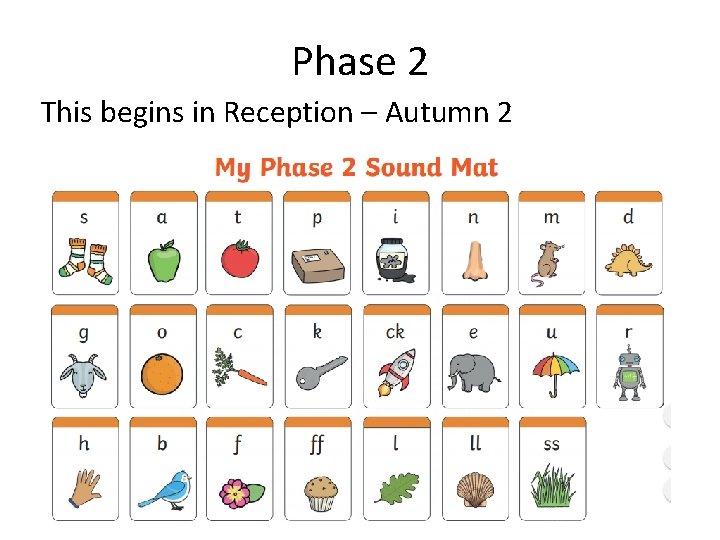
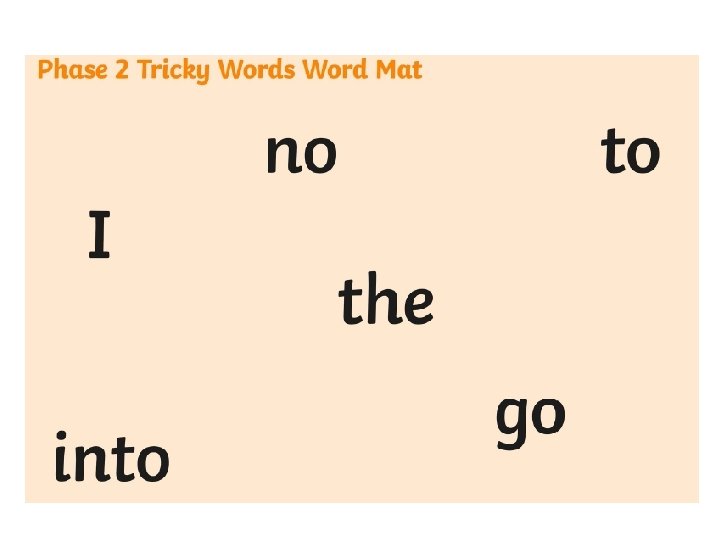
Phase 2 This begins in Reception – Autumn 2
Link – how to pronounce sounds correctly • https: //www. youtube. com/watch? v=DWQ 6 M ecc. RCU
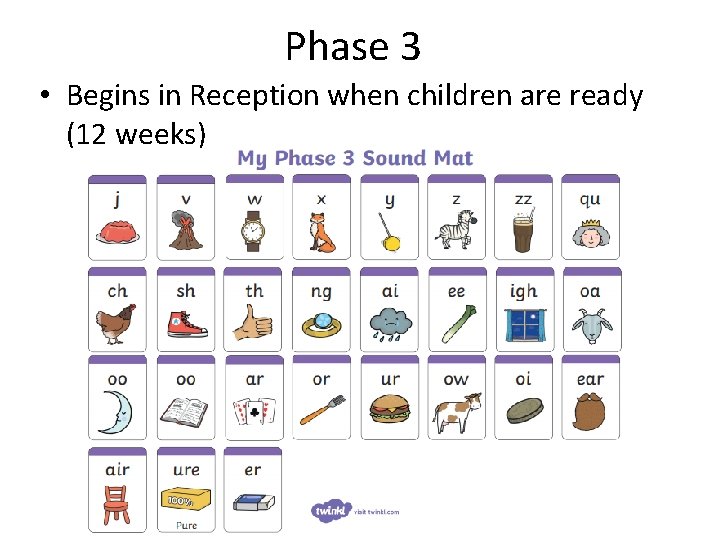
Phase 3 • Begins in Reception when children are ready (12 weeks)
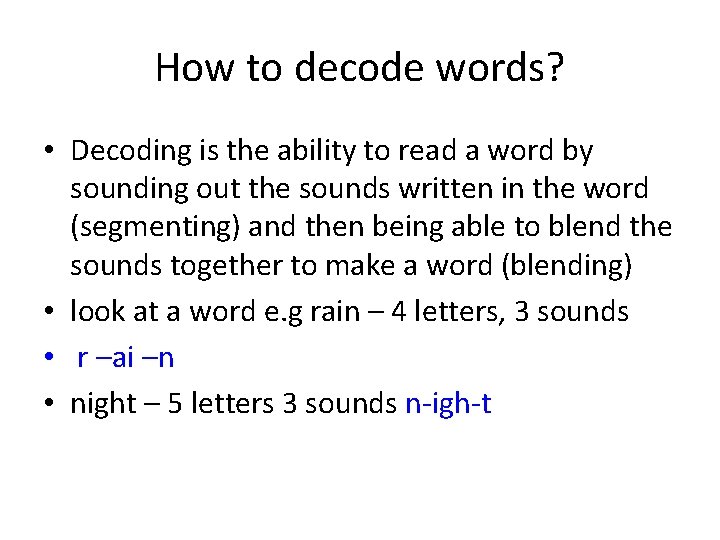
How to decode words? • Decoding is the ability to read a word by sounding out the sounds written in the word (segmenting) and then being able to blend the sounds together to make a word (blending) • look at a word e. g rain – 4 letters, 3 sounds • r –ai –n • night – 5 letters 3 sounds n-igh-t
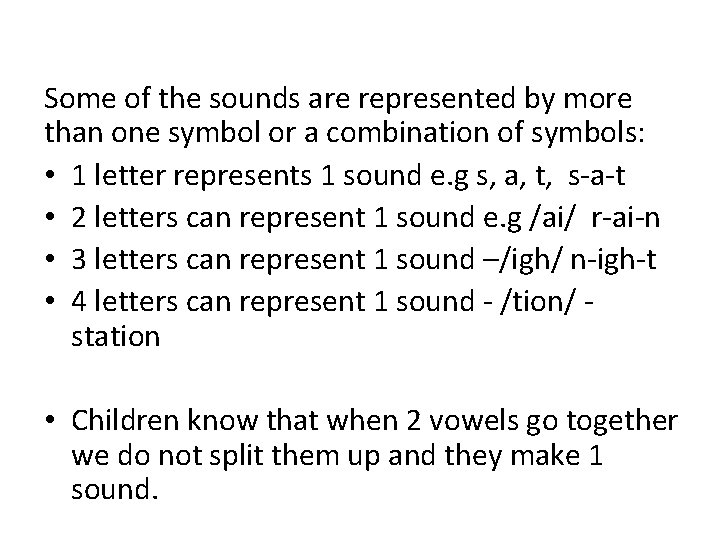
Some of the sounds are represented by more than one symbol or a combination of symbols: • 1 letter represents 1 sound e. g s, a, t, s-a-t • 2 letters can represent 1 sound e. g /ai/ r-ai-n • 3 letters can represent 1 sound –/igh/ n-igh-t • 4 letters can represent 1 sound - /tion/ station • Children know that when 2 vowels go together we do not split them up and they make 1 sound.
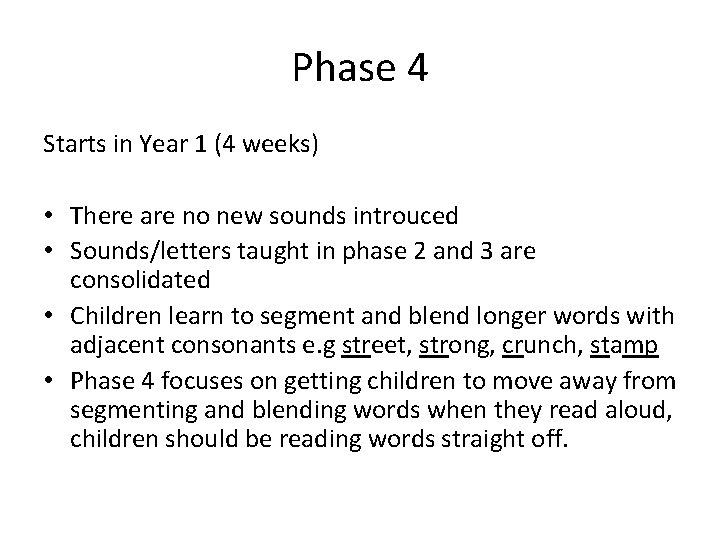
Phase 4 Starts in Year 1 (4 weeks) • There are no new sounds introuced • Sounds/letters taught in phase 2 and 3 are consolidated • Children learn to segment and blend longer words with adjacent consonants e. g street, strong, crunch, stamp • Phase 4 focuses on getting children to move away from segmenting and blending words when they read aloud, children should be reading words straight off.
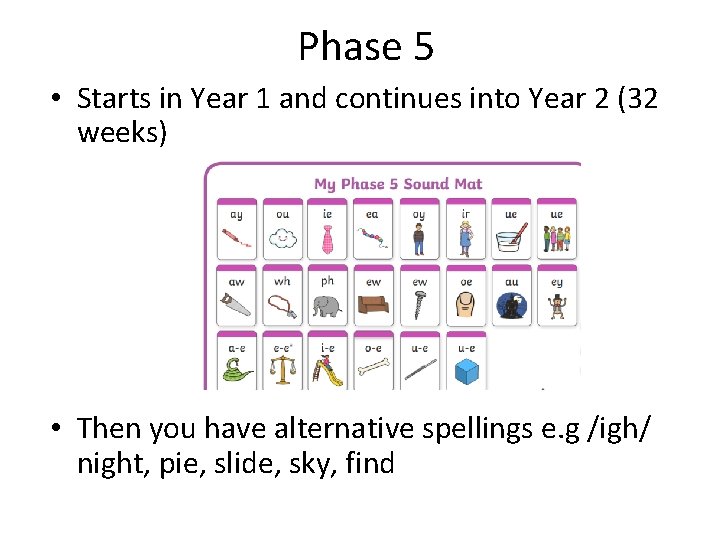
Phase 5 • Starts in Year 1 and continues into Year 2 (32 weeks) • Then you have alternative spellings e. g /igh/ night, pie, slide, sky, find
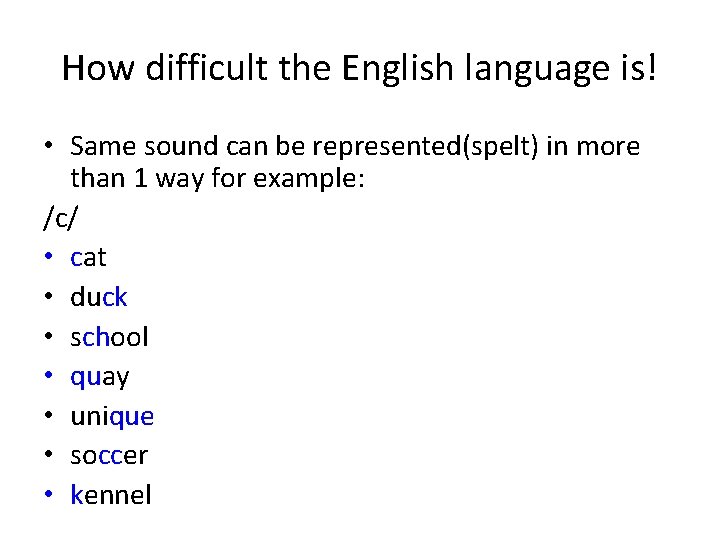
How difficult the English language is! • Same sound can be represented(spelt) in more than 1 way for example: /c/ • cat • duck • school • quay • unique • soccer • kennel
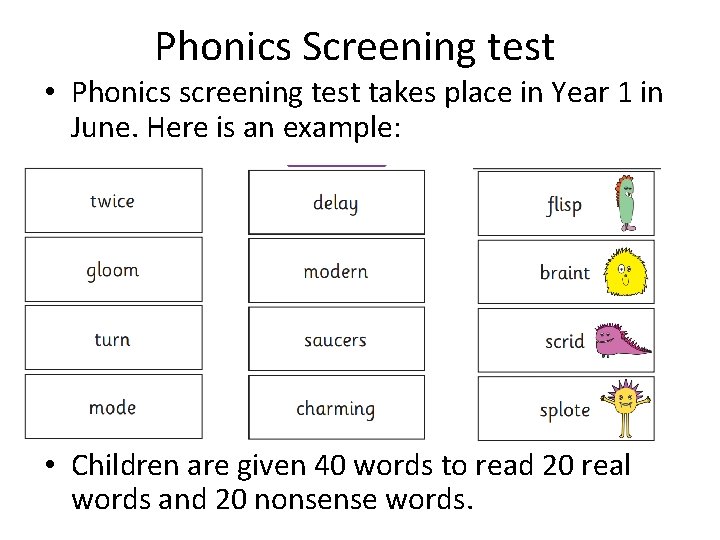
Phonics Screening test • Phonics screening test takes place in Year 1 in June. Here is an example: • Children are given 40 words to read 20 real words and 20 nonsense words.
Phase 6 –Year 2 • By the beginning of Phase Six, children should know most of the common grapheme (letter)– phoneme (sound)correspondences (GPCs). They should be able to read hundreds of words, doing this in three ways: • reading the words automatically if they are very familiar; • decoding them quickly and silently because their sounding and blending routine is now well established; • decoding them aloud. • During this phase, children become fluent readers and increasingly accurate spellers.
Phase 6 –Year 2 Teaching spelling : • Introducing and teaching the past tense • Investigating and learning how to add suffixes happy – happiness, happier; glad + ly = gladly • Teaching spelling long words eg. adventure • Finding and learning the difficult bits in words
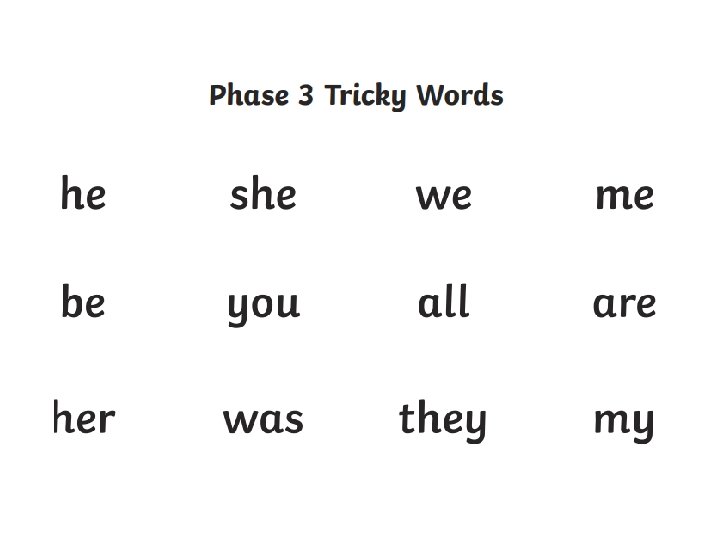
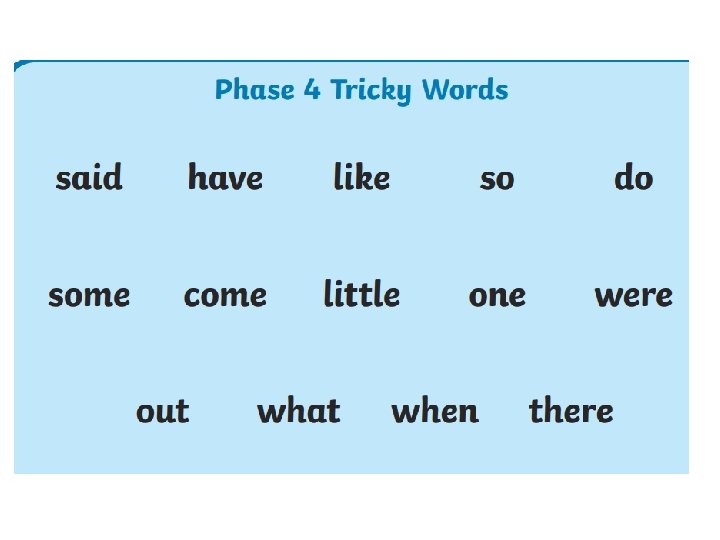
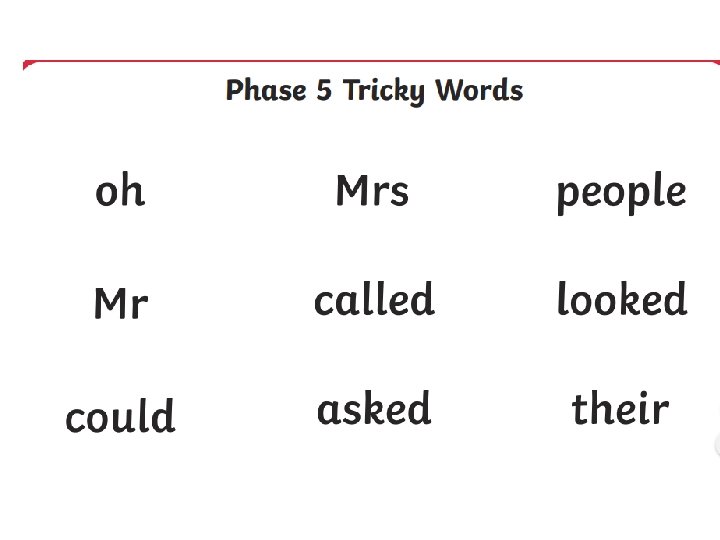
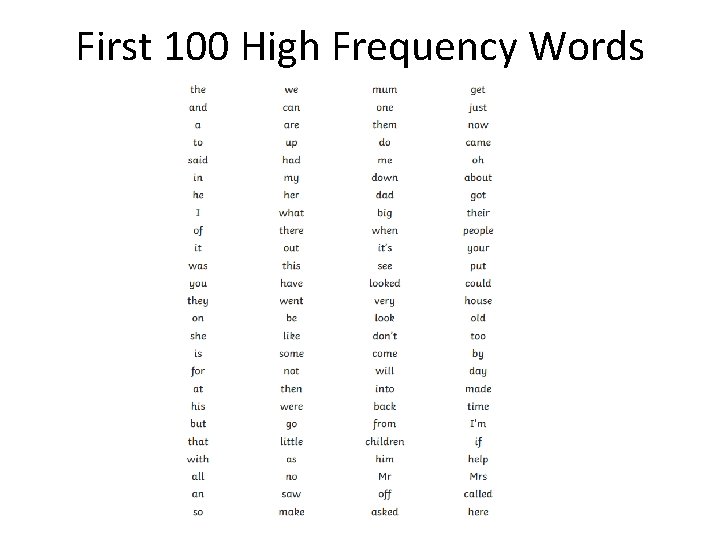
Word recognition is the key to lifelong reading skills. • Tricky words for each phonic stage • High frequency words – words used most frequently in reading and writing e. g. and, the • Common exception words Year 1 and 2
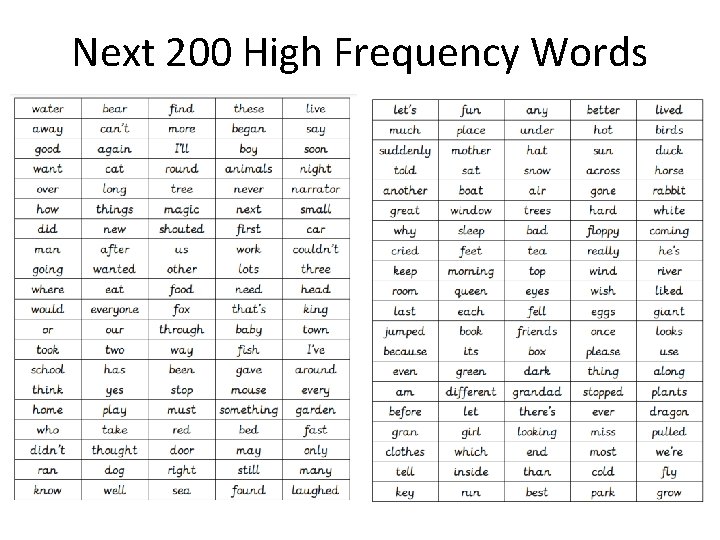
Why learn high frequency words? • Research says that learning just 13 of the most frequently used words enable children to read 25% of any text. • Learning 100 High Frequency words gives a beginner reader virtually 50% access to any text, whether it is a children's book or a newspaper report. • When you combine automatic recognition of the High Frequency words with a good knowledge of phonics that’s when a child's reading really takes off. • During the course of the phonics programme children will learn over 300 HF and tricky words.
First 100 High Frequency Words
Next 200 High Frequency Words
Spoken language and Vocabulary • Spoken language underpins the development of reading and writing. • Quality and variety of language heard and spoken is vital for developing vocabulary, grammar and understanding for reading and writing. • Teach the children the meaning of new words, repetition of the words is very important for children to embed in their vocabulary. • If children do not have a love of words they will never become great readers let alone great writers. • A child needs to hear a word 4 -12 times before it becomes part of their vocabulary. • Use the words in sentences so the children are able to understand the exact meaning of the word.
Comprehension and Context Clues Key comprehension strategies: • Prior knowledge • Predicting • Identifying main ideas • Questioning • Making inference • Retelling /sequencing • Visualising
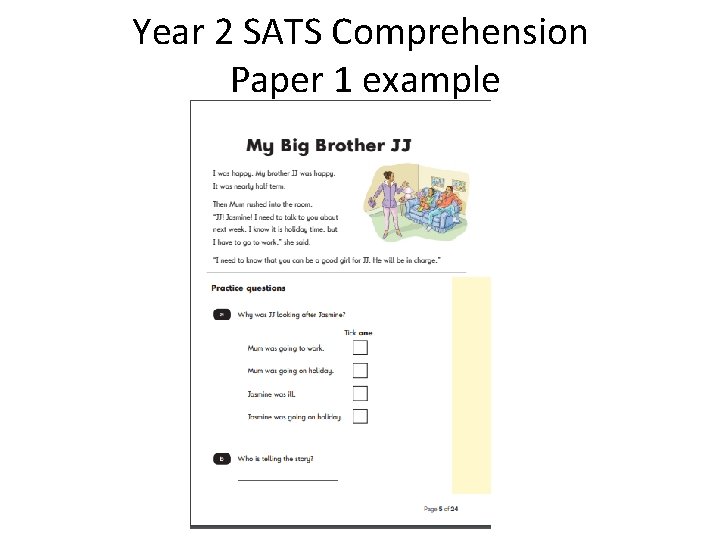
Year 2 SATS Comprehension Paper 1 example
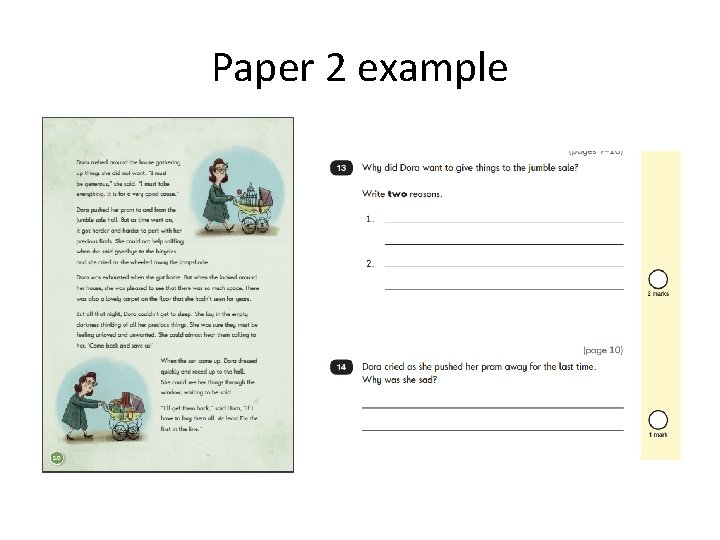
Paper 2 example
Why is fluency important? For children to be fluent readers they must read • accurately • smoothly • with expression and comprehension • with pace and rhythm (punctuation) • Fluent readers recognise words automatically without struggling over decoding issues. • Fluency is important because it bridges between word recognition and comprehension. It allows the child to focus on what the text is saying. • Children should be reading about 120 words per minute for fluency
What causes reading fluency problems? Most common causes are • Lack of reading practice • Word recognition difficulties • Children stumble on particular words • Lack of recognition of words automatically • Children sounding out too many words • Comprehension difficulties also disrupt fluency, e. g. a child not understanding what is read.
Reading for pleasure • Let children read what they want. Let them read for pleasure. • Any form of text that will help children develop a love of reading e. g comics, magazines, books that capture their interest. • Visiting the library, books in the home Benefits of reading for pleasure – • improves vocabulary, improves reading attainment and writing ability • greater self confidence as a reader • General knowledge • Better understanding of people and cultures
How to help your child at home • • • Listen to your child read regularly Read to your child Talk about books, stories and words Use pictures to discuss stories Explore word meaning together Let children see you read Give your child the gift of reading!