
Reading for pleasure benefits and challenges www researchrichpedagogies
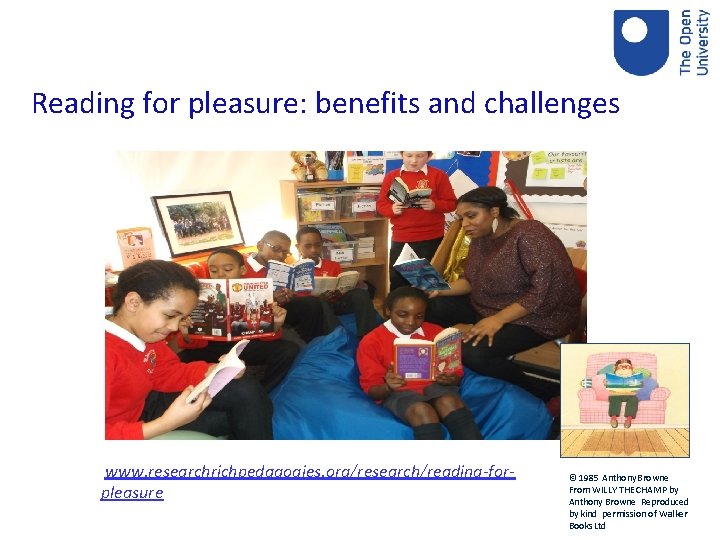
Reading for pleasure: benefits and challenges www. researchrichpedagogies. org/research/reading-forpleasure © 1985 Anthony Browne From WILLY THE CHAMP by Anthony Browne Reproduced by kind permission of Walker Books Ltd
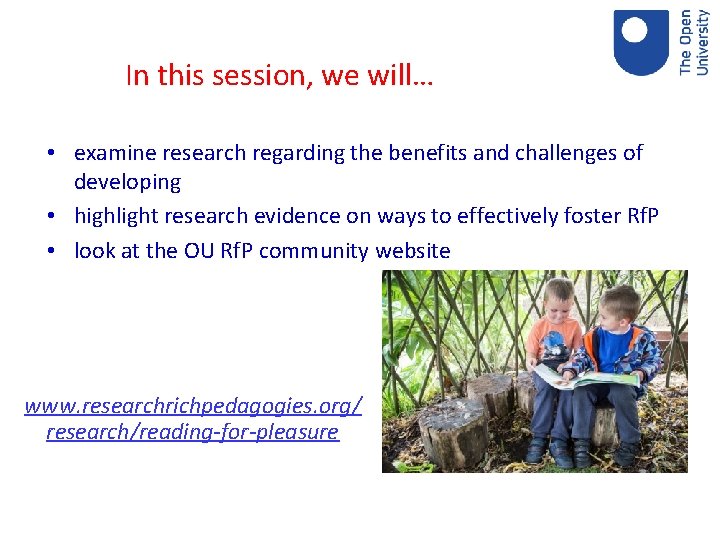
In this session, we will… • examine research regarding the benefits and challenges of developing • highlight research evidence on ways to effectively foster Rf. P • look at the OU Rf. P community website www. researchrichpedagogies. org/ research/reading-for-pleasure
Rf. P: significant benefits International evidence demonstrates: • increased attainment in literacy and numeracy (e. g. Anderson et al. , 1988; OECD, 2010; Sullivan & Brown, 2013) • • improved general knowledge (e. g. Clark and Rumbold, 2006) richer vocabulary (e. g. Sullivan & Brown, 2013) supports identity explorations (e. g. Rothbauer, 2004) encourages imagination, empathy and mindfulness of others (e. g. Kidd & Costano, 2013) The will influences the skill and vice versa
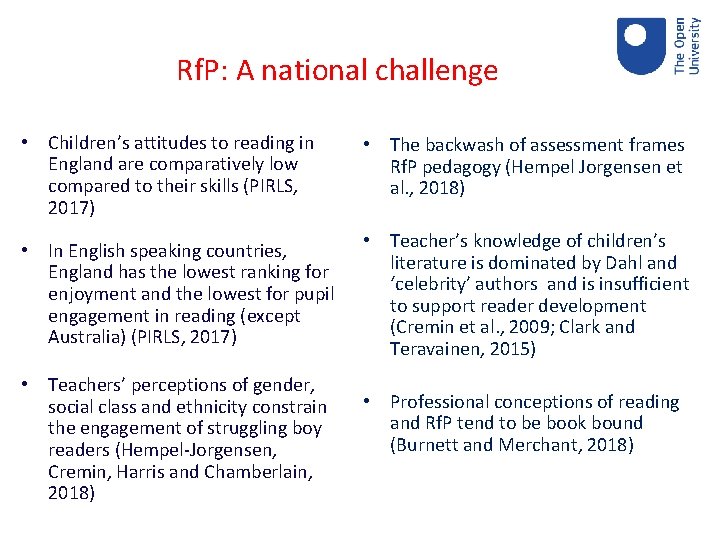
Rf. P: A national challenge • Children’s attitudes to reading in England are comparatively low compared to their skills (PIRLS, 2017) • The backwash of assessment frames Rf. P pedagogy (Hempel Jorgensen et al. , 2018) • In English speaking countries, England has the lowest ranking for enjoyment and the lowest for pupil engagement in reading (except Australia) (PIRLS, 2017) • Teacher’s knowledge of children’s literature is dominated by Dahl and ‘celebrity’ authors and is insufficient to support reader development (Cremin et al. , 2009; Clark and Teravainen, 2015) • Teachers’ perceptions of gender, social class and ethnicity constrain the engagement of struggling boy readers (Hempel-Jorgensen, Cremin, Harris and Chamberlain, 2018) • Professional conceptions of reading and Rf. P tend to be book bound (Burnett and Merchant, 2018)
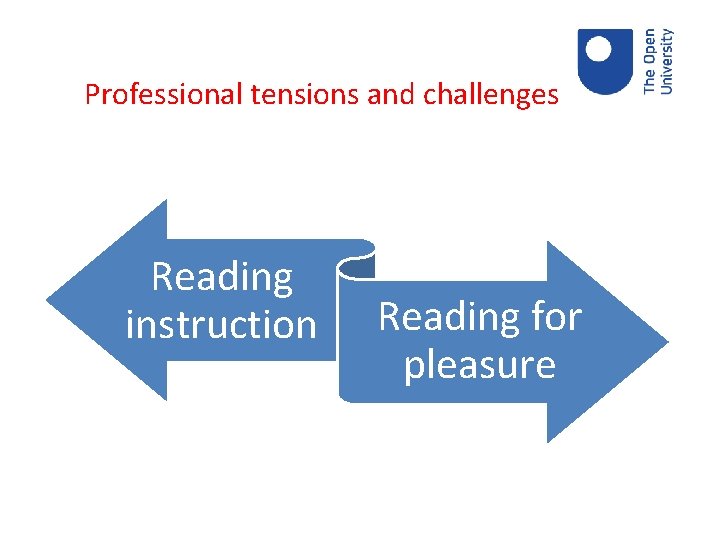
Professional tensions and challenges Reading instruction Reading for pleasure
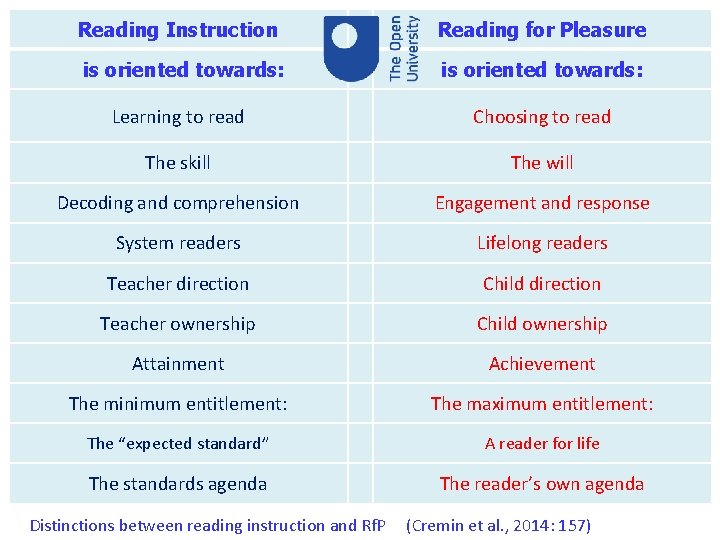
Reading Instruction Reading for Pleasure is oriented towards: Learning to read Choosing to read The skill The will Decoding and comprehension Engagement and response System readers Lifelong readers Teacher direction Child direction Teacher ownership Child ownership Attainment Achievement The minimum entitlement: The maximum entitlement: The “expected standard” The standards agenda A reader for life The reader’s own agenda Distinctions between reading instruction and Rf. P (Cremin et al. , 2014: 157)
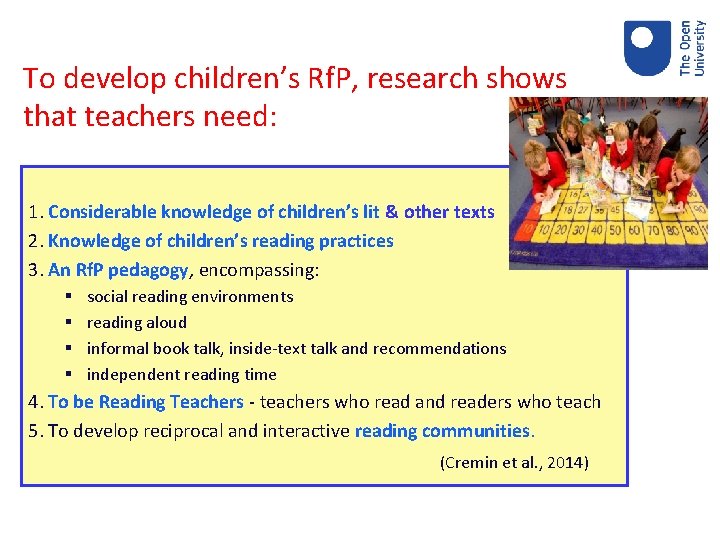
To develop children’s Rf. P, research shows that teachers need: 1. Considerable knowledge of children’s lit & other texts 2. Knowledge of children’s reading practices 3. An Rf. P pedagogy, encompassing: § § social reading environments reading aloud informal book talk, inside-text talk and recommendations independent reading time 4. To be Reading Teachers - teachers who read and readers who teach 5. To develop reciprocal and interactive reading communities. (Cremin et al. , 2014)
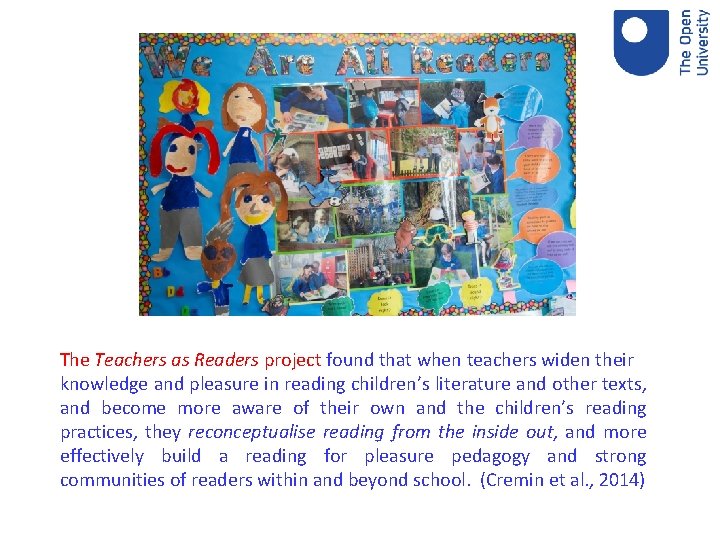
The Teachers as Readers project found that when teachers widen their knowledge and pleasure in reading children’s literature and other texts, and become more aware of their own and the children’s reading practices, they reconceptualise reading from the inside out, and more effectively build a reading for pleasure pedagogy and strong communities of readers within and beyond school. (Cremin et al. , 2014)
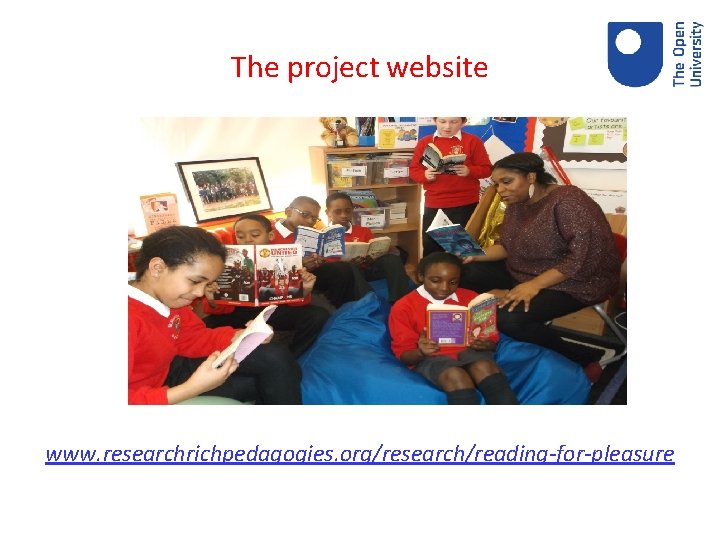
The project website www. researchrichpedagogies. org/research/reading-for-pleasure
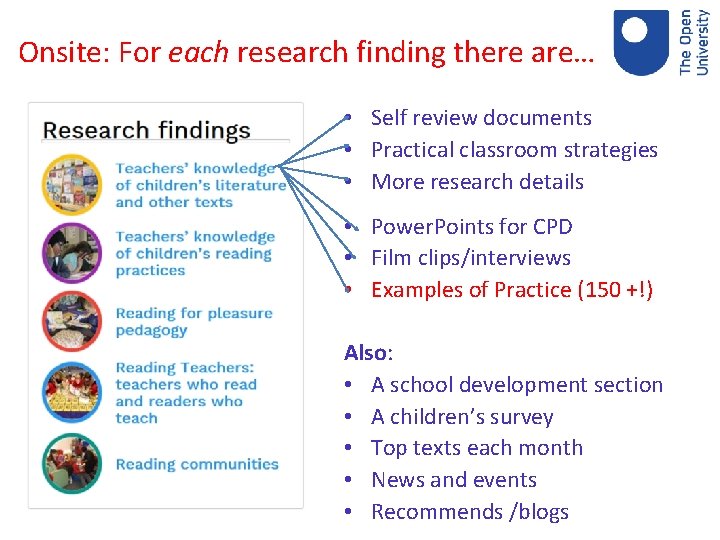
Onsite: For each research finding there are… • Self review documents • Practical classroom strategies • More research details • Power. Points for CPD • Film clips/interviews • Examples of Practice (150 +!) Also: • A school development section • A children’s survey • Top texts each month • News and events • Recommends /blogs
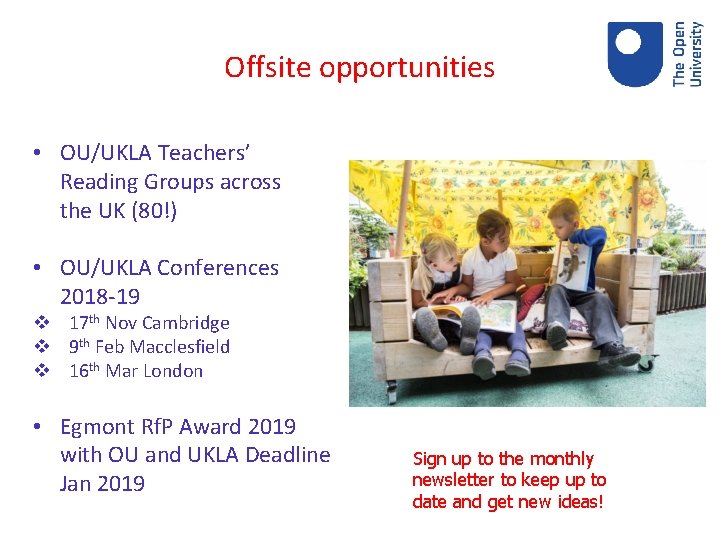
Offsite opportunities • OU/UKLA Teachers’ Reading Groups across the UK (80!) • OU/UKLA Conferences 2018 -19 v 17 th Nov Cambridge v 9 th Feb Macclesfield v 16 th Mar London • Egmont Rf. P Award 2019 with OU and UKLA Deadline Jan 2019 Sign up to the monthly newsletter to keep up to date and get new ideas!
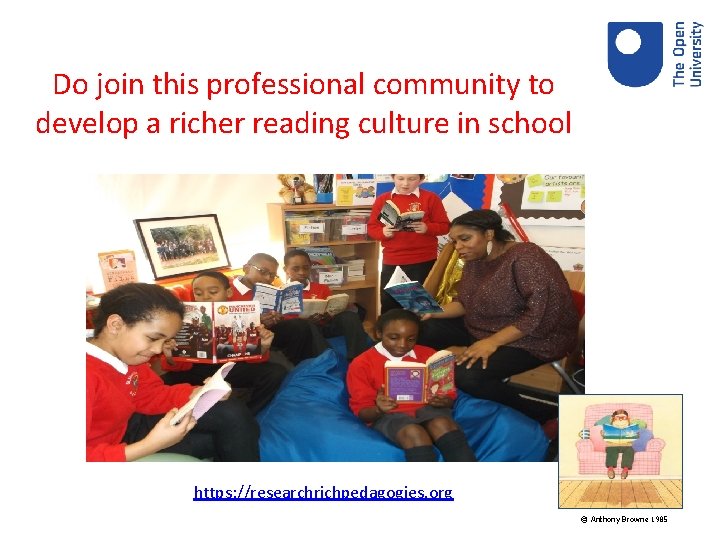
Do join this professional community to develop a richer reading culture in school https: //researchrichpedagogies. org © Anthony Browne 1985
References Anderson R. Wilson, P and Fielding L (1988) Growth in Reading and How children spend their time out of school Reading Research Quarterly, 23(3): 85 -303. Burnett, C. and Merchant, G. (2018) Affective encounters: enchantment and the possibility of reading for pleasure, Literacy 52 (2): 62 -69. Clark C. and Rumbold, K (2006) Reading for Pleasure: A research overview London: National Literacy Trust. Clark, C, and Teravainen, A. (2017) What it means to be a reader at age 11: valuing skills, affective components and behavioural processes. London: National Literacy Trust for Read on Get on. Cremin, T. , Mottram, M. , Collins, F. , Powell, S. and Drury, R. (2015) Researching literacy lives: Building home school communities London: Routledge Cremin, T, Mottram, M. , Collins, F. and Powell, S. (2014) Building Communities of Engaged Readers: Reading for pleasure, London: Routledge. Cremin, T. , Mottram, M. , Collins, F. , Powell, S. and Safford, K. (2009) Teachers as readers: building communities of readers, Literacy 43 (1): 11 -19. Cremin, T. , Bearne, E. , Mottram, M. and Goodwin, P. (2008) Exploring teachers knowledge of children’s literature, Cambridge Journal of Education, 38 (4): 449464.
References, cont’d. Hempel Jorgensen, A. Cremin, T. Harris, D. and Chamberlain, L. (2018) Understanding boys’ (dis)engagement with reading for pleasure Literacy 52 (2): 86 -94. Kidd, D. and Castano, E. (2013) Reading literary fiction improves theory of mind Science 342(6156): 377 -390. Mc. Geown, S. , Norgate, R. , & Warhurst, A. (2012). Exploring intrinsic and extrinsic reading motivation among very good and very poor readers. Educational Research, 54(3): 309 -322. OECD (2010), PISA 2009 Results: Learning to Learn – Student Engagement, Strategies and Practices (Vol III). http: //dx. doi. org/10. 1787/9789264083943 -en PIRLS (2017) National report for England Mc. Grane, J. Stiff, J. Baird, JA. , Lenkeit, J and Hopfenbeck, D. Oxford: OUCEA Rothbauer, P. M. (2004) Reading practices that inform personal and social identities of self. Canadian Journal of Information and Library science. 28 (3): 53 -74. Sullivan, A. and Brown, M. (2013) Social inequalities in cognitive scores at age 16: The role of reading. CLS Working Paper, London: Centre for Longitudinal Studies.
- Slides: 15