
Reading for all ages http www youtube comwatch

Reading for all ages http: //www. youtube. com/watch? v=o. RBch. ZLk. QR 0
Literacy What is reading? n Elements of Reading-pre-reading, phonemic awareness, phonics, stages of development, comprehension development n What teachers do n What parents can do n
What is reading? Reading is a highly complex process each reader builds a system for processing text that begins with early reading behaviours and becomes a network of strategic activities for reading increasingly challenging texts. Reading is essentially, thinking in response to written language.
What Reading involves… Reading involves knowing about: n the subject n how our language is spoken n the conventions of print — reading from left to right and top to bottom n sounds and letters and how they are represented in print. n 3 Sources of information used in reading include structure, meaning and visual clues. n
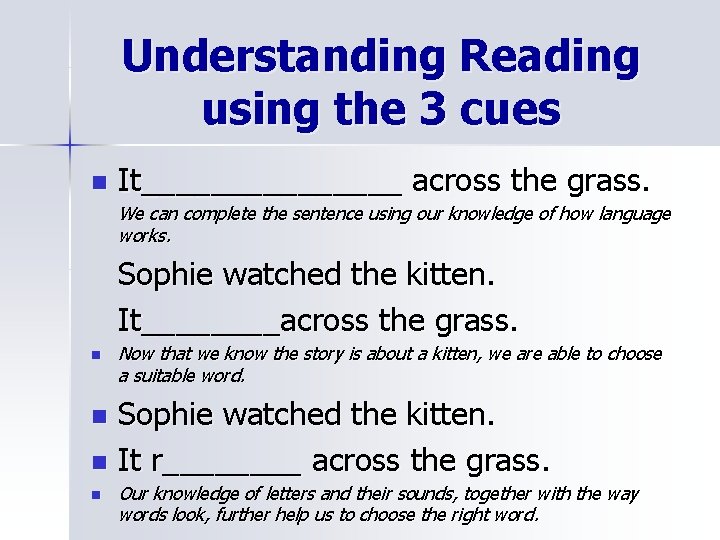
Understanding Reading using the 3 cues n It________ across the grass. We can complete the sentence using our knowledge of how language works. Sophie watched the kitten. It____across the grass. n Now that we know the story is about a kitten, we are able to choose a suitable word. Sophie watched the kitten. n It r____ across the grass. n n Our knowledge of letters and their sounds, together with the way words look, further help us to choose the right word.
What teachers do Big Books Benchmarking Guided Reading Home Readers Research- links to integrated curriculum Levelled Literacy Intervention – Small group reading assistance
Effective Reading Instruction Must Include: – Systematic and explicit instruction that includes the five essential components of reading: – phonemic awareness, – phonics, – fluency, – vocabulary, and – text comprehension
Prereading Recent research is showing the importance of Phonemic Awareness in the development of reading skills. Phonemic Awareness: The ability to hear, identify, and manipulate the individual sounds – phonemes – in spoken words. This understanding is essential to learning to read.
Phonemic Awareness Some activities to develop phonemic awareness are n Identifying beginning sounds – alphabet book n Same /different sounds n Substituting sounds in words n Rhyming words
Developmental stages of reading Beginning Readers n Emergent Readers n Early Readers n Fluent Readers n
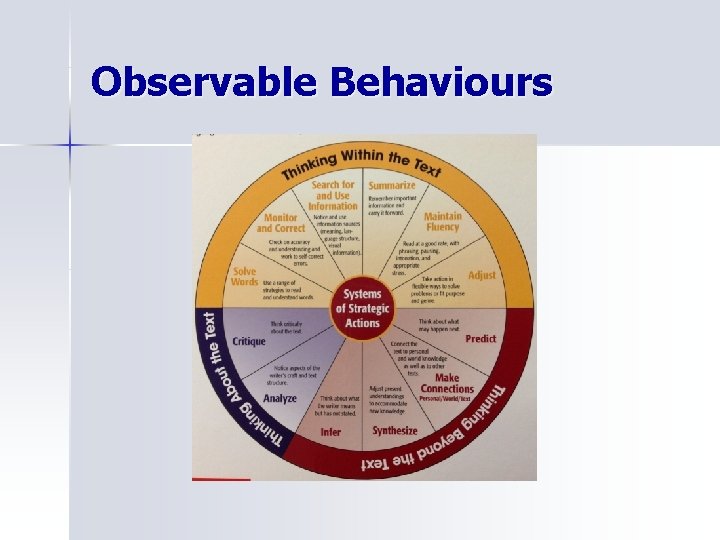
Observable Behaviours
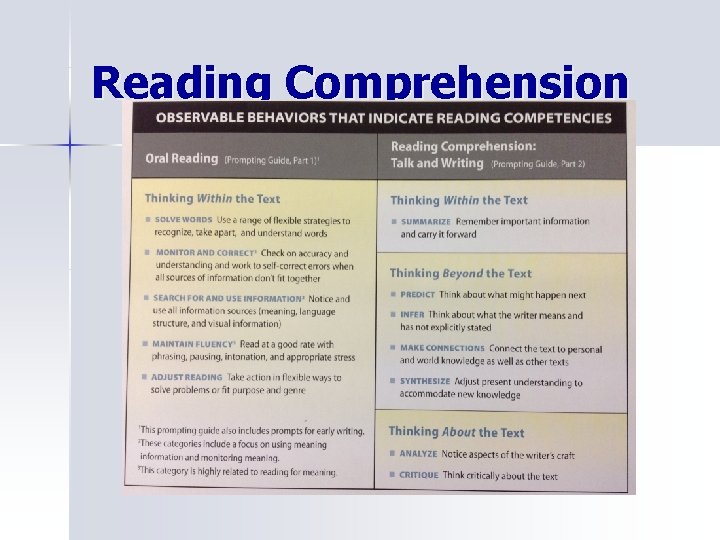
Reading Comprehension
We learn in many ways, but we need… n A reason to learn n To be actively involved n Demonstration and Modelling n Opportunities for repetition and reinforcement n Helpful instructions n To be encouraged n Our efforts to be praised
THE 3 P’s - PAUSE n - Wait a few seconds if you think the child is unsure. - Allow them some time to think about what they are doing. n Say: ‘ Have some thinking time…’ ‘Reread the instructions then we’ll work on this together. ’ ‘ Let’s discuss this as a group before we get to work. ’ ‘This is a bit tricky, let’s think together. ’
THE 3 P’s - PROMPT Prompt them to look closer and ‘have a go’ n Ask: Tell me about…? Does it look right? What would sound right? Show me how? What do you know about? How can we find out? What strategies or resources can we use? If not give encouragement and then tell.
THE 3 P’s - PRAISE At all times it is important that children are praised and encouraged for their efforts. n The support and encouragement provided through your praise will greatly assist children’s development. n Try: ‘I like the way…, Well Done…, That’s really great…, You must have been practising…, You did a lot of work…’
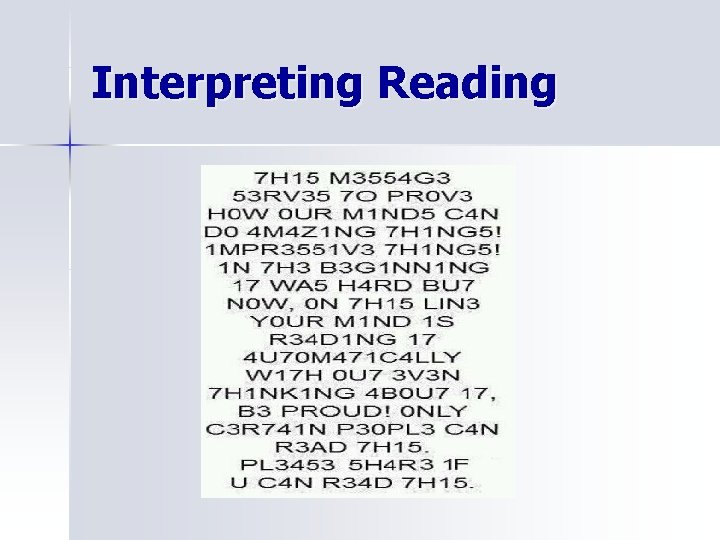
Interpreting Reading
Putting it together… n n Good readers have learned how to apply decoding and word recognition skills accurately and rapidly when reading words and text. They have learned how to use context to confirm accurate decoding and pronunciation of unknown words.
Summing Up n n n Your child is never to old to listen to and read with. Model and discuss reading behaviours Share your passion of reading Question (thinking Within the text, About the text and Beyond the text. Have fun!
What Parents can do n n n Use nursery rhymes, songs and finger plays to introduce the early stages of awareness of speech sounds. Perform rhyme, alliteration and sound-judgement tasks (e. g. , Which words start with the same sounds? ). Do sound segmentation and blending tasks (e. g. , ‘Which sound does ball start with? ’; ‘What does C-A-T say? ’). Expose children to different types of books (picture books, story books, alphabet books, activity books, card games such as snap, word games such as ‘I spy’, learning words of songs and rhymes, newspapers, comics, ibooks etc) as early as possible. Encourage "print recognition" in everyday situations Encourage children to make inferences about what is being read to them (e. g. , ‘Who will they ask to help them? ’ ‘What’s going to happen, do you think? ).
- Slides: 20