
Reading Fluorescence with a Microplate Reader Bio Tek
Reading Fluorescence with a Microplate Reader Bio. Tek Instruments, Inc.

Fluorescence § FI- Fluorescence Intensity § FP- Fluorescent Polarization § TRF- Time Resolve Fluorescents

1. 2. 3. 4. What is fluorescence? Reading fluorescence in a microplate Excitation and Emission parameters How to. . .
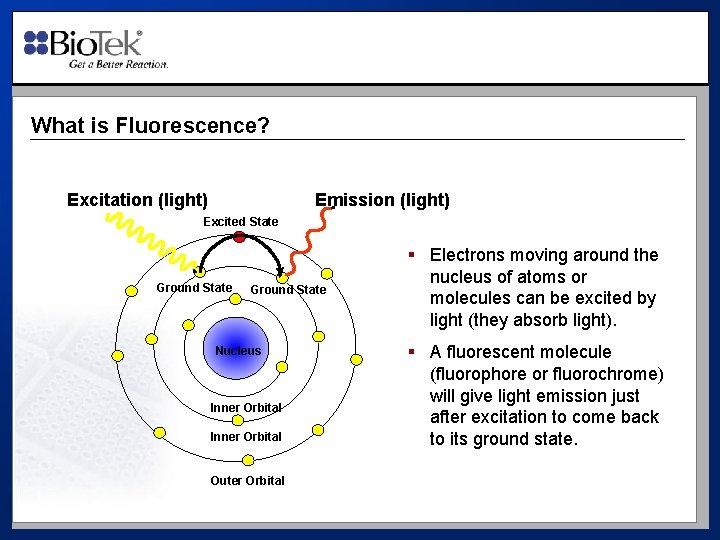
What is Fluorescence? Excitation (light) Emission (light) Excited State Ground State Nucleus Inner Orbital Outer Orbital § Electrons moving around the nucleus of atoms or molecules can be excited by light (they absorb light). § A fluorescent molecule (fluorophore or fluorochrome) will give light emission just after excitation to come back to its ground state.
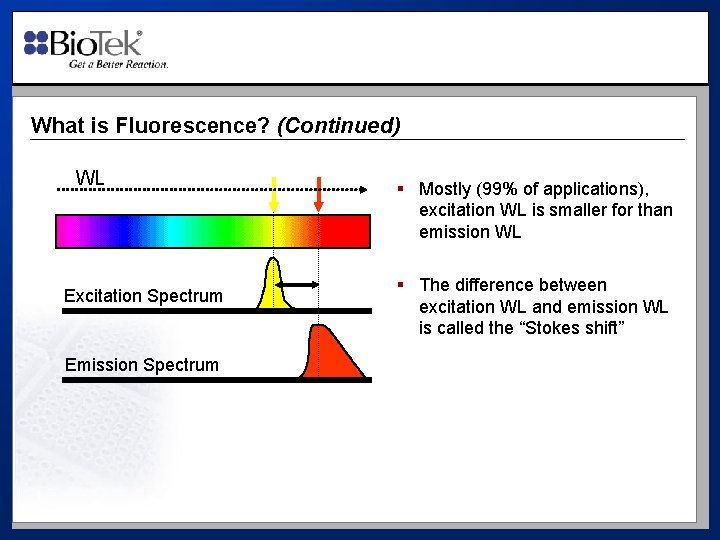
What is Fluorescence? (Continued) WL Excitation Spectrum Emission Spectrum § Mostly (99% of applications), excitation WL is smaller for than emission WL § The difference between excitation WL and emission WL is called the “Stokes shift”
Four important elements to detect Fluorescence § § Source of Excitation (Light Source) Fluorophore Wavelength selectors (most often Filters) to isolate the excited photons from the emitted photons Detector to register the emitted photons and to convert them into a electronical Output-signal (PMT-element) or into a picture
Reading Fluorescence in a Microplate 1. 2. 3. 4. What is fluorescence? Reading fluorescence in a microplate Excitation and Emission parameters How to. . .
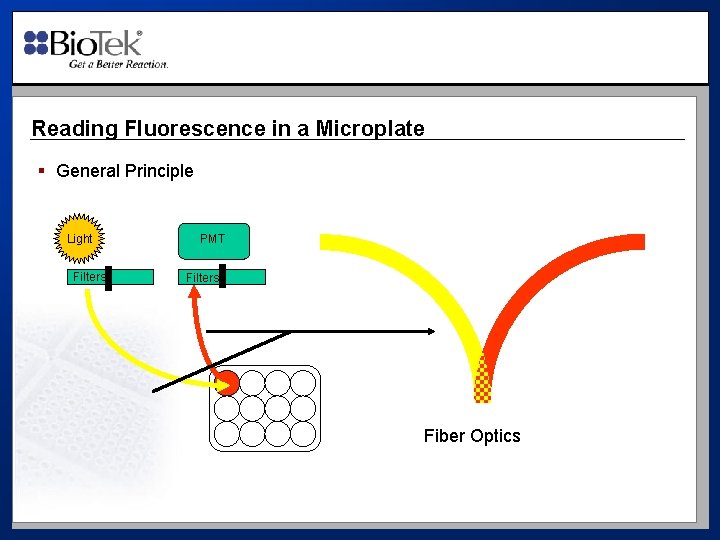
Reading Fluorescence in a Microplate § General Principle Light Filters PMT Filters Fiber Optics
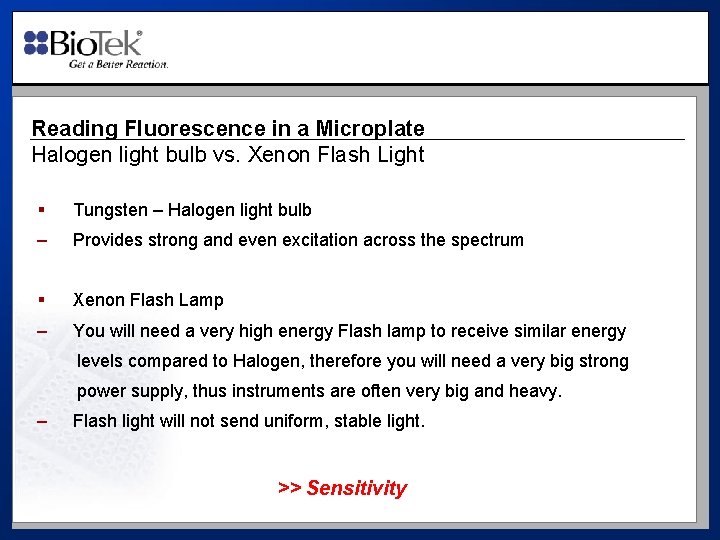
Reading Fluorescence in a Microplate Halogen light bulb vs. Xenon Flash Light § Tungsten – Halogen light bulb – Provides strong and even excitation across the spectrum § Xenon Flash Lamp – You will need a very high energy Flash lamp to receive similar energy levels compared to Halogen, therefore you will need a very big strong power supply, thus instruments are often very big and heavy. – Flash light will not send uniform, stable light. >> Sensitivity
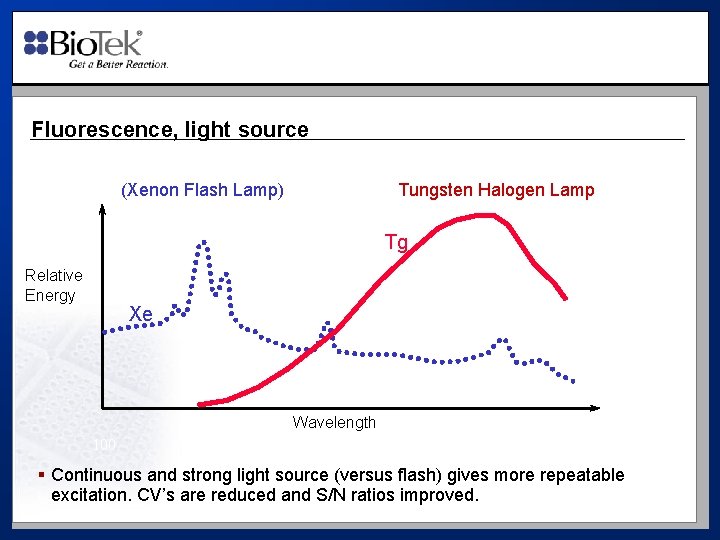
Fluorescence, light source (Xenon Flash Lamp) Tungsten Halogen Lamp Tg Relative Energy Xe Wavelength 100 250 500 750 1100 § Continuous and strong light source (versus flash) gives more repeatable excitation. CV’s are reduced and S/N ratios improved.
Reading Fluorescence in a Microplate Filter vs. Monochromator § Filter-based – Filters are assay specific (e. g. 400/10; 635/32; 580/50) – Transmit 50% of light vs. 15% for a monochromator § Monochromator-based – Much more flexible – Spectral scans possible >> Sensitivity
Filter-based Fluorescence § Filters transmit more light than monochromators – Typically 50% of target wavelength goes through a filter vs. 15% through a monochromator. – Monochromator-based systems require big expensive light sources to achieve similar sensitivity. § Filters are dye-specific – Depending on the Stokes shift, the bandwidth is exactly tailored to the assay (e. g. 400/10; 635/32; 580/50 nm filters). – Monochromator-based systems have typically a fixed bandwidth (or only a few choices around 10 nm): the sensitivity is assay dependent. >> Sensitivity

Filter-based Fluorescence (Continued) § Filters have much sharper wavelength profiles than monochromators. They give a much better wavelength specificity, allowing to bring more light to the sample with less risk of interference with emission measurement system. – In red: filter profile of a 360/40 nm light. Because of the straight cut-off, the bandwidth can be large. 340 360 380 WL – In blue: monochromator profile of a 360 nm light. Because of the cut-off slope, bandwidth of monochromator systems is typically around 10 nm. Less excitation light goes to the sample, risk of interference with (nm) emission is higher with dyes with small Stokes shift. >> Sensitivity
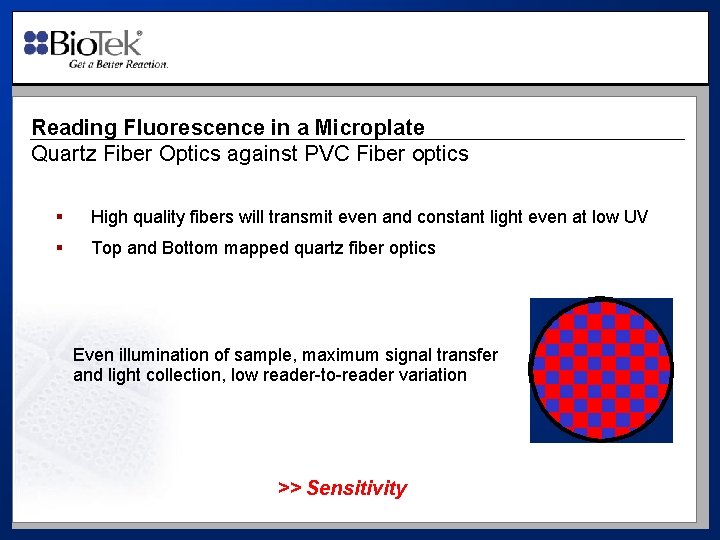
Reading Fluorescence in a Microplate Quartz Fiber Optics against PVC Fiber optics § High quality fibers will transmit even and constant light even at low UV § Top and Bottom mapped quartz fiber optics Even illumination of sample, maximum signal transfer and light collection, low reader-to-reader variation >> Sensitivity
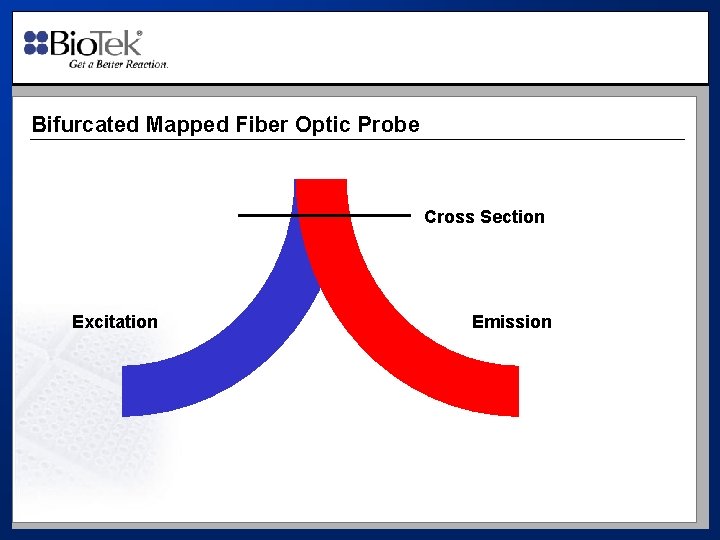
Bifurcated Mapped Fiber Optic Probe Cross Section Excitation Emission
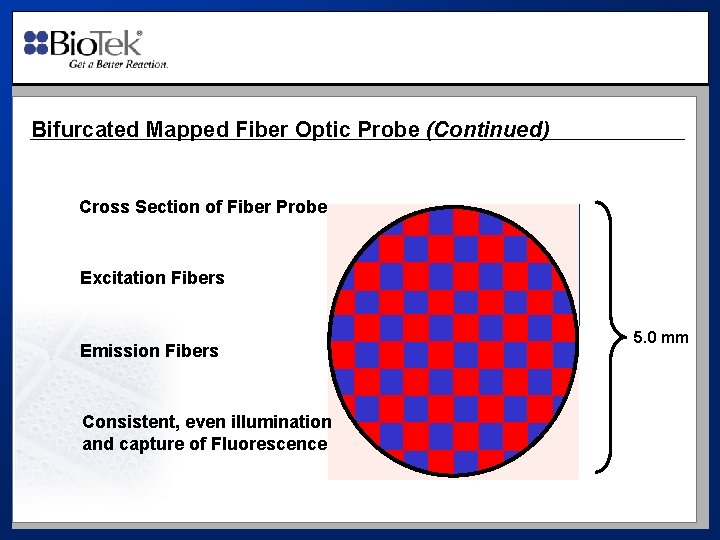
Bifurcated Mapped Fiber Optic Probe (Continued) Cross Section of Fiber Probe Excitation Fibers Emission Fibers Consistent, even illumination and capture of Fluorescence 5. 0 mm
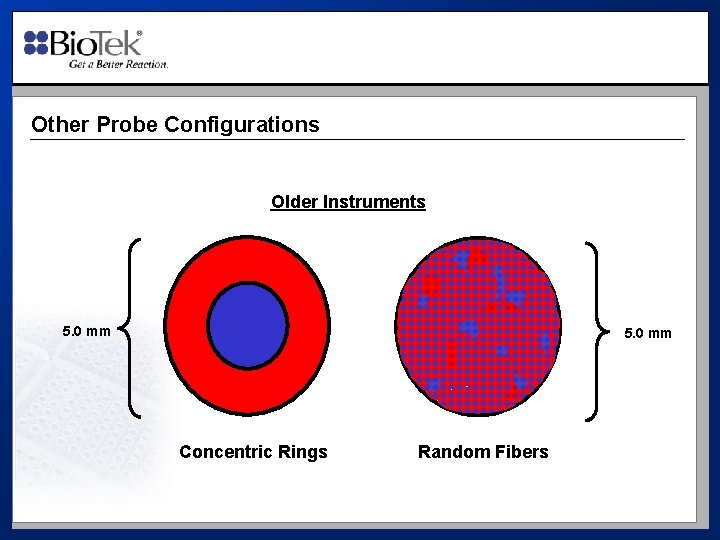
Other Probe Configurations Older Instruments 5. 0 mm Concentric Rings Random Fibers
Reading Fluorescence in a Microplate 1. 2. 3. 4. What is fluorescence? Reading fluorescence in a microplate Excitation and Emission parameters How to. . .
Excitation and Emission Parameters § Filters selection § Light intensity – Fiber optics diameter – Distance from sample § Top/Bottom reading
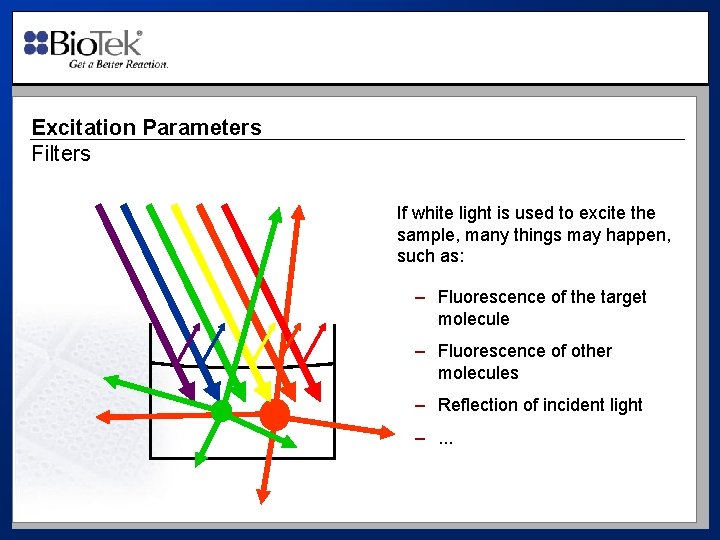
Excitation Parameters Filters If white light is used to excite the sample, many things may happen, such as: – Fluorescence of the target molecule – Fluorescence of other molecules – Reflection of incident light –. . .
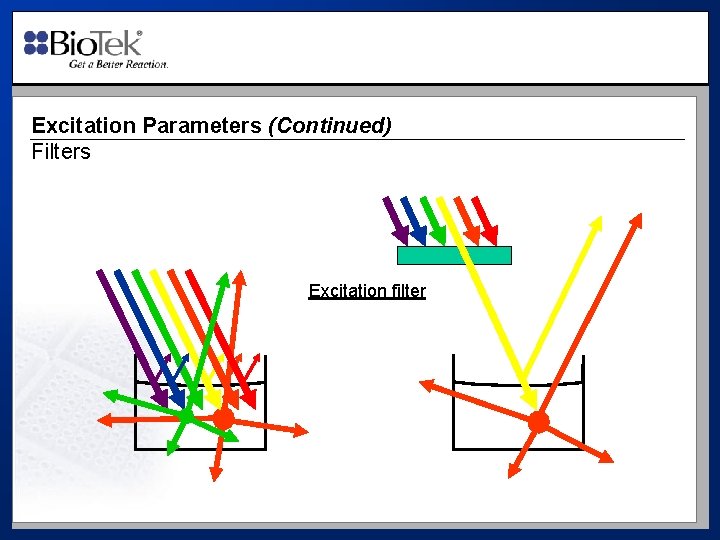
Excitation Parameters (Continued) Filters Excitation filter
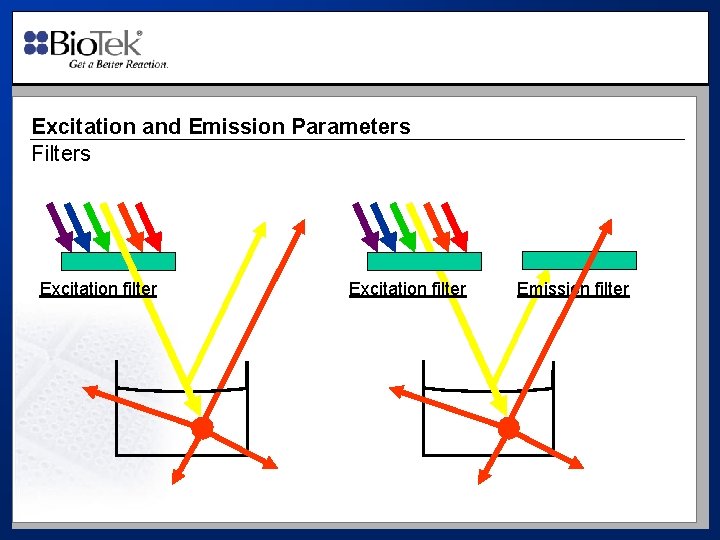
Excitation and Emission Parameters Filters Excitation filter Emission filter
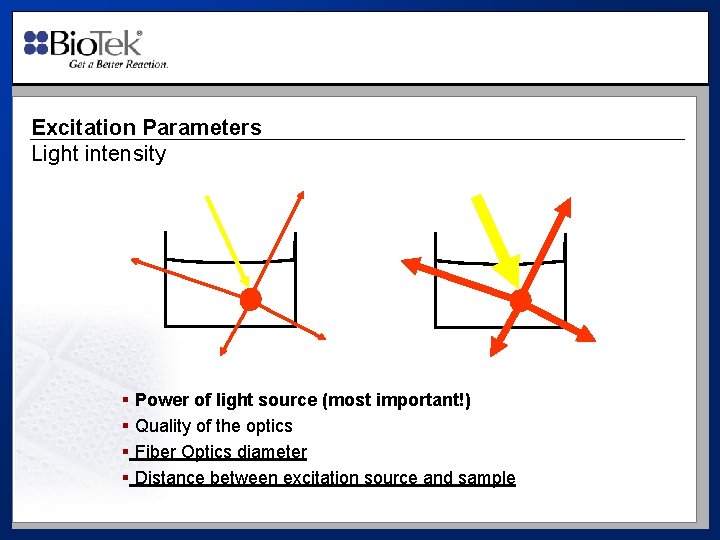
Excitation Parameters Light intensity § Power of light source (most important!) § Quality of the optics § Fiber Optics diameter § Distance between excitation source and sample
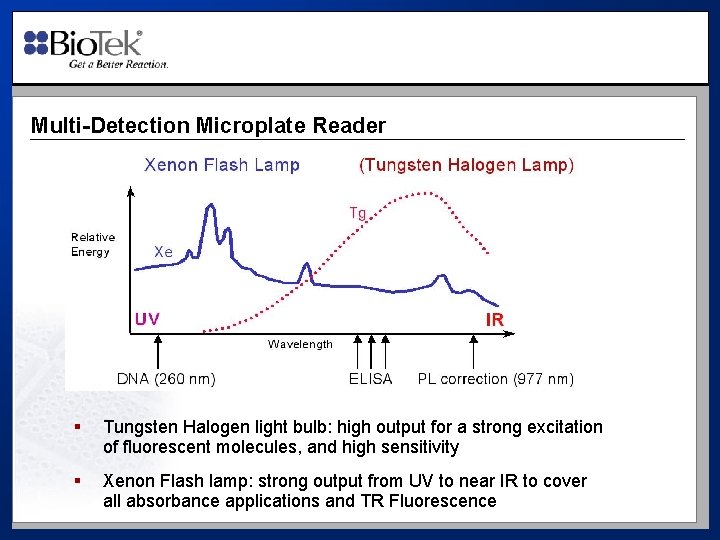
Multi-Detection Microplate Reader § Tungsten Halogen light bulb: high output for a strong excitation of fluorescent molecules, and high sensitivity § Xenon Flash lamp: strong output from UV to near IR to cover all absorbance applications and TR Fluorescence
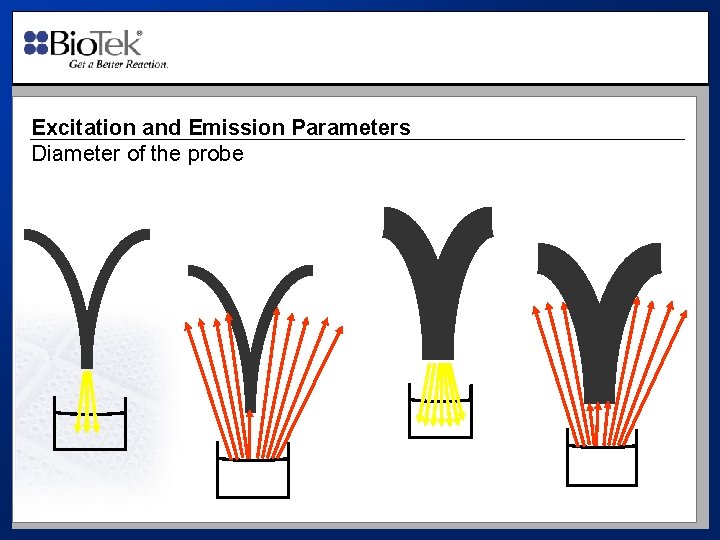
Excitation and Emission Parameters Diameter of the probe
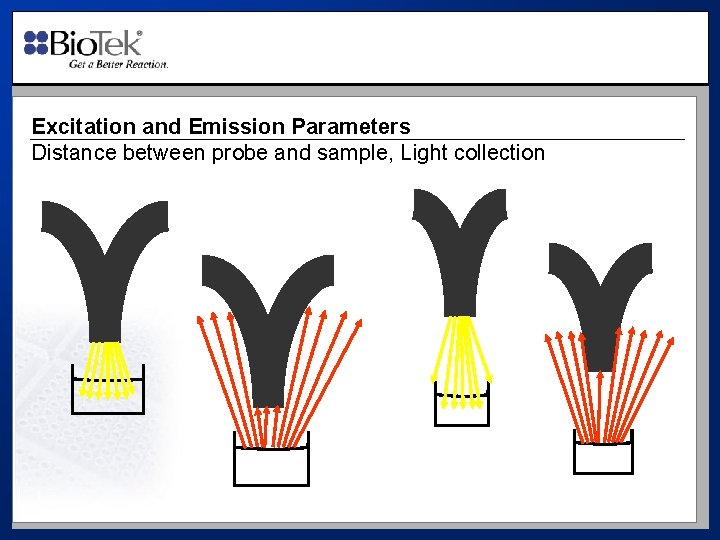
Excitation and Emission Parameters Distance between probe and sample, Light collection
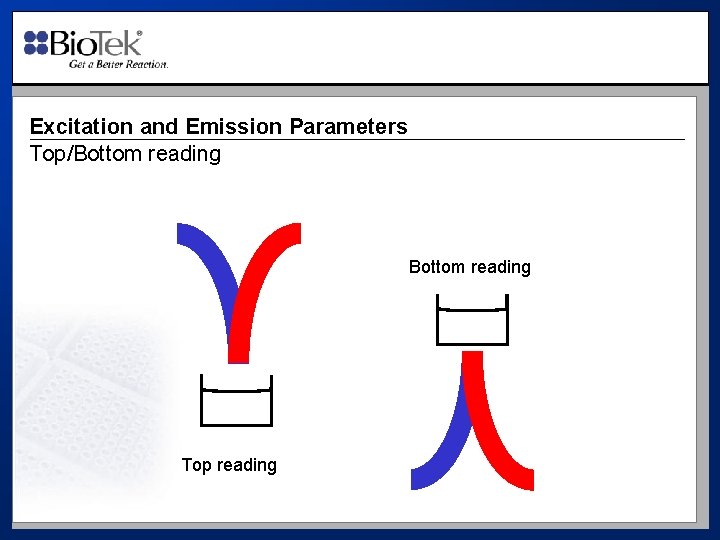
Excitation and Emission Parameters Top/Bottom reading Top reading
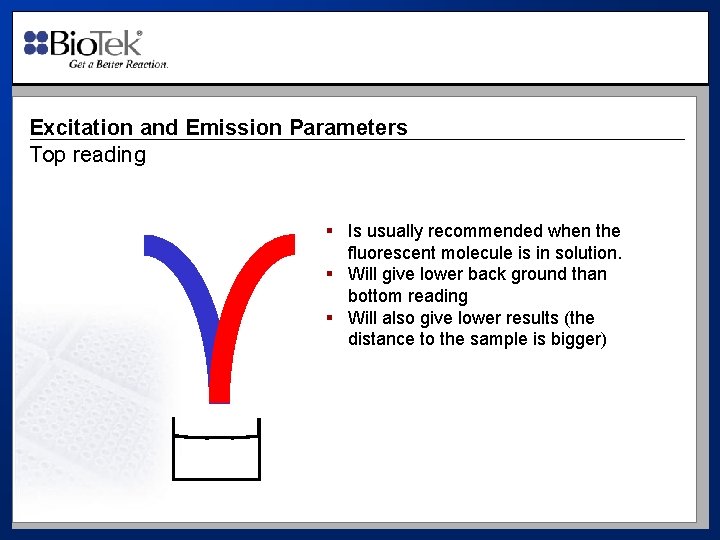
Excitation and Emission Parameters Top reading § Is usually recommended when the fluorescent molecule is in solution. § Will give lower back ground than bottom reading § Will also give lower results (the distance to the sample is bigger)
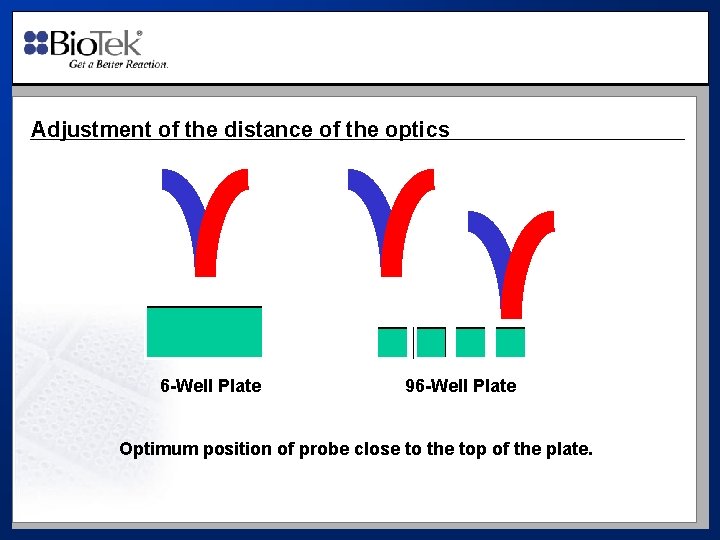
Adjustment of the distance of the optics 6 -Well Plate 96 -Well Plate Optimum position of probe close to the top of the plate.
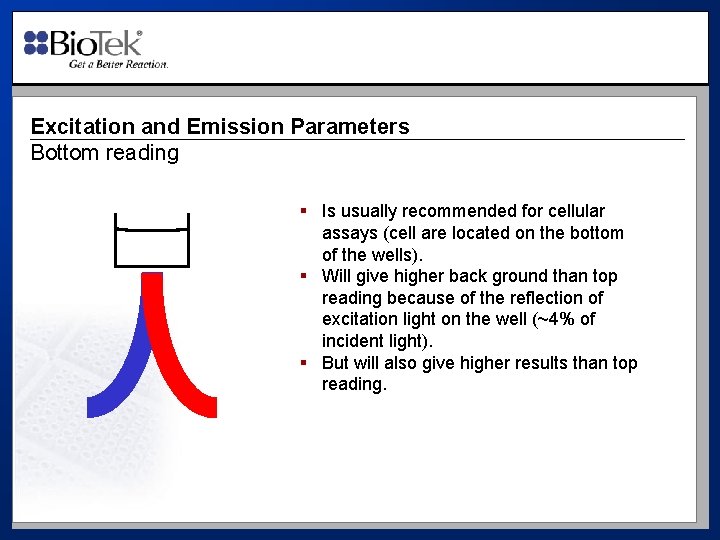
Excitation and Emission Parameters Bottom reading § Is usually recommended for cellular assays (cell are located on the bottom of the wells). § Will give higher back ground than top reading because of the reflection of excitation light on the well (~4% of incident light). § But will also give higher results than top reading.
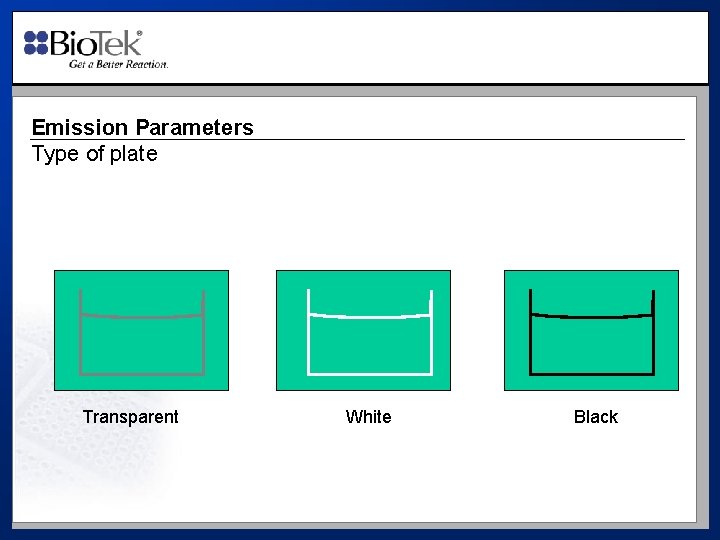
Emission Parameters Type of plate Transparent White Black
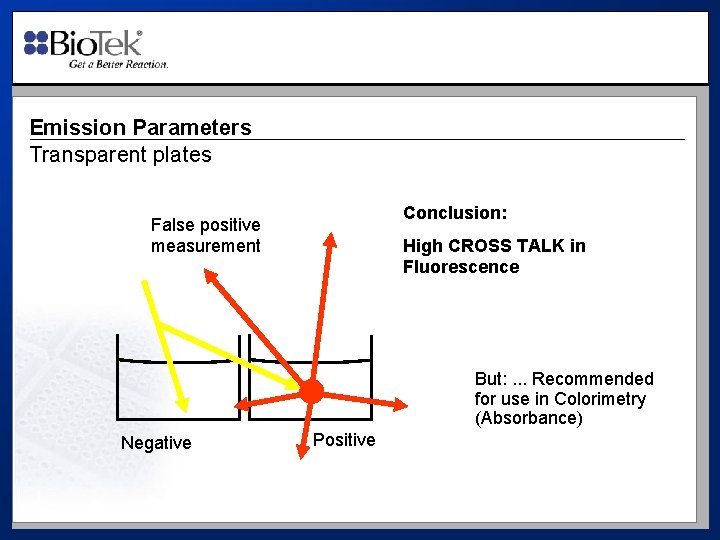
Emission Parameters Transparent plates Conclusion: False positive measurement High CROSS TALK in Fluorescence But: . . . Recommended for use in Colorimetry (Absorbance) Negative Positive
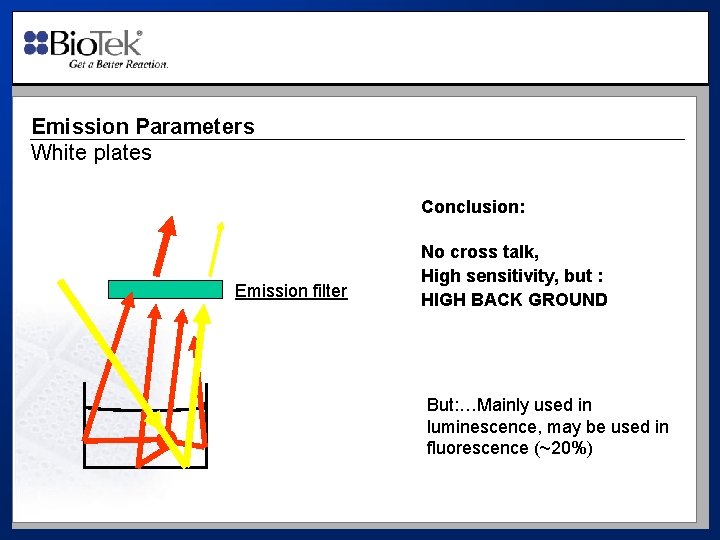
Emission Parameters White plates Conclusion: Emission filter No cross talk, High sensitivity, but : HIGH BACK GROUND But: …Mainly used in luminescence, may be used in fluorescence (~20%)
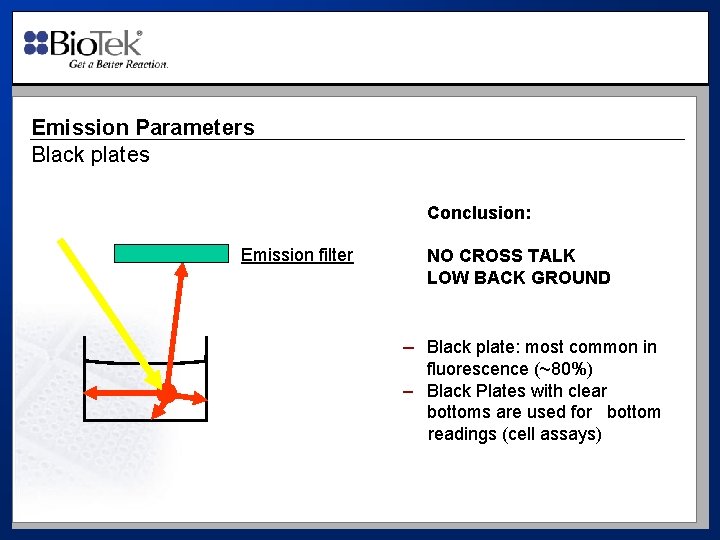
Emission Parameters Black plates Conclusion: Emission filter NO CROSS TALK LOW BACK GROUND – Black plate: most common in fluorescence (~80%) – Black Plates with clear bottoms are used for bottom readings (cell assays)
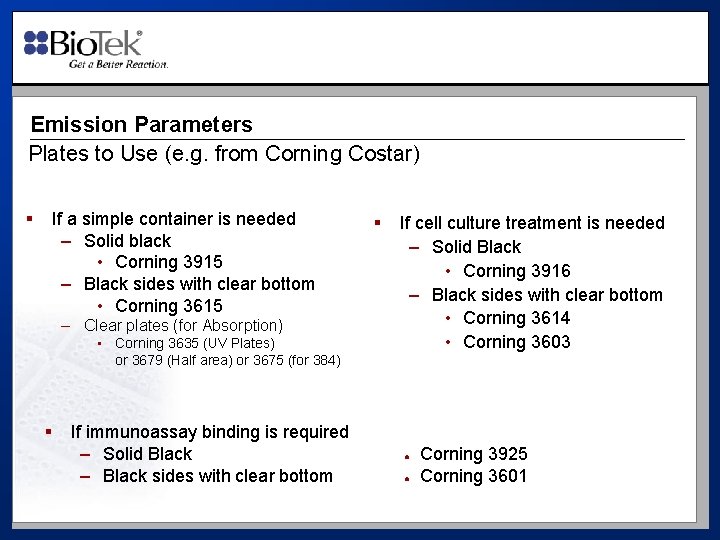
Emission Parameters Plates to Use (e. g. from Corning Costar) § If a simple container is needed – Solid black • Corning 3915 – Black sides with clear bottom • Corning 3615 – Clear plates (for Absorption) • Corning 3635 (UV Plates) or 3679 (Half area) or 3675 (for 384) § If immunoassay binding is required – Solid Black – Black sides with clear bottom § If cell culture treatment is needed – Solid Black • Corning 3916 – Black sides with clear bottom • Corning 3614 • Corning 3603 ● ● Corning 3925 Corning 3601
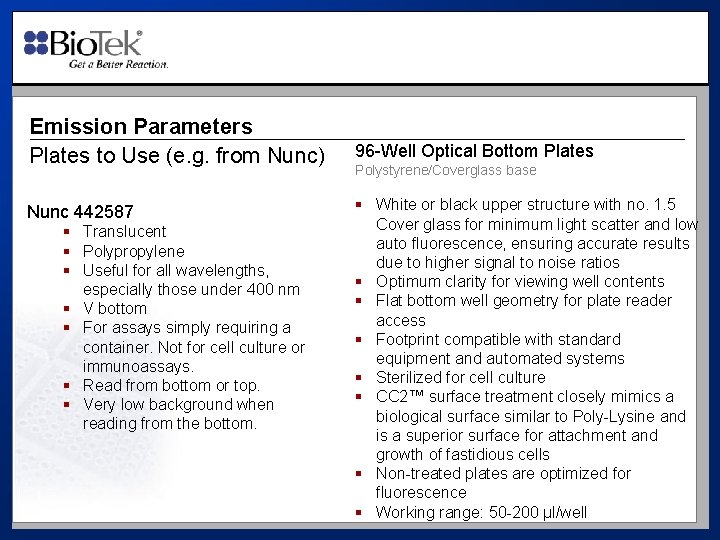
Emission Parameters Plates to Use (e. g. from Nunc) Nunc 442587 § Translucent § Polypropylene § Useful for all wavelengths, especially those under 400 nm § V bottom § For assays simply requiring a container. Not for cell culture or immunoassays. § Read from bottom or top. § Very low background when reading from the bottom. 96 -Well Optical Bottom Plates Polystyrene/Coverglass base § White or black upper structure with no. 1. 5 Cover glass for minimum light scatter and low auto fluorescence, ensuring accurate results due to higher signal to noise ratios § Optimum clarity for viewing well contents § Flat bottom well geometry for plate reader access § Footprint compatible with standard equipment and automated systems § Sterilized for cell culture § CC 2™ surface treatment closely mimics a biological surface similar to Poly-Lysine and is a superior surface for attachment and growth of fastidious cells § Non-treated plates are optimized for fluorescence § Working range: 50 -200 µl/well
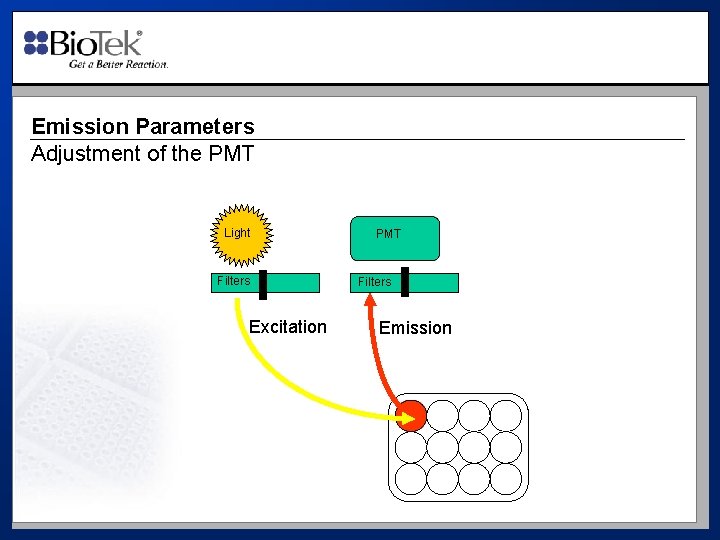
Emission Parameters Adjustment of the PMT Light Filters Excitation PMT Filters Emission
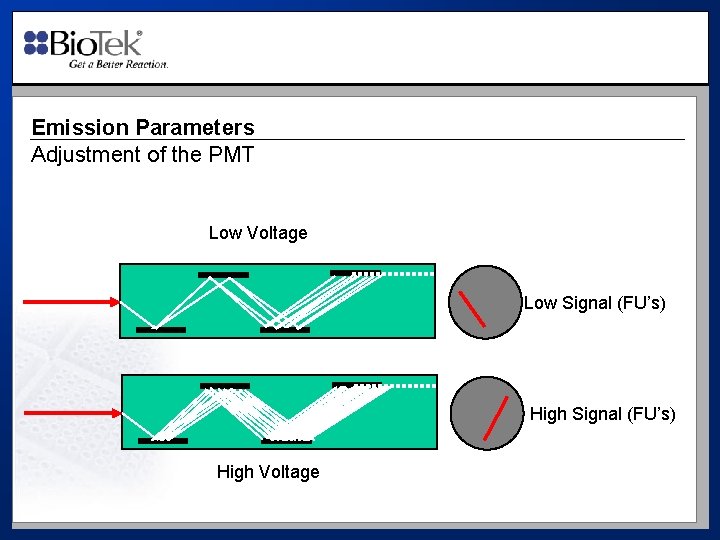
Emission Parameters Adjustment of the PMT Low Voltage Low Signal (FU’s) High Voltage
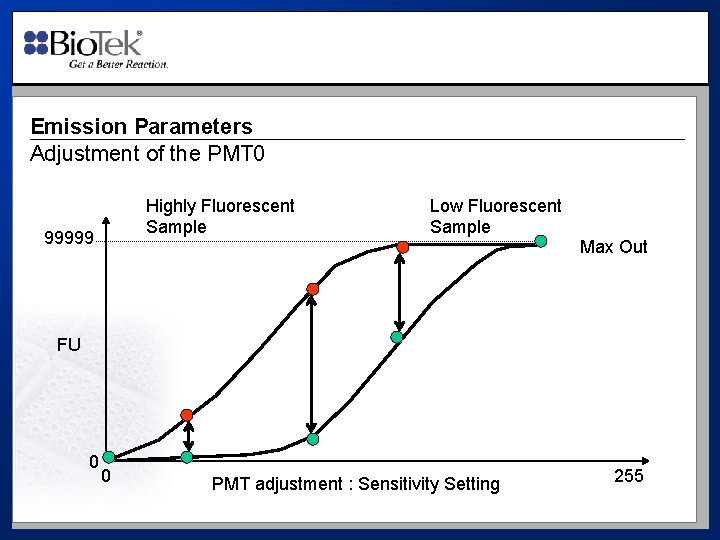
Emission Parameters Adjustment of the PMT 0 Highly Fluorescent Sample 99999 Low Fluorescent Sample Max Out FU 0 0 PMT adjustment : Sensitivity Setting 255
Excitation and Emission Parameters Summary § Filters selection: to avoid interference and to read only the WL of interest § Light intensity: to have a strong excitation (Fiber optics diameter, Distance between probe and sample) § Light collection (Distance, Fiber Optics diameter): to collect a lot of energy § Top/Bottom: to have the best excitation and emission for the current application § Type of plate § Adjustment of the PMT: to optimize dynamic range of results
Reading Fluorescence in a Microplate 1. 2. 3. 4. What is fluorescence? Reading fluorescence in a microplate Excitation and Emission parameters How to. . .
How to. . . § § § § Select the right filter set Adjust the distance of the optics Select Top/Bottom reading Select the right fiber optics diameter Select the proper type of plate Adjust the PMT. . .
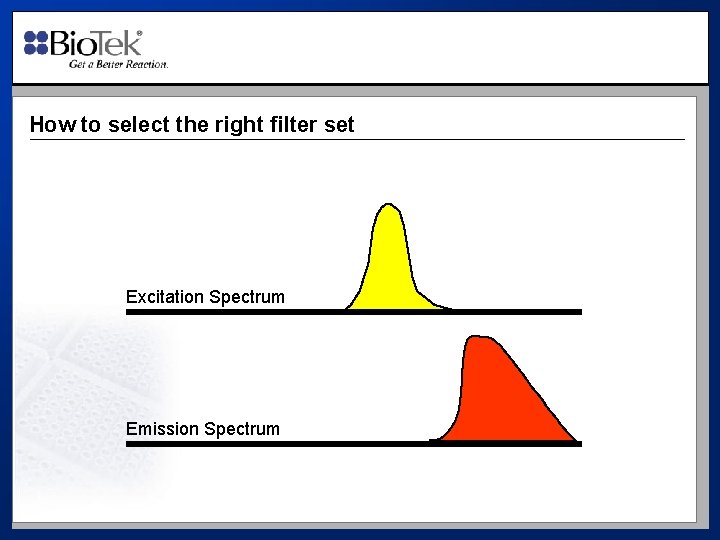
How to select the right filter set Excitation Spectrum Emission Spectrum
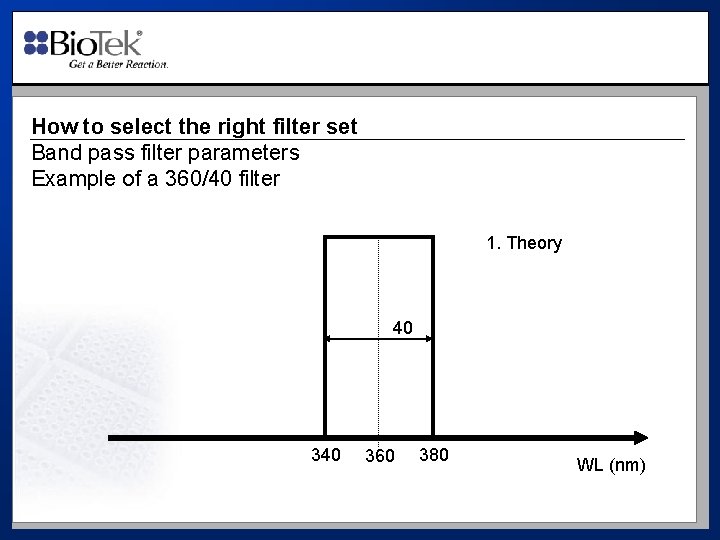
How to select the right filter set Band pass filter parameters Example of a 360/40 filter 1. Theory 40 360 380 WL (nm)
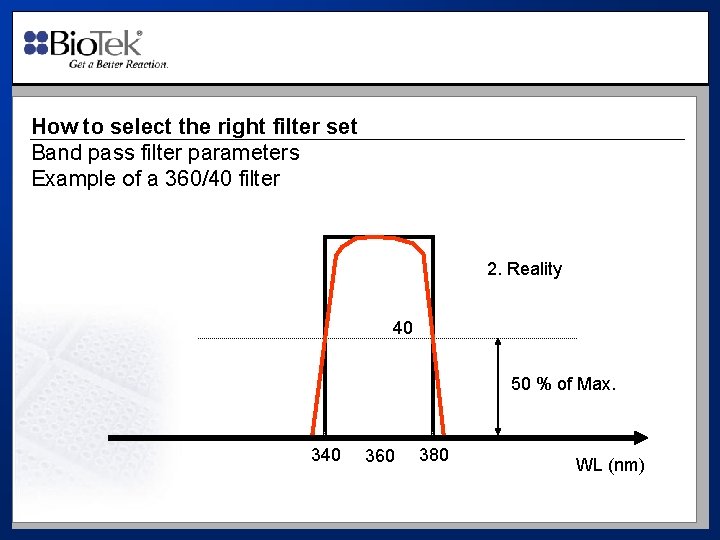
How to select the right filter set Band pass filter parameters Example of a 360/40 filter 2. Reality 40 50 % of Max. 340 360 380 WL (nm)
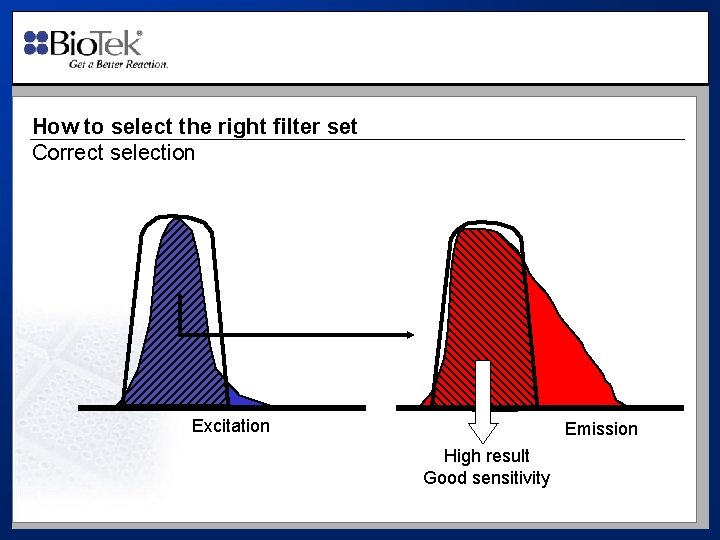
How to select the right filter set Correct selection Excitation Emission High result Good sensitivity
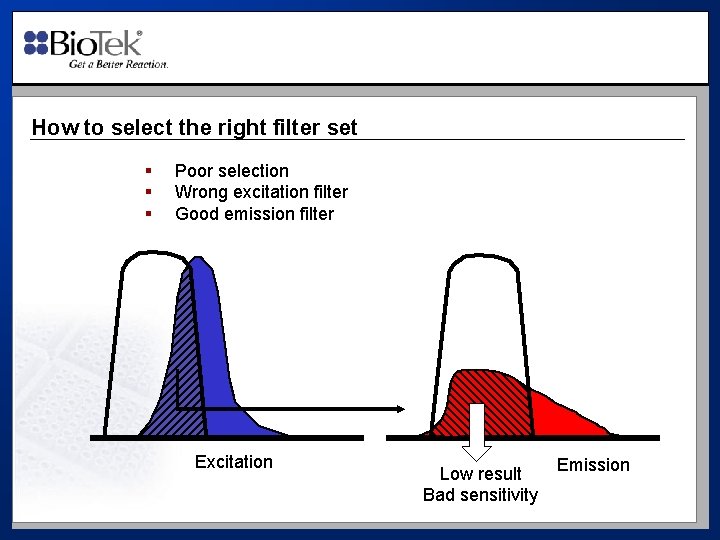
How to select the right filter set § § § Poor selection Wrong excitation filter Good emission filter Excitation Low result Bad sensitivity Emission
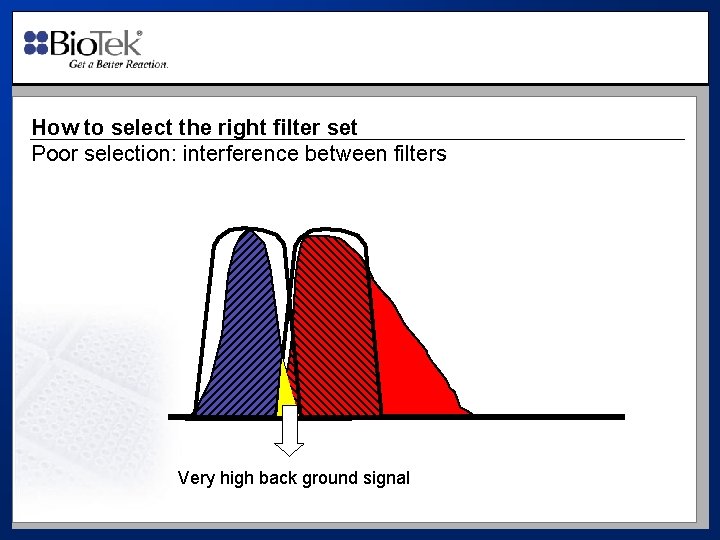
How to select the right filter set Poor selection: interference between filters Very high back ground signal
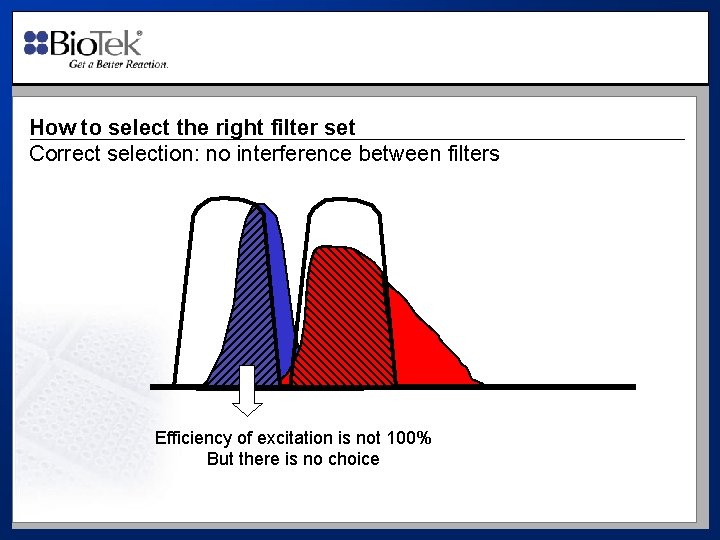
How to select the right filter set Correct selection: no interference between filters Efficiency of excitation is not 100% But there is no choice
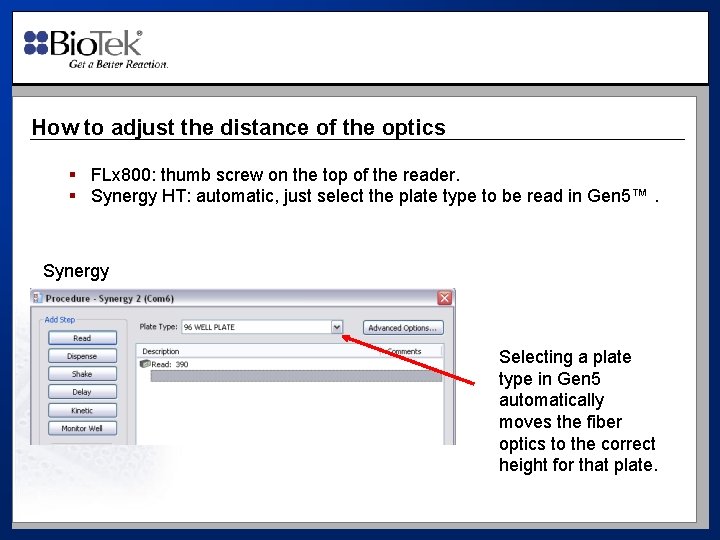
How to adjust the distance of the optics § FLx 800: thumb screw on the top of the reader. § Synergy HT: automatic, just select the plate type to be read in Gen 5™. Synergy Selecting a plate type in Gen 5 automatically moves the fiber optics to the correct height for that plate.
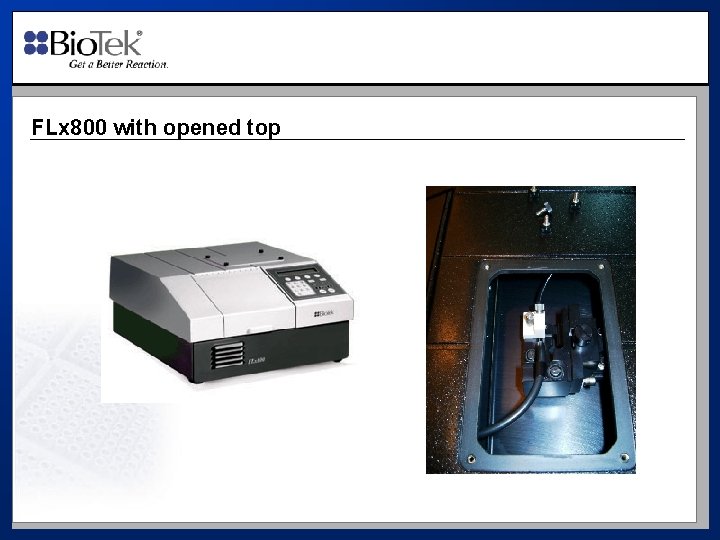
FLx 800 with opened top
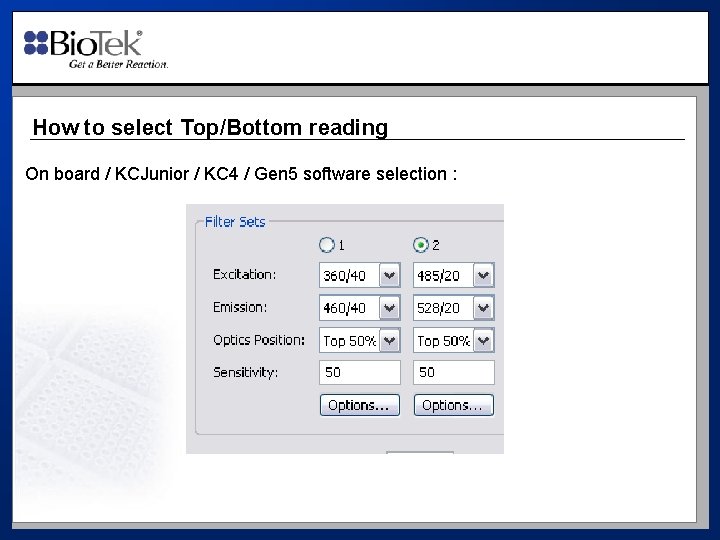
How to select Top/Bottom reading On board / KCJunior / KC 4 / Gen 5 software selection :
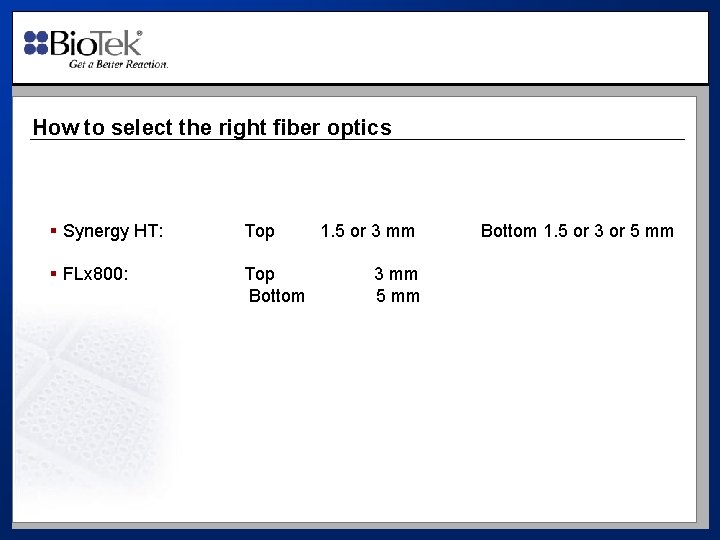
How to select the right fiber optics § Synergy HT: Top § FLx 800: Top Bottom 1. 5 or 3 mm 5 mm Bottom 1. 5 or 3 or 5 mm
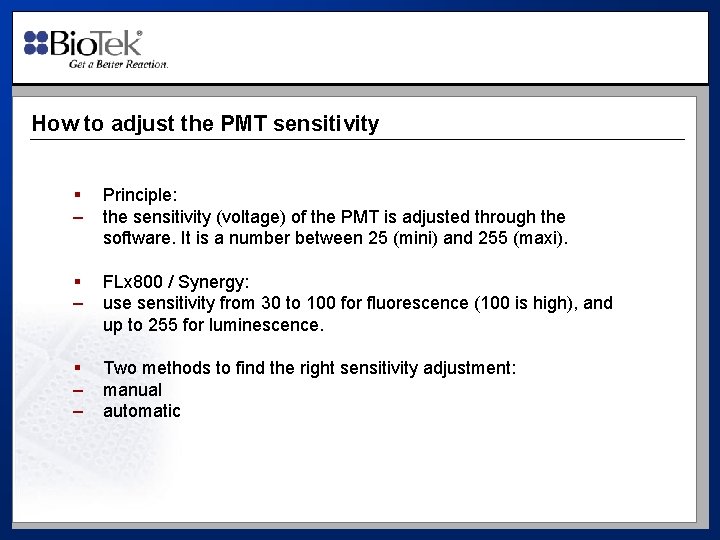
How to adjust the PMT sensitivity § – Principle: the sensitivity (voltage) of the PMT is adjusted through the software. It is a number between 25 (mini) and 255 (maxi). § – FLx 800 / Synergy: use sensitivity from 30 to 100 for fluorescence (100 is high), and up to 255 for luminescence. § – – Two methods to find the right sensitivity adjustment: manual automatic
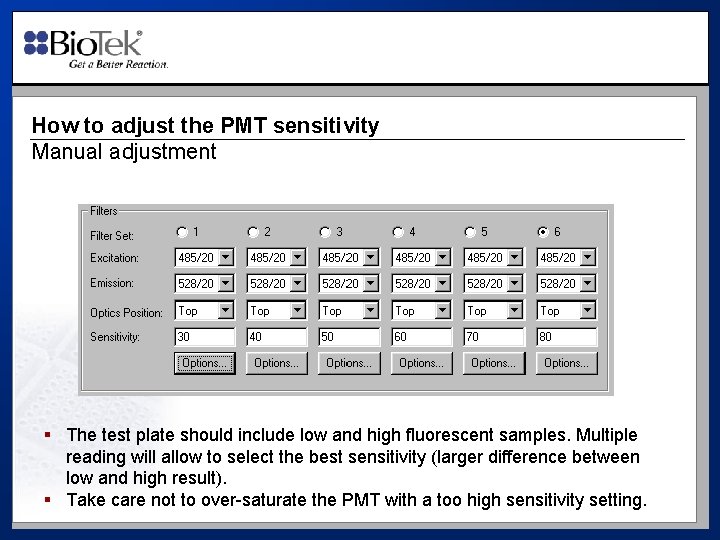
How to adjust the PMT sensitivity Manual adjustment § The test plate should include low and high fluorescent samples. Multiple reading will allow to select the best sensitivity (larger difference between low and high result). § Take care not to over-saturate the PMT with a too high sensitivity setting.
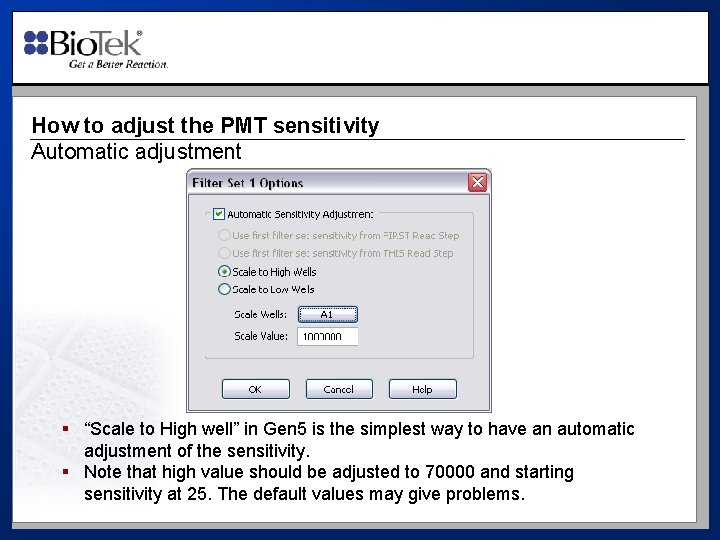
How to adjust the PMT sensitivity Automatic adjustment § “Scale to High well” in Gen 5 is the simplest way to have an automatic adjustment of the sensitivity. § Note that high value should be adjusted to 70000 and starting sensitivity at 25. The default values may give problems.
Conclusion § A lot of parameters! § We have an excellent application team in the U. S. for these applications (Ted Quigley & Dr. Paul Held)
Fluorescence § FI- Fluorescence Intensity § FP- Fluorescent Polarization § TRF- Time Resolve Fluorescents ** Time for a Break **
FP- Fluorescent Polarization Synergy™ 2
Contents § Theory – What is polarized light? – How do you measure polarized light? – Typical example of FP measurement § § Review of optical system and software for FP measurement Why is FP used: advantages and limitations Typical applications and users Reagent manufacturers and kits
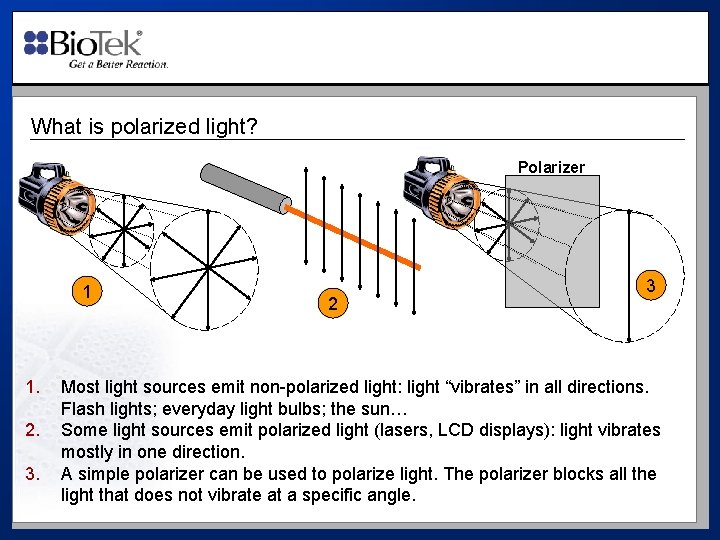
What is polarized light? Polarizer 1 1. 2. 3. 2 3 Most light sources emit non-polarized light: light “vibrates” in all directions. Flash lights; everyday light bulbs; the sun… Some light sources emit polarized light (lasers, LCD displays): light vibrates mostly in one direction. A simple polarizer can be used to polarize light. The polarizer blocks all the light that does not vibrate at a specific angle.
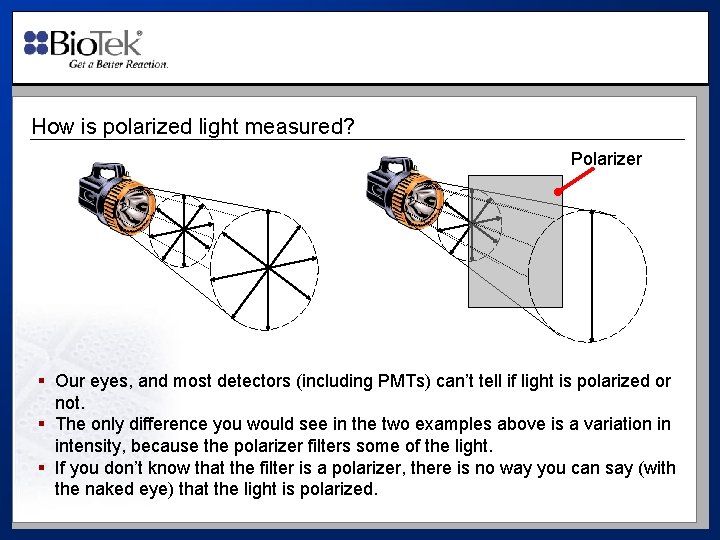
How is polarized light measured? Polarizer § Our eyes, and most detectors (including PMTs) can’t tell if light is polarized or not. § The only difference you would see in the two examples above is a variation in intensity, because the polarizer filters some of the light. § If you don’t know that the filter is a polarizer, there is no way you can say (with the naked eye) that the light is polarized.
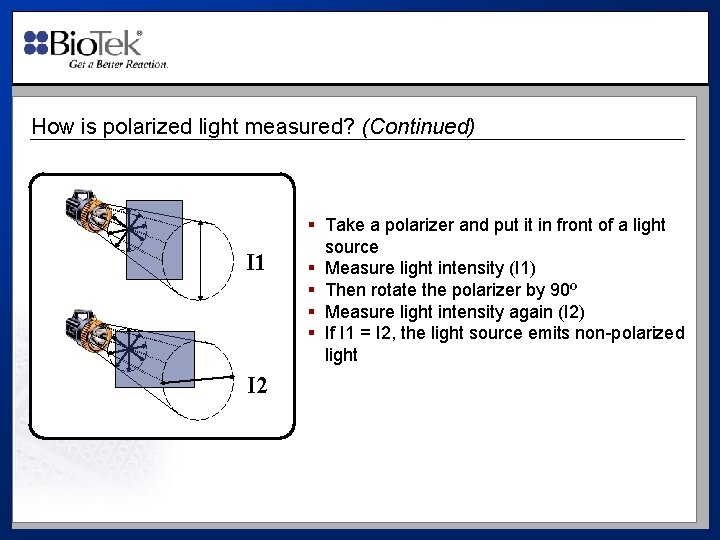
How is polarized light measured? (Continued) I 1 I 2 § Take a polarizer and put it in front of a light source § Measure light intensity (I 1) § Then rotate the polarizer by 90º § Measure light intensity again (I 2) § If I 1 = I 2, the light source emits non-polarized light
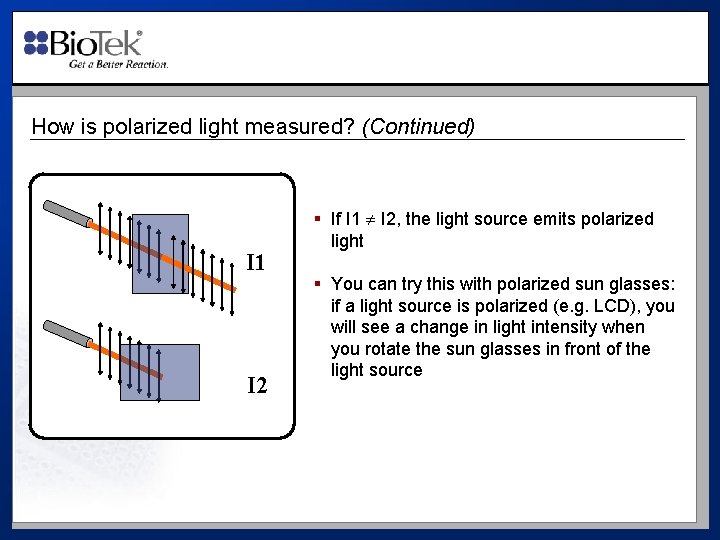
How is polarized light measured? (Continued) I 1 I 2 § If I 1 I 2, the light source emits polarized light § You can try this with polarized sun glasses: if a light source is polarized (e. g. LCD), you will see a change in light intensity when you rotate the sun glasses in front of the light source
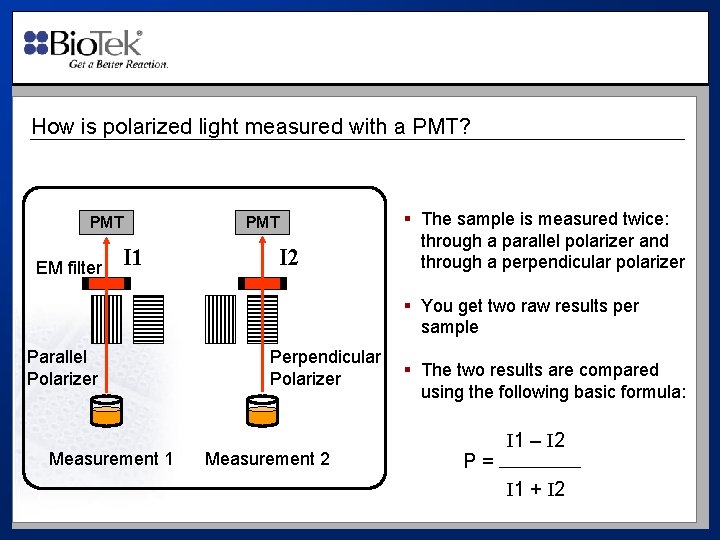
How is polarized light measured with a PMT? PMT EM filter I 1 PMT I 2 § The sample is measured twice: through a parallel polarizer and through a perpendicular polarizer § You get two raw results per sample Parallel Polarizer Measurement 1 Perpendicular Polarizer Measurement 2 § The two results are compared using the following basic formula: P= I 1 – I 2 I 1 + I 2
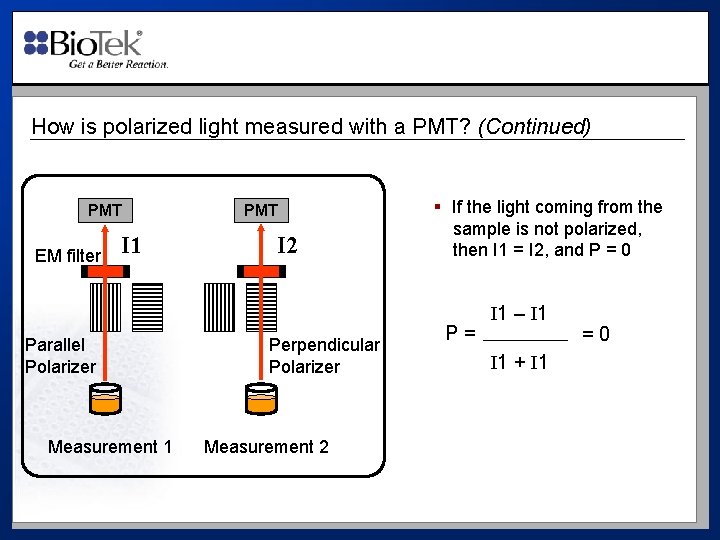
How is polarized light measured with a PMT? (Continued) PMT EM filter I 1 Parallel Polarizer Measurement 1 PMT I 2 Perpendicular Polarizer Measurement 2 § If the light coming from the sample is not polarized, then I 1 = I 2, and P = 0 P= I 1 – I 1 + I 1 =0
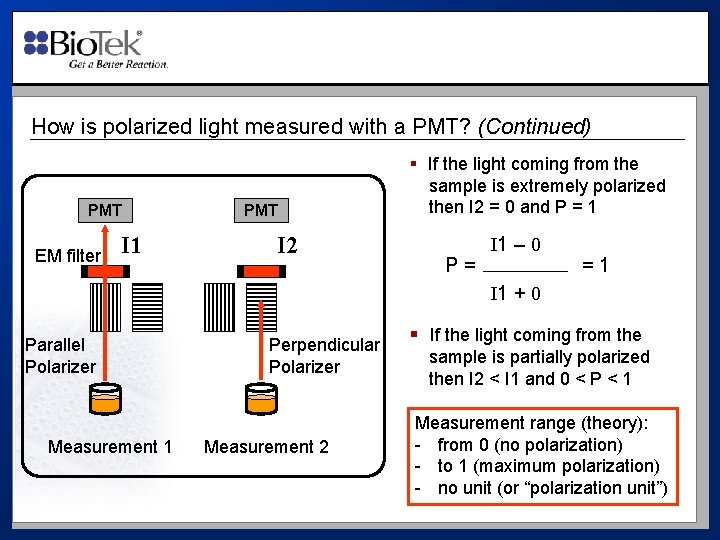
How is polarized light measured with a PMT? (Continued) PMT EM filter I 1 PMT I 2 § If the light coming from the sample is extremely polarized then I 2 = 0 and P = 1 P= I 1 – 0 =1 I 1 + 0 Parallel Polarizer Measurement 1 Perpendicular Polarizer Measurement 2 § If the light coming from the sample is partially polarized then I 2 < I 1 and 0 < P < 1 Measurement range (theory): - from 0 (no polarization) - to 1 (maximum polarization) - no unit (or “polarization unit”)
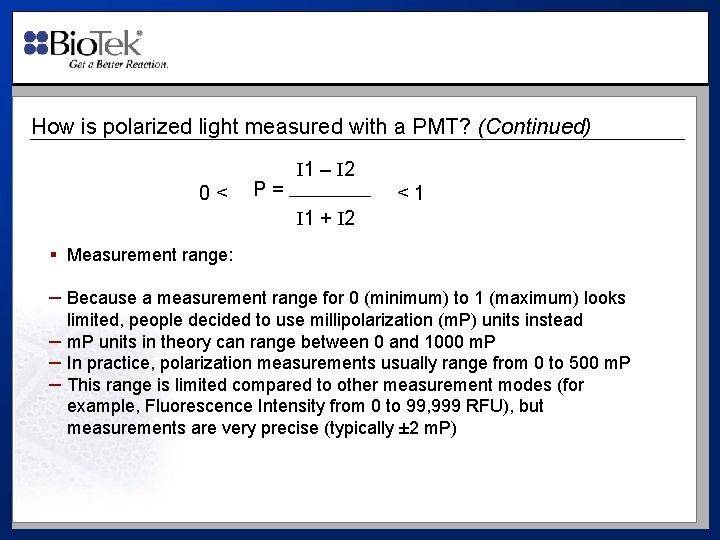
How is polarized light measured with a PMT? (Continued) 0< P= I 1 – I 2 <1 I 1 + I 2 § Measurement range: – Because a measurement range for 0 (minimum) to 1 (maximum) looks – – – limited, people decided to use millipolarization (m. P) units instead m. P units in theory can range between 0 and 1000 m. P In practice, polarization measurements usually range from 0 to 500 m. P This range is limited compared to other measurement modes (for example, Fluorescence Intensity from 0 to 99, 999 RFU), but measurements are very precise (typically ± 2 m. P)
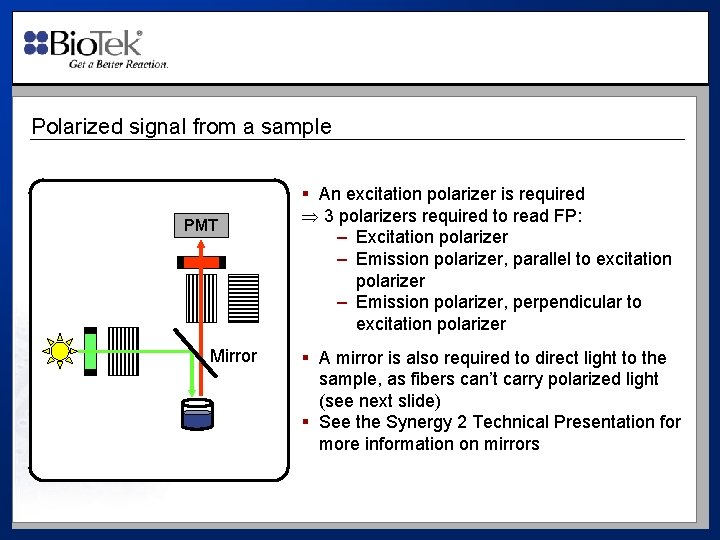
Polarized signal from a sample PMT Mirror § An excitation polarizer is required 3 polarizers required to read FP: – Excitation polarizer – Emission polarizer, parallel to excitation polarizer – Emission polarizer, perpendicular to excitation polarizer § A mirror is also required to direct light to the sample, as fibers can’t carry polarized light (see next slide) § See the Synergy 2 Technical Presentation for more information on mirrors
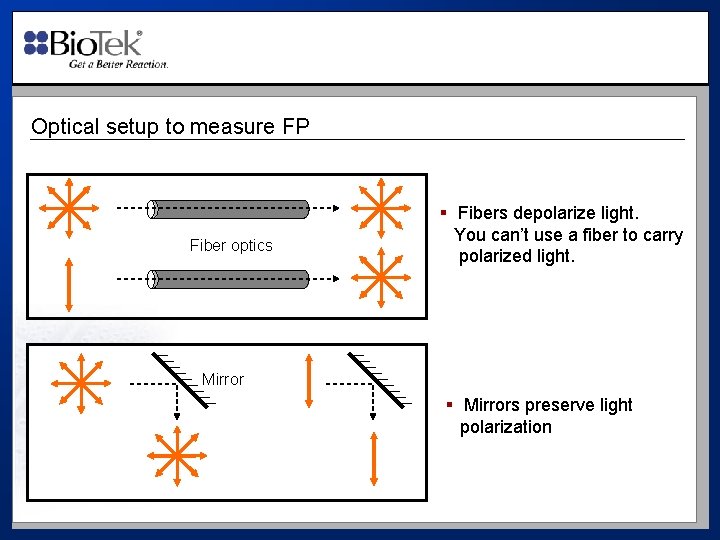
Optical setup to measure FP Fiber optics § Fibers depolarize light. You can’t use a fiber to carry polarized light. Mirror § Mirrors preserve light polarization
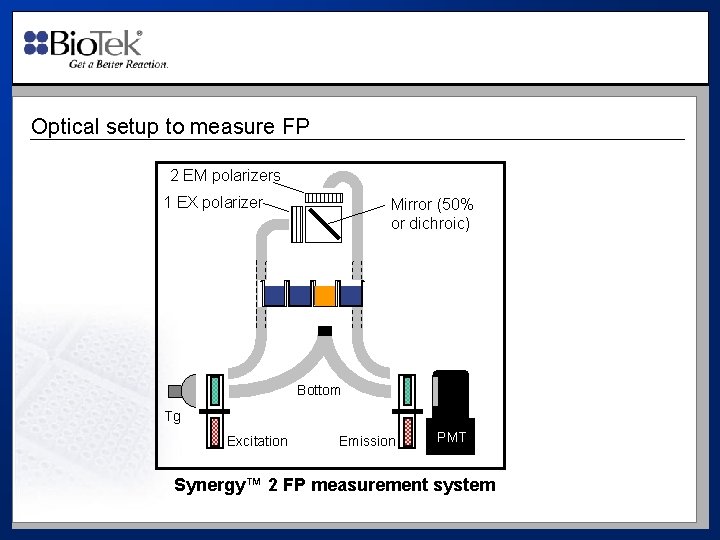
Optical setup to measure FP 2 EM polarizers 1 EX polarizer Mirror (50% or dichroic) Bottom Tg Excitation Emission PMT Synergy™ 2 FP measurement system
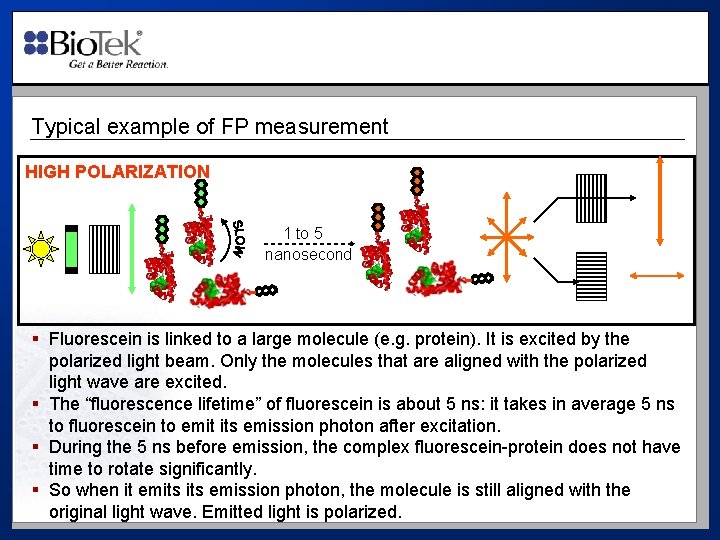
Typical example of FP measurement HIGH POLARIZATION 1 to 5 nanosecond § Fluorescein is linked to a large molecule (e. g. protein). It is excited by the polarized light beam. Only the molecules that are aligned with the polarized light wave are excited. § The “fluorescence lifetime” of fluorescein is about 5 ns: it takes in average 5 ns to fluorescein to emit its emission photon after excitation. § During the 5 ns before emission, the complex fluorescein-protein does not have time to rotate significantly. § So when it emits emission photon, the molecule is still aligned with the original light wave. Emitted light is polarized.
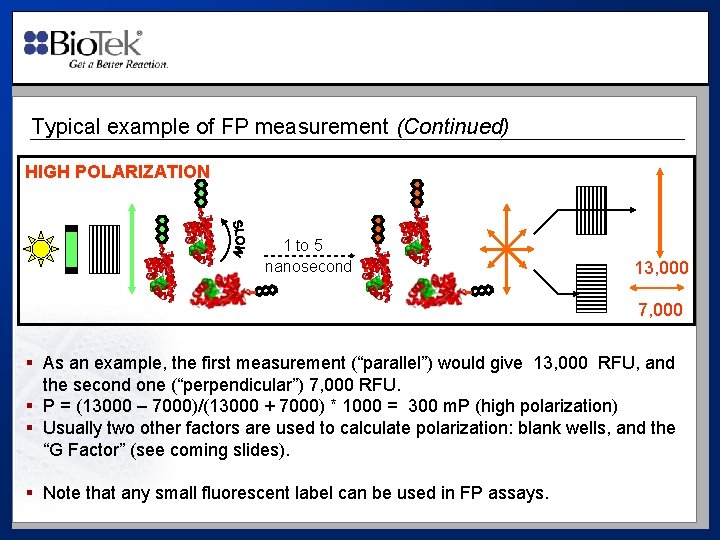
Typical example of FP measurement (Continued) HIGH POLARIZATION 1 to 5 nanosecond 13, 000 7, 000 § As an example, the first measurement (“parallel”) would give 13, 000 RFU, and the second one (“perpendicular”) 7, 000 RFU. § P = (13000 – 7000)/(13000 + 7000) * 1000 = 300 m. P (high polarization) § Usually two other factors are used to calculate polarization: blank wells, and the “G Factor” (see coming slides). § Note that any small fluorescent label can be used in FP assays.
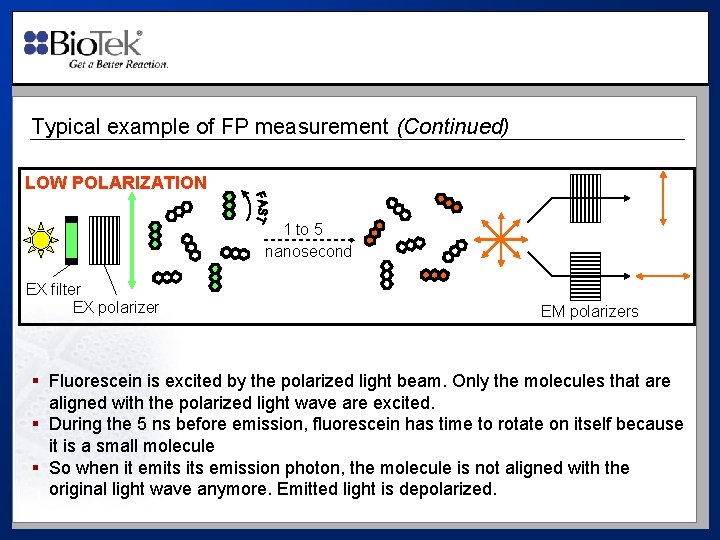
Typical example of FP measurement (Continued) LOW POLARIZATION 1 to 5 nanosecond EX filter EX polarizer EM polarizers § Fluorescein is excited by the polarized light beam. Only the molecules that are aligned with the polarized light wave are excited. § During the 5 ns before emission, fluorescein has time to rotate on itself because it is a small molecule § So when it emits emission photon, the molecule is not aligned with the original light wave anymore. Emitted light is depolarized.
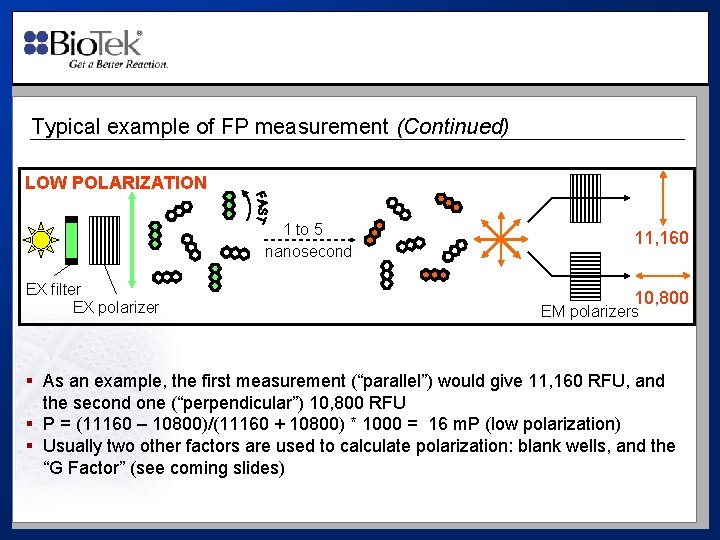
Typical example of FP measurement (Continued) LOW POLARIZATION 1 to 5 nanosecond EX filter EX polarizer 11, 160 10, 800 EM polarizers § As an example, the first measurement (“parallel”) would give 11, 160 RFU, and the second one (“perpendicular”) 10, 800 RFU § P = (11160 – 10800)/(11160 + 10800) * 1000 = 16 m. P (low polarization) § Usually two other factors are used to calculate polarization: blank wells, and the “G Factor” (see coming slides)
Typical example of FP measurement (Continued) In summary: § Fluorescence Polarization measures the rotation speed of fluorescent molecules § Small molecules rotate faster than big molecules § For example, fluorescein is a small fluorescent molecule. If you make an FP measurement on pure fluorescein, you should measure about 20 m. P (low polarization) § If you bind fluorescein to a large molecule (e. g. protein) and measure again, you should measure high polarization
Contents § Theory – What is polarized light? – How do you measure polarized light? – Typical example of FP measurement § § Review of optical system and software for FP measurement Why is FP used: advantages and limitations Typical applications and users Reagent manufacturers and kits
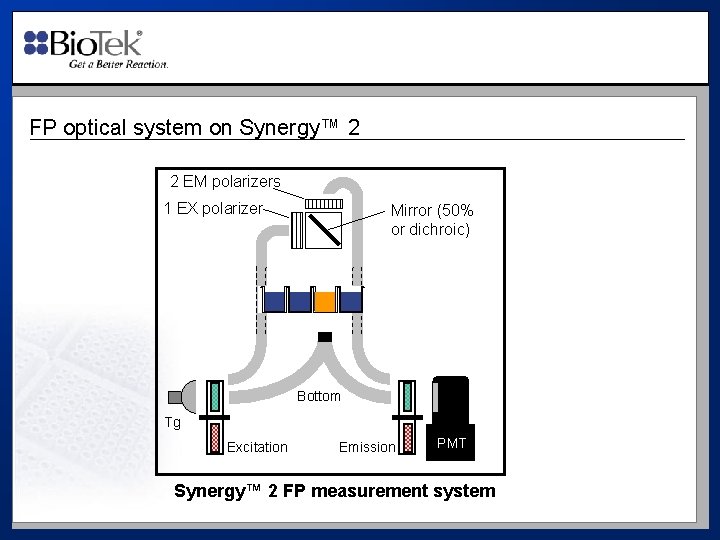
FP optical system on Synergy™ 2 2 EM polarizers 1 EX polarizer Mirror (50% or dichroic) Bottom Tg Excitation Emission PMT Synergy™ 2 FP measurement system
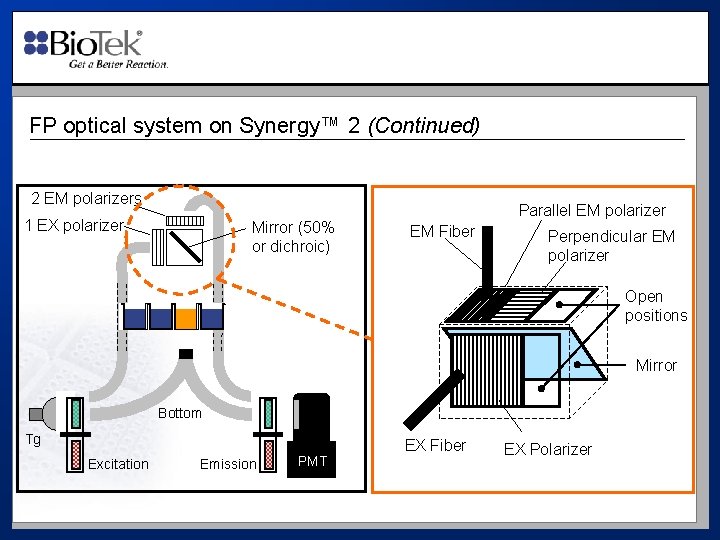
FP optical system on Synergy™ 2 (Continued) 2 EM polarizers 1 EX polarizer Mirror (50% or dichroic) Parallel EM polarizer EM Fiber Perpendicular EM polarizer Open positions Mirror Bottom Tg Excitation Emission PMT EX Fiber EX Polarizer
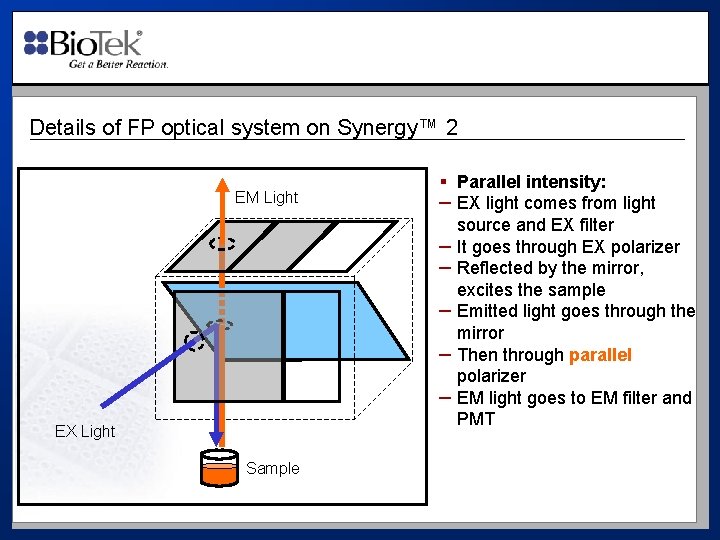
Details of FP optical system on Synergy™ 2 EM Light EX Light Sample § Parallel intensity: – EX light comes from light source and EX filter – It goes through EX polarizer – Reflected by the mirror, excites the sample – Emitted light goes through the mirror – Then through parallel polarizer – EM light goes to EM filter and PMT
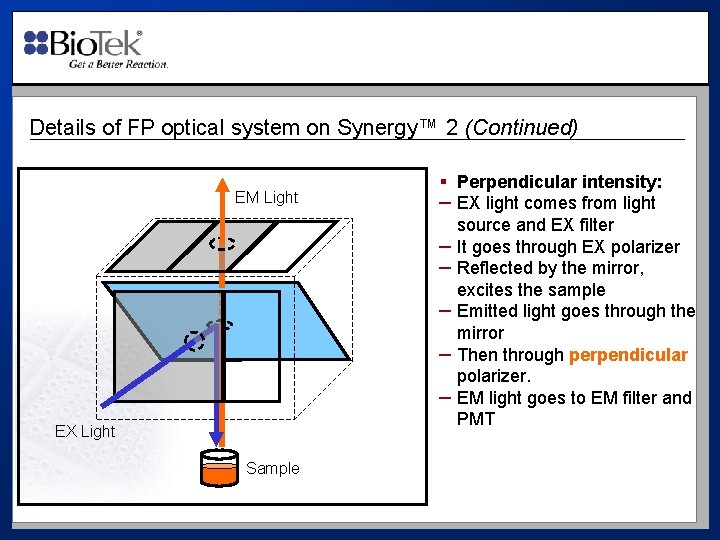
Details of FP optical system on Synergy™ 2 (Continued) EM Light EX Light Sample § Perpendicular intensity: – EX light comes from light source and EX filter – It goes through EX polarizer – Reflected by the mirror, excites the sample – Emitted light goes through the mirror – Then through perpendicular polarizer. – EM light goes to EM filter and PMT
Contents § Theory – What is polarized light? – How do you measure polarized light? – How do you get a polarized signal from a sample? – Optical setup to measure polarization – Typical example of FP measurement – Calculation of Polarization, Anisotropy, and role of G Factor § Review of optical system and software for FP measurement § Typical application: binding assay § Why is FP used: advantages and limitations § Typical applications and users § Reagent manufacturers and kits
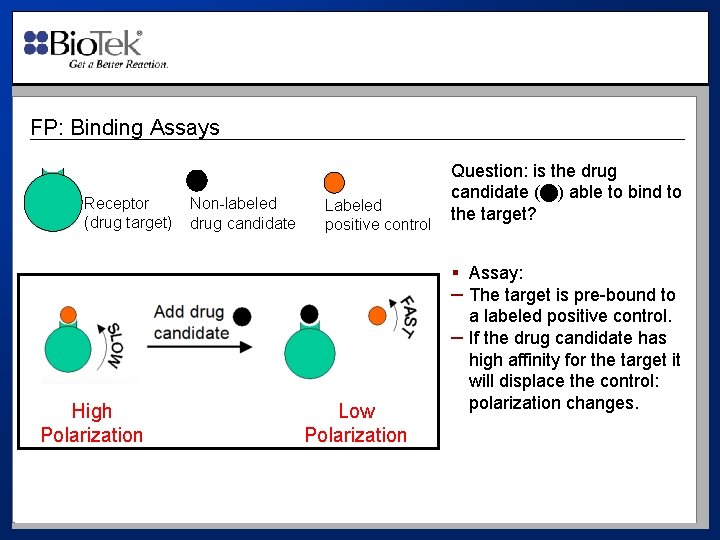
FP: Binding Assays Receptor (drug target) High Polarization Non-labeled drug candidate Labeled positive control Low Polarization Question: is the drug candidate ( ) able to bind to the target? § Assay: – The target is pre-bound to a labeled positive control. – If the drug candidate has high affinity for the target it will displace the control: polarization changes.
FP: Binding Assays (Continued) § In Life Sciences, studying binding events between biomolecules is very common and very important to understand how cells or organisms work. § FP is a great tool to study these binding events and is used extensively in research labs (understand the fundamentals of molecule interactions) and screening labs (screen for drug candidates). § FRET can also be used for binding assay, as it also detects distance changes at the molecular level, but the assays are more difficult to design than FP assays. § FRET assays use two fluorescent labels, so labeling is more complex and more problematic.
Contents § Theory – What is polarized light? – How do you measure polarized light? – How do you get a polarized signal from a sample? – Optical setup to measure polarization – Typical example of FP measurement – Calculation of Polarization, Anisotropy, and role of G Factor § Review of optical system and software for FP measurement § Typical application: binding assay § Concept of assay platforms § Typical applications and users § Reagent manufacturers and kits
FP: Concept of Assay Platform § FP shares with FRET and TR-FRET another big advantage: it is an homogeneous technology (also known as “mix and read” technology). There is no need to have a wash step in an FP assay (unlike ELISA assays, for example). § Homogeneous assays are very desirable in screening labs for the following reasons: – Easier automation (no 384/1536 washer needed) – Higher throughput (less steps) – No complex timing requirement like for ELISA assays § For that reason, homogeneous technologies have been used as “assay platforms” for screening assays.
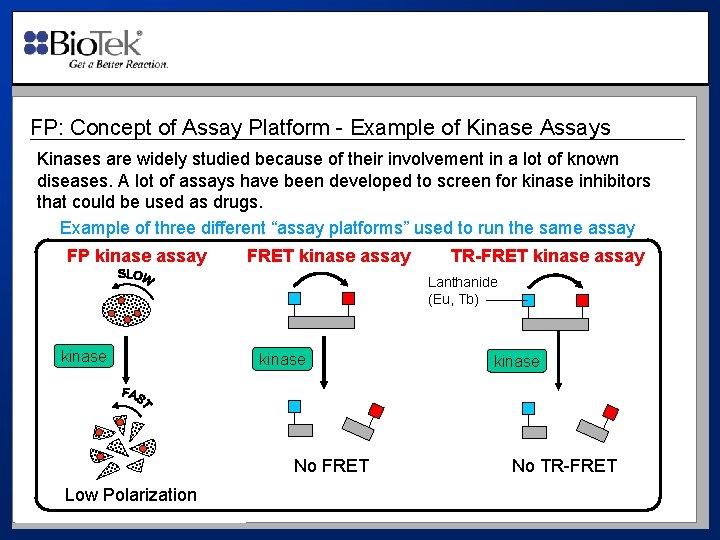
FP: Concept of Assay Platform - Example of Kinase Assays Kinases are widely studied because of their involvement in a lot of known diseases. A lot of assays have been developed to screen for kinase inhibitors that could be used as drugs. Example of three different “assay platforms” used to run the same assay FP kinase assay FRET kinase assay TR-FRET kinase assay Lanthanide (Eu, Tb) kinase No FRET Low Polarization kinase No TR-FRET
FP: Concept of Assay Platform How is FP typically used in laboratories? There are thousands of assays you can run with FP. Obviously, kits are not available for all these assays: § Researchers often design their own FP assays (e. g. use fluorescein to do their own labeling). § Reagent manufacturers do offer kits for some of the most common assays (for example, common drug targets…) § Reagent manufacturers also offer custom assay design or molecule labeling services.
FP: Applications - Summary 1. FP allows to easily design binding assays. For that reason, it is used in research and screening laboratories to study molecular interactions and run binding assays. 2. FP is an homogenous assay format. For that reason, it has been used by assay developers to create all sorts of assays (not necessarily binding assays) designed for automation, and used specifically for screening purpose.
A quick note about FRET, TRF and TR-FRET § FRET works on the Synergy HT and FLx 800. Application notes are already available on BTResource. No change with Synergy 2, except more sensitivity. § TRF works on the Synergy HT. Application notes are already available on BTResource. No change with Synergy 2, except much more sensitivity. § TR-FRET works on the same exact principle as FRET. See new Power. Point presentation posted on BTResource for details on theory and applications of FRET and TR-FRET.
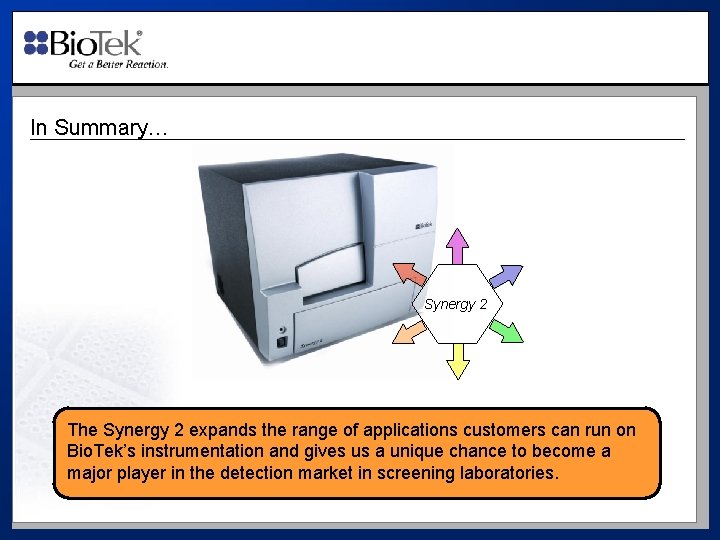
In Summary… Synergy 2 The Synergy 2 expands the range of applications customers can run on Bio. Tek’s instrumentation and gives us a unique chance to become a major player in the detection market in screening laboratories.

For more information, visit our website www. biotek. com Recommended website for fluorescence www. probes. com (Molecular Probes resp. Invitrogen) Call Bio. Tek TAC Europe in Bad Friedrichshall Tel +49 7136 968 0 E-mail: customercare@biotek. com
- Slides: 92