
READING COMPREHENSION CT 448 READING AND WRITING ACROSS








- Slides: 70
READING COMPREHENSION C&T 448: READING AND WRITING ACROSS THE CURRICULUM
DEFINITION OF COMPREHENSION Rand Reading Study Group. (2002). Reading for understanding: Toward an R&D program in reading comprehension. CA: RAND. RRSG defines reading comprehension as, the process of simultaneously extracting and constructing meaning through interaction and involvement with written language…comprehension entails three elements: the reader, the text, and the activity. These elements occur within a larger sociocultural context that shapes and is shaped by the reader (pp. 11 -17).
DEFINITION OF COMPREHENSION (CONT. ) National Assessment of Educational Progress (NAEP) defined reading comprehension for its assessment in 2009. This group said that reading comprehension was an active and complex process that involved: -Understanding written text -Developing and interpreting meaning -Using meaning as appropriate to type of text, purpose and situation
COMPREHENSION HIGHLIGHTS From Farstrup & Samuels, 2003, pp. 205 -242 -Most of what we know about reading comprehension and effective comprehension instruction has been learned since 1975 -One of the biggest success stories of the research of the 1980 s is “this research showed over and over again that comprehension can in fact be taught” -Comprehension strategy instruction was found to be especially effective for students who began studies as poor comprehenders, probably because they were less likely to invent effective strategies on their own
HIGHLIGHTS (CONT. ) Willingham & Lovette (2014). Can reading comprehension be taught? Teachers College Record. http: //www. tcrecord. org. In 2014, Willingham & Lovette asked, “Can reading comprehension be taught? ” -They concluded “reading comprehension strategy instruction undeniably works”…it should be “explicit and brief”…then let students engage in “generative vocabulary instruction, deep content exploration, and opportunities for reading across genres and content areas. ”
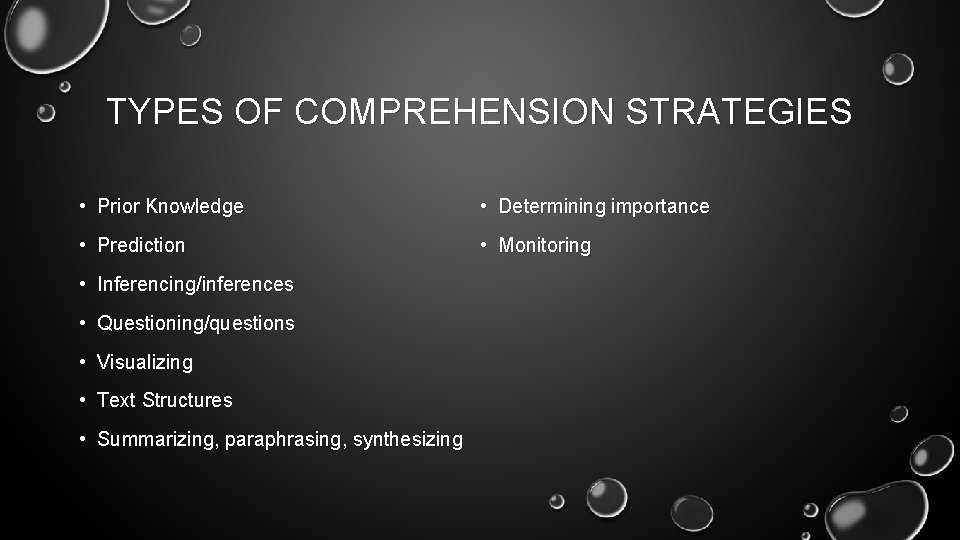
TYPES OF COMPREHENSION STRATEGIES • Prior Knowledge • Determining importance • Prediction • Monitoring • Inferencing/inferences • Questioning/questions • Visualizing • Text Structures • Summarizing, paraphrasing, synthesizing
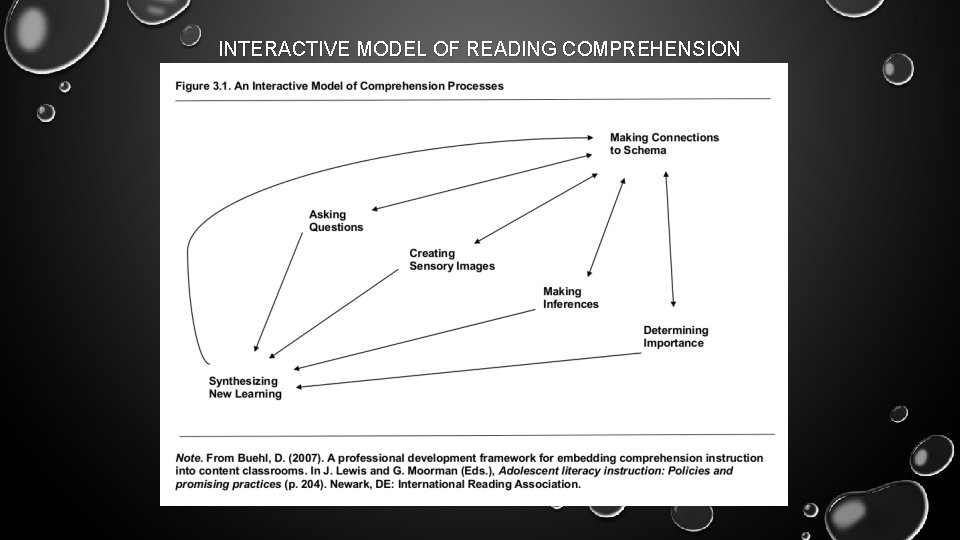
INTERACTIVE MODEL OF READING COMPREHENSION
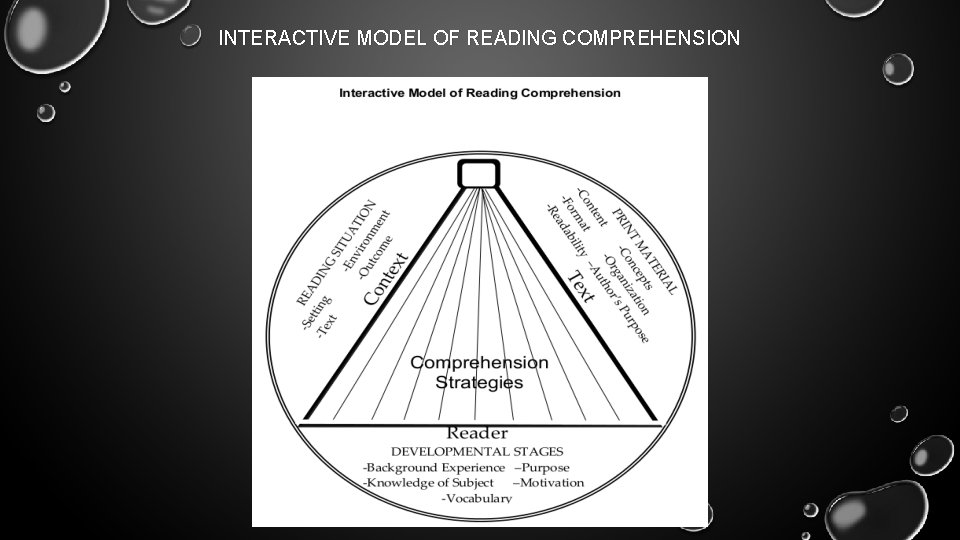
INTERACTIVE MODEL OF READING COMPREHENSION
IMAGES Images aid comprehension because using them requires: -Dual encoding verbal for language nonverbal for imagery -Dual encoding requires more effort, which leads to deeper processing (Paivio, 2007, 2004; Gambrell & Koskinen, 2002)
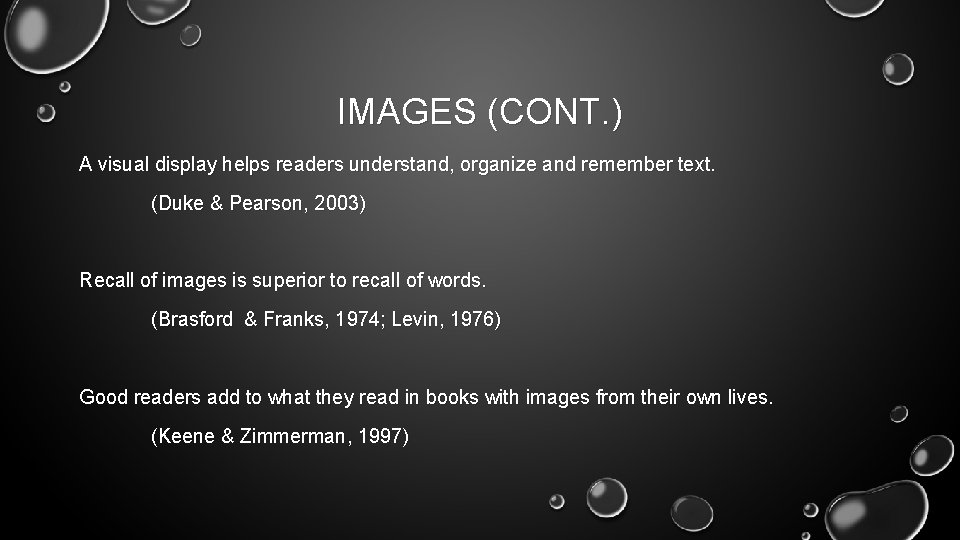
IMAGES (CONT. ) A visual display helps readers understand, organize and remember text. (Duke & Pearson, 2003) Recall of images is superior to recall of words. (Brasford & Franks, 1974; Levin, 1976) Good readers add to what they read in books with images from their own lives. (Keene & Zimmerman, 1997)
QUESTIONS AND QUESTIONING Students who struggle as readers tend not to ask questions at any time as they read – before, during, or after (especially older students). These readers are ‘inert’ as they read. They ‘submit to the text’ – never questioning content, style, or the intent of the author. Active readers generate questions at all stages – before, during, and after reading. They engage in self-questioning.
SELF-QUESTIONING -Has a high level of success in improving comprehension because it leads to more active reading and thinking. (Alverman, 2005) -Effective for ELLs-helps students express thoughts in English by using language of the text. (Jiminez & Gomez, 1996) -Can be taught (NPR, 2000)
TEACHER QUESTIONS Before reading-help readers focus on targeted information -guides the reader toward key concepts During reading-called ‘slicing’ -reduces the amount of text students has to read and comprehend (Wood, 1986) After reading-creates broader understanding -builds connections -clarifies misconceptions
QUESTIONING TAXONOMIES ‘Taxonomy’ refers to classifications. Each of the following breaks different types of questions into different classes. • Bloom’s Taxonomy • Ciardiello’s Taxonomy • QAR Taxonomy • Buehl’s Taxonomy
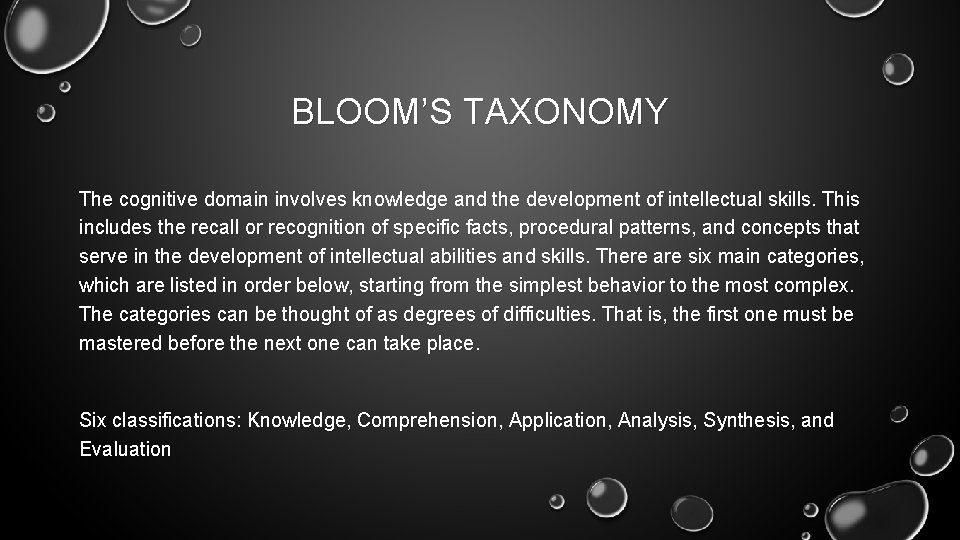
BLOOM’S TAXONOMY The cognitive domain involves knowledge and the development of intellectual skills. This includes the recall or recognition of specific facts, procedural patterns, and concepts that serve in the development of intellectual abilities and skills. There are six main categories, which are listed in order below, starting from the simplest behavior to the most complex. The categories can be thought of as degrees of difficulties. That is, the first one must be mastered before the next one can take place. Six classifications: Knowledge, Comprehension, Application, Analysis, Synthesis, and Evaluation
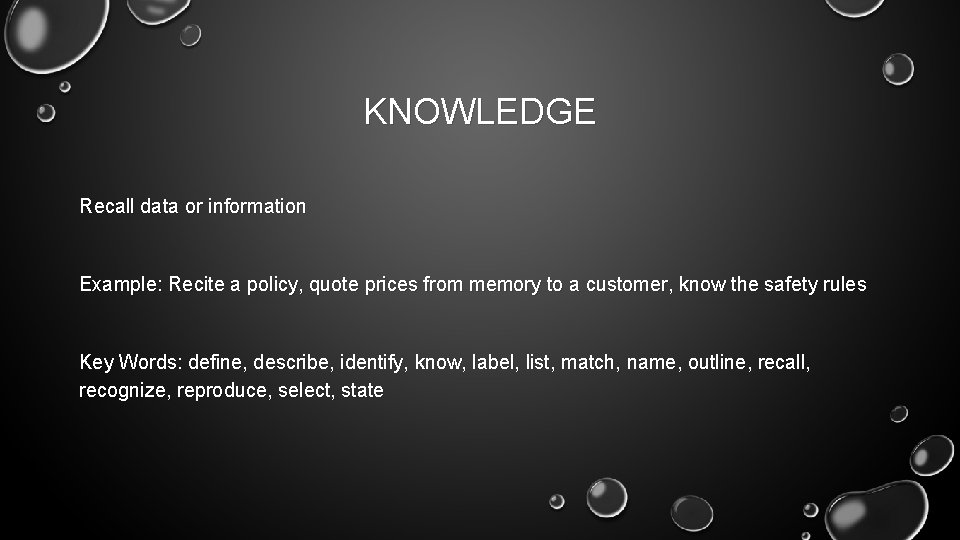
KNOWLEDGE Recall data or information Example: Recite a policy, quote prices from memory to a customer, know the safety rules Key Words: define, describe, identify, know, label, list, match, name, outline, recall, recognize, reproduce, select, state
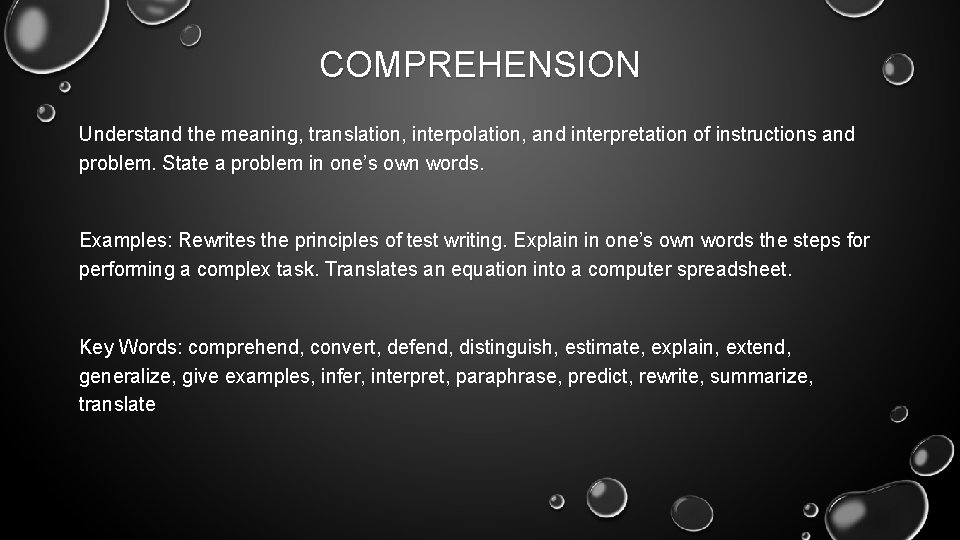
COMPREHENSION Understand the meaning, translation, interpolation, and interpretation of instructions and problem. State a problem in one’s own words. Examples: Rewrites the principles of test writing. Explain in one’s own words the steps for performing a complex task. Translates an equation into a computer spreadsheet. Key Words: comprehend, convert, defend, distinguish, estimate, explain, extend, generalize, give examples, infer, interpret, paraphrase, predict, rewrite, summarize, translate
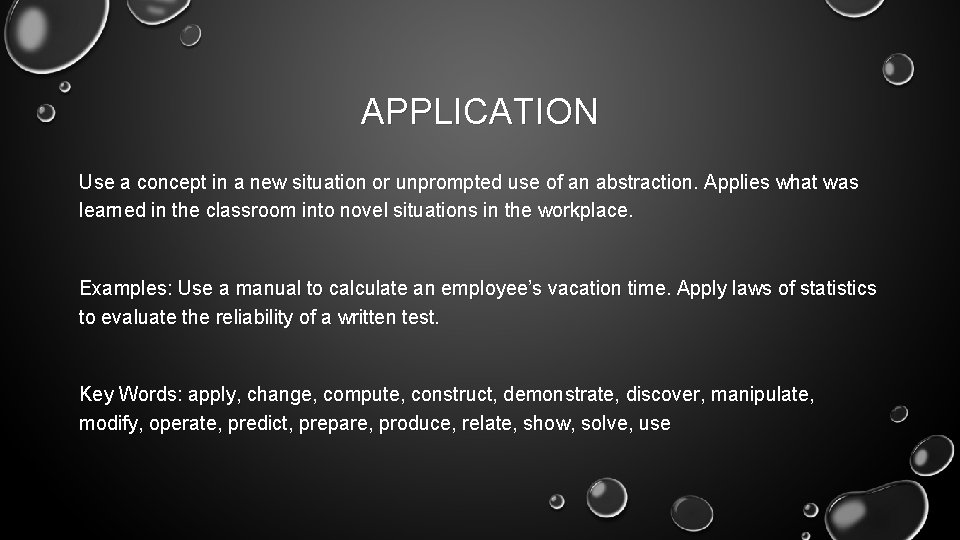
APPLICATION Use a concept in a new situation or unprompted use of an abstraction. Applies what was learned in the classroom into novel situations in the workplace. Examples: Use a manual to calculate an employee’s vacation time. Apply laws of statistics to evaluate the reliability of a written test. Key Words: apply, change, compute, construct, demonstrate, discover, manipulate, modify, operate, predict, prepare, produce, relate, show, solve, use
ANALYSIS Separates material or concepts into component parts so that its organizational structure may be understood. Distinguishes between facts and inferences. Examples: Troubleshoot a piece of equipment by using logical deduction. Recognize logical fallacies in reasoning. Gathers information from a department and selects the required tasks for training. Key Words: analyze, break down, compare, contrast, diagram, deconstruct, differentiate, discriminate, distinguish, identify, illustrate, infer, outline, relate, select, separate
SYNTHESIS Builds a structure or pattern from diverse elements. Put parts together to form a whole, with emphasis on creating a new meaning or structure. Examples: Write a company operations or process manual. Design a machine to perform a specific task. Integrates training from several sources to solve a problem. Revises a process to improve the outcome. Key Words: categorize, combine, compile, compose, create, devise, design, explain, generate, modify, organize, plan, rearrange, reconstruct, relate, reorganize, revise, rewrite, summarize, tell, write
EVALUATION Make judgments about the value of ideas or materials Examples: Select the most effective solution. Hire the most qualified candidate. Explain and justify a new budget. Key Words: appraise, compare, conclude, contrast, criticize, critique, defend, describe, discriminate, evaluate, explain, interpret, justify, relate, summarize, support
CIARDIELLO’S TAXONOMY From: Ciardiello, Angelo. (1998). Did you ask a good question today? Journal of Adolescent and Adult Literacy, 42(3), 210 -219. Four types of questions: -Memory Questions -Convergent Thinking Questions -Divergent Thinking Questions -Evaluative Thinking Questions
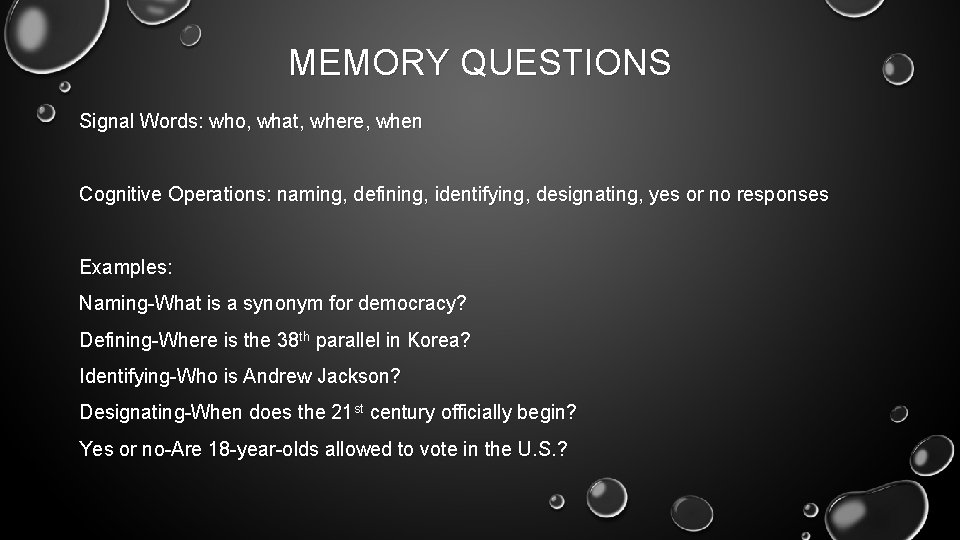
MEMORY QUESTIONS Signal Words: who, what, where, when Cognitive Operations: naming, defining, identifying, designating, yes or no responses Examples: Naming-What is a synonym for democracy? Defining-Where is the 38 th parallel in Korea? Identifying-Who is Andrew Jackson? Designating-When does the 21 st century officially begin? Yes or no-Are 18 -year-olds allowed to vote in the U. S. ?
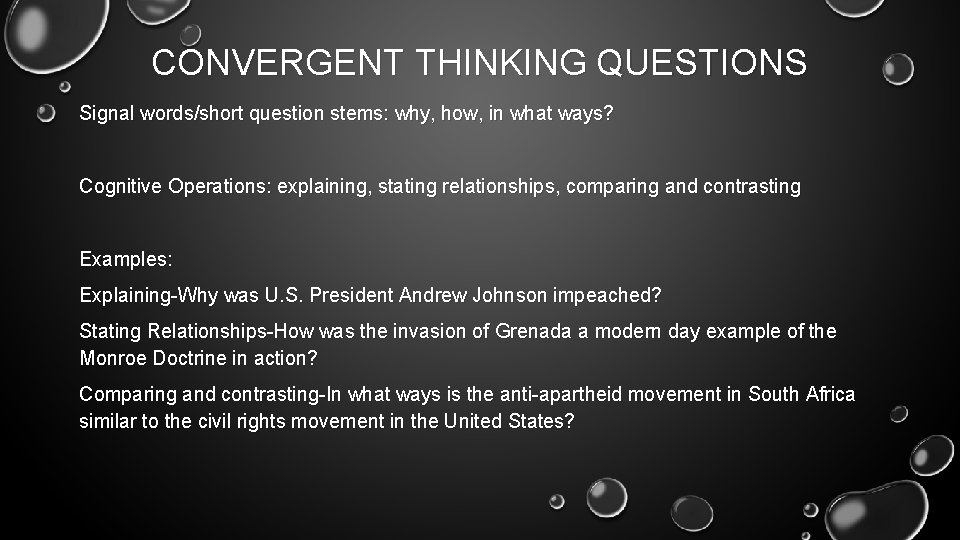
CONVERGENT THINKING QUESTIONS Signal words/short question stems: why, how, in what ways? Cognitive Operations: explaining, stating relationships, comparing and contrasting Examples: Explaining-Why was U. S. President Andrew Johnson impeached? Stating Relationships-How was the invasion of Grenada a modern day example of the Monroe Doctrine in action? Comparing and contrasting-In what ways is the anti-apartheid movement in South Africa similar to the civil rights movement in the United States?
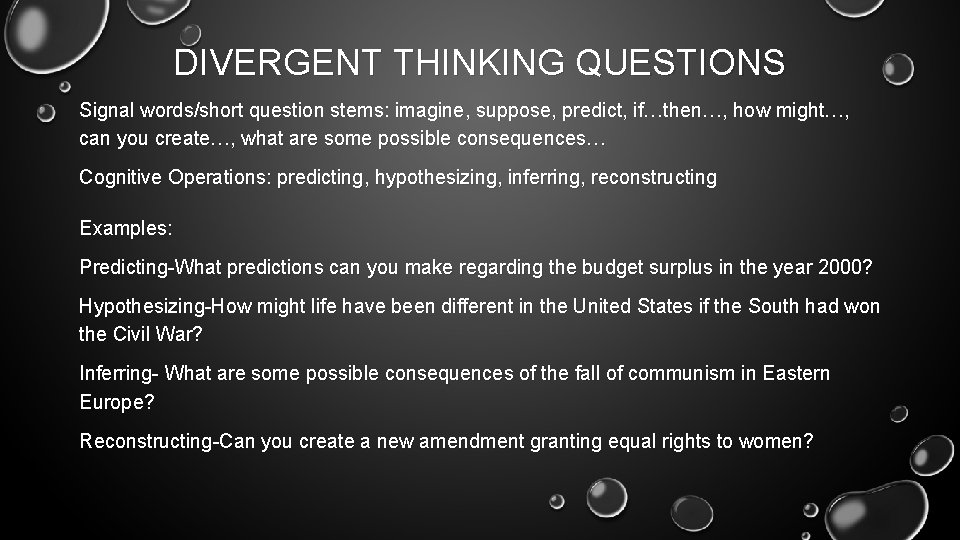
DIVERGENT THINKING QUESTIONS Signal words/short question stems: imagine, suppose, predict, if…then…, how might…, can you create…, what are some possible consequences… Cognitive Operations: predicting, hypothesizing, inferring, reconstructing Examples: Predicting-What predictions can you make regarding the budget surplus in the year 2000? Hypothesizing-How might life have been different in the United States if the South had won the Civil War? Inferring- What are some possible consequences of the fall of communism in Eastern Europe? Reconstructing-Can you create a new amendment granting equal rights to women?
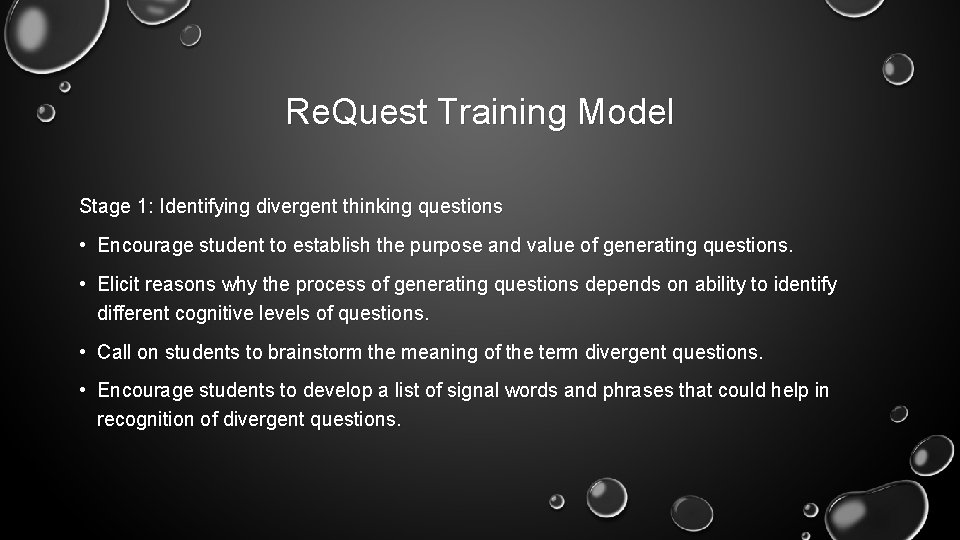
Re. Quest Training Model Stage 1: Identifying divergent thinking questions • Encourage student to establish the purpose and value of generating questions. • Elicit reasons why the process of generating questions depends on ability to identify different cognitive levels of questions. • Call on students to brainstorm the meaning of the term divergent questions. • Encourage students to develop a list of signal words and phrases that could help in recognition of divergent questions.
EVALUATIVE THINKING QUESTIONS Signal words/short question stems: defend, judge, justify/What do you think…, what is your opinion…? Cognitive Operations: valuing, judging, defending , justifying choices Examples: Valuing-How do you feel about abortion for teenagers? Judging-What do you think of capital punishment for drug dealers? Defending-Why did you vote for Bill Clinton? Justifying Choices-Why would you prefer to live in the suburbs?
QUESTION-ANSWER RELATIONSHIPS (QAR) From: Raphael, 1984, 1982 A way to help students realize that the answers they seek are related to the type of question that is asked; it encourages them to be strategic about their search for answers based on an awareness of what different types of questions look for. Even more important is understanding where the answer will come from. Students must first understand the core notion: when confronted with a question, the answer will come either form the text or from what kids know. These are the Core Categories which Raphael calls: 1. In the book (or video, or website, instructional materials, etc. ) 2. In my head
QAR (CONT. ) Once students are comfortable with these simpler distinctions (and do note that this does not take very long!), it will please them to move to the next level of understanding question types. Raphael divides ‘In the book’ into two QAR types (Right there and Think & Search); and ‘In my head’ into two QAR types (Author & You and On my own).
RIGHT THERE The answer is in the text, and if we pointed at it, we’d say it’s “right there!” Often, the answer will be in a single sentence or place in text, and the words used to create the question are often also in that same place. Examples: -What is an inequality? -What does an open dot on the number line mean? -What is the sign for greater than? Less than?
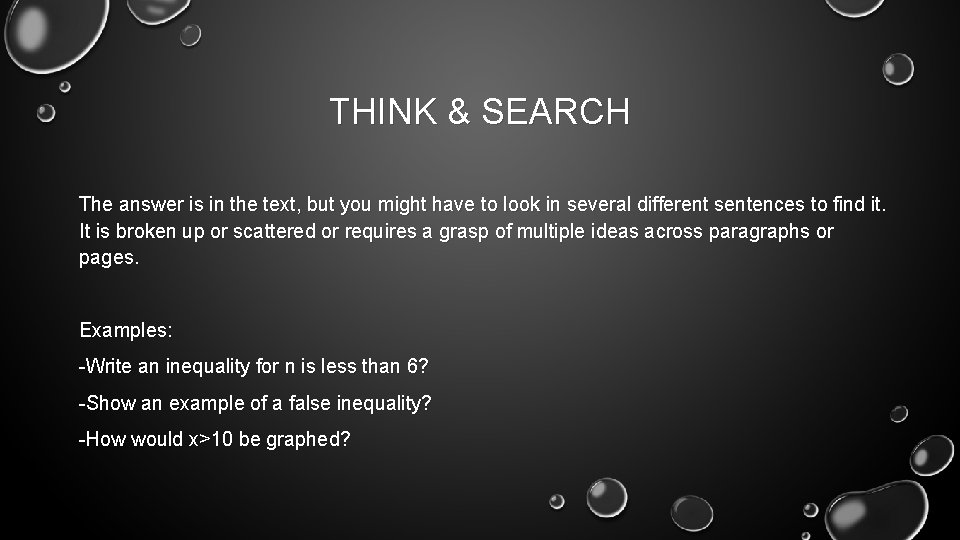
THINK & SEARCH The answer is in the text, but you might have to look in several different sentences to find it. It is broken up or scattered or requires a grasp of multiple ideas across paragraphs or pages. Examples: -Write an inequality for n is less than 6? -Show an example of a false inequality? -How would x>10 be graphed?
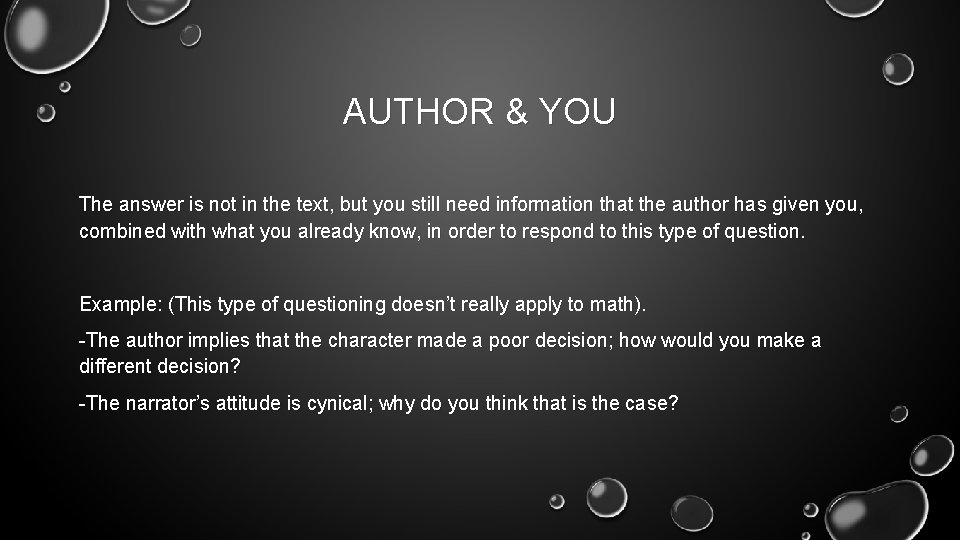
AUTHOR & YOU The answer is not in the text, but you still need information that the author has given you, combined with what you already know, in order to respond to this type of question. Example: (This type of questioning doesn’t really apply to math). -The author implies that the character made a poor decision; how would you make a different decision? -The narrator’s attitude is cynical; why do you think that is the case?
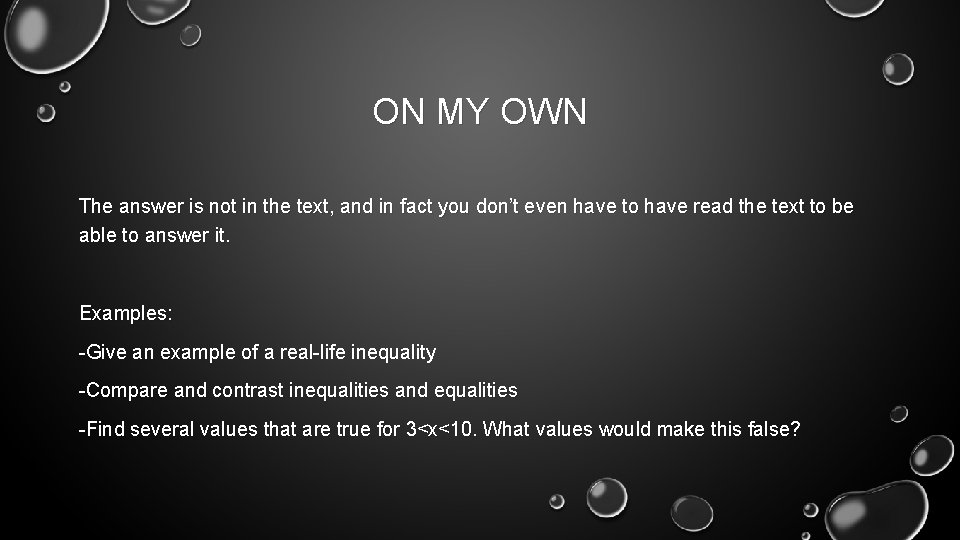
ON MY OWN The answer is not in the text, and in fact you don’t even have to have read the text to be able to answer it. Examples: -Give an example of a real-life inequality -Compare and contrast inequalities and equalities -Find several values that are true for 3<x<10. What values would make this false?
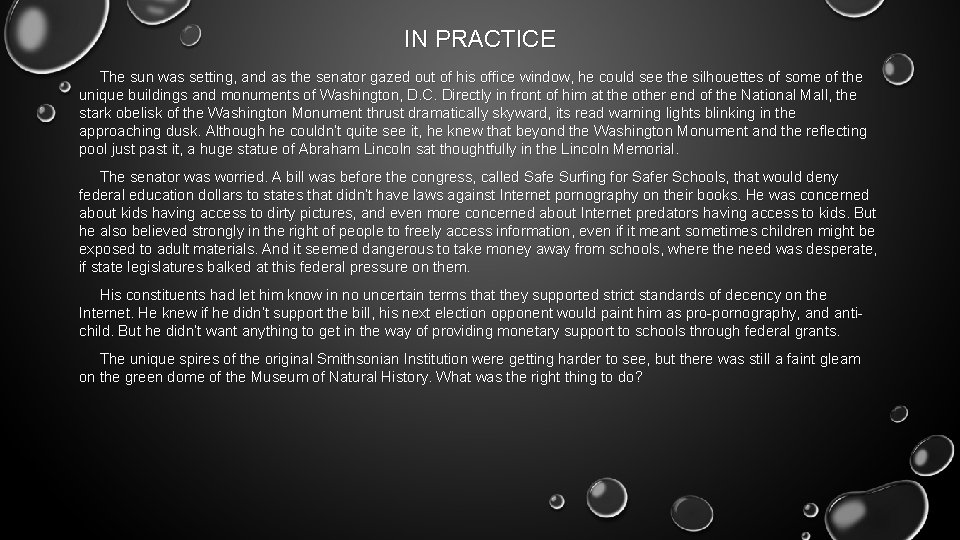
IN PRACTICE The sun was setting, and as the senator gazed out of his office window, he could see the silhouettes of some of the unique buildings and monuments of Washington, D. C. Directly in front of him at the other end of the National Mall, the stark obelisk of the Washington Monument thrust dramatically skyward, its read warning lights blinking in the approaching dusk. Although he couldn’t quite see it, he knew that beyond the Washington Monument and the reflecting pool just past it, a huge statue of Abraham Lincoln sat thoughtfully in the Lincoln Memorial. The senator was worried. A bill was before the congress, called Safe Surfing for Safer Schools, that would deny federal education dollars to states that didn’t have laws against Internet pornography on their books. He was concerned about kids having access to dirty pictures, and even more concerned about Internet predators having access to kids. But he also believed strongly in the right of people to freely access information, even if it meant sometimes children might be exposed to adult materials. And it seemed dangerous to take money away from schools, where the need was desperate, if state legislatures balked at this federal pressure on them. His constituents had let him know in no uncertain terms that they supported strict standards of decency on the Internet. He knew if he didn’t support the bill, his next election opponent would paint him as pro-pornography, and antichild. But he didn’t want anything to get in the way of providing monetary support to schools through federal grants. The unique spires of the original Smithsonian Institution were getting harder to see, but there was still a faint gleam on the green dome of the Museum of Natural History. What was the right thing to do?
YOUR TURN Right There- Think & Search- Author & You- On My Own-
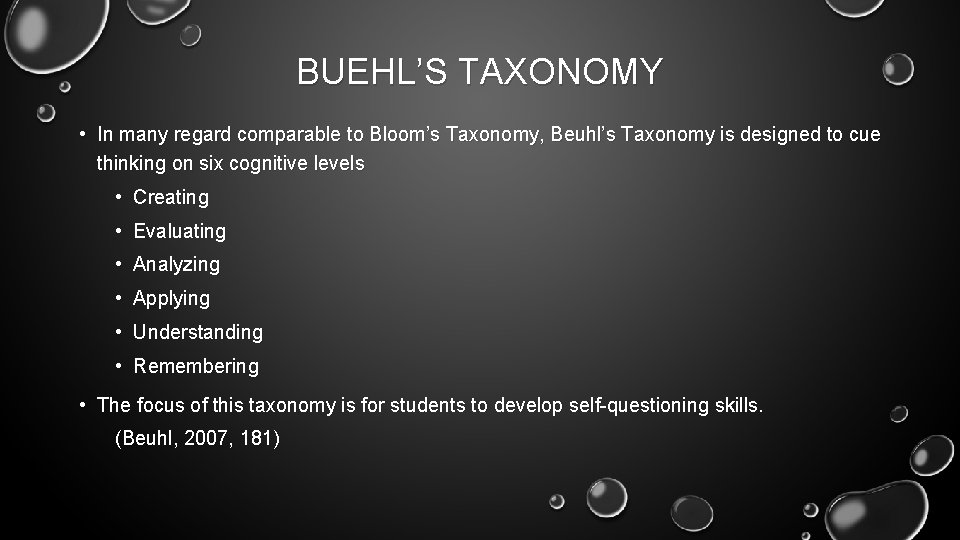
BUEHL’S TAXONOMY • In many regard comparable to Bloom’s Taxonomy, Beuhl’s Taxonomy is designed to cue thinking on six cognitive levels • Creating • Evaluating • Analyzing • Applying • Understanding • Remembering • The focus of this taxonomy is for students to develop self-questioning skills. (Beuhl, 2007, 181)
Level of Thinking Comprehension Self-Assessment Focusing Questions Creating I have created new knowledge. How has this author changed what • Synthesizing I understand? • Creating mental images Evaluating I can critically examine this author’s message. What perspective or authority does • Inferring the author bring to what he or she tells me? Analyzing I can explore deeper How is this similar to (or different relationships of the author’s from) what I have heard or read message. before? Applying I can use my understanding How can I connect what this author • Making connections in a meaningful way. is telling me to understand • Inferring something better? Understanding I can understand what the author is telling me. Remembering I can recall specific details, What do I need to remember to information, and ideas from make sense of this text? the text. What does this author want me to understand? Comprehension Processes • Making connections • Determining importance • Inferring • Creating mental images • Determining importance Note. From “Modeling Self-Questioning on Bloom’s Taxonomy, ” by D. Buehl, September 2007, retrieved April 20, 2011, from www. weac. org/news_and_publications/education_news/2007 -2008/readingroom_modeling. aspx. Copyright 2007 by Doug Buehl. Adapted with permission.
REVIEW QUESTIONS • Which of the 4 taxonomies would you use with your students? Why? Would it vary depending on the task or is one more universal than another? Explain. • Compare and contrast the 4 questioning taxonomies discussed: • Bloom’s • Ciardiello’s • Buehl’s • QARs
REVIEW QUESTIONS (CONT. ) From Buehl, Chapter 5 1) What is the author telling you? 2) What does the author seem to find most important? 3) Find and examine the ‘Self-questioning Taxonomy’ for your discipline. (World language teachers, choose either history or literary fiction taxonomies, as Buehl suggests. ) Write your reaction to the taxonomy. Would you use it in your classroom? All of it? Parts of it? Why or why not? Which pieces? When? How? What are its strengths? Weaknesses?
ANTICIPATION GUIDES Also called reaction or prediction guides, these are used to prepare readers by asking them to react to a series of statements that are related to the text. These statements require students to compare current beliefs/knowledge with text information. Misconceptions about a topic are not likely to be discarded unless conflicting information is actively confronted. (Merkley, 1997; Duffelmeyer, 1992)
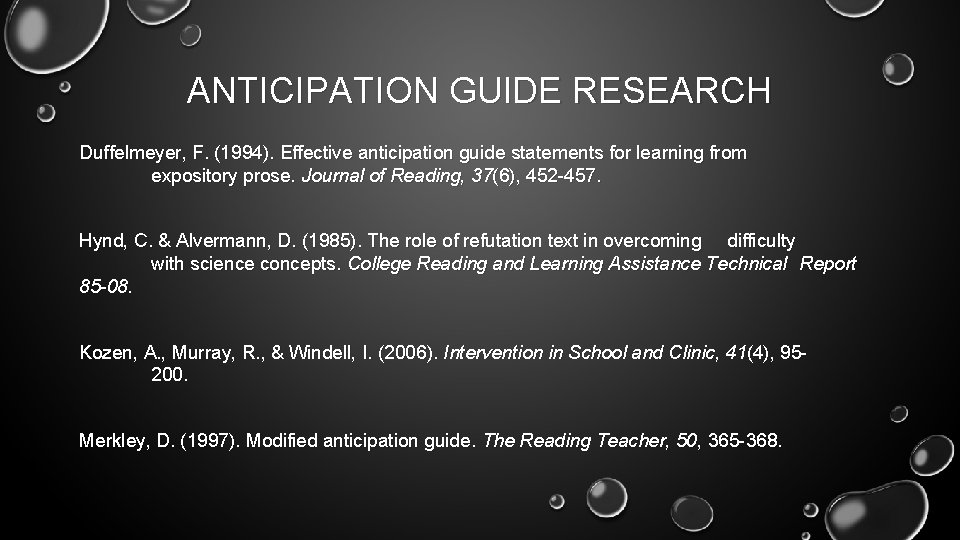
ANTICIPATION GUIDE RESEARCH Duffelmeyer, F. (1994). Effective anticipation guide statements for learning from expository prose. Journal of Reading, 37(6), 452 -457. Hynd, C. & Alvermann, D. (1985). The role of refutation text in overcoming difficulty with science concepts. College Reading and Learning Assistance Technical Report 85 -08. Kozen, A. , Murray, R. , & Windell, I. (2006). Intervention in School and Clinic, 41(4), 95200. Merkley, D. (1997). Modified anticipation guide. The Reading Teacher, 50, 365 -368.
CONSTRUCTING AN ANTICIPATION GUIDE 1. Identify major ideas in the text 2. Consider beliefs your students are likely to have 3. Create statements to elicit those beliefs 4. Arrange statements in a form that requires students to respond to each one either positively or negatively (Think, ‘yes/no’ or ‘true/false’)
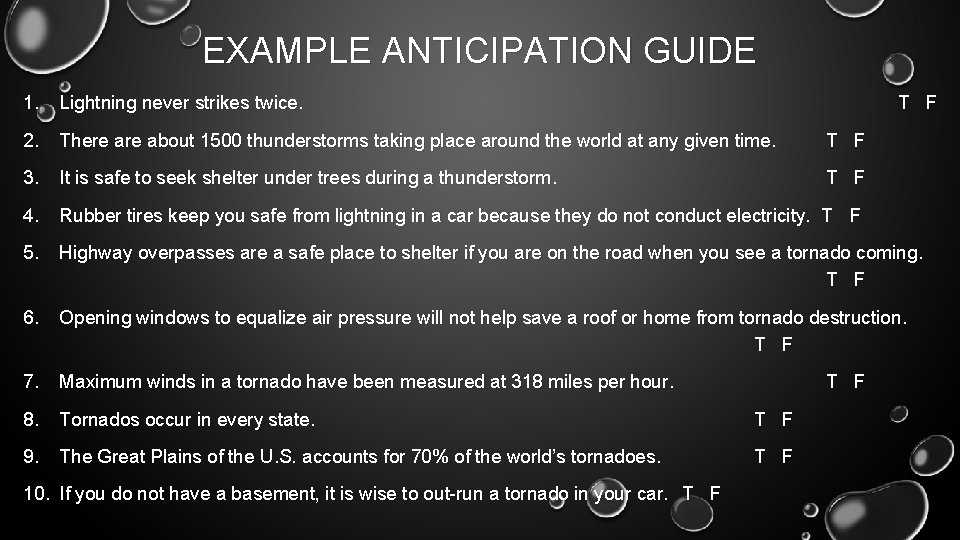
EXAMPLE ANTICIPATION GUIDE 1. Lightning never strikes twice. T F 2. There about 1500 thunderstorms taking place around the world at any given time. T F 3. It is safe to seek shelter under trees during a thunderstorm. T F 4. Rubber tires keep you safe from lightning in a car because they do not conduct electricity. T F 5. Highway overpasses are a safe place to shelter if you are on the road when you see a tornado coming. T F 6. Opening windows to equalize air pressure will not help save a roof or home from tornado destruction. T F 7. Maximum winds in a tornado have been measured at 318 miles per hour. T F 8. Tornados occur in every state. T F 9. The Great Plains of the U. S. accounts for 70% of the world’s tornadoes. T F 10. If you do not have a basement, it is wise to out-run a tornado in your car. T F
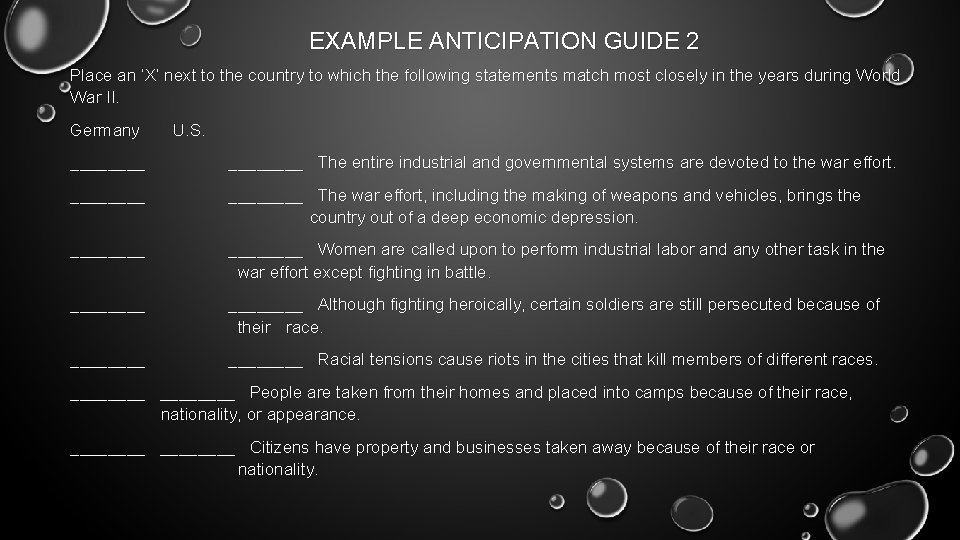
EXAMPLE ANTICIPATION GUIDE 2 Place an ‘X’ next to the country to which the following statements match most closely in the years during World War II. Germany U. S. ________ The entire industrial and governmental systems are devoted to the war effort. ________ The war effort, including the making of weapons and vehicles, brings the country out of a deep economic depression. ________ Women are called upon to perform industrial labor and any other task in the war effort except fighting in battle. ________ Although fighting heroically, certain soldiers are still persecuted because of their race. ________ Racial tensions cause riots in the cities that kill members of different races. ________ People are taken from their homes and placed into camps because of their race, nationality, or appearance. ________ Citizens have property and businesses taken away because of their race or nationality.
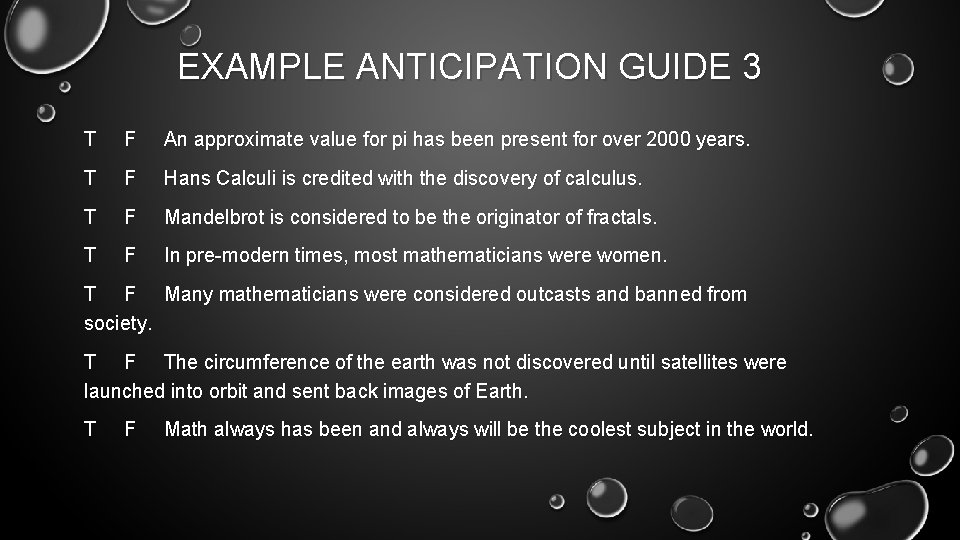
EXAMPLE ANTICIPATION GUIDE 3 T F An approximate value for pi has been present for over 2000 years. T F Hans Calculi is credited with the discovery of calculus. T F Mandelbrot is considered to be the originator of fractals. T F In pre-modern times, most mathematicians were women. T F Many mathematicians were considered outcasts and banned from society. T F The circumference of the earth was not discovered until satellites were launched into orbit and sent back images of Earth. T F Math always has been and always will be the coolest subject in the world.
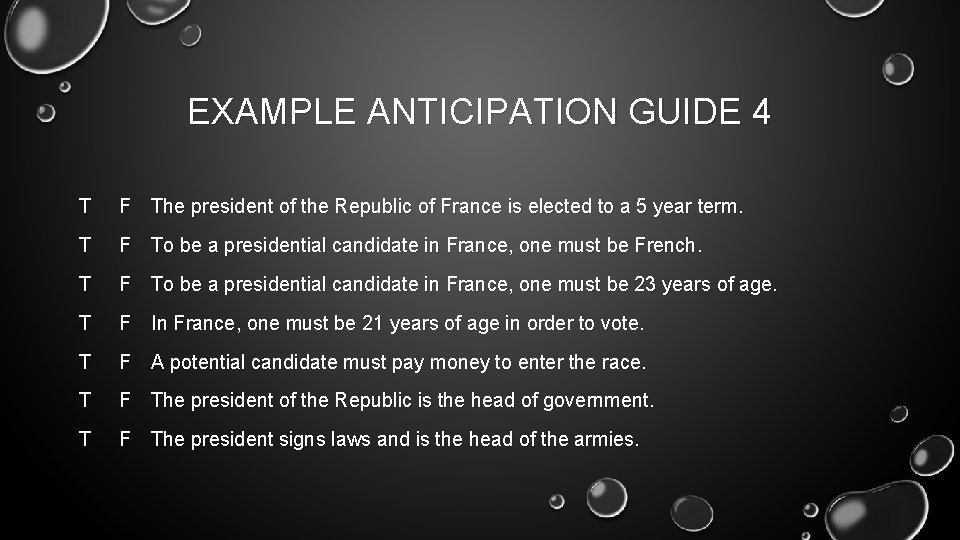
EXAMPLE ANTICIPATION GUIDE 4 T F The president of the Republic of France is elected to a 5 year term. T F To be a presidential candidate in France, one must be French. T F To be a presidential candidate in France, one must be 23 years of age. T F In France, one must be 21 years of age in order to vote. T F A potential candidate must pay money to enter the race. T F The president of the Republic is the head of government. T F The president signs laws and is the head of the armies.
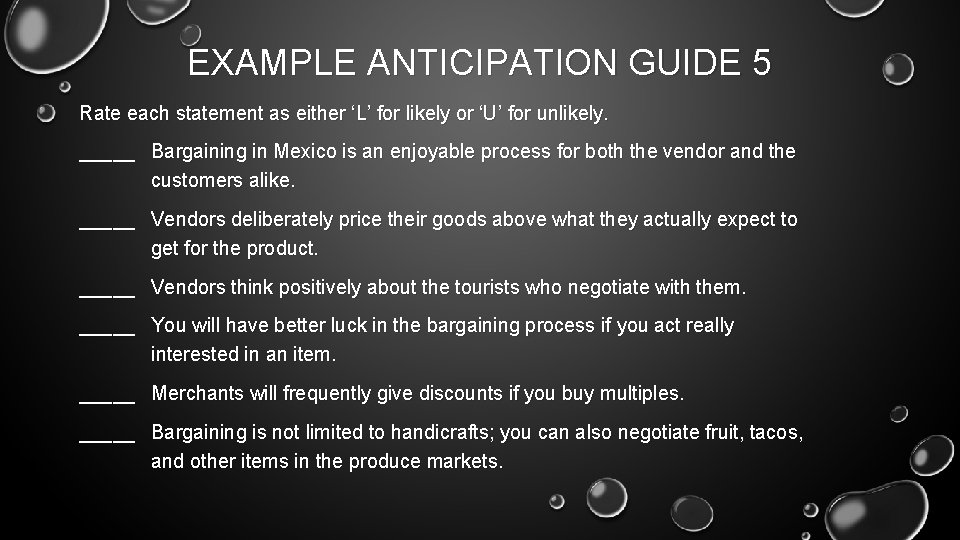
EXAMPLE ANTICIPATION GUIDE 5 Rate each statement as either ‘L’ for likely or ‘U’ for unlikely. _____ Bargaining in Mexico is an enjoyable process for both the vendor and the customers alike. _____ Vendors deliberately price their goods above what they actually expect to get for the product. _____ Vendors think positively about the tourists who negotiate with them. _____ You will have better luck in the bargaining process if you act really interested in an item. _____ Merchants will frequently give discounts if you buy multiples. _____ Bargaining is not limited to handicrafts; you can also negotiate fruit, tacos, and other items in the produce markets.
BEFORE/AFTER ANTICIPATION GUIDE BEFORE AFTER T/F It is always best to tell the truth. T/F No one gets harmed by practical jokes. T/F Children should always be raised by their natural parents. T/F You should NEVER judge a person base on the color of his/her skin. T/F There are times when it is okay to break the law. T/F Best friends can never be from two different ethnic backgrounds. T/F I am a superstitious person. T/F Running away from home is a dumb thing to do. T/F It is acceptable to run away from your problems. T/F If someone speaks slowly or grammatically incorrect, they are stupid. T/F T/F
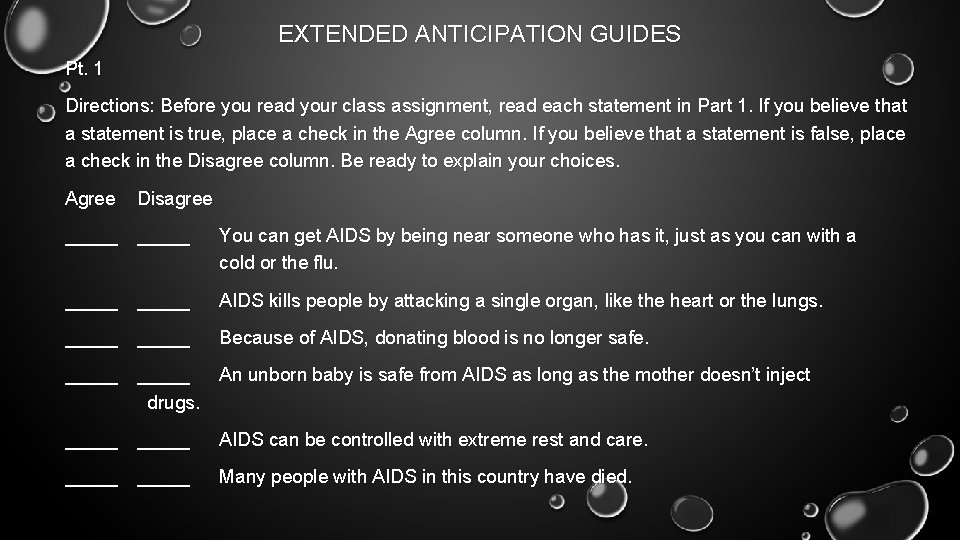
EXTENDED ANTICIPATION GUIDES Pt. 1 Directions: Before you read your class assignment, read each statement in Part 1. If you believe that a statement is true, place a check in the Agree column. If you believe that a statement is false, place a check in the Disagree column. Be ready to explain your choices. Agree Disagree _____ You can get AIDS by being near someone who has it, just as you can with a cold or the flu. _____ AIDS kills people by attacking a single organ, like the heart or the lungs. _____ Because of AIDS, donating blood is no longer safe. _____ An unborn baby is safe from AIDS as long as the mother doesn’t inject drugs. _____ AIDS can be controlled with extreme rest and care. _____ Many people with AIDS in this country have died.
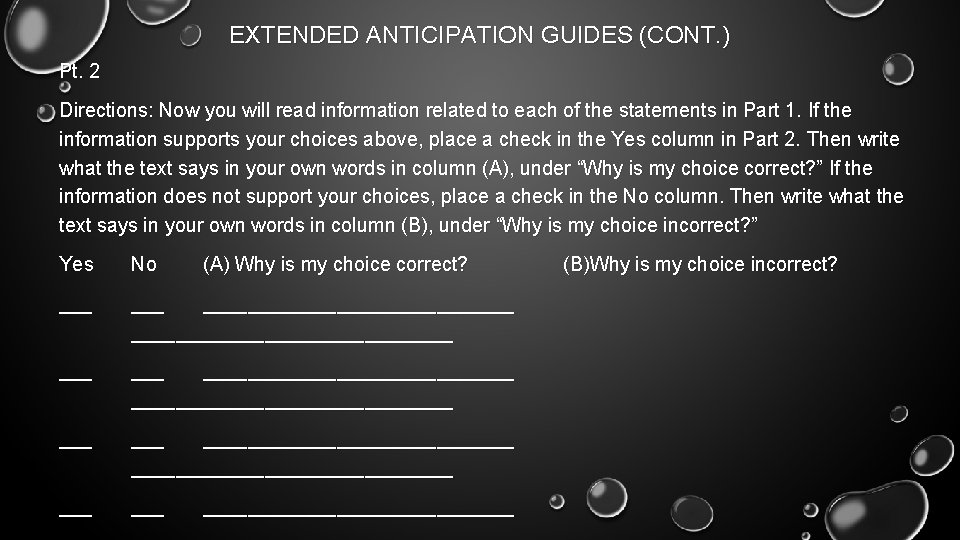
EXTENDED ANTICIPATION GUIDES (CONT. ) Pt. 2 Directions: Now you will read information related to each of the statements in Part 1. If the information supports your choices above, place a check in the Yes column in Part 2. Then write what the text says in your own words in column (A), under “Why is my choice correct? ” If the information does not support your choices, place a check in the No column. Then write what the text says in your own words in column (B), under “Why is my choice incorrect? ” Yes No (A) Why is my choice correct? ___ ___ _____________________________ ___ _____________________________ ___ ______________ (B)Why is my choice incorrect?
PROBLEM PERSPECTIVES A comprehension technique in which the teacher creates a problem to be solved or a perspective from which readers approach the text. This method allows teachers to: -Activate students’ prior knowledge -Set purpose for learning -Foster critical thinking -Peak interests -Motivate This method may be used at any time before, during, or after reading.
PROBLEM PERSPECTIVES RESEARCH Gaskins, I. & Guthrie, J. (1994). Integrating science, reading and writing: Goals, teacher development and assessment. Journal of Research in Science Teaching, 31, 1039 -1056. Reisman, A. (2012). Reading like a historian: A document-based history curriculum intervention in urban high schools. Cognition and Instruction, 30(1), 86 -112.
PROBLEM PERSPECTIVE EXAMPLE Problem: The mouse colony we use to feed the class snake has an infestation of ear mites. The symptoms are bloody ears from the intense scratching the mice do to try and relieve this, and some of the results are droopy mouths, lethargy and lower reproduction in the females. Choose one of the following actions and defend your decision. I will tabulate the results and follow the wishes of the majority of all students in the six classes. 1) Kill all the rats and mice humanely and freeze them for food for the winter. Clean out the cages and let no new animals into the room until spring. The cost for this, including new mice, will be $25. 00. 2) Treat the animals. This would involve a procedure that for each animal every day for 10 days, one drop of solution would be placed in each ear, massaged and then each cage would have to be cleaned with a 10% bleach solution and any leftover food would have to be discarded. Student would have to commit to coming in on the weekend to continue treatment. The chance that this would fully treat the problem is less than 10% and cost would be $75. 00. 3) Continue as we are, with no treatment or cleaning, and live with weak mice with low reproduction with the chance of infestation of some of the other mammals in the classroom. (Releasing them into the wild is not an option given that domesticated mice would not survive the night in a hostile environment. )
FOLLOW-UP ON THAT PARTICULAR EXAMPLE The students began writing almost immediately, most of them completing one or two pages in about 15 minutes. I looked at some of the responses, and while the range of writing and communication skills varied, the students stated their beliefs and defended them quite well. The majority of the students agreed with option #1 since it would be inhumane and dangerous to do nothing, and the cost and energy involved in trying to save the colony was not worth it. Some of the students described working with some of the infected mice and felt they were suffering needlessly. Since the mice would be frozen and used as food this winter, the majority saw no problem with it. A few of the students in their writing samples offered to take some of the animals and treat them at home, which Mr. Eubanks responded to positively and asked them to bring a signed permission slip from their parents along with having the parent actually read the writing assignment.
PREVIEWS Previews provide a frame of reference to help students understand/move into new material. They also provide more substantive information than the brief introductory statements typically found in texts. Procedure 1) Begin with statements and questions linking new to known, to motivate and/or encourage reflection on a theme. 2) Provide a synopsis. 3) Define key terms.
PREVIEWS (CONT. ) Previews significantly increased students’ comprehension of difficult short stories, improving both factual and inferential comprehension. Students recalled twice as many propositions when they received previews. Scores on the short-answer test were about 40% higher when students received previews.
PREVIEWS (CONT. ) Presenting previews increased students’ (of all levels of ability) comprehension of expository passages on both multiple-choice and short answer tests. • 67% of the students believed the preview helped them read and understand. • 62% did not feel the preview gave too much away • 80% felt previews should be given before difficult passages
PREVIEW RESEARCH Graves, Cooke & La. Berge. (1983). “Effects of previewing difficult short stories on low ability junior high school students’ comprehension, recall, and attitudes. ” Graves & Prenn. (1984). “Effects of previewing expository passages on junior high school students’ comprehension and attitudes. ”
PREVIEW EXAMPLE For ‘The Lottery, ’ by Shirley Jackson What comes to mind when you think of a lottery? Do you think of winning a great amount of money? What other kinds of lotteries do you know of? Have you ever participated in a lottery? What was it like? Were you trying to win a prize? Was the lottery a fun thing? Imagine that you were participating in a lottery, but it wasn’t fun. You are forced to participate. If you win, you really lose. In Shirley Jackson’s work, the story begins with an entire community preparing for an annual lottery. Excitement and anticipation fill the air. Everyone seems to be very happy. We even see the children playing and collecting rocks. It is a pleasant autumn day.
PREVIEW EXAMPLE (CONT. ) The mood, however, slowly changes. Everyone in the community is very nervous about this lottery, and it is a must that every one is at the lottery proceedings themselves. We learn about the ominous ‘black box’. Pay close attention to what is taking place in this small community. Why is everyone so nervous? What happens at this lottery and why? Also pay special attention to the actions and attitude of the characters, especially Mrs. Hutchinson. What happens to her and is her fate ironic? Finally, what other themes come out of this story?
PREVIEW EXAMPLE 2 For ‘The Signalman’ It seems sometimes that life is full of dangers! Would you agree? Nearly every day an accident or a disaster of some kind happens somewhere. A plane crashes, an earthquake occurs, or cars pile up on the freeway. Can you think of some accidents or disasters that have happened lately? Many times before a disaster occurs a warning is given. For example, lights might blink on the instrument panel of an airplane, or instruments might pick up tremors in the earth that predict an earthquake is about to occur. Can you think of other types of warnings? Were warnings given for the disasters we just talked about? Some people believe that they are warned of dangers in supernatural ways. They believe in spirits, or voices, or maybe even ghosts guiding them to do—or not do— something. Have you ever heard of someone being warned like this? What did that person say?
PREVIEW EXAMPLE 2 (CONT. ) Maybe you’ve been warned about something. For example, have you ever awakened from a dream thinking that what you dreamed would happen? And then —did it? Have you ever had a feeling something bad was about to happen? And then—did it happen? Can you think of any examples? The story you will read today is about a man who often gets warnings. But, the warnings this man gets don’t come from dreams or his mind. The man gets warning of bad things about to happen from a ghost, or specter. It seems that the ghost always appears before something terrible happens, as if he is trying to warn of danger. The story takes place in a very lonely and gloomy spot, hidden away in the mountains. The man you will read about lives alone in a hut which is on a railroad line and near a tunnel. The hut has many things the man needs—such as a desk, a record book, an instrument to send telegraphs, and a bell.
PREVIEW EXAMPLE 2 (CONT. ) The man is a signalman. His job is to signal the trains, watch for danger on the tracks, and warn passing trains of trouble ahead. The signalman works very hard at his job and is quite exact in all his duties. He is nervous, though, because he has seen many people die in train accidents near his post. He wants to be sure that he signals the trains of any danger. You will learn about what the signalman does and says through the man who tells the story. This man visited the signalman at two different times and learned much about him. The story you will read is the story the visitor tells after meeting the signalman. The story opens as the visitor calls—“Hello! Bellow there!” to the signalman. He wants to know how to reach the signalman’s hut from where he is at the top of a cliff. The signalman hears the man call to him but doesn’t answer. He is afraid and looks down the railroad line instead of up to the man.
PREVIEW EXAMPLE 2 (CONT. ) What does the signalman think he will see? Why is he afraid? Read to find out. Before you read the story, I want to show you a list of some of the people in it. They don’t have names and are described by who they are or what they do. The signalman is the man who lives in a hut near the railroad. The visitor is the man who visits the signalman and who tells the story. Another character is the ghost. There also some words I would like to define for you. The signalman is a dark, sallow man, with a dark beard and heavy eyebrows. Sallow means that he looks sickly and pale. The signalman’s hut is also called a post because it is where he is stationed to do his job. The ghost is also called a specter.
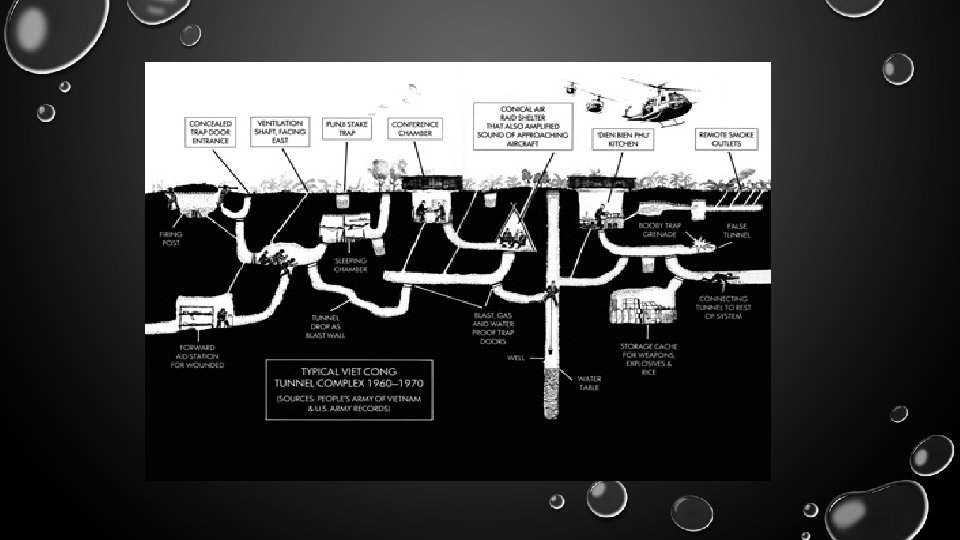
PREVIEW EXAMPLE 3 For ‘War Underground’ Study the tunnel complex diagram for a few minutes. (See next slide. ) What effect would bombers, tanks, or helicopters have on it? What kinds of problems could you expect to have if you lived in one of these? Would you be willing to live in a tunnel for five years to defend your home? Would it be an advantage to be big and strong or small? You are about to read a true story of a battle that happened in August, 1968 near the town to Cu Chi. There had been fighting in this area for almost twenty years. There were 300, 000 U. S. troops in the country. The U. S. had never lost a war. This was the most powerful military force in the history of the world. Some have said that we could have won the Vietnam War if we had bombed more, or if the media and students had supported the war more, or if we had sent more men, or if we had stayed and fought longer. Do you agree? As you read the story, think about how you would answer those arguments.
GRAPHIC ORGANIZERS • By definition-graphical representations of the text’s concepts and relations in a ‘structured’ form that illustrates the ‘content, principles, concepts, and details’ of the material (Barron, 1969) • Visuals that use content vocabulary to help students see relationships between concepts. • Help simplify complex texts • Many textbooks have poor organization or a structure that inhibits learning important between-concept relations (Robinson, 1994) • Graphic organizers display those interconcept relations spatially and this reduces the complexity of the relationships
GRAPHIC ORGANIZERS (CONT. ) • Graphic organizers serve as scaffolding • The spatial display also helps students activate prior knowledge better and faster than the text alone and connect this new information to what is known • Graphic organizers facilitate memory for text • The visual display also allows for dual encoding in memory (verbally and spatially) (Pavio, 1983) and th spatial cue is triggered if the verbal cue fails—called the conjoint retention hypothesis (Kulhavy, Stock, Peterson, Pridemore, & Klein, 1992) • Information organized hierarchically is easier to retain and retrieve than information organized in a linear structure (Bean, Singer, Sorter, & Frazee, 1986)
GRAPHIC ORGANIZERS (CONT. ) • Most effective when constructed by students themselves after reading • Demonstrate greater effects in the post-reading position than in the pre-reading position (Moore & Readence, 1984) • The deeper the processing, the greater the effect • Deep processing is required to reorganize the material and depict interrelationships in the construction of the graphic organizer
GRAPHIC ORGANIZER CAVEATS • Longer text generally has multiple themes and elaborate hierarchical structures and it’s unlikely that a single graphic organizer could capture the entire structure and substructure • Probably unnecessary in a text shorter than 2500 words or 4 -5 pages • There is a ‘surprising lack of consistency concerning the format of the graphic organizer’ (Robinson, 1998); therefore, it is difficult to give directions regarding the construction of graphic organizers.